
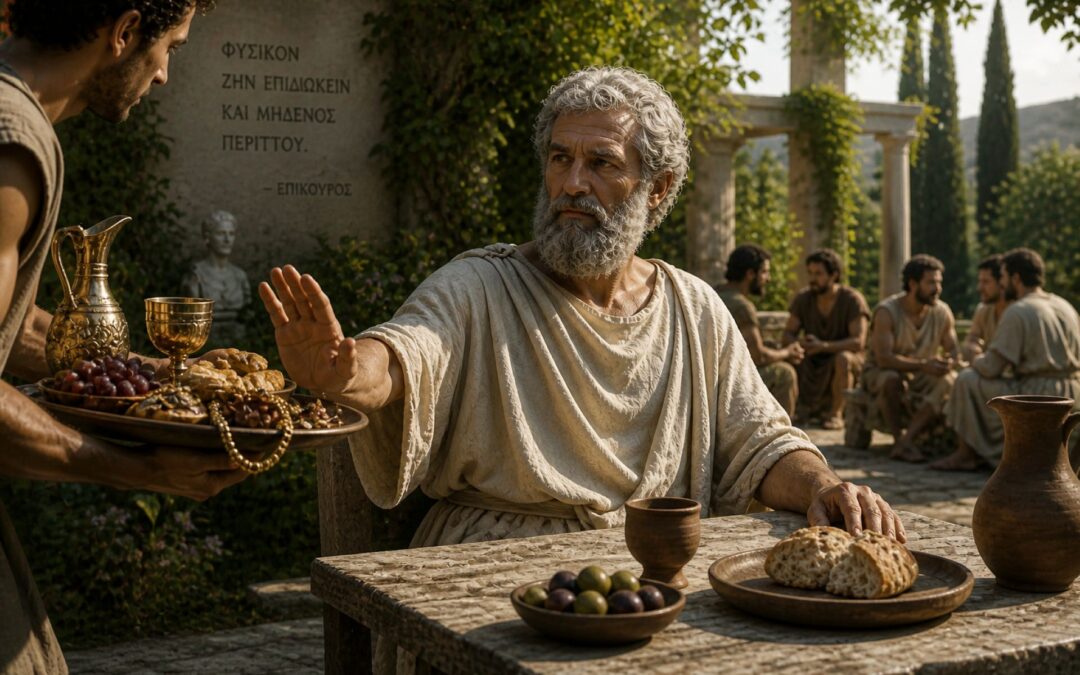
The Misunderstood Idea of Pleasure
Pleasure is a dangerous word.
Say it out loud, and most people immediately think of excess—rich food, endless entertainment, indulgence without restraint. Pleasure, in the modern sense, has become almost synonymous with losing control. It carries the quiet suspicion that if you follow it too far, you’ll eventually pay the price.
This is precisely why the philosophy of pleasure is so often misunderstood.
When Epicurus declared that pleasure is the highest good, he wasn’t advocating a life of indulgence. He wasn’t pointing toward luxury, intoxication, or excess. In fact, his idea of pleasure stands in sharp opposition to the way most people pursue it today.
For Epicurus, pleasure was something far simpler—and far more radical.
It was the absence of pain in the body and the absence of disturbance in the mind.
This definition changes everything. Pleasure is no longer something you chase. It is something you uncover when the noise subsides. It is not found in adding more, but in removing what troubles you.
And yet, this subtle idea has been flattened over time. The Epicurean has been recast as a hedonist, someone devoted to sensory indulgence. But this version misses the point entirely. If anything, Epicurus was closer to an ascetic than an indulgent philosopher. He believed that the more we depend on external pleasures, the more fragile our happiness becomes.
Because anything you need can be taken away.
The modern world only deepens this misunderstanding. We are surrounded by a constant invitation to indulge—more food, more stimulation, more experiences, more everything. Pleasure is marketed as intensity. The stronger the sensation, the better the life.
But this creates a quiet contradiction.
If pleasure is something that must be constantly intensified, then it can never truly satisfy. Each new experience raises the threshold. What once felt exciting becomes ordinary. What once satisfied begins to feel insufficient. And so the pursuit continues, not because it fulfills us, but because it never quite does.
Epicurus saw this pattern long before it became embedded in modern culture.
He understood that a life built on chasing pleasure eventually turns into a life haunted by dissatisfaction. Not because pleasure is bad, but because we misunderstand where it comes from.
True pleasure, in his view, does not lie in excess. It lies in stability. In contentment. In reaching a point where nothing more is needed.
This is why his philosophy feels almost inverted compared to our instincts.
We assume that more leads to better.
He argued that less leads to enough.
And in that quiet shift—from chasing to being satisfied—his entire philosophy begins to reveal itself.
Why Humans Naturally Seek Pleasure
Before judging the pursuit of pleasure, it helps to understand something more fundamental: we don’t choose to seek pleasure—it is built into us.
Epicurus didn’t arrive at his philosophy through abstract speculation alone. He began with observation. Look at a child, he suggested, and you’ll see the most honest expression of human nature. A child instinctively moves toward what feels good and recoils from what causes discomfort. There is no moral framework yet, no social conditioning—just a direct, unfiltered orientation toward pleasure and away from pain.
This, for Epicurus, was the starting point.
Pleasure and pain are not just experiences; they are the basic signals that guide our lives. Every choice we make, no matter how complex it appears, can ultimately be traced back to this simple mechanism. We move toward what we believe will bring us some form of satisfaction, and we avoid what we think will harm or disturb us.
Even our most “rational” decisions are quietly shaped by this dynamic.
As we grow older, however, something changes. The raw simplicity of this instinct becomes layered with experience, culture, and expectation. We begin to realize that not all pleasures are equal, and not all pains are worth avoiding.
A child avoids discomfort immediately. An adult learns to delay gratification.
We accept short-term pain for long-term gain—working late, exercising, enduring stress—because we anticipate a greater pleasure down the line. In this sense, our pursuit of pleasure becomes more refined, more strategic. It is no longer about immediate satisfaction, but about calculating outcomes.
But the underlying principle remains unchanged.
Even actions that appear selfless or altruistic are not entirely separate from this framework. Helping others, contributing to a community, or sacrificing for someone else often brings a different kind of pleasure—one rooted in meaning, connection, or inner peace. The form changes, but the structure stays the same.
This is not a cynical observation. It’s a clarifying one.
Epicurus wasn’t trying to reduce human behavior to something trivial. He was trying to show that the pursuit of pleasure is not a flaw in our nature—it is our nature. The problem arises not from seeking pleasure, but from misunderstanding what kind of pleasure is worth seeking.
Because once pleasure becomes confused with intensity, status, or excess, we lose the ability to distinguish between what satisfies us and what merely stimulates us.
And this is where most people begin to go wrong.
We don’t struggle because we seek pleasure.
We struggle because we don’t understand it.
The Hidden Problem with Overindulgence
If pleasure is the goal, then more should be better.
That’s the assumption most people operate under. More comfort, more entertainment, more stimulation—each layer is expected to bring us closer to satisfaction. But in practice, something strange happens. The more intensely we pursue pleasure, the more unstable it becomes.
What begins as enjoyment often turns into dependency.
Epicurus recognized this pattern with remarkable clarity. He observed that certain pleasures carry a hidden cost. They offer immediate gratification, but leave behind a residue—fatigue, dissatisfaction, craving, or even regret. In isolation, the pleasure feels worthwhile. But when viewed over time, it begins to erode rather than enhance our well-being.
Overindulgence doesn’t fail because pleasure is bad. It fails because it distorts the balance between pleasure and pain.
Take something as simple as food. Eating is pleasurable, and rightly so—it satisfies a natural need. But when eating turns into excess, the experience changes. What was once enjoyable becomes uncomfortable. The body resists. The pleasure collapses under its own weight.
The same pattern repeats across different areas of life.
Endless entertainment dulls our attention.
Constant stimulation weakens our sensitivity.
Excessive comfort reduces our resilience.
What once felt exciting becomes ordinary. What once satisfied begins to feel insufficient. And so we increase the intensity, not realizing that the very act of increasing is what’s diminishing the experience.
This is the trap.
Overindulgence trains us to chase peaks rather than appreciate stability. It conditions us to associate pleasure with intensity instead of contentment. And in doing so, it quietly raises the threshold for satisfaction. We need more to feel the same, and eventually, even more doesn’t feel like enough.
Epicurus saw that this cycle leads not to happiness, but to a subtle form of restlessness—a constant sense that something is missing, even when we have plenty.
The irony is difficult to ignore.
In trying to maximize pleasure, we often undermine it.
This is why he didn’t reject pleasure, but refined it. He understood that the problem isn’t enjoyment itself, but the lack of discrimination in how we pursue it. Without that awareness, pleasure stops being a guide and becomes a distraction.
And once that happens, the pursuit of happiness begins to work against us rather than for us.
The Hierarchy of Desires
If the problem isn’t pleasure itself, but how we pursue it, then the question becomes unavoidable:
How do we know which pleasures are worth pursuing?
This is where Epicurus makes one of his most important contributions. Instead of rejecting desire altogether, he organizes it. He introduces a structure—a way of distinguishing between desires so that we’re no longer blindly driven by them.
Because not all desires are equal.
Some lead to stability and satisfaction. Others lead to restlessness and dependence. Without a way to tell the difference, we remain vulnerable to chasing what ultimately makes us unhappy.
Epicurus’ solution was simple, but powerful: a hierarchy of desires.
At the foundation of this hierarchy lies a principle that guides the entire system—living in accordance with nature. This doesn’t mean retreating into the wilderness or rejecting society. It means understanding what is genuinely necessary for a human being to live well, and separating that from what is artificially imposed.
Once we begin to look at desire through this lens, a pattern starts to emerge.
There are desires that arise naturally from our basic needs—things that sustain life and bring immediate relief when fulfilled. There are others that are still natural, but not essential—things that add comfort or variety, but are not required for well-being. And then there are desires that don’t come from nature at all, but from social conditioning—endless pursuits that promise fulfillment but never quite deliver it.
This distinction changes the way we approach happiness.
Instead of asking, “What do I want?” we begin asking, “What do I actually need?” And more importantly, “What kind of desire is this?”
Because once you recognize that many of your strongest desires are not rooted in necessity, but in influence—status, comparison, expectation—you gain a certain distance from them. They no longer feel absolute. They become optional.
And that shift is liberating.
Epicurus didn’t suggest eliminating desire. That would be unrealistic. Instead, he encouraged clarity. By understanding the nature of our desires, we can align our choices with what actually leads to contentment, rather than what merely promises it.
Happiness, in this sense, becomes less about acquiring more and more about needing less.
But to apply this idea properly, we need to look closer at the different kinds of desires he identified—because each one shapes our lives in a very different way.
Natural and Necessary Desires
At the base of Epicurus’ hierarchy are the desires that matter most—the ones that are both natural and necessary.
These are the desires tied directly to our survival and basic well-being. Food, shelter, rest, safety. Without them, life becomes painful very quickly. When they are fulfilled, that pain disappears just as quickly.
There is something important hidden in that simplicity.
Natural and necessary desires are not complicated. They don’t demand excess, refinement, or perfection. Hunger doesn’t require gourmet meals. Thirst doesn’t require anything more than water. The body asks for what it needs in a direct and honest way, and once that need is satisfied, the desire fades.
This is what makes these desires so reliable.
They come with built-in limits.
You can only eat so much before you feel full. You can only rest so much before you feel restored. There is a natural stopping point, and once you reach it, there is nothing more to chase. The satisfaction is complete.
Epicurus saw this as a kind of hidden advantage.
Because these desires are easy to fulfill, they make happiness accessible. You don’t need wealth, status, or extraordinary circumstances to satisfy them. In fact, the more complicated your life becomes, the more you risk losing touch with how simple these needs really are.
This is why he placed so much emphasis on them.
If you can find contentment in meeting your basic needs, then your happiness becomes stable. It no longer depends on unpredictable factors or external conditions. It rests on something far more dependable—your ability to live in alignment with what your nature actually requires.
There is also a deeper psychological effect at play.
When you learn to appreciate the satisfaction of simple needs, your sensitivity to pleasure increases. A modest meal becomes genuinely enjoyable. A moment of rest feels complete. You are no longer numbed by excess or constantly comparing your experience to something more intense.
In contrast, when we ignore these natural limits and chase more elaborate forms of satisfaction, we often lose the ability to recognize when enough is enough.
And that is where dissatisfaction begins.
Epicurus’ insight here is almost disarmingly simple: if the things you truly need are easy to obtain, then a peaceful and happy life is not as far away as it seems.
The challenge is not in acquiring more, but in recognizing when you already have enough.
Natural but Non-Necessary Desires
Beyond our basic needs lies another category of desires—ones that are still natural, but no longer essential.
These are the desires that add flavor to life rather than sustain it. Good food instead of simple food. Comfort instead of mere shelter. Travel, entertainment, aesthetic pleasure. They arise from the same human nature, but they go a step further—they refine experience rather than secure it.
Epicurus didn’t reject these desires.
That’s an important distinction.
He understood that there is nothing inherently wrong with enjoying a well-prepared meal, a beautiful environment, or a moment of leisure. These things can enrich life. They can deepen our appreciation of the world. In moderation, they are perfectly compatible with happiness.
But they come with a subtle risk.
Unlike natural and necessary desires, these don’t have such clear limits. Hunger disappears when you eat, but the desire for better food can continue indefinitely. Comfort can always be improved. Experiences can always be upgraded.
And this is where things begin to shift.
If we treat these desires as necessities rather than preferences, we quietly increase our dependence on external conditions. What was once optional becomes expected. What was once enjoyable becomes insufficient.
A simple meal no longer satisfies. A quiet evening begins to feel boring. The baseline of contentment starts to rise.
Epicurus’ guidance here is not to eliminate these pleasures, but to remain independent from them.
To enjoy them without needing them.
Because the moment a non-essential desire becomes essential, it begins to control us. Our happiness becomes tied to circumstances we may not always be able to maintain. And when those conditions disappear, so does our sense of satisfaction.
There’s also a revealing question embedded in this idea.
If hunger is satisfied with simple food, and luxury food removes the same hunger, what is the real difference afterward?
The craving is gone either way. The body is content either way. The additional pleasure exists only in the moment of consumption, not in the lasting state that follows.
This doesn’t mean luxury has no value—it means its value is temporary.
And once we see that clearly, we can approach it differently. Not as something to build our lives around, but as something to appreciate occasionally, without attachment.
Epicurus himself lived this principle. Most of the time, he chose simplicity. But he didn’t deny himself small luxuries entirely. He allowed them in, sparingly, as a way to heighten appreciation rather than dull it.
Because when your baseline is simple, even small pleasures feel significant.
But when your baseline is excess, nothing feels like enough.
Vain Desires
If natural desires can be satisfied, vain desires cannot.
This is what makes them so dangerous.
Epicurus described vain desires as those that do not arise from nature, but from opinion. They are not rooted in genuine need, but in perception—what society tells us is valuable, what others admire, what we are conditioned to chase.
Power, fame, extreme wealth, status.
At first glance, these seem like natural extensions of ambition. But unlike hunger or rest, they don’t come with clear limits. There is no point at which power feels complete, no amount of wealth that finally says, “this is enough.”
Instead, they expand as we pursue them.
The more you have, the more you want. And more importantly, the more you feel you must protect what you’ve gained. What begins as desire slowly transforms into pressure—pressure to maintain, to grow, to compete.
And this is where the cost reveals itself.
Vain desires don’t just fail to satisfy us; they entangle us. They demand time, energy, attention, and often sacrifice. Relationships are strained. Peace of mind is traded for achievement. Life becomes structured around acquisition rather than contentment.
What makes this even more subtle is that these desires rarely feel artificial.
They feel urgent. Meaningful. Necessary.
But this urgency is not coming from within—it is absorbed from the outside. We are constantly exposed to images of success, wealth, recognition. Over time, these ideas settle into our thinking, shaping what we believe we should want.
And so we begin to measure our lives accordingly.
Not by how content we are, but by how much we’ve accumulated. Not by how peaceful our minds are, but by how we compare to others.
Epicurus saw this clearly. He understood that these desires are not only difficult to fulfill—they are designed in such a way that fulfillment is impossible. There is always a higher level, a bigger goal, a new comparison waiting.
In that sense, they keep us moving, but never arriving.
This is why he rejected them, not out of moral judgment, but out of practicality. A desire that cannot be satisfied cannot contribute to happiness. It can only delay it.
And yet, in many ways, these are the desires that dominate modern life.
We are encouraged to pursue them, rewarded for chasing them, and often defined by them. But in doing so, we trade something quiet and essential—the ability to feel that what we have is already enough.
Epicurus’ insight here cuts through the illusion.
If a desire has no natural endpoint, it has no place in a peaceful life.
Because a life built on endless wanting will always feel incomplete, no matter how much it achieves.
Moving Pleasure vs Static Pleasure
Once Epicurus clarifies what we should desire, he takes a step further and asks a more subtle question:
What kind of pleasure actually leads to happiness?
Because even when we pursue the right desires, not all pleasures are equal in value.
To explain this, he makes a distinction that is easy to overlook but deeply important—the difference between moving pleasure and static pleasure.
Moving pleasure is what we usually think of when we hear the word “pleasure.” It is active, dynamic, and tied to the process of satisfying a desire. Eating when you’re hungry, drinking when you’re thirsty, listening to music, experiencing excitement—these are all forms of moving pleasure.
They are immediate and often intense.
But they also share a limitation.
They exist only while the activity is taking place.
The moment the experience ends, so does the pleasure. And often, what follows is either neutrality or the return of desire. This creates a cycle—desire arises, we act to satisfy it, pleasure is felt briefly, and then the cycle begins again.
There is nothing inherently wrong with this. It is a natural part of life. But if we rely solely on this kind of pleasure, we become dependent on constant activity to feel good.
And that dependence can quietly become exhausting.
This is why Epicurus placed greater value on what he called static pleasure.
Static pleasure is not about stimulation—it is about the state that follows satisfaction. It is the calm that comes when hunger is gone, the ease that comes when the body is at rest, the quiet contentment of not needing anything in that moment.
It is not intense, but it is stable.
And that stability is what makes it superior.
When you are no longer disturbed by unmet desires, there is nothing pushing or pulling you. No urgency. No craving. Just a sense of sufficiency. This is what Epicurus considered the highest form of pleasure—not because it overwhelms the senses, but because it frees you from needing anything more.
It is a very different way of understanding what it means to feel good.
In modern life, we are trained to chase moving pleasure. We seek stimulation—new experiences, constant entertainment, endless novelty. Stillness is often mistaken for boredom. Contentment is overlooked because it lacks intensity.
But in doing so, we miss something essential.
The most reliable form of happiness is not found in peaks of experience, but in the absence of disturbance.
Epicurus’ insight here is subtle but transformative.
If you measure your life by moments of excitement, you will always need the next one.
But if you learn to value the state of being at ease, you discover a form of pleasure that doesn’t depend on anything happening at all.
And that kind of pleasure is far harder to take away.
Friendship, Simplicity, and the Good Life
For a philosophy centered on pleasure, Epicurus’ way of life was surprisingly simple.
He did not surround himself with luxury. He did not seek influence or recognition. Instead, he withdrew from the noise of public life and created a small community—a place where he and his followers could live quietly, think freely, and enjoy each other’s company.
This place came to be known as “the Garden.”
It wasn’t grand or elaborate. It didn’t need to be.
What mattered was what it made possible.
Epicurus believed that one of the greatest sources of happiness is friendship. Not in the casual or transactional sense, but in the deeper form—trust, mutual support, shared understanding. In a world where so much of life is uncertain, friendship provides a kind of stability that no material possession can offer.
It reduces fear.
When you are surrounded by people you trust, the anxieties of life lose some of their weight. You are no longer facing everything alone. There is reassurance in knowing that someone else is there—not for gain, not for status, but simply because they choose to be.
This kind of connection, for Epicurus, was far more valuable than romantic or sexual pursuits, which he often viewed as sources of disturbance. Jealousy, insecurity, expectation—these emotional fluctuations could disrupt the very peace he considered essential to happiness.
Friendship, by contrast, was steadier.
It aligned with his broader philosophy of minimizing disturbance and cultivating contentment.
But friendship alone wasn’t enough. It had to be paired with a certain way of living.
Simplicity.
Epicurus intentionally chose a modest lifestyle. Bread, water, occasional wine—nothing extravagant, nothing excessive. Not because he rejected pleasure, but because he understood something that is easy to miss:
The simpler your life, the easier it is to satisfy.
When your needs are few, meeting them becomes effortless. And when meeting your needs is effortless, contentment is always within reach.
There is also a hidden benefit to simplicity.
It sharpens your appreciation.
When luxury is rare, it feels meaningful. When comfort is not taken for granted, it is genuinely felt. But when indulgence becomes routine, it fades into the background. What once felt special becomes normal, and what is normal is rarely appreciated.
Epicurus didn’t deny himself pleasure—he restructured his relationship with it.
He chose a life where pleasure did not depend on complexity, where happiness did not require constant input, and where the most important experiences—friendship, peace, contentment—were always available.
In many ways, this stands in quiet contrast to modern life.
We are surrounded by options, yet often feel disconnected. We pursue more, yet struggle to feel satisfied. We fill our lives with activity, yet rarely experience stillness.
Epicurus’ answer is disarmingly simple.
Strip away what is unnecessary.
Value what remains.
Because the good life, in his view, is not built on accumulation, but on clarity—knowing what truly matters, and having the courage to live accordingly.
The Illusion of Wealth and Poverty
What does it mean to be rich?
At first, the answer seems obvious—having more than enough. More money, more possessions, more security. But Epicurus challenges this assumption in a way that shifts the question entirely.
Wealth, he suggests, is not determined by how much you have, but by how much you need.
This idea, later echoed by Seneca, cuts directly through one of the most persistent illusions in human life. We tend to measure wealth externally—by accumulation, comparison, visible success. But from Epicurus’ perspective, this way of measuring is fundamentally flawed.
Because it ignores the role of desire.
A person with modest means but few desires can feel complete. Their needs are easily met, their expectations are grounded, and their satisfaction is stable. In contrast, someone with vast resources but endless desires can feel perpetually lacking. No matter how much they acquire, it never quite resolves the sense of “not enough.”
In this sense, poverty is not simply a lack of resources—it is a state of constant wanting.
And wealth is not merely possession—it is freedom from that wanting.
This is why Epicurus draws a distinction between living according to nature and living according to opinion. Nature asks for very little. It demands what is necessary for survival and basic well-being, nothing more. Opinion, on the other hand, has no limits. It is shaped by comparison, ambition, and social expectation.
And because it has no natural endpoint, it keeps expanding.
You reach one level, and another appears. You achieve one goal, and it is replaced by a higher one. Satisfaction is always deferred, always just out of reach.
This is the illusion.
We believe that by increasing what we have, we will eventually feel secure. But if our desires are not examined, the increase only raises the standard. What once felt like abundance becomes the new baseline. And from there, the sense of lack returns.
Epicurus’ insight is not that material things are meaningless, but that their value is limited by the desires attached to them.
If your happiness depends on conditions that are difficult to maintain—status, recognition, constant growth—then your sense of well-being becomes fragile. It is tied to forces that are unstable and often outside your control.
But if your needs are simple, your position changes entirely.
You are no longer chasing.
You are no longer comparing.
You are no longer waiting for something more to feel complete.
You already are.
This is why, in Epicurus’ view, the richest life is not the one that accumulates the most, but the one that requires the least.
Not because less is inherently better, but because needing less makes satisfaction possible.
And once satisfaction becomes possible, happiness stops being a distant goal and becomes a present reality.
Freedom from Fear: God and Death
Even if our desires are simple and our lives are modest, something deeper can still disturb us.
Fear.
Not the immediate kind—the fear of physical danger or loss—but the quieter, more persistent fears that sit in the background of our lives. Fear of what happens after death. Fear of divine judgment. Fear that something beyond our control is watching, evaluating, and waiting to punish.
Epicurus believed that as long as these fears remain, true happiness is impossible.
Because fear, by its nature, unsettles the mind. It creates a constant tension—an unease that doesn’t disappear even when everything else seems fine. You can have comfort, security, even pleasure, and still feel disturbed if you believe something terrible awaits you beyond this life.
This is why he addressed these fears directly.
Not with faith, but with reasoning.
Epicurus argued that the fear of gods is misplaced. Even if gods exist, he suggested, they would not concern themselves with human affairs. A perfect being would not be involved in punishment, judgment, or intervention. These ideas, he believed, were projections—human attempts to make sense of the world through familiar concepts like authority and control.
And if gods are not involved in our lives, then there is nothing to fear from them.
No punishment waiting.
No reward to earn.
No invisible force shaping our fate.
This leads to a second, even more powerful conclusion.
If there is no divine judgment after death, then death itself loses its threat.
Epicurus’ reasoning here is simple, almost disarming.
All good and bad require sensation. Pleasure and pain exist only when we are aware of them. But death is the end of all sensation. When we die, there is no awareness, no experience—nothing to feel harm or suffering.
So how can death be bad?
It cannot harm the living, because they are not dead.
It cannot harm the dead, because they no longer exist.
This removes the foundation of one of our deepest anxieties.
We fear death not because of what it is, but because of what we imagine it to be—darkness, punishment, loss, continuation of suffering. But if death is simply the absence of experience, then it is no more troubling than the time before we were born.
It is nothing to us.
This idea is not meant to diminish life, but to clarify it.
When the fear of death is removed, something unexpected happens. The urgency of life becomes clearer. Not in a frantic sense, but in a grounded one. If this is the only life we have, then it is the only opportunity for happiness.
And yet, we often postpone it.
We delay contentment, waiting for better conditions. We chase things that promise fulfillment later, while overlooking what is available now. All the while, time passes—quietly, steadily—whether we pay attention or not.
Epicurus saw this as one of the greatest mistakes we make.
We sacrifice present peace for imagined futures.
We trade real contentment for uncertain rewards.
We let fear dictate how we live, even when that fear has no solid foundation.
By removing these fears, he wasn’t offering comfort in the traditional sense. He was offering clarity.
And with that clarity comes a kind of freedom.
A life no longer shaped by what might happen after it ends, but by what is possible within it.
A life where happiness is not postponed, but lived—here, now, while it is still within reach.
Why We Struggle to Be Happy Today
If happiness, as Epicurus suggests, is rooted in simplicity, clarity, and freedom from unnecessary desire, then a difficult question arises:
Why does it feel so out of reach?
It’s not because happiness is complicated. In many ways, it has never been more accessible. Our basic needs are easier to meet than at almost any other time in history. Food, shelter, comfort—these are within reach for far more people than in the past.
And yet, dissatisfaction persists.
The problem is not scarcity. It is misdirection.
Modern life is structured in a way that constantly pulls us away from the kind of happiness Epicurus described. We are surrounded by signals telling us what to want, how to live, what to strive for. These signals are not neutral—they are designed to keep us engaged, striving, consuming.
And so, our desires are shaped accordingly.
We begin to want things not because they fulfill us, but because they are presented as desirable. Wealth becomes a measure of worth. Status becomes a measure of success. Visibility becomes a measure of existence.
Without realizing it, we internalize these standards.
And once we do, the baseline of “enough” begins to shift.
What would have satisfied us before no longer feels sufficient. A simple life begins to look like a compromise. Contentment starts to resemble stagnation. We become restless, not because we lack anything essential, but because we’ve been conditioned to expect more.
This is where Epicurus’ distinction between natural and vain desires becomes especially relevant.
Much of what we chase today falls into the category of desires that have no natural limit. There is always more to earn, more to achieve, more to display. And because there is no endpoint, there is no moment of completion.
Just continuation.
Technology amplifies this effect. We are constantly exposed to curated versions of other people’s lives—highlighted success, filtered experiences, visible achievements. Comparison becomes automatic. Even when we are doing well, it rarely feels like enough, because there is always someone doing more.
This creates a quiet but persistent dissatisfaction.
Not because our lives are lacking, but because our perception of them is distorted.
At the same time, we are overstimulated. Entertainment is constant, distraction is immediate, and silence is increasingly rare. We fill every gap with input, leaving little room for stillness. And without stillness, it becomes difficult to experience the kind of static pleasure Epicurus valued—the simple sense of being at ease.
We are always moving, always consuming, always anticipating the next thing.
But rarely settling.
The result is a kind of paradox.
We have more access to pleasure than ever before, yet struggle to feel satisfied. We are surrounded by opportunities for enjoyment, yet often feel restless, distracted, or empty.
Epicurus’ philosophy offers a quiet explanation.
It’s not that happiness has become harder to achieve.
It’s that we’ve moved further away from the conditions that make it possible.
We’ve complicated what is simple.
We’ve expanded what should be limited.
We’ve chased what cannot satisfy, while overlooking what already does.
And in doing so, we’ve made something inherently accessible feel distant.
The path back, then, is not about adding more.
It is about seeing clearly—and choosing differently.