
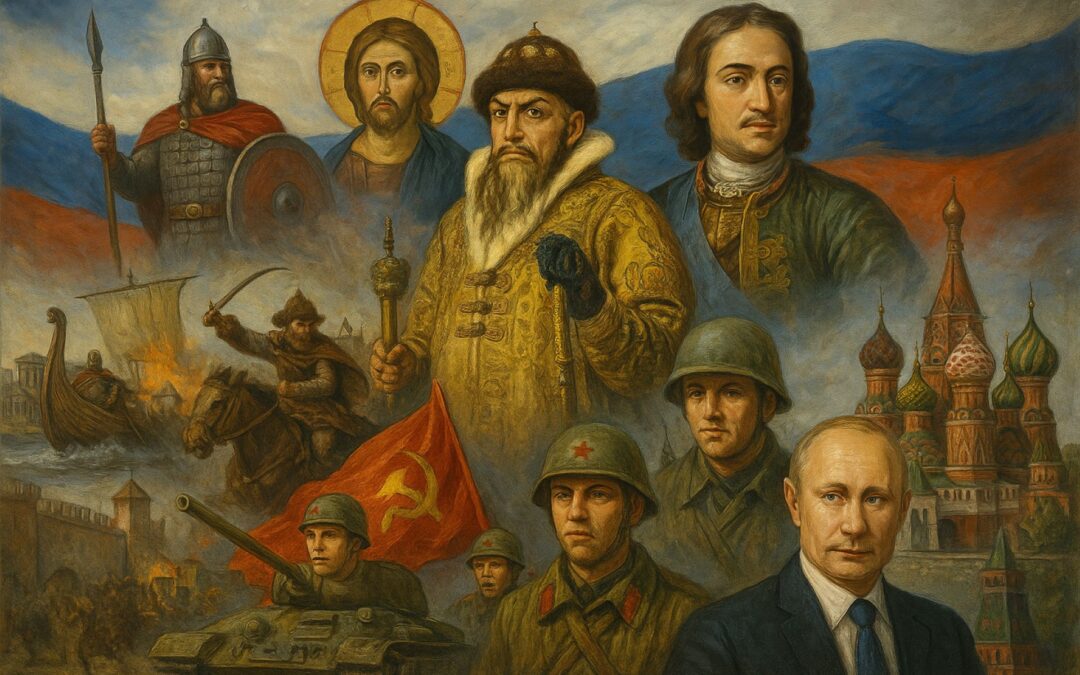
Russia’s history is a chronicle of extremes—of vastness and vulnerability, of splendor and suffering, of sudden collapse and improbable resurgence. From the Norse adventurers who founded trading outposts along its rivers to the Mongol khans who burned its cities, from the iron will of tsars to the red banners of the Soviet Union, Russia has been shaped by forces that few other nations have endured. Its landmass alone defies comprehension, stretching across eleven time zones and binding Europe to Asia.
Yet it is not geography alone that explains its story, but the relentless drive of its rulers and people to endure, to expand, and to define themselves against both neighbors and invaders. To trace the arc of Russia’s past is to witness the making of a civilization that has never been marginal, always pivotal, and often terrifyingly powerful.
The Landscape of Giants
Russia is not merely large; it is almost incomprehensible in scale. Stretching over 6.6 million square miles, its landmass accounts for one-ninth of the Earth’s habitable surface. From Kaliningrad, wedged between Poland and Lithuania, to the windswept Diomede Islands facing Alaska, the country unfurls across eleven time zones. To cross it by train, even on the legendary Trans-Siberian Railway, takes more than a week of uninterrupted travel. Its landscapes encompass arctic tundra, endless steppe, dense taiga forests, towering mountains, and sprawling river systems that seem to have no end.
This immensity has always been both Russia’s greatest asset and its most punishing liability. The distances between its major cities are vast, communication has historically been sluggish, and the task of governing such a territory has tested every ruler. Harsh winters have been a recurring character in Russia’s story: they froze Napoleon’s Grande Armée in 1812 and brought Hitler’s Wehrmacht to its knees in 1941. The cold and the scale of the land itself became instruments of defense, unconquerable allies that preserved Russia when armies could not.
The size also forged a particular mentality. Living on boundless plains instilled in Russians a sense of resilience and fatalism, an acceptance that survival often depends less on control than on endurance. Yet in the early medieval period, this colossal space was not bound under one rule. It was a patchwork of tribes, small polities, and roving horsemen. The Russian state, as we know it, was still centuries away. What tied the land together in those early days were not borders but rivers—arteries that carried traders, raiders, and ideas deep into the continent’s heart.
The Arrival of the Rus
The story of Russia’s first political awakening begins not in Moscow, nor even within the Slavic tribes, but with outsiders: the Norse adventurers known as the Varangians. In the 9th century, they navigated the Baltic Sea, turned their prows down the great rivers of Eastern Europe, and discovered highways into the rich worlds of Byzantium and the Islamic caliphates. The Dnieper, Volga, and Don carried them southward, linking the northern forests with the Black and Caspian Seas.
At first, the Varangians came as raiders, plundering cities and monasteries much as they did in Britain and France. But here, in the East, something different happened. They began to settle, intermarry, and establish fortified outposts. Cities like Novgorod, Smolensk, and Kyiv became centers of trade and power. These Norse rulers were known as the Rus, and over generations they fused with the local Slavic peoples. Their languages blended, their customs merged, and out of this fusion emerged the first recognizable Russian polity: Kievan Rus.
By the late 10th century, Kievan Rus had grown into a loose federation of principalities, stretching across modern-day Ukraine, Belarus, and western Russia. Its rulers, especially Prince Vladimir, embraced Orthodox Christianity in 988, importing Byzantine religion, architecture, and art. Cathedrals rose where pagan shrines once stood, icons adorned wooden churches, and literacy spread through the Cyrillic script developed by Byzantine missionaries. This adoption of Christianity was transformative: it gave the disparate Rus lands a shared identity, rooted in faith, and tethered them culturally to Constantinople rather than Rome.
Kievan Rus thrived as a crossroads of commerce. Furs, honey, and slaves flowed south; silk, wine, and coins moved north. Its merchants linked the Baltic to the Black Sea, while its warriors, hired as mercenaries, served in the famed Varangian Guard of Byzantium. Yet beneath the wealth and power lay fragility. The federation was loose, its unity dependent on the charisma of its rulers. Succession disputes fractured the realm, and local princes often acted as sovereigns. Still, in these centuries the essential foundations of Russia were laid: cities, faith, and the idea—however tenuous—of a people bound together.
Mongol Shadows
The 13th century brought a cataclysm that forever altered the trajectory of the Rus lands. From the east, across the boundless Eurasian steppe, came the Mongols—nomadic horsemen under the heirs of Genghis Khan. They were not a mere raiding party but a tidal wave of conquest, moving with such speed and discipline that entire kingdoms crumbled before they could mount a defense.
In 1223, the Rus principalities attempted to resist. A coalition of princes clashed with the Mongols at the Battle of the Kalka River. The result was disastrous: the Mongols annihilated the Rus forces and, though they withdrew afterward, they had demonstrated their terrifying power. Fourteen years later, they returned in force. City after city fell. In 1240, Kyiv—once the luminous heart of Kievan Rus—was obliterated, its churches razed, its people slaughtered or enslaved. The destruction was so complete that Kyiv would never again hold the same central role in Russian history.
The Mongols established the Golden Horde, a khanate that dominated much of Russia for nearly two centuries. Russian princes became vassals, forced to pay heavy tribute and acknowledge Mongol supremacy. Yet the Mongols did not directly administer these lands; instead, they ruled indirectly through local rulers, extracting wealth while leaving the day-to-day governance intact. This arrangement allowed Moscow and other northern principalities to survive, though always under the shadow of Mongol authority.
The Mongol presence, often remembered as the “Mongol yoke,” left deep scars but also indelible lessons. The Rus absorbed Mongol military tactics, administrative systems, and methods of taxation. They saw firsthand the power of a centralized, autocratic ruler whose word was absolute. This model would echo through Russian political culture for centuries. At the same time, the Mongols isolated Russia from much of Western Europe during a period of rapid cultural and economic growth, leaving the region lagging behind. By the 15th century, however, the Mongol empire was fraying, and in that vacuum Moscow began its steady ascent.
The Birth of a Tsardom
As the Mongols weakened, Moscow seized the chance to rise. Unlike Novgorod, which was wealthy but mercantile, or Tver, which was powerful but divided, Moscow offered stability and shrewd leadership. Through careful diplomacy and occasional betrayal, its rulers secured the role of chief tax collectors for the Mongols—a despised position but one that filled their coffers. By the late 15th century, Moscow had grown strong enough to openly challenge Mongol authority.
Ivan III, known as Ivan the Great, was the architect of Moscow’s transformation. He refused to pay tribute, consolidated surrounding lands, and declared Moscow the “Third Rome”—the rightful heir to the legacy of Byzantium after the fall of Constantinople. He married Sophia Palaiologina, a Byzantine princess, cementing this claim with dynastic prestige. Under his reign, the double-headed eagle, symbol of the Byzantine emperors, became the emblem of Russia.
Ivan III’s work was carried forward by his grandson, Ivan IV—better remembered as Ivan the Terrible. In 1547, he crowned himself Tsar of All Russia, a title derived from “Caesar,” signaling imperial ambition. Ivan was ruthless. He subdued the boyars, Russia’s powerful nobility, through terror and confiscation. He established the oprichnina, a state-within-a-state governed by his personal loyalists, who rode black horses and carried out purges with unrestrained brutality. Yet beneath the terror lay vision. Ivan expanded Russia southward into the Khanates of Kazan and Astrakhan, pushing Russian borders to the Caspian Sea.
Beyond the Urals, Ivan unleashed the Cossacks—formidable horsemen and adventurers. Led by atamans like Yermak Timofeyevich, they pushed into Siberia, defeating local khanates and opening vast new territories. Within decades, Russian explorers had reached the Pacific, claiming the endless forests and tundra of Siberia for the tsar.
By the late 16th century, Russia had become a centralized, expansive state—autocratic in governance, imperial in ambition, and continental in scope. It had cast off the Mongol yoke, subdued its neighbors, and proclaimed itself an empire in all but name. Yet this transformation came at a cost: Ivan’s paranoia, wars, and internal strife left the land scarred, setting the stage for the Time of Troubles that followed his death. Still, the foundation was laid. A tsardom had been born, one that would soon stare westward toward Europe.
Peter and the Western Gaze
By the dawn of the 17th century, Russia was already vast, stretching from the Baltic forests to the Pacific coast. Yet it remained insular, agrarian, and technologically backward compared to the rising powers of Western Europe. Its access to the wider world was throttled by geography—its northern ports were frozen half the year, and its southern frontier was blocked by the Ottoman Empire. Into this stagnation stepped Peter Alekseyevich Romanov, remembered to history as Peter the Great. His reign (1682–1725) would wrench Russia into the modern age, often violently, and alter the nation’s trajectory forever.
From his youth, Peter was restless, inquisitive, and fascinated by all things foreign. In 1697, he embarked on the so-called “Grand Embassy,” a secretive diplomatic tour of Europe. For over a year, he traveled incognito through shipyards in the Netherlands, dockyards in England, and academies in the German states. He studied naval architecture, military drill, surgery, even urban planning. The trip was no leisurely affair—it was reconnaissance. Peter saw firsthand the dynamism of Europe’s science, commerce, and warfare, and he resolved to transplant those strengths into Russian soil.
Returning to Moscow, Peter forced change with unrelenting energy. He built a navy where none had existed, modernized the army along Western lines, and introduced new technologies and industries. He commanded nobles to shave their beards, wear Western dress, and abandon old Muscovite customs. Resistance was crushed mercilessly; modernization was not optional. His reforms culminated in war—specifically, the Great Northern War (1700–1721) against Sweden, then a dominant Baltic power under Charles XII.
The conflict was brutal and protracted. For two decades, Russia bled resources and men, but Peter’s persistence paid off. At Poltava in 1709, Russian forces decisively defeated the Swedes, turning the tide of the war. When peace came, Russia had secured access to the Baltic Sea. On this conquered marshland, Peter founded a new capital—St. Petersburg. Designed as a “window to the West,” the city rose out of swamps at staggering human cost. But it embodied Peter’s vision: Russia no longer looking inward, but outward, facing Europe with ambition and authority.
By his death in 1725, Peter had transformed Russia from a sprawling backwater into a formidable European power. His legacy was paradoxical—he left a modernized, centralized state, but one reshaped by force and drenched in blood. Still, he had propelled Russia onto the European stage, where it would remain.
Catherine the Great and Imperial Zenith
If Peter the Great had flung open the window to Europe, Catherine the Great (1762–1796) widened it into a door. A German princess who seized the throne after the deposition of her ineffectual husband, Peter III, Catherine proved to be one of Russia’s most formidable rulers. Her reign stretched over three decades and combined Enlightenment ideals with ruthless expansionism.
Catherine cultivated the image of a philosopher-queen. She corresponded with Voltaire, Diderot, and Montesquieu, absorbed Enlightenment ideas, and introduced limited reforms in education, law, and administration. She sought to project Russia not only as a military colossus but also as a cultural power, commissioning palaces, founding academies, and fostering the arts. Under her, St. Petersburg blossomed into a European capital in every sense.
Yet Catherine’s true genius lay in foreign policy. Against the Ottoman Empire, she pursued relentless campaigns, capturing key Black Sea ports, including Crimea in 1783. This acquisition was monumental—it secured Russia’s access to warm-water harbors and cemented its role as a Black Sea power. To the west, she took advantage of the internal decay of the Polish-Lithuanian Commonwealth. In three successive partitions (1772, 1793, 1795), Catherine, along with Austria and Prussia, carved up Poland. Russia gained vast swathes of territory: Ukraine, Belarus, Lithuania, and parts of Poland itself.
Her empire expanded by millions of square miles, absorbing diverse peoples and resources. By the end of her reign, Russia’s borders stretched further than ever before, and its army was recognized as one of the strongest in Europe. Catherine’s expansion made Russia a continental hegemon, feared by its rivals and admired—sometimes begrudgingly—by Enlightenment thinkers.
But Catherine’s Russia was also marked by contradiction. While she spoke the language of reason and reform, she deepened serfdom, binding peasants ever more tightly to the land and their landlords. This paradox—Enlightenment rhetoric masking autocratic reality—would haunt Russia long after her death.
Still, by 1796, Catherine had elevated Russia to the zenith of its imperial might. From the Baltic to the Black Sea, from Poland to the Caucasus, her dominions sprawled across Europe and Asia. She had made Russia not merely a participant but a decisive arbiter in the balance of European power.
The Great Game and the 19th Century
The 19th century was Russia’s imperial high tide—a century in which its reach spanned the Caucasus, Central Asia, and the Far East, yet also one in which the fault lines of decay became increasingly visible.
In the south, Russia turned its attention to the rugged mountains of the Caucasus, launching campaigns against fierce tribes such as the Chechens, Circassians, and Dagestanis. These wars were long, brutal, and unrelenting. Villages were razed, populations deported, and resistance leaders like Imam Shamil became legends of defiance. By the mid-1800s, Russia had subdued the region, but only at staggering human cost. The Caucasus became both a prize and a quagmire—a borderland that required constant military attention.
Meanwhile, Russian expansion swept across Central Asia. The khanates of Khiva, Bukhara, and Kokand fell one by one, their ancient cities—Samarkand, Tashkent, Bukhara—absorbed into the empire. By the 1880s, Russian rule stretched deep into the heart of Asia, bringing fertile oases and deserts under the tsar’s control. Yet this was no quiet conquest. Britain, ruling over India, watched with growing alarm. Afghanistan and Persia became the buffer states in a contest of influence that history would remember as “The Great Game.” Russian envoys and British agents maneuvered in dusty bazaars, while armies probed mountain passes, each empire determined to block the other. Though Russia never conquered Afghanistan, its shadow loomed over the region, a constant thorn in Britain’s imperial designs.
In the east, Russia secured its first true Pacific foothold with the founding of Vladivostok in 1861. The city, its name meaning “Rule the East,” symbolized Russia’s ambitions in Asia. But these ambitions clashed with emerging powers. In 1904–05, war erupted with Japan. To the shock of the world, Japan triumphed, sinking much of the Russian navy and humbling the tsarist empire. The defeat exposed the inefficiency, corruption, and brittleness of Russian governance.
At the same time, internal contradictions deepened. While Europe surged forward with industrialization, Russia lagged. Serfdom chained millions to the land until its abolition in 1861—an emancipation that freed peasants in name but left them burdened with debts and without opportunities. Radical ideologies spread: anarchism, populism, and Marxism gained ground as workers and intellectuals turned against the autocracy. Tsars responded with repression, but repression only fanned the flames. By the late 19th century, Russia was an empire of enormous size and military power but one riddled with discontent. The cracks in the imperial edifice were widening, and the shock of the 20th century would bring it crashing down.
Revolution and the Soviet Dawn
The First World War was the hammer blow that shattered the tsarist regime. Russia entered the conflict in 1914 with enthusiasm, but its armies were poorly equipped, its economy fragile, and its government incapable of sustaining a modern war. Millions of soldiers perished, cities starved, and faith in the monarchy evaporated. In February 1917, protests in Petrograd (formerly St. Petersburg) erupted into revolution. Strikes, food riots, and mutiny within the army forced Tsar Nicholas II to abdicate, ending three centuries of Romanov rule.
A provisional government was formed, promising democracy and reform. But it was weak, divided, and fatally committed to continuing the war. Into this chaos stepped the Bolsheviks, led by Vladimir Lenin. They promised what the people longed for: “Peace, Land, and Bread.” In October 1917, they seized power in a coup that became known as the October Revolution. The Red flag rose over Petrograd, and a new era began.
What followed was not peace but civil war. From 1918 to 1921, the Reds—Bolsheviks under Lenin and Trotsky—fought against the Whites, a coalition of monarchists, liberals, and anti-communists. Foreign armies from Britain, France, Japan, and the United States intervened, hoping to strangle Bolshevism in its cradle. The conflict was savage. Cities changed hands, villages burned, and famine swept the land. Ultimately, the Reds triumphed, owing to their discipline, control of the heartland, and ruthless use of terror.
In 1922, the Union of Soviet Socialist Republics (USSR) was officially proclaimed. It was a federation in name but a dictatorship in reality, ruled by the Communist Party. Though it had lost Poland, Finland, and the Baltic states, the USSR retained the bulk of the old tsarist empire, stretching from Europe to the Pacific. Moscow was once again the center of power.
The early Soviet years were marked by both idealism and brutality. Lenin pushed through land reforms and industrial plans but also created the secret police and the gulag system. The state claimed to represent the workers, yet it demanded obedience under penalty of imprisonment or death. Still, for many across the globe, the Soviet Union symbolized a bold experiment, an alternative to capitalism and monarchy.
What began as revolution would, within decades, become one of the two superpowers that defined the modern world. But in 1917, in the ruins of empire and civil war, all that was certain was that Russia had been reborn—this time under the banner of communism.
The Crucible of World War II
The Soviet Union entered the Second World War reluctantly and disastrously. In 1939, Joseph Stalin had signed the Molotov–Ribbentrop Pact with Hitler, a cynical agreement that divided Eastern Europe into spheres of influence. For nearly two years, the Soviets and Nazis maintained a tense neutrality while the Red Army seized eastern Poland, the Baltic states, and parts of Romania. But on June 22, 1941, Hitler shattered the pact with Operation Barbarossa—the largest invasion in human history.
Three million German soldiers surged across the border, supported by tanks, aircraft, and artillery. Within weeks, Soviet defenses crumbled. By autumn, German armies had reached the gates of Leningrad, Moscow, and Rostov. Entire Soviet armies were encircled and annihilated. Millions of soldiers were taken prisoner, millions of civilians fled or perished. It seemed as though the USSR might collapse in a matter of months.
Yet the Soviet Union did not fall. The vastness of its territory, the resilience of its people, and the brutality of its leadership forged a defense. Stalin, who had initially been paralyzed by shock, rallied the nation with uncompromising resolve. Moscow held in the winter of 1941, aided by reinforcements from Siberia and temperatures that froze German machinery. In Leningrad, citizens endured a blockade that lasted 872 days, surviving on meager rations while shellfire rained daily.
The turning point came at Stalingrad (1942–43). On the banks of the Volga, Soviet and German forces fought in apocalyptic conditions. The city was reduced to rubble, battles raged from cellar to rooftop, and casualties mounted in the hundreds of thousands. In February 1943, the German 6th Army surrendered. Stalingrad was not merely a victory; it was the moment the Red Army began to push westward, inch by inch, reclaiming lost ground.
Kursk followed in 1943, the largest tank battle in history, where German armor was shattered by Soviet defenses. From there, the Red Army advanced relentlessly, through Ukraine, Belarus, and Poland, all the way to Berlin. By May 1945, the Soviet flag was raised over the Reichstag. The cost was almost unimaginable: at least 20 million Soviet lives lost, entire cities obliterated, and industries uprooted and rebuilt under fire.
But out of this crucible, the USSR emerged as one of the world’s two superpowers. It had borne the brunt of the Nazi war machine and delivered its death blow. With victory came not just survival but dominion: Soviet troops occupied Eastern Europe, and Stalin ensured those nations would remain in Moscow’s orbit.
The Cold War Colossus
The end of World War II did not bring peace, but a new kind of struggle. With half of Europe under its control and a vast army stationed across the continent, the Soviet Union stood toe-to-toe with the United States. What followed was the Cold War—a contest of ideologies, weapons, and influence that defined the second half of the 20th century.
Stalin established communist regimes in Poland, East Germany, Czechoslovakia, Hungary, Romania, and Bulgaria. These states, though nominally independent, were bound tightly to Moscow through military alliances like the Warsaw Pact and economic networks such as COMECON. The Baltic states, annexed outright, became Soviet republics. An “Iron Curtain,” in Winston Churchill’s phrase, descended across Europe.
Beyond Europe, the USSR projected power through alliances and proxy wars. It supported Mao’s China, armed North Korea in the Korean War, and provided weapons and advisors to North Vietnam. In 1962, the world teetered on the brink of nuclear war during the Cuban Missile Crisis, when Soviet attempts to station missiles in Cuba triggered a showdown with the United States. Across Africa, Asia, and Latin America, Moscow backed revolutionary movements, seeking to spread communism globally.
Yet the Soviet Union’s military and ideological strength masked deep weaknesses. While the United States surged ahead in consumer goods and technology, the USSR stagnated. Central planning stifled innovation. Citizens queued for bread, shoes, and soap while rockets soared into space. Political dissent was crushed by secret police, censorship, and prison camps, but dissatisfaction simmered beneath the surface.
By the 1970s, the Soviet Union had reached its territorial and military zenith, with nuclear arsenals capable of annihilating humanity several times over. But the costs of sustaining empire grew unbearable. The war in Afghanistan, launched in 1979, became a quagmire—“the Soviet Vietnam”—draining resources and morale.
When Mikhail Gorbachev came to power in 1985, he sought to reform the system with glasnost (openness) and perestroika (restructuring). Instead, his reforms loosened the iron grip of the state, encouraged dissent, and exposed the rot at the empire’s core. Within a few years, Eastern European states toppled their communist governments, one after another. The Berlin Wall fell in 1989, and the Cold War colossus found itself cornered.
By 1991, the Soviet Union itself collapsed, disintegrating into fifteen independent republics. What had once been a superpower rivaling the United States dissolved almost overnight, leaving behind the Russian Federation and a legacy of awe, fear, and contradiction.
Collapse and the Russian Federation
The fall of the Soviet Union in 1991 was as sudden as it was seismic. For decades, the USSR had presented itself as unshakable—a superpower locked in eternal struggle with the United States. Yet within a span of just two years, the entire edifice crumbled. The unraveling began with economic stagnation in the 1980s, compounded by the immense costs of maintaining a global empire, a bloated military, and an unwinnable war in Afghanistan. Gorbachev’s reforms, meant to modernize the system, instead loosened its bolts. Glasnost encouraged open criticism, perestroika exposed inefficiencies, and once-fearful voices across the Soviet republics began to demand independence.
By 1990, the Eastern Bloc had collapsed: Poland, Hungary, East Germany, and Czechoslovakia broke free, casting aside communist regimes. The Baltic states—Lithuania, Latvia, and Estonia—declared independence despite Moscow’s protests. Nationalism surged elsewhere too: Ukrainians, Georgians, Armenians, and Central Asian peoples all pressed for sovereignty. In August 1991, hardline communists attempted a coup to reverse the tide, but it failed, further weakening the center. By December, the USSR was no more. Fifteen independent republics emerged from its carcass, and the red flag was lowered from the Kremlin for the last time.
What remained was the Russian Federation, a nation still immense but humbled. Stripped of empire, it faced an identity crisis. In the 1990s under Boris Yeltsin, Russia was wracked by economic collapse, corruption, and lawlessness. State industries were privatized in chaotic deals that enriched a handful of oligarchs while millions fell into poverty. Inflation devoured savings, wages went unpaid, and organized crime flourished. For many ordinary Russians, the promises of democracy and capitalism felt like betrayal.
Geopolitically, Russia shrank into itself. NATO expanded eastward, absorbing former Soviet allies. Chechnya erupted in brutal wars of independence, testing Russia’s hold on its own territory. Once a superpower commanding half of Europe, Russia seemed reduced to chaos, a faded shadow of its former self.
Yet even in decline, Russia’s resources remained formidable. It held the world’s largest arsenal of nuclear weapons, vast reserves of oil and gas, and a cultural memory of empire that would not easily fade. By the early 2000s, under Vladimir Putin, Russia sought to reassert its strength. Stability was restored, the economy revived on the back of energy exports, and the state re-centralized authority. For some, this was a return to dignity; for others, it was a revival of authoritarianism.
The Russian Federation, born out of collapse, has since wrestled with contradictions—part democracy, part autocracy; part European, part Asian; weakened by its past yet haunted by its imperial legacy. Its history did not end in 1991—it merely entered a new chapter. The echoes of Kievan Rus, the Mongol yoke, the tsars, and the Soviet empire still resonate in its politics and identity. Russia remains, as always, too vast, too complex, and too consequential to be ignored.
Conclusion
Russia’s journey is one of survival through upheaval. It has endured the Mongol yoke, the autocracy of the tsars, the storms of revolution, and the rise and fall of a superpower. Each epoch left scars, but also resilience. The Russia of today is the heir to this layered past—a federation forged from collapse, still haunted by its imperial shadow, still commanding attention on the world stage.
Its story is not simply one of borders and battles but of identity: a people stretched across continents, caught between East and West, forever wrestling with questions of power, belonging, and destiny. To understand Russia is to recognize that its history is never finished—it is a continuum, immense as the land itself, and as unpredictable as the seasons that sweep across its boundless steppe.