
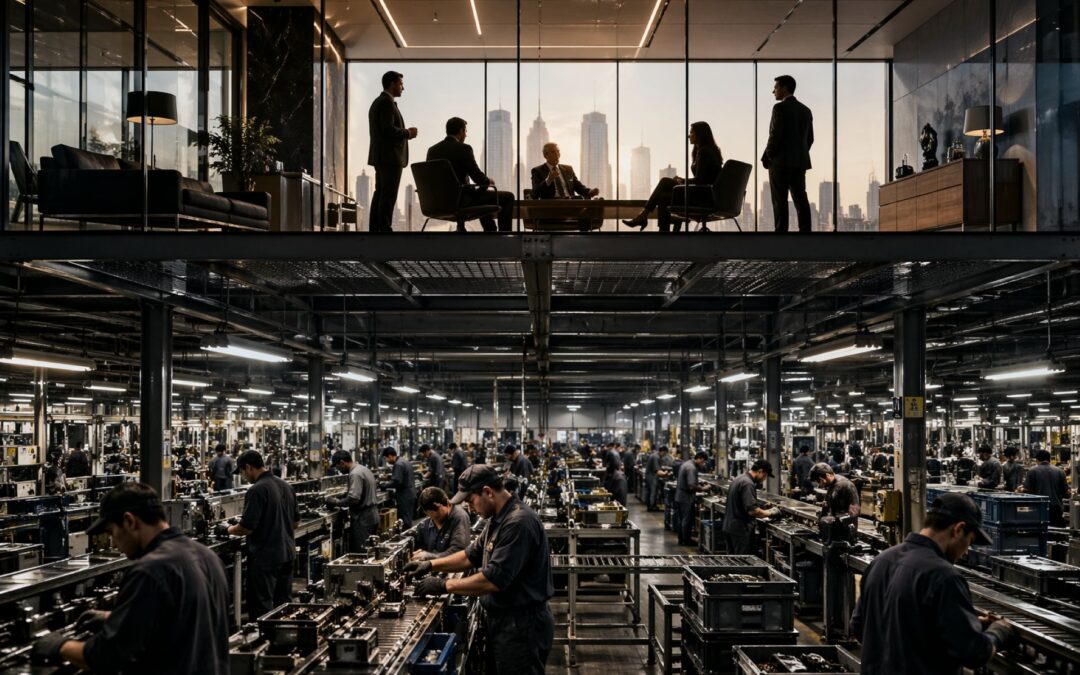
A World That Could Be Different
What if the world worked differently?
Not in small, incremental ways—but at its very foundation. Imagine a system where the wealth produced by society didn’t concentrate in the hands of a few, but flowed back to everyone who helped create it. A world where workers didn’t just survive on wages, but actually shared in the profits their labor generated. Where the workplace wasn’t a hierarchy dictated from above, but a space shaped collectively by those within it.
In such a world, economic life would resemble democracy far more closely than it does today. Decisions about production, distribution, and value wouldn’t be made by a narrow class of owners or executives, but by the people whose lives are directly shaped by those decisions. Work wouldn’t feel like something you sell under pressure just to get by—it would feel like something you genuinely participate in, with both agency and reward.
This wasn’t a utopian fantasy in the mind of Karl Marx. It was a serious response to what he saw as a deeply flawed system—one that, despite its promises of freedom and progress, continued to produce inequality, instability, and quiet forms of exploitation.
Marx didn’t deny that capitalism had improved upon earlier systems like feudalism or slavery. But he believed those improvements masked something more fundamental: the structure of domination hadn’t disappeared—it had simply changed form. Instead of masters and slaves, or lords and serfs, society was now divided between those who owned the means of production and those who had no choice but to sell their labor.
And so, for Marx, the question wasn’t just how the world works—but whether it could work differently. Not through minor reforms, but through a complete transformation of the system itself.
“The philosophers have only interpreted the world, in various ways,” he wrote. “The point, however, is to change it.”
That sentence captures the essence of his project. Marx wasn’t interested in passive observation. He was trying to diagnose a system—and, ultimately, to replace it.
To understand why his ideas still provoke such strong reactions today—both admiration and fear—we first need to understand the man behind them, and the world he was responding to.
Who Was Karl Marx and Why He Still Matters
Karl Marx was born in 1818 in Trier, in what is now Germany, into a middle-class family. He began his academic journey studying law, but quickly found himself drawn toward philosophy. That shift wasn’t accidental. Marx was less interested in rules than in the deeper question beneath them: why society is structured the way it is.
His intellectual development took place during a time of enormous change. Europe was being reshaped by the Industrial Revolution. Old systems like feudalism were fading, and a new economic order—capitalism—was rapidly expanding. Factories were rising, cities were growing, and with them came a new class of workers whose lives revolved around wage labor. Marx didn’t observe these changes from a distance. He lived through them, often in poverty, while trying to make sense of their implications.
Early in his career, Marx worked as a journalist, writing about political and social issues. But his critiques quickly made him a target. His writings were considered too radical, too dangerous. He was forced into exile, moving between countries, eventually settling in London, where he would spend much of his life struggling financially while continuing his work.
Despite these hardships, Marx produced some of the most influential works in modern thought. Alongside Friedrich Engels, he wrote The Communist Manifesto, a short but powerful text that called for the working class to rise against the capitalist system. Later, he devoted years to writing Das Kapital, a dense and detailed analysis of how capitalism functions—its mechanics, its contradictions, and its consequences.
What makes Marx different from many other thinkers is that he didn’t treat philosophy as an abstract exercise. For him, ideas were inseparable from material reality. He believed that to understand society, you had to look at how people produce and distribute the things they need to survive. Economics wasn’t just one aspect of life—it was the foundation upon which everything else was built: politics, culture, even individual consciousness.
More than a century after his death, Marx remains one of the most debated figures in history. His ideas have inspired revolutions, shaped entire political systems, and sparked intense criticism. In many parts of the world, his name is still associated with authoritarian regimes and failed experiments. That legacy has made people understandably cautious—sometimes outright hostile—toward anything labeled “Marxist.”
But at the same time, his work continues to attract new readers. Not because people are blindly embracing his conclusions, but because his analysis still feels uncomfortably relevant. Rising inequality, job insecurity, economic crises—these are not relics of the past. They are features of the present.
Marx’s enduring influence lies in this: he provided a framework for understanding not just what is happening in society, but why it keeps happening. And once you begin to see the system through that lens, it becomes difficult to ignore the questions he raised.
To fully grasp those questions, we need to step back even further—beyond Marx himself—and look at the broader patterns he identified in human history.
Understanding How Societies Produce and Distribute Wealth
To understand Marx, you have to understand one of his most fundamental ideas: the way a society produces and distributes wealth shapes everything else about it.
This might sound abstract at first, but it’s actually very simple. Every society, no matter how advanced or primitive, has to solve the same basic problem: how do we turn the resources of nature into the things we need to survive? Food, shelter, tools, clothing—these don’t just appear. They are produced. And once they are produced, they must be distributed.
Who does the producing? Who owns what is produced? Who decides how it’s shared? These are not just economic questions—they are the foundation of power, hierarchy, and social structure.
Marx called these arrangements “modes of production.” Each mode of production is defined by two things: the forces of production (the tools, technology, and labor used to create goods) and the relations of production (the social relationships between those who produce and those who control production).
When these elements combine, they create an entire system—a way of organizing society. And according to Marx, history is essentially a story of different modes of production replacing one another over time.
This isn’t a smooth or peaceful process. It happens through tension and conflict. As productive forces evolve—new tools, new technologies, new ways of working—the old social structures begin to break down. Eventually, they are replaced by new ones that better align with the changed conditions.
What’s important here is that no system is permanent. The way we organize work, ownership, and wealth today is not some final, natural state of affairs. It is just one stage in a long historical progression.
To see this more clearly, Marx looked back at earlier forms of society. By understanding how humans have organized production in the past, we can better understand the system we live in now—and why it might eventually change as well.
Primitive Communism: A World Without Ownership
Long before factories, markets, or even agriculture, human societies operated in a radically different way. According to Karl Marx, early hunter-gatherer communities lived under what he described as “primitive communism.”
This wasn’t communism in the modern political sense. There were no ideologies, no manifestos, no centralized plans. It was simply a way of life shaped by necessity.
In these small, nomadic groups, survival depended on cooperation. People hunted together, gathered food together, and shared what they found. There was no concept of private ownership over land or resources because there was no practical way to enforce it. You couldn’t “own” a forest you constantly moved through, nor could you accumulate wealth when most goods were perishable and used immediately.
Because of this, there was little room for hierarchy based on wealth. There were no capitalists, no landlords, no ruling class extracting value from others. Social roles certainly existed—some hunted, others gathered, some led temporarily—but these roles didn’t translate into permanent economic domination.
Production itself was simple and direct. What people produced was what they consumed. There was no significant surplus, no stockpiling of resources to generate profit later. Without surplus, there was no foundation for inequality as we understand it today.
Of course, this doesn’t mean these societies were perfect. Life was harsh, uncertain, and often short. But from Marx’s perspective, they were fundamentally different in one crucial way: exploitation, in the structured sense of one class living off the labor of another, did not exist.
This mode of life began to change with one of the most important developments in human history: agriculture.
Once humans learned to cultivate land and produce more than they immediately needed, everything shifted. Surplus made accumulation possible. Accumulation made ownership meaningful. And ownership laid the groundwork for division—between those who had and those who did not.
What followed was the emergence of entirely new systems, where inequality was no longer incidental, but built into the structure itself.
Slave Societies: The Rise of Ownership and Exploitation
The development of agriculture changed everything.
For the first time in human history, people could produce more than they immediately needed. This surplus transformed the structure of society. Instead of consuming everything right away, resources could now be stored, accumulated, and—most importantly—controlled.
With surplus came the concept of private property. Land, tools, and resources were no longer just used—they were owned. And once ownership entered the picture, so did inequality. Some people controlled more than others. And those who controlled more had the power to shape the system in their favor.
One of the most extreme expressions of this shift was the emergence of slave societies.
In these systems, not only were land and goods owned, but human beings themselves became property. Enslaved people were forced to work, producing goods and services for their masters, who reaped the benefits without contributing labor themselves. The division between those who produced and those who owned became absolute.
From a structural perspective, the logic was straightforward. A slave needed just enough to survive—food, basic shelter, minimal care. Everything beyond that—the surplus created by their labor—belonged entirely to the master. The more slaves one owned, the more surplus one could extract, and the more wealth one could accumulate.
Civilizations like Ancient Rome and Ancient Egypt were built on this model. Their economic and political power depended heavily on the labor of enslaved populations. It allowed ruling classes to live in relative comfort while maintaining large-scale production and expansion.
But this system came at a cost that went far beyond inequality. It was deeply dehumanizing. Slaves had no autonomy, no rights, and no claim to the value they created. They were reduced to instruments of production—treated less as people and more as tools.
From Marx’s perspective, this was exploitation in its most visible and brutal form.
And yet, even such a rigid system didn’t last forever.
Over time, slave societies began to transform. Political changes, economic shifts, and internal tensions gradually gave rise to a different structure—one that still involved inequality and dependence, but in a less direct form.
This next stage would redefine the relationship between power and labor, replacing outright ownership of people with something more subtle—but still deeply unequal.
Feudalism: A Slight Shift in Power
As slave societies declined, they didn’t give way to equality—they gave way to a different structure of dependence.
Feudalism emerged as the dominant system across much of medieval Europe. The relationship between people changed, but the underlying imbalance remained. Instead of masters and slaves, society was now organized around lords and serfs.
At first glance, this looked like progress.
Serfs were not owned in the same way slaves were. They couldn’t be bought or sold as individuals, and they had certain basic rights. They could marry, have families, and maintain a small portion of land to sustain themselves. But this limited autonomy came with a condition: they were bound to the land they worked on.
That land belonged to the feudal lord.
In exchange for being allowed to live and farm on it, serfs were required to give a portion of their labor and produce to the lord. Part of their week was spent working for themselves—growing food for their families. The rest was spent working the lord’s land or fulfilling various obligations.
So while the form of control had softened, the structure of dependency had not disappeared.
The serf was no longer a piece of property, but they were still tied to a system they couldn’t easily escape. Their survival depended on access to land they didn’t own, controlled by someone who did. And that dynamic created a clear hierarchy: those who worked, and those who benefited from that work.
From Marx’s perspective, this was another variation of the same underlying pattern. A dominant class controlled the means of production—in this case, land—while a subordinate class labored within that structure, giving up a portion of what they produced.
Feudalism was, in many ways, less brutal than slavery. But it was still unequal, still restrictive, and still exploitative.
Over time, however, the system began to strain under its own limitations.
Trade expanded. Towns grew. A new class of merchants and producers began to emerge—people who didn’t fit neatly into the old hierarchy of lord and serf. Economic life started to shift away from land and toward markets, production, and exchange.
And with that shift came the conditions for something entirely new.
Feudalism didn’t collapse overnight. But gradually, as new forms of production took hold and new economic relationships developed, it gave way to a system that would come to dominate the modern world: capitalism.
Capitalism: Freedom with Conditions
With the decline of feudalism and the rise of industry, a new system took shape—one that still defines most of the world today: capitalism.
On the surface, capitalism looks like a clear improvement over what came before. People are no longer bound to land, nor are they owned by another person. In principle, individuals are free. Free to move, free to choose their work, free to enter into agreements.
But this freedom comes with conditions.
In a capitalist system, the means of production—factories, land, machinery, resources—are privately owned. A relatively small group of people controls these assets. Everyone else, lacking ownership of productive resources, must find another way to survive.
That way is wage labor.
Instead of being forced to work directly through coercion, individuals sell their labor in exchange for money. This arrangement is often seen as voluntary: the worker agrees to work, the employer agrees to pay. But beneath that apparent freedom lies a structural necessity. Without income, most people cannot meet their basic needs. And without owning productive assets, their only real option is to sell their time and effort to someone who does.
This creates a new kind of relationship between two groups: those who own capital, and those who don’t.
The owners—businesses, investors, shareholders—organize production. They decide what gets produced, how it gets produced, and what happens to the profits. Workers, on the other hand, carry out the actual labor required to make that production possible. In return, they receive a wage.
Here’s where the system reveals its deeper logic.
The goal of production under capitalism isn’t simply to meet human needs—it’s to generate profit. Goods and services are created, sold, and expanded primarily because they can produce financial returns for their owners. The more efficient and profitable the system becomes, the more wealth accumulates at the top.
Workers benefit in the sense that they receive wages and, in many cases, enjoy better living conditions than in earlier systems. But they don’t share directly in the profits they help generate. Their compensation is fixed, while the surplus—the extra value created beyond their wages—flows upward.
So while capitalism offers more personal freedom than slavery or feudalism, it also introduces a different kind of constraint.
You are free—but within a system where your survival depends on selling your labor to those who own what you need.
This tension between freedom and dependence sits at the heart of Marx’s critique. And to understand that critique more clearly, we need to look at how this system actually functions beneath the surface.
The Core of Capitalism: How the System Really Works
At the center of capitalism lies a simple exchange: labor for wages.
A worker agrees to sell their time, effort, and skills to an employer. In return, the employer pays a fixed amount—typically a salary or hourly wage. On the surface, this looks fair. Both sides agree to the terms, and both appear to benefit. The worker earns a living, and the employer gets work done.
But Marx argued that this exchange hides something deeper.
To see it, you have to look not at what the worker is paid—but at what the worker produces.
Imagine a worker in a factory, office, or warehouse. Over the course of a day, they create value through their labor. That value is embodied in the goods they produce or the services they help deliver. Now, suppose that by a certain point in the workday—say, halfway through—they have already produced enough value to cover the cost of their wages.
Everything they produce after that point doesn’t go to them.
It becomes surplus.
This idea—surplus value—is central to Marx’s analysis. It refers to the difference between the value a worker creates and the wage they are paid. That difference doesn’t disappear. It is captured by the employer and becomes the source of profit.
From this perspective, profit isn’t just the result of smart business decisions or efficient management. It is rooted in the structure of the system itself. As long as workers produce more value than they receive in wages—and they must, otherwise there would be no profit—the system generates surplus.
And that surplus flows upward.
This doesn’t mean every employer is acting maliciously. In fact, most are simply operating within the logic of the system. To remain competitive, businesses must control costs, increase productivity, and maximize returns. If they don’t, they risk being outcompeted by others who do.
So the system reinforces itself.
Employers aim to extract as much value as possible from labor. Workers, in turn, depend on wages to survive, which limits their ability to resist these conditions. The result is a stable pattern: labor produces value, wages cover only part of it, and the rest accumulates as profit.
Once you begin to see this dynamic, many features of modern work start to make more sense.
Long hours, productivity targets, performance pressure, automation—these are not random developments. They are all connected to the same underlying goal: increasing the amount of value produced relative to the cost of labor.
And this is where Marx’s critique sharpens.
Because if profit depends on this gap between what workers produce and what they receive, then exploitation is not an accident within capitalism—it is a requirement of it.
Exploitation: The Engine Behind Profit
Once the mechanics of capitalism are laid bare, Marx’s argument becomes difficult to ignore: profit depends on exploitation.
Not exploitation in the crude, obvious sense of chains and coercion—but in a structural sense built into the system itself.
If a worker were paid exactly the value they produce, there would be no surplus left over. And without surplus, there would be no profit. The entire system relies on a gap between what workers create and what they receive in return.
That gap is where profit comes from.
This doesn’t require cruelty or bad intentions from individual employers. Even well-meaning business owners are bound by the same logic. To survive in a competitive market, they must keep costs low and output high. And labor, for most businesses, is one of the largest costs.
So the pressure is constant: get more out of workers while giving as little as possible in return.
This can take many forms. Wages may stagnate while productivity increases. Employees may be asked to do more in less time. Workdays stretch longer, expectations rise higher, and performance is measured more intensely. Efficiency becomes the central obsession—not to reduce human effort, but to extract more value from it.
Technology plays a key role here.
In theory, advances in technology should make life easier. Machines can do in minutes what once took hours. Processes become faster, smoother, more precise. But instead of reducing the burden on workers, these gains are often used to increase output. The same worker is now expected to produce more, at a faster pace, under tighter constraints.
In some cases, this leads to working conditions that feel increasingly mechanical—repetitive tasks, constant monitoring, strict quotas. The human being begins to resemble an extension of the machine rather than the other way around.
Marx described this transformation in stark terms. As productivity rises, he argued, the worker is reduced to a fragment—stripped of creativity, autonomy, and meaning. Work becomes less about human expression and more about relentless output.
And the benefits of that output are unevenly distributed.
As companies grow more efficient and profitable, the rewards tend to accumulate at the top. Executives, shareholders, and owners capture the surplus, while workers continue to operate within fixed or slowly changing wages. The more successful the system becomes, the more pronounced this divide can grow.
This is why Marx saw exploitation not as a flaw that could be easily corrected, but as a defining feature of capitalism.
Because as long as profit remains the primary goal, the system will always seek ways to widen that gap between what workers give and what they get.
And over time, that gap doesn’t just affect income—it begins to shape how people experience their work, their relationships, and even themselves.
Alienation: When Work Becomes Meaningless
Exploitation explains how value is extracted from workers. But for Marx, the damage didn’t stop at economics. It extended into something more personal, more psychological: alienation.
Alienation describes a condition in which people become disconnected—from their work, from what they produce, from others, and ultimately from themselves.
Start with the product of labor.
In most jobs today, the things people create don’t belong to them. A worker might spend hours contributing to a product, a service, or a system, but once the work is done, it disappears into the machinery of the company. It is owned, controlled, and sold by someone else. The worker has no real connection to the final outcome.
Then there’s the process of work itself.
Rather than being a space for creativity or self-expression, work is often reduced to a set of repetitive, narrowly defined tasks. One person handles a small fragment of a much larger process. Over time, this specialization strips work of its meaning. The worker is no longer engaged in creating something whole, but in performing the same motion, again and again.
This fragmentation has consequences.
When you spend most of your waking hours doing something that feels disconnected from your own intentions or abilities, it begins to affect how you see yourself. Work stops being an extension of who you are and becomes something external—something you endure rather than something you participate in.
This is what Marx meant by being alienated from oneself.
But the effects don’t end there.
Alienation also reshapes how people relate to each other. In a system where individuals compete for jobs, promotions, and security, others are no longer simply collaborators—they become rivals. The workplace becomes a space of quiet competition, where cooperation is often overshadowed by the pressure to stand out or stay ahead.
This dynamic fragments social bonds. Instead of shared purpose, there is comparison. Instead of solidarity, there is tension.
And above it all, decisions about work—what is produced, how it is produced, and why—are made by those who own the system, not those who operate within it. Workers carry out tasks, but they rarely shape the direction of their labor.
So the disconnection runs in multiple directions at once.
You are separated from what you create.
You are separated from the act of creating.
You are separated from others doing the same.
And eventually, you are separated from your own sense of purpose.
This is why, for Marx, alienation was not just an emotional side effect of modern work. It was a structural outcome of a system where labor is treated as a commodity—something to be bought, sold, and optimized.
And when human activity is reduced to that, meaning becomes increasingly hard to find.
Inequality: Why the Gap Keeps Growing
If exploitation explains how profit is generated, inequality explains where that profit ends up.
Under capitalism, wealth doesn’t just circulate—it accumulates. And it tends to accumulate in the hands of those who already own the means of production.
The logic is straightforward. When a business generates profit, that profit doesn’t get evenly distributed among everyone who contributed to it. Workers receive wages, which are relatively fixed. Owners and shareholders, on the other hand, receive the surplus—the part that grows when the business becomes more successful.
And success compounds.
With more profit, owners can reinvest. They can buy more machines, expand operations, acquire competitors, and hire more workers. Each expansion creates the potential for even more surplus. Over time, this creates a feedback loop: wealth generates more wealth.
Workers, by contrast, remain dependent on wages.
Even when wages increase, they rarely keep pace with the growth of capital at the top. The cost of living rises, new expenses emerge, and financial security remains fragile. Most people don’t accumulate enough capital to escape this cycle. They work, they earn, they spend—and then they work again.
This is what creates the widening gap.
At one end, a small group controls a growing share of resources, assets, and decision-making power. At the other, a much larger group lives within tighter constraints, with limited influence over the system that shapes their lives.
This isn’t just about income—it’s about control.
Those who own capital decide what gets produced, where investments go, which industries expand, and which decline. Their decisions ripple outward, affecting jobs, communities, and entire economies. Meanwhile, the people most affected by those decisions often have little say in them.
The result is a system where economic power becomes increasingly concentrated.
You can see it in everyday life. Some people struggle to cover basic expenses, living paycheck to paycheck, while others accumulate wealth at a scale that allows them to influence markets, politics, and even global trends. The contrast is stark—and it continues to grow.
For Marx, this wasn’t an unfortunate side effect of capitalism. It was a predictable outcome.
Because when profit is the goal, and ownership determines who receives that profit, inequality is not something the system accidentally produces—it is something the system continuously reinforces.
Instability: Why Capitalism Never Settles
If inequality reveals where wealth goes, instability reveals how fragile the system can be over time.
For Marx, capitalism was never a steady, balanced system. It was inherently unstable—prone to cycles of expansion and collapse. Periods of rapid growth would be followed by downturns, crises, and uncertainty. And this wasn’t a flaw that could be permanently fixed. It was built into the system itself.
At its core, capitalism is driven by constant expansion.
Businesses must grow to survive. They must produce more, sell more, and generate higher returns. But this drive creates tension. As companies push to maximize profits, they increase production—often beyond what the market can absorb. At the same time, workers, whose wages are kept relatively low, may not have enough purchasing power to buy back what they produce.
This creates a contradiction.
The system produces abundance, but struggles to distribute it in a way that sustains demand. When this imbalance grows too large, it leads to overproduction. Goods remain unsold, revenues drop, businesses cut costs, and layoffs begin. What started as growth turns into contraction.
These are the boom-and-bust cycles Marx identified.
During boom periods, optimism runs high. Jobs are plentiful, markets expand, and wealth appears to grow. But beneath that surface, imbalances are building. Then, when a crisis hits—whether triggered by financial collapse, declining demand, or external shocks—the system corrects itself, often abruptly.
And when it does, the consequences are uneven.
Workers tend to bear the brunt. Jobs disappear, wages stagnate or fall, and financial insecurity spreads. Meanwhile, those with capital often have the resources to weather the storm—or even take advantage of it by acquiring assets at lower prices.
This instability doesn’t just affect the economy. It spills over into society.
Periods of crisis create frustration, anxiety, and a search for explanations. People look for causes, and sometimes for someone to blame. Political tensions rise. Divisions deepen. In extreme cases, this can give rise to populist movements that channel dissatisfaction into anger—often directed at vulnerable groups rather than the underlying structure.
So the instability of capitalism isn’t just about numbers on a chart. It shapes how people think, how they relate to each other, and how societies respond to pressure.
For Marx, these recurring crises were not temporary disruptions. They were signals—indications that the system contains internal contradictions it cannot fully resolve.
And as those contradictions intensify, the question he raised at the beginning returns with greater urgency:
Can a system built on endless growth, unequal distribution, and structural tension sustain itself indefinitely?
Theory vs Reality: What Happened to Marx’s Vision
Marx didn’t just analyze capitalism—he believed it would eventually be replaced.
According to his theory, the growing inequality and instability within the system would lead to a breaking point. The working class, pushed far enough, would recognize its position and rise collectively to overthrow the capitalist order. In its place, a new system would emerge—one based on shared ownership, democratic control of production, and the elimination of class divisions.
But history didn’t unfold the way Marx expected.
In the 20th century, several countries attempted to build societies inspired by his ideas. The most prominent examples include the Soviet Union and Maoist China. These revolutions did, in fact, dismantle older systems—overthrowing monarchies, ending feudal structures, and redistributing land and resources.
In some respects, they achieved significant changes. Literacy rates improved. Access to healthcare expanded. Industrialization accelerated in regions that had previously lagged behind.
But these outcomes came at a heavy cost.
Instead of a decentralized, worker-led transformation, power became concentrated in the hands of the state. Rather than dissolving hierarchy, these systems often replaced one ruling class with another—party elites and centralized authorities who controlled production and decision-making from above.
The result was a form of control that, in many cases, became deeply oppressive.
Political dissent was suppressed. Freedoms were restricted. Economic inefficiencies led to shortages, while mismanagement and authoritarian policies contributed to widespread suffering. In some instances, millions of people died due to famine, forced labor, and political purges.
This stark contrast between Marx’s vision and its real-world implementations shaped how his ideas are perceived today.
For many, “Marxism” became synonymous with authoritarianism, economic failure, and human rights abuses. The association is so strong that the term is often used as a political accusation rather than a philosophical position—frequently disconnected from Marx’s original work.
But the story isn’t that simple.
What these regimes implemented was not a pure realization of Marx’s ideas, but a specific interpretation—often imposed from the top down, rather than emerging from the working class itself. The state didn’t “wither away” as Marx predicted; it became more powerful.
At the same time, capitalism did not collapse under its own contradictions.
Instead, it adapted.
In many parts of the world, especially in Western and Nordic countries, elements of social welfare were introduced—public healthcare, labor protections, social safety nets. These reforms softened some of capitalism’s harsher edges, creating systems that are more stable and, in some cases, more equitable.
Yet the underlying issues Marx identified haven’t disappeared.
Inequality persists. Economic crises still occur. Many workers remain dependent on wages, with limited control over their work or its outcomes. New forms of concentration—especially in technology and global finance—have intensified the dynamics he described.
So while Marx’s predictions about revolution may not have played out as expected, his diagnosis of the system continues to resonate.
And that leaves us in an unusual position.
The theory didn’t fully become reality. But the reality still reflects the theory in ways that are difficult to ignore.
Is Marx Still Relevant Today?
More than a century after his death, Karl Marx remains difficult to dismiss.
Not because the world has embraced his solutions, but because many of the problems he identified are still with us—often in more complex forms. The structure of modern capitalism has evolved, but its underlying dynamics continue to raise the same questions about power, labor, and distribution.
Take inequality.
Across much of the world, wealth has become increasingly concentrated. A small fraction of the population controls a disproportionate share of resources, while large segments struggle with rising living costs, stagnant wages, and financial insecurity. This isn’t limited to any one country—it’s a global pattern.
Then there’s the nature of work itself.
For many, employment has become more precarious. Stable, long-term jobs are giving way to short-term contracts, gig work, and flexible arrangements that often lack security. On paper, this flexibility can look like freedom. In practice, it often means uncertainty—an ongoing need to hustle for the next opportunity, with little control over long-term outcomes.
Technology adds another layer.
Automation and artificial intelligence have increased productivity dramatically, but the benefits are unevenly distributed. While some gain efficiency and profit, others face displacement or downward pressure on wages. The question Marx raised—who benefits from increased productivity—hasn’t gone away. If anything, it has become more urgent.
And then there are the broader social consequences.
Housing has become unaffordable in many cities. Mental health issues are rising. Economic pressure shapes life decisions in ways that feel increasingly restrictive. At the same time, societies are becoming more polarized, with growing distrust in institutions and deepening divisions between different groups.
None of this proves that Marx was entirely right.
But it does suggest that he was asking the right kinds of questions.
His work provides a lens—a way of looking at society that focuses on structure rather than surface. It encourages you to ask not just how things function, but who they function for. Who benefits? Who bears the cost? And who gets to decide?
You don’t have to agree with his conclusions to find value in that perspective.
Because even if capitalism remains the dominant system, understanding its inner workings—its strengths, its limits, and its consequences—is essential. And in that sense, Marx’s relevance doesn’t come from offering a final answer.
It comes from refusing to let the question go away.
Conclusion
What if the world worked differently?
That question, which once sounded radical, now feels strangely familiar. Not because we’ve found a clear answer, but because the problems it points to haven’t gone away.
Karl Marx didn’t just critique capitalism—he challenged the assumption that it was the final stage of human organization. He saw it as one system among many, shaped by history, driven by internal tensions, and ultimately subject to change.
History, however, didn’t follow his script.
Attempts to build alternatives in his name often produced outcomes far removed from his vision—systems marked by control, suffering, and concentration of power. Those failures left a lasting imprint, making any discussion of Marx both complicated and controversial.
At the same time, the system he critiqued continues to generate the very issues he identified: inequality that keeps widening, work that often feels detached from meaning, and cycles of growth and crisis that never quite settle.
So we’re left in a tension.
On one side, a system that functions—but not without cost. On the other, a critique that resonates—but offers no easy path forward.
There is no simple resolution here.
But perhaps that was never the point.
Marx’s enduring contribution isn’t a blueprint for a perfect society. It’s a way of looking at the world that refuses to accept its current form as inevitable. It pushes us to question how wealth is created, how it’s distributed, and who gets to decide.
And once you begin asking those questions, it becomes harder to see the world as fixed.
The structure we live in starts to look less like a permanent reality—and more like something that, like all systems before it, could one day change.