
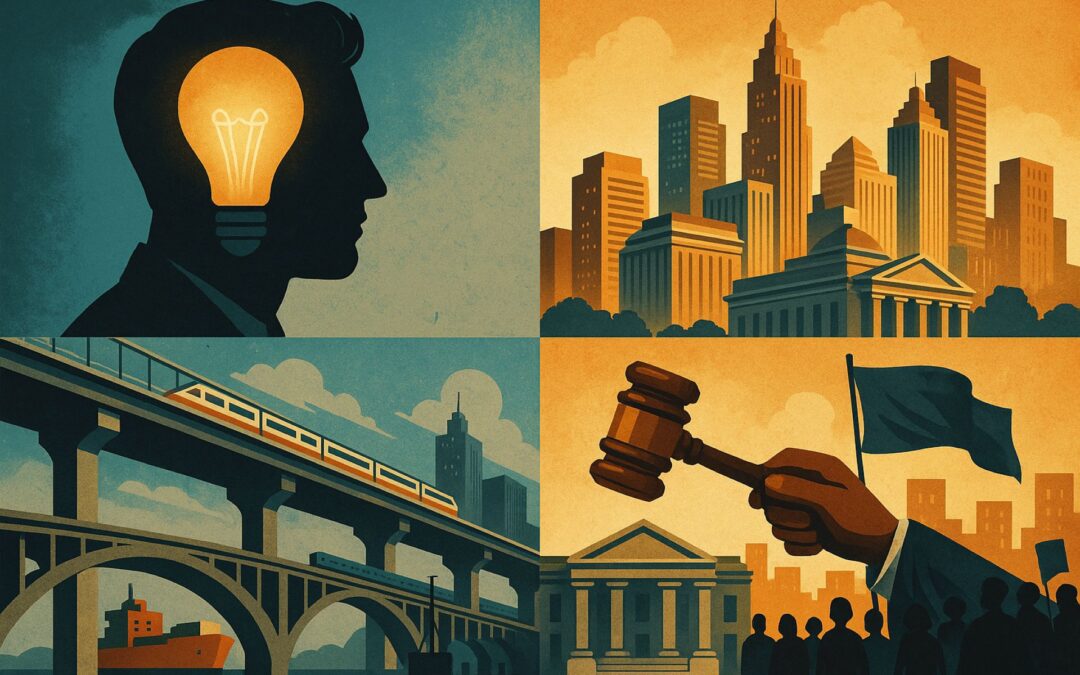
Every city dreams of wealth. Gleaming skylines, bustling trade, and cultural prestige are the ambitions of leaders and citizens alike. Yet history reveals a sobering truth: very few cities ever achieve enduring prosperity. Some flare brightly for a generation before fading into obscurity, while others steadily accumulate power and influence that lasts centuries. What separates them is not luck or geography, but the principles they adopt.
Cities that rise to greatness do so by magnetizing talent, curbing corruption, building infrastructure, embracing innovation, and cultivating identities that endure. The richest cities in history followed these same blueprints, and their lessons remain as relevant today as they were in ancient Athens or industrial New York.
Attracting the Brightest Minds
The heartbeat of any wealthy city is not its monuments, industries, or even its skyline—it’s the people who choose to call it home. Cities rise and fall depending on their ability to attract ambitious individuals who bring with them knowledge, creativity, and the hunger to push boundaries. This is why Detroit’s story is both inspiring and cautionary. In the early 20th century, the city stood at the cutting edge of industry. Henry Ford’s automobile revolution turned Detroit into a global powerhouse, magnetizing engineers, designers, machinists, and laborers from across America and abroad. The city thrived because it became synonymous with opportunity. But when the auto industry collapsed and Detroit struggled to reinvent itself, that gravitational pull disappeared. Once the inflow of talent dried up, so too did the city’s vitality.
Now consider Silicon Valley, which offers the mirror image of Detroit’s decline. Once little more than fertile farmland and orchards, it transformed into the world’s most famous innovation hub. The turning point wasn’t the discovery of oil or the building of factories—it was Stanford University’s decision to nurture its talent. Instead of exporting their brightest graduates to the East Coast, Stanford encouraged them to stay and build. Hewlett-Packard was the first spark, lighting the path for other companies, and before long, a network effect emerged. Engineers attracted investors, investors attracted entrepreneurs, and entrepreneurs attracted more engineers. The Valley’s wealth did not spring from natural resources; it grew from the ability to consistently draw and retain brilliant people. This is the formula every aspiring city must master: if you can attract talent, you can create wealth from thin air.
Keeping Talent Anchored
Attracting ambitious individuals is difficult; holding on to them is even harder. Cities often forget that talent is not tethered—it moves where it feels most valued and comfortable. San Francisco serves as a sharp reminder of this truth. For decades, it sat at the pinnacle of global innovation, home to the world’s most daring startups and brilliant engineers. Yet in recent years, cracks in its foundation have driven thousands of people away. Sky-high housing costs made it unaffordable for many. Rising crime and homelessness eroded the sense of safety. Infrastructure failed to keep up with demand. Suddenly, the very people who had built its reputation were packing their bags, seeking greener pastures.
Austin, Texas, became one of those greener pastures. Once a modest mid-sized city, it reinvented itself by leaning into affordability, culture, and lifestyle. Tesla opened a massive factory, big tech firms set up offices, and thousands of skilled workers followed. But here’s the crucial difference: Austin didn’t just offer jobs—it offered a life. With a strong music scene, livable neighborhoods, and a sense of community, people saw Austin not only as a place to work but as a place to settle, raise families, and grow old. This is the overlooked half of prosperity. A city must ask itself not just how to attract the best people, but how to make them stay. That means building safety, livability, culture, and affordability into the city’s DNA. Wealth compounds only when ambition remains rooted in place.
Controlling Crime and Corruption
Talent and capital are like water—they flow toward stability and away from chaos. A city plagued by crime and corruption will inevitably repel the very resources it needs to thrive. Caracas, Venezuela, embodies this tragedy. Sitting atop some of the largest oil reserves in the world, it had every chance to become one of the wealthiest cities in the Americas. Yet rampant violence, extortion, and political instability turned opportunity into disillusionment. Businesses left. Families emigrated. Investors fled. The raw material for prosperity was there, but the environment poisoned it.
Singapore, by contrast, was dealt one of the weakest hands imaginable. In the 1960s, it was a swampy island with no natural resources, a poor population, and crime-infested streets. It could have remained irrelevant. Instead, its leaders launched an uncompromising campaign against corruption and crime. Civil servants were paid well to remove the temptation of bribes, the law was enforced consistently, and businesses learned that contracts would be honored and disputes settled fairly. In a short time, Singapore became one of the safest, most trustworthy business hubs in the world. Global investors poured money in, entrepreneurs flocked to build, and citizens enjoyed stability.
The contrast could not be sharper. Caracas shows that resources alone mean nothing if lawlessness prevails. Singapore proves that stability, trust, and fairness are magnets stronger than gold. This is why eliminating crime and corruption is not just about morality—it is an economic strategy. It tells the world: this is a place where the rules matter, and money, people, and ideas are safe here.
Building Infrastructure that Works
A city can have all the talent and capital in the world, but without functioning infrastructure, prosperity stalls. Infrastructure is the bloodstream of a city—it carries goods, energy, and ideas to every corner. When it fails, everything else slows to a crawl. Lagos, Nigeria, illustrates this painfully well. On paper, it should be one of Africa’s richest cities, with abundant natural resources, a large population, and access to global markets. But reality paints a harsher picture: traffic jams that can trap commuters for hours, chronic power outages that cripple productivity, and ports so inefficient that businesses bleed money just trying to move goods. The infrastructure bottleneck strangles growth, forcing both companies and workers to seek opportunity elsewhere.
Shenzhen, China, offers the opposite trajectory. Just forty years ago, it was a fishing village. But in 1980, it was designated as China’s first special economic zone and underwent a radical transformation. The government invested heavily in highways, ports, industrial parks, and later, cutting-edge digital networks. By the 1990s, Shenzhen had shifted from making cheap toys to manufacturing sophisticated electronics. Today, it rivals New York in skyline and economic power, home to tech titans like Huawei and Tencent. Its infrastructure did more than just support growth—it catalyzed it, attracting global companies and millions of ambitious workers. The lesson is clear: if a city wants to grow rich, it must invest in roads, ports, power grids, and broadband. Without them, prosperity remains a dream; with them, it becomes inevitable.
Embracing Technology as a Force Multiplier
Every era of prosperity has been driven by those who seized its defining technology. In the Industrial Revolution, it was steam power and mechanized factories. In the 20th century, it was mass production and electricity. In the 21st century, it is digital innovation. Cities that resist or delay embracing new technologies inevitably fall behind. Much of Europe has lived this decline—cities like Milan, Madrid, and Vienna remain culturally vibrant but technologically sluggish, causing their brightest young talent to emigrate to places more aligned with the digital future.
Seoul, South Korea, demonstrates what happens when a city bets boldly on technology. In the 1960s, South Korea was one of the poorest nations in the world. But rather than clinging to agriculture or cheap labor, its leaders wagered that technology was the path forward. That gamble paid off spectacularly. Companies like Samsung, Hyundai, and LG became household names, and Seoul transformed into a global hub of innovation. For years, it boasted the fastest internet in the world, and even today it’s pioneering advancements like 6G. By embracing technology early and consistently, Seoul not only caught up with but in some cases surpassed wealthier nations.
The truth is stark: innovation is the ultimate multiplier. It accelerates industries, creates entirely new markets, and attracts the next generation of entrepreneurs. For cities, ignoring technology isn’t just risky—it’s a death sentence in a world where progress moves at the speed of light.
Diversifying the Economic Base
Dependence on a single industry is a recipe for fragility. A city can appear prosperous for decades, even centuries, only to collapse when that foundation crumbles. Venice is a haunting example. For generations, it dominated trade routes between Europe and Asia, amassing vast wealth and global influence. But when new Atlantic routes opened, Venice failed to adapt. The city’s economic engine sputtered, and over time, it was reduced to a beautiful relic, surviving largely on tourism rather than innovation.
New York City, by contrast, has mastered the art of diversification. In the 19th century, it thrived as an industrial and shipping hub, the gateway to America. When manufacturing declined, it reinvented itself as the financial capital of the world, a role it still holds today. But New York didn’t stop there—it expanded into media, fashion, art, and technology, ensuring that no single downturn could sink it. Its ability to pivot has kept it at the center of global commerce for over a century.
Dubai presents a modern version of this principle. For decades, its wealth was tied almost exclusively to oil. But its leaders understood that oil reserves were finite, and more importantly, unsustainable as the sole foundation of prosperity. So they diversified—investing in tourism, aviation, real estate, and finance. Today, less than 1% of Dubai’s GDP comes from oil, yet it ranks among the world’s wealthiest and most globalized cities.
The lesson is straightforward: monocultures collapse. Flexibility is survival. A rich city isn’t defined by one dominant industry but by its ability to reinvent itself when industries shift. Cities that diversify create economic ecosystems that can withstand shocks, crises, and the relentless march of change.
Investing in Quality of Life
A city can generate vast sums of wealth, but if daily life for its residents feels like a constant struggle, that wealth becomes hollow. Prosperity must filter down into livability—otherwise, the very people who fuel growth will eventually leave. São Paulo is one of Latin America’s largest economic engines, but extreme inequality, rampant crime, and inadequate infrastructure keep much of its population in survival mode. For many, the city represents a grind rather than a dream. Businesses may thrive for a time, but the lack of social balance steadily erodes the foundation for long-term growth.
Now compare that with Copenhagen. Instead of prioritizing raw economic growth at all costs, it has deliberately invested in livability: bike-friendly streets that ease congestion, abundant parks and green spaces that encourage community, and efficient public transportation that reduces stress. These investments might not seem as glamorous as skyscrapers or industrial zones, but they generate something far more enduring—happiness. Zurich, too, embodies this principle. With safe streets, excellent healthcare, and world-class education, it offers not only opportunities for wealth but also an environment where families can flourish. When people feel safe, inspired, and cared for, they are more likely to remain, to innovate, and to build. A city that prioritizes quality of life doesn’t just attract wealth—it multiplies it by anchoring human capital for generations.
Creating a Global Brand
Wealthy cities don’t just exist on the map—they exist in the imagination. Paris is not merely a location; it’s a symbol of art, fashion, romance, and cuisine. That symbolic power translates into billions in tourism, luxury industries, and real estate premiums. People pay not only for square meters in Paris but for the intangible prestige of being associated with it. The city has spent centuries cultivating this image, turning itself into an aspirational brand as powerful as any corporation.
Contrast this with Johannesburg. Despite being the richest city in Africa, it lacks the same global resonance. Outside of economic metrics, it does not inspire the same dreams or emotional pull. This is the key difference: a city with a global brand captures both wallets and hearts. Dubai has recognized this truth in modern times, branding itself as a futuristic playground of luxury and ambition. New York, too, functions as an icon—symbolizing opportunity, diversity, and power. Cities that master branding extend their wealth beyond borders, because people everywhere want a piece of the identity they project. Without this, a city may still be rich, but it risks being forgotten.
Resilience: The Ultimate Principle
Getting rich is one achievement. Staying rich across centuries is another altogether. History is filled with once-great cities that failed to adapt, their glory preserved only in ruins or museums. Athens is a poignant example. In its golden age, it was the wealthiest and most influential city on Earth, the birthplace of democracy and philosophy. But over centuries, as it failed to uphold key principles—innovation, infrastructure, and adaptability—it ceded its place on the global stage. Today, Athens is admired for its past rather than its present.
London tells a different story. Nearly two millennia old, it has endured plagues, fires, invasions, and the collapse of an empire, yet it remains one of the richest cities in the world. Its strength lies in resilience. When one era ended, it reinvented itself for the next—shifting from imperial power to financial capital, from industrial hub to cultural and educational center. London’s wealth is not tied to a single industry, leader, or moment in history; it is built on systems, institutions, and adaptability.
Resilience, then, is the culmination of all the other principles. Talent, infrastructure, governance, technology, diversification, quality of life, and branding all contribute to a city’s ability to reinvent itself. Without resilience, wealth is temporary. With it, prosperity can endure for centuries, even millennia.
Conclusion
Wealth, at its core, is never static. Cities that rest on past glory inevitably decline, while those that adapt, reinvent, and reinvest secure their place in the future. Prosperity is built not in a single moment, but through centuries of resilience—through systems that outlast leaders and institutions that weather storms. Athens dazzles us with what it once was. London inspires us with what it still is. The difference lies in resilience. For modern cities, the path to wealth remains unchanged: attract and retain talent, build stability and infrastructure, embrace technology, diversify, invest in quality of life, and craft a global identity. Do these things consistently, and prosperity doesn’t just arrive—it endures across generations.