
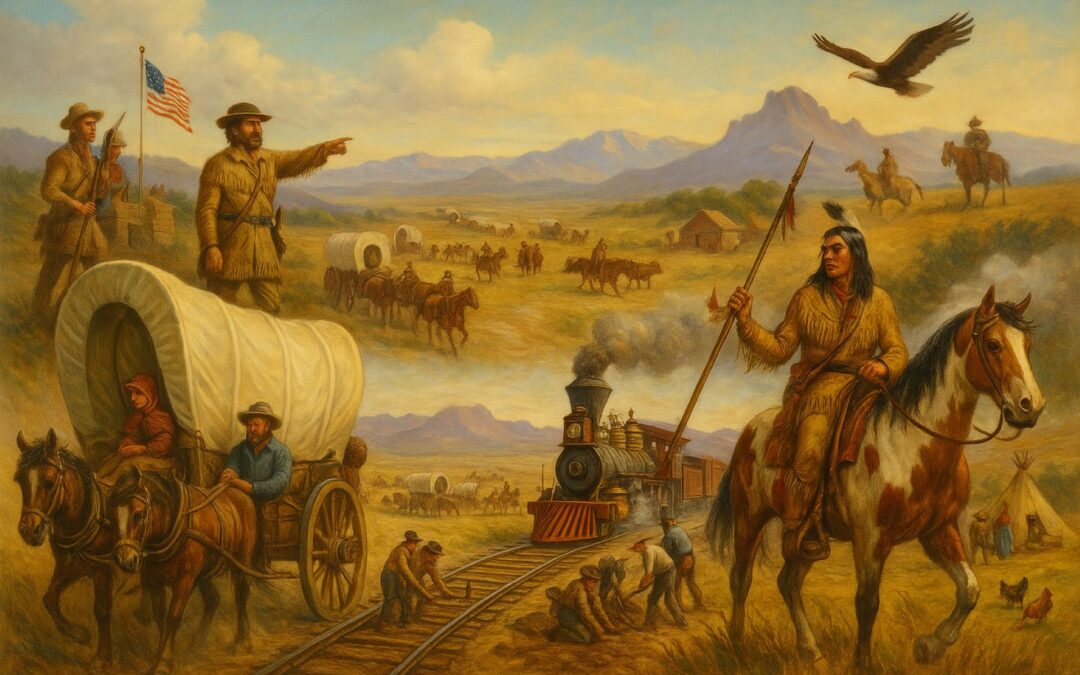
The story of the United States is a story of movement. From its earliest days as a small cluster of colonies hugging the Atlantic shore, the nation’s destiny was bound up with the urge to push outward—to cross mountains, ford rivers, and settle lands that seemed limitless.
What began as fragile coastal settlements grew into a continental empire in little more than a century. Each stage of expansion—whether by treaty, purchase, war, or migration—reshaped not only the map but also the people, their culture, and their identity.
The tale is one of audacity and endurance, but also of displacement and loss. To follow the arc of America’s expansion is to see how ambition forged opportunity, how conflict carved boundaries, and how the promise of a frontier both inspired and scarred a nation.
The Early Republic and the First Steps West
At the turn of the 19th century, the United States was a fragile republic, young and untested. Its five million citizens lived primarily in small coastal towns and rural farms tucked between the Atlantic Ocean and the Appalachian Mountains. Beyond those rugged ridges stretched an immensity that most Americans only knew through rumor and imagination. To them, the wilderness was a forbidding mystery. To the Native peoples who lived there—Cherokee, Shawnee, Iroquois, and countless others—it was familiar, sacred, and deeply rooted in their cultural memory.
The Treaty of Paris in 1783 had dramatically shifted the map. Britain’s surrender of the thirteen colonies extended American territory westward to the Mississippi River, at least on paper. For many leaders of the new republic, this was more than a territorial gain; it was an inheritance of possibility. Yet the territory remained largely unmapped, sparsely known except to fur traders and Native guides. It was one thing to claim land in treaty negotiations, quite another to make it livable for settlers who had never seen a prairie or crossed a major river beyond the Appalachians.
Early pioneers like Daniel Boone became the embodiment of this restless urge to move westward. Boone had spent years exploring the Cumberland Gap, a natural pass through the Appalachians long used by Native tribes. By making the route accessible to wagons, he opened the way into the Kentucky frontier, founding Boonsboro in 1775. His exploits were mythologized in pamphlets and stories, transforming him into a symbol of courage and opportunity. For those squeezed by rising populations in the East, Boone’s path westward was a tantalizing invitation.
Yet this early movement was still tentative. Settlers risked hostile encounters with Native peoples defending their ancestral territories, isolation from established communities, and the sheer difficulty of carving farms and villages out of untamed landscapes. Still, even in its infancy, the republic’s history revealed a pattern: the combination of treaty, migration, and myth-making would be repeated again and again as the United States pushed across the continent.
The Northwest Ordinance and the Organized Frontier
As pioneers like Boone opened physical pathways into the wilderness, the federal government crafted the legal frameworks to govern it. In 1787, Congress passed the Northwest Ordinance, a landmark act that set the rules for expansion into lands north of the Ohio River and east of the Mississippi. This was no haphazard land grab; it was a carefully designed template for orderly growth.
The ordinance outlined how territories could be surveyed, settled, and eventually admitted as states with equal status to the original thirteen. It established civil liberties, banned slavery in the region, and reserved land for schools, signaling that the expansion of the United States was not to be a mere scattering of farms but the deliberate creation of communities. The act also marked a turning point in American federalism: it showed that Congress, not just individual states, would oversee the growth of the republic’s borders.
For settlers, the ordinance gave structure and reassurance. Buying land from the federal government carried legitimacy; they were not squatting in lawless territory but investing in what would eventually become a new state. Within a decade, Kentucky (1792) and Tennessee (1796) were admitted to the Union, proof that the system worked. Towns emerged along rivers and fertile valleys, while surveyors laid out the iconic grid pattern of fields and townships that still marks the American Midwest today.
But the promise of the ordinance was shadowed by displacement. Native nations living in the region were not parties to its design, and their sovereignty was steadily eroded as settlers poured in. Skirmishes and wars erupted, most notably in the Ohio Valley, as tribes fought to preserve their lands. While the ordinance represented a bold vision of national growth, it also revealed the deep contradictions of expansion: the Republic’s march westward meant liberty and opportunity for some, but dislocation and loss for others.
The Louisiana Purchase and the Lewis & Clark Expedition
By the opening years of the 19th century, the United States had outgrown its initial frame. Farmers and settlers pressed against the Appalachian barrier, eager for new lands. But the Mississippi River was the true lifeline of the interior. Whoever controlled it—and the port of New Orleans in particular—held the key to the young nation’s commerce. Farmers in Ohio, Kentucky, and Tennessee relied on the river to send their crops downstream to markets. For them, free navigation of the Mississippi was not a luxury but a necessity.
At the time, however, the river’s lower reaches and New Orleans lay in French hands. Napoleon Bonaparte, who sought to fund his European conquests, was more concerned with armies in Austria than with maintaining an empire in North America. The Haitian Revolution had already destroyed France’s grip on its Caribbean sugar colonies, making Louisiana far less valuable. When American diplomats approached France in 1803, they expected to negotiate only for New Orleans. To their astonishment, Napoleon offered the entire Louisiana Territory—a staggering 828,000 square miles—for $15 million.
The Louisiana Purchase more than doubled the size of the United States overnight, stretching the nation’s reach to the Rocky Mountains. It was an audacious acquisition, both in its scale and in its uncertainty. No one in Washington truly knew what lay beyond the Mississippi. Maps were sketchy, rumors abounded of mammoth rivers, endless forests, and even prehistoric animals still roaming the interior. For some, the purchase was a gamble, a wild leap into the unknown. For others, it was destiny fulfilled—the soil on which a continental republic could grow.
To unlock its mysteries, President Jefferson turned to science and exploration. He commissioned Meriwether Lewis and William Clark to lead a Corps of Discovery westward. From 1804 to 1806, the expedition traced rivers, charted mountains, catalogued plants and animals, and recorded encounters with dozens of Native nations. Their journey was perilous: rapids overturned boats, grizzly bears threatened camps, and hunger gnawed at the men. Yet with the guidance of Sacagawea, a Shoshone woman, they threaded mountain passes and eventually reached the Pacific Ocean in 1805.
The return of Lewis and Clark electrified the nation. Their journals described fertile valleys, vast herds of bison, and navigable waterways, firing imaginations and planting the idea that America’s reach would not end at the Mississippi but stretch unbroken to the Pacific. The Louisiana Purchase had been a bold stroke of diplomacy; the expedition gave it life, transforming lines on a treaty into landscapes of possibility.
Traders, Mountain Men, and the Early Trails
After the Louisiana Purchase, settlers did not immediately pour across the Mississippi in great numbers. The land was too vast, too wild, and too poorly understood. Instead, it was the mountain men—fur trappers, explorers, and traders—who first ventured deep into the interior. Men like Hugh Glass, Jedediah Smith, and Jim Bridger became legendary for their resilience, carving out lives in some of the harshest conditions imaginable.
These men were not driven by farmland or homesteads but by profit. Beaver pelts, highly prized in Europe for fashionable hats, commanded immense value. Following rivers into the Rocky Mountains, the trappers built trading posts that doubled as fortified outposts, linking the wilderness to eastern markets. In doing so, they created the first fragile networks of commerce in regions still far beyond the reach of American law.
But their contributions were not purely economic. The mountain men mapped passes through the Rockies, identified fertile valleys, and learned the intricacies of river systems. They often relied on alliances with Native peoples, trading goods in exchange for survival knowledge. Without these interactions, many would not have survived the brutal winters or navigated the unfamiliar terrain.
From their paths emerged the earliest trails. What began as rough tracks used by hunters and traders slowly became marked routes for wagon trains. The Oregon Trail, the Santa Fe Trail, and other arteries of migration would later carry thousands of settlers westward. In their infancy, these trails were no more than faint scars across vast plains, but they represented promise—lines of connection between the established East and the undiscovered West.
The mountain men lived dangerous, short lives, often dying in isolation or violence. Yet their legacy endured. They were scouts for a nation, their individual quests for furs and freedom laying the groundwork for the great migrations to come. Each trapline and each trading post was a stitch, slowly sewing the wilderness into the fabric of the United States.
Native Nations and the Tragedy of Removal
As settlers crept westward and the nation’s appetite for land grew insatiable, the question of what to do about the Indigenous peoples who already inhabited these territories loomed large. For generations, Native nations had lived across the valleys, plains, and forests the Republic now coveted. They were not passive occupants of the land but vibrant, complex societies with political structures, spiritual traditions, and deep connections to their homelands.
Early American leaders, conscious of their own revolutionary ideals, attempted to resolve this tension through treaties. Dozens were signed, promising that Native nations would retain sovereignty over their lands in perpetuity. In practice, these agreements were fragile, often ignored as soon as settlers pressed in. The federal government lacked both the will and the desire to enforce them when expansion beckoned.
By the 1820s, pressure for farmland in the South had reached a fever pitch. Cotton, driven by the Industrial Revolution and slave labor, was transforming the economy of the region. Planters eyed the fertile lands of Georgia, Alabama, and Mississippi—lands held by the so-called “Five Civilized Tribes”: the Cherokee, Chickasaw, Choctaw, Creek (Muscogee), and Seminole. These nations had adopted aspects of European-American culture, from written constitutions to farming techniques, in hopes of coexisting with their encroaching neighbors. But assimilation offered no protection.
In 1830, President Andrew Jackson pushed through the Indian Removal Act. The legislation gave the federal government authority to exchange Native-held lands east of the Mississippi for territory further west, in present-day Oklahoma. It was presented as a “voluntary” relocation, but in reality it was enforced with soldiers and coercion. The Cherokee, despite winning a Supreme Court case affirming their rights, were nonetheless expelled from their homes. Their forced march—over 1,000 miles in brutal conditions—claimed thousands of lives and entered history as the Trail of Tears.
The removal was more than a tragedy; it was a turning point. It institutionalized the policy of displacing Native peoples whenever their lands were coveted, a pattern repeated again and again across the 19th century. For the United States, it cleared the way for expansion. For Native nations, it marked an era of dispossession, suffering, and cultural upheaval that still reverberates today.
War with Mexico and the California Gold Rush
By the mid-19th century, the United States’ territorial ambitions reached beyond the Mississippi and into lands controlled by its southern neighbor, Mexico. The Republic of Texas, which had broken away from Mexico in 1836, was the flashpoint. For nearly a decade, Texas remained independent, but its annexation by the U.S. in 1845 enraged Mexico and made conflict inevitable.
In 1846, war erupted. U.S. troops, better equipped and led, pushed deep into Mexican territory. Battles raged from the deserts of New Mexico to the halls of Mexico City. The campaign was brutal but swift. By 1847, American forces occupied the Mexican capital, forcing negotiations. The Treaty of Guadalupe Hidalgo, signed in 1848, redrew the map of North America. Mexico ceded an immense swath of land—nearly half its territory—including present-day California, Arizona, New Mexico, Nevada, Utah, Texas, and parts of Colorado and Wyoming. It was one of the largest land transfers in history, cementing America’s status as a continental power.
Even as the ink dried on the treaty, another force accelerated westward expansion: gold. In 1848, James Marshall discovered flakes of the metal in the American River near Sutter’s Mill in California. The news spread like wildfire. By 1849, tens of thousands of prospectors—soon called “49ers”—were streaming westward. Some traveled by wagon across the plains, others by ship around Cape Horn, and still others through the fever-ridden jungles of Panama.
San Francisco, once a sleepy outpost, exploded into a booming city almost overnight. Camps, mining towns, and trading posts sprang up in valleys and along rivers. The Gold Rush was not only a migration of Americans but an international phenomenon, drawing adventurers from China, Latin America, and Europe. Within a year, California’s population had surged so dramatically that it qualified for statehood, admitted to the Union in 1850.
But the rush was not only about fortunes struck in riverbeds. Merchants, hoteliers, and opportunists often made more money supplying miners than the miners made themselves. Lawlessness flourished, with vigilante justice taking the place of courts. For Native Californians, the Gold Rush was catastrophic—disease, violence, and displacement decimated their communities.
Together, the Mexican-American War and the California Gold Rush altered the nation’s trajectory. The war handed the United States control of the Southwest, while the Gold Rush cemented its presence on the Pacific coast. The dream of a nation stretching “from sea to shining sea” was no longer aspiration—it was reality.
Boomtowns, Cowboys, and the Spirit of the West
The mid-to-late 19th century was an era when the West pulsed with feverish energy, driven by sudden discoveries of gold, silver, copper, and oil. Each strike sent ripples across the nation, igniting stampedes of fortune seekers. From the Black Hills of South Dakota to the mountains of Nevada and the deserts of Arizona, the landscape became dotted with settlements that sprang up seemingly overnight. These were the boomtowns—raw, raucous, and transient.
In places like Deadwood, Virginia City, and Tombstone, thousands gathered with hopes of instant wealth. Prospectors clawed at riverbeds and tunneled into mountains, while gamblers, saloon keepers, and shop owners rushed in to supply them. Saloons blared with music, miners spent their meager earnings on whiskey and cards, and shootouts in dusty streets fed the legends of the Wild West. But the prosperity was fleeting. As soon as the veins of precious metal ran dry, miners abandoned their claims, and towns that had once buzzed with thousands of people became eerie ghost towns, their boarded-up buildings left as monuments to the fickleness of fortune.
While prospectors sought wealth beneath the soil, the rolling plains gave birth to another economy—cattle. Vast stretches of grassland across Texas, New Mexico, Colorado, and the Dakotas proved ideal for grazing. Ranching operations multiplied, and soon great herds were driven hundreds of miles to railheads where they could be shipped east. Out of this industry emerged one of America’s most enduring icons: the cowboy.
Cowboys were not the polished figures of dime novels but rugged laborers, enduring grueling workdays under the sun, battling storms, and protecting cattle from rustlers or predators. Their life was harsh, their pay modest, yet their image came to symbolize independence, grit, and freedom. The cowboy became the living emblem of the frontier spirit—a figure balancing on the line between law and lawlessness, civilization and wilderness.
Together, the boomtowns and cattle ranges captured the essence of the American West: a place of boundless opportunity, wild ambition, and constant risk. It was a land where fortunes could be made and lost in a season, and where survival itself demanded resilience and daring.
The Railroads and the Binding of a Nation
If boomtowns and cowboys embodied the energy of expansion, the railroads embodied its permanence. For decades, the great barrier to westward settlement was distance. Crossing the plains and mountains by wagon could take six months, with dangers from disease, hunger, and hostile terrain. But steel rails transformed the equation.
Construction of the first Transcontinental Railroad began in 1863, in the midst of the Civil War. Two companies led the charge: the Union Pacific, building westward from Omaha, and the Central Pacific, pushing eastward from Sacramento. The work was backbreaking. Laborers blasted tunnels through the Sierra Nevada, bridged canyons, and laid track across treeless plains. Thousands of immigrants fueled the effort—Irish workers on the Union Pacific, Chinese laborers on the Central Pacific—enduring grueling hours, low pay, and dangerous conditions.
On May 10, 1869, at Promontory Summit in Utah Territory, the two lines met. A ceremonial golden spike was driven into the final tie, and telegraph wires carried the news across the nation in real time. For the first time, the United States was bound by iron, its coasts linked in a single continuous line.
The effects were seismic. What had once been a perilous half-year journey could now be made in just over a week. Goods flowed across the continent with unprecedented speed, settlers traveled with relative ease, and distant territories were drawn tightly into the economic orbit of the East. Towns sprang up along the tracks, fueled by the commerce and movement the railroads brought.
The railroad also magnified the power of the federal government. Troops could be dispatched swiftly to suppress uprisings, whether from Native nations resisting displacement or from striking workers protesting harsh labor conditions. The railroad was both artery and weapon, carrying not only settlers and trade but also authority and order into the farthest reaches of the republic.
More than any single development, the completion of the Transcontinental Railroad symbolized the triumph of expansion. It stitched the nation into a single fabric, transforming vast distances into manageable spans. The frontier was no longer remote; it was within reach of anyone with the fare to ride west.
Immigrants and the New West
The West was never solely the project of Americans born east of the Mississippi. By the mid-19th century, waves of immigrants from across the world poured into the expanding republic, drawn by the promise of land, liberty, and fresh beginnings. These newcomers did not merely supplement westward migration—they transformed it.
German and Irish settlers arrived in particularly large numbers, fleeing political upheaval, famine, and poverty in Europe. Germans often gravitated toward the fertile plains of the Midwest, where they brought with them traditions of careful farming, beer brewing, and community life centered around churches and schools.
Irish immigrants, many of whom had survived the Great Famine of the 1840s, found work on railroads, in mines, and in urban centers before some ventured west in search of stability and farmland. Scandinavians—Norwegians, Swedes, and Danes—were drawn to the cold northern plains, where the climate mirrored the fjords and forests of their homelands. They established tight-knit farming communities, introducing techniques that thrived in harsh winters and short growing seasons.
Across the Pacific came thousands of Chinese immigrants. Initially lured by the California Gold Rush, many remained to work in agriculture, establish businesses, and play a vital role in constructing the Central Pacific Railroad. They endured appalling conditions—dangerous blasting in mountain tunnels, long hours, and widespread discrimination—yet their labor was indispensable in binding the nation together. Chinese communities grew in California, often centered in Chinatowns, which became hubs of cultural resilience and economic activity despite hostility and exclusionary laws.
African Americans, too, carved a place in the West’s story. Following the Civil War and emancipation, many sought refuge from the entrenched racism of the South. They became farmers, cowhands, and even town-builders, establishing all-Black communities like Nicodemus in Kansas. On the cattle trails, African Americans made up as much as a quarter of all cowboys, their contributions long overshadowed by Hollywood mythmaking.
The influx of immigrants and freedmen gave the West its mosaic character. It was not a monolithic society but a patchwork of languages, traditions, and religions stitched together under the banner of opportunity. While prejudice and hardship followed many, the sheer diversity of those who moved west turned the frontier into a living experiment in cultural fusion, one that would shape the character of the United States for generations.
Conflict, Conquest, and the End of the Frontier
If immigrants and settlers gave the West its energy, Native resistance gave it its fiercest struggles. Despite treaties and forced relocations, many tribes continued to fight for their ancestral lands. The conflict was brutal, protracted, and deeply tragic.
The Sioux, Cheyenne, and Arapaho, facing relentless encroachment onto the Great Plains, mounted fierce resistance. Under leaders like Sitting Bull and Crazy Horse, they fought with courage and tactical brilliance. In 1876, they stunned the nation by defeating Lieutenant Colonel George Custer and his men at the Battle of the Little Bighorn—“Custer’s Last Stand.”
For a brief moment, it seemed Native warriors had turned back the tide of expansion. But the triumph was fleeting. The U.S. Army responded with overwhelming force, sending columns of soldiers across the plains and building forts to secure the territory. Within a few years, Sioux resistance had been broken, and survivors were forced onto reservations.
Farther south, the Apache resisted with equal tenacity. Leaders like Cochise and Geronimo launched guerrilla campaigns from mountain strongholds, raiding settlements and ambushing troops. Their knowledge of the harsh desert terrain gave them an edge, but relentless pursuit by U.S. forces, coupled with dwindling supplies and betrayal by informants, eventually brought their resistance to an end by the late 1880s.
Each battle, each uprising, carried immense human cost. Entire communities were uprooted. Buffalo herds, central to Native survival and culture, were hunted nearly to extinction—sometimes deliberately, as a military strategy to starve tribes into submission. By the close of the century, the Native peoples of the West were confined to reservations, their sovereignty shattered, their lands absorbed into the expanding republic.
Meanwhile, the Census Bureau declared in 1890 that the frontier line no longer existed. Settlement had spread so extensively that there was no longer a clear boundary between wilderness and civilization.
The “closing of the frontier” became both a fact and a metaphor. For some Americans, it was cause for pride: the nation had fulfilled its destiny and spanned the continent. For others, it was a moment of unease. The frontier had symbolized opportunity, reinvention, and boundless space. What would America become without it?
Even as the continental frontier closed, expansion continued elsewhere. Alaska, purchased from Russia in 1867, drew prospectors during the Klondike Gold Rush of the 1890s. In the Pacific, Hawaii was annexed in 1898 after years of American commercial influence and political maneuvering. These acquisitions signaled a new phase of ambition—America was no longer merely a continental power but a rising force with global reach.
The end of the frontier did not mean the end of expansionist energy. It meant that the restless, often ruthless spirit that had driven settlers westward would now be projected outward, shaping the United States’ role in the 20th century as an emerging superpower.
The Legacy of Expansion
The westward expansion of the United States was not merely a chapter of history—it was a crucible that forged the nation’s identity. By the dawn of the 20th century, the dream of a continental republic stretching from the Atlantic to the Pacific had been realized. Yet the costs and consequences of that achievement were profound, leaving legacies that continue to echo in American life.
On one side, expansion was a triumph of ambition and resilience. It created vast opportunities for millions of settlers who carved farms from prairies, built towns on frontiers, and opened markets that fueled industrial growth. Railroads stitched together distant regions into a national economy, enabling wheat from Kansas to feed New York, and lumber from Oregon to build Chicago. The expansion also solidified America’s position as a continental power, giving it resources and space unparalleled by any European nation. Coal, timber, fertile soil, and precious metals extracted from western lands provided the raw materials that propelled the United States into the ranks of industrial giants.
Culturally, the expansion generated enduring myths and symbols. The pioneer wagon, the cowboy, the gold prospector, and the mountain man became icons of independence and self-reliance. Stories of courage, risk, and reinvention shaped a national ethos that celebrated the individual’s ability to overcome hardship. Writers and artists romanticized the frontier as a place where freedom was tested and reborn, where every valley held opportunity and every horizon beckoned with possibility.
But the other side of this legacy is darker. For Native nations, expansion was synonymous with displacement, broken treaties, and cultural devastation. Entire communities were uprooted, forced onto reservations, and stripped of their sovereignty. The deliberate extermination of the buffalo, the Trail of Tears, and the bloody wars of resistance left scars that remain unhealed. Expansion also entrenched inequalities: Native peoples, Chinese immigrants, and freed African Americans often faced systemic exclusion even as they contributed labor and knowledge to the building of the West.
Environmental consequences were equally far-reaching. Vast forests were felled, rivers dammed, and plains overgrazed. Mining booms scarred landscapes with abandoned shafts and toxic tailings. The drive to conquer and exploit nature for immediate gain often ignored long-term sustainability, setting patterns of resource extraction that would challenge future generations.
Politically, the closing of the frontier reshaped America’s trajectory. The 1890 Census declared that the frontier line no longer existed, prompting historians and thinkers like Frederick Jackson Turner to argue that the frontier had been the defining force in American democracy and character. If so, what would replace it? The answer soon emerged: America’s expansionist impulse would turn outward. The annexation of Hawaii, the purchase of Alaska, and the Spanish-American War signaled a shift from continental conquest to overseas influence.
The legacy of expansion, then, is a paradox. It gave rise to prosperity, unity, and a sense of limitless possibility, while simultaneously inflicting immense suffering and injustice. It produced a nation both admired for its vitality and criticized for its ruthlessness. To this day, the imagery of the frontier—its grit, its promise, its contradictions—remains deeply woven into the American psyche. Expansion built not just a nation of states, but an enduring mythology of ambition, reinvention, and the belief that the horizon, no matter how distant, is always within reach.
Conclusion
By the dawn of the 20th century, the frontier had closed, but the legacy of expansion endured. Railroads, homesteads, and bustling cities stood where wilderness and Native nations once thrived. The United States had secured not only its continental span but also the resources and confidence to project power globally.
Yet the cost of this achievement—measured in broken treaties, lost lives, and landscapes transformed—remains part of the national memory. Expansion gave Americans their enduring myths of pioneers, cowboys, and boundless horizons, while also leaving unresolved contradictions of liberty and dispossession.
In the end, the conquest of the frontier was more than a geographic triumph; it was the crucible in which the United States defined itself, for better and for worse, as a nation forever looking toward the horizon.