
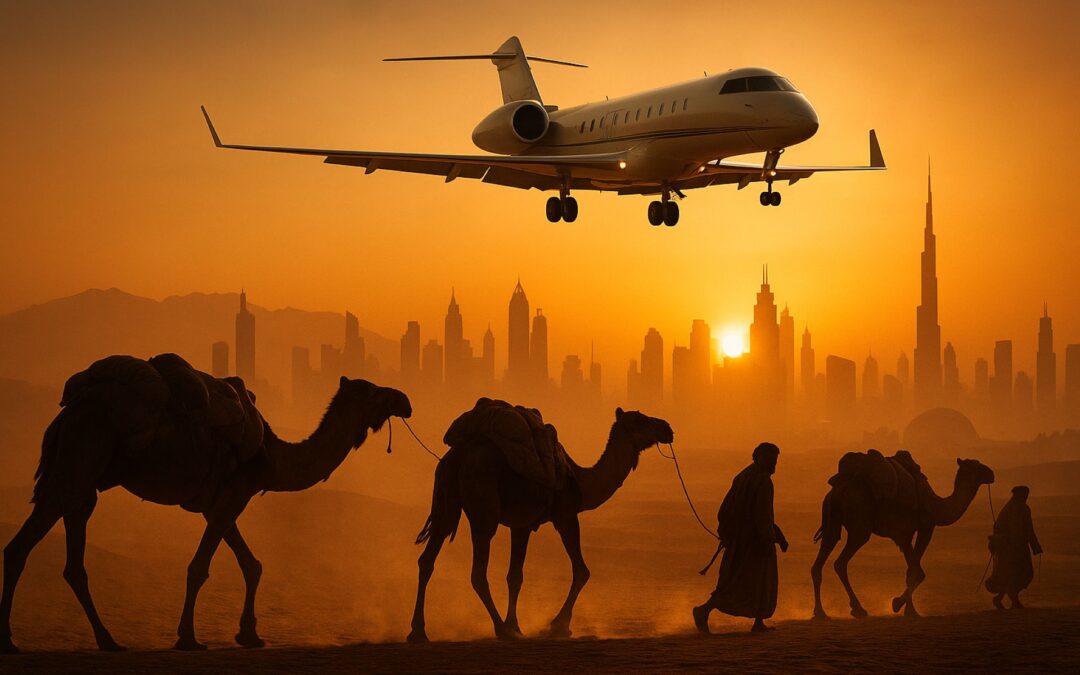
Two thousand years ago, caravans trudged across deserts carrying silk so precious it was guarded like state secrets. That network of paths, now remembered as the Silk Road, didn’t just move goods—it moved wealth, ideas, and power. Cities at its crossroads rose to dominance, empires swelled, and entire civilizations were reshaped by the flow of commerce. Today, the dirt tracks are gone, but the pattern remains. The new Silk Road doesn’t cut through mountains or deserts—it cuts through the skies. Private jet routes have become the modern arteries of influence, ferrying billionaires, CEOs, and policymakers whose decisions create empires faster than any caravan ever could. Where these jets land, wealth consolidates, industries pivot, and futures are written.
The Birth of the Ancient Silk Road
Two thousand years ago, the world’s most desired commodity wasn’t oil, gold, or spices—it was silk. Exquisite, luminous, and stronger than steel for its weight, silk was unlike anything else in existence. Only the Chinese knew the craft of cultivating silkworms and weaving their cocoons into delicate threads. This secret was so closely guarded that revealing it was punishable by death. Such exclusivity turned silk into the ultimate status symbol for emperors, kings, and elites across Asia, the Middle East, and Europe.
The hunger for silk ignited one of the greatest networks of trade in human history: the Silk Road. Far from being a single road, it was an elaborate system of overlapping paths, stretching thousands of miles across deserts, mountain passes, fertile valleys, and bustling ports. From the Yellow River Valley in China, caravans wound westward through Central Asia, across Persia, and into Constantinople—the bridge between Asia and Europe—before reaching the heart of Rome.
Yet the Silk Road’s magic wasn’t in the dirt tracks themselves. It lay in the infrastructure that emerged to support trade. Wells carved into barren deserts quenched the thirst of weary caravans. Caravanserais, fortified inns, became sanctuaries for merchants, their guards, and their animals. Watchtowers rose to defend travelers from raiding nomads. Entire cities blossomed out of the sand simply because traders needed safe harbors. These hubs became crossroads of civilization, where languages mixed, goods exchanged hands, and fortunes were made.
Empires understood the value of control. The Han dynasty protected the road eastward; Rome fortified it to the west. Whoever managed the choke points—whether a mountain pass or a narrow strait—could levy taxes and dictate the terms of global commerce. What started as a way to move bolts of silk quickly transformed into the first structured international economy.
The Mechanics of Wealth Creation
Silk itself wasn’t wealth until it moved. A roll of fabric stored in a Chinese treasury was beautiful but inert. Once strapped onto the back of a camel, carried across deserts, and offered in a Roman marketplace, it became a treasure worth many times its original value. The act of movement—through perilous terrain, past hostile tribes, and across vast distances—multiplied its worth exponentially. Scarcity elevated its desirability, but danger made it priceless.
The real fortune, however, wasn’t in the fabric but in the infrastructure and systems built to facilitate its journey. Cities like Samarkand became indispensable because every caravan moving east or west had to pass through. Warehouses sprouted to store goods, markets bustled with traders from every corner of the known world, and rulers stationed armies to defend the flow of commerce. Each camel that trudged through paid a toll, enriching the city and its rulers.
Financial innovations emerged alongside the trade. Merchants learned that lugging physical goods across thousands of miles was inefficient and perilous. Instead, they deposited goods with trusted bankers and received notes of credit—lightweight slips of parchment that could be exchanged like money. These notes financed not only trade caravans but also wars, expeditions, and imperial projects. Goods transformed into financial instruments, birthing a primitive but effective system of global banking.
Baghdad thrived as a hub of scholarship and finance, turning commerce into credit and knowledge. Constantinople, controlling the Bosporus, grew unimaginably wealthy by charging passage fees for every shipment flowing between Asia and Europe. Each city that mastered the art of extracting value from movement became a nexus of power.
In truth, the Silk Road created the first prototype of globalization: an interconnected economy where luxury goods, ideas, and capital could leap continents. The caravans were just the surface; the true wealth lay in the invisible networks of trust, finance, and power beneath them.
The Fall of the Old Road
The Silk Road, for all its grandeur and centuries of prosperity, was never invincible. Its very strength—land-based connectivity—proved to be its weakness. By the 15th century, the great artery of Eurasian trade began to choke under the weight of geopolitics and new technologies. The Ottoman Empire, having seized Constantinople in 1453, understood the city’s strategic importance as the bottleneck between East and West. But rather than nurturing the flow of goods, they imposed punitive taxes on caravans and merchants. The cost of moving silk, spices, and porcelain skyrocketed, making overland trade increasingly unprofitable.
Meanwhile, another revolution was unfolding at sea. Portuguese explorers, led by visionaries like Vasco da Gama, began charting maritime routes around Africa to India and Asia. The ocean, once feared as unpredictable and dangerous, suddenly became a cheaper, faster, and safer alternative to the treacherous overland path. Caravans took months or years to cross deserts and mountains, battling nomadic raiders and brutal climates. Ships, on the other hand, carried far larger volumes of goods in a fraction of the time, all under the protective gaze of expanding European naval powers.
The decline of the Silk Road was not just an economic shift but a cultural one. Cities that had thrived for centuries—Samarkand, Kashgar, and others—found their lifeblood drained. Caravans dwindled, inns emptied, and bustling markets went silent. Empires that had enriched themselves by controlling the land routes lost influence as wealth funneled into coastal cities and naval powers. By the late 1400s, the once-pulsating Silk Road was reduced to a trickle, more a shadow of its legendary past than a functioning trade network.
Yet even as its roads crumbled into dust, the Silk Road left an indelible legacy. It had already accomplished something extraordinary: it had spread the technologies, philosophies, and political systems that reshaped human civilization. Papermaking from China made its way westward, enabling Europe’s printing revolution. The concept of zero and algebra from India laid the foundations of modern mathematics and finance. Gunpowder transformed warfare, while the compass changed navigation forever. Even the systems of taxation, record-keeping, and diplomatic alliances pioneered along the route influenced empires for centuries after. The road itself may have died, but the world it created continued to flourish.
Enter the New Silk Road
Fast forward to the 21st century, and the Silk Road has re-emerged—this time not across deserts and mountains, but in the skies. The caravans have been replaced by Gulfstreams, Bombardiers, and Dassault Falcons. The precious bundles are no longer rolls of silk or sacks of pepper, but the decision-makers themselves—billionaires, CEOs, political leaders, and tech visionaries. Their mere presence can shift markets, redirect capital, and alter the destiny of entire nations.
In 2023 alone, private jets logged more than 4.2 million flights worldwide. These weren’t aimless journeys; they traced invisible lines of power across the globe. Just as the Silk Road’s significance wasn’t in the dirt road itself but in the nodes of activity where merchants stopped, today’s private jet routes are valuable because of the cities where they land. Private airports, luxury hotels, members-only clubs, and boardrooms have become the new caravanserais—exclusive arenas where wealth, influence, and ideas converge.
The parallels with the ancient world are striking. Then, silk was the luxury that ignited demand; today, it is access to the ultra-wealthy themselves. Commodities have lost their scarcity—spices, silks, and gems that once defined empires are now mass-produced and accessible to all. The scarcest resource today is the decision-maker—the individual with the power to redirect billions with a signature or a conversation. When these individuals disembark from their jets, they carry more potential wealth than any camel caravan ever did.
And just as the Han dynasty or Rome once fortified and taxed key trade hubs, modern cities compete to attract these travelers. Some, like New York, Dubai, and Singapore, have established themselves as indispensable nodes of the new Silk Road. Others, like Hanoi or Riyadh, find their fortunes transformed overnight by the arrival of a single influential figure. Every landing is a potential inflection point, every airport a gateway to tomorrow’s empire.
In essence, the Silk Road has not disappeared—it has ascended. The desert trails have become contrails in the sky, and the future of wealth now follows the flight paths of the privileged few.
Cities at the Crossroads of Power
The cities that dominate today’s private jet routes mirror the choke points of the ancient Silk Road. In antiquity, Samarkand prospered because every caravan moving east or west had to stop there. Constantinople grew rich because it controlled the strait between Asia and Europe. The same principle applies in our era—wealth pools where the powerful congregate, and those cities become the nodes of global influence.
Take Teterboro Airport, just twelve miles from Manhattan. Though modest in size compared to JFK or LaGuardia, it is the busiest private jet airport in the world. Its proximity to Wall Street and Midtown Manhattan makes it the runway of choice for corporate titans, hedge fund magnates, and fashion elites. During the 2008 financial crisis, jets streamed into Teterboro carrying CEOs and bankers summoned for emergency meetings—proof that the city’s power is so magnetic it pulls in capital even during collapse. New York today plays the role Constantinople once did: it is the bottleneck through which much of global finance must pass. Every deal, every merger, every capital raise seems to orbit the gravitational pull of Manhattan.
To the east, Dubai has become the Baghdad of the new age. Its geographic position midway between Europe and Asia gives it the same advantage Baghdad once held along the Tigris and Euphrates. But Dubai added its own innovation: it positioned itself as a tax-free zone, inviting foreign investors and multinational corporations to plant their flags. The result is a city that has turned its airport into one of the busiest in the world, where private jets line up daily, ferrying billionaires, investors, and royalty. Dubai is not just a stopover—it is a nexus where deals are inked, funds are launched, and east-west partnerships are sealed.
Singapore functions as a modern-day Samarkand. The city-state has earned a reputation as one of the safest, most efficient places to store and multiply wealth. Ultra-high-net-worth individuals park their fortunes there, knowing its financial system is secure, transparent, and globally connected. Like Samarkand’s warehouses and bazaars, Singapore’s banks, funds, and markets serve as holding points for the wealth flowing through Asia.
Even smaller destinations can experience dramatic transformations when a billionaire’s jet descends. In Hanoi, Vietnam, a fleet of private planes carrying tech executives led to the opening of a $1.6 billion semiconductor factory, creating jobs and signaling the country’s entry into the high-tech supply chain. In Riyadh, Masayoshi Son’s 45-minute meeting with Crown Prince Mohammed bin Salman resulted in a $45 billion investment commitment that rippled across the globe, financing startups from San Francisco to London.
These examples reveal a timeless pattern: control of trade routes is never about the path itself, but about the points where value consolidates. Whether it’s caravans paying taxes at Constantinople’s gates or private jets landing in Dubai, the city that attracts and manages the flow of wealth becomes an empire in its own right.
Beyond Wealth: The Spread of Ideas
The Silk Road’s most enduring legacy was not wealth but wisdom. Gold and silk may have vanished into treasuries, but the ideas carried along the route reshaped the world permanently. Papermaking journeyed from China to the Middle East, then to Europe, enabling books and the printing press. The concept of zero, pioneered in India, traveled westward, giving birth to modern accounting, science, and engineering. The compass revolutionized navigation, while gunpowder transformed warfare. The Silk Road was less a marketplace of goods than a superhighway of culture and knowledge.
The new Silk Road—defined by private jet routes—operates in a similar way, though its cargo is subtler. Today’s caravans carry conversations, strategies, and deals that reverberate globally. Consider Davos, the annual World Economic Forum in Switzerland. For one week each January, Zurich airport is overwhelmed with hundreds of private jets, each one carrying heads of state, billionaire investors, or Fortune 500 CEOs. Within the conference halls of a ski resort, climate policies are debated, trillion-dollar funds are allocated, and geopolitical strategies are quietly hammered out. In 2020, Donald Trump defended his economic record there, while Greta Thunberg accused leaders of failing the planet. Microsoft and BlackRock announced new green investment strategies in the same gathering. These exchanges, like ancient scrolls traded on camelback, set the direction of nations.
The film industry has its own node of cultural exchange: Cannes. Each May, private jets descend on the French Riviera carrying media moguls, studio executives, and streaming giants. Deals struck in hotel suites or on yachts dictate what stories, ideas, and cultural touchstones will shape global audiences for years to come. A bidding war over a film in Cannes is not so different from traders bartering over silks in Samarkand—it is the trade of narratives, not textiles.
Similarly, the Sun Valley Conference in Idaho is where tech titans and media barons gather, away from the cameras, to negotiate mergers and acquisitions that reshape industries. Amazon’s $8.45 billion acquisition of MGM, for instance, was first discussed in this cloistered setting. Just as gunpowder traveling westward shifted the balance of military power, these boardroom whispers shift the balance of cultural and technological power.
Even sports is not immune. When Saudi Arabia’s Public Investment Fund, led by Yasir Al-Rumayyan, acquired Newcastle United, it was not just a financial transaction. It altered the political and cultural landscape of European football, giving oil wealth an entry point into one of the world’s most influential industries.
The lesson is the same as it was two thousand years ago: wealth may fade, but ideas compound. The ancient Silk Road transformed the world by spreading paper, numbers, and weapons. The new Silk Road transforms it by spreading financial innovations, cultural narratives, and political agendas. Wherever the jets land, the ideas they carry ripple outward, shaping the very fabric of tomorrow.
The Exclusive Nature of the New Road
The ancient Silk Road, though arduous and dangerous, was inclusive by necessity. Peasants, camel drivers, merchants, artisans, soldiers, and rulers all participated in the same economic chain. A bolt of silk could pass through dozens of hands before reaching its destination—each middleman clipping a profit, each local ruler levying a tax, each market adding its markup. Wealth dispersed widely, even if unevenly, and entire communities were sustained by this perpetual movement. The road was not egalitarian, but it was permeable; countless people touched and benefitted from it.
The modern version, however, has sealed its gates. The caravans are no longer laden with fabrics or spices but with billionaires and CEOs in private jets, and their wealth doesn’t trickle down through layers of traders. Decisions are made at the top and executed globally, bypassing the messy middle. When a Masayoshi Son steps off his Gulfstream and secures $45 billion in funding within an hour, the wealth doesn’t first circulate through local merchants, shopkeepers, or guards. It cascades directly into massive funds and multinational corporations. Entire cities or nations can be reshaped by the stroke of a pen, while ordinary citizens remain spectators to the process.
This exclusivity is reinforced by physical and social barriers. Private airports operate in near invisibility, cordoned off from commercial terminals. Deals are struck behind closed doors at Davos chalets, Cannes hotel suites, or Manhattan boardrooms, inaccessible to the public. The New Silk Road does not hum with the bustling activity of bazaars or caravanserais. Instead, it whispers in discreet lounges, with NDAs and handshakes between the already powerful.
And yet, this very exclusivity is what concentrates influence. Whereas the old Silk Road was a vast network of countless actors, the new one is streamlined, controlled by a handful of decision-makers whose leverage far surpasses the emperors of old. The cargo itself—the billionaire, the policymaker, the media mogul—has become the scarcest resource of all. Goods can be replicated and scaled; a Jeff Bezos or a Yasir Al-Rumayyan cannot. This shift has rewritten the dynamics of global power: access to the individual matters more than access to the product.
The Legacy and the Future
For all its exclusivity, today’s Silk Road is still the descendant of its ancient forebear. The logic remains identical: prosperity accrues where value flows, and value flows where scarcity and power intersect. In antiquity, the movement of silk and spices created empires like Constantinople and Baghdad. Today, the movement of billionaires and their capital strengthens New York, Dubai, Singapore, and Zurich. These cities do not just host wealth—they actively shape its trajectory, much as Samarkand once dictated the fortunes of passing caravans.
The legacy of the old Silk Road was not merely economic. It seeded the Renaissance, accelerated scientific progress, and reshaped governance by diffusing technologies and ideas across continents. The new Silk Road carries a similar potential, though in different domains. Private jets ferry not only capital but also ideologies, innovations, and cultural exports. A week in Davos can set the tone for climate policy, technological adoption, or international finance. A festival in Cannes can dictate the stories that will capture global imaginations. A discreet meeting in Riyadh can spark investments that redefine entire industries.
Looking ahead, the question is not whether this Silk Road will continue, but how it will evolve. Will it remain as exclusive as it is today, a rarefied circuit of billionaires, or will new technologies broaden its accessibility? Could virtual hubs—metaverse conferences, AI-driven negotiations, digital financial platforms—create parallel routes where influence flows more widely? Or will the concentration of power intensify, making access to these airborne caravans even more decisive for the shaping of the future?
What is clear is that the world’s next empires—whether economic, technological, or cultural—will be built along these invisible flight paths. The contrails in the sky trace not leisure but legacy. The Silk Road has always been about more than goods; it is about who controls the gates, who directs the flow, and who benefits from the exchange. The dirt roads of the past have simply ascended into the heavens, and tomorrow’s history will be written in the descent of private jets onto the runways of cities vying to be the Constantinople of the future.
Conclusion
The Silk Road has always been less about the journey and more about the nodes of power it connected. In antiquity, silk transformed barren landscapes into bustling hubs of trade and knowledge. In our age, private jets perform the same function, though at a higher altitude and an even higher level of exclusivity. The most valuable cargo today isn’t fabric or spice—it’s the individual decision-maker whose presence can rewire economies, redirect industries, and influence cultures. Tomorrow’s empires are already forming along these invisible routes in the sky, just as yesterday’s were forged in the dust of camel tracks. The contrails above us are more than flights; they are the new frontiers of wealth and influence.