
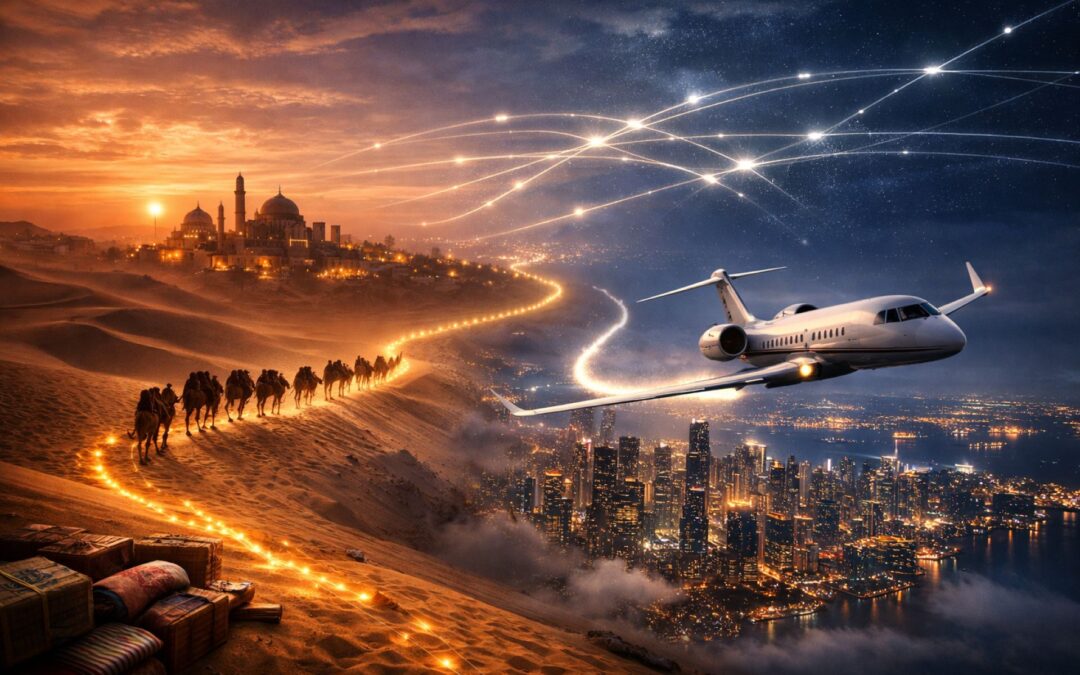
More than 2,000 years ago, the Silk Road connected civilizations across continents, moving goods, wealth, and influence between East and West. It wasn’t just a trade route—it was the backbone of the ancient world’s economy, shaping empires and defining power.
Caravans carried silk, spices, and precious materials across vast and dangerous terrains. Cities that sat along these routes didn’t just survive—they flourished, becoming centers of wealth, culture, and control. The Silk Road created the first system where value could move at scale, and wherever that value flowed, power followed.
But the real story of the Silk Road isn’t about silk.
It’s about movement.
Because wealth has never been defined by what exists—it’s defined by what moves, who controls that movement, and where it flows.
Today, the caravans are gone. The deserts are quiet. The old roads have faded into history.
But the system never disappeared.
It evolved.
There is a new Silk Road—one that doesn’t run across land, but through the sky. It doesn’t carry goods, but people. And instead of merchants and camels, it’s dominated by private jets, billionaires, and decision-makers shaping the future in real time.
And if you know how to read these routes, you can see exactly where the next empires are being built.
The Ancient Silk Road Was Never About the Road
When people imagine the Silk Road, they picture a long, continuous path stretching from China to Europe—a dusty trail carved through deserts and mountains, traveled by caravans loaded with goods.
But that picture is misleading.
The Silk Road was never a single road. It was a sprawling network of interconnected routes, cities, ports, and trading hubs that stretched across thousands of miles. No single merchant traveled its entire length. Goods moved in stages, passed from one trader to another, crossing borders, empires, and cultures along the way.
What made the Silk Road powerful wasn’t the path itself—it was everything built around it.
For trade to function at that scale, infrastructure had to emerge. Cities were established where caravans needed to rest. Wells were dug in barren regions. Warehouses stored goods in transit. Armies were stationed to protect merchants from bandits. Governments imposed order, enforced rules, and collected taxes.
The road didn’t create wealth.
The system did.
Places like Samarkand, Baghdad, and Constantinople didn’t become powerful because they were beautiful or strategically located by accident. They became powerful because they positioned themselves as essential stops in the movement of value. Every caravan that passed through brought opportunity—trade, taxation, information, and influence.
Control the stop, and you control the flow.
And once you control the flow, you don’t need to produce anything yourself. You simply extract value from everything that moves through your domain.
This is the first principle of the Silk Road:
Wealth is not created by the thing being traded—it is created by the infrastructure that allows it to move.
The dirt under the caravans was irrelevant. What mattered were the nodes—the cities, the checkpoints, the intersections where decisions were made and transactions occurred.
That’s where power concentrated.
And that same principle still governs the world today.
Wealth Was Created by Movement, Not Possession
At the height of the Silk Road, silk was one of the most valuable commodities on Earth. It was rare, beautiful, lightweight, and tightly controlled. Entire empires wanted it.
But here’s the paradox.
Silk sitting in a warehouse in China wasn’t nearly as valuable as silk moving across continents.
Value didn’t come from possession. It came from movement.
The moment silk left its place of origin, its worth began to multiply. Every mile it traveled increased its scarcity in the destination market. Every risk taken—bandits, harsh terrain, political instability—added a premium. By the time it reached distant cities, its value could rival gold.
This wasn’t limited to silk. Spices, porcelain, jade, paper, and glass all followed the same pattern.
The journey was the multiplier.
And the more difficult the journey, the greater the reward.
But the real insight goes deeper than that.
The greatest value wasn’t even in the goods themselves—it was in enabling their movement.
Caravans required logistics. Logistics required coordination. Coordination required trust. And trust required systems—agreements, enforcement, and eventually, finance.
Merchants began depositing goods with intermediaries in exchange for written notes—early forms of credit. These notes could be carried instead of bulky cargo, traded between parties, and even lent out. Suddenly, wealth was no longer just physical—it became abstract.
A piece of paper could represent value moving across thousands of miles.
And once that happened, the system evolved.
Trade turned into finance. Finance turned into leverage. And leverage turned into power.
Because when you control how value moves, you’re no longer just participating in the system—you’re shaping it.
This is the second principle of the Silk Road:
Wealth compounds through movement, but power comes from controlling how that movement happens.
And that distinction is what separated merchants from empires.
The Rise of Trade Cities and Strategic Choke Points
As goods moved across continents, something predictable began to happen.
They didn’t spread out evenly.
They concentrated.
Certain cities became unavoidable. Not because they were the largest or the oldest, but because geography—and later, infrastructure—forced trade through them. These were the choke points of the Silk Road, and they became the true centers of power.
Samarkand sat at the crossroads of Central Asia, where east-west caravans naturally converged. It wasn’t just a stop—it was a necessity. Every merchant passing through needed supplies, storage, protection, and access to local markets. Over time, the city transformed into a hub of commerce, culture, and wealth.
Baghdad thrived for a different reason. Positioned between the Tigris and Euphrates, it became more than a transit point—it became a processing center. Goods didn’t just pass through; they were financed, traded, and redistributed. Banking systems emerged. Credit expanded. Knowledge accumulated. Baghdad turned movement into an ecosystem.
Then there was Constantinople.
If Samarkand was a crossroads and Baghdad was a hub, Constantinople was a gate.
Sitting at the narrow passage between Asia and Europe, it controlled the final bottleneck before goods entered Western markets. Everything heading west had to pass through it. And that gave the city something more powerful than trade—it gave it leverage.
It could tax, restrict, or accelerate the flow of goods at will.
And it did.
Empires don’t just grow from producing value. They grow from controlling access to it.
Every caravan that passed through these cities generated multiple layers of wealth. Traders made profits. Local businesses thrived. Governments collected taxes. Armies were funded. Infrastructure expanded. And with each cycle, the city’s influence grew stronger.
This is where the Silk Road reveals its most important pattern.
Wealth doesn’t distribute itself randomly. It accumulates at points of friction.
Where movement slows down, stops, or must pass through, value can be captured.
And the ones who control those points don’t just participate in trade—they define its terms.
That’s how cities turned into empires.
The Financialization of Trade and the Birth of Power Systems
As the Silk Road matured, something subtle but transformative began to happen.
Trade stopped being just about goods.
It became about systems.
At first, value was tangible. Silk, spices, metals—these were physical objects that had to be moved, protected, and exchanged. But as the scale of trade increased, so did the complexity. Carrying large quantities of goods across dangerous terrain wasn’t just inefficient—it was risky.
So merchants adapted.
Instead of transporting everything physically, they began to deposit goods with trusted intermediaries and receive written claims in return. These early forms of credit allowed traders to move value without moving weight. A piece of paper could now represent a shipment of silk sitting hundreds of miles away.
This changed everything.
Because once value could be represented symbolically, it could also be manipulated.
That piece of paper could be traded, lent out, or used as collateral. One transaction could finance another. A single shipment could support multiple layers of economic activity. Wealth was no longer tied to a single object—it became fluid, expandable, and scalable.
Trade had evolved into finance.
And finance introduced leverage.
Those who controlled these systems—bankers, intermediaries, and ruling authorities—gained a new kind of power. They didn’t need to own the goods. They didn’t need to travel the roads. They controlled the rules that governed how value moved, how it was stored, and how it could be multiplied.
This was the birth of financial infrastructure.
And with it came a new hierarchy.
Merchants who once made fortunes from trade now depended on those who financed it. Rulers who once taxed caravans began to shape entire economic systems. Power shifted away from those who carried value to those who controlled its abstraction.
This is where the Silk Road quietly transitioned from a trade network into a power network.
Because once you control the system behind the movement of wealth, you no longer rely on the journey.
You define it.
Why the Original Silk Road Collapsed
For centuries, the Silk Road thrived because it was the most efficient way to move value across continents. It connected civilizations, enabled trade, and concentrated wealth in strategic locations.
But systems built on movement are only as strong as their efficiency.
And eventually, a better system emerged.
The beginning of the end came in the 1400s, when the Ottoman Empire captured Constantinople—the most critical choke point between East and West. With control over this gateway, they imposed heavy taxes on goods passing through.
What was once a profitable route became expensive.
Margins shrank. Risk increased. Incentives disappeared.
Merchants didn’t stop trading—they started looking for alternatives.
At the same time, a technological shift was unfolding. European explorers, particularly the Portuguese, began opening new maritime routes to Asia. These sea paths bypassed the traditional land networks entirely.
Ships could carry more goods than caravans. They moved faster. They were cheaper. And most importantly, they avoided the political bottlenecks that had made the Silk Road inefficient.
The equation had changed.
Land-based trade, once dominant, was now outcompeted.
And just like that, the Silk Road began to fade.
Cities that once thrived on caravan traffic lost their relevance. The infrastructure that had supported centuries of wealth became obsolete. Trade didn’t stop—it simply rerouted.
This is the third principle of the Silk Road:
Wealth always follows the most efficient path.
It doesn’t care about history, legacy, or tradition. It flows toward speed, scale, and lower friction.
The Silk Road didn’t collapse because trade disappeared.
It collapsed because something better replaced it.
And that pattern repeats itself, again and again, throughout history.
The New Silk Road Exists in the Sky
The old Silk Road disappeared from the ground—but the system it created never went away.
It simply changed form.
Today, the movement of value no longer depends on caravans crossing deserts or ships navigating oceans. It happens faster, more selectively, and with far greater precision.
It happens in the sky.
In 2023 alone, private jets completed millions of flights across the globe. At first glance, these routes might seem like a symbol of luxury—an indulgence reserved for the ultra-wealthy.
But that misses the point.
Private jet routes are infrastructure.
They are the modern equivalent of trade paths, connecting the most powerful cities, institutions, and individuals in the world. Just like the ancient Silk Road, their value isn’t in the path itself—it’s in where they begin and where they end.
Because the real activity doesn’t happen in the air.
It happens on the ground.
Every landing represents a transfer of opportunity. A negotiation. A deal. A decision that can move billions of dollars, reshape industries, or redirect entire economies. The airports that receive these flights have effectively become the new trade hubs—highly controlled, highly efficient nodes in a global network of power.
The comparison is almost perfect.
Caravans have been replaced by jets. Trade posts by private terminals. Inns and markets by boardrooms, exclusive clubs, and closed-door meetings.
But the underlying structure is identical.
A network that enables the movement of value between key points.
The only difference is speed and exclusivity.
Where the old Silk Road was open to merchants willing to endure the journey, the new one is restricted to those who already control significant capital and influence. Access is limited. Entry is selective. And participation is concentrated among a small group of decision-makers.
This is the evolution of the system.
From physical trade to strategic movement.
From goods to influence.
And from open networks to highly exclusive corridors of power.
The Shift from Commodities to Decision-Makers
For most of human history, wealth was tied to things.
Silk, spices, gold, oil—these were the assets that defined power. Whoever controlled the production and distribution of these commodities held influence over entire regions. Empires were built around resources, and trade existed to move those resources where they were needed most.
But that model has been quietly replaced.
The shift began centuries ago, when ownership started to matter more than possession. The creation of early stock markets introduced a new idea—that you didn’t need to carry goods to profit from them. You could own a share of the system that produced or transported those goods and extract value at scale.
Over time, this abstraction deepened.
Industrialists like John D. Rockefeller and Andrew Carnegie didn’t just deal in commodities—they controlled entire industries. Oil still mattered, steel still mattered, but owning the systems behind them mattered more.
Then finance took over.
Capital became the dominant force. Those who controlled investment flows—bankers, fund managers, institutional investors—gained leverage far beyond any physical asset. They could influence which companies grew, which industries expanded, and which ideas received funding.
And eventually, the hierarchy flipped completely.
Today, the most valuable “commodity” isn’t oil or data or even technology.
It’s the decision-maker.
The individual who controls capital, allocates resources, and directs strategy has become the most scarce and powerful asset in the system. In a world where almost anything can be produced at scale, scarcity has shifted from materials to judgment.
And that changes how wealth moves.
When a billionaire steps off a private jet, they’re not carrying goods—they’re carrying potential. The deals they negotiate, the investments they approve, and the partnerships they form can generate more value than any shipment of physical commodities ever could.
This is why private jet routes matter.
They don’t just connect places—they connect decision-makers to opportunity.
And wherever those decision-makers go, wealth tends to follow.
Modern Trade Hubs: Cities Where Power Lands
If the ancient Silk Road was defined by cities like Samarkand, Baghdad, and Constantinople, the modern version is defined by a new set of nodes—places where private jets land, deals are made, and capital is deployed.
These cities don’t just attract wealth.
They concentrate it.
Take Teterboro Airport, just outside New York City. It’s one of the busiest private jet hubs in the world, serving Wall Street, corporate headquarters, and the upper layers of global finance. During moments of crisis—like the 2008 financial collapse—it became a logistical lifeline, flying executives and decision-makers into emergency meetings that would shape the global economy.
New York functions much like Constantinople once did.
It doesn’t produce all the value that flows through it, but it controls access to it. As the financial capital of the modern world, it acts as a gateway—pulling in capital, redistributing it, and extracting value at every stage. High costs don’t deter people; they reinforce the city’s position as a place where decisions happen.
Then there’s Dubai.
Positioned between Europe and Asia, it has engineered itself into a modern choke point. By removing friction—low taxes, business-friendly regulations, world-class infrastructure—it has turned geography into advantage. Like Baghdad once did, Dubai doesn’t just sit on a route—it amplifies the value moving through it.
Singapore plays a similar role in Asia.
It has become a magnet for capital, a place where wealth is stored, managed, and redirected. Much like Samarkand in its time, it thrives not because of size, but because of position within the network.
And then there are the less obvious nodes.
Cities that might not receive constant traffic but experience massive impact when they do. When technology executives fly into a place like Hanoi and decide to build a multi-billion-dollar facility, the economic ripple effects can transform entire regions. Jobs are created, supply chains emerge, and new ecosystems form almost overnight.
In this system, consistency isn’t the only factor.
Impact matters.
A single landing can inject more value into a location than years of traditional trade.
This is the modern version of the Silk Road’s choke points.
Not defined purely by geography, but by relevance.
Wherever decision-makers choose to land becomes a temporary center of gravity. And the more frequently those landings occur, the more permanent that gravity becomes.
That’s how cities rise again—not by producing wealth, but by positioning themselves where wealth arrives.
Beyond Wealth: How Ideas, Culture, and Power Spread
If the Silk Road only moved goods, it would have been important.
But it wouldn’t have changed the world.
Because the most enduring thing it carried wasn’t wealth—it was ideas.
As caravans moved between civilizations, they carried knowledge with them. Paper-making techniques spread from China westward, making it possible to record, preserve, and distribute information at scale. Mathematical concepts like zero and early algebra traveled across regions, eventually forming the backbone of modern finance and engineering.
The compass reshaped navigation. Gunpowder reshaped warfare. Systems of governance, taxation, and diplomacy evolved as empires learned from one another.
These weren’t side effects of trade.
They were its most powerful consequences.
Wealth faded when routes collapsed. Cities declined. Empires fell.
But ideas compounded.
They outlived the system that carried them.
And the same dynamic exists today.
The modern Silk Road doesn’t just move capital—it moves influence.
When global leaders gather at places like World Economic Forum Annual Meeting, they’re not exchanging goods. They’re exchanging perspectives, strategies, and narratives that shape global policy and economic direction. A single conversation can influence regulations, redirect investment, or shift public discourse across entire industries.
Culture spreads the same way.
When media executives, investors, and creators converge at events like the Cannes Film Festival, they’re deciding which stories will be told—and by extension, how people around the world think, speak, and perceive reality. What gets funded becomes what gets seen. And what gets seen becomes what gets normalized.
Even industries evolve through these interactions.
Private meetings between executives can lead to acquisitions, partnerships, and innovations that ripple across markets. Entire sectors can be reshaped not through public announcements, but through quiet decisions made behind closed doors.
This is the deeper layer of the system.
Wealth is visible.
Power is structural.
But influence is what endures.
And influence spreads fastest when the right people move through the same nodes, exchanging ideas in concentrated bursts.
That’s what the Silk Road always did.
And that’s what the new one continues to do—at a much higher speed, with far greater reach.
The New Gatekeepers of the Global Economy
On the ancient Silk Road, power was distributed.
Goods moved through many hands. Merchants negotiated trades. Middlemen earned margins. Local rulers collected taxes at every checkpoint. Value was fragmented, and each participant captured a piece of it along the way.
The system required layers.
And those layers created opportunity.
But the modern Silk Road operates differently.
It is compressed.
Today, a single decision-maker can control what once required entire networks of traders, financiers, and intermediaries. Capital can be deployed instantly. Deals can be negotiated in hours. Entire industries can shift direction based on a handful of conversations between a small group of people.
The middle has disappeared.
Or more accurately—it has been absorbed.
Technology removed friction. Finance removed dependency on physical movement. And scale concentrated power into fewer hands. What used to be a distributed system is now highly centralized around those who control capital and influence.
These are the new gatekeepers.
Not because they own everything, but because they decide what gets built, funded, or scaled.
A venture capitalist choosing where to allocate billions can determine which technologies shape the next decade. A sovereign wealth fund backing a project can transform a region’s economic future. A corporate executive signing a deal can redirect entire supply chains overnight.
And all of this happens within the same network.
Private flights, exclusive gatherings, closed-door meetings—these are not luxuries. They are the infrastructure of modern decision-making. They allow the most powerful actors to move quickly, align interests, and act before the rest of the world even becomes aware of the shift.
This creates a new kind of asymmetry.
On the old Silk Road, information moved slowly. Opportunities were visible to those along the route. Participation was difficult, but not impossible.
Today, the system is far more opaque.
Access is limited. Information is concentrated. And decisions are made in environments that most people will never see. By the time outcomes become public, the advantage has already been captured.
This is the final evolution of the Silk Road model.
From open trade routes to controlled corridors.
From shared opportunity to selective access.
And from distributed wealth creation to concentrated decision-making power.
The road still exists.
But now, only a few control where it leads.
Conclusion
The Silk Road was never just a route—it was a system for moving value.
It revealed a pattern that has repeated itself across centuries: wealth flows along the most efficient paths, accumulates at key nodes, and concentrates in the hands of those who control its movement.
What began with caravans carrying silk across deserts has evolved into private jets carrying decision-makers across continents. The terrain has changed. The speed has increased. The access has narrowed.
But the structure remains the same.
Cities still rise by positioning themselves along these flows. Power still concentrates at choke points. And the greatest advantage still belongs to those who understand how the system works—not just those who participate in it.
The difference now is subtle, but profound.
In the past, wealth followed goods.
Today, wealth follows people.
And more specifically, it follows the individuals who decide where capital goes, what gets built, and which ideas are scaled into reality.
That is the modern Silk Road.
Invisible to most, but shaping everything.
And if you learn to trace these routes—not the roads on a map, but the movement of influence—you begin to see the future before it fully arrives.
Because the next empires won’t announce themselves.
They’ll emerge quietly, at the places where power chooses to land.