
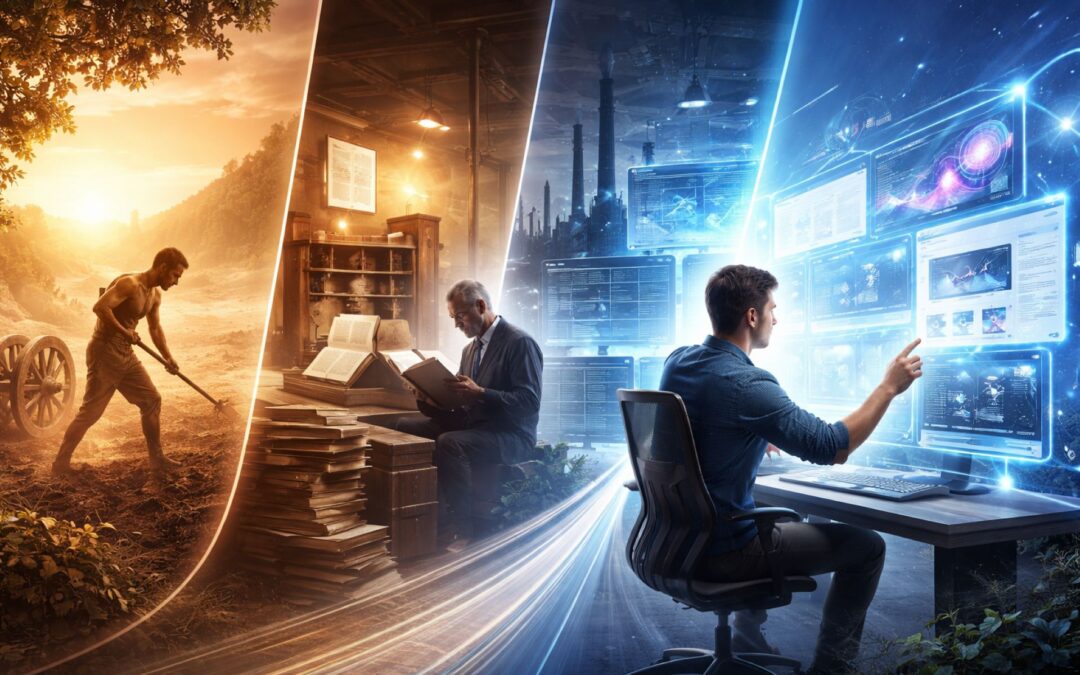
The Pattern Most People Miss
Throughout human history, technological revolutions have never arrived quietly. They reshape economies, redraw power structures, and redefine what it means to be capable. From agriculture to the internet, each breakthrough has left behind a world that looks nothing like the one before it.
But here’s what most people fail to notice: these disruptions are not random.
They follow a pattern.
At first glance, the inventions themselves seem wildly different. Farming has nothing to do with printing. The printing press has little in common with the internet. And yet, beneath the surface, they all solve the same fundamental problem: how to do more with less.
Less effort.
Less time.
Less specialized knowledge.
And every time humanity crosses that threshold, something extraordinary happens. What was once scarce becomes abundant. What was once reserved for a few becomes accessible to many. Entire classes of people gain access to capabilities that were previously out of reach.
That’s when the real disruption begins.
Understanding this pattern is more than just a historical exercise. It’s the key to recognizing what’s happening right now. Because once you see it clearly, the current wave of change stops looking like hype, fear, or speculation.
It starts to look inevitable.
From Survival to Surplus: The First Disruption
Long before algorithms, machines, or even written language, the first great technological breakthrough was surprisingly simple: learning how to grow food.
Before agriculture, human life was defined by constant uncertainty. Survival depended on hunting and gathering, a daily gamble against nature. Food was scarce, unpredictable, and required continuous effort. There was no room for specialization, no time for innovation, and no stability to build anything beyond the immediate present.
Agriculture changed that.
For the first time, humans could produce more food than they immediately needed. That single shift—from survival to surplus—was revolutionary. It meant fewer people were required to secure basic resources, freeing others to pursue entirely different roles. Some became builders, others traders, others thinkers.
This is where civilization begins.
Settlements formed because people no longer had to move constantly. Structures emerged, both physical and social. Hierarchies developed. Trade networks expanded. And perhaps most importantly, time itself became a resource that could be invested rather than merely endured.
All of this came from doing more with less.
Less risk.
Less effort per unit of food.
Less dependence on chance.
Agriculture didn’t just feed people—it unlocked human potential. It created the conditions for everything that followed. And like every disruption after it, it lowered the barrier to survival just enough to allow something greater to emerge.
Moving Faster Than Before: The Power of the Wheel
If agriculture gave humans stability, the wheel gave them momentum.
Before its invention, movement was slow, limited, and costly. Transporting goods meant carrying them by hand or relying on animals, both of which imposed strict limits on distance and scale. Trade existed, but it was constrained. Communication happened, but it was delayed. Expansion was possible, but inefficient.
The wheel changed all of that.
With a relatively simple mechanical innovation, humans dramatically increased how much they could move and how far they could move it. Goods that once required enormous effort could now be transported with ease. Distances that once felt significant began to shrink. Entire regions became interconnected in ways that were previously impossible.
This wasn’t just about convenience—it was about scale.
Trade networks expanded because it became viable to move larger quantities of goods across longer distances. Economies grew because specialization could now extend beyond local boundaries. Ideas traveled faster, not just physically but culturally, as interaction between distant communities increased.
Once again, the same pattern emerges.
More output with less effort.
More reach with fewer constraints.
More connection with reduced friction.
The wheel didn’t just make things faster—it made systems larger. It allowed human activity to operate on a scale that was previously unattainable. And like every major disruption, it quietly lowered a barrier that most people didn’t even realize was there until it disappeared.
The Printing Press and the Democratization of Knowledge
Of all the technological disruptions in history, the printing press stands out—not because it was the most complex, but because it changed something far more powerful than transportation or production.
It changed who had access to knowledge.
Before its invention in the mid-15th century, information was scarce by design. Books were not just expensive—they were rare. Each copy had to be written by hand, often by scribes or monks, a process that could take months or even years. As a result, knowledge was concentrated in the hands of a very small group: the wealthy, the educated, and the institutions that controlled both.
For everyone else, information was something you heard, not something you owned.
Stories were passed down orally. Traditions were memorized. Education, in any formal sense, was inaccessible to the majority. And because access to knowledge was limited, so was the ability to question, innovate, or challenge existing systems.
This created a natural imbalance.
Those who controlled information controlled influence.
Those without it remained dependent.
The printing press disrupted that balance.
By making it possible to reproduce text quickly, accurately, and at scale, it transformed books from luxury items into accessible tools. Suddenly, knowledge was no longer confined to a select few. It could spread across cities, across regions, and eventually across entire societies.
Barriers began to fall.
More people could learn to read because there was something to read. More people could access ideas because those ideas were no longer locked away. And perhaps most importantly, individuals could now engage with information directly, without relying on intermediaries.
For the first time in history, knowledge started to level the playing field.
And that single shift would go on to reshape everything.
What Changed When Knowledge Became Accessible
Once knowledge was no longer scarce, everything downstream began to shift.
The most immediate change was literacy. When books became more available, learning to read was no longer reserved for necessity—it became an opportunity. Over time, literacy spread beyond elites into broader segments of society, creating populations that could engage with ideas rather than simply inherit them.
And with literacy came independence.
People no longer had to rely solely on authority figures to interpret the world for them. They could read, compare, question, and form their own conclusions. This may seem obvious today, but at the time, it was a radical transformation. Information was no longer filtered through a narrow set of institutions—it became something individuals could access directly.
That shift weakened monopolies on knowledge.
Religious institutions, ruling classes, and established authorities could no longer control narratives as tightly as before. Competing ideas began to circulate. Scientific thinking accelerated. Philosophical movements gained traction. Entire intellectual revolutions—from the Renaissance to the Enlightenment—were fueled by this newfound accessibility.
But the impact wasn’t just intellectual. It was structural.
When more people have access to the same information, the gap between classes begins to narrow—not immediately, but inevitably. Opportunity expands. Talent that would have otherwise remained hidden starts to surface. Societies become more dynamic, more unpredictable, and more innovative.
Once again, the same pattern reveals itself.
More people participating.
More ideas competing.
More progress emerging.
The printing press didn’t just spread knowledge—it redistributed power. And in doing so, it set the stage for the modern world.
The Industrial Revolution and Scaling Human Output
If the printing press transformed access to knowledge, the Industrial Revolution transformed what humans could physically produce.
Before it, production was limited by human and animal labor. Everything had to be made by hand, often by skilled craftsmen working slowly and individually. Output was low, costs were high, and scaling production was nearly impossible. If you wanted more, you needed more people—and even then, there were limits.
The Industrial Revolution broke that constraint.
Machines began to replace manual labor, not by eliminating human effort entirely, but by amplifying it. A single worker operating a machine could now produce what previously required dozens. Factories emerged, standardization took hold, and production shifted from artisanal to industrial.
This wasn’t just an increase in efficiency—it was an exponential leap.
Goods became cheaper because they could be produced in larger quantities. Availability increased because production could keep up with demand. Entire industries were born, and economies began to grow at a pace that had never been seen before.
But like every disruption, it came with consequences.
Jobs changed. Skills that were once valuable became obsolete. New roles emerged, requiring different kinds of expertise. There was resistance, fear, and uncertainty—just as there is with every major technological shift.
Yet the underlying pattern remained consistent.
More output with less manual effort.
More production with fewer constraints.
More capability distributed across fewer hands.
The Industrial Revolution didn’t just make things—it redefined what was possible to make at scale. And in doing so, it pushed humanity into a new phase of growth, one where productivity was no longer bound by the limits of the human body alone.
The Core Pattern: Doing More With Less
At this point, the pattern is no longer subtle—it’s unmistakable.
Agriculture reduced the effort required to survive.
The wheel reduced the effort required to move.
The printing press reduced the effort required to access knowledge.
The Industrial Revolution reduced the effort required to produce.
Different eras, different tools—but the same underlying shift every single time.
Doing more with less.
Less time.
Less labor.
Less specialized access.
And when that threshold is crossed, something bigger happens. Barriers collapse. Capabilities expand. What was once difficult becomes trivial. What was once exclusive becomes universal.
This is the real engine behind every major disruption.
It’s not the technology itself that matters—it’s what the technology removes. Every breakthrough eliminates a bottleneck that was previously holding human potential back. And once that bottleneck disappears, participation explodes.
More people can contribute.
More ideas can be tested.
More outcomes become possible.
That’s why these moments don’t just improve existing systems—they redefine them.
Because when the cost of doing something drops dramatically, behavior changes. Entire industries reorganize. Power structures shift. And the definition of what it means to be capable gets rewritten.
Which brings us to the present.
Because if you follow this pattern to its logical conclusion, the next disruption isn’t about producing more things or accessing more information.
It’s about something deeper.
It’s about who gets to create in the first place.
The New Shift: From Knowledge to Ability
For most of modern history, access to knowledge was the defining advantage.
If you knew more, you could do more.
If you had access to better information, you could make better decisions.
If you understood systems others didn’t, you could build things they couldn’t.
That’s why the internet felt like such a breakthrough. It didn’t just store information—it made it accessible. Suddenly, anyone with a connection could tap into the collective knowledge of humanity. Tutorials, forums, documentation—everything was there, waiting to be found.
But there was still a bottleneck.
Knowing what to do is not the same as being able to do it.
You could read about how to build a website, but that didn’t mean you could code one. You could understand how an app works, but that didn’t mean you could create it. You could study design, writing, or data analysis, but execution still required time, skill, and often years of practice.
In other words, knowledge was democratized—but ability was not.
That’s the shift we’re entering now.
Artificial intelligence is beginning to close the gap between understanding and execution. It doesn’t just give you information—it helps you act on it. Instead of spending hours searching, filtering, and assembling knowledge, you can directly translate intent into output.
You don’t just learn how something works.
You ask for it—and it gets built.
This is a fundamentally different kind of disruption.
Because for the first time, the barrier is not access to knowledge, but access to capability itself. And as that barrier begins to fall, the implications extend far beyond convenience.
They reach into who gets to participate in creation at all.
How AI Changes the Way We Access and Use Information
For the past two decades, interacting with knowledge has followed a familiar pattern.
You search.
You sift.
You piece things together.
Search engines became the gateway to information, and over time, knowing how to search became a skill in itself. The difference between finding the right answer and getting lost in irrelevant results often came down to how well you could phrase a query, evaluate sources, and connect fragments into something usable.
In a strange way, we didn’t just rely on knowledge—we relied on our ability to navigate it.
AI changes that completely.
Instead of searching for information, you ask for outcomes. Instead of collecting pieces, you get synthesized answers. The process collapses from multiple steps into one interaction. What once required time, effort, and a certain level of digital fluency now becomes almost instantaneous.
The friction is gone.
This has two immediate consequences.
First, the skill of navigating information becomes less important. You no longer need to be particularly good at searching, filtering, or interpreting scattered data. The system does that for you. What used to be an advantage becomes baseline.
Second, access becomes more equal.
Someone who struggled to find relevant information before can now get high-quality answers with minimal effort. The gap between those who were “good at the internet” and those who weren’t starts to disappear. In that sense, AI does to search what the printing press did to books—it removes the gatekeeping layer.
And once again, the pattern holds.
More clarity with less effort.
More access with fewer skills required.
More people able to engage with the same level of information.
But this is only the surface-level change.
Because the real shift isn’t just in how we access knowledge—it’s in what we can do with it once we have it.
Breaking the Barrier of Technical Know-How
Look around, and almost everything you interact with is built on a layer you don’t see.
Websites, apps, platforms, systems—all of it runs on code. Interfaces, visuals, interactions—all of it is constructed through technical processes that, until recently, required specialized knowledge to create. The modern world is digital at its core, but the ability to shape that world has been concentrated in the hands of a relatively small group of people.
Not because others lacked ideas.
But because they lacked the ability to execute them.
Learning to code, design systems, or build digital products takes time, access, and often formal training. For many, those barriers were enough to keep ideas from ever becoming reality. You could imagine something clearly, understand its value, even plan it out—but without the technical skill, it remained just that: an idea.
AI begins to remove that constraint.
Instead of needing to understand programming languages, frameworks, or complex tools, you can describe what you want in plain language. The system translates intent into execution. What once required years of learning can now be approximated, assisted, or even fully handled by AI.
This doesn’t mean expertise becomes irrelevant.
It means expertise is no longer the only path to creation.
Someone with no coding background can now prototype a website. Someone with no design training can generate visual assets. Someone with no technical foundation can build functional systems that would have previously been out of reach.
And once again, the same pattern reveals itself.
More creation with less technical knowledge.
More execution with fewer barriers.
More people able to participate in building the digital world.
This is where the shift becomes tangible.
Because when the barrier to execution drops, the number of people who can bring ideas to life doesn’t just increase—it explodes.
The Democratization of Creation
Once the barrier to execution begins to fall, creation itself stops being a specialized activity.
It becomes a default.
For most of the digital age, building something meaningful—whether a website, an app, or even high-quality content—required layers of effort. You needed technical skills, access to tools, time to learn them, and often money to bring everything together. Even if you had a strong idea, turning it into reality was a project in itself.
That constraint is disappearing.
With AI, the distance between idea and execution is shrinking rapidly. What once required a team can now be attempted by an individual. What once took months can now be prototyped in days, sometimes hours. The cost of experimentation drops to near zero, which changes how people approach creation altogether.
You no longer need to be certain something will work before you try it.
You can just build it and see.
This is where the real acceleration happens. When more people are able to create, more ideas enter the system. Most will fail—but that’s the point. The volume of experimentation increases, and with it, the probability of something exceptional emerging.
Creation becomes less about permission and more about initiative.
And importantly, the competitive landscape shifts.
It’s no longer about who has access to resources or specialized skills. It’s about who can think clearly, iterate quickly, and execute effectively using the tools available. The bottleneck moves away from capability and toward judgment.
Once again, the pattern holds.
More creators with fewer constraints.
More output with less friction.
More innovation driven by accessibility.
And when creation becomes accessible to everyone, the question is no longer who can build.
It becomes who can build something that matters.
What This Means for the Future of Work
When the ability to create becomes widely accessible, the structure of work doesn’t just evolve—it gets redefined.
For a long time, value in the job market was closely tied to specialized skills. If you knew how to code, design, analyze data, or write at a high level, you had a clear advantage. These skills were scarce, and scarcity is what made them valuable.
AI begins to challenge that scarcity.
Not by eliminating the need for skill entirely, but by compressing the gap between those who have it and those who don’t. Tasks that once required deep expertise can now be assisted, accelerated, or partially automated. What used to take hours can be done in minutes. What used to require training can now be guided.
This changes what it means to be valuable.
Execution alone is no longer enough. If everyone can produce something, the differentiator shifts to how well you think, how clearly you communicate intent, and how effectively you direct these new tools. The role of the individual moves from doing the work to orchestrating it.
In a sense, everyone becomes a kind of operator.
You define the problem.
You guide the process.
You refine the outcome.
And the quality of what you produce depends less on your raw technical ability and more on your judgment—your ability to ask the right questions, recognize good output, and iterate toward something better.
Of course, this transition won’t be seamless.
Some roles will shrink or disappear. Others will expand or emerge. There will be friction, uncertainty, and resistance—just as there has been with every major disruption before this one.
But the broader shift is clear.
Work is moving away from execution as a barrier and toward execution as a baseline.
And once that happens, the real competition begins somewhere else entirely.
The Real Concern: Inequality or Opportunity?
Every major technological shift brings the same question with it.
Who benefits—and who gets left behind?
With AI, that question feels especially urgent. If machines can assist with tasks that once required human skill, it’s reasonable to worry about displacement. Jobs may change. Some roles may become obsolete. Entire industries could be reshaped faster than people can adapt.
These concerns aren’t unfounded.
But they’re also not new.
The same fears existed during the Industrial Revolution, when machines began replacing manual labor. They appeared again with the rise of computers, when automation started reshaping office work. And yet, over time, new roles emerged, new industries formed, and overall productivity—and opportunity—expanded.
The pattern repeats.
What matters is not whether change happens, but how access to that change is distributed.
If powerful tools are limited to a small group, inequality increases. Those who control the tools gain disproportionate advantage. But if access is broad—if the tools are available to anyone willing to use them—then the opposite can happen.
Opportunity expands.
This is what makes the current moment different in a subtle but important way. Many AI tools are already widely accessible. You don’t need institutional backing, expensive infrastructure, or years of formal training to start using them. The entry point is lower than it has ever been.
That doesn’t eliminate inequality.
But it shifts the dynamic.
Instead of a system where only a few can participate, we’re moving toward one where many can. And when participation increases, the distribution of outcomes becomes less predictable—and potentially more equitable.
Once again, the pattern holds.
More access with fewer restrictions.
More opportunity with lower barriers.
More people able to compete on a similar playing field.
The concern, then, is not just about what AI might take away.
It’s about whether we ensure that what it enables is available to everyone.
The Playing Field Is Leveling
When access to both knowledge and ability becomes widespread, the rules of the game change.
For most of history, advantage came from what you had access to. Better education, better tools, better networks—these were the factors that separated those who could build from those who couldn’t. Capability was unevenly distributed, and that unevenness defined outcomes.
AI begins to flatten that landscape.
When the same tools are available to everyone, access stops being the differentiator. The gap between someone with formal training and someone without it narrows—not completely, but enough to shift the balance. What once required years to even attempt can now be explored almost immediately.
This doesn’t create equality of outcome.
But it creates something arguably more important: equality of opportunity to try.
And once that happens, the focus moves elsewhere.
It’s no longer about who has permission or resources to build. It’s about who can think better, adapt faster, and persist longer. Creativity, taste, judgment—these become the new leverage points. The advantage shifts from possession to application.
In a leveled field, access is assumed.
What matters is execution.
This is what makes the current shift so significant. Previous disruptions expanded access to resources—food, movement, knowledge, production. This one expands access to capability itself. And when capability is no longer scarce, the only remaining constraint is what people choose to do with it.
Once again, the pattern completes itself.
More people with the same tools.
More competition on ideas, not access.
More outcomes driven by intent rather than limitation.
And that changes everything.
Conclusion
If you step back and look at the arc of human progress, the pattern becomes difficult to ignore.
Every major technological disruption removes a constraint.
Every removed constraint expands participation.
And every expansion reshapes the world that follows.
Agriculture removed the uncertainty of survival.
The wheel removed the limits of movement.
The printing press removed the scarcity of knowledge.
The Industrial Revolution removed the ceiling on production.
And now, AI is beginning to remove something even more fundamental.
The barrier between knowing and doing.
For the first time, the ability to create, build, and execute is no longer reserved for those with specialized training or privileged access. It’s becoming something anyone can tap into, provided they’re willing to engage with it.
That doesn’t mean the future will be easy.
It means it will be open.
The tools are here. The pattern is clear. And the direction is already set. What remains uncertain is not what AI will do to the world, but what people will choose to do with AI.
Because in a world where more people can do more with less, the advantage no longer belongs to those who have access.
It belongs to those who act.