
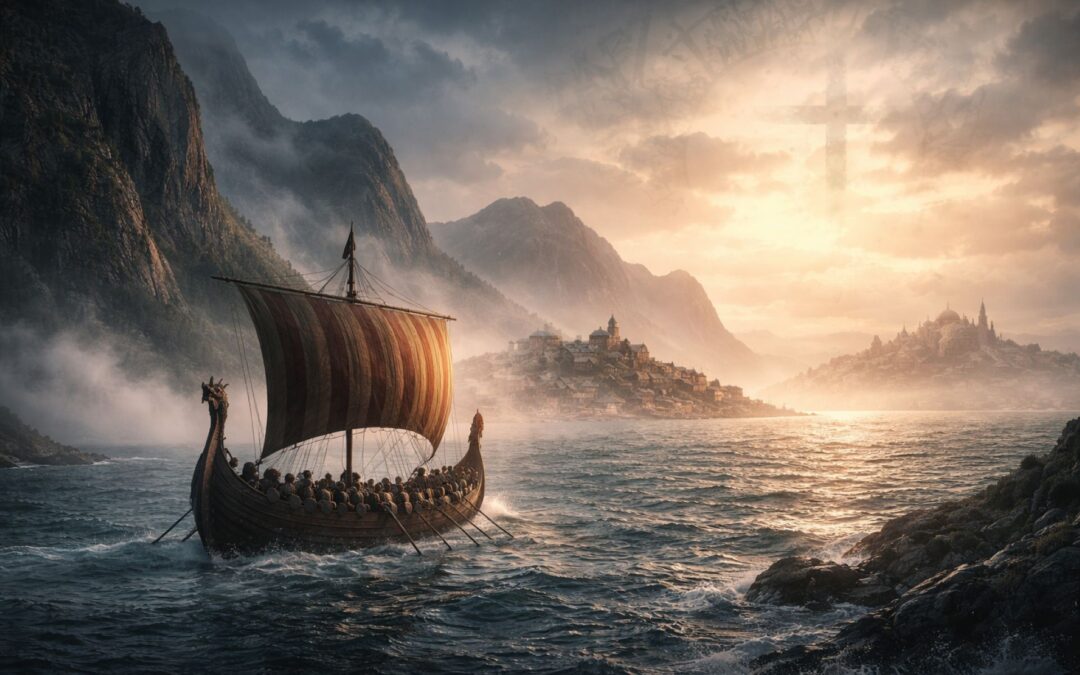
Introduction — From the Edge of the World to the Center of History
At the dawn of the Middle Ages, Scandinavia lay at the far northern edge of the known European world. It was distant from the legions of Rome, untouched by the marble cities of the Mediterranean, and fragmented into small kin-based communities scattered between fjords, forests, and cold inland plains. To outsiders, it seemed remote and marginal.
Within three centuries, however, the peoples of this region would shake the foundations of Europe.
They would raid monasteries in England, sack cities like Paris, found kingdoms in Ireland, carve out trade empires across the rivers of Eastern Europe, serve as elite bodyguards in Constantinople, and reach the shores of North America five hundred years before Columbus. They would create Dublin, shape the English language, influence the political birth of Russia, and establish the medieval states of Denmark, Norway, and Sweden.
The Vikings were not simply pirates in dragon-prowed ships. They were traders, settlers, explorers, state-builders, mercenaries, and cultural adapters. Their story is not one of sudden eruption and violent collapse, but of transformation — of how a decentralized warrior society rose, expanded across continents, and gradually absorbed itself into the very world it had reshaped.
To understand the Vikings is to understand how medieval Europe was forged — not only through conquest, but through exchange, migration, and assimilation.
Before the Viking Age: Scandinavia on the Fringe of Europe
Geography and Isolation
In the centuries before the Viking Age began in the late 8th century, Scandinavia occupied a peripheral position in Europe’s political and cultural life. Unlike regions shaped directly by the Roman Empire, the lands that are now Denmark, Norway, and Sweden developed largely beyond Mediterranean influence.
The geography of the region played a decisive role. Norway’s deep fjords and mountainous terrain made overland travel difficult. Sweden’s forests and lakes fragmented communities into isolated clusters. Denmark, lower and more accessible, sat closest to continental Europe but was still separated by sea from major centers of power.
Road networks were sparse. Agricultural land was limited. Communication across long distances was challenging. Yet the coastline was vast and accessible. The sea was not a barrier — it was a highway.
This environmental reality shaped Scandinavian society long before the first Viking sail appeared on the horizon.
Fragmented Power and Kinship Society
By the 6th and 7th centuries, Scandinavian communities were organized around kinship groups led by local chieftains. Political authority was decentralized. Power rested not in unified states, but in small, competitive polities.
A chieftain’s authority depended on three pillars:
- Control of land
- Success in warfare
- The loyalty of followers
Wealth was not hoarded; it was redistributed. Leaders rewarded warriors with treasure, weapons, and prestige. In return, they gained military backing and status. This competitive structure encouraged ambition. Rival elites constantly sought ways to increase their influence.
But Scandinavia’s limited resources created pressure. Arable land was scarce. Population growth strained local economies. The solution was not inward reform — it was outward expansion.
The Maritime Turn
Because overland travel was slow and fragmented, Scandinavians turned naturally to the water. Rivers, lakes, and coastlines connected communities more efficiently than roads ever could. Over generations, this reliance on waterways fostered extraordinary shipbuilding expertise.
By the 7th century, Scandinavian traders were already active along the Baltic and North Sea coasts. They exchanged furs, amber, honey, and iron for foreign goods and silver. Through trade, they gained intelligence about distant lands — where wealth accumulated, which ports were vulnerable, and which political systems were unstable.
Out of this maritime culture, a new possibility emerged: mobility on an unprecedented scale.
The conditions for the Viking Age were now in place — political fragmentation, resource pressure, competitive elites, and the technical mastery of ships.
What remained was the breakthrough that would turn Scandinavian seafarers into a force that reshaped Europe.
The Technological Breakthrough: Ships That Changed the World
Clinker-Built Innovation
The single greatest advantage the Vikings possessed was not brute strength or numerical superiority — it was technological.
By the 8th century, Scandinavian shipwrights had perfected a construction method known as clinker-building. Instead of placing planks edge to edge, they overlapped them, fastening each board to the next with iron rivets. The result was a hull that was both flexible and strong, capable of absorbing the shock of waves without breaking apart.
These vessels were light enough to be hauled over land, shallow enough to navigate rivers, and sturdy enough to cross open seas. Few ships in Europe at the time could match that combination of mobility and durability.
The sea, rivers, and even narrow estuaries were no longer obstacles. They were pathways.
The Longship as Weapon and Trade Vessel
The most iconic product of this innovation was the longship — narrow, symmetrical, and built for speed. Some reached up to 30 meters in length and carried crews of nearly one hundred men. Their shallow draft allowed them to sail up rivers deep into continental Europe. Their oars meant they were not dependent on wind.
They could strike quickly, retreat swiftly, and land almost anywhere.
But longships were not purely instruments of war. They also carried goods, livestock, and settlers. The same maritime culture that enabled raiding also supported trade and colonization. There was no strict divide between merchant and warrior — the two roles often overlapped.
Trade and Raiding as One Culture
By the 7th and early 8th centuries, Scandinavian traders were active across the Baltic and North Seas. They learned where wealth accumulated — in monasteries, trading towns, and river cities. They observed political instability. They understood which sites were poorly defended.
Raiding did not emerge from chaos. It evolved from commerce.
A trading expedition could become a plundering one if opportunity presented itself. Wealth acquired abroad was redistributed at home, strengthening the authority of ambitious leaders. Successful expeditions attracted more followers. Larger fleets formed. Seasonal ventures became organized campaigns.
The ship was not just transportation. It was a force multiplier — allowing small, fragmented societies on Europe’s edge to project power thousands of miles beyond their homeland.
With mobility solved, expansion became inevitable.
Then, in the year 793, one event would send shockwaves across Christendom — and mark the symbolic beginning of the Viking Age.
The Shock of 793: Lindisfarne and the Birth of the Viking Age
Why Monasteries Were Targeted
In the year 793, Norse raiders struck the monastery of Lindisfarne, located off the northeast coast of England. The attack was swift and devastating. Monks were killed or enslaved. Sacred objects were looted. The monastery’s treasures were carried away by sea.
For Christian Europe, the event felt apocalyptic. A holy site — isolated, peaceful, and undefended — had been violated by what chroniclers described as pagan barbarians. The raid was recorded with horror in the Anglo-Saxon Chronicle, cementing its place in history.
But from the Viking perspective, Lindisfarne was not a symbolic act of religious warfare. It was an opportunity.
Monasteries were wealthy. They stored precious metals, illuminated manuscripts, and tribute offerings. They were often located along coasts or rivers. And they lacked military protection.
The logic was practical, not ideological.
Seasonal Raids and Expanding Horizons
Following Lindisfarne, similar attacks spread across the British Isles and beyond. Throughout the 790s and early 800s, Viking ships targeted coastal monasteries and trading centers in Ireland, Scotland, and northern England.
At first, these raids were seasonal. Fleets sailed in spring and summer, plundered, and returned home before winter. The pattern was opportunistic rather than imperial.
But success encouraged escalation.
By the mid-9th century, Viking raiders were no longer confined to coastlines. Using their shallow-draft ships, they navigated deep into Europe’s river systems. In 845, a large Viking fleet sailed up the River Seine and forced the rulers of Paris to pay a ransom to avoid further destruction.
Raiding was evolving from isolated strikes into sustained campaigns.
Then, in 865, a decisive shift occurred. A massive Viking force landed not to plunder and leave — but to conquer and remain.
The era of temporary raids was giving way to settlement and rule.
From Raiders to Rulers: The Great Heathen Army
Conquest of England
In 865, a massive Norse force landed in eastern England. Unlike earlier expeditions, this was no seasonal raid. It was an invasion. Anglo-Saxon sources referred to it as the “Great Heathen Army,” a coalition of Viking warbands determined not merely to plunder, but to seize territory.
Legend claims the army was led by the sons of the semi-mythical warrior Ragnar Lodbrok, seeking revenge for their father’s death. Whether the story is true or not, what followed was unmistakably real.
Within a year, the Vikings captured York, transforming it into the center of a powerful Scandinavian kingdom known as Jórvík. From there, they advanced across eastern and northern England, defeating local rulers and absorbing territories.
Anglo-Saxon England, long divided into competing kingdoms, struggled to respond. One by one, East Anglia and Mercia fell. Only Wessex remained independent.
Alfred the Great and the Danelaw
The survival of Anglo-Saxon rule depended on the leadership of Alfred the Great, king of Wessex. After years of conflict, Alfred defeated Viking forces at the Battle of Edington in 878.
The resulting peace agreement divided England. The Vikings retained control over vast regions of the north and east, an area that came to be known as the Danelaw — land governed under Scandinavian legal traditions and customs.
This was not merely military occupation. It was settlement.
Scandinavian farmers, traders, and families migrated into the region. Norse place names reshaped the map. Old Norse words entered everyday English. Terms like “sky,” “egg,” “take,” and “window” are linguistic traces of this demographic transformation.
England was no longer simply Anglo-Saxon. It had become Anglo-Scandinavian.
Cultural Transformation of Anglo-Scandinavian England
Over time, Viking settlers integrated into local society. Intermarriage blurred ethnic lines. Trade networks expanded. Towns flourished under mixed governance.
The Vikings did not erase English culture — nor were they erased themselves. Instead, a hybrid society emerged, combining Norse and Anglo-Saxon traditions in law, language, and commerce.
The transformation marked a turning point. The Vikings were no longer transient raiders haunting coastlines. They were rulers, landowners, and political actors shaping the destiny of kingdoms.
But England was only one theater of expansion.
Across the Irish Sea and into the North Atlantic, a different kind of Viking world was taking shape — one built not just on conquest, but on assimilation and maritime dominance.
The Irish Sea World and Norse Integration
Dublin and the Longphorts
While large armies reshaped England, Viking activity in Ireland followed a slightly different path. Initial raids in the late 8th and early 9th centuries targeted monasteries and coastal settlements, much like in Britain. But by the 840s, something more permanent emerged.
In 841, Norse forces established a fortified ship enclosure — known as a longphort — on the River Liffey. From this base grew the city of Dublin, which would become one of the most important Viking settlements in Europe.
Dublin was not just a raiding hub. It became a commercial powerhouse. Slaves, silver, textiles, and imported goods flowed through its markets. Over time, other towns such as Waterford, Limerick, Wexford, and Cork followed similar patterns of Norse foundation.
The Vikings were no longer merely seasonal intruders. They were urban builders.
Norse-Gaels and Hybrid Identity
Unlike in parts of England where conquest dominated early interaction, Ireland saw extensive cultural blending. Norse leaders formed alliances with Irish kings. Marriages bridged communities. Language and customs intermingled.
From this fusion emerged the Norse-Gaels — a hybrid cultural group that combined Scandinavian maritime power with Gaelic political structures. They controlled sea lanes around Ireland and western Scotland, creating a distinct Irish Sea world tied together by trade, kinship, and naval mobility.
Identity became fluid. “Viking” was no longer simply an ethnic label; it described a way of life rooted in maritime networks and power.
Scotland and the Atlantic Fringe
The pattern extended northward. Norse settlers established control over the Northern and Western Isles of Scotland — including Shetland, Orkney, the Hebrides, and the Isle of Man. These regions became enduring outposts of Scandinavian influence.
Here, as in Ireland, integration often followed conquest. Norse rulers governed local populations, but over generations, cultural lines blurred.
The Irish Sea and Atlantic fringe became a web of interconnected Norse-linked territories stretching from western Scotland to Ireland and across to northern England — all tied back to Scandinavia.
Yet even as Viking power solidified in the west, another expansion was unfolding in the east — one that would help shape the political foundations of Eastern Europe.
The Eastern Expansion: Varangians and the Birth of Kievan Rus
River Trade Routes to the Black and Caspian Seas
While Norwegian and Danish Vikings pushed westward across the North Atlantic, Swedish Vikings — often known as Varangians — turned east.
Instead of storming monasteries, they navigated river highways. From the Baltic Sea, they sailed deep into the river systems of Eastern Europe, following the Dnieper and Volga southward toward the Black and Caspian Seas. These routes connected Scandinavia to the Islamic world and the Byzantine Empire.
Furs, amber, honey, and slaves moved south. In return came silver coins, fine textiles, spices, and luxury goods from as far away as Baghdad. Vast quantities of Islamic silver dirhams found in Scandinavian hoards today testify to the scale of this trade.
This eastern expansion was less about dramatic conquest and more about commercial integration — but it would have lasting political consequences.
Rurik and the Foundations of Rus
In 862, according to later chronicles, a Varangian leader named Rurik established rule in Novgorod. A generation later, his successor Oleg seized control of Kiev in 882, creating a powerful political center that became known as Kievan Rus.
This emerging state united Slavic and Norse elements. Scandinavian elites ruled over predominantly Slavic populations, gradually adopting local customs and language while maintaining control over trade networks.
Over time, Norse identity in the region faded as Slavic culture became dominant. But the political structure laid down by these early rulers shaped the trajectory of Eastern Europe for centuries.
Constantinople and the Varangian Guard
The river routes also brought the Vikings into contact with the greatest city of the medieval world: Constantinople, capital of the Byzantine Empire.
To the Norse, it was known as Miklagard — “the Great City.” Its wealth was legendary. Viking fleets occasionally attacked it, but more enduring ties emerged through diplomacy and mercenary service.
In 988, the Byzantine emperors formalized a unit known as the Varangian Guard — elite bodyguards recruited largely from Scandinavian and Rus warriors. Renowned for their loyalty and battlefield ferocity, they became a prestigious avenue for Norse adventurers seeking wealth and status abroad.
From the British Isles to the steppes of Ukraine, the Vikings had woven themselves into the political and economic fabric of Europe.
Yet as Norse influence spread outward, change was also unfolding at home. The loose patchwork of chieftains in Scandinavia was beginning to consolidate into kingdoms — and a new religion was reshaping the old pagan world.
Kings, Crosses, and Consolidation: The Transformation of Scandinavia
By the 10th century, the Viking world was changing — not because it had been defeated, but because it was evolving. The same outward expansion that had enriched Scandinavian elites also strengthened royal authority at home. Wealth from trade and conquest flowed back into Denmark, Norway, and Sweden, enabling ambitious rulers to centralize power.
At the same time, Christianity was advancing northward.
The Viking Age had been rooted in decentralized kinship politics and Norse pagan belief. But over the course of the 10th and early 11th centuries, these foundations began to give way to monarchy, church institutions, and integration into the wider European order.
Denmark and Harald Bluetooth
Among the Scandinavian realms, Denmark was the first to consolidate. By the mid-10th century, royal authority had begun to solidify under Harald Bluetooth.
Harald is credited with unifying Denmark and formally introducing Christianity into the kingdom. Runestones erected during his reign proclaim that he “made the Danes Christian,” signaling a profound shift in religious and political identity.
Conversion was not merely spiritual. Christianity strengthened royal power. It linked Denmark diplomatically to other Christian kingdoms and legitimized centralized rule. A recognizable medieval Danish kingdom had emerged.
Norway’s Violent Unification
Norway’s path was more turbulent. Tradition holds that Harald Fairhair unified Norway after the Battle of Hafrsfjord in the late 9th century. In reality, consolidation was gradual and contested throughout the 10th century.
Regional chieftains resisted central authority, especially in the western fjords. Christianity was often imposed by force under later rulers such as Olaf Tryggvason and Olaf II of Norway.
The struggle between pagan tradition and royal Christianity was intense. But over time, church structures took root. Norway moved from fragmented warbands to a monarchy embedded in the European Christian system.
Sweden’s Gradual Christianization
Sweden centralized more slowly than its neighbors. Power remained divided among regional elites deep into the 10th century. Christianity gained a foothold gradually, particularly among ruling families.
Olof Skötkonung is often considered Sweden’s first Christian king. Yet even after his baptism around the turn of the millennium, pagan traditions endured for generations.
Only over the following century and a half did Sweden fully consolidate into a unified Christian kingdom.
As Denmark, Norway, and Sweden transformed into centralized monarchies, the social structure that had sustained the Viking Age began to dissolve. Warrior bands evolved into royal armies. Raiding gave way to taxation. Pagan ritual gave way to church authority.
Yet even as Scandinavia stabilized, some Norse communities were pushing farther than ever before — across the open North Atlantic into lands previously unknown to Europe.
The North Atlantic Frontier: Iceland, Greenland, and Vinland
The Althing and Icelandic Society
As royal authority strengthened in Norway during the late 9th and 10th centuries, not all local elites accepted consolidation. Some chose exile over submission. This resistance helped drive one of the most remarkable migrations of the Viking Age — westward into the North Atlantic.
By the 870s, Norse settlers began arriving in Iceland. Unlike Britain or Ireland, Iceland was largely uninhabited. There was no conquest, only settlement.
The newcomers established farms across the island and created a unique political system centered on a general assembly known as the Althing. Founded around 930, the Althing functioned as a national gathering where laws were recited, disputes were settled, and alliances forged.
Iceland became a society without a king — governed instead by law and consensus. It would later preserve much of Norse mythology and oral tradition in the sagas, becoming a crucial source for understanding the Viking world.
Erik the Red and Greenland
From Iceland, expansion continued westward. In 985, an Icelandic chieftain named Erik the Red, exiled for violence, sailed further into the Atlantic and discovered Greenland.
Despite its harsh climate, he promoted the new land as fertile and promising. Settlers followed, establishing communities along Greenland’s southwestern coast. These colonies remained connected to Iceland and Norway through trade, particularly in walrus ivory and other Arctic resources.
Greenland represented the furthest permanent extension of the Norse world.
Leif Erikson and North America
Around the year 1000, Norse exploration reached its outermost frontier. Under the leadership of Leif Erikson, voyages from Greenland reached the shores of North America.
Archaeological evidence at L’Anse aux Meadows in Newfoundland confirms the presence of a Norse settlement. The site appears to have been temporary — a base for exploration and resource gathering rather than a lasting colony.
Norse accounts describe encounters with Indigenous peoples, whom they called “skrælings.” Relations were tense and often hostile. Combined with distance and limited manpower, these challenges made sustained settlement impractical.
The Vinland venture was eventually abandoned.
Yet the achievement remains extraordinary. Nearly five centuries before Columbus, Viking sailors had crossed the Atlantic and reached the Americas — a testament to their unmatched maritime capabilities.
By the early 11th century, Viking expansion had reached its geographical peak. But signs of contraction were already visible. Political consolidation at home and resistance abroad were beginning to limit further growth.
The age of expansion was approaching its end.
The Twilight of Viking Power
By the early 11th century, the Viking world had reached its greatest geographical extent. From North America to the Black Sea, Norse influence stretched across continents. Yet this very expansion contained the seeds of decline.
The decentralized raiding culture that had defined the Viking Age was increasingly replaced by monarchies, standing armies, and Christian diplomacy. The conditions that once favored swift maritime strikes were changing.
The Reconquest of England
In England, the territories of the Danelaw had gradually been reclaimed by Anglo-Saxon rulers during the early 10th century. By 927, a unified Kingdom of England had emerged, incorporating former Viking lands.
Attempts by Scandinavian forces to reassert dominance met growing resistance. The defeat of Norse-aligned forces at the Battle of Brunanburh in 937 marked a decisive setback. Although Scandinavian cultural influence remained strong in northern and eastern England, direct political control was severely weakened.
Still, Viking ambition was not finished.
Cnut’s North Sea Empire
In the early 11th century, renewed Danish invasions succeeded where earlier efforts had failed. In 1013, King Sweyn Forkbeard briefly seized the English throne. After his death, his son Cnut the Great completed the conquest in 1016.
Cnut forged a North Sea Empire, uniting England, Denmark, and later Norway under a single ruler. It was the largest political structure ever created by a Viking king.
Yet it was fragile.
After Cnut’s death in 1035, succession disputes fractured the empire. By 1042, the English throne returned to Anglo-Saxon control under Edward the Confessor. Scandinavian political dominance in England had ended.
The Battle of Stamford Bridge
The symbolic end of the Viking Age came in 1066.
After Edward’s death, the English throne was contested. The Norwegian king Harald Hardrada, claiming ancestral rights, launched an invasion of England.
He initially succeeded, winning an early battle in northern England. But on September 25, 1066, he was defeated and killed at the Battle of Stamford Bridge by King Harold Godwinson.
Hardrada’s death marked the last major Viking invasion of England.
Ironically, just weeks later, another claimant crossed the English Channel: William the Conqueror. Though culturally French by 1066, William descended from Viking settlers who had established Normandy in the 10th century.
When William defeated Harold at the Battle of Hastings, it was a dynasty with Norse roots that ultimately reshaped England.
The Viking Age did not end in sudden annihilation. It ended through transformation — through integration into the very political and religious systems that had once been its targets.
The End of the Viking Age: Assimilation, Not Extinction
By the late 11th century, the Vikings had ceased to exist — not because they were wiped out, but because they had changed.
The warrior bands that once sailed from fragmented Scandinavian shores were replaced by centralized monarchies. Pagan rituals gave way to churches and bishops. Raiding economies evolved into systems of taxation and feudal obligation. The Norse world did not collapse; it matured into medieval Europe.
The Norman Connection
One of the clearest examples of this transformation lay in Normandy. In the early 10th century, the Frankish king granted land to the Viking leader Rollo in exchange for loyalty and conversion to Christianity.
Within a few generations, Rollo’s descendants had adopted the French language and feudal customs. By 1066, when William the Conqueror invaded England, the Normans were culturally French — yet their origins were unmistakably Scandinavian.
In this way, Viking legacy persisted even as Viking identity faded.
Absorption into Medieval Europe
Across the British Isles, Norse settlers blended into local populations. In Ireland, the descendants of Viking founders became integrated into Gaelic society. In Scotland’s islands, Scandinavian sovereignty gradually yielded to Scottish rule. In Eastern Europe, the Norse ruling class of Kievan Rus merged into Slavic culture.
Even in Greenland, the remote Norse settlements slowly disappeared over the following centuries as trade networks shifted and climatic conditions worsened.
What vanished was not people, but distinction. The Vikings became indistinguishable from their neighbors.
Legacy in Language, Law, and Landscape
Though the Viking Age ended, its imprint endured.
English place names ending in “-by” and “-thorpe” mark Scandinavian settlement. Everyday English words such as “sky,” “knife,” “egg,” and “law” carry Old Norse roots. Political institutions in Iceland trace back to the early Althing. Trade networks in Eastern Europe were shaped by Varangian routes.
The Vikings altered demographic patterns, economic systems, and state formation across Europe. They accelerated cultural exchange between distant regions. They connected the North Atlantic, the British Isles, the Mediterranean, and the Eurasian steppes in ways previously unimaginable.
They did not disappear in defeat. They dissolved into the societies they helped create.
By the High Middle Ages, Denmark, Norway, and Sweden stood as Christian kingdoms integrated into continental politics. The age of dragon-prowed raids was over. But the Europe that emerged bore unmistakable Scandinavian fingerprints.
The End of the Viking Age: Assimilation, Not Extinction
The Viking Age did not conclude with a dramatic collapse or a decisive conquest of Scandinavia. There was no final battle that erased the Norse from history. Instead, the Viking way of life faded gradually — transformed by the very forces it had helped unleash.
The raiding culture that had once thrived on fragmented politics and vulnerable coastlines became increasingly obsolete in a Europe defined by fortified kingdoms, organized taxation, and Christian diplomacy. As Scandinavian rulers embraced monarchy and church authority, the incentives for seasonal plunder diminished.
The Vikings did not disappear. They adapted.
The Norman Connection
One of the clearest examples of this transformation lies in Normandy. In the early 10th century, a Norse leader named Rollo was granted land by a Frankish king in exchange for loyalty and conversion to Christianity. Over generations, his descendants adopted the French language and customs, becoming indistinguishable from the local population.
By 1066, the Duke of Normandy — William the Conqueror — was culturally French, politically feudal, and fully Christian. Yet his lineage traced back to Viking settlers.
When he conquered England, it was not the return of Viking pagan raiders — it was the triumph of a new medieval aristocracy born from Norse origins.
Absorption into Medieval Europe
Across the British Isles, Norse communities blended into local societies. In England, Ireland, and Scotland, intermarriage and shared governance gradually erased distinct ethnic boundaries.
In Eastern Europe, the Scandinavian ruling elite of Kievan Rus adopted Slavic language and traditions within a few generations. Their Norse roots became historical memory rather than living identity.
In the North Atlantic, Iceland eventually came under Norwegian rule in 1262. Greenland’s Norse settlements slowly vanished over the following centuries. Scandinavian kingdoms themselves evolved into stable Christian monarchies, integrated into the broader European order.
The Vikings ceased to exist as a separate cultural force not because they were defeated, but because they assimilated.
Legacy in Language, Law, and Landscape
The Viking imprint endured.
English absorbed hundreds of Old Norse words. Place names across Britain bear Scandinavian endings like “-by” and “-thorpe.” Cities such as Dublin began as Viking settlements. Political structures in parts of Eastern Europe trace back to Norse foundations.
Even myths of gods like Odin and Thor survived through later literary preservation.
By the High Middle Ages, the distinctive raiding culture of the Viking Age had dissolved. What remained was influence — woven into the languages, borders, and institutions of Europe.
The Vikings did not vanish. They became part of the medieval world they had helped create.
Conclusion — How the Vikings Remade Europe
The story of the Vikings is often reduced to burning monasteries and dragon-headed ships cutting through fog. But the deeper truth is far more complex.
From the late 8th to the mid-11th century, Scandinavian seafarers reshaped the political, economic, and cultural landscape of Europe. They connected distant regions through trade routes stretching from the North Atlantic to the Islamic world. They founded cities, influenced languages, altered dynasties, and accelerated the formation of centralized kingdoms.
Their expansion was not simply destructive — it was transformative.
In England, Scandinavian settlement reshaped governance and language. In Ireland and Scotland, Norse communities became woven into local identity. In Eastern Europe, the foundations of Kievan Rus emerged from Viking-led trade networks. In the North Atlantic, they pushed the boundaries of known geography to Iceland, Greenland, and even North America.
And in Scandinavia itself, the wealth and power accumulated abroad helped drive the rise of unified Christian monarchies, marking the end of the Viking Age as a distinct era.
The Vikings did not disappear in defeat. They adapted, assimilated, and evolved. Their warrior bands became royal armies. Their pagan rites gave way to churches. Their scattered chieftaincies transformed into kingdoms that still exist today.
By the time the High Middle Ages took shape, the Viking world had dissolved — but its legacy endured across Europe’s languages, laws, trade networks, and state structures.
The Viking Age was not an interruption in European history.
It was one of the forces that made medieval Europe possible.