
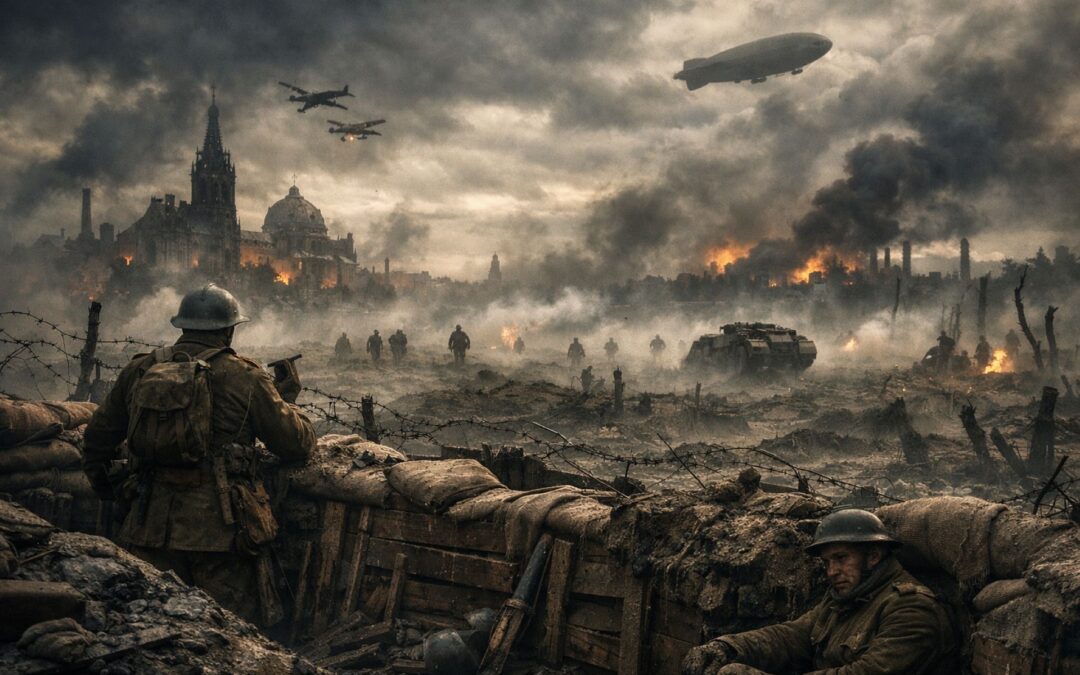
Introduction: The Illusion of a Stable World
In the summer of 1914, Europe appeared to stand at the pinnacle of civilization. Industrial powerhouses churned out goods at unprecedented scales, railroads stitched continents together, telegraphs carried information across borders in seconds, and international trade connected the world in ways that previous generations could scarcely imagine. Great cities like London, Paris, Berlin, and Vienna pulsed with intellectual energy, cultural experimentation, and economic optimism. To many observers, the modern world seemed not only prosperous but stable—guided by diplomacy, commerce, and the rational interests of powerful states.
Yet beneath this façade of stability lay a system that had become dangerously brittle. The European balance of power—maintained for decades through alliances, rivalries, and delicate diplomacy—had evolved into a volatile web of obligations and fears. Every major power was preparing for war even while publicly insisting it desired peace. Military planners drew up elaborate mobilization schedules, generals studied potential invasion routes, and politicians formed defensive alliances meant to deter aggression. Ironically, these very preparations would ensure that once conflict began, it would spread rapidly and uncontrollably.
Nationalism was another powerful force reshaping the continent. Throughout the nineteenth century, nationalist movements had transformed Europe, unifying countries like Germany and Italy while simultaneously destabilizing multi-ethnic empires. Nowhere was this tension more pronounced than in the Austro-Hungarian Empire, a vast and fragile state composed of numerous ethnic groups—Germans, Hungarians, Czechs, Slovaks, Croats, Bosnians, Serbs, and others—many of whom aspired to independence. These competing national ambitions created an atmosphere of resentment and unrest that threatened to tear the empire apart.
Meanwhile, Germany had risen dramatically as a new industrial and military powerhouse. Unified only in 1871 after defeating France in the Franco–Prussian War, the German Empire quickly became Europe’s dominant economic force. Its rapid growth unsettled older powers, particularly Britain and France, who viewed Germany’s expanding military and naval ambitions with increasing alarm. Germany, for its part, felt surrounded by potential enemies and believed it must prepare for a future conflict in order to secure its place in the world.
Across Europe, alliances were forming into two opposing camps. Germany and Austria-Hungary stood together, soon joined by the Ottoman Empire and later Bulgaria. Opposing them were France, Russia, and Britain—powers that had historically mistrusted each other but had gradually aligned to counterbalance Germany’s growing influence. This alliance system created a precarious equilibrium: any conflict involving one nation risked pulling multiple powers into war.
Technological change added yet another layer of danger. Industrialization had revolutionized warfare. Machine guns, heavy artillery, rapid-fire rifles, and modern logistics systems meant that the next war would be vastly more destructive than any previous conflict. Yet many political leaders and military strategists failed to grasp the implications of these innovations. They still imagined wars as relatively short campaigns of maneuver and decisive battles—conflicts that would end quickly once one side achieved a breakthrough.
In reality, the stage had been set for something far more catastrophic.
All that remained was a spark.
That spark arrived in June 1914 in the city of Sarajevo, when a single assassination triggered a chain reaction that no leader could fully control. Within weeks, alliances were activated, armies mobilized, and declarations of war cascaded across the continent. What began as a regional dispute between Austria-Hungary and Serbia rapidly escalated into a global conflict involving dozens of nations and millions of soldiers.
The First World War would transform the twentieth century. It would destroy empires, redraw borders, and unleash levels of destruction previously unimaginable. Entire generations would be scarred by the experience, and the political consequences of the war would echo for decades, ultimately laying the groundwork for an even larger conflict only twenty years later.
But in the summer of 1914, none of this was yet clear. Many Europeans believed the war would be short—perhaps even glorious. Soldiers marched off to battle expecting to return home by Christmas.
Instead, they were marching into one of the deadliest and most transformative events in human history.
Europe’s Powder Keg: Rivalries, Nationalism, and Fragile Alliances
By the early twentieth century, Europe had become a continent armed with unprecedented power yet governed by increasingly unstable political dynamics. Beneath the surface of prosperity and cultural achievement, tensions had been building for decades. These tensions were driven by a complex mixture of nationalism, imperial competition, military expansion, and rigid alliances that divided the continent into hostile camps. When the crisis finally arrived in 1914, these underlying forces ensured that what might have remained a localized dispute instead exploded into a continental—and eventually global—war.
The Legacy of the Franco–Prussian War
One of the most important sources of tension in Europe stemmed from events that had occurred more than forty years earlier. In 1870, the Kingdom of Prussia led a coalition of German states in a war against France. The resulting conflict—the Franco–Prussian War—ended in a decisive German victory. In its aftermath, the German Empire was proclaimed in the Hall of Mirrors at the Palace of Versailles, a symbolic humiliation for France.
The peace settlement imposed on France was harsh. Germany annexed the provinces of Alsace and Lorraine, territories rich in industry and natural resources that had long been contested between the two countries. For the French public, the loss was not merely territorial—it was deeply emotional and political. The humiliation fostered a powerful sense of resentment and a determination to one day reclaim the lost provinces.
For decades afterward, French foreign policy was shaped by this desire for revenge. The recovery of Alsace-Lorraine became a national obsession, influencing military planning and diplomatic strategy alike. France sought alliances that would strengthen its position against Germany, and over time it found willing partners in Russia and later Britain.
From Germany’s perspective, however, the annexation of Alsace-Lorraine was considered essential for national security. German leaders feared that if the territory were returned to France, it would strengthen a potential enemy and weaken Germany’s defensive position. This mutual distrust created a permanent source of hostility between the two nations.
The Rise of German Power
The German Empire that emerged in 1871 was one of the most dynamic and powerful states in Europe. Its population was large and rapidly growing, its economy was booming, and its industrial output soon rivaled—and in some areas surpassed—that of Britain.
Germany quickly became a leader in steel production, chemical manufacturing, and engineering. Its universities and research institutions were among the most advanced in the world. By the early twentieth century, German industrial productivity had transformed the country into a formidable economic competitor on the global stage.
With economic power came political ambition. German leaders sought to expand their influence abroad and secure their place among the great imperial powers of the age. This ambition included colonial expansion in Africa and the Pacific as well as a dramatic expansion of the German navy.
The naval buildup particularly alarmed Britain. For more than a century, Britain’s security had depended on maintaining the world’s most powerful navy. The emergence of a rapidly expanding German fleet threatened to undermine this advantage. As Germany began constructing massive modern battleships—known as dreadnoughts—Britain responded with its own accelerated shipbuilding program.
The resulting naval arms race intensified mistrust between the two nations. Although Britain and Germany had no fundamental territorial disputes, the competition for naval supremacy created a growing sense that the two powers might eventually clash.
Nationalism Inside the Austro-Hungarian Empire
If Germany represented the rising power of a unified nation-state, the Austro-Hungarian Empire represented the opposite: a sprawling multinational empire struggling to contain growing nationalist movements within its borders.
By the early twentieth century, Austria-Hungary governed a diverse collection of peoples with different languages, cultures, and political aspirations. Germans and Hungarians held dominant political power, but large populations of Slavs—including Czechs, Slovaks, Croats, Bosnians, and Serbs—lived throughout the empire.
Many of these groups increasingly demanded greater autonomy or outright independence. Among the most volatile regions was Bosnia, which Austria-Hungary had annexed in 1908. The annexation angered neighboring Serbia, a small but fiercely nationalist state that saw itself as the protector of Slavic peoples in the Balkans.
Serbian nationalists believed that all South Slavs should eventually be united in a single nation. From their perspective, Bosnia—which contained a large Slavic population—rightfully belonged in such a state. Austrian rule over the region therefore became a major source of resentment.
Secret nationalist organizations began to emerge, some of which were willing to use violence to achieve their goals. These groups viewed Austria-Hungary as an oppressive imperial power and believed that dramatic action might ignite a broader movement for independence.
The Alliance System That Divided Europe
As these tensions simmered, Europe’s major powers increasingly organized themselves into opposing alliances designed to deter aggression and preserve the balance of power.
Germany and Austria-Hungary formed the core of what became known as the Central Powers. Their alliance was based on both strategic necessity and political compatibility. Germany relied on Austria-Hungary as a partner against Russia and France, while Austria-Hungary depended on Germany’s military strength to maintain its fragile empire.
Opposing them was a loose coalition that gradually solidified into the Triple Entente. France had already formed an alliance with Russia in the 1890s, recognizing that cooperation with the vast Russian Empire could counterbalance German strength in central Europe. Britain, traditionally wary of entangling alliances, eventually joined this alignment through a series of diplomatic agreements with France and Russia in the early twentieth century.
Although these arrangements were not always formal military alliances, they created a clear division of power across the continent. Each side feared that the other might gain a strategic advantage, and both began preparing for the possibility of a large-scale war.
Military planning became increasingly rigid. Mobilization timetables—detailed schedules for assembling armies and transporting troops—were drawn up with extraordinary precision. Once initiated, these plans were difficult to halt or modify, meaning that a diplomatic crisis could quickly escalate into full-scale war.
By 1914, Europe had effectively become a continent on edge. Rivalries were entrenched, alliances were firmly in place, and military forces were poised for rapid mobilization.
What remained uncertain was how—and when—the spark would arrive.
It came in the Balkans, a region long known as the most volatile corner of Europe.
The Assassination That Ignited the War
By the summer of 1914, Europe had become a geopolitical tinderbox. Rivalries between great powers, nationalist tensions in the Balkans, and rigid alliance commitments had created a situation in which even a small crisis could escalate dramatically. The event that finally set the system in motion occurred in the city of Sarajevo on June 28, 1914. What began as a political assassination quickly evolved into a diplomatic crisis that spiraled beyond anyone’s control.
Sarajevo and the Death of Archduke Franz Ferdinand
Archduke Franz Ferdinand, heir to the throne of the Austro-Hungarian Empire, traveled to Sarajevo to observe military exercises and make an official visit to Bosnia. The date of the visit was politically sensitive. June 28 was Vidovdan, a day of deep historical significance for Serbian nationalists because it commemorated the medieval Battle of Kosovo—an event associated with Serbian resistance and sacrifice.
For many Serbian nationalists, Austrian rule over Bosnia symbolized the suppression of Slavic independence. The presence of the future emperor in Sarajevo on such a symbolic day was viewed by extremists as an opportunity to strike a blow against imperial authority.
Several conspirators connected to a nationalist network known as the Black Hand positioned themselves along the archduke’s planned motorcade route through the city. Their objective was simple but explosive: assassinate the heir to the Austro-Hungarian throne and ignite a broader movement against Austrian rule in the Balkans.
The first attempt nearly succeeded but ultimately failed. One of the conspirators threw a bomb at the archduke’s car. The explosive bounced off the vehicle and detonated beneath the car following behind, injuring several officers. Franz Ferdinand and his wife Sophie escaped unharmed and were quickly taken to safety.
At this point, the crisis could have ended quietly. Instead of leaving Sarajevo immediately, the archduke decided to continue his schedule and later planned to visit the wounded officers in the hospital. This decision would place him back on the streets of the city—and directly into the path of one of the failed assassins.
As the motorcade drove through Sarajevo again, the driver mistakenly turned onto the wrong street. By extraordinary coincidence, the car stopped directly in front of Gavrilo Princip, one of the conspirators who had earlier abandoned hope of carrying out the attack.
Princip seized the opportunity. He stepped forward and fired two shots at close range. One bullet struck Franz Ferdinand, the other hit his wife Sophie. Both were mortally wounded.
Within minutes, the heir to the Austro-Hungarian Empire was dead.
Austria-Hungary’s Ultimatum to Serbia
The assassination shocked Europe, but its political consequences depended on how Austria-Hungary chose to respond. Leaders in Vienna were furious. They believed the attack had been orchestrated with support from elements within the Serbian government, particularly members of Serbian military intelligence who had connections to nationalist groups operating in Bosnia.
Although the exact level of Serbian government involvement remains debated by historians, Austria-Hungary saw the assassination as an act of state-sponsored terrorism. For many officials in Vienna, the event provided an opportunity to crush Serbian nationalism once and for all.
Before taking action, Austria-Hungary sought reassurance from its most powerful ally: Germany. In early July, Austrian leaders consulted with German officials about how they should respond to Serbia. Germany offered what later became known as the “blank check”—a promise of full political and military support if Austria-Hungary decided to confront Serbia.
With German backing secured, Austria-Hungary issued a formal ultimatum to Serbia on July 23, 1914. The document contained a series of extremely harsh demands. Among them were requirements that Serbia suppress nationalist organizations, remove anti-Austrian propaganda, and allow Austro-Hungarian officials to participate in investigations inside Serbian territory.
The ultimatum was intentionally designed to be difficult to accept. Austria-Hungary expected that Serbia would reject at least some of the conditions, thereby providing justification for military action.
Serbia’s response, however, surprised many observers. In an effort to avoid war, the Serbian government accepted most of the demands and expressed willingness to negotiate on the remaining points. Nevertheless, Serbia refused to allow Austrian investigators to operate within its borders, viewing this condition as a violation of national sovereignty.
For Austria-Hungary, this partial rejection was enough.
On July 28, 1914, Austria-Hungary declared war on Serbia.
What might have remained a regional conflict between two Balkan states quickly triggered a chain reaction. Alliances activated, mobilization plans were set in motion, and within days Europe’s great powers found themselves sliding toward a war none of them fully anticipated—but none of them were willing to avoid.
The Domino Effect: How Europe Declared War on Itself
Austria-Hungary’s declaration of war on Serbia in July 1914 might have remained a limited regional conflict. Balkan wars had occurred before, and great powers had often intervened diplomatically to prevent them from escalating. But this time, the political and military structures of Europe had become too rigid and too interconnected. The alliance system that had been designed to preserve stability instead acted like a row of falling dominoes. Once one power moved, others felt compelled to follow.
Within days of the assassination crisis turning into open war, the entire continent was being pulled into the conflict.
Russia Mobilizes
Serbia’s most powerful supporter was Russia. For decades, Russia had presented itself as the protector of Slavic peoples in Eastern Europe and the Balkans. Serbian nationalists in particular viewed Russia as a natural ally against Austro-Hungarian domination.
The Russian government also had strategic reasons for supporting Serbia. Russia feared that if Austria-Hungary crushed Serbia, it would expand its influence throughout the Balkans and significantly weaken Russia’s own position in the region. Such an outcome would tilt the balance of power toward the Central Powers—Germany and Austria-Hungary—and undermine Russian influence.
When Austria-Hungary declared war on Serbia on July 28, Russia faced a difficult decision. If it did nothing, Serbia would likely be defeated quickly. But if Russia intervened militarily, it risked triggering a much larger war involving Germany.
Ultimately, Russian leaders chose to act. On July 30, Russia ordered a general mobilization of its enormous army. Mobilization in the early twentieth century was an immense logistical undertaking involving millions of soldiers, railways, supply networks, and military equipment. Once begun, it was extremely difficult to stop.
To Germany, Russian mobilization was interpreted as a direct threat.
Germany Declares War
Germany had long feared the possibility of a two-front war. Its strategic nightmare was being caught between France in the west and Russia in the east. If both countries attacked simultaneously, Germany believed it might be overwhelmed.
When Russia began mobilizing its forces, German leaders concluded that war had become unavoidable. On August 1, 1914, Germany declared war on Russia.
But Germany’s strategic planning went further than simply confronting Russia. For years, German military leaders had been preparing for exactly this situation. They had developed a detailed strategy—known as the Schlieffen Plan—designed to defeat France quickly before Russia could fully mobilize.
As a result, Germany’s declaration of war on Russia quickly expanded into a broader military operation that would bring additional nations into the conflict.
France Joins the Conflict
France had maintained a formal alliance with Russia since the 1890s. The purpose of this alliance was straightforward: if Germany attacked either nation, the other would provide military support.
When Germany declared war on Russia, French leaders understood that they might soon become targets themselves. France began mobilizing its own army, preparing for a possible German invasion.
German leaders did not wait long. On August 3, 1914, Germany formally declared war on France.
Almost immediately, German forces began implementing their invasion plan—one that would involve marching through neutral Belgium in order to outflank France’s heavily fortified eastern border.
This decision would prove to be a critical turning point in the expansion of the war.
Britain Enters the War
Britain had historically avoided permanent alliances on the European continent, preferring to maintain flexibility in its foreign policy. However, by the early twentieth century Britain had developed increasingly close diplomatic ties with France and Russia through a series of agreements that collectively formed the Triple Entente.
Although Britain was not formally obligated to join a war on France’s side, several factors pushed it toward intervention.
One of the most important was the status of Belgium. Since 1839, European powers—including Britain—had agreed to guarantee Belgium’s neutrality. This agreement was intended to prevent any major power from using Belgian territory as a military corridor.
Germany’s invasion plan required exactly that.
When German troops crossed into Belgium on August 4, 1914, it created a major diplomatic crisis. Britain issued an ultimatum demanding that Germany withdraw its forces from Belgian territory.
Germany refused.
Later that same day, Britain declared war on Germany.
What had begun as a conflict between Austria-Hungary and Serbia had now escalated into a full-scale European war involving the continent’s most powerful states. Within weeks, additional nations would be drawn into the conflict as alliances activated and colonial empires mobilized their resources.
The war that many had expected to be short and decisive was rapidly expanding into something far larger and far more destructive than anyone had anticipated.
Germany’s Gamble: The Schlieffen Plan
When Europe plunged into war in the summer of 1914, Germany faced a strategic dilemma that had shaped its military planning for years. Geographically, the German Empire sat at the center of Europe, surrounded by potential enemies on multiple sides. If Germany were forced to fight France in the west and Russia in the east simultaneously, it would face the classic military nightmare of a two-front war.
German strategists believed that if such a war occurred, it would have to be fought quickly and decisively. The longer the conflict lasted, the greater the advantage would shift toward Germany’s enemies, who collectively possessed larger populations and greater resources. To overcome this disadvantage, German military planners developed an ambitious strategy designed to defeat France before Russia could fully mobilize.
This strategy became known as the Schlieffen Plan.
Why Germany Needed a Quick War
The Schlieffen Plan was named after Count Alfred von Schlieffen, a former chief of the German General Staff who had spent years studying how Germany might survive a two-front conflict. His conclusion was stark: Germany could not win a long war against both France and Russia at the same time.
Russia’s enormous size meant that its military mobilization would take time. Transporting troops across vast distances and assembling supplies would require weeks or even months. France, however, could mobilize much more quickly.
Schlieffen believed Germany’s only realistic chance of victory was to concentrate nearly all of its forces against France at the very beginning of the war. If Germany could defeat France within six weeks, it could then shift its armies eastward to confront Russia before Russian forces had fully prepared for battle.
The entire strategy depended on speed, coordination, and overwhelming force.
But there was a major obstacle: France had spent decades building powerful defensive fortifications along its eastern border with Germany. These fortresses formed a defensive barrier that would be extremely costly and time-consuming to attack directly.
German planners therefore devised a bold alternative.
The Invasion of Belgium
Instead of attacking France head-on along the heavily fortified border, Germany would sweep around it. The plan called for German armies to advance through neutral Belgium and northern France in a massive arc, moving rapidly toward Paris.
This maneuver would allow German forces to bypass the French defenses and strike from the north, where France was less prepared. Once Paris was threatened, French armies would either be surrounded or forced into a decisive battle that Germany hoped to win quickly.
The strategy was daring but risky. Belgium was a neutral country, and invading it meant violating international agreements that guaranteed its independence. German leaders hoped Belgium would offer little resistance and allow German troops to pass through quickly.
They were wrong.
When German forces crossed the Belgian border in early August 1914, the Belgian army resisted fiercely. Although Belgium’s military was small compared to Germany’s massive forces, its defenders fought stubbornly, particularly in fortified cities such as Liège.
This unexpected resistance slowed the German advance. Every day of delay mattered because the entire Schlieffen Plan depended on rapid movement.
Britain’s Entry Into the War
Germany’s invasion of Belgium also had enormous political consequences. Britain had long pledged to protect Belgian neutrality as part of an international agreement signed in 1839. Although Britain had been hesitant to enter the conflict earlier, the violation of Belgian territory made the decision far more straightforward.
On August 4, 1914, Britain declared war on Germany.
The entry of Britain transformed the war dramatically. The British Empire possessed the world’s most powerful navy and access to vast resources across its global empire. Britain could also draw soldiers from across its dominions, including Canada, Australia, New Zealand, India, and South Africa.
For Germany, the situation was becoming more complicated than anticipated. The Schlieffen Plan assumed a swift and overwhelming offensive that would crush France before outside factors could intervene. Instead, Belgian resistance, British involvement, and logistical challenges began to slow the German advance.
Nevertheless, German armies pushed forward with remarkable speed. By late August and early September 1914, German forces had advanced deep into French territory and were approaching Paris itself.
For a moment, it appeared that the German gamble might succeed.
But the plan was about to encounter a critical failure—one that would transform the war into something entirely different from what anyone had expected.
The Western Front and the Birth of Trench Warfare
In the opening weeks of the war, Germany’s massive offensive seemed unstoppable. German armies surged across Belgium and northern France with remarkable speed, pushing Allied forces backward and threatening the very heart of France. Many observers believed that Germany’s strategy might work exactly as planned: a rapid and decisive victory that would end the war before the year was over.
Instead, the advance stalled. What followed would transform the character of the war entirely. The conflict on the Western Front would settle into a brutal stalemate defined by trenches, artillery bombardments, and grinding battles of attrition that lasted for years.
The Battle That Stopped Germany
By early September 1914, German forces had advanced to within striking distance of Paris. French government officials even prepared to evacuate the capital as German armies approached. It appeared that the German plan to encircle and defeat the French army might succeed.
However, the speed of the German advance created new problems. As German armies pushed deeper into France, their supply lines stretched dangerously thin. Communication between different German units became more difficult, and coordination between armies began to break down.
Sensing an opportunity, the French commander-in-chief, General Joseph Joffre, ordered a massive counterattack. French forces, supported by the recently arrived British Expeditionary Force, struck the German armies along the Marne River in early September 1914.
The resulting confrontation became known as the First Battle of the Marne.
During the battle, a gap opened between two advancing German armies. Allied commanders recognized the danger this posed to the German offensive. If Allied forces could exploit the gap, they might be able to attack the German armies from the flank and disrupt the entire advance.
French and British troops moved quickly to exploit the opening. Under growing pressure, the German command realized that continuing the offensive risked catastrophic encirclement. German forces were ordered to retreat.
The retreat marked the failure of the Schlieffen Plan. Germany had failed to defeat France quickly, and the war was now becoming the prolonged conflict that German strategists had feared.
The Race to the Sea
After the German retreat from the Marne, both sides attempted to regain the initiative. Each army tried to outflank the other by moving northward in an effort to break through enemy lines.
This maneuvering phase became known as the “Race to the Sea.”
In reality, neither side was actually racing to the coastline itself. Instead, both armies were trying to extend their lines northward and find a weak point in the opposing defenses. Each time one side attempted to outflank the other, the opposing army moved to block the maneuver.
This process repeated itself several times as the armies shifted northward across northern France and Belgium. Eventually, the opposing forces reached the North Sea.
By the end of 1914, the Western Front had stabilized into a continuous line of defensive positions stretching from the English Channel all the way to the Swiss border—a distance of nearly 700 kilometers.
Neither side had achieved the decisive breakthrough it wanted.
Instead, the war had become a stalemate.
Life and Death in the Trenches
To defend their positions along the Western Front, both sides began constructing elaborate trench systems. These trenches were not simple ditches but complex networks of defensive structures that stretched across vast distances.
Typically, a trench system consisted of multiple parallel lines connected by communication trenches. The front line faced the enemy directly, while support and reserve trenches lay further behind. Between the opposing trench lines was a deadly stretch of terrain known as “no-man’s land.”
No-man’s land was often a devastated landscape filled with shell craters, barbed wire, shattered trees, and the remains of fallen soldiers. Crossing this terrain under enemy fire was extraordinarily dangerous.
Life inside the trenches was harsh and miserable. Soldiers lived for weeks or months at a time in muddy, cramped conditions. Rain frequently flooded the trenches, turning them into stagnant pools of water and mud. In some areas, the mud was so deep that soldiers risked becoming trapped and drowning.
Corpses often remained buried in the mud or caught in barbed wire just beyond the trench lines. The constant presence of death created a grim atmosphere that soldiers struggled to endure.
Rats thrived in the trenches, feeding on food scraps and human remains. Many grew unusually large, frightening the soldiers who lived among them. Lice were another persistent problem, spreading disease and causing constant itching.
Disease and infection were common. One particularly notorious condition was “trench foot,” a painful and sometimes deadly infection caused by prolonged exposure to cold, wet conditions.
Perhaps the most terrifying aspect of trench warfare was the relentless artillery bombardment. Soldiers could spend hours—or even days—under heavy shellfire as thousands of artillery shells exploded around them. The psychological toll of these bombardments was immense, leading to a condition then known as “shell shock,” which we now recognize as a form of severe psychological trauma.
Attacks across no-man’s land were equally brutal. Typically, an offensive would begin with an artillery bombardment intended to destroy enemy defenses. Once the bombardment ended, soldiers would climb out of their trenches and advance toward the enemy.
But defenders often survived the bombardment in deep bunkers and quickly returned to their positions once the shelling stopped. When attacking soldiers emerged into no-man’s land, they frequently faced devastating machine-gun fire.
The result was enormous casualties for very little territorial gain. Entire waves of soldiers could be cut down in minutes, and after days or weeks of fighting, armies might capture only a few hundred meters of ground.
This brutal pattern of attack, slaughter, and stalemate would define the Western Front for much of the war. Millions of soldiers would live—and die—in the trenches as the conflict ground on year after year.
What had begun as a war of rapid movement had transformed into a war of endurance, where victory would depend not on quick triumphs but on which side could survive the longest.
A War That Consumed the World
By the end of 1914, the Western Front had hardened into an immense system of trenches stretching across Europe. The rapid war of movement that generals had expected had turned into a grinding stalemate. Neither side could achieve a decisive breakthrough, yet neither side was willing to accept defeat.
Faced with this deadlock, both the Allies and the Central Powers began searching for ways to shift the balance of the war. If victory could not be achieved on the Western Front alone, perhaps new fronts elsewhere might change the strategic equation. As a result, the conflict rapidly expanded beyond Europe, drawing in colonial territories, distant empires, and new participants across the globe.
What had begun as a European war was becoming a truly global conflict.
Colonial Fronts in Africa and the Pacific
At the outbreak of war, Germany possessed several overseas colonies scattered across Africa and the Pacific. These territories were relatively small compared to the massive colonial empires of Britain and France, but they still represented valuable strategic assets and symbols of imperial prestige.
Once the war began, Allied powers quickly moved to eliminate these German colonies. In the Pacific, forces from Australia and New Zealand rapidly seized German-controlled islands and the territory of German New Guinea. These operations were swift and largely successful, giving the Allies control over key strategic positions in the region.
In Africa, the situation was more complex. German colonies such as German East Africa, German Southwest Africa, and Kamerun became battlegrounds as Allied forces attempted to capture them.
The fighting in Africa often involved local populations who were recruited or forced into service by both sides. Thousands of African soldiers and carriers were drawn into the conflict, transporting supplies, building infrastructure, and participating directly in combat operations.
The human cost of these campaigns was enormous. In many regions, disease, starvation, and forced labor caused devastating losses among African populations. Although these colonial battles rarely influenced the main European fronts, they extended the suffering of the war far beyond Europe’s borders.
Italy Changes Sides
Italy’s position at the beginning of the war added another layer of complexity to the conflict. Before 1914, Italy had been formally allied with Germany and Austria-Hungary as part of the Triple Alliance. However, the alliance had always been fragile, and relations between Italy and Austria-Hungary were strained by territorial disputes.
When war broke out, Italy initially declared neutrality. Italian leaders argued that their alliance obligations were defensive, and since Austria-Hungary had initiated the conflict by declaring war on Serbia, Italy was not required to participate.
Both sides quickly began courting Italy, recognizing that its military could influence the balance of power in Europe.
The Allies ultimately made the more attractive offer. In secret negotiations, they promised Italy significant territorial gains—particularly regions of Austria-Hungary inhabited by Italian-speaking populations—if Italy joined the war against the Central Powers.
In 1915, Italy accepted the deal and declared war on Austria-Hungary.
Italy opened a new front in the mountainous region along the Austro-Hungarian border. Fighting there proved extremely difficult. The terrain consisted of steep mountains, narrow valleys, and harsh weather conditions that made large-scale offensives nearly impossible.
The Italian front quickly became another stalemate. Both sides launched repeated offensives with little success, suffering heavy casualties for minimal territorial gains.
Japan’s Entry Into the War
Another unexpected participant in the war was Japan.
In the early twentieth century, Japan had emerged as a rising power in East Asia following its victories in the Russo-Japanese War and its rapid industrial modernization. Japan had also formed an alliance with Britain in 1902, creating diplomatic ties that connected it indirectly to the emerging conflict.
When the war began, Japan saw an opportunity to expand its influence in the Pacific and East Asia. In 1914, Japan declared war on Germany and quickly moved to seize German territories in the region, including the port of Qingdao in China and several Pacific island colonies.
Japanese forces encountered relatively limited resistance, and the campaigns were completed quickly. By occupying these territories, Japan significantly expanded its strategic reach in the Pacific.
Although Japan’s military involvement in Europe itself was minimal, its participation demonstrated how the war was evolving into a global struggle involving powers from multiple continents.
As more nations entered the conflict and new fronts opened across the world, the scale of the war continued to grow. Yet despite these expansions, the central problem remained unresolved: the Western Front was still locked in stalemate.
Both sides now faced a grim realization.
If the war could not be won quickly, it might instead become a long and brutal contest of endurance—one that would test the limits of entire nations.
The Ottoman Empire and the Middle Eastern Front
As the war expanded beyond Europe, one of the most significant developments was the entry of the Ottoman Empire into the conflict. Once a dominant imperial power spanning parts of Europe, Asia, and Africa, the Ottoman state had been steadily declining throughout the nineteenth century. By the early twentieth century it was often referred to by European observers as the “sick man of Europe,” weakened by internal instability, territorial losses, and economic struggles.
Despite this decline, the Ottoman Empire still controlled vast territories across the Middle East, including modern-day Turkey, Syria, Iraq, Palestine, and parts of the Arabian Peninsula. These regions held immense strategic importance, particularly because they controlled vital trade routes and increasingly valuable oil resources.
When the Ottomans joined the war, they transformed the conflict into a major struggle across the Middle East.
The Strategic Importance of Oil
One of the key reasons the Middle East became strategically important during the First World War was the growing importance of oil.
Industrialization had begun shifting the world’s major navies from coal-powered ships to oil-powered vessels. Oil offered significant advantages: ships could travel faster, operate more efficiently, and refuel more easily. For the British Empire—whose naval dominance was the cornerstone of its global power—securing reliable oil supplies became a critical priority.
Large oil reserves had been discovered in Persia (modern Iran) and the surrounding regions. Protecting access to these resources required maintaining control over nearby territories and waterways.
The Ottoman Empire’s geographic position placed it directly along these strategic routes. British leaders therefore feared that if the Ottomans joined the Central Powers, they could threaten British access to Middle Eastern oil and disrupt key imperial communications.
This concern helped push the Middle East into the center of wartime strategy.
The Gallipoli Campaign
One of the most ambitious Allied attempts to weaken the Ottoman Empire came in the form of the Gallipoli Campaign.
The Dardanelles Strait—a narrow waterway connecting the Mediterranean Sea to the Black Sea—was controlled by the Ottomans. If the Allies could capture this route, they would gain a direct supply line to Russia, their ally on the Eastern Front. This would allow the Allies to send weapons and supplies to Russia while also threatening the Ottoman capital of Constantinople (modern-day Istanbul).
In 1915, the Allies launched a major operation to seize the Dardanelles. The plan involved both naval and land assaults. Allied warships attempted to force their way through the strait while ground troops landed on the Gallipoli Peninsula to capture Ottoman defensive positions.
The campaign quickly turned into a disaster.
Ottoman forces, led in part by the talented commander Mustafa Kemal (later known as Atatürk), mounted a determined defense of the peninsula. Allied troops—many of whom came from Britain’s dominions, including Australia and New Zealand—found themselves trapped on narrow beaches under heavy fire.
The rugged terrain made large-scale advances extremely difficult. Much like the Western Front in Europe, the Gallipoli campaign soon devolved into trench warfare.
Months of brutal fighting followed, but the Allies were unable to break through Ottoman defenses. By early 1916, the campaign was abandoned, and Allied forces withdrew from the peninsula.
The failure of Gallipoli was a major strategic setback for the Allies and a significant morale boost for the Ottoman Empire.
The Armenian Genocide
While military campaigns raged across the Ottoman territories, one of the darkest chapters of the war unfolded within the empire itself.
Ottoman authorities increasingly suspected that ethnic Armenian populations living within the empire might sympathize with Russia, which was fighting against the Ottomans along the Caucasus front. Armenian communities had long faced discrimination within the empire, and wartime paranoia intensified existing tensions.
In 1915, the Ottoman government initiated a series of mass deportations targeting Armenians. Entire Armenian communities were forcibly removed from their homes and marched across deserts toward detention camps in Syria.
These deportations quickly became death marches.
Many Armenians died from starvation, dehydration, disease, and violence along the way. Others were killed outright by Ottoman forces or irregular militias. Over the course of the war, an estimated 1 to 1.5 million Armenians perished.
Historians widely recognize these events as the Armenian Genocide—one of the first large-scale genocides of the twentieth century.
The tragedy highlighted the broader human cost of the war, which extended far beyond the battlefields themselves. Entire populations were caught in the crossfire of collapsing empires, nationalist tensions, and wartime desperation.
By the middle years of the war, the conflict had spread across continents. Europe remained the central battlefield, but fighting now stretched across Africa, the Middle East, and the oceans of the world.
Yet even with new fronts opening and new nations joining the struggle, the war remained trapped in stalemate. Neither side could deliver a decisive blow.
The next phase of the conflict would see both sides turning increasingly to new technologies and harsher methods in an effort to break the deadlock.
New Weapons and Total War
As the First World War dragged on, both sides faced a grim reality: traditional battlefield tactics were proving incapable of breaking the stalemate. Armies could bombard enemy positions for days, launch massive infantry assaults, and still gain only a few meters of ground. Casualties mounted into the hundreds of thousands while the front lines barely moved.
Faced with this deadlock, military leaders began turning toward new technologies and increasingly ruthless methods in hopes of gaining an advantage. The war became a laboratory for modern warfare, introducing weapons and strategies that would permanently reshape how wars were fought.
At the same time, the conflict expanded beyond the battlefield itself. Entire economies were mobilized for war, civilians became direct targets, and industrial production became as important as military strategy. The First World War was becoming a total war, in which entire societies were engaged in the struggle.
Chemical Warfare
One of the most shocking innovations of the war was the use of chemical weapons.
Before the conflict began, international agreements had attempted to regulate warfare. The Hague Conventions had prohibited certain forms of inhumane weaponry, including the use of poisonous gases. Yet as the stalemate deepened and desperation grew, these rules began to erode.
In 1915, German forces introduced chlorine gas on the battlefield during fighting near the Belgian city of Ypres. When the gas drifted toward Allied trenches, soldiers found themselves choking and suffocating as the chemical burned their lungs. Many died where they stood, while others fled in panic.
The psychological effect was almost as devastating as the physical one. Soldiers suddenly faced an invisible weapon that could silently drift across the battlefield and kill in horrifying ways.
Soon other forms of gas followed. Phosgene gas proved even deadlier than chlorine, and later mustard gas became notorious for causing severe burns, blindness, and long-term injuries. Mustard gas could linger in the soil for days, turning entire sections of the battlefield into toxic zones.
Despite initial outrage, both sides soon began using chemical weapons. Gas masks became standard equipment for soldiers, and chemical warfare became a grim but routine feature of trench combat.
Although gas caused a smaller proportion of deaths compared to artillery, its psychological impact was enormous. The fear of gas attacks haunted soldiers constantly, adding another layer of terror to life in the trenches.
Submarines and Naval Blockades
While trench warfare dominated the land battles in Europe, control of the seas was equally crucial to the outcome of the war.
Britain possessed the world’s most powerful navy, and from the beginning of the conflict it used that advantage to impose a naval blockade on Germany. British warships patrolled key maritime routes, preventing ships carrying food, raw materials, and other supplies from reaching German ports.
Over time, the blockade had devastating effects on the German economy and civilian population. Shortages of food and basic goods became increasingly severe, and malnutrition spread throughout the country.
Germany responded with a new weapon that threatened Britain’s own lifelines: the submarine.
German U-boats began attacking merchant ships traveling across the Atlantic and the North Sea. Submarines could operate stealthily beneath the surface, making them difficult to detect and destroy. Their goal was to sink ships carrying supplies to Britain and its allies, thereby weakening the Allied war effort.
However, submarine warfare soon became controversial because many of the ships being targeted were civilian vessels. One of the most infamous incidents occurred in 1915 when a German submarine sank the British passenger liner Lusitania, killing nearly 1,200 people—including 159 Americans.
The sinking caused outrage around the world and significantly damaged Germany’s international reputation. Although Germany later temporarily restricted submarine attacks in response to diplomatic pressure, unrestricted submarine warfare would eventually play a major role in drawing the United States into the war.
Propaganda and Civilian Suffering
As the war expanded, governments increasingly recognized that victory depended not only on battlefield success but also on maintaining public support at home.
Propaganda became a powerful tool used by all sides to shape public opinion and sustain morale. Newspapers, posters, films, and speeches portrayed the enemy as cruel and barbaric while emphasizing the righteousness of one’s own cause.
Stories of atrocities—particularly reports of German brutality during the invasion of Belgium—circulated widely and helped mobilize public support for the Allied war effort. Although some stories were exaggerated or distorted, they reinforced the perception that the war was a moral struggle as well as a military one.
Meanwhile, civilians were experiencing the harsh realities of total war.
Governments redirected vast portions of their economies toward military production. Factories that had once produced consumer goods now manufactured weapons, ammunition, and military equipment. Millions of men were mobilized into the armed forces, leaving labor shortages that were increasingly filled by women entering industrial workforces for the first time on a large scale.
Food rationing became common as supplies grew scarce. Air raids and naval blockades exposed civilian populations to the dangers of war in ways that had rarely occurred in earlier conflicts.
The boundary between the battlefield and the home front was rapidly disappearing.
By the middle years of the war, the conflict had transformed into a massive industrial struggle involving entire nations. Technology, economic power, and civilian endurance had become just as important as military tactics.
Yet despite these new weapons and strategies, the fundamental problem remained unsolved. The Western Front was still locked in stalemate.
Breaking that stalemate would require battles of unprecedented scale and brutality—battles that would come to define the war itself.
The War of Attrition: Verdun and the Somme
By 1916, the First World War had settled into a brutal rhythm. The initial hopes of quick victory had vanished, replaced by the grim logic of attrition. Since neither side could achieve a decisive breakthrough, the war increasingly became a contest of endurance. The goal was no longer simply to seize territory but to exhaust the enemy—draining its manpower, resources, and morale until it could no longer continue the fight.
This strategy produced some of the most devastating battles in human history. Two of the most infamous confrontations of the war—the Battle of Verdun and the Battle of the Somme—became symbols of the industrial slaughter that defined the conflict.
The Battle of Verdun
In early 1916, the German High Command devised a plan to break the stalemate by attacking the French fortress city of Verdun. Rather than aiming to capture large amounts of territory, the German strategy focused on forcing the French army into a battle so intense that it would “bleed France white.”
Verdun held enormous symbolic importance for the French. The city had long been part of a defensive ring of fortresses protecting France’s eastern border, and it represented national pride and determination. German commanders understood that France would feel compelled to defend the city at almost any cost.
In February 1916, the German assault began with one of the most massive artillery bombardments ever seen. Thousands of guns unleashed a relentless storm of shells across French positions, devastating the landscape and turning the surrounding countryside into a wasteland of craters and shattered trees.
Following the bombardment, German infantry advanced against the weakened French defenses. The initial attacks achieved some success, capturing several key positions and forts.
But the French refused to surrender Verdun.
Under the leadership of General Philippe Pétain, the French army organized a determined defense. Supplies and reinforcements were rushed to the front along a vital road known as the Voie Sacrée, or “Sacred Way.” Day and night, trucks carried soldiers, ammunition, and food into the battlefield while wounded troops were transported out.
The battle quickly devolved into a relentless cycle of attacks and counterattacks. Artillery bombardments pounded the battlefield continuously, reducing entire hillsides to mud and debris. Soldiers fought in shattered trenches, underground bunkers, and ruined fortifications.
The conditions were almost unimaginable. Shellfire churned the earth so thoroughly that entire landscapes disappeared. Bodies were often obliterated or buried beneath the mud, and survivors struggled to maintain any sense of normality amid the destruction.
The fighting at Verdun lasted nearly ten months. By the time the battle finally ended in December 1916, the front lines had barely changed. France had successfully defended the city, but the cost was staggering.
Both sides together suffered roughly 700,000 casualties—killed, wounded, or missing. Verdun became a symbol of national sacrifice for France and one of the most brutal battles of the war.
The Battle of the Somme
While the French struggled to hold Verdun, their allies sought to relieve pressure by launching a major offensive of their own.
In the summer of 1916, British and French forces began a massive attack along the Somme River in northern France. The offensive was designed to break through German lines and force Germany to divert troops away from Verdun.
The Battle of the Somme opened on July 1, 1916, after a week-long artillery bombardment intended to destroy German defenses. Allied commanders believed the bombardment had devastated the enemy trenches and barbed wire.
They were tragically mistaken.
Many German soldiers had survived the shelling by sheltering in deep underground bunkers. When the bombardment stopped and British infantry advanced across no-man’s land, German machine gunners quickly emerged from their shelters and opened fire.
The result was catastrophic.
On the first day of the Somme offensive alone, the British army suffered approximately 60,000 casualties, including more than 19,000 killed. It remains the bloodiest single day in the history of the British military.
Despite the horrific losses, the offensive continued for months. Repeated assaults were launched against German defenses, gradually pushing the front line forward at enormous cost.
One of the Somme’s most notable developments was the introduction of a new weapon: the tank. Early tanks were large armored vehicles designed to cross trenches and barbed wire while protecting soldiers from machine-gun fire.
Although the first tanks were slow, unreliable, and deployed in limited numbers, they represented a glimpse of the future of warfare.
By the time the battle ended in November 1916, Allied forces had advanced only a few kilometers. The total casualties for both sides approached one million soldiers.
The First Appearance of Tanks
The tank was one of the few technological innovations during the war specifically designed to break the trench stalemate.
Early tanks were crude machines—slow-moving armored vehicles equipped with cannons and machine guns. Their heavy armor allowed them to cross barbed wire and resist small-arms fire, making them potentially effective against entrenched defenders.
The British first introduced tanks during the later stages of the Somme offensive in 1916. Although mechanical failures limited their effectiveness, the psychological impact was significant. German soldiers had never encountered such machines before, and their sudden appearance on the battlefield caused confusion and fear.
Over time, tank technology improved, and these vehicles would become increasingly important in later stages of the war.
But in 1916, even new technologies could not immediately solve the fundamental problem of trench warfare.
Verdun and the Somme demonstrated the brutal reality of the conflict: enormous armies could fight for months, suffer hundreds of thousands of casualties, and still fail to achieve decisive victory.
By the end of 1916, Europe was exhausted. Millions were dead, entire regions had been devastated, and the war showed no signs of ending.
Yet even greater upheavals were about to shake the foundations of the nations fighting it. The next turning point would come not from the battlefield, but from political revolutions and collapsing empires.
Revolutions, Mutinies, and the Collapse of Russia
By 1917, the First World War had pushed the major powers of Europe to the brink of exhaustion. Years of relentless fighting had drained national economies, devastated populations, and shattered morale across the continent. The enormous casualties on the battlefield were matched by growing hardship on the home front, where shortages of food, fuel, and basic goods became increasingly severe.
Across Europe, the strain of total war began to fracture the political and social stability of entire nations. Soldiers grew weary of endless offensives that produced little progress, civilians struggled with hunger and economic collapse, and governments faced mounting pressure to find a way out of the conflict.
Nowhere did these pressures explode more dramatically than in Russia.
Exhaustion on the Home Front
Russia had entered the war as one of the largest military powers in Europe, with vast manpower and enormous territory. Yet the Russian Empire faced serious structural weaknesses that quickly became apparent once the war began.
The Russian economy was less industrialized than those of Germany, Britain, or France. Supplying millions of soldiers with weapons, ammunition, and food proved extraordinarily difficult. Transportation networks were inadequate, and railroads struggled to move troops and supplies across the enormous distances of the empire.
Russian armies often found themselves fighting with severe shortages of equipment. In some cases, soldiers were sent into battle without rifles and were instructed to pick up weapons from fallen comrades.
Meanwhile, conditions at home deteriorated rapidly. The war placed enormous strain on Russia’s economy, causing inflation to skyrocket and food shortages to spread through major cities. Long lines formed outside bakeries and food markets as civilians struggled to obtain basic necessities.
Public anger increasingly focused on the Russian monarchy. Tsar Nicholas II had taken personal command of the army in 1915, meaning that military failures were now directly associated with the emperor himself. At the same time, political scandals and corruption within the royal court further damaged the credibility of the government.
One particularly controversial figure was Grigori Rasputin, a mysterious mystic who had gained influence within the royal family. Many Russians believed that Rasputin wielded undue power over government decisions, fueling resentment and distrust toward the monarchy.
As military defeats mounted and living conditions worsened, Russia moved steadily toward political collapse.
The Russian Revolution
In early 1917, the situation finally reached a breaking point.
In the capital city of Petrograd (modern-day Saint Petersburg), widespread protests erupted over food shortages and economic hardship. Workers went on strike, demonstrations filled the streets, and clashes between protesters and authorities intensified.
What began as protests quickly escalated into a full-scale revolution.
Large sections of the Russian army stationed in Petrograd refused to suppress the demonstrations. Instead, many soldiers joined the protesters, effectively turning the uprising into a nationwide revolt against the monarchy.
Facing overwhelming pressure, Tsar Nicholas II was forced to abdicate the throne in March 1917. The centuries-old Romanov dynasty collapsed, bringing an end to imperial rule in Russia.
A provisional government took control of the country, promising democratic reforms and a more representative political system. However, the new leadership made a critical decision that would prove disastrous: it chose to continue fighting the war.
The Russian population, already exhausted and suffering, had little appetite for further military sacrifice. Discontent continued to grow throughout the country, weakening the authority of the provisional government.
Russia Leaves the War
Later in 1917, a second revolution reshaped Russia’s political future.
In October, a radical socialist faction known as the Bolsheviks seized power in Petrograd. Led by Vladimir Lenin, the Bolsheviks promised sweeping changes: land for peasants, workers’ control of industry, and most importantly, an immediate end to Russia’s involvement in the war.
Once in power, the Bolsheviks moved quickly to negotiate peace with Germany and the Central Powers.
In March 1918, Russia formally withdrew from the conflict by signing the Treaty of Brest-Litovsk. The agreement ended Russia’s participation in the war but required the new Soviet government to surrender vast territories to Germany.
For Germany, Russia’s exit from the war appeared to be a major strategic victory. The Eastern Front—where Germany had previously been forced to divide its military forces—was effectively eliminated.
German commanders now believed they had a final opportunity. With Russia defeated, they could shift hundreds of thousands of troops to the Western Front and launch a decisive offensive against Britain and France before new enemies could intervene.
Yet while Russia was leaving the war, another powerful nation was moving steadily toward entering it.
Across the Atlantic, events were unfolding that would soon bring the United States into the conflict—and dramatically alter the balance of power in the final stages of the war.
America Enters the Conflict
For most of the early years of the First World War, the United States remained officially neutral. President Woodrow Wilson had been elected in 1916 on the slogan “He kept us out of war,” reflecting the widespread desire among Americans to avoid becoming entangled in Europe’s destructive conflict.
Yet neutrality did not mean isolation. The war had profound economic and political effects on the United States, gradually pulling the country closer to the Allied side. By 1917, a series of events—combined with growing economic ties to the Allies—pushed the United States into the war and fundamentally changed the balance of power.
The Lusitania and Submarine Warfare
One of the earliest events to shock American public opinion was the sinking of the British passenger liner Lusitania in May 1915.
The ship was traveling from New York to Liverpool when it was torpedoed by a German submarine off the coast of Ireland. Within minutes the vessel sank, killing nearly 1,200 passengers and crew.
Among the dead were 159 American citizens.
The attack caused outrage in the United States. Newspapers published dramatic accounts of the tragedy, portraying it as an example of German brutality and disregard for civilian life. Although Germany argued that the ship had been carrying war supplies for the Allies, the loss of civilian lives—including women and children—deeply disturbed the American public.
For a time, the German government attempted to ease tensions by restricting its submarine attacks on passenger vessels. Nevertheless, the incident left a lasting impact on American attitudes toward Germany.
Submarine warfare remained a contentious issue throughout the war, and it would eventually play a decisive role in bringing the United States into the conflict.
The Zimmermann Telegram
The final catalyst came in early 1917 with the discovery of a secret diplomatic message that stunned the American government.
Germany, recognizing that the United States might soon join the war on the Allied side, sought a way to distract or weaken the Americans. German Foreign Minister Arthur Zimmermann sent a coded telegram to the German ambassador in Mexico.
The message proposed an extraordinary alliance: if the United States entered the war against Germany, Mexico should declare war on the United States. In return, Germany promised to support Mexico in reclaiming territories it had lost to the United States in the nineteenth century—specifically Texas, New Mexico, and Arizona.
The message might have remained secret, but British intelligence intercepted the telegram and successfully decrypted it. The British government then passed the information to the United States.
When the contents of the telegram were published in American newspapers, the reaction was explosive. Many Americans who had previously favored neutrality now viewed Germany as a direct threat to national security.
The Arrival of American Troops
At the same time, Germany resumed unrestricted submarine warfare, allowing its U-boats to attack any ships—military or civilian—suspected of supplying the Allies. German leaders believed this strategy could starve Britain into submission before the United States could mobilize effectively.
Instead, the policy pushed the United States toward war.
In April 1917, President Wilson asked Congress for a declaration of war against Germany. In his address, Wilson framed the conflict not merely as a military struggle but as a moral one. The United States, he argued, must fight to defend democracy and ensure a stable international order.
Congress approved the declaration, and the United States officially entered the war.
Initially, American forces were relatively small compared to the massive armies already fighting in Europe. However, the United States possessed enormous industrial capacity and a large population capable of sustaining a long war effort.
Over the next year, millions of American soldiers—known as the American Expeditionary Force—began arriving in Europe under the command of General John J. Pershing.
For the Allies, American entry into the war was a critical turning point. Fresh troops, vast economic resources, and renewed morale strengthened the Allied position at a moment when many European nations were close to exhaustion.
Germany understood the implications immediately. If the United States fully mobilized, the Central Powers would eventually be overwhelmed.
German leaders therefore made a desperate decision.
They would launch one final massive offensive on the Western Front—an all-out effort to defeat the Allies before American forces could arrive in overwhelming numbers.
The fate of the war would now depend on the outcome of that final gamble.
The Final Year: Germany’s Last Gamble
By 1918, the First World War had entered its fourth year, and the exhaustion of the major powers was becoming impossible to ignore. Entire economies had been reorganized around the war effort, millions of soldiers had already been killed or wounded, and civilian populations across Europe were suffering from shortages, hunger, and political unrest.
For Germany and its allies, the situation was particularly desperate. The British naval blockade had severely restricted the flow of food and raw materials into Germany, leading to widespread malnutrition and declining morale among the civilian population. At the same time, the arrival of American troops in Europe threatened to shift the balance of manpower decisively in favor of the Allies.
Yet Germany had gained one crucial advantage. With Russia’s withdrawal from the war following the Bolshevik Revolution, the Eastern Front had effectively disappeared. This allowed Germany to transfer large numbers of experienced soldiers to the Western Front.
German leaders believed they had one final opportunity to win the war before American forces arrived in overwhelming numbers.
The Spring Offensive
In March 1918, Germany launched a massive series of attacks known collectively as the Spring Offensive. The plan was simple but risky: concentrate overwhelming force on the Western Front, break through Allied lines, and force Britain and France to surrender before American reinforcements could tip the balance permanently.
The offensive began along the Somme region with an intense artillery bombardment followed by rapid infantry assaults. German forces used new infiltration tactics, sending highly trained stormtrooper units to bypass strong defensive positions and attack weak points behind the front lines.
Initially, the strategy achieved remarkable success. German troops advanced rapidly, pushing Allied forces back and capturing significant territory. For a moment, it appeared that Germany might finally break the stalemate that had defined the Western Front for years.
The German army launched several additional attacks in different sectors, attempting to exploit the momentum and overwhelm Allied defenses.
However, the offensive had a critical weakness.
Germany lacked the resources to sustain such massive operations for long.
The Allied Counterattack
As the offensive continued, German forces began to suffer from the same logistical problems that had plagued earlier campaigns. Supply lines struggled to keep up with the advancing troops, and soldiers became increasingly exhausted.
At the same time, the Allies were reorganizing their command structure. For the first time in the war, Allied forces placed their armies under a unified command led by French General Ferdinand Foch. This coordination allowed British, French, and American forces to respond more effectively to German attacks.
Crucially, fresh American troops were now arriving in large numbers. By mid-1918, the United States was sending tens of thousands of soldiers to Europe each month. These reinforcements provided the Allies with a growing manpower advantage.
Once the German offensives began to lose momentum, the Allies seized the opportunity to launch their own counterattacks.
Beginning in August 1918, Allied forces launched a series of coordinated offensives along the Western Front. Using improved tactics that combined infantry, artillery, tanks, and aircraft, the Allies gradually pushed German forces back.
The momentum of the war had shifted decisively.
German soldiers, exhausted after years of fighting, found themselves facing fresh enemy troops and increasingly effective Allied coordination. The German high command began to recognize that victory was no longer possible.
The Collapse of the Central Powers
As the military situation deteriorated, Germany’s allies began collapsing one by one.
In September 1918, Bulgaria surrendered after Allied forces broke through its defenses in the Balkans. Shortly afterward, the Ottoman Empire—already weakened by defeats in the Middle East—also sought peace.
Austria-Hungary was disintegrating internally as nationalist movements within the empire declared independence. The once-powerful empire fragmented into separate states as its government lost control.
Germany now stood alone.
Inside Germany, the situation became increasingly unstable. Food shortages, war fatigue, and growing political unrest created widespread dissatisfaction with the government. Strikes and protests erupted across major cities.
Recognizing that the war could not continue, German leaders sought an armistice.
On November 11, 1918, at 11:00 a.m., the guns finally fell silent. Germany agreed to the terms of an armistice that ended the fighting on the Western Front.
After more than four years of conflict, the First World War had come to an end.
But the consequences of the war were only beginning to unfold. Empires had collapsed, millions of lives had been lost, and the political map of Europe had been radically reshaped.
The peace settlement that followed would attempt to rebuild the world after unprecedented destruction—but it would also plant the seeds for another, even more devastating conflict only two decades later.
Conclusion: The War That Changed the World Forever
When the First World War ended in November 1918, the world that had existed in 1914 was gone. What began as a regional crisis triggered by the assassination of an archduke had evolved into one of the most destructive conflicts in human history. Over four years of industrial warfare had reshaped entire societies, toppled empires, and left millions dead.
The scale of the devastation was staggering. An estimated 16 to 20 million people lost their lives, including soldiers and civilians alike. Millions more were wounded, displaced, or permanently scarred by the trauma of the war. Entire regions of Europe—especially in France and Belgium—had been reduced to devastated landscapes of craters, ruined towns, and abandoned farmland.
Beyond the physical destruction, the war fundamentally transformed the global political order.
Four great empires collapsed during the conflict: the German Empire, the Austro-Hungarian Empire, the Ottoman Empire, and the Russian Empire. In their place emerged a new collection of nation-states across Europe and the Middle East. Countries such as Poland, Czechoslovakia, and Yugoslavia appeared on the map, while new borders were drawn in ways that often created fresh tensions and unresolved disputes.
The peace settlement that followed the war attempted to prevent future conflicts. In 1919, the victorious Allied powers gathered at the Paris Peace Conference to negotiate the terms of the Treaty of Versailles. Germany was forced to accept responsibility for the war, reduce its military, surrender territory, and pay massive reparations to the Allies.
At the same time, a new international organization—the League of Nations—was created with the hope of maintaining peace through diplomacy and collective security.
Yet many of these solutions carried deep flaws.
The Treaty of Versailles left Germany economically weakened and politically humiliated, creating resentment that would fuel political instability in the years to come. Meanwhile, new national borders often ignored complex ethnic realities, leaving many minority groups dissatisfied with the new arrangements.
Although the war had ended, the tensions that had contributed to it had not fully disappeared.
Perhaps the most lasting impact of the war was psychological. The conflict shattered the optimism that had characterized much of the early twentieth century. Many people had believed that technological progress and economic development would lead to a more peaceful and prosperous world. Instead, the war revealed how those same technological advances could be used to produce unprecedented destruction.
The First World War introduced the world to mechanized slaughter on an unimaginable scale: machine guns, poison gas, aerial bombardment, submarines, tanks, and mass artillery barrages. Warfare had become industrialized, and future conflicts would only become more devastating.
The war also altered the balance of global power. European nations, once the unquestioned centers of global dominance, emerged from the conflict weakened and economically strained. Meanwhile, the United States had risen to new prominence as both a military and financial power.
Yet despite the enormous sacrifices and the promise that such devastation would never be repeated, the peace that followed proved fragile.
Only twenty-one years later, the world would once again plunge into an even larger and more destructive conflict.
The First World War was supposed to be “the war to end all wars.”
Instead, it became the beginning of a turbulent century defined by global conflict, political upheaval, and the struggle to build a more stable world from the ruins of the old one.