
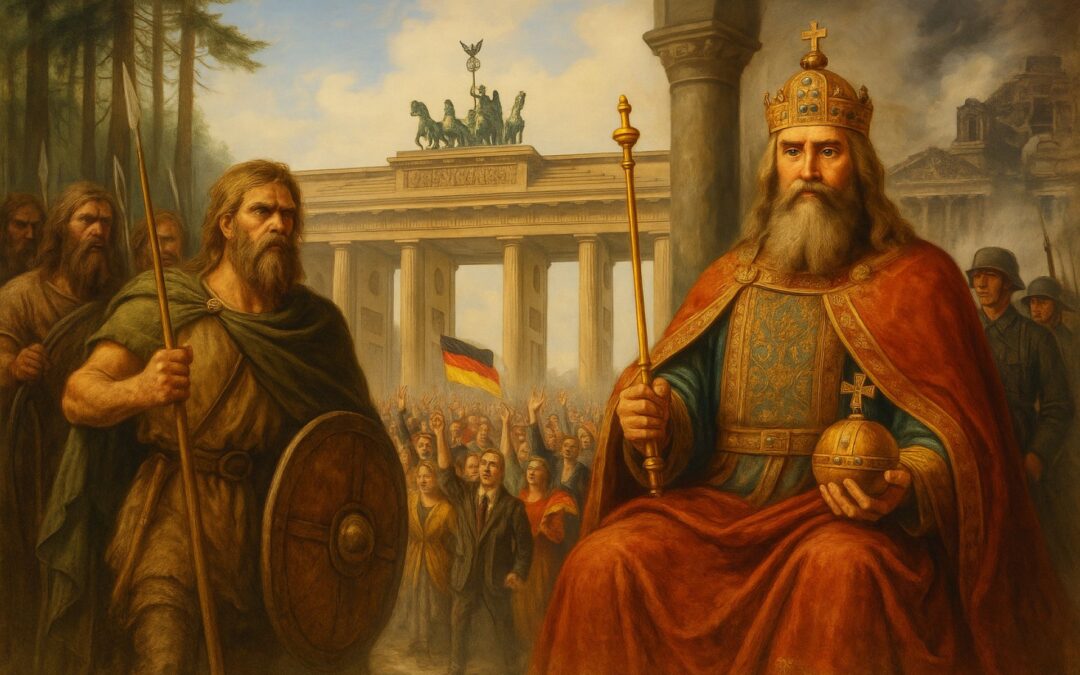
Germany’s story is one of constant reinvention. From the hunter-gatherers who roamed its forests after the Ice Age, to the rise of powerful empires, devastating wars, and the rebirth of a modern republic, the nation has endured cycles of fragmentation and unity, collapse and renewal.
No other land in Europe has been as central to the continent’s fate—whether resisting Rome’s legions, shaping medieval Christendom, igniting the Protestant Reformation, or standing at the fault line of the Cold War. Its history is marked by both towering cultural achievements and unimaginable tragedy, a duality that continues to define its character. To trace Germany’s past is to trace the very currents of European civilization itself.
Ancient Beginnings
The story of Germany begins long before there was anything resembling a nation. The land itself was the first architect. As the glaciers of the Ice Age receded, valleys opened up, rivers carved their way through soil, and vast forests unfurled across central Europe. In these landscapes, Mesolithic hunter-gatherers stalked deer and boar, their lives dictated by the rhythm of seasons and the availability of game. By the time Neolithic farmers arrived, these same valleys became fertile grounds for agriculture. Wheat, barley, and rye were planted, while cattle, pigs, and sheep grazed in clearings hacked out of dense woodland.
Centuries passed, and new waves of people brought new technologies. The Bronze Age introduced metallurgy, with artisans crafting weapons, jewelry, and ceremonial goods that signified social hierarchies. Iron Age societies advanced further, organizing into tribes and clans with distinct identities. The Celts dominated southern regions, constructing fortified hillforts and perfecting intricate metalwork. In the north, Germanic tribes descended from Scandinavia, carving out their place along the Elbe and beyond. These migrations marked the first great divide: the Celts to the south and the Germanic tribes to the north. By the final centuries BC, central Europe was already a cultural crossroads, shaped as much by geography as by human ambition.
Clash with Rome
Rome’s inexorable expansion eventually reached the forests of Germania. Julius Caesar was the first Roman general to cross the Rhine, describing its people as wild, untamed, and fiercely independent. His expeditions were more exploratory than conquering, but they set the stage for Rome’s fascination with this rugged land. Under Emperor Augustus, the Roman legions returned with far more serious intent. The vision was clear: Germania should be brought into the orbit of the empire.
The plan met its doom in 9 AD. In the dense thickets of Teutoburg Forest, Arminius—a Germanic chieftain trained by the Romans themselves—sprang an ambush that obliterated three legions. Over 20,000 Roman soldiers were massacred, their standards captured, their dreams of conquest extinguished. The defeat was so total, so humiliating, that Rome never attempted wholesale annexation again. Instead, the empire fortified its boundaries along the Rhine and Danube with forts, watchtowers, and walls, known collectively as the Limes Germanicus.
But borders could not block influence. Roman towns sprang up near the frontier—Cologne, Mainz, Regensburg—serving as conduits for trade and culture. Germanic warriors joined Roman auxiliary forces, learning tactics, discipline, and even Latin. Roman pottery, coins, and agricultural tools seeped across the divide, yet Germanic tribes preserved their autonomy. They maintained decentralized leadership, ruled by warrior elites, and worshiped gods like Wodan (Odin) and Donar (Thor). Life beyond the frontier remained simpler and communal, more village than city, more oral tradition than written law. The Rhine became less a wall than a membrane—allowing exchange, but never complete absorption.
The Great Migrations
The late 4th century was a turning point that forever altered the trajectory of Europe. A new menace—the Huns—swept in from the steppes, pushing before them a wave of terrified tribes. Germanic peoples such as the Visigoths sought refuge within the Roman Empire, crossing the Danube with imperial permission. Yet desperation turned to rebellion. At Adrianople in 378, the Goths crushed a Roman army, exposing the empire’s weakness. Over the next century, tribe after tribe surged across imperial frontiers. The Vandals, once camped in the forests of central Europe, trekked through Gaul into Spain and eventually North Africa, carving out a maritime empire from Carthage. The Suebi settled in Galicia. The Visigoths wandered from Italy into Spain, sacking Rome itself in 410 under Alaric’s leadership, a symbolic blow that reverberated across the known world.
Meanwhile, the Angles, Saxons, and Jutes crossed the North Sea to establish new kingdoms in Britain, reshaping its cultural identity. Burgundians settled in Gaul, and the Franks, pragmatic and resilient, steadily expanded their territory in the same region. By the close of the 5th century, the Western Roman Empire had collapsed entirely. Its grandeur gave way to a patchwork of kingdoms built by so-called “barbarian” peoples. Yet these new realms were not mere destroyers of Rome’s legacy—they fused Germanic traditions of kinship and warrior loyalty with Roman law, administration, and the Christian faith. This fusion would become the bedrock of medieval Europe.
The Frankish Legacy and Charlemagne
Of all the new powers that emerged from the migration chaos, none proved more decisive than the Franks. Under King Clovis I, they united much of Gaul and parts of western Germany, blending Germanic vigor with Roman-Christian legitimacy. Clovis’s baptism into Catholic Christianity ensured the support of the Roman Church, a bond that would echo for centuries.
Two centuries later, his Carolingian descendants forged an empire of staggering proportions. The most formidable of them, Charlemagne, embarked on an almost ceaseless campaign of conquest. His armies subdued the Lombards in Italy, vanquished the Bavarians, and waged a ruthless thirty-year struggle against the Saxons, forcibly Christianizing them with fire and sword. His empire stretched from the Pyrenees to the Elbe, from northern Italy to the North Sea. Aachen, his chosen capital, became a center of learning and governance, where scholars from across Christendom gathered in what is remembered as the Carolingian Renaissance.
On Christmas Day in the year 800, Charlemagne’s authority reached its zenith. In St. Peter’s Basilica, Pope Leo III placed a crown upon his head, proclaiming him “Emperor of the Romans.” The act was more than ceremonial—it was a symbolic revival of the Western Roman Empire, anchoring the idea that Germany’s kings could claim imperial authority. Yet, like Rome before him, Charlemagne’s empire did not endure intact. After his death in 814, his heirs divided the realm, and East Francia—the eastern heartland—emerged under Louis the German. Out of this fragment would grow the medieval German kingdom, and with Otto the Great’s coronation in 962, the mantle of empire would be taken up once more, binding German kingship to the Roman legacy for centuries.
Fragmentation of the Holy Roman Empire
The empire that Otto the Great had rekindled in 962 wore the crown of Rome but never its centralized power. Instead, medieval Germany developed into a sprawling patchwork of duchies, bishoprics, counties, and free cities. Each lord, bishop, or burgher jealously defended local privileges, often resisting the emperor’s will. Attempts at unification by charismatic rulers such as Frederick Barbarossa in the 12th century and his grandson Frederick II in the 13th brought temporary cohesion but ultimately collapsed under the weight of competing interests.
The balance tilted decisively in 1356 with Emperor Charles IV’s Golden Bull. This decree formalized the process of electing emperors through seven prince-electors—powerful rulers who now held the destiny of the crown in their hands. The act ensured the emperor would remain first among equals, not an absolute monarch. Yet this political disunity did not stifle shared culture. Germans of the Middle Ages raised monumental Gothic cathedrals like Cologne’s, which took centuries to complete. Merchants of the Hanseatic League bound together port cities like Lübeck and Hamburg, building a maritime trade empire that reached from London to Novgorod. Scholars established universities such as Heidelberg in 1386, nurturing intellectual life. German knights marched on crusades, while eastward settlement carried language, law, and custom into Slavic territories. Fragmentation may have prevented political unity, but it fostered a vibrant, diverse society stitched together by language, faith, and commerce.
Reformation and Religious Wars
In 1517, the hammer blows of a monk in Wittenberg echoed far louder than anyone could have imagined. Martin Luther’s 95 Theses, denouncing indulgences and corruption in the Catholic Church, ignited a religious revolution. The timing was fortuitous: Gutenberg’s printing press, invented decades earlier in Mainz, amplified Luther’s message, spreading it rapidly across Europe. German princes in the north and east seized upon Protestantism, some driven by conviction, others by the chance to assert independence from Catholic Habsburg emperors. The south and west remained loyal to Rome, splitting the empire into two spiritual camps.
This rift soon erupted into violence. Emperor Charles V tried to restore unity by force, defeating Protestant armies at Mühlberg in 1547. Yet his victory proved fleeting. The Peace of Augsburg in 1555 institutionalized division by allowing each ruler to choose the faith of his territory—cuius regio, eius religio. Still, the compromise was fragile. Underlying tensions boiled over in 1618, beginning with the Defenestration of Prague, when rebellious Protestant nobles hurled Catholic envoys from a castle window. The Thirty Years’ War that followed ravaged the German lands more brutally than any conflict before it.
For three decades, armies from across Europe trampled through towns and villages. Fields lay fallow, famine spread, and plague followed in the wake of soldiers. Population losses were catastrophic: some regions lost half their people. By the war’s end in 1648, the Peace of Westphalia reaffirmed the empire’s fractured structure, granting sovereignty to hundreds of states. Germany emerged devastated, politically divided, and socially scarred. Yet the religious settlement forged here set the template for modern notions of state sovereignty and tolerance, even if born from unimaginable suffering.
Prussia and Austria Ascend
By the late 17th century, Germany was less a unified realm than a chessboard of princes. Yet two players began to tower above the rest: Austria and Prussia. The Habsburg dynasty, ruling from Vienna, had long dominated Central Europe. Their influence stretched beyond Austria into Bohemia, Hungary, and parts of Italy, giving them not only German authority but also a vast, multiethnic empire. The Habsburgs were defenders of Catholicism and wielded the imperial crown more often than not, but their energies were stretched thin across too many borders.
Prussia, by contrast, emerged from obscurity. The Hohenzollerns of Brandenburg, ruling from Berlin, transformed a scattered collection of territories into a disciplined state. The “Great Elector” Frederick William (1640–1688) laid the groundwork, building a formidable standing army and centralizing authority with ruthless efficiency. His successors refined this model, turning Prussia into a military machine.
The apogee came under Frederick II—better known as Frederick the Great (1740–1786). He embodied both the Enlightenment prince and the iron-willed general. Frederick reformed the bureaucracy, streamlined taxation, and modernized agriculture, all while cultivating music, philosophy, and letters. Yet his true genius lay on the battlefield. During the War of Austrian Succession and the Seven Years’ War, he defied seemingly insurmountable odds, facing coalitions of Austria, Russia, France, and others. Though often outnumbered, his discipline and daring kept Prussia alive—and even enlarged it.
By 1763, Prussia had doubled its territory and earned recognition as a European great power. From this point forward, German affairs revolved around the duel between Habsburg Austria and Hohenzollern Prussia. Their rivalry would shape diplomacy, spark wars, and, eventually, determine who would lead the German people toward unity.
Napoleonic Shocks and Nationalism
The end of the 18th century brought upheaval from France. The French Revolution (1789) sent shockwaves through Europe. German intellectuals, steeped in Enlightenment ideals, watched with fascination as liberty, equality, and fraternity stormed across the Rhine. Yet the monarchies of Vienna and Berlin recoiled in horror. When they intervened militarily to restore the French king, they found themselves swept into a maelstrom.
Napoleon Bonaparte, rising from the chaos, shattered Prussian armies and humbled Austria. His reorganization of Germany was nothing short of revolutionary. In 1806, he dissolved the thousand-year-old Holy Roman Empire, a relic of Charlemagne’s dream. In its place, he established the Confederation of the Rhine, a federation of German states bound to French power. Sixteen princes bent the knee, aligning their fortunes with Napoleon. The once mighty imperial crown was gone, its authority extinguished by French arms.
Yet French domination sowed seeds Napoleon could not control. His reforms swept away feudal privileges, introduced modern legal codes, and—ironically—awakened a sense of German national identity. Intellectuals like Fichte and poets like Arndt spoke of a shared German spirit, no longer content with being pawns of foreign empires.
After Napoleon’s disastrous march into Russia and his defeat at Leipzig in 1813—the “Battle of Nations,” fought largely on German soil—Prussian and Austrian troops helped deliver the final blow. At the Congress of Vienna in 1815, Europe’s victors redrew the map. Germany was reconstituted not as one nation but as a loose German Confederation of 39 states. It was a compromise—order restored, but unity deferred.
Still, nationalism smoldered. Students, writers, and thinkers dreamed of one Germany, bound not by a patchwork of princes but by a common destiny. Though suppressed by conservative rulers, this longing would erupt again before the century was out, and it would be Prussia, not Austria, that seized the mantle of leadership.
Bismarck and Unification
By the mid-19th century, the German Confederation was a fragile balance of 39 states—each guarding its sovereignty, each wary of its neighbors. The dream of unity lingered, but revolutions in 1848 had failed to achieve it. Into this vacuum stepped Otto von Bismarck, appointed Prussia’s Minister President in 1862. Shrewd, pragmatic, and utterly unsentimental, Bismarck believed in achieving national unity not through speeches or parliaments, but through what he famously called “blood and iron.”
His strategy was deliberate. First, he struck against Denmark in 1864, partnering temporarily with Austria to seize the duchies of Schleswig and Holstein. Victory emboldened him, but he had no intention of sharing spoils. Two years later, in 1866, Bismarck provoked Austria into conflict. The resulting Austro-Prussian War, culminating in the Battle of Königgrätz, was decisive. Prussia’s modernized army and efficient rail mobilization crushed Austria in a matter of weeks. Austria was forced to withdraw from German affairs altogether. In the war’s aftermath, Bismarck established the North German Confederation under Prussian dominance.
The southern states—Bavaria, Württemberg, Baden, and Hesse—remained outside this federation. Bismarck, however, knew that only an external threat could bind them to Prussia. That opportunity arrived in 1870, when tensions with France erupted into the Franco-Prussian War. Napoleon III, underestimating Prussia, declared war. What followed was a stunning demonstration of German unity. The southern states rallied behind Prussia, German armies encircled French forces at Sedan, and Napoleon III himself was captured.
In January 1871, the culmination came in the Hall of Mirrors at Versailles. Surrounded by princes and generals, King Wilhelm I of Prussia was proclaimed Kaiser of the newly united German Empire. The symbolism was unmistakable: the humiliation of France and the birth of a new European titan. The empire, rich in coal, iron, and human talent, industrialized at a staggering pace. By the turn of the century, Germany rivaled Britain and the United States in steel production, chemical research, and scientific innovation. Intellectuals like Nietzsche and scientists like Einstein emerged in this fertile environment, while composers like Wagner embodied cultural grandeur.
Bismarck, as Chancellor, guided the empire with a careful hand. He pioneered social welfare systems—pensions, health insurance, accident compensation—designed to blunt the appeal of socialism. Abroad, he crafted a web of alliances to isolate France and keep peace in Europe. Germany, he declared, was a “satiated power” with no territorial ambitions. But his cautious realism would not long outlast him. In 1890, Kaiser Wilhelm II dismissed the Iron Chancellor, setting Germany on a more reckless path.
The World Wars
Wilhelm II, restless and ambitious, envisioned Germany as a world power to rival Britain’s empire. He poured resources into building a navy that challenged British supremacy and sought colonies in Africa and the Pacific. This aggressive Weltpolitik strained relations across Europe. By 1914, Germany was locked into an alliance with Austria-Hungary, while France, Britain, and Russia drew closer in opposition. Europe was a powder keg; the assassination of Archduke Franz Ferdinand in Sarajevo was the spark.
When Austria declared war on Serbia, Germany backed its ally with fervor, triggering the First World War. The German army swept into Belgium and nearly reached Paris before being halted on the Marne. The war then settled into the grim stalemate of trenches. German victories in the east against Russia could not offset the grinding attrition on the Western Front. By 1918, exhausted by blockade, shortages, and staggering casualties—more than two million dead—Germany collapsed. Kaiser Wilhelm II abdicated, and the armistice silenced the guns.
The Treaty of Versailles in 1919 imposed crippling reparations, territorial losses, and the infamous “war guilt” clause. Humiliation and economic turmoil haunted the new Weimar Republic, a fragile democracy wracked by hyperinflation, political assassinations, and extremist movements. When the Great Depression struck in 1929, faith in democratic politics evaporated. Into this crisis marched Adolf Hitler and the Nazi Party.
By 1933, Hitler had transformed Germany into a totalitarian state. He outlawed opposition, militarized society, and unleashed virulent antisemitism. Jews were stripped of rights, persecuted, and ultimately targeted in the Holocaust, one of history’s darkest crimes. Hitler’s foreign policy tore up Versailles: rearmament, the remilitarization of the Rhineland, the annexation of Austria, and the seizure of Czechoslovakia. On September 1, 1939, Germany invaded Poland, prompting Britain and France to declare war.
The Second World War saw German forces sweep across Europe with terrifying speed. By 1941, Nazi control stretched from Norway to Greece, from France to the gates of Moscow. But hubris proved fatal. The invasion of the Soviet Union bogged down, and after Stalingrad, German armies were pushed back. Meanwhile, Allied forces invaded from the west. By 1945, Germany lay in ruins—its cities bombed to rubble, its people broken, its crimes exposed. Hitler’s suicide in his Berlin bunker marked the regime’s collapse. On May 8, 1945, Germany surrendered unconditionally.
From the ashes of two world wars, Germany’s very existence as a unified nation was once again called into question.
Division and Reunification
In the wake of the Second World War, Germany ceased to exist as a singular nation. The Allies divided it into four zones of occupation—American, British, French, and Soviet. At first, this arrangement was meant to be temporary, a mechanism to demilitarize and rebuild the country. Yet as relations between the Western Allies and the Soviet Union deteriorated, Germany became the very frontline of the Cold War. By 1949, the split was formalized. In the west, the three Allied zones merged into the Federal Republic of Germany (FRG), better known as West Germany. It embraced democracy, market economics, and integration with Western Europe. In the east, the Soviet zone became the German Democratic Republic (GDR), a communist state bound to Moscow.
The differences between the two states could not have been more stark. West Germany, aided by the Marshall Plan, underwent an “economic miracle” (Wirtschaftswunder). Cities rebuilt from rubble sprouted modern industries, exports soared, and standards of living climbed. Bonn became its modest capital, but the FRG was anything but small—by the 1960s, it was one of the world’s largest economies. Meanwhile, East Germany industrialized under central planning, but life was constrained by shortages, surveillance, and political repression. The ruling Socialist Unity Party, backed by the Stasi secret police, stamped out dissent.
Berlin was the epicenter of division. Though located deep within the GDR, the city itself was split between East and West. In 1961, East German authorities, with Soviet backing, built the Berlin Wall—concrete and barbed wire that not only divided a city but symbolized the Iron Curtain across Europe. Families were separated, escape attempts were deadly, and the Wall became a grim reminder of ideological confrontation.
Decades of division followed. West Germany anchored itself in NATO and the European Economic Community, while East Germany marched in step with the Warsaw Pact. Yet the GDR’s economy stagnated in the 1980s, and its people grew restless. Inspired by reform movements across Eastern Europe, East Germans began to stage peaceful protests demanding freedom. The climax came on November 9, 1989, when the GDR government unexpectedly announced new travel freedoms. Thousands surged to the checkpoints, guards stood down, and jubilant crowds began tearing down the Berlin Wall with hammers and bare hands.
Less than a year later, on October 3, 1990, Germany was formally reunified. The five eastern states were re-established and joined the FRG, creating a single sovereign nation once more. Berlin regained its status as the capital. The process was not without strain—economic disparity between east and west persisted, and the costs of integration were enormous. Yet the symbolism was undeniable: a divided nation, after four decades, was made whole again.
Modern Germany
The reunified Germany stepped into the 21st century as Europe’s anchor. With more than 80 million citizens, it became the most populous country on the continent and the engine of the European Union. Its economy, rooted in engineering, automotive excellence, and high-tech industries, propelled it to global prominence. Companies like Volkswagen, Siemens, and BMW became household names worldwide, while the country’s Mittelstand—the backbone of small and medium enterprises—ensured resilience and innovation.
Politically, Germany emerged as a stabilizing force. Leaders such as Helmut Kohl, Gerhard Schröder, and Angela Merkel guided the nation through milestones: the adoption of the euro, EU expansion, and global crises from the 2008 financial collapse to the 2015 refugee influx. Merkel, in particular, became a symbol of pragmatism and steadiness, steering Germany for 16 years and cementing its role as Europe’s de facto leader.
Culturally, Germany embraced both remembrance and renewal. Memorials and museums dedicated to the Holocaust and the tragedies of war stood alongside thriving art, film, and music scenes. Berlin, once scarred by walls and checkpoints, reinvented itself as a vibrant global capital of creativity and cosmopolitanism. Universities and research institutes placed Germany at the forefront of science, renewable energy, and climate policy.
Yet challenges remain. The integration of eastern and western regions, though advanced, is not complete. Far-right populism has tested the nation’s democratic fabric, while demographic decline and energy transitions pose questions for the future. Still, Germany’s ability to reinvent itself—from tribal lands to empire, from ruin to republic, from division to unity—demonstrates a resilience unmatched in European history. Today, it stands not as a conqueror, but as a peaceful, democratic, and innovative leader on the global stage.
Conclusion
Today’s Germany bears the weight of its history while forging a role as a stabilizing force in Europe and beyond. From its tribal beginnings to the might of the Holy Roman Empire, from the horrors of world wars to the jubilation of reunification, the nation’s path has never been a linear one.
Yet through it all, Germany has emerged resilient—an industrial powerhouse, a cultural beacon, and a democratic leader. Its journey stands as proof that even lands scarred by conflict can reinvent themselves, that unity can follow division, and that a country once fractured by walls can rise to embody peace and progress in the modern world.