
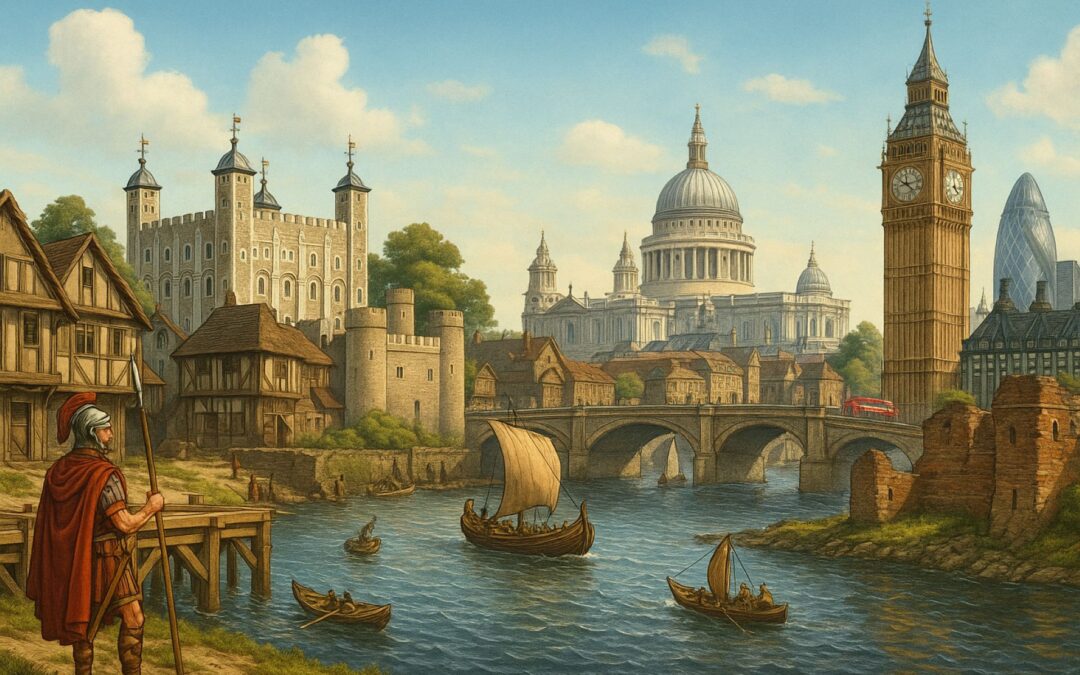
London is no ordinary city. For over two millennia, it has stood at the confluence of conquest, commerce, and culture—forever torn down, rebuilt, and reimagined. From its birth as a Roman outpost on the banks of the Thames to its rise as the beating heart of an empire, London’s history is a tale of resilience and reinvention. Fire, plague, rebellion, and war have scarred its streets, yet each calamity only carved new layers into its character.
Today, it thrives as one of the most diverse and influential metropolises on earth, a living archive where ancient ruins meet glass towers and the voices of every continent mingle in its markets. To understand London is to trace the arc of human ambition itself, etched into stone, steel, and story.
Londinium: Rome’s Frontier Outpost
The Thames Valley in the mid-first century was wild country—dense forests, muddy floodplains, and scattered Celtic tribes who fished, farmed, and worshipped their gods in sacred groves. Into this untamed land marched the legions of Rome in 43 AD. Their arrival was not an exploratory visit but a decisive act of imperial ambition: Claudius, eager to secure glory, sought to bring the mysterious island of Britain into the fold of the Empire.
Londinium was founded soon after, its birth rooted in strategy rather than symbolism. The chosen site sat at the narrowest practical crossing of the Thames, an ideal point for a bridge that would stitch together the Roman road network with the vital artery of the river. From here, supplies could be ferried, troops deployed, and commerce regulated. The first Londinium was a modest affair—timber buildings, earth ramparts, and docks jutting into the water—but it had a pulse. Merchants unloaded amphorae of wine, olive oil, and garum; in exchange, Britain exported hides, metals, and grain.
Yet the settlement’s infancy was fragile. In 60 AD, a conflagration swept through as Queen Boudica of the Iceni rose in revolt. Stung by Roman exploitation and the brutal treatment of her family, Boudica rallied tribes in a fury that torched Colchester, St. Albans, and Londinium itself. Contemporary accounts describe Londoners fleeing in terror, leaving the city to the flames. Thousands were slaughtered, and the budding colony seemed destined for oblivion.
Rome, however, excelled at resurrection. The ruins were cleared, and within a generation, Londinium was reborn with a grandeur befitting empire. The grid-pattern streets mirrored those of Rome, lined with tiled houses, shops, and workshops. Public spaces declared authority: a massive forum served as both marketplace and civic center, while the basilica towered over the skyline—a cathedral of bureaucracy and law. Temples honored Jupiter and Mithras; an amphitheater hosted blood-soaked spectacles of gladiators and wild beasts.
By the 2nd century, Londinium had eclipsed Colchester as Britannia’s capital, boasting as many as 60,000 inhabitants. The city’s walls, built around 200 AD, encircled its core with stone ramparts nearly three miles long, punctuated by imposing gates—Aldgate, Ludgate, Bishopsgate—through which carts, traders, and soldiers streamed daily. These defenses were both practical and symbolic: Londinium was no longer a frontier outpost but a city of permanence, a northern jewel in the imperial crown.
Yet as Rome’s strength faltered in the 4th century, so too did Londinium. By 410, the legions had departed, summoned home to defend a crumbling empire. The streets grew silent, forums deserted, temples roofless. The once-proud capital became a ghost city, its great walls guarding only memories.
Saxon Lundenwic and Viking Fury
For two centuries, London lay in a kind of slumber, its Roman grandeur reduced to ruins overgrown with weeds. The Saxons, Germanic tribes migrating from what is now Germany and Denmark, bypassed the decaying Roman site and built anew to the west. Their settlement, known as Lundenwic, rose on open ground near modern-day Covent Garden. It was less fortified than its Roman predecessor but thrived as a trading hub. The Thames carried merchants from across the North Sea, and Lundenwic bustled with markets, timber houses, and craft workshops.
The foundation of St. Paul’s Cathedral in 604 by Bishop Mellitus added spiritual weight. Though modest compared to later incarnations, it was a beacon of Christianity amidst lingering pagan practices, signaling the Saxons’ gradual conversion. The cathedral was also symbolic—a declaration that London would not just be a place of trade but of faith and learning.
By the 8th century, Lundenwic had grown into one of England’s most important ports, home to perhaps 10,000 people. It traded wool, leather, and slaves, receiving luxuries such as wine, quernstones, and fine pottery. Archaeological evidence reveals bustling markets, workshops producing bone combs and glass beads, and imported wares from as far afield as Gaul and the Rhineland.
This prosperity, however, made it irresistible to raiders. In 793, the first Viking attack on Lindisfarne monastery announced a new era of terror, and London was soon in their sights. By the 830s, Viking longships prowled the Thames, plundering churches and settlements. Their attacks escalated from sporadic raids to sustained campaigns. In 871, the Great Heathen Army, a coalition of Norse warriors, seized London, camping within the decaying Roman walls for strategic cover.
The city’s salvation came in 886, when Alfred the Great retook it. Understanding the value of the Roman fortifications, he ordered the population of Lundenwic to relocate within the old city walls, reestablishing the settlement as Lundenburg. Alfred rebuilt the ramparts, restored the bridge over the Thames, and created a fortified burh (stronghold) that could resist Viking assaults. This decision was pivotal. Without it, London might have remained a secondary port; instead, it regained its stature as a political and commercial powerhouse.
Despite further Viking incursions in the 10th and 11th centuries, Lundenburg endured. Its fortifications held, its markets thrived, and its reputation grew. By the time Edward the Confessor founded Westminster Abbey in the mid-11th century, London had already eclipsed Winchester in wealth and significance. The stage was set for its transformation under Norman rule into the unquestioned capital of England.
The Norman Transformation
The Norman conquest in 1066 was more than a dynastic reshuffling—it was a tectonic shift in London’s identity. After William of Normandy defeated Harold Godwinson at Hastings, he marched swiftly on London. The city, wary of resistance, opened its gates, and on Christmas Day William was crowned king in Westminster Abbey. That moment welded London to the monarchy in a way no other city could rival.
The Normans understood power was not merely proclaimed but displayed in stone. At the eastern edge of the city, William ordered the construction of a great fortress—what would become the Tower of London. Initially a timber stronghold, it was soon rebuilt in gleaming Caen stone, imported from Normandy, to emphasize permanence. Its massive keep, the White Tower, dominated the skyline and intimidated the population. Over the centuries, the Tower expanded into a symbol of royal authority and fear—part palace, part prison, part arsenal, part execution ground.
Beyond fortresses, the Normans reshaped governance. London, though flourishing, was still technically beholden to royal power. Yet William recognized the city’s economic clout and granted charters that secured its privileges. Merchants prospered, guilds proliferated, and foreign communities—French vintners, Flemish weavers, Jewish financiers—settled within its walls, making London a hub of cosmopolitan commerce long before the word existed.
The lifeblood of trade demanded infrastructure. In 1209, a new stone London Bridge was completed, replacing the unreliable timber versions that had spanned the Thames for centuries. Unlike the simple crossings of old, this bridge was lined with shops, houses, and even a chapel in the middle. It became a microcosm of the city itself: noisy, crowded, alive with commerce, and perilously perched over flowing water. For more than six hundred years, it remained the only pedestrian crossing of the Thames in central London.
London’s independence was further entrenched in 1215, when the city’s rights were formally acknowledged in the Magna Carta. Unlike other towns, London enjoyed the privilege of electing its own mayor—Henry Fitz-Ailwin, the first, had already taken office in 1189—and governing itself through civic institutions. These liberties separated London from the feudal web binding the rest of England, giving it a character that was fiercely protective of autonomy.
By the late medieval period, the city’s guilds had become its backbone. The Weavers’ Company, established in 1155, was the first of many. Soon followed the Mercers, Goldsmiths, Brewers, Fishmongers, and more, each regulating their trade with obsessive precision. Standards were enforced, apprenticeships created, and wealth pooled into elaborate halls that still stand today. Together, they gave London not only economic stability but a civic identity rooted in craft, trade, and self-governance.
By the dawn of the 14th century, London had grown into a bustling metropolis of over 80,000 people. Its narrow lanes and timber houses bustled with bakers, smiths, and merchants. Yet this prosperity came with fragility, for disease and unrest waited in the shadows.
Plague, Revolt, and the Tudor Dawn
The medieval city was a paradox: rich yet vulnerable, vibrant yet filthy. Its crowded streets, open sewers, and lack of sanitation created perfect conditions for epidemics. None proved more catastrophic than the Black Death of 1348–49. Carried by fleas and rats, the plague tore through London with terrifying speed. At its height, 200 people died every day. Entire parishes vanished, trade halted, and the population shrank by nearly half. Death pits were dug outside the city walls to contain the corpses, grim reminders of mortality in a city that had grown too fast for its own infrastructure.
Survivors rebuilt, but grievances simmered. Taxes imposed to finance the ongoing wars with France fell heavily on peasants and artisans. In 1381, frustration exploded into the Peasants’ Revolt. Thousands marched into London under leaders like Wat Tyler and John Ball, storming across London Bridge. They torched palaces, executed officials, and looted at will. For a few chaotic days, London was in the hands of commoners. The uprising ended brutally—Tyler was killed, promises broken—but its memory lingered as proof of the city’s combustible social fabric.
Crime was another constant. With no professional police force, justice relied on spectacle and terror. Thieves might find themselves clamped in the stocks at Cheapside; traitors could expect a gruesome beheading at Tower Hill; highwaymen and murderers met their fate at Tyburn, where public hangings were treated as macabre festivals. Law and order were fragile constructs, held together by fear and ritual punishment rather than systematic enforcement.
Yet even as plague and rebellion scarred London, the city grew in stature. By the 15th century, it was Europe’s beating mercantile heart. The lure of trade drew migrants from across England and beyond, swelling its population once more. Timber houses crowded against one another; markets overflowed with wool, cloth, and imported luxuries. The skyline, meanwhile, was punctuated by spires and church towers, proclaiming the city’s wealth in stone.
The Tudor dynasty accelerated this momentum. Under Henry VII and his successors, London’s population quadrupled from 50,000 in 1500 to over 200,000 by 1600. The city spilled beyond its ancient walls into suburbs like Southwark and Shoreditch. Merchants organized themselves into vast trading corporations—the Muscovy Company, the East India Company—which expanded commerce to Russia, Africa, and the New World. London was no longer just England’s largest city; it was becoming Europe’s financial engine and the launchpad of a burgeoning empire.
Culture too blossomed. Taverns, inns, and brothels catered to Londoners’ appetites, but it was the theater that defined the age. At first staged in inn-yards, plays became so popular that permanent playhouses were built beyond the city walls. The most famous of these, the Globe Theatre, hosted Shakespeare’s works, immortalizing London as a capital of drama and imagination. The Tudor city, noisy and unruly, became not only the center of trade and politics but also the birthplace of modern English culture.
Fire, Rebuilding, and Empire
The Stuart period thrust London into a maelstrom of political upheaval, pestilence, and flame. The century began with intrigue—the Gunpowder Plot of 1605, when Guy Fawkes and his fellow conspirators attempted to blow up Parliament. Their failure set the tone for a city forever perched on the edge of crisis. By 1642, England had erupted into civil war, and London, wary of King Charles I’s autocratic leanings, declared itself for Parliament. Earthen fortifications were hastily raised around the city, transforming London into a fortress against royalist armies. When Parliament triumphed, Charles was captured and, in 1649, executed in Whitehall. For the first and only time, England became a republic, with London as its uneasy heart.
But calamities came not from politics alone. In 1665, the city was struck by the Great Plague. Carried on the backs of fleas, the disease killed 60,000 Londoners in a single summer. The dead were carted off in wagons by night, their bodies piled into pits. Doors of infected houses were painted with red crosses and sealed shut. Silence fell over once-bustling streets. As if this was not ruin enough, the following year brought inferno. In September 1666, a bakery fire on Pudding Lane grew into the Great Fire of London, whipped by winds that carried flames through the timbered warrens of the medieval city. Four days later, more than 13,000 houses, 87 churches, and St. Paul’s Cathedral lay in smoldering ruin.
Yet from destruction came renewal. Parliament decreed that rebuilding must be done in stone and brick, eliminating the tinderbox conditions that had fueled the blaze. At the forefront of reconstruction was Sir Christopher Wren, whose masterwork, the domed St. Paul’s Cathedral, still dominates the skyline. Wren also designed 52 new churches, weaving elegance and order into a city long known for its chaotic sprawl. A monument to the fire was erected—a tall Doric column that still stands as a reminder of catastrophe and resilience.
This rebuilding coincided with London’s deepening entanglement in empire. By the late 17th century, the West End was flourishing as an aristocratic playground, filled with grand mansions, coffee houses, and theaters. In contrast, the City of London, centered around Cheapside and the Royal Exchange, pulsed with mercantile energy. Here stood the Bank of England (established 1694), Lloyd’s of London, and the headquarters of the East India Company. The docks along the Thames teemed with ships unloading spices, tea, sugar, and textiles from across the globe. London was no longer just a capital—it was the empire’s counting house, fueling Britain’s transformation into a world power.
The 18th and 19th Centuries: Expansion and Industry
By 1700, London had swollen into Europe’s largest city, a polyglot metropolis of half a million souls. Immigration brought Irish laborers, Jewish merchants, Huguenot silk weavers, and African and Asian sailors into its neighborhoods. The city’s landmarks reflected both grandeur and governance. In 1732, 10 Downing Street became the official residence of Britain’s Prime Minister. In 1761, George III acquired Buckingham House, soon to be remodeled into Buckingham Palace. Bridges proliferated to ease the crush on London Bridge: Westminster Bridge opened in 1750, followed by Blackfriars in 1769.
The Industrial Revolution accelerated everything. By 1800, London was home to more than one million people; by 1900, over 6.5 million. This tidal wave of humanity created extremes: vast wealth and crushing poverty. In Mayfair and Belgravia, the elite dined in glittering townhouses. In the East End, families crammed into airless tenements where disease thrived. These slums inspired the novels of Charles Dickens—grim portraits of orphans, thieves, and workhouses.
Crime became a defining challenge. In 1829, Home Secretary Robert Peel founded the Metropolitan Police, nicknamed “Bobbies” or “Peelers.” It was the world’s first modern urban police force, tasked with patrolling not just the City but the sprawling suburbs that railways had stitched into the capital. Their presence was soon tested in the East End by the gruesome murders of Jack the Ripper in the 1880s, crimes that transfixed the world and underscored the darkness festering in industrial London.
Transport reshaped the city. Railways radiated outward from colossal termini—Euston, King’s Cross, Paddington—pulling new suburbs into London’s orbit. In 1863, the Underground debuted as the world’s first subterranean railway, linking Paddington to Farringdon and setting a precedent followed across the globe. Steamships in the Thames connected London directly to empire, while iron bridges such as Tower Bridge (opened 1894) fused engineering ingenuity with civic pride.
London also presented itself as the beating heart of progress. The Great Exhibition of 1851, housed in the glittering glass-and-iron Crystal Palace, displayed inventions, machinery, and wonders from across the world, attracting six million visitors. Yet the veneer of grandeur concealed squalor. The city’s reliance on the Thames as an open sewer triggered repeated outbreaks of cholera, killing tens of thousands. By 1858, the river had become so foul that the stench—dubbed the Great Stink—overwhelmed Parliament itself. Salvation came through the genius of engineer Joseph Bazalgette, who designed a revolutionary sewer system that carried waste downstream. This intervention not only banished cholera but laid the foundations of modern sanitation, saving more lives than any general or politician of the era.
By the end of the 19th century, London was the largest city on Earth, the capital of an empire on which the sun never set. Its palaces, parliaments, and factories broadcast power, but its slums, strikes, and scandals revealed the human cost of empire. It was a city of contradictions—majestic and squalid, global yet intensely local, ancient in its bones and modern in its ambitions.
War and Resilience in the 20th Century
London entered the 20th century as the beating heart of the British Empire, its docks pouring in goods from India, Africa, the Caribbean, and beyond. But behind the imperial grandeur, the city was vulnerable to a new and terrifying reality: modern warfare. During World War I, German Zeppelins floated silently over the rooftops and dropped their bombs on unsuspecting civilians. Later, Gotha bombers followed, marking the first time Londoners experienced the fear of aerial attack. Though the death toll—around 670 people—was modest compared to the carnage on the Western Front, the psychological shock was profound. London was no longer untouchable; the war had breached its skies.
The true trial came in World War II. In September 1940, the Luftwaffe unleashed the Blitz, a relentless bombing campaign that lasted 57 consecutive nights and continued sporadically until May 1941. The East End, with its docks and warehouses, bore the brunt of destruction. Incendiaries turned entire streets into firestorms. Families huddled in Underground stations, the platforms transformed into makeshift dormitories. Children had been evacuated months earlier to the countryside in one of the largest mass relocations in British history. Yet for those who stayed, daily life became an endurance test of courage, resourcefulness, and grief.
The losses were staggering: more than 30,000 Londoners killed, hundreds of thousands of homes destroyed, and iconic neighborhoods reduced to rubble. Yet the city refused to break. Images of St. Paul’s Cathedral, its dome rising intact above smoke and flame, became a symbol of London’s defiance. Winston Churchill himself declared that “London can take it,” and indeed it did—standing bloodied but unbowed until the war’s end in 1945.
The aftermath was both bleak and hopeful. Vast swaths of the city lay in ruins, forcing planners to think beyond patchwork repairs. Bombed-out Victorian terraces gave way to new housing estates and high-rise blocks, reshaping the cityscape. But perhaps more transformative was the human shift. The war accelerated the decline of empire, and in its wake came a new wave of migration. From the Caribbean (the Windrush generation), South Asia, and Africa, men and women arrived to rebuild the labor-starved capital. They brought languages, cuisines, and traditions that enriched London’s cultural fabric.
By the 1960s, the scars of war were being overlain by cultural revolution. London became the capital of style, rebellion, and sound. The “Swinging Sixties” put Carnaby Street, Soho, and Chelsea at the center of global attention. Fashion designers like Mary Quant, bands like The Beatles and The Rolling Stones, and cultural icons from literature to film made London synonymous with innovation and cool. It was no longer merely an imperial capital; it had reinvented itself as the cultural capital of the world.
London Today: A Capital of the World
The London of the 21st century is the culmination of two thousand years of upheaval, reinvention, and resilience. Nearly nine million people live within its borders, and almost 40 percent were born outside the UK. This diversity makes London not just a British city but a microcosm of the globe. Walk its streets and you hear hundreds of languages, see mosques beside churches, synagogues beside temples, and find markets offering everything from Jamaican patties to Bangladeshi curries, Nigerian jollof rice to Polish pierogi. Few cities embody globalization so vividly.
Its skyline tells the same layered story. The ruins of the Roman wall still stand, cradled between glass towers like the Shard and the Gherkin. Westminster Abbey continues to host coronations and funerals, while the skyscrapers of Canary Wharf pulse with financial energy that links London to New York, Singapore, and Dubai. Ancient lanes like Cheapside and Fleet Street whisper of medieval guilds and scribes, even as the Underground carries millions daily beneath them.
London remains a paradox. It is both a financial powerhouse and a city of stubborn inequality. The same metropolis that houses billionaires in Mayfair also shelters the homeless under its bridges. It is celebrated for its history and culture, yet constantly threatened by the pressures of overpopulation, rising costs, and the uncertainties of politics—from Brexit to debates about its role in a changing world.
And yet, its magnetism endures. Tourists flock to Buckingham Palace and the British Museum. Students arrive from across the globe to study at its universities. Innovators and artists continue to choose London as their stage. Its theaters thrive, its music scenes evolve, and its neighborhoods—Brixton, Hackney, Shoreditch—continually reinvent themselves.
London is not static; it never has been. From a Roman outpost to a Saxon port, from a Norman stronghold to the heart of empire, from a bomb-scarred city to a multicultural metropolis, it has always absorbed, adapted, and redefined itself. Today it is not merely Britain’s capital. It is the capital of stories, a crossroads of humanity, and perhaps the closest thing the modern world has to a city of the world.
Conclusion
London’s journey is not one of uninterrupted triumph but of constant transformation. A Roman bridgehead, a Saxon port, a Norman fortress, a Tudor stage, a Victorian giant, a wartime survivor, and now a global capital—it has never ceased to evolve. Each age has left its imprint, from Wren’s dome of St. Paul’s to the financial might of Canary Wharf, from Shakespeare’s Globe to the multicultural energy of Brixton and Brick Lane.
The city has endured fire, pestilence, and bombs, yet always emerged renewed, each reinvention a reminder of its unmatched capacity to adapt. More than Britain’s capital, London has become a city of the world—a place where history is not locked in museums but breathed in daily life, a place that belongs to no single people but to all who walk its streets.