
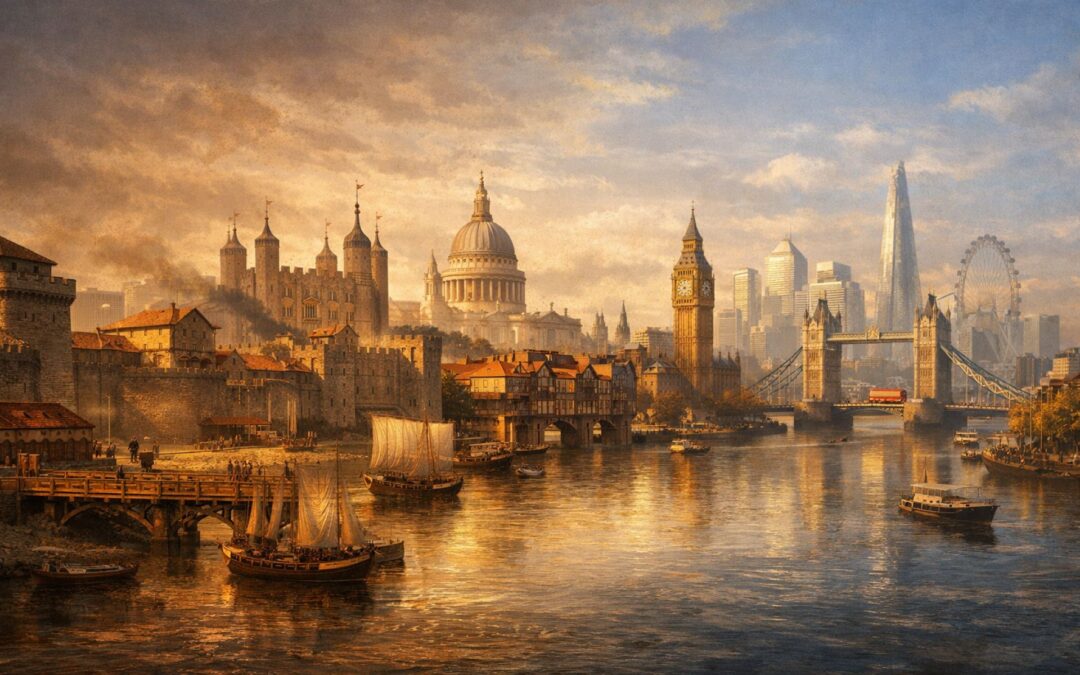
Few cities in the world possess a history as long, complex, and influential as London. Today it stands as one of the world’s most important global capitals—home to nearly nine million people and representing hundreds of cultures, languages, and traditions. Yet London’s rise to prominence was neither immediate nor inevitable. Over the course of two millennia, the city has been destroyed, rebuilt, invaded, expanded, and transformed repeatedly.
London’s story begins with the Romans, who established a small settlement called Londinium along the banks of the River Thames in the first century AD. From those modest beginnings, the city gradually evolved into a major trading hub, a center of royal authority, and eventually the heart of a vast global empire. Each era—from the Anglo-Saxon and Norman periods to the Industrial Revolution and the world wars—left its mark on the city’s streets, institutions, and identity.
What makes London unique is the way layers of history overlap within the same urban space. Roman walls once defined its boundaries, medieval markets filled its streets, and grand imperial institutions later shaped its skyline. At the same time, moments of catastrophe—plague, fire, rebellion, and war—forced the city to reinvent itself again and again.
Understanding London’s past is therefore not simply about tracing a timeline of events. It is about examining how geography, commerce, politics, and culture combined over centuries to turn a provincial Roman town into one of the most influential cities in human history.
This is the story of how London grew from a small riverside settlement into a global metropolis and a symbol of power, culture, and opportunity for people from across the world.
The Roman Foundation of Londinium (43–410 AD)
London’s story begins with the arrival of the Romans in Britain during the reign of Emperor Claudius. In 43 AD Roman legions invaded the island and began establishing military and administrative centers to secure their control over the newly conquered territory. One of these settlements was built along the northern bank of the River Thames at a strategic crossing point where the river was narrow enough to construct a bridge. This settlement became known as Londinium.
Like many Roman towns, Londinium was carefully planned to serve both military and commercial purposes. Its location along the Thames made it an ideal hub for trade, allowing goods to move easily between the interior of Britain and the wider Roman world. Roads connected the settlement to other important towns across the province of Britannia, transforming it into a vital node within the empire’s transportation network.
Despite its promising location, the early settlement faced significant challenges. In 60 AD the city was caught in the violent rebellion led by the Celtic queen Boudica, who rose against Roman rule in southeastern Britain. Londinium, along with several other Roman settlements, was completely destroyed during the uprising. The Roman governor chose not to defend the city due to its vulnerability, instead retreating with his forces to confront the rebels elsewhere.
After Boudica’s defeat, the Romans rebuilt Londinium on a much larger and more organized scale. Over the following decades it developed into a thriving urban center. Public buildings such as temples, bathhouses, an amphitheater, and administrative structures appeared throughout the city. A massive basilica and forum—among the largest built north of the Alps—served as the center of political and commercial life.
By the end of the first century, Londinium had grown into the most important city in Roman Britain. Its population may have reached as many as 60,000 people, making it one of the largest settlements in the region. The city replaced Camulodunum (modern Colchester) as the provincial capital of Britannia, further cementing its importance.
During the late Roman period, new defensive measures were introduced to protect the increasingly valuable city. Between roughly 190 and 225 AD, a massive stone wall was constructed around Londinium. This fortification enclosed the urban core and included several gates that controlled access to the city. These walls would define London’s boundaries for centuries and remain a visible symbol of the city’s Roman origins.
However, by the early fifth century the power of the Roman Empire was weakening across Europe. In 410 AD Roman authorities withdrew their remaining legions from Britain, leaving the province to fend for itself. Without the support of Roman administration and military protection, Londinium gradually declined. Trade networks collapsed, public buildings fell into disrepair, and much of the population abandoned the city.
By the end of the century the once-thriving Roman capital had largely been deserted. Yet although Londinium appeared to fade into obscurity, the foundations it had established—its roads, its bridge, and its strategic location—would ensure that the site would not remain abandoned forever. In the centuries that followed, new peoples would arrive and give the old Roman city a new life.
Anglo-Saxon London and the Viking Threat (5th–11th Centuries)
The Rise of Lundenwic
After the Romans withdrew from Britain in the early fifth century, Londinium quickly declined. The administrative structure that had sustained the city disappeared, trade routes collapsed, and much of the population gradually abandoned the walled Roman settlement. For several generations the once-thriving Roman city stood largely deserted, its stone buildings falling into ruin.
The arrival of the Anglo-Saxons in Britain during the fifth and sixth centuries eventually brought life back to the area, though not immediately within the old Roman walls. Instead of occupying the abandoned city, the newcomers established a new settlement slightly to the west, in the area that roughly corresponds to modern Covent Garden and the Strand. This new town became known as Lundenwic.
Unlike the Roman Londinium, which had functioned as an administrative center of imperial power, Lundenwic developed primarily as a commercial port and trading settlement. Its position along the Thames made it an ideal location for maritime trade with continental Europe. Merchants and sailors traveled between England and regions such as Scandinavia, the Frankish kingdoms, and the Low Countries, bringing goods, wealth, and cultural exchange.
By the late seventh century Lundenwic had grown into one of the most prosperous trading centers in early medieval England. Archaeological evidence suggests that the settlement had a population of around 10,000 people, making it a significant urban community by the standards of the time.
Religion also played a major role in the development of Anglo-Saxon London. In 604, the missionary bishop Mellitus founded the first post-Roman St Paul’s Cathedral, establishing London as an important center of Christianity. The presence of this religious institution helped spread the Christian faith among the Anglo-Saxon kingdoms and reinforced the city’s growing regional importance.
Alfred the Great and the Rebirth of the Walled City
Despite its prosperity, Lundenwic’s wealth made it an attractive target for raiders from across the North Sea. Beginning in the late eighth century, Viking attacks spread throughout the British Isles. Wealthy monasteries and trading settlements were especially vulnerable, and London soon found itself caught in the path of these expanding raids.
The first recorded Viking attacks on London occurred in the early ninth century. Over time these raids intensified, eventually evolving into full-scale invasions. In 871, a powerful Viking force known as the Great Heathen Army occupied London and reportedly used the old Roman walls as a defensive base.
The situation remained unstable for several years until King Alfred the Great of Wessex recaptured the city in 886. Recognizing London’s strategic value, Alfred implemented a series of reforms that would reshape the city’s future.
One of his most important decisions was to move the population from Lundenwic back into the old Roman walled city. The ancient fortifications were repaired and strengthened, transforming the settlement into a defensible urban center. At the same time, the bridge across the River Thames was rebuilt, restoring a vital crossing point for trade and communication.
The newly fortified city became known as Lundenburh, marking the revival of London as a major political and economic center. Protected by strong walls and positioned along key trade routes, the city gradually expanded in both population and influence over the following centuries.
Although London still faced occasional Viking attacks during the tenth and early eleventh centuries, it continued to prosper. By the reign of Edward the Confessor in the mid-eleventh century, the city had become one of the most important urban centers in England. Edward strengthened London’s royal connections by establishing Westminster Abbey, which was completed around 1060 and soon became the ceremonial heart of the English monarchy.
Despite this growing prominence, London was not yet officially the capital of England. That status still belonged to Winchester, the traditional seat of Anglo-Saxon royal authority. However, events were about to unfold that would permanently transform London’s role in the kingdom. The year 1066 would mark a decisive turning point in the city’s history.
The Norman Conquest and the Rise of Royal London (1066–1100s)
The Tower of London and Norman Authority
The year 1066 marked one of the most decisive turning points in English history and fundamentally reshaped London’s political future. After the death of Edward the Confessor in January 1066, the English throne passed to Harold Godwinson, a powerful Anglo-Saxon noble. However, the succession was contested by William, Duke of Normandy, who believed he had a rightful claim to the crown.
William launched an invasion of England and defeated Harold’s army at the Battle of Hastings in October 1066. With the English king dead, William marched toward London to secure control over the kingdom’s most important city. Although resistance briefly formed around the capital, the city ultimately submitted, and William was crowned King of England in Westminster Abbey on Christmas Day 1066.
The Norman rulers understood that maintaining control over London was essential for governing the country. To consolidate their authority and suppress potential rebellion, they began constructing a series of powerful fortifications throughout England. In London, the most significant of these defenses was built at the eastern edge of the city.
This fortress would become known as the Tower of London. Initially constructed as a timber stronghold, it was soon replaced by a massive stone castle, making it the first stone fortress built in England after the conquest. Over time the Tower was expanded and strengthened, evolving into a symbol of Norman power and royal authority.
The Tower served multiple purposes throughout its long history. It functioned as a royal residence, a military stronghold, a treasury, and eventually a prison. Most importantly, its imposing presence overlooking the city acted as a constant reminder of Norman rule.
Westminster and the Growth of Royal Power
Although London was already the largest city in England by the late eleventh century, it was not immediately recognized as the official capital of the kingdom. For generations, the traditional seat of royal administration had been Winchester, where many important government institutions were located.
Nevertheless, the Norman conquest accelerated London’s rise as the center of political power. One of the most important developments occurred when William II, the son of William the Conqueror, began construction of Westminster Hall in 1097. Originally intended as a royal residence and ceremonial space, Westminster Hall would later become one of the most important administrative buildings in the kingdom.
Meanwhile, Westminster Abbey, originally founded by Edward the Confessor, continued to grow in importance as the ceremonial heart of English monarchy. It became the traditional site for royal coronations and burials, strengthening the connection between London and the institution of kingship.
During this period London’s economic importance also expanded rapidly. Its thriving markets and access to maritime trade routes made it the center of England’s commercial activity. Merchants, craftsmen, and traders increasingly concentrated in the city, turning it into the kingdom’s primary hub of wealth and commerce.
A major shift occurred when a fire devastated much of Winchester in the late eleventh century. As royal offices gradually relocated to London in the aftermath, the city’s role as the administrative center of England became increasingly secure.
By the beginning of the twelfth century, London had effectively become the political, economic, and ceremonial heart of the kingdom. Although the transition happened gradually rather than through a single formal declaration, the city’s growing royal institutions, defensive structures, and expanding population ensured that London would remain the focal point of English governance for centuries to come.
Medieval London: Trade, Guilds, and Urban Life (1100–1500)
London Bridge and the Expansion of the City
During the medieval period, London underwent rapid growth and transformation. What had once been a fortified settlement within Roman walls evolved into a bustling commercial center whose influence extended far beyond England. Between 1100 and 1300, the city’s population expanded dramatically—from roughly 15,000 people to more than 80,000, making it one of the largest cities in Europe at the time.
Most of this growing population still lived within the boundaries of the ancient Roman walls, but the city gradually expanded outward as surrounding areas developed. One particularly important district was Southwark, located south of the River Thames. Although technically outside the main city, Southwark became an important extension of London, filled with inns, markets, and entertainment venues that served travelers arriving from across the country.
The connection between the two sides of the river was made possible by London Bridge, which for centuries served as the only crossing point over the Thames in the city. Earlier wooden bridges had existed for generations, but these structures were frequently damaged by fires, floods, and decay.
In 1176, construction began on a new stone London Bridge, designed to provide a more durable crossing. After more than three decades of work, the bridge was completed in 1209. The structure quickly became one of the most remarkable landmarks in medieval London.
The bridge was not simply a crossing—it functioned almost like a street suspended above the river. Houses and shops lined both sides of the bridge, rising several stories high and projecting outward over the water. A fortified gatehouse stood at the southern end, helping control access into the city. For more than 600 years, this bridge remained London’s primary connection across the Thames.
Guilds, Merchants, and the Rise of Civic Government
London’s economic prosperity during the Middle Ages was largely driven by trade. Merchants from across England and Europe brought goods into the city’s markets, turning London into the kingdom’s commercial center. Foreign traders—including French wine merchants, Flemish textile traders, and German seafarers—were a common presence in the city.
As commerce expanded, London’s craftsmen and merchants began organizing themselves into guilds. These professional associations regulated their respective trades, maintained standards of quality, and protected the economic interests of their members.
Many of these guilds would later evolve into the famous livery companies of London. Among the earliest was the Weavers’ Company, which received a royal charter in 1155. Over time, numerous other guilds were established, representing professions such as brewers, goldsmiths, ironmongers, butchers, and plumbers.
These organizations played a central role not only in economic life but also in the governance of the city. London gradually developed a strong tradition of civic independence, with local leaders managing many aspects of urban administration.
One important milestone occurred in 1189, when Henry FitzAilwin became the first recorded Mayor of London. The city’s autonomy was further reinforced in 1215 when King John signed the Magna Carta, which formally recognized London’s privileges and its right to govern itself through its own institutions rather than direct royal control.
This degree of independence made London unique among medieval European cities and allowed its merchant elite to wield considerable political influence.
Disease, Rebellion, and Medieval Justice
Despite its growing wealth and influence, medieval London remained a harsh and dangerous place for many of its inhabitants. The city’s streets were narrow, crowded, and often unsanitary. Waste was frequently dumped into the streets or directly into the Thames, creating conditions that were ideal for the spread of disease.
The most devastating epidemic to strike London during this period was the Black Death, which arrived in 1348. The plague swept rapidly through the densely packed city, killing thousands of residents. At its peak, as many as 200 people were dying every day, leaving entire neighborhoods devastated.
Social tensions also simmered beneath the surface of medieval life. One of the most dramatic examples occurred during the Peasants’ Revolt of 1381. Thousands of peasants from the countryside marched on London to protest against heavy taxation and oppressive economic conditions. The rebels stormed the city, destroying property and executing several government officials before the uprising was eventually suppressed.
Maintaining law and order in medieval London was difficult. There was no organized police force, and the authorities relied heavily on harsh punishments to deter crime. Public executions were carried out at locations such as Tyburn, Smithfield, and Tower Hill, where large crowds gathered to witness the fate of condemned criminals.
Punishments for lesser crimes could include humiliation in the stocks or pillory, where offenders were placed on public display and often subjected to ridicule from passersby.
Although medieval London was a city of wealth and opportunity, it was also a place of stark contrasts—where prosperity existed alongside poverty, and thriving commerce coexisted with disease, unrest, and harsh justice. Yet despite these challenges, London continued to grow steadily, laying the foundations for its transformation into one of the most powerful cities in the world.
Tudor London and the Dawn of Global Trade (1500–1600)
Population Growth and Urban Expansion
By the beginning of the sixteenth century, London had entered a new phase of growth that would dramatically reshape its role in both England and the wider world. The rise of the Tudor dynasty, beginning with Henry VII in 1485 and continuing through the reign of Elizabeth I, coincided with a period of remarkable expansion for the city.
London’s population increased at an extraordinary pace during this era. Around 1530, the city had roughly 50,000 inhabitants, but by 1600 that number had surged to over 200,000 people. This rapid growth was driven largely by economic opportunity. London was becoming the central hub of commerce in England, drawing migrants from across the countryside who hoped to find work, higher wages, and the possibility of social advancement.
As the population expanded, the city began to spill beyond its traditional medieval boundaries. While the ancient Roman walls still defined the core of the city, new neighborhoods developed to the west toward Westminster, where royal authority was increasingly concentrated. Streets, houses, markets, and workshops multiplied as London transformed into a sprawling urban center.
Maps from this period illustrate the city’s changing landscape. One of the earliest detailed panoramic views of London was created in 1543 by the Flemish artist Anton van den Wyngaerde, showing a growing city stretching along the Thames with ships crowding its busy riverfront.
The Rise of Trade Companies and Early Capitalism
London’s explosive growth during the Tudor era was closely tied to the expansion of international trade. Merchants based in the city increasingly looked beyond England’s traditional trading partners in Western Europe, establishing commercial links with distant regions across the globe.
To manage these ventures, merchants formed powerful trading companies that pooled resources and shared risks. Among the earliest of these was the Muscovy Company, founded in the mid-sixteenth century to develop trade routes with Russia. Even more significant was the establishment of the East India Company in 1600, which would later become one of the most influential commercial enterprises in history.
These companies helped transform London into the center of a rapidly expanding global trading network that stretched across Europe, Africa, Asia, and the Americas. Wealth flowed into the city from overseas commerce, laying the foundations for England’s emergence as a major maritime and imperial power.
The financial practices associated with these trading ventures also helped accelerate the development of early capitalism. Investors funded long-distance expeditions in exchange for shares in the profits, marking an important shift toward more complex financial systems that would later shape global economic structures.
Shakespeare and the Cultural Life of the City
Economic prosperity also fueled a vibrant cultural life in Tudor London. The city became a center of entertainment, creativity, and artistic expression, attracting writers, actors, musicians, and performers from across England.
One of the most significant cultural developments of this period was the rise of the public theater. Initially, plays were performed in courtyards of inns or within the homes of wealthy patrons. However, as theatrical performances grew increasingly popular, purpose-built theaters began appearing on the outskirts of the city.
In 1574, authorities banned theaters within the city walls due to concerns about disorder and disease. As a result, many playhouses were constructed just outside London’s official boundaries, particularly in Southwark, across the Thames.
The most famous of these venues was The Globe Theatre, where many of the works of William Shakespeare were performed. Shakespeare’s plays—including tragedies, comedies, and historical dramas—captured the imagination of London audiences and helped define the cultural identity of the era.
The theater became one of the defining features of Tudor London, reflecting both the city’s growing population and its appetite for entertainment and storytelling.
By the end of the sixteenth century, London had firmly established itself as the largest and most dynamic city in England. Its expanding population, flourishing trade networks, and vibrant cultural life positioned it to play an increasingly important role on the global stage. Yet the city was also on the brink of a turbulent century that would bring political upheaval, disease, and disaster—events that would ultimately transform London into a modern metropolis.
Turmoil and Transformation in the Stuart Era (1600–1700)
The Gunpowder Plot and the English Civil War
The beginning of the seventeenth century ushered London into an era of profound political upheaval. The Tudor dynasty ended in 1603 with the death of Queen Elizabeth I, and the English throne passed to James VI of Scotland, who became James I of England. This transition marked the beginning of the Stuart dynasty, a period that would see the city caught in a series of dramatic conflicts and crises.
One of the earliest shocks to the political order occurred in 1605 with the infamous Gunpowder Plot. A group of English Catholics, frustrated by the continued persecution of their faith, devised a plan to assassinate the king and destroy Parliament by detonating barrels of gunpowder beneath the House of Lords during the State Opening of Parliament. The conspiracy was uncovered when Guy Fawkes, one of the plotters, was discovered guarding the explosives in the basement of the building. The conspirators were arrested, tried, and executed, and the failed plot left a lasting mark on English political culture.
Political tensions continued to escalate under King Charles I, who inherited the throne in 1625. Charles frequently clashed with Parliament over taxation, religion, and royal authority. His attempts to rule without parliamentary consent created deep divisions throughout the country.
These tensions eventually erupted into the English Civil War in 1642. London quickly aligned itself with the Parliamentarian cause, largely because the city’s merchants and political leaders feared the consequences of unchecked royal power. To defend the capital from a potential royalist attack, Londoners constructed a ring of fortifications around the city.
The war ultimately ended in victory for Parliament. In 1649, Charles I was captured, tried for treason, and executed outside the Banqueting House in London, marking a moment of extraordinary political transformation. England was briefly declared a republic under the leadership of Oliver Cromwell, and London remained the political center of the new government.
The republican experiment lasted only a decade. In 1660, the monarchy was restored when Charles II, the son of the executed king, returned from exile and was crowned in Westminster Abbey, bringing the Stuart monarchy back to power.
The Great Plague of 1665
Even as political stability returned, London soon faced another devastating crisis. In 1665, the city was struck by the Great Plague, the last major outbreak of bubonic plague in England.
The disease spread rapidly through the overcrowded and unsanitary streets of the city. Houses were marked with red crosses to indicate infection, and families were often sealed inside their homes in an attempt to contain the spread. Trade slowed, public gatherings were restricted, and thousands of residents fled the city to escape the epidemic.
Despite these efforts, the plague proved catastrophic. Over the course of a single year, approximately 60,000 people died, representing a significant portion of London’s population. Entire neighborhoods were left devastated as the epidemic swept through the city.
By the end of the year the outbreak finally subsided, but London had barely begun to recover before an even greater disaster struck.
The Great Fire of London and the Rebuilding of the City
In September 1666, a fire broke out in a bakery on Pudding Lane. What began as a small blaze quickly spiraled out of control. Strong winds carried flames across the tightly packed wooden buildings of medieval London, allowing the fire to spread rapidly through the city.
For four days the Great Fire of London raged across the capital. Entire neighborhoods were consumed by flames, including churches, houses, markets, and public buildings. By the time the fire was finally extinguished, most of the city within the old Roman walls had been destroyed.
Although the fire caused massive destruction, it also presented an opportunity to rebuild London on a more modern foundation. In the aftermath, new building regulations required structures to be constructed primarily from brick and stone, reducing the risk of future fires.
One of the most important figures in the rebuilding effort was the architect Sir Christopher Wren. Wren designed and reconstructed numerous buildings across the city, including St Paul’s Cathedral, which became one of London’s most iconic landmarks. In total, he rebuilt 52 churches as part of the city’s reconstruction.
At the same time, new areas of development emerged west of the old city. The West End began to evolve into a fashionable district where aristocrats constructed elegant houses, theaters, and coffeehouses. Areas such as Covent Garden and St James’s became centers of social and cultural life.
By the end of the seventeenth century, London had been fundamentally transformed. It was no longer simply a medieval trading city but a rapidly modernizing capital that served as the political, financial, and commercial heart of England. These changes set the stage for the city’s explosive growth during the age of empire that would follow.
London in the Age of Empire (1700–1800)
Financial Institutions and Global Trade
By the beginning of the eighteenth century, London had firmly established itself as the economic heart of England. The city’s population had grown to around 500,000 people, making it one of the largest and most dynamic urban centers in Europe. Its influence extended far beyond the British Isles, as London became a central hub in the rapidly expanding networks of global trade.
Several powerful financial and commercial institutions helped fuel this transformation. The Bank of England, founded in 1694, provided stability to the country’s financial system and supported government borrowing. Meanwhile, the East India Company continued to expand its commercial activities across Asia, gradually evolving into a dominant force in international trade and imperial administration.
Another key institution was Lloyd’s of London, which developed from a coffeehouse where merchants and shipowners gathered to exchange news and negotiate insurance for maritime ventures. Over time, Lloyd’s became one of the most important centers of marine insurance in the world, helping protect the ships and cargoes that traveled between Britain and its overseas markets.
Together, these institutions turned London into a global financial center. Capital flowed through the city as merchants financed voyages, insured cargo, and invested in the expanding British Empire. The Thames waterfront and the growing docklands to the east became crowded with ships carrying goods from across the world, including textiles, spices, sugar, and tea.
The Expansion of Bridges and Infrastructure
As London’s population and trade expanded, the city’s infrastructure struggled to keep pace. For centuries, London Bridge had been the only crossing over the River Thames within the city. This created severe congestion as merchants, travelers, and residents all relied on the same narrow route.
To alleviate the pressure, new bridges were constructed during the eighteenth century. Westminster Bridge, completed in 1750, provided an additional crossing further upstream and helped connect Westminster more directly with the southern districts of the city. A few decades later, Blackfriars Bridge opened in 1769, further improving access across the river.
These new bridges played a crucial role in facilitating the city’s continued expansion. They allowed people and goods to move more freely across the Thames, encouraging the development of new neighborhoods on both sides of the river.
At the same time, London’s streets became increasingly busy as commercial traffic intensified. Markets expanded, warehouses multiplied along the riverfront, and new roads connected the growing suburbs to the city’s economic core.
Immigration and the Growing Cosmopolitan City
London’s prosperity during the eighteenth century attracted migrants from across Britain and beyond. The city’s population included not only English residents but also a wide range of foreign communities who contributed to its economic and cultural life.
Many immigrants arrived from elsewhere in Europe, including Irish laborers, Jewish merchants, and skilled craftsmen from the Low Countries and Germany. Others came from much farther afield, reflecting the global reach of Britain’s expanding empire. People from Africa, the Caribbean, and Asia began appearing in the city’s ports, markets, and households.
This diversity gradually transformed London into one of the most cosmopolitan cities in the world. Different languages, religions, and cultural traditions coexisted within the same urban environment, creating a dynamic and constantly evolving social landscape.
The eighteenth century also saw the emergence of some of London’s most recognizable landmarks and institutions. In 1732, 10 Downing Street became the official residence of the British Prime Minister, beginning with Robert Walpole, often regarded as Britain’s first prime minister. Later, Buckingham Palace was acquired by King George III in 1761 and began its transformation into a royal residence.
By the end of the eighteenth century, London had firmly established itself as the center of Britain’s imperial power. Its financial institutions, commercial networks, and growing population positioned the city at the heart of a global empire that stretched across continents. Yet even greater transformations awaited London in the nineteenth century, when industrialization would turn the city into the largest metropolis the world had ever seen.
The Industrial Revolution and the Victorian Metropolis (1800–1900)
Railways, the Underground, and Urban Expansion
By the beginning of the nineteenth century, London had already become one of the largest cities in Europe. However, the arrival of the Industrial Revolution transformed the city on an unprecedented scale. Factories, warehouses, docks, and workshops multiplied across the urban landscape, drawing huge numbers of people from the countryside into the capital in search of employment.
London’s population grew rapidly during this period. Around 1800, the city was home to roughly one million people. By the end of the century, that figure had risen to approximately 6.7 million, making London the largest city in the world.
One of the most important drivers of this expansion was the development of the railway network. Rail lines connected London to towns and cities across Britain, allowing goods and passengers to travel quickly and efficiently. Major railway termini were constructed around the edge of central London, including Euston, Paddington, Waterloo, King’s Cross, and St Pancras.
These stations acted as gateways between the capital and the rest of the country. They also helped reshape the city’s geography by encouraging the development of suburbs where middle-class residents could live while commuting into the city for work.
To connect these railway hubs and relieve congestion on the streets, London built the world’s first underground railway system. The London Underground, often called the Tube, opened its first line in 1863, marking a revolutionary innovation in urban transportation. Over time, the expanding underground network helped knit together the sprawling metropolis.
Another major event during this period was the Great Exhibition of 1851, held in the spectacular Crystal Palace in Hyde Park. The exhibition attracted around six million visitors and showcased technological innovations, industrial achievements, and cultural artifacts from across the globe. It symbolized Britain’s confidence and its dominant position during the height of the Victorian era.
Crime, Policing, and the Metropolitan Police
The enormous growth of London’s population created new challenges for maintaining order in the city. The overcrowded streets and densely packed neighborhoods provided fertile ground for crime and social unrest.
Until the early nineteenth century, London had no organized police force. Law enforcement relied largely on local watchmen and community officials, which proved increasingly inadequate for a rapidly growing metropolis.
In 1829, the British government introduced a major reform when Home Secretary Robert Peel established the Metropolitan Police Service. The new force was responsible for policing the entire urban area of London and became one of the first modern professional police organizations in the world.
The officers quickly became known as “Bobbies” or “Peelers”, nicknames derived from Peel’s surname. Their presence helped bring greater order to the city, though crime and poverty remained serious problems.
One of the most infamous criminal cases of the Victorian era occurred in the late 1880s, when a mysterious killer known as Jack the Ripper murdered several women in London’s impoverished East End. The crimes shocked the nation and highlighted the harsh conditions that many residents of the city’s poorest districts endured.
Sanitation, the Great Stink, and Modern Infrastructure
While London projected an image of imperial power and prosperity during the Victorian era, the reality of daily life for many residents was far less glamorous. Overcrowding, pollution, and poor sanitation plagued the rapidly expanding city.
For centuries, the River Thames had served as the primary dumping ground for sewage and industrial waste. As London’s population increased, the river became dangerously polluted, leading to frequent outbreaks of diseases such as cholera.
The situation reached a crisis point in 1858, during a summer so hot that the smell from the polluted Thames became unbearable. The event became known as the Great Stink, as the stench drifting from the river was so overwhelming that it disrupted the functioning of Parliament itself.
In response to the crisis, the government commissioned engineer Joseph Bazalgette to design and construct a modern sewer system for the city. Bazalgette oversaw the creation of an extensive network of underground sewers that carried waste away from central London and discharged it far downstream.
This ambitious engineering project dramatically improved public health and helped eliminate the recurring cholera outbreaks that had plagued the city. Bazalgette’s sewer system is widely regarded as one of the most important infrastructure achievements of the Victorian era, and it continues to form the backbone of London’s sanitation system today.
By the end of the nineteenth century, London had been transformed into a vast industrial metropolis. Railways, bridges, underground tunnels, and new public institutions reshaped the city’s landscape. At the same time, its enormous population and global influence made London the symbolic center of the British Empire, a city whose power and reach extended across the world. Yet the twentieth century would bring challenges unlike any London had faced before, as global conflict would test the resilience of the city and its people.
London at War: The World Wars and the Blitz (1900–1945)
The twentieth century brought unprecedented upheaval to London as the city was drawn into two global conflicts that reshaped the political and social landscape of Europe. As the capital of the British Empire, London became both a strategic target for enemy forces and a center of national mobilization during wartime.
The First World War, which began in 1914, introduced a new and frightening dimension to warfare: aerial bombardment. For the first time in its history, London was attacked from the air. German Zeppelins and later fixed-wing aircraft conducted bombing raids over the city, targeting both military installations and civilian areas.
Although the physical destruction caused by these early air raids was limited compared to later conflicts, they created widespread fear among London’s residents. Approximately 670 people were killed in these attacks, and the psychological impact of aerial warfare left a lasting impression on the population.
Yet the greater toll of the First World War was felt in the loss of life among London’s soldiers. Tens of thousands of men from the city were sent to fight on the battlefields of Europe, and many never returned. It is estimated that around 124,000 Londoners died during the war, leaving a profound mark on families and communities throughout the city.
Only two decades later, London would face an even greater threat during the Second World War. When war broke out in 1939, the British government anticipated that the capital would become a major target for German bombing campaigns. In preparation, thousands of children were evacuated from London to safer areas in the countryside.
Those who remained in the city took shelter during air raids in underground stations, basements, and specially constructed bomb shelters. The most intense phase of the bombing campaign came during the Blitz, which lasted from September 1940 to May 1941.
During this period, London endured 71 major bombing raids, as German aircraft dropped more than 18,000 tons of explosives on the city. Industrial areas, docklands, and central districts were heavily targeted. Buildings across London were destroyed or severely damaged, and entire neighborhoods were reduced to rubble.
Despite the devastation, the city’s population demonstrated remarkable resilience. One of the most iconic images of the Blitz was St Paul’s Cathedral standing intact amid the smoke and destruction, symbolizing London’s determination to survive the assault.
The human cost of the bombing was immense. By the end of the war, approximately 30,000 Londoners had been killed, and hundreds of thousands of homes had been destroyed or damaged. Large portions of the city’s infrastructure and housing stock lay in ruins.
Yet the wartime destruction also created the conditions for London’s postwar transformation. Reconstruction efforts would reshape the city’s landscape, replacing damaged neighborhoods with new housing and modern developments. At the same time, the end of the war marked the beginning of a new chapter in London’s history—one defined not by empire or industrial dominance, but by cultural change, migration, and the emergence of a truly global city.
Post-War Reconstruction and the Cultural Revolution (1945–2000)
The end of the Second World War left London heavily damaged but determined to rebuild. Large sections of the city had been destroyed during the Blitz, particularly in the docklands and working-class districts of East London. Hundreds of thousands of homes had been lost, leaving many families displaced and living in temporary accommodation.
In the years that followed, the British government launched ambitious reconstruction programs aimed at modernizing the capital. Many of the overcrowded Victorian-era slums that had survived the war were demolished and replaced with new housing developments. Large apartment complexes and council estates were built across the city in an effort to address the severe housing shortage.
Urban planning during the post-war period focused heavily on rebuilding infrastructure and improving living conditions. New roads, residential districts, and public buildings reshaped parts of the city’s landscape. At the same time, London’s damaged industrial areas gradually evolved into new commercial and residential zones.
Another major transformation occurred through immigration. As Britain sought workers to help rebuild the economy after the war, large numbers of migrants arrived from across the Commonwealth and former territories of the British Empire. Many newcomers came from the Caribbean, South Asia, and Africa, settling in London and other major British cities.
This wave of migration significantly reshaped London’s social and cultural identity. Neighborhoods that had once been relatively homogeneous became increasingly diverse, introducing new languages, cuisines, religions, and cultural traditions into the fabric of the city. Over time, London developed into one of the most cosmopolitan and multicultural urban centers in the world.
The city also became a major center of cultural innovation during the 1960s, a period often referred to as the “Swinging Sixties.” London emerged as a global hub for music, fashion, and youth culture. British musicians such as The Beatles and The Rolling Stones achieved worldwide fame, helping establish London as a major influence on global popular culture.
Fashion designers, photographers, and artists also contributed to this cultural renaissance. Areas such as Carnaby Street and King’s Road became famous for their cutting-edge fashion and vibrant nightlife. London’s creative industries attracted young people from across Britain and around the world who were drawn to the city’s new energy and artistic freedom.
Despite this cultural dynamism, London also faced economic challenges during the later decades of the twentieth century. Traditional industries declined, and the city’s once-busy docks along the Thames gradually fell into disuse as shipping moved to larger container ports outside the capital.
In response, large redevelopment projects were launched to revitalize these neglected areas. One of the most significant initiatives was the transformation of the London Docklands, which eventually became a major financial district centered around Canary Wharf. This redevelopment signaled London’s shift away from industrial manufacturing toward a modern service-based and financial economy.
By the end of the twentieth century, London had successfully reinvented itself once again. It had evolved from an imperial capital and industrial powerhouse into a global center of finance, culture, and international migration—setting the stage for the emergence of the modern metropolis in the twenty-first century.
London in the 21st Century: A Global Megacity
At the beginning of the twenty-first century, London entered a new phase of its long history—one defined by globalization, cultural diversity, and economic influence on a worldwide scale. The city had already undergone massive reconstruction and transformation during the post-war decades, but the new millennium further cemented London’s position as one of the most important urban centers on the planet.
Modern London is home to nearly nine million people, making it one of the largest cities in Europe. What truly distinguishes the city today, however, is its extraordinary diversity. A large portion of London’s population was born outside the United Kingdom, representing hundreds of nationalities, languages, and cultural traditions. This multicultural character is the result of centuries of migration and trade, but it accelerated dramatically in the late twentieth and early twenty-first centuries.
Economically, London has evolved into one of the world’s most powerful financial centers. The City of London, often referred to simply as “the City,” remains the historic heart of global finance. Meanwhile, modern financial districts such as Canary Wharf have expanded the capital’s role in international banking, investment, and commerce. Together, these districts connect London directly to financial markets across Europe, North America, and Asia.
London’s global importance also extends far beyond finance. The city has become a major center for media, technology, education, tourism, and creative industries. Universities, cultural institutions, and museums attract students and visitors from around the world, while London’s theaters, galleries, and music scenes continue to shape international cultural trends.
Major global events have also reinforced the city’s international stature. Hosting the 2012 Olympic Games brought global attention to London and led to significant redevelopment projects, particularly in the eastern parts of the city. New transportation systems, parks, and residential districts emerged from these initiatives, further modernizing the capital.
Despite its economic strength and global prestige, London continues to face many challenges common to major megacities. Rising housing costs, traffic congestion, and social inequality remain pressing issues for policymakers and residents alike. Nevertheless, the city’s long history of adaptation suggests a remarkable ability to evolve in response to changing circumstances.
Today, London stands as a city shaped by two thousand years of continuous transformation. From its origins as a Roman trading settlement to its present status as a global megacity, the capital has repeatedly reinvented itself in response to political upheaval, economic opportunity, and cultural change. This constant reinvention is perhaps the defining characteristic of London—an enduring metropolis that continues to influence the world just as it has for centuries.
Conclusion
London’s journey from a small Roman outpost to one of the most influential cities in the world is a story shaped by geography, resilience, and constant reinvention. Over the course of two thousand years, the city has experienced invasions, political upheavals, devastating fires, deadly epidemics, industrial transformation, and the destruction of global war. Yet each time it faced catastrophe, London rebuilt itself stronger and more complex than before.
Its strategic position along the River Thames initially made it valuable as a Roman trading hub. In the centuries that followed, that same location allowed it to flourish as a medieval commercial center, a seat of royal authority, and eventually the heart of a vast global empire. Trade networks, financial institutions, and political power all converged within the city, steadily expanding its influence far beyond the shores of Britain.
London’s history also reflects the broader story of migration and cultural exchange. From Roman soldiers and Anglo-Saxon settlers to medieval merchants, imperial traders, and modern immigrants, people from across the world have shaped the city’s identity. Each wave of newcomers added new languages, customs, and ideas, turning London into one of the most diverse urban centers in history.
Perhaps the most remarkable aspect of London’s past is its ability to adapt. The city survived the Black Death, the Great Fire of 1666, the upheaval of civil war, and the destruction of the Blitz during the Second World War. Each crisis forced the city to evolve—introducing new institutions, new infrastructure, and new forms of governance that reshaped its future.
Today, London stands not only as the capital of the United Kingdom but also as one of the world’s most globally connected cities. Its financial markets influence international economies, its cultural industries shape global trends, and its streets reflect the diversity of people from every corner of the planet.
From Londinium to modern London, the city’s history demonstrates how a settlement can grow into a global metropolis through centuries of transformation, resilience, and opportunity.