
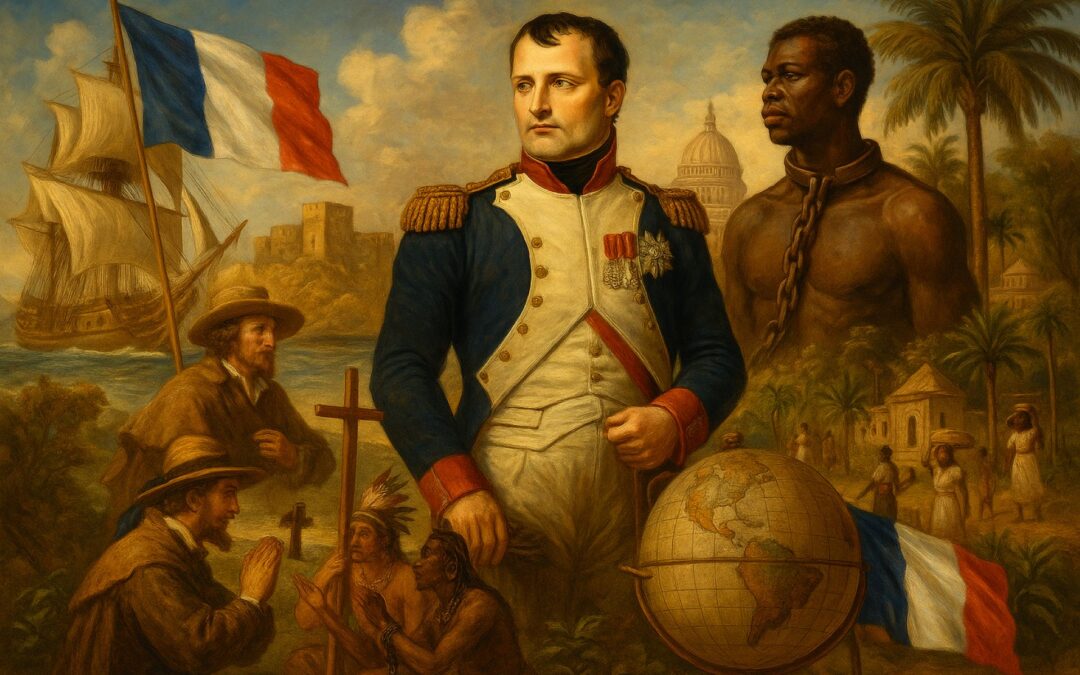
The story of France is not just the story of a nation—it is the story of an empire that once spanned oceans and continents, rivaling the mightiest powers of its time. From the icy rivers of Canada to the lush plantations of the Caribbean, from the deserts of North Africa to the bustling ports of Indochina, the French Empire cast its net wide. It rose through daring exploration and ambition, was scarred by bitter wars with Britain, shaken by revolution, and revived in new forms during the great scramble for territory in the 19th century.
Though it ultimately fragmented under the weight of independence movements and global wars, its legacy endures in language, law, culture, and memory. To understand the French Empire is to understand how ambition, conflict, and ideology shaped the modern world.
The Birth of Ambition
When the 16th century dawned, France was already a colossus in Europe. Its borders stretched wide, its kings commanded loyalty, and its armies stood among the finest on the continent. The Renaissance spirit—artistic, scientific, and exploratory—coursed through its veins, and the promise of newfound lands across the Atlantic beckoned. Spain had reaped fortunes in gold and silver from the Americas, Portugal had carved monopolies in Africa and Asia, and England was beginning to stir. France, however, hesitated between domestic entanglements and overseas opportunity.
Giovanni da Verrazzano, an Italian navigator in French service, became the first to spearhead this ambition in 1524. Sailing under King Francis I, he traced the contours of North America’s Atlantic coast, from modern-day Florida to Newfoundland. His voyage added knowledge to European maps but yielded no permanent claim. The French crown applauded the discovery yet failed to follow it with settlement. The riches of the New World seemed tantalizing but frustratingly out of reach.
A decade later, Jacques Cartier’s expeditions offered a more determined attempt. Beginning in 1534, he sailed into the Gulf of St. Lawrence, encountering the towering cliffs of Gaspé and laying the groundwork for what would be called New France. Cartier ascended the mighty river that would become the lifeline of French Canada, reaching the sites of present-day Montreal and Quebec. He returned to France with tales of fertile lands and promise, sparking hopes of a thriving colony.
But dreams turned to dust. The settlement he founded in 1541 near Quebec collapsed within two harsh winters. Starvation, disease, and conflict with local peoples forced abandonment. No gold was found, no new passage to Asia uncovered. France, flush with ambition yet short of results, began to falter in its pursuit of empire.
Compounding these setbacks was the turmoil boiling within France itself. By mid-century, the Wars of Religion erupted, pitting Catholics against Huguenots in cycles of massacres, sieges, and betrayals. Resources and attention were consumed by domestic strife. Colonization—costly, uncertain, and far away—could not compete with the urgency of survival at home. While Spain fortified its empire and England pressed steadily into North America, France seemed trapped in paralysis, its imperial ambitions fragile and unfinished.
The Struggle for Survival in the New World
Despite repeated failures, the lure of the New World refused to vanish entirely. For French Protestants—the Huguenots—colonization carried not only the promise of land and wealth but also of refuge. Religious persecution at home drove them to seek havens abroad, far from the reach of Catholic authorities. This marriage of faith and exploration produced France’s earliest true colonies outside Europe, though none would endure for long.
In 1555, Nicolas Durand de Villegaignon led an expedition to Brazil, establishing France Antarctique in present-day Rio de Janeiro. Here, Huguenots and Catholics briefly coexisted, carving out a fragile settlement beneath the shadow of tropical mountains. The colony became a beacon for Protestant exiles and an audacious challenge to Portugal’s dominance in South America. Yet by 1567, Portuguese forces stormed the settlement, destroying it utterly. The dream of a Protestant New France in Brazil dissolved in fire and blood.
Undeterred, Huguenot leaders turned their eyes north. Admiral Gaspard de Coligny, a towering Protestant figure, envisioned “French Florida”—a safe haven on the southeastern coast of North America. In 1562, Jean Ribault established Charlesfort in what is now South Carolina. But food shortages, isolation, and lack of reinforcements doomed the settlement. Within a year, it was abandoned.
Two years later, René de Laudonnière tried again at Fort Caroline near present-day Jacksonville, Florida. This colony showed promise—fortifications, fertile land, and a growing population of settlers. Yet it stood in the path of Spain, which claimed Florida as its own. In 1565, Spanish forces under Pedro Menéndez de Avilés descended upon the fort, slaughtering nearly all the colonists. France’s ambitions were once again erased at sword’s edge.
By the late 16th century, a pattern had emerged: French colonial attempts were bold but brittle, inspired by faith and fortune but undermined by poor planning, hostile powers, and domestic upheaval. Religious wars at home deepened the reluctance to invest in distant ventures. Colonization, in the eyes of many French leaders, seemed a luxury rather than a necessity. And so, while England’s Jamestown and Spain’s Havana grew into thriving centers of empire, France remained a spectator, nursing failures and doubts.
Yet even in defeat, embers smoldered. The riches of furs, fisheries, and fertile river valleys lay untapped. The 16th century was a century of frustration for France, but it also planted seeds—seeds that would, in the century to come, germinate into the beginnings of a genuine empire.
New France Expands
The 17th century marked a turning point. After decades of dashed hopes and fleeting settlements, France finally began to establish a durable presence across the Atlantic. The architect of this revival was Samuel de Champlain, a soldier, navigator, and diplomat whose vision of a French North America transcended the failures of earlier generations.
In 1608, Champlain founded Quebec City on the narrowing cliffs of the St. Lawrence River. The site was no accident: it provided a commanding vantage point over river traffic and a natural defensive position. More than just a military foothold, Quebec became the anchor of French civilization in the New World. Unlike the Spaniards who pursued gold or the English who sought farmland, the French fixed their gaze on fur. Beaver pelts, prized in Europe for their use in felt hats, became the currency of New France.
Yet survival in this new land required more than commerce—it demanded diplomacy. Champlain forged alliances with the Huron and Algonquin tribes, embedding French fortunes within the intricate tapestry of indigenous politics. These alliances gave France both trading partners and military allies against rivals like the Iroquois Confederacy, who often aligned with the English. For Champlain, cooperation was not just strategy but necessity.
Despite this progress, the colony grew slowly. In 1627, Cardinal Richelieu, adviser to King Louis XIII, intervened with the founding of the Company of One Hundred Associates. This chartered company promised to populate and develop New France by granting land to settlers. Outposts multiplied: Trois-Rivières in 1634, Montreal in 1642. Missionaries also arrived, determined to convert indigenous peoples to Christianity, leaving behind both schools and martyrs.
Population, however, remained the Achilles’ heel. By mid-century, New France counted only a few thousand settlers, compared to tens of thousands in the English colonies. Recognizing the imbalance, Louis XIV declared New France a royal province in 1663, placing it directly under his control. Soldiers of the Carignan-Salières Regiment arrived to strengthen defenses, and the crown sponsored the passage of nearly 800 young women—known as the Filles du Roi or King’s Daughters—between 1663 and 1672. They married settlers, raised families, and anchored French society in North America. In less than a decade, the population doubled, from around 3,200 to nearly 7,000.
Exploration pushed French influence further. Louis Jolliet and Jacques Marquette explored the upper Mississippi River in 1673, dispelling hopes that it might lead westward to the Pacific. A decade later, René-Robert Cavelier, Sieur de La Salle, descended the Mississippi to its delta, planting a cross at its mouth and claiming the vast Louisiana Territory for France. By century’s end, New France stretched from the icy St. Lawrence to the warm waters of the Gulf of Mexico—a thin but astonishingly expansive ribbon of empire.
A Global Web of Colonies
France’s ambitions, however, were never confined to the forests and rivers of North America. Like Spain, Portugal, and England, France envisioned a truly global empire—one that spanned oceans, continents, and climates.
In the Caribbean, sugar was the lodestar. Beginning with Guadeloupe and Martinique in the 1630s, France expanded rapidly across the archipelago. Saint-Domingue—on the western half of Hispaniola—emerged as the crown jewel, its plantations producing immense wealth through the labor of enslaved Africans. The colony became the richest in the Caribbean and, by some measures, the richest in the world. But the wealth was built on brutality: the Code Noir, issued in 1685, codified slavery and laid bare the cruelty of the plantation system.
South America, too, bore a French imprint. In 1643, France carved out French Guiana on the northern coast, establishing its capital at Cayenne. The colony remained small but strategically valuable, a foothold in a region contested by Portuguese and Dutch rivals.
Africa entered the French orbit as both a source and a staging ground. Fortified outposts along the Senegal River became critical nodes in the transatlantic slave trade, feeding the labor demands of the Caribbean sugar plantations. Over time, these coastal settlements became springboards for France’s later expansion deep into the African continent.
The Indian Ocean offered yet another theater. France settled Madagascar and the Mascarene Islands (Réunion, Mauritius, and Rodrigues) by the mid-17th century, securing vital refueling points for ships sailing to Asia. The lure of Asian riches—spices, silks, and porcelain—remained irresistible. To compete with Portuguese, Dutch, and English rivals, France created its own East India Company in 1604. While initially less successful, the company established trading posts in India, including Pondicherry and Chandernagore, which grew into important enclaves of French influence.
Even the Pacific was touched by French ambition. Explorers mapped Tahiti, New Caledonia, and Polynesian archipelagos, planting early markers of what would later become French colonial territories.
By the close of the 17th century, the French flag fluttered over territories that spanned the Atlantic, Indian, and Pacific Oceans. From Quebec to Saint-Domingue, from Senegal to Pondicherry, France was no longer merely a European power—it was an imperial one. Yet such vastness invited rivalry. Britain, the perennial foe, lurked at every corner, ready to test France’s claim to global supremacy.
Britain: The Eternal Rival
No other adversary shaped the destiny of the French Empire as much as Britain. The two nations, bound by proximity yet divided by ambition, became locked in a centuries-long contest. Their rivalry was not confined to Europe—it stretched across oceans, into forests, onto sugar islands, and through Indian bazaars. Wherever France planted its flag, Britain seemed determined to uproot it.
The first decisive blow fell during the War of the Spanish Succession (1701–1714). Although fought mainly over dynastic claims in Europe, the conflict spilled into the New World. By its conclusion in the Treaty of Utrecht, France was forced to surrender key possessions: Newfoundland, the Hudson Bay territories, and Acadia (modern Nova Scotia). These lands, rich in fisheries and fur, passed into British hands, weakening France’s grip on North America. Even in the Caribbean, St. Kitts slipped away to Britain, signaling that the French were vulnerable in their prized sugar colonies.
Three decades later, the War of the Austrian Succession (1740–1748) reignited tensions. This time, the rivalry stretched into India, where French and British trading companies competed for influence. Fortresses were built, alliances struck with local rulers, and battles fought in the Carnatic Wars. Yet the Treaty of Aix-la-Chapelle restored captured territories, leaving the contest unresolved but seething.
Then came the flashpoint that would seal the fate of the First French Colonial Empire: the Seven Years’ War (1756–1763). It began in the wilds of North America, when a young British officer—George Washington—clashed with French Canadian forces in Pennsylvania. What started as a frontier skirmish cascaded into a global conflict, stretching across Europe, the Caribbean, Africa, and Asia.
At first, French forces held their ground, buoyed by alliances with Native tribes and early successes in North America. But Britain’s naval dominance proved overwhelming. The Royal Navy severed France’s lifelines, blockading ports and cutting off supplies. In 1759, the pivotal Battle of the Plains of Abraham outside Quebec City sealed New France’s fate. Within years, the French presence in Canada collapsed.
The Treaty of Paris in 1763 formalized the devastation. France ceded all its mainland territories in North America, surrendering Canada and Louisiana east of the Mississippi to Britain and Spain. Most Caribbean islands—though some, like Guadeloupe and Martinique, were retained—also fell. In India, French forts remained, but their political influence evaporated under British supremacy. What had once been a sprawling empire was reduced to a scattering of islands and enclaves.
France, once poised to rival Spain and Britain for global dominance, saw its first empire dismembered in less than a century. Yet the loss bred not resignation, but a burning desire for resurgence.
Revolution and Ruin
The late 18th century delivered a double catastrophe: revolution at home and rebellion abroad. France, already wounded by imperial losses, now faced turmoil that threatened the very foundations of its global presence.
The spark came in 1789, when the French Revolution erupted, overturning monarchy and aristocracy in the name of liberty, equality, and fraternity. But these lofty ideals clashed violently with the realities of colonialism. Nowhere was this contradiction more explosive than in Saint-Domingue.
Saint-Domingue, the jewel of France’s Caribbean holdings, was a marvel of wealth. Its plantations produced nearly half of the world’s sugar and a large share of its coffee. Yet the prosperity rested on the backs of enslaved Africans, subjected to unspeakable brutality. Inspired by revolutionary ideals—and driven by desperation—enslaved men and women rose in revolt in 1791. The Haitian Revolution had begun.
For over a decade, waves of violence, shifting alliances, and international interventions tore the colony apart. France, embroiled in European wars, struggled to maintain control. Even Napoleon Bonaparte, who seized power in 1799, failed to retake the colony. His forces were decimated not only by resistance but also by tropical disease. In 1804, Haiti declared independence, becoming the first Black republic and the second independent nation in the Americas. The loss was staggering: France had forfeited its richest colony and a cornerstone of its imperial economy.
Meanwhile, across the Atlantic, France briefly regained Louisiana from Spain in 1800. But Napoleon, preoccupied with wars in Europe, had little interest in rebuilding a North American empire. In 1803, he sold the vast Louisiana Territory to the United States for $15 million—the Louisiana Purchase. For France, it was a relinquishment of ambition; for America, it was a leap into continental destiny.
The Napoleonic Wars (1803–1815) brought further ruin. While Napoleon conquered swathes of Europe, Britain wielded its naval supremacy to strike France’s colonies. Islands in the Caribbean, bases in the Indian Ocean, and territories in Africa all fell under British assault. When the wars ended, France recovered some possessions, but many—such as St. Lucia, Tobago, and Mauritius—were permanently lost.
The revolution and its aftermath left France diminished and humiliated on the global stage. Its first empire had collapsed, reduced to fragments scattered across oceans. Yet the French spirit of ambition was not extinguished. The 19th century would see a resurgence, a second empire built on new strategies and new frontiers, particularly in Africa and Asia.
The Second French Empire: Africa and Asia
Defeat in the Seven Years’ War and humiliation in the Napoleonic era might have broken lesser nations, but for France, they became fuel for revival. By the early 19th century, France yearned to restore its grandeur, and colonial expansion became the chosen instrument. The Second French Colonial Empire began in 1830 with the conquest of Algeria.
At first, the invasion of Algeria was a punitive measure—France sought to discipline the Regency of Algiers after a diplomatic dispute spiraled into violence. Yet what began as reprisal evolved into annexation. By 1848, Algeria was declared not merely a colony but French territory itself, incorporated into the national fabric. The conquest was brutal, marked by scorched-earth campaigns and the displacement of entire populations, but it established France’s beachhead in Africa. Algeria would remain a cornerstone of the empire for more than a century, and a symbol of both pride and controversy.
From Algeria, France extended its dominion across Africa. Senegal became a vital hub, serving as both administrative center and departure point for further conquests. The French moved inland, forming protectorates and colonies that would later be consolidated into French West Africa in 1895. This federation united vast territories: modern Mali, Guinea, Ivory Coast, Burkina Faso, and more. In parallel, French Equatorial Africa took shape in 1904, binding Gabon, Congo, Chad, and the Central African Republic under Paris’s control. Together, these blocs placed enormous swathes of West and Central Africa under the tricolor.
North Africa remained a strategic obsession. In 1881, Tunisia became a protectorate, expanding France’s influence along the Mediterranean coast. Morocco followed in 1912, split into French and Spanish zones of control. From the Atlantic to the Sahara, France’s presence reshaped the political map of North Africa.
French ambitions were not limited to Africa. Asia drew Paris’s gaze, both for its resources and its symbolic prestige. The spark came in 1858, when the Vietnamese emperor attempted to purge Catholic missionaries from his realm. Napoleon III, invoking the protection of faith as a pretext, dispatched a naval expedition. Saigon fell, and by 1864, Cochinchina became a French possession. Expansion continued northward and westward until Vietnam, Laos, and Cambodia were folded into French Indochina in 1887. The colony became a showcase of France’s “civilizing mission,” though in reality it served as a reservoir of resources—rice, rubber, and labor—for the metropole.
Meanwhile, in the Pacific, France seized New Caledonia in 1853, turning it into both a penal colony and a strategic naval outpost. Tahiti and surrounding islands were annexed in 1880, extending France’s influence deep into Polynesia. By the dawn of the 20th century, France’s empire spanned Africa, Asia, and the Pacific, second in size only to Britain’s. It was both vast and diverse—deserts, jungles, and islands tied together by the authority of Paris.
The Second French Empire was built with more method and structure than the first. It relied not only on trade but also on military conquest, administrative federations, and the rhetoric of the mission civilisatrice—France’s self-proclaimed duty to “civilize” non-European peoples. Yet beneath the veneer of benevolence lay exploitation: forced labor, economic extraction, and cultural imposition. France had recovered its empire, but it had also planted the seeds of resistance.
War and Decolonization
The 20th century brought both the zenith and the unraveling of French imperial power. At the outbreak of World War I in 1914, France commanded the second-largest empire on Earth—more than 5 million square miles of territory and over 50 million colonial subjects. This vast dominion became a lifeline during the conflict.
Colonial soldiers, known as tirailleurs sénégalais from Africa and infantry from Indochina, were conscripted and shipped to Europe. They fought and bled in battles like the Marne, Verdun, and the Somme, enduring the same horrors of trench warfare as French soldiers. Colonies also provided raw materials—rubber, metals, grain—that kept the French war machine alive. By 1918, the contributions of empire had proven indispensable, and France emerged victorious.
The spoils of victory expanded the empire even further. With the Ottoman Empire dismantled, France gained mandates over Syria and Lebanon, ruling them under League of Nations supervision. Former German colonies in Africa—Cameroon and Togo—were added as well. At this moment, France’s empire seemed invincible, spanning continents and reaching new heights of prestige.
But cracks were forming. The colonial soldiers who had fought for France returned home with heightened awareness of their sacrifice and the hypocrisy of colonial rule. They had defended ideals of liberty in Europe, yet remained subjects without freedom in their own lands. Nationalist movements stirred quietly, waiting for their moment.
That moment came with World War II. In 1940, France fell to Nazi Germany, and its empire fractured. Some colonies remained loyal to Vichy France, others rallied to Charles de Gaulle’s Free French forces. The empire became both battleground and lifeline—North Africa was a key theater of Allied operations, while colonies provided men and resources once again. But the war also emboldened colonial voices demanding self-determination.
After 1945, expectations of independence surged. Yet de Gaulle envisioned not dissolution but transformation, announcing a French Union to bind colonies more closely to the metropole. His plan met fierce resistance. In Indochina, Ho Chi Minh’s nationalist forces clashed with French troops, leading to the First Indochina War (1946–1954). The French defeat at Dien Bien Phu ended their rule in Vietnam, Laos, and Cambodia.
In Africa, too, the tide turned. Algeria became the crucible. Though legally part of France, its population rose in revolt in 1954, sparking an eight-year war marked by guerrilla warfare, atrocities, and deep divisions in France itself. The Algerian War ended in 1962 with independence, a searing wound that scarred French politics for decades.
Elsewhere, colonies in West and Central Africa gained independence largely through negotiation during the late 1950s and early 1960s. Madagascar, Morocco, and Tunisia also broke free. By the 1970s, what remained were fragments: a handful of overseas territories in the Caribbean, Indian Ocean, and Pacific—remnants rather than dominions.
The story of French decolonization was one of both violence and diplomacy, triumph and trauma. France lost its empire but did not lose its influence. Through language, law, and culture, the echoes of empire persisted, ensuring that even in its political decline, France remained a global presence.
The Echo of Empire
Though the French Empire dissolved in stages, its shadow stretches across the modern world. The physical colonies may have vanished, but the cultural, linguistic, and institutional footprints remain strikingly vivid. In many ways, the empire’s afterlife is as consequential as its existence.
The French language is perhaps the most enduring legacy. Today, more than 238 million people across five continents speak French as a first or second language. It is an official tongue in countries as diverse as Canada, Senegal, Vietnam, and Vanuatu. It serves as a diplomatic language in the United Nations, the European Union, and the African Union—a testament to France’s centuries of influence. Walk through the streets of Dakar, Montreal, or Port-au-Prince, and you hear the echoes of Paris woven into local dialects, adapted and enriched by cultures far from Europe.
Beyond language, institutions and laws bear the imprint of French governance. The Code Napoléon, originally crafted in the early 19th century, influenced legal systems from West Africa to Southeast Asia. Civil law traditions in countries like Vietnam, Madagascar, and Lebanon still reflect French jurisprudence. Education, too, carried the French mark. Schools established in colonial times taught not only arithmetic and grammar but also ideals of French identity—producing generations who straddled two worlds.
Architecture and city planning also reveal this inheritance. The boulevards of Hanoi, with their colonial villas shaded by tamarind trees, evoke Haussmann’s Paris. In North Africa, the casbahs stand beside French-built administrative quarters, an urban layering of cultures. Even in the Caribbean and Pacific, from Martinique’s town squares to Tahiti’s churches, the material presence of France endures.
Yet the legacy is not simply cultural—it is also psychological and political. The trauma of slavery in Saint-Domingue, the scars of conquest in Algeria, the upheaval of partition in Indochina—these remain deeply embedded in national identities. Independence movements were born not only out of resistance but also out of the contradictions France introduced: preaching liberty at home while imposing domination abroad.
At the same time, post-colonial ties never severed completely. France forged new relationships with its former colonies through economic partnerships, defense agreements, and cultural institutions like the Francophonie. Critics argue that such arrangements amount to néo-colonialisme—continued dominance under softer guises—while supporters claim they preserve shared heritage and cooperation. The debate itself underscores the empire’s unresolved legacy.
Even within France, the empire’s echo reverberates. Millions of French citizens trace their ancestry to North Africa, Sub-Saharan Africa, the Caribbean, and Asia—descendants of colonial subjects who later migrated to the metropole. Their presence has transformed French society, enriching its culture but also challenging its notions of identity and belonging. The empire lives on not only overseas but in the very fabric of modern France.
Thus, while the tricolor no longer flutters over vast dominions, the empire’s spirit survives in unexpected forms: in the cadences of French spoken in Abidjan, in the legal codes of Phnom Penh, in the food markets of Guadeloupe, and in the multicultural streets of Paris itself. The French Empire was built on ambition, conquest, and contradiction. Its ruins are scattered, but its legacy is indelible—woven into the daily lives of millions who carry forward its language, its culture, and its complexities.
Conclusion
The French Empire, once vast and commanding, no longer exists as a territorial reality. Yet its echoes continue to shape nations and peoples worldwide. The language of Paris is spoken in Africa and Asia; the legal codes of Napoleon still survive in courts far from Europe; the architecture of French colonial cities remains, layered over older traditions. Its history is one of brilliance and brutality, of vision and violence, of collapse and reinvention.
France’s empire may have crumbled, but its influence remains stitched into the fabric of global culture and identity. In many ways, the empire lives on—not in dominion, but in the shared heritage of those who carry its imprint into the present.