
There’s a particular kind of person who can ruin a perfectly good conversation.
You’re sitting with friends, telling a story, connecting the dots, building a neat little narrative that explains everything. It feels right. It sounds convincing. Everyone nods along. The world, for a brief moment, makes sense.
And then someone interrupts.
They don’t outright disagree. That would almost be easier to deal with. Instead, they hesitate. They raise an eyebrow. They say something like, “Well… we don’t actually know that for sure.”
Suddenly, the whole structure collapses.
What was once a satisfying explanation becomes shaky, incomplete, uncertain. The story loses its charm. The certainty dissolves. And in its place, there’s only ambiguity.
It’s irritating.
Skeptics—those who question what others accept—often feel like unwelcome guests in the smooth flow of everyday life. They complicate things. They slow things down. They refuse to let us settle into comfortable conclusions. Whether it’s gossip, politics, religion, or even personal beliefs, they insist on poking holes where we’d rather not look too closely.
And yet, as frustrating as they may be, skeptics serve a purpose that is far more important than our temporary comfort.
Because what truly gets us into trouble is not what we don’t know—but what we are absolutely certain about, and wrong.
This tension between certainty and doubt is not new. It didn’t begin with social media, misinformation, or modern echo chambers. It goes back more than two and a half thousand years, to a time when the foundations of Western thought were just beginning to take shape.
In that early world—long before science, long before systematic philosophy—there lived a man who dared to question everything his society took for granted. Not just casually, but fundamentally. He challenged the gods, the stories, and even the very idea that humans could ever truly know the truth.
His name was Xenophanes.
And in many ways, he was the first skeptic.
This is the story of how his radical way of thinking began—and why, in an age overwhelmed by information, his ideas might matter more than ever.
Why Skeptics Annoy Us More Than We Admit
There’s a reason skepticism feels so disruptive—and it has very little to do with logic.
It’s emotional.
When someone questions what we believe, they’re not just challenging an idea. They’re unsettling a sense of certainty that we’ve quietly grown attached to. And that attachment runs deeper than we like to admit. Our beliefs aren’t just neutral conclusions we arrived at through careful reasoning—they’re often tied to our identity, our experiences, and the way we make sense of the world.
So when a skeptic steps in and says, “You might be wrong,” it doesn’t feel like an invitation to think. It feels like a threat.
Take something as simple as a casual conversation. A group of people might be discussing a messy breakup, confidently assigning blame, constructing motives, and reinforcing each other’s views. The narrative feels complete. It explains everything. It even offers a kind of emotional satisfaction.
Then comes the skeptic.
They don’t deny the story outright. They simply point out that there could be more to it—missing details, unknown perspectives, complexities no one in the room has access to. And just like that, the certainty dissolves. The story no longer holds together as neatly as it did before.
What follows is often irritation, sometimes even hostility.
Why?
Because certainty is comfortable. It gives us closure. It allows us to move on without lingering doubt. Skepticism, on the other hand, keeps things open. It refuses to settle. It replaces clarity with ambiguity—and ambiguity is hard to live with.
This is why people who question too much are often labeled as difficult, smug, or unnecessarily contrarian. They disrupt the natural human tendency to simplify reality into something manageable. They remind us that things are rarely as clear-cut as we’d like them to be.
But beneath that irritation lies something more revealing.
We don’t just dislike skeptics because they complicate things—we dislike them because, on some level, we suspect they might be right.
And if they are, then the neat, reassuring stories we rely on begin to look fragile.
This discomfort isn’t limited to small, everyday conversations. It scales up. The same dynamic plays out in politics, religion, media, and culture at large. Entire systems of belief—sometimes even entire societies—are built on shared assumptions that go largely unquestioned.
Until someone questions them.
And that’s where skepticism becomes something far more powerful—and far more dangerous.
Because once doubt enters the picture, it doesn’t just stop at one idea.
It spreads.
The Birth of Skepticism in Ancient Greece
To understand why skepticism emerged at all, we have to step into a very different world.
Ancient Greece was not a place of doubt. It was a place of stories.
The Greeks lived in a universe filled with gods—powerful, human-like beings who controlled everything from the weather to war, love, and fate itself. Zeus ruled the heavens, Poseidon stirred the oceans, and Aphrodite governed desire. These weren’t abstract forces. They were personalities—dramatic, emotional, and deeply involved in human affairs.
People didn’t just believe in these gods. They lived with them.
Temples stood at the center of cities. Rituals structured daily life. Offerings were made in hopes of favor, and misfortunes were often interpreted as divine punishment. The stories told by poets like Homer and Hesiod shaped how people understood the world—where it came from, how it worked, and what it all meant.
In such a world, belief wasn’t something you questioned.
It was something you inherited.
The idea that these stories might not be true—or that they might simply be human creations—was not just controversial. It was almost unthinkable. Religion wasn’t separate from society; it was woven into its very fabric. To doubt it was to risk more than just being wrong—it was to disrupt the order that held everything together.
But something began to shift.
In regions like Ionia, a coastal area of the Greek world, new ways of thinking started to emerge. Instead of explaining the world through myths, some thinkers began to look for natural causes. They asked different kinds of questions—not “Which god caused this?” but “What is this made of?” or “How does this work?”
Figures like Thales of Miletus and Anaximander started to move away from mythology and toward reason. They weren’t skeptics in the full sense yet, but they were taking the first steps toward something new: a way of understanding the world that didn’t rely entirely on tradition or authority.
And then came someone who took that shift even further.
Not by offering a new explanation of the gods—but by questioning whether the gods, as people imagined them, made sense at all.
A wandering poet from the city of Colophon.
A man who didn’t just challenge stories—but the very certainty behind them.
Xenophanes: The Wandering Critic of Gods and Men
Xenophanes was not your typical philosopher.
He didn’t found a school. He didn’t write systematic treatises. He didn’t sit in one place, surrounded by students, carefully building a structured body of thought. Instead, he wandered—from city to city, reciting poetry, observing people, and, more often than not, provoking them.
If philosophy, in its earliest form, was a quiet search for understanding, Xenophanes turned it into something closer to a public performance.
He was, in many ways, an outsider.
Born in the Ionian city of Colophon, he is said to have spent much of his life traveling after being forced into exile. This distance from any one community may have given him a unique perspective. He wasn’t deeply rooted in a single tradition. He could step back, observe, compare—and question.
And question he did.
Where others accepted the stories of the gods as sacred truth, Xenophanes saw something else entirely. He saw projection. He saw exaggeration. He saw human beings creating divine figures in their own image and then treating those creations as ultimate reality.
But instead of quietly disagreeing, he mocked them.
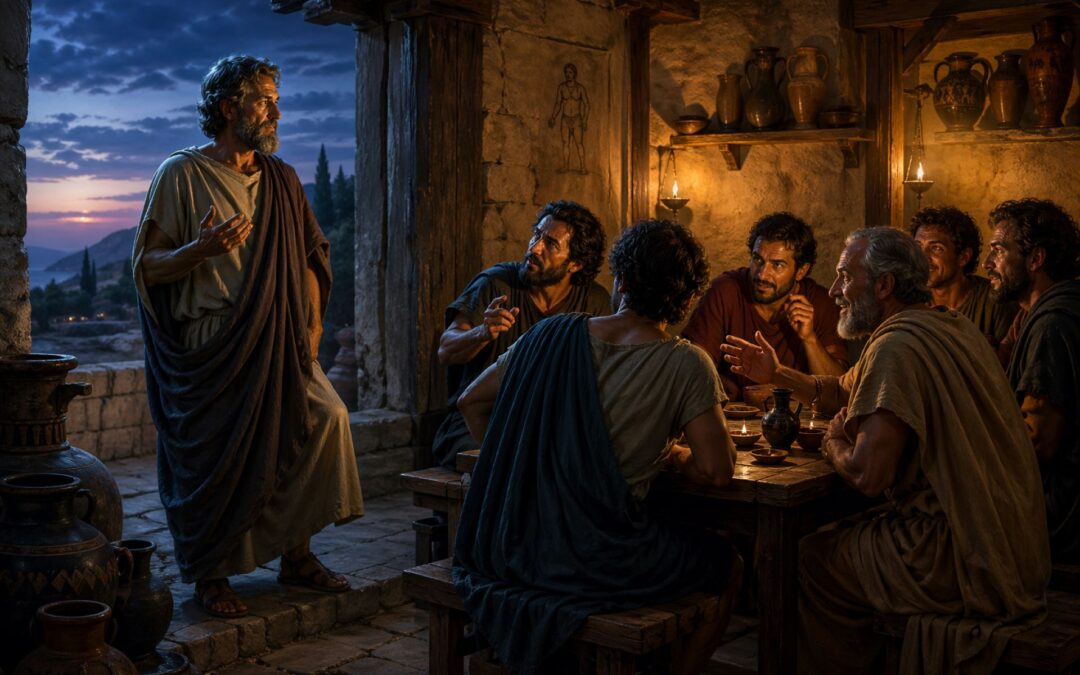
In taverns and public gatherings, he would recite verses that openly criticized the most respected sources of Greek belief—especially the works of Homer and Hesiod. These poets had shaped the Greek understanding of the gods, portraying them as powerful but deeply flawed beings—capable of jealousy, deceit, theft, and violence.
To most people, these stories were simply the way things were.
To Xenophanes, they were absurd.
Why would divine beings behave like the worst versions of humans? Why would gods, supposedly superior in every way, lie, cheat, and betray one another? And more fundamentally—why would they look like humans at all?
His criticism wasn’t subtle. It was direct, almost confrontational. He exposed the contradictions in what people believed, not with dry argumentation, but with sharp, memorable lines that were hard to ignore.
You can imagine the reaction.
Some may have laughed. Others may have felt uncomfortable. Many likely saw him as disrespectful, even dangerous. After all, he wasn’t just challenging a few stories—he was challenging the authority behind them.
And in doing so, Xenophanes wasn’t merely being provocative.
He was planting the seeds of something far more radical: the idea that what people accept as truth might not be truth at all—but something they’ve constructed without realizing it.
When Gods Look Like Us: The First Blow to Certainty
Xenophanes’ most famous insight is also one of his simplest—and most devastating.
If you look closely at the gods people worship, you begin to notice a pattern.
They look like the people who believe in them.
Xenophanes pointed this out with striking clarity. He observed that different cultures imagined their gods in their own image: darker-skinned people envisioned darker-skinned gods, lighter-skinned people imagined lighter-skinned gods, and so on. What was supposed to be divine and universal turned out to be suspiciously local and familiar.
And then he pushed the idea even further.
If horses could paint, he suggested, their gods would look like horses. If cattle could draw, their gods would resemble cattle.
It’s a simple thought experiment—but once you see it, it’s hard to unsee.
What Xenophanes exposed here wasn’t just a flaw in religious thinking. It was a deeper tendency of the human mind: the urge to project itself onto the world. We don’t just observe reality—we reshape it in ways that feel recognizable, comfortable, and aligned with our own experience.
In doing so, we mistake what is familiar for what is true.
This was the first real crack in the foundation of certainty.
Because if our most sacred beliefs—our ideas about gods, creation, and ultimate reality—are shaped by culture, perspective, and imagination, then what exactly are we trusting when we call something “truth”?
Xenophanes didn’t offer a complete answer. But he made something clear: what people accept without question often says more about them than about reality itself.
And once that realization takes hold, it doesn’t stop at religion.
It spreads into everything.
Our moral judgments. Our political views. Our interpretations of events. The stories we tell about ourselves and others. All of them begin to look less like objective truths—and more like constructions shaped by perspective.
This is where skepticism becomes unsettling.
Because it doesn’t just ask whether a belief is wrong.
It asks whether the very process by which we form beliefs can be trusted at all.
“All Is Opinion”: Xenophanes on the Limits of Knowledge
If Xenophanes had stopped at criticizing the gods, he would still have been controversial.
But he went further.
He didn’t just question what people believed—he questioned whether anyone could truly know anything at all.
In one of his most striking fragments, he makes a claim that still feels radical today: no human being has seen the clear and certain truth, nor will anyone ever know it. Even if someone were to speak the truth perfectly, they would have no way of knowing that it is true.
It’s a subtle but powerful shift.
The problem, according to Xenophanes, is not just that people are often wrong. It’s that even when they might be right, they have no way of verifying it with absolute certainty. Human beings are limited—by perception, by language, by perspective. We don’t have direct access to reality as it is. We only have interpretations.
What we call “knowledge” is, in the end, closer to belief.
Closer to opinion.
This doesn’t mean that all views are equal, or that evidence doesn’t matter. Xenophanes wasn’t arguing for chaos or intellectual laziness. He wasn’t saying that truth doesn’t exist. His point was more precise—and more uncomfortable.
Truth may exist.
But we cannot possess it with certainty.
Think about something as simple as the sky on a clear day. It appears blue. It feels obvious, undeniable. But even this depends on how our eyes perceive light, how our brain processes it, and the conditions under which we observe it. What seems like a straightforward fact is already filtered through layers of human limitation.
Now extend that to more complex matters—history, politics, relationships, motives, beliefs.
The further we move from direct experience, the more uncertain things become.
And yet, despite this uncertainty, people speak with confidence. They assert conclusions as if they were facts. They defend their views as if they were final. They build identities around beliefs that, from Xenophanes’ perspective, are fundamentally provisional.
This is where his skepticism becomes something deeper than criticism.
It becomes a form of intellectual humility.
To accept that all is, in some sense, opinion is not to give up on understanding. It is to recognize the limits within which understanding operates. It is to hold beliefs lightly—to remain open, to question, to revise.
And most importantly, to resist the illusion of certainty.
Because once we believe we fully possess the truth, we stop looking for it.
Why Humans Believe What Feels Right, Not What Is True
If Xenophanes showed that certainty is fragile, he also hinted at something equally important:
We don’t believe things because they’re true.
We believe them because they feel right.
This is a far more unsettling idea than simple ignorance. It suggests that our relationship with truth is not neutral. We are not passive observers carefully collecting facts and forming conclusions. We are participants—shaping reality in ways that align with our preferences, experiences, and emotional needs.
Xenophanes saw this clearly in religion.
Why did different cultures imagine their gods so differently? Why did divine beings so often resemble the people who worshipped them—not just in appearance, but in behavior, values, and flaws?
Because people weren’t discovering the gods.
They were creating them.
And they were doing so in a way that felt familiar, understandable, and, most importantly, comfortable.
A god who looks like you, thinks like you, and behaves in ways you recognize is easier to accept than something entirely alien. A god who shares your values is easier to follow than one who challenges them. And a god who justifies your actions—no matter how questionable—is far more convenient than one who condemns them.
This tendency hasn’t disappeared.
It has simply taken new forms.
We see it in how people interpret events. Two individuals can witness the same situation and come away with completely different conclusions—not because one is lying, but because each is filtering reality through their own expectations and beliefs.
We see it in how people consume information. Faced with multiple explanations, we gravitate toward the one that confirms what we already think. The one that fits neatly into our existing worldview. The one that doesn’t force us to reconsider too much.
And we see it most clearly in how easily people accept ideas that align with their identity.
If a belief reinforces who we think we are—our values, our group, our sense of being right—we’re far more likely to accept it without scrutiny. It feels true. And that feeling often substitutes for actual verification.
This is the quiet force behind so many confident opinions.
Not careful investigation, but psychological comfort.
Xenophanes didn’t have the language of modern psychology, but he understood the pattern. He saw that belief is not just about evidence—it’s about inclination. About familiarity. About what we are willing to accept.
And once you recognize this, something becomes clear.
The greatest obstacle to truth is not ignorance.
It’s attachment.
From Ancient Taverns to Modern Media: The Same Problem Persists
The setting has changed.
The scale has changed.
But the pattern Xenophanes noticed is still very much alive.
Back then, it played out in small gatherings—taverns, marketplaces, public recitals. A few people exchanging stories, reinforcing shared beliefs, occasionally interrupted by someone willing to question the narrative.
Today, those taverns have expanded into something far larger.
We live in a world of endless information streams—news outlets, social media platforms, podcasts, influencers, comment sections. At any given moment, we are exposed to more opinions, interpretations, and claims than any human being can reasonably process.
And yet, despite this explosion of information, something curious happens.
People don’t become more cautious.
They become more certain.
With so many perspectives available, you might expect more hesitation, more nuance, more acknowledgment of complexity. But often, the opposite occurs. People latch onto one version of events—usually the one that resonates most—and treat it as definitive.
Just like in Xenophanes’ time.
The only difference is speed and scale.
Where a conversation once reached a handful of listeners, a modern narrative can reach millions within minutes. Where beliefs once formed slowly, they now solidify almost instantly. Where doubt once required courage, certainty now comes pre-packaged and easily consumed.
And perhaps most importantly, the emotional stakes have intensified.
Information today doesn’t just inform—it provokes. It is designed to capture attention, trigger reactions, and keep people engaged. Anger, fear, outrage, validation—these are the currencies of modern media. The more something aligns with our existing beliefs and amplifies our emotions, the more likely we are to accept it without hesitation.
This creates a strange paradox.
We have more access to knowledge than ever before, yet we are constantly at risk of being misled.
Not necessarily because the information is entirely false—but because it is partial, selective, framed in ways that encourage certainty rather than inquiry.
And in this environment, the absence of skepticism becomes dangerous.
Without it, we absorb narratives as facts. We react to interpretations as if they were reality. We form strong opinions based on incomplete pictures—and then defend them as if they were undeniable truths.
Exactly the kind of behavior Xenophanes warned against.
The ancient skeptic, standing in a crowded tavern, questioning a popular story, now has a modern counterpart.
Except today, the “tavern” is global.
And the noise is constant.
Echo Chambers, Influencers, and the Illusion of Truth
If Xenophanes were alive today, he wouldn’t need to travel from city to city to observe how people form their beliefs.
He could just open a social media app.
Because what he noticed in ancient Greece—the tendency to accept what feels familiar and convenient—has now been amplified into entire systems designed around it.
These systems are what we call echo chambers.
An echo chamber is not just a group of people who agree with each other. It is an environment where agreement is constantly reinforced and disagreement is filtered out. Over time, this creates a closed loop: the same ideas circulate, the same assumptions go unchallenged, and the same conclusions are repeated until they feel undeniable.
Inside such a space, belief hardens into certainty.
Not because it has been thoroughly tested—but because it has never been meaningfully questioned.
This is where modern influencers come in.
Unlike traditional authorities, influencers don’t need to prove they are right. They only need to be convincing. And the easiest way to be convincing is not to present a balanced, nuanced view of reality, but to deliver a clear, emotionally satisfying narrative that aligns with what their audience already believes.
Tell people what they want to hear, and they will trust you.
Reinforce their worldview, and they will follow you.
Confirm their suspicions, and they will defend you.
It’s a simple formula—and an effective one.
But it comes at a cost.
Because the more people immerse themselves in these environments, the less exposure they have to alternative perspectives. The less friction their beliefs encounter. The fewer opportunities they have to refine or question what they think they know.
Truth, in such spaces, becomes something else entirely.
It becomes consensus.
If everyone around you believes the same thing, it starts to feel obvious. Self-evident. Beyond dispute. Doubt fades—not because the belief is necessarily accurate, but because there is no longer anything pushing against it.
And this is precisely the illusion.
What feels like certainty is often just repetition.
What feels like truth is often just familiarity.
Xenophanes warned that humans shape their beliefs in ways that reflect themselves. In echo chambers, this tendency reaches its peak. Entire groups begin to mirror their own assumptions back at themselves, mistaking that reflection for reality.
The skeptic, by contrast, steps outside that loop.
Not to reject everything—but to resist the comfort of unquestioned agreement.
Because once you recognize how easily belief can be shaped by environment, one thing becomes difficult to ignore:
Confidence is not proof.
When Skepticism Goes Wrong: Conspiracies and False Doubt
If skepticism is so valuable, why does it sometimes lead people in the exact opposite direction of truth?
Why do some of the most vocal “skeptics” end up believing things that are clearly absurd?
Because doubt, by itself, is not enough.
When Xenophanes questioned the beliefs of his time, he wasn’t replacing one certainty with another. He was opening space for inquiry. For careful thinking. For a more honest relationship with what we don’t know.
But that’s not always how skepticism plays out.
In many cases, people reject one source of information—mainstream media, institutions, experts—not because they’ve developed a deeper understanding, but because they’ve lost trust. And instead of staying in that space of uncertainty, they rush to fill it.
With something else.
This is where skepticism turns into something distorted.
Instead of questioning all claims with equal care, it becomes selective. People doubt established sources, but then accept alternative narratives with little to no scrutiny—as long as those narratives feel more satisfying, more exciting, or more aligned with their instincts.
“I don’t trust the official story” quickly becomes “I’ve found the real truth.”
And often, that “truth” is far more extreme.
Conspiracy theories thrive in this environment. They offer simple explanations for complex realities. They turn uncertainty into certainty, confusion into clarity, and randomness into intention. Everything fits. Everything makes sense. Nothing is left unresolved.
In a strange way, they provide the same comfort as unquestioned belief—just in a different form.
But the process is the same.
Instead of carefully evaluating evidence, people gravitate toward what feels compelling. Toward narratives that explain everything in one stroke. Toward conclusions that eliminate doubt rather than tolerate it.
This is not skepticism.
It’s certainty in disguise.
True skepticism doesn’t rush to replace one belief with another. It resists the urge to settle too quickly. It remains cautious—even toward its own conclusions. It asks not only “Is this wrong?” but also “What would count as evidence?” and “How do I know that I’m not just believing what I want to believe?”
That last question is the hardest.
Because it turns skepticism inward.
And that’s where many so-called skeptics stop.
They question everything—except themselves.
The Hidden Strength of Skepticism in an Age of Information Overload
At first glance, skepticism seems like a burden.
If nothing can be known with certainty, if every claim must be questioned, if every belief is provisional—then what are we left with? Doesn’t that just lead to confusion, hesitation, maybe even paralysis?
In theory, it could.
But in practice, something very different happens.
Because the real burden today is not uncertainty.
It’s excess.
We are constantly exposed to information—headlines, opinions, breaking news, expert takes, viral clips. Each piece arrives with urgency, demanding attention, reaction, and often, belief. Every day presents dozens of potential “truths,” many of them conflicting, most of them incomplete.
And the default response for many people is to engage.
To absorb, to react, to take sides.
This is where things begin to spiral.
Because once we treat every piece of information as something we must process, evaluate, and emotionally respond to, the mind becomes overwhelmed. It jumps from one issue to another, from one outrage to the next, rarely pausing long enough to reflect.
Skepticism interrupts this cycle.
Not by solving the problem of truth—but by changing our relationship to it.
Instead of immediately accepting or rejecting a claim, the skeptic holds it at a distance. Not dismissing it, but not embracing it either. There’s a pause. A gap between exposure and reaction.
And in that gap, something important happens.
We are no longer compelled to engage with everything.
Not every headline needs to be believed.
Not every opinion needs to be challenged.
Not every narrative deserves emotional investment.
This doesn’t make the skeptic indifferent. It makes them selective.
They still seek understanding. They still evaluate evidence. But they do so deliberately, not reactively. They recognize that most information is partial, framed, and often designed to provoke rather than inform.
So instead of being pulled in every direction, they remain grounded.
In a world where certainty is constantly being manufactured and sold, skepticism acts as a filter. It reduces noise. It prevents overcommitment to fragile conclusions. It protects the mind from being dragged into every passing wave of outrage or fear.
And perhaps most importantly, it restores a sense of control.
Not control over truth—but control over attention.
Because once you stop treating every claim as something you must believe or fight, the pressure begins to lift.
You no longer need to have an opinion on everything.
You no longer need to resolve every uncertainty.
You can let things remain open.
And in doing so, something unexpected emerges.
Not confusion.
But clarity.
Skepticism as a Path to Inner Peace
It may sound counterintuitive.
How can doubt—constant questioning, refusal to settle, lack of certainty—lead to peace of mind?
Shouldn’t it do the opposite?
After all, certainty feels reassuring. It gives us ground to stand on. It tells us what to believe, who to trust, and how to interpret the world. Without it, things seem unstable, unresolved.
But look closely at how certainty actually operates in today’s world.
People cling to beliefs, defend them aggressively, argue endlessly, and feel threatened when those beliefs are challenged. Entire emotional states—anger, fear, anxiety—are often tied to ideas that are treated as unquestionable truths.
And yet, as Xenophanes pointed out, these “truths” are rarely as solid as they appear.
So what happens when you loosen your grip?
When you stop treating your beliefs as final?
Something subtle shifts.
You begin to carry your views more lightly.
Instead of thinking, “This is how things are,” you move toward, “This is how things seem to me—for now.” That small change creates distance. It reduces attachment. It softens the instinct to defend, to argue, to react.
And with that, much of the emotional weight disappears.
You don’t need to win every debate.
You don’t need to correct every opinion.
You don’t need to feel personally threatened when someone disagrees.
Because your beliefs are no longer rigid extensions of your identity. They are working models—useful, but revisable.
This also changes how you relate to information.
A disturbing headline appears. Instead of immediately absorbing it as reality, you pause. You acknowledge that it may be true—but also that it may be incomplete, exaggerated, or misinterpreted.
The emotional spike never fully takes hold.
You remain steady.
This doesn’t mean disengaging from the world. It means engaging with it differently. With awareness. With restraint. With a constant reminder that what you are reacting to is not reality itself, but a version of it.
And that version is always filtered.
There’s also a quiet humility in this approach.
When you accept that you might be wrong, you become less defensive and more curious. Conversations shift from battles to explorations. Disagreement becomes an opportunity to learn, not a threat to overcome.
Even conflict loses some of its intensity.
Because if no one fully possesses the truth, then there’s less reason to fight over it so fiercely.
In this sense, skepticism becomes something more than a method of thinking.
It becomes a way of being.
A kind of mental posture that keeps you open, flexible, and, above all, less burdened by the illusion of certainty.
And in a world that constantly pushes you to take sides, form instant opinions, and react emotionally to incomplete information, that lightness is not weakness.
It’s stability.
Conclusion: The Courage to Say “Maybe I’m Wrong”
In a world that rewards certainty, skepticism feels almost rebellious.
We are constantly encouraged to have strong opinions, to take clear sides, to speak with confidence—even when the foundations of that confidence are shaky. The louder and more certain someone sounds, the more credible they often appear.
But Xenophanes points us in a very different direction.
Not toward silence, not toward indifference—but toward humility.
His insight was simple, yet profound: we may seek understanding, we may come closer to the truth, but we can never fully possess it. What we have are interpretations—some better than others, some more informed, some more refined—but never final.
And once you truly accept that, something changes.
You stop clinging so tightly.
You stop reacting so quickly.
You stop mistaking confidence for correctness.
Instead, you begin to navigate the world with a quieter, steadier mindset. You listen more carefully. You question more honestly. You remain open to being wrong—not as a weakness, but as a necessary part of getting closer to what is real.
This is not an easy stance to take.
It requires patience in a culture of immediacy. It requires restraint in a culture of reaction. And perhaps most of all, it requires the willingness to let go of the comfort that certainty provides.
But what you gain in return is something far more valuable.
Clarity without rigidity.
Engagement without overwhelm.
And a kind of inner peace that doesn’t depend on always being right.
In the end, skepticism is not about doubting everything for the sake of it.
It is about refusing to settle too quickly.
About recognizing the limits of what we know.
And about having the courage to say, even when everything in you wants to be sure:
Maybe I’m wrong.