
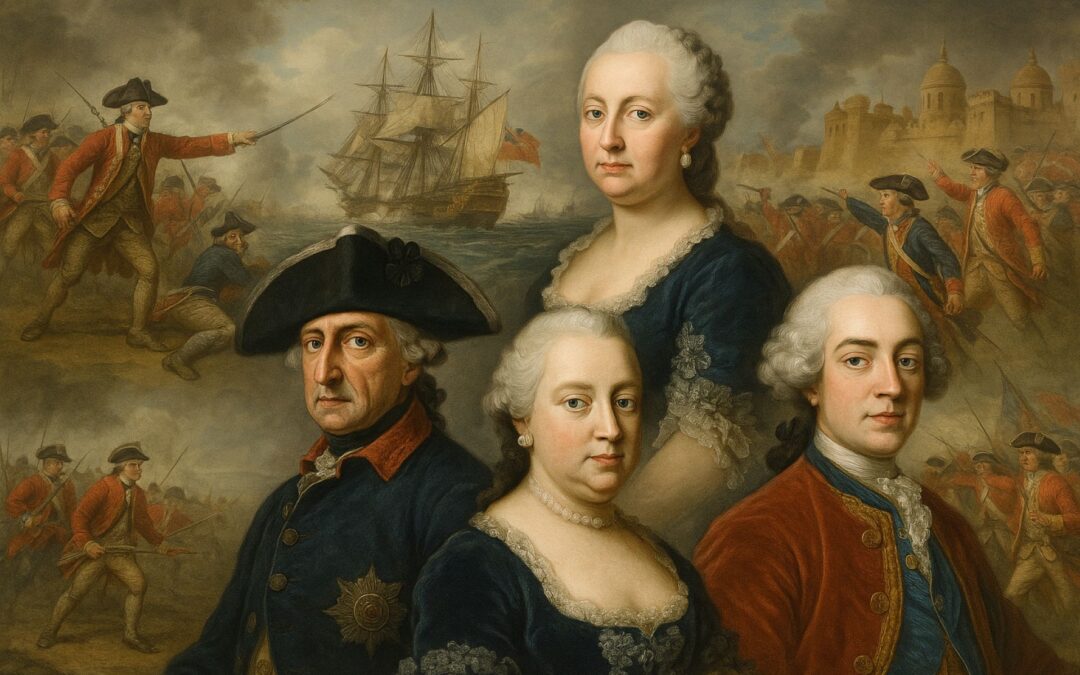
History books often teach us to think of the “world wars” as 20th-century phenomena—two cataclysmic conflicts defined by trenches, tanks, and total mobilization. Yet more than a century earlier, the globe was already caught in a struggle that stretched across continents and oceans. From the Ohio River Valley to the jungles of Bengal, from the sugar islands of the Caribbean to the heartlands of Europe, the Seven Years’ War (1756–1763) pulled nearly every great power into its orbit.
It was not just another dynastic quarrel but the first truly global war—reshaping alliances, collapsing empires, and setting the stage for revolutions to come. To understand how the modern world emerged, one must begin here, in the smoke of muskets and the clash of fleets that defined the mid-18th century.
A Global Conflict Before Its Time
The Seven Years’ War was unlike anything the world had seen before. Earlier wars—such as the War of the Spanish Succession—had pulled in multiple European nations, but their theaters of conflict remained largely confined to Europe itself, with colonial skirmishes acting as distant sideshows. This conflict was different. It was woven into the very fabric of empire, fought across oceans, continents, and climates as varied as the icy rivers of Canada, the steamy jungles of Bengal, and the volcanic soils of the Caribbean.
What made it truly global was the way local disputes became inseparable from wider ambitions. A clash between settlers and French soldiers in the Ohio Valley was not merely a frontier dispute—it was tied to who would dominate trade routes across the Atlantic. A battle fought between British sepoys and French allies in Bengal reverberated in European capitals, shifting calculations in Paris and London. Unlike wars that came before, no region existed in isolation. Each loss, each triumph, carried consequences across the globe.
It also redefined what a “world power” meant. Britain, though smaller in population and landmass than France, harnessed its navy to strangle French shipping and project force across the seas. France, stretched between defending its continental borders and its overseas colonies, struggled to balance its ambitions. Prussia, landlocked and seemingly fragile, proved itself a formidable continental force under Frederick the Great. This was not just a war about territory—it was a war about identity, about who would be the architect of the modern world order.
The Web of Old Rivalries
The fuse for this powder keg was long and tangled. To understand why the Seven Years’ War erupted, one must step back into the earlier struggles that had defined Europe for half a century. The Bourbon monarchy of France and the Habsburg dynasty of Austria had been locked in a seemingly eternal duel for dominance. The War of the Spanish Succession (1701–1714) had already pitted them against one another, dragging in Britain and other European powers to maintain a fragile balance. That war ended with treaties that carved up influence but left lingering distrust.
The War of the Austrian Succession (1740–1748) deepened the fractures. When Charles VI of Austria died, his daughter, Maria Theresa, inherited the throne. Her claim was challenged, and Europe once again plunged into war. Britain and Austria stood together, with Russia and the Dutch Republic lending support. France, smelling opportunity, aligned with Prussia, Spain, and Sweden. For eight years, Europe bled. The outcome seemed inconclusive, yet one event tilted the balance: Frederick the Great of Prussia wrested the wealthy province of Silesia from Austria.
This loss was not merely territorial. Silesia was a gem of Central Europe—rich in agriculture, industry, and manpower. Its seizure humiliated Austria and made Frederick a figure to be reckoned with. Maria Theresa never forgave the theft, and Austria’s desire to reclaim Silesia became a central obsession. Britain, however, was content to accept the peace, leaving Austria to stew in resentment. France, too, was dissatisfied: it had spent blood and treasure but gained little. These unresolved frustrations meant that Europe was primed for yet another war. Treaties had been signed, but they were little more than brittle parchment trying to contain dynastic ambition.
The Diplomatic Revolution
The mid-18th century saw one of the most startling turnabouts in European political history—what historians call the “Diplomatic Revolution.” For centuries, Austria and France had been bitter enemies. Their dynasties clashed repeatedly over succession crises, borders, and influence within the Holy Roman Empire. Generations of rulers and subjects had grown accustomed to thinking of one another as perpetual foes. Yet, by 1756, that enmity was abandoned in favor of alliance.
Why? At the heart of this transformation was Austria’s unhealed wound—Silesia. Maria Theresa had seen her realm diminished by Frederick the Great’s cunning seizure of the province during the War of the Austrian Succession. She was determined to win it back, but to do so she needed allies stronger than Britain, who had grown increasingly indifferent to Austria’s plight. Britain’s primary concern was Hanover, the ancestral homeland of its ruling dynasty, not Austrian ambitions in Central Europe. London saw little reason to spend more blood or coin on a war to restore Maria Theresa’s pride.
This cold indifference drove Austria into the arms of its former enemy, France. For Louis XV, too, the logic was clear: Britain was becoming the greater threat, not Austria. British naval dominance and expanding colonial holdings endangered French interests overseas. By siding with Austria, France hoped to check Britain’s ambitions while containing Prussia, which was rapidly rising as a new continental rival. Russia, ever wary of Prussian expansion toward its borders, leaned into this coalition as well.
Meanwhile, Britain sought protection elsewhere. With Hanover always under threat from French invasion, King George II needed a partner who could defend it on the continent. Pragmatism outweighed mistrust, and Britain aligned itself with Prussia, promising financial subsidies in exchange for Frederick’s military muscle. It was a marriage of convenience, not affection, but it gave Frederick what he craved most: resources to sustain his campaigns and legitimacy as a partner of the world’s foremost naval power.
This rearrangement of alliances shocked contemporaries. Old enemies became allies; old allies became adversaries. The careful equilibrium of 17th- and early 18th-century politics was gone. What emerged was a volatile new order that ensured any spark—whether in Europe, America, or Asia—would ignite a conflict far wider than before.
Colonial Flashpoints
While Europe reshuffled its alliances, the colonies were already burning. The 18th century was an age of voracious expansion, and nowhere was the appetite for territory and trade more visible than in the Americas and Asia. Britain and France, in particular, were locked in an imperial rivalry that spanned oceans.
In India, both nations had transformed trading posts into fortified settlements. Their East India Companies acted as hybrid entities: part merchants, part governors, part military forces. They cultivated local allies among princes and nawabs, offering money, weapons, and promises of support in exchange for commercial privilege. These alliances, however, were fragile and opportunistic. When promises faltered or profits dwindled, rulers switched sides, fueling a cycle of betrayal and conflict. The Carnatic Wars in southern India had already shown how European disputes could flare into regional wars fought with Indian soldiers under foreign flags.
But it was North America where tension boiled over. Britain’s thirteen colonies hugged the Atlantic coast, expanding steadily westward as settlers carved farms and towns into frontier lands. France, by contrast, controlled a vast interior empire, from Canada down the Mississippi to the Gulf of Mexico. Their claim was more about breadth than density—New France’s population was sparse, barely 100,000 compared to Britain’s two million colonists—but it gave them leverage over rivers, trade routes, and alliances with Native American nations.
The Ohio River Valley became the flashpoint. To assert its claim, France began constructing a line of forts stretching through the wilderness, culminating in Fort Duquesne, on the site of modern Pittsburgh. To British colonists, this was a red line. Expansion westward was their lifeblood, and French forts looked like a noose tightening around their ambitions. In 1754, Virginia’s governor dispatched a young militia officer, George Washington, to confront the French presence. The skirmish at Jumonville Glen, where Washington’s men ambushed a French detachment, seemed minor at the time. Yet its consequences were immense: France retaliated, Washington was forced to surrender at Fort Necessity, and the frontier erupted into violence.
This was more than a colonial quarrel. Each empire saw these lands not only as valuable in themselves but as essential to the wealth and power of the state. Timber, furs, farmland, trade routes—all were bound into the mercantilist system that underpinned European prosperity. Thus, a musket fired in the forests of Pennsylvania echoed in Versailles, London, and Vienna. The colonial world was no longer peripheral; it was central to the struggle for global supremacy.
War Without Declaration
The Seven Years’ War did not begin with a thunderclap of formal declarations. Instead, it bled gradually into existence—an undeclared war of ambushes, blockades, and opportunistic strikes. For two years before official war was proclaimed, Britain and France were already locked in escalating hostilities.
In North America, the frontier smoldered. After George Washington’s failed defense at Fort Necessity in 1754, both sides poured reinforcements into the colonies. French forces, supported by Native American allies, struck forts along the frontier, while British colonial militias scrambled to hold their settlements. The violence spread like wildfire—raids, massacres, scorched villages—creating an atmosphere of fear and reprisal that hardened into open conflict.
At sea, Britain leveraged its naval superiority to choke France’s lifelines. Admiral Edward Boscawen intercepted French reinforcements bound for Quebec in 1755, capturing ships and thousands of sailors. British warships prowled the Atlantic, seizing merchant vessels under the guise of “protection” while London and Paris still pretended to be at peace. This shadow conflict blurred the line between piracy and policy, but its impact was devastating: French trade faltered, colonial outposts weakened, and resentment deepened.
In the Mediterranean, France struck back with boldness. In 1756, its forces descended on Minorca, a strategic British stronghold. The British dispatched Admiral John Byng to relieve the island, but his failure to press the attack—and subsequent retreat—sealed Minorca’s fall. The loss caused an uproar in Britain. Byng was scapegoated, court-martialed, and executed, a chilling reminder that incompetence, or even caution, would not be tolerated. Voltaire famously quipped that Britain had shot its admiral “to encourage the others.”
By the time Britain formally declared war in May 1756, the reality was clear: peace had already vanished. France followed with its own declaration weeks later, but the fighting had been raging across oceans and continents long before. The world was already in flames, and the legalities of diplomacy had become little more than ceremony.
Frederick’s Gambit
While Britain and France clashed overseas, Europe itself was bracing for upheaval. At the center of it all stood Frederick II of Prussia—known to history as Frederick the Great. His kingdom was not vast in size, but it was drilled into military perfection. Prussia’s army was its backbone, its pride, and its weapon for survival. Surrounded by Austria, Russia, and France, Frederick understood that hesitation meant annihilation. His solution was audacity.
In August 1756, he launched a preemptive invasion of Saxony, a state allied with Austria. His strategy was simple in design but breathtaking in risk: deliver lightning blows against Austria before Russia could mobilize, force Vienna into submission, and then turn to face his other enemies. The invasion of Saxony set the tone. Frederick captured Dresden and sought to cow his opponents through speed and ferocity.
But war rarely bends to plans. The Austrians, under General Maximilian von Browne, held firm at battles like Kolín, blunting Frederick’s advance into Bohemia. Instead of a swift victory, Prussia found itself entangled, fighting on multiple fronts. Russia pushed from the east, Sweden invaded Pomerania from the north, and France marched into Hanover, threatening Frederick’s British ally. By late 1757, Prussia teetered on the edge of collapse.
It was here that Frederick’s genius as a commander shone brightest. At Rossbach in November 1757, he faced a combined French and Imperial army nearly twice the size of his own. Through feints and rapid maneuvers, he outflanked them, routing the enemy in one of the most dazzling displays of tactical brilliance in European history. Barely a month later, at Leuthen, he repeated the feat—outnumbered yet again, he smashed the Austrian army with devastating precision. His soldiers, drilled to perfection, executed complex movements with machine-like discipline, turning apparent disadvantages into triumphs.
These victories preserved Prussia from destruction, but they came at a terrible cost. The kingdom bled men and treasure, its population strained to sustain constant warfare. Frederick’s gambit—audacity over caution, attack over defense—kept his enemies at bay, but survival was always precarious. He was winning battles, but whether he could win the war remained uncertain.
The Struggle for India
Thousands of miles from Europe, India became one of the most decisive arenas of the Seven Years’ War. Though formally ruled by great indigenous powers—the remnants of the Mughal Empire in the north, the Maratha Confederacy in the west and center, and independent sultanates in the south—the real contest was increasingly between two foreign corporations: the British East India Company and the French East India Company. On paper, both were trading enterprises. In practice, they acted like states. They maintained fortified settlements, minted their own currency, negotiated alliances, and commanded private armies of sepoys—Indian soldiers trained and equipped in European style.
This was not merely commerce; it was conquest disguised as trade. The British and French courted local rulers with promises of protection and tribute, while simultaneously plotting to dominate them. Indian princes, in turn, used the Europeans to bolster their own power, switching allegiances when expedient. The subcontinent became a chessboard where European ambition collided with Indian politics, producing alliances that shifted like desert sands.
The turning point came in Bengal in 1757. Robert Clive, a young and audacious officer of the British East India Company, marched against the Nawab of Bengal, Siraj-ud-Daulah, who had allied with the French. At the Battle of Plassey, Clive commanded just a few thousand men—British regulars, sepoys, and Indian allies—against an army of nearly 50,000. On paper, the British should have been annihilated. Instead, treachery within the Nawab’s ranks delivered victory. Several of his commanders defected mid-battle, leaving Siraj-ud-Daulah exposed. Clive’s forces seized the moment, routing the much larger army and capturing immense wealth.
The consequences were staggering. Bengal, one of the richest provinces in India, fell under British control. Its revenues funded further conquests, while the French, humiliated, saw their influence in India collapse. Though French forces fought on—seizing Cuddalore and threatening Madras—they were decisively defeated at the Battle of Wandiwash in 1760. Pondicherry, their last stronghold, fell the following year. With that, French dreams of an Indian empire ended.
The British East India Company emerged not as a merchant among equals, but as a sovereign power. Plassey and Wandiwash set the stage for nearly two centuries of British domination in India, transforming the subcontinent into the crown jewel of empire.
The Fight for North America
Across the Atlantic, another vast theater shaped the war’s outcome: North America. For over a century, Britain and France had vied for dominance of the continent. Britain’s thirteen colonies stretched along the eastern seaboard, their population booming past two million. New France, by contrast, sprawled across Canada, the Great Lakes, and down the Mississippi to Louisiana—but its population was a mere 100,000. France compensated for this weakness by forging strong alliances with Native American nations, who sought to check the relentless push of British settlers westward.
At the war’s outset, the French struck first. They captured Fort Oswego in 1756 and Fort William Henry in 1757, inflicting humiliations on the British and their colonial allies. These victories emboldened France and spread panic through the frontier, where settlers faced raids that left towns burned and families displaced. Yet demographic realities were against France. Britain’s colonies had manpower, resources, and—crucially—the support of the Royal Navy, which could funnel reinforcements and supplies across the Atlantic.
The tide began to turn with the rise of William Pitt the Elder, Britain’s new Secretary of State. Unlike his predecessors, Pitt understood the war’s global nature. He poured money into Frederick the Great’s campaigns in Europe to keep France pinned down there, while directing British armies and fleets to strike at France’s colonies. His vision was clear: Europe would be the anvil, but the empire would be the hammer.
By 1758, momentum shifted. The British captured Fort Duquesne, renaming it Pittsburgh after Pitt himself, and seized Fort Frontenac on Lake Ontario, cutting French supply lines. The following year brought the war’s decisive moment: the Battle of the Plains of Abraham outside Quebec. General James Wolfe led 4,000 British troops up the cliffs overlooking the city, confronting the French army under the Marquis de Montcalm. The battle was brief but brutal. Wolfe and Montcalm both fell, mortally wounded, but the British carried the field. Quebec surrendered, and with it, France’s grip on Canada loosened fatally.
The fall of Quebec paved the way for the conquest of Montreal in 1760, extinguishing France’s empire in North America. What had begun as scattered skirmishes in the Ohio Valley ended with Britain commanding almost the entire continent east of the Mississippi. France ceded Louisiana to Spain as consolation, but the fleur-de-lis disappeared from North America.
This was more than a colonial reshuffle. It was the foundation for future revolutions. Britain’s new dominion required defense and administration, costs that London sought to recover through taxation of its colonies. The seeds of American rebellion were sown in the very triumphs that gave Britain its global empire.
The War Goes Global
By the late 1750s, the Seven Years’ War had outgrown its European roots and erupted into a truly global conflict. The fighting was no longer confined to the Rhine or the forests of North America; it spread to the sugar islands of the Caribbean, the trade forts of West Africa, and the vast expanse of the world’s oceans. Britain, wielding the Royal Navy like a bludgeon, turned the seas into its battlefield, while France, overstretched and battered, scrambled to defend its far-flung possessions.
The Caribbean was a prize beyond measure. Sugar, not gold, was the currency of power in the 18th century, and islands like Guadeloupe, Martinique, and Saint-Domingue were the beating heart of France’s wealth. In 1759, British fleets descended on the Caribbean, capturing Guadeloupe after a brutal campaign in which tropical diseases killed more men than musket balls. Martinique, better defended, resisted until later, but the message was clear: Britain would strike at France’s richest veins.
In West Africa, British forces seized French trading posts in Senegal, cutting into the slave trade that underpinned French and European economies alike. These victories further strangled France’s ability to supply its colonies. Every captured ship and port tightened the noose.
At sea, Britain scored its most decisive victories. The French dreamed of an invasion of Britain itself, assembling fleets and flat-bottomed boats to ferry troops across the Channel. It was a desperate gamble, one that might have turned the war if successful. But the Royal Navy crushed these ambitions. In August 1759, Admiral Boscawen defeated the French Mediterranean fleet at Lagos, scattering it beyond repair. Three months later, Admiral Hawke met the Brest fleet at Quiberon Bay, in a storm-tossed battle that ended with French ships wrecked, sunk, or captured. The invasion plans were abandoned forever.
The year 1759 became Britain’s annus mirabilis—a year of miracles. Victories in Canada, triumphs at sea, seizures of colonies abroad—Britain seemed unstoppable. The war had become global in scope and global in consequence, confirming Britain as the premier naval and colonial power of the age. France, in contrast, found itself overstretched and bleeding, fighting battles it could no longer hope to win.
Spain Enters the Fray
While Britain basked in triumph, a new danger loomed. Spain, ruled since 1759 by Charles III, watched Britain’s ascendance with alarm. The Bourbon monarch could not ignore the collapse of French power in the Americas; if Britain triumphed too thoroughly, its next target might be Spain’s vast colonial possessions—from Mexico and the Caribbean to South America and the Philippines.
For several years, Spain had remained neutral, balancing its Bourbon ties to France with its desire to avoid a ruinous war. But by 1761, pressure mounted. France, desperate for aid, courted its Spanish cousins. Charles, fearing that inaction would doom Spain to irrelevance, signed the “Family Compact,” binding Madrid to Paris. In 1762, Britain declared war on Spain, widening the conflict once more.
The results were catastrophic for Spain. In the Caribbean, a massive British expedition of 30,000 men and more than 200 ships besieged Havana, the jewel of Spain’s empire. The siege lasted two brutal months, with heavy casualties on both sides, but by August 1762, Havana surrendered. The British captured hundreds of ships, immense stockpiles of silver, and gained control of one of the most strategic ports in the Americas.
Almost simultaneously, another British expedition sailed across the Pacific and seized Manila, the capital of the Philippines. The fall of Manila stunned the Spanish world—it revealed how vulnerable even their most distant holdings were to Britain’s global reach. Back in Europe, Spanish and French armies launched an invasion of Portugal, Britain’s ally, hoping to strike a decisive blow. But the Anglo-Portuguese defense held firm, repelling the invaders in battle after battle.
In less than a year, Spain had lost its richest Caribbean city, its Pacific capital, and failed in Iberia. The gamble to enter the war in solidarity with France had turned into a disaster. Spain’s prestige and influence were shredded, and its empire, though vast, now appeared brittle. The message was clear: Britain’s naval supremacy made no colony, however distant, truly safe.
The Russian Twist
No episode in the Seven Years’ War illustrates the fickleness of fate more than the dramatic reversal that came from Russia. From the beginning, Empress Elizabeth of Russia had been one of Frederick the Great’s most implacable enemies. Her armies, vast and resilient, were determined to crush Prussia and dismantle Frederick’s growing power. Russian forces poured into East Prussia, capturing fortresses like Königsberg and threatening to drive straight into Berlin. In August 1759, at Kunersdorf, Frederick’s army suffered its most catastrophic defeat—nearly annihilated by a combined Austrian and Russian force. For a moment, Prussia’s very survival seemed impossible.
By 1761, the pressure was unbearable. Russian troops had seized Kolberg on the Baltic coast, securing a vital port and cutting off Prussia’s access to supplies. Even Frederick himself admitted that Prussia was staring into the abyss. Yet just as the walls closed in, fortune intervened in a way no strategist could have foreseen. On January 5, 1762, Empress Elizabeth died. Her death was more than the passing of a monarch—it was the salvation of Prussia.
Her successor, Peter III, was a peculiar figure: clumsy, unpopular, and ill-prepared for the throne. But he was also an unabashed admirer of Frederick the Great, idolizing the Prussian king and his military genius. Within months of taking power, Peter withdrew Russia from the war, returned captured territories, and even offered Frederick auxiliary troops. Historians have often called this the “Miracle of the House of Brandenburg”—a single dynastic change that rescued a kingdom on the brink of destruction.
Peter’s reign was short. By July 1762, he was overthrown by his wife, who would become Catherine the Great. But even she saw little reason to throw Russia back into the costly war. Instead, Russia exited altogether, leaving Austria without its most powerful ally. Sweden, exhausted and with little to gain, soon followed suit. Frederick, who had seemed doomed only a year earlier, suddenly found his enemies dissolving around him. He seized the opportunity, reclaiming much of Silesia and stabilizing his battered realm. Prussia emerged not only alive but recognized as a permanent fixture among Europe’s great powers—all thanks to an extraordinary twist of dynastic luck.
The Peace Settlements
By 1762, all combatants were staggering under the weight of exhaustion. Years of fighting had drained treasuries, bled armies, and disrupted economies. The war had become unsustainable. Even Britain, flush with victories, was staggering under the cost of global campaigns. The time for peace had arrived.
Negotiations culminated in two key treaties in February 1763. The Treaty of Hubertusburg, signed between Austria, Prussia, and Saxony, brought the European struggle in the heart of the continent to a close. Its terms were strikingly conservative: all occupied territories were returned, and borders restored almost to their prewar lines. Yet beneath that apparent stalemate lay a decisive outcome—Prussia retained Silesia. This single province, fought over for decades, was the symbol of Frederick’s resilience. It confirmed Prussia’s rise as a great power, on equal footing with Austria and France.
More transformative was the Treaty of Paris, signed just days earlier between Britain, France, Spain, and Portugal. Here, the map of the world was redrawn. France ceded all its territories in North America east of the Mississippi River to Britain, effectively ending its empire on the continent. To compensate its ally, Spain received Louisiana but was forced to surrender Florida to Britain. In India, France was allowed to keep a handful of trading posts but lost any real political influence; Britain’s East India Company was now the undisputed foreign power in the subcontinent.
The Caribbean islands of Guadeloupe and Martinique, however, were restored to France, underscoring their immense economic value. In fact, French negotiators considered the sugar islands far more precious than Canada—a striking reflection of the priorities of the age. Spain, though defeated, regained both Havana and Manila, yet the humiliation lingered: its supposed show of strength had instead exposed the fragility of its empire.
The war ended with Britain as the unrivaled global hegemon. It controlled Canada, dominated India, commanded the seas, and possessed colonies in every corner of the globe. But its triumph came at a cost: staggering debt. To service that debt, London would turn to taxation of its American colonies—taxation that would provoke rebellion within a decade. France, though humbled, nursed its wounds and quietly prepared for revenge, a revenge it would exact by aiding those same rebellious colonies.
Thus, the peace of 1763 was not an end but a prelude. The treaties closed the chapter on the Seven Years’ War, yet they opened the door to the American Revolution and, eventually, the upheavals of the French Revolution. In seeking to resolve one conflict, Europe had merely planted the seeds of the next.
Legacies of the Seven Years’ War
The Seven Years’ War did not simply redraw borders—it reshaped the trajectory of global history. Its echoes reverberated for decades, influencing revolutions, empires, and the very concept of world power.
For Britain, the war was both a crowning triumph and the beginning of new troubles. Victory brought an empire of unprecedented scope: Canada, dominance in India, supremacy on the seas, and key footholds in the Caribbean and West Africa. Britain emerged as the undisputed global superpower of the 18th century. Yet this empire came with staggering costs. Financing far-flung campaigns had left the treasury heavily indebted. To recoup expenses, Parliament turned to its colonies—most notably the thirteen in North America. Taxes such as the Stamp Act and duties on tea, sugar, and other goods provoked anger among colonists who felt they had borne the brunt of war without being given representation in London. The cry of “no taxation without representation” was born from the financial fallout of the Seven Years’ War. Within a dozen years, rebellion erupted, and Britain’s hard-won empire fractured with the American Revolution.
France emerged humbled and bitter. The loss of Canada and India stripped it of its global reach, and its naval defeats exposed the limits of French power against Britain’s maritime supremacy. Yet the sting of humiliation did not vanish—it fermented. French leaders, eager to strike back at Britain, would eagerly support the American colonists in their rebellion, providing money, arms, and fleets. That intervention would cripple Britain while also helping to bankrupt France itself. The war debts, combined with the social strains of defeat, contributed directly to the crisis that culminated in the French Revolution of 1789. In losing one empire, France laid the groundwork for its monarchy’s collapse.
Prussia, though battered, emerged transformed. Against overwhelming odds, Frederick the Great had held his kingdom together and secured permanent possession of Silesia. This victory elevated Prussia from a middling German state into a great power, reshaping the balance within the Holy Roman Empire and across Europe. The war cemented Frederick’s reputation as a military genius and made Prussia a rival that Austria, France, and Russia could no longer ignore. It also sowed the seeds for a future struggle over German dominance, one that would continue into the 19th and 20th centuries.
Spain’s fortunes declined sharply. Its late entry into the war had exposed the vulnerability of its empire. The loss of Havana and Manila, though later returned, was a humiliation. The failed invasion of Portugal revealed cracks in its military strength. Worse, Spain had traded Florida to regain its Caribbean jewels, shrinking its influence in North America. Though its empire still stretched across the globe, the war underscored its weakness compared to Britain’s rising supremacy.
Beyond the great powers, the consequences were equally profound. Native American nations that had allied with France found themselves abandoned to British expansion. In India, the British East India Company grew from a trading concern into a territorial power, laying the foundation for two centuries of colonial rule. In the Caribbean, sugar’s importance was confirmed, entrenching slavery even deeper into the economic lifeblood of empires.
The Seven Years’ War, often called the “first world war,” was more than a clash of kings and armies—it was a turning point in the story of modernity. It demonstrated that wars could no longer be contained within regions, that commerce and colonies mattered as much as crowns and thrones, and that the costs of victory could be as destabilizing as defeat. Its treaties ended the fighting, but its legacies ensured that the world it created was one primed for revolution, upheaval, and the dawn of a new global order.
Conclusion
The Seven Years’ War was more than a contest of borders—it was a hinge in history. Britain emerged triumphant but indebted, sowing the seeds of rebellion in its American colonies. France, stripped of empire, nursed its wounds until vengeance arrived in the form of revolution and renewed conflict with Britain. Prussia rose from precarious survival to the ranks of Europe’s great powers, altering the balance of the continent for generations.
Spain, humbled, entered a long decline. Beyond the royal courts and battlefields, the war redrew the map of commerce, cemented colonialism, and tightened the chains of slavery in the Caribbean. It was a conflict that revealed the world’s interconnection long before the word “globalization” existed. In its victories and defeats lay the blueprint for the age that followed—an age of revolutions, empires, and the relentless power struggle that still echoes today.