
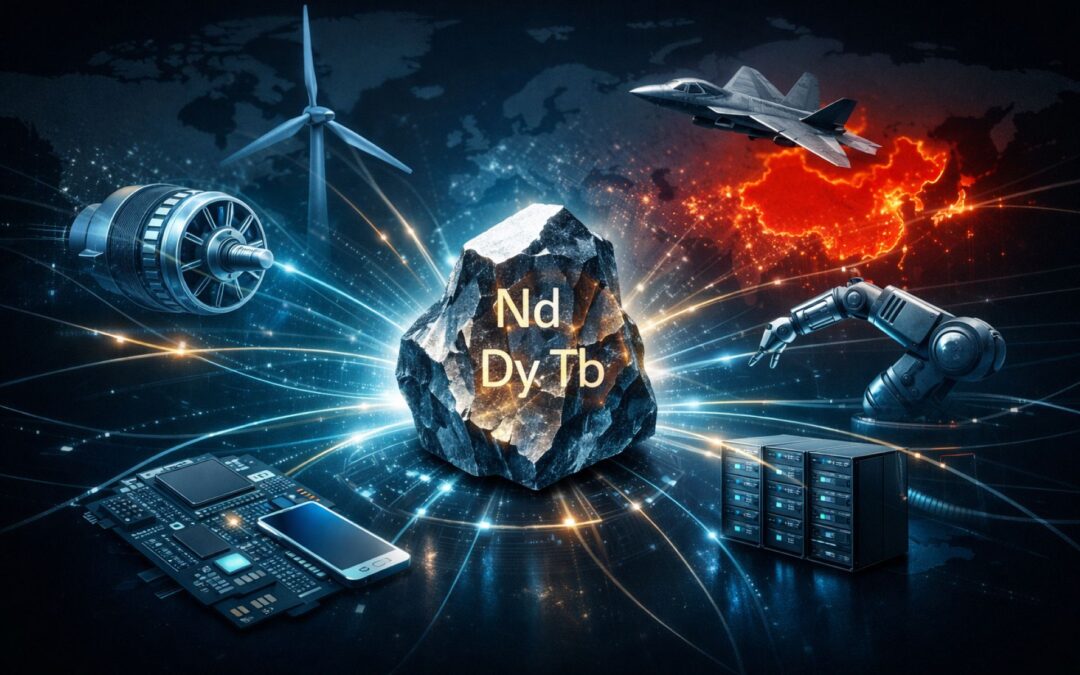
Modern technology often depends on things we rarely notice. Inside a smartphone, a fighter jet, or an electric vehicle are thousands of components working together in complex systems. But sometimes, the most important ingredient is also the smallest.
Consider the electric motor inside a modern EV like the Tesla Model Y. The entire vehicle weighs nearly two tons and contains more than ten thousand parts. Yet deep inside its motor lies a critical component that weighs barely more than a pound: rare earth metals embedded inside powerful magnets. That tiny amount of material dramatically improves efficiency, torque, and performance. Without it, the motor would be heavier, more expensive, and far less effective.
This small detail reveals a much larger reality about the modern economy. Rare earth elements—seventeen obscure metals buried in the periodic table—have quietly become essential to nearly every advanced technology. Electric vehicles, wind turbines, smartphones, robotics, advanced weapons systems, and even AI infrastructure all depend on them. Their quantities are tiny, but their strategic importance is enormous.
And today, one country dominates them.
Over the past three decades, China has built overwhelming control over the global rare earth industry. It produces the majority of the world’s supply and controls nearly all of the refining capacity required to transform raw ore into the magnets and materials used by high-tech manufacturers. This dominance did not happen by accident. It was the result of industrial strategy, technological acquisition, environmental trade-offs, and a series of policy mistakes made by Western governments.
What began as a niche mining sector has quietly evolved into one of the most important geopolitical supply chains in the world.
To understand how China gained this position—and why it may shape the future of technology and global power—we need to start with the minerals themselves.
The Tiny Ingredient That Powers Modern Technology
To understand why rare earth minerals matter, it helps to return to the electric vehicle motor.
The Tesla Model Y is the best-selling electric vehicle in the United States. It weighs roughly 4,388 pounds and contains more than 10,000 individual parts. But one of the most important components in the entire vehicle sits inside the rear drive unit, a compact system that powers the motor and transfers torque to the wheels.
That unit weighs just under 200 pounds—less than five percent of the car’s total weight. Hidden inside the motor are powerful permanent magnets that generate the magnetic field necessary to spin the rotor and produce motion. These magnets are what allow electric motors to deliver high torque, efficiency, and reliability.
Inside those magnets lies the true secret: rare earth metals.
A Tesla Model Y uses roughly half a kilogram of rare earth materials embedded within these magnets. Compared to the total weight of the vehicle, this is almost insignificant. Yet those few hundred grams dramatically improve motor performance. Without them, the motor would need to be larger, less efficient, and significantly more expensive to manufacture.
This paradox defines the rare earth industry.
Rare earth elements are rarely used in large quantities, but they are essential to the performance of modern technology. They enable stronger magnets, lighter components, and higher efficiency in advanced electronics. Their presence allows engineers to shrink devices, improve energy efficiency, and push technological performance to new levels.
In other words, these materials are not valuable because of their volume. They are valuable because of what they make possible.
And that small detail carries enormous implications for the global economy. When a handful of elements can determine the efficiency of electric vehicles, the capabilities of military hardware, and the power consumption of data centers, control over their supply becomes more than just a mining issue.
It becomes a matter of strategic power.
What Rare Earth Minerals Actually Are
Despite the name, rare earth minerals are not necessarily rare in the Earth’s crust. Many of them are relatively abundant. The challenge is that they are rarely found in concentrations large enough to be economically mined and processed.
The term “rare earths” refers to a group of seventeen metallic elements located near the bottom of the periodic table. These elements include neodymium, dysprosium, terbium, praseodymium, and several others that possess unusual magnetic, chemical, and electrical properties.
Those properties make them uniquely valuable for modern manufacturing.
Neodymium and dysprosium, for example, are used to produce extremely powerful permanent magnets. These magnets are essential in electric motors used in electric vehicles, wind turbines, drones, robotics, and industrial machinery. Lanthanum is widely used in petroleum refining, while europium and terbium help produce the vibrant colors found in screens and lighting technologies.
Rare earths also play a crucial role in defense technology. Advanced fighter jets, precision-guided missiles, radar systems, and satellite communications all rely on components that use rare earth materials. A single F-35 fighter jet, for instance, requires hundreds of kilograms of rare earth elements throughout its systems.
In renewable energy systems, their role is just as important. Wind turbines rely on rare earth magnets to generate electricity efficiently. Electric vehicles depend on them for compact, high-performance motors. Even the growing infrastructure behind artificial intelligence—massive data centers and advanced electronics—depends on materials that incorporate rare earth components.
The key point is that rare earths are not valuable because they are large commodities like oil or iron ore. Their value lies in their enabling role. They make modern technologies possible.
This means that whoever controls the production and processing of these minerals gains influence over some of the most important industries in the world.
And today, that control largely belongs to China.
China’s Dominance Over Rare Earth Supply
Today, China occupies a position in the rare earth industry that few countries have ever achieved in any critical resource market.
Roughly 70 percent of the world’s rare earth minerals are mined in China. But the more important figure is not mining—it is refining. Transforming raw rare earth ore into usable materials requires complex chemical processing, separation techniques, and specialized facilities.
In that stage of the supply chain, China’s dominance is even greater.
Around 90 percent of the world’s rare earth refining capacity is located in China. That means even when rare earth minerals are mined elsewhere, they are often shipped to China for processing before they can be used in manufacturing.
This distinction is crucial.
Mining rare earths is only the first step. The raw ore contains multiple elements mixed together, often alongside radioactive materials. Extracting each individual element requires complex chemical separation processes involving acids, solvents, and multiple refining stages. These processes are expensive, environmentally damaging, and technically demanding.
Because of this, refining has become the real choke point in the global rare earth supply chain.
A country might mine rare earth ore, but without refining capabilities, that ore is largely useless to manufacturers. China’s dominance in refining therefore gives it a powerful strategic advantage. It effectively controls the gateway between raw minerals and the high-tech industries that depend on them.
Demand for these materials is also growing rapidly.
Global demand for rare earth elements is expected to rise significantly over the next two decades as electric vehicles, renewable energy systems, robotics, and advanced electronics become more widespread. By some estimates, annual demand could grow from roughly 91,000 metric tons in 2024 to around 150,000 metric tons by 2040.
In other words, the world is becoming more dependent on rare earth minerals at the exact moment when one country controls most of their supply chain.
But China did not stumble into this position by chance. Just a few decades ago, the global rare earth industry looked very different. In fact, the United States once dominated the entire sector.
To understand how China gained its current advantage, we need to go back to the moment when America was the world’s rare earth superpower.
When the United States Was the Global Leader
Before China dominated the rare earth industry, the United States held the leading position in global production.
For much of the late twentieth century, the center of this industry was a single mine located in California’s Mojave Desert: the Mountain Pass mine. Discovered in the 1940s and developed in the decades that followed, Mountain Pass became the largest rare earth mining operation in the world. At its peak, it supplied the majority of global rare earth demand.
The mine’s output supported a wide range of industries. Rare earth materials from Mountain Pass were used in petroleum refining catalysts, advanced metallurgy, electronics, and early generations of precision military hardware. For decades, the United States possessed both the resources and the industrial capabilities necessary to supply these materials domestically.
Despite this strategic importance, rare earth mining was not treated as a critical industry.
At the time, rare earth elements represented only a small segment of the broader mining business. Compared to commodities like oil, coal, or iron ore, the market for rare earths was relatively niche. The materials were important, but their small volumes meant they rarely attracted the same level of attention from policymakers or investors.
As a result, the industry operated largely as a specialized corner of the global mining sector rather than as a strategic pillar of national security or technological competition.
Meanwhile, on the other side of the world, China was paying close attention.
During the Cold War, Chinese scientists and policymakers began studying the rare earth industry carefully. They understood that these materials were deeply embedded in the technologies powering advanced economies—especially in sectors related to energy, electronics, and military capability.
If China wanted to compete with the United States technologically and militarily, mastering rare earth production would become an essential step.
And in the decades that followed, China would begin building the foundation of the industry that now dominates the global market.
How China Learned the Rare Earth Industry
During the Cold War, China began studying the industries that powered American technological leadership. Among the sectors that drew particular attention was rare earth mining and processing.
Chinese scientists and geologists closely examined how the United States extracted and refined these materials. One of the most important opportunities for learning came through visits to the Mountain Pass mine in California, which at the time was the largest rare earth mine in the world.
American companies welcomed these visits.
Executives at firms involved in rare earth production allowed Chinese researchers to tour the facilities, observe mining operations, and study processing techniques. Engineers explained how the ore was extracted, how it was separated into individual elements, and how the refining process worked. Visitors were even allowed to photograph equipment and collect samples for further study.
At the time, these exchanges seemed harmless.
The United States believed that encouraging scientific cooperation and economic engagement with China would help integrate the country into the global economy. Many policymakers assumed that technological collaboration would ultimately push China toward political reform and deeper participation in international trade.
Rare earth mining itself also appeared to be a relatively small industry. Few people saw it as a strategic battleground.
But Chinese researchers approached the industry with a very different perspective. They recognized that rare earth elements formed the backbone of several high-value technologies, particularly in electronics, energy systems, and military hardware. Mastering this sector would not simply create another mining industry—it would create leverage over entire technological ecosystems.
Using the knowledge gathered from studying American operations, China began developing its own rare earth resources. One of the most important discoveries came in Inner Mongolia at the Bayan Obo deposit, which would eventually become the largest rare earth mining site in the world.
Over time, China transitioned from a student of the rare earth industry to a major competitor.
But learning how to mine the materials was only part of the story. The real value in the rare earth supply chain lay further downstream—in the manufacturing of the specialized magnets that power modern technology.
The Technology Transfer That Changed Everything
Mining rare earth minerals was only the first step in the supply chain. The real technological value lay in turning those materials into advanced components—especially the powerful permanent magnets used in motors, electronics, and military systems.
These magnets, often made from alloys containing elements like neodymium and dysprosium, are essential for many modern technologies. They allow electric motors to be smaller, lighter, and far more efficient. From electric vehicles to wind turbines and precision weapons, these magnets sit at the heart of critical systems.
In the early 1990s, the United States still possessed much of the expertise required to manufacture these materials.
One of the most important companies in this field was Magnequench, the rare earth magnet division of General Motors. Magnequench had pioneered key technologies for producing high-performance neodymium-iron-boron magnets—some of the strongest permanent magnets ever developed. These materials were crucial for both commercial products and advanced defense technologies.
But in 1995, the U.S. government approved the sale of Magnequench to a consortium of Chinese companies.
At first, the company continued operating its American facilities. But over time, the new owners began building manufacturing capacity in China. Gradually, production shifted overseas. Eventually, the American factories were closed entirely, and the knowledge, expertise, and industrial capacity that had once been concentrated in the United States were relocated to China.
The transfer of Magnequench was more than a corporate acquisition. It marked a turning point in the rare earth industry.
By gaining access to both the raw materials and the advanced manufacturing techniques required to produce rare earth magnets, China moved further down the supply chain. Instead of simply mining the minerals, the country now possessed the capabilities needed to produce the high-value components that industries around the world depended on.
This shift dramatically strengthened China’s position.
Control over raw materials was important, but control over manufacturing and processing created far greater leverage. With the ability to both produce and refine rare earth elements—and turn them into specialized components—China was beginning to build a vertically integrated industry that would soon dominate the global market.
Yet even with these advantages, China’s rare earth sector initially developed in a chaotic and uncontrolled way. In the early years, the industry resembled less of a strategic national project and more of a lawless frontier.
The Wild West Era of Chinese Rare Earth Mining
Despite the long-term strategic vision behind China’s rare earth ambitions, the industry did not initially develop in a controlled or carefully managed way. In fact, for many years it resembled a chaotic gold rush.
During the 1990s and early 2000s, China encouraged the expansion of rare earth production through tax incentives and policies that prioritized domestic mining. The government had already identified rare earths as a strategic resource, but the actual industry grew rapidly and largely without tight regulation.
Across several regions—particularly Inner Mongolia and southern China—hundreds of small mining operations sprang up.
Local governments welcomed the activity because mining generated jobs, tax revenue, and economic growth. Entrepreneurs rushed into the industry, opening mines and processing facilities wherever rare earth deposits could be found. Competition among these firms quickly became intense.
This explosion of supply had a dramatic effect on global markets.
Chinese producers began flooding international markets with rare earth materials at extremely low prices. Many operations cut corners on safety standards, environmental protection, and waste management in order to remain competitive. The result was a race to the bottom that drove prices down worldwide.
For mining companies outside China, this was devastating.
Rare earth extraction is expensive, and the environmental regulations in Western countries made it even more costly. When Chinese producers began exporting cheap rare earths in large quantities, mines in the United States and elsewhere struggled to compete.
One by one, they shut down.
Meanwhile, the environmental consequences inside China were severe. Rare earth processing often involves toxic chemicals, radioactive waste, and large volumes of contaminated water. In several mining regions, poorly regulated operations scarred landscapes and polluted local ecosystems.
By the early 2010s, the Chinese government recognized that the industry had grown too fragmented and too damaging to remain unchecked.
What began as a chaotic rush for profit was about to undergo a dramatic transformation. Beijing would soon step in and restructure the entire sector—turning a disorderly industry into one of the most tightly controlled strategic supply chains in the world.
The Government Crackdown That Created a Monopoly
By the early 2010s, China’s rare earth industry had grown too chaotic to manage. Hundreds of mines and processing facilities were operating across the country, many of them illegally. Smuggling was widespread, environmental damage was mounting, and the intense competition between producers had pushed prices dangerously low.
For the Chinese government, this situation created two major problems.
First, uncontrolled mining was damaging the environment and undermining long-term resource management. Second, fragmented production meant the government had limited control over prices, exports, and the strategic use of rare earths.
So Beijing stepped in.
Beginning around 2011, Chinese authorities launched a sweeping campaign to restructure the entire rare earth industry. Regulators began conducting surprise inspections of mines and refineries. Illegal operations were shut down, assets were seized, and unauthorized mines were destroyed.
The goal was simple: eliminate the chaos and bring the industry under centralized control.
Over the next several years, the number of companies operating in the sector was dramatically reduced. Dozens of competing producers were consolidated into a small group of massive state-supported firms, often referred to as the “Big Six.”
This consolidation transformed the industry.
Instead of hundreds of small miners competing with one another, a handful of large companies now controlled nearly the entire supply chain. The government could monitor production levels, enforce export policies, and manage environmental compliance much more easily.
Perhaps more importantly, consolidation gave China enormous influence over global prices.
When production is fragmented, individual firms compete aggressively, pushing prices downward. But when production is concentrated among a few dominant players, supply can be managed more strategically. Output levels can be adjusted, exports can be regulated, and market conditions can be shaped in ways that benefit domestic industry.
In effect, China had created something close to a rare earth cartel.
To understand the scale of this power, consider the comparison often made between China and OPEC. The oil cartel controls roughly 40 percent of global oil production. China, by contrast, controls around 90 percent of the world’s refined rare earth output.
That level of dominance gives Beijing enormous leverage.
But China’s rise was not solely the result of its own strategy. At several key moments, Western governments made decisions that unintentionally strengthened China’s position in the global rare earth supply chain.
And one of those decisions would prove particularly costly.
How Western Policy Mistakes Strengthened China
China’s rise in the rare earth industry was not driven by strategy alone. In several key moments, Western governments unintentionally helped accelerate China’s dominance.
One of the most important turning points occurred in the mid-2000s.
In 2005, China began tightening export quotas on rare earth minerals. These quotas limited the amount of rare earth materials that could be sold to foreign buyers. As a result, global prices surged. Companies that relied on these materials—especially automakers, electronics manufacturers, and defense contractors—suddenly faced supply uncertainty and higher costs.
From China’s perspective, the quotas served a strategic purpose. They helped conserve domestic resources and encouraged manufacturers that relied on rare earth materials to relocate their production to China, where supplies were more accessible.
But Western governments viewed the quotas differently.
The United States, the European Union, and Japan accused China of unfairly restricting exports in order to manipulate global markets. In response, they filed a complaint with the World Trade Organization (WTO), arguing that China’s export limits violated international trade rules.
In 2014, the WTO ruled against China.
The decision forced China to remove its export quotas and allow rare earth materials to flow freely into global markets. At first glance, this seemed like a victory for Western countries seeking access to cheaper materials.
But the outcome had an unintended consequence.
Once the quotas were removed, rare earth exports surged and prices collapsed. The sudden oversupply destroyed the economic viability of rare earth mining outside China. Companies that had been trying to revive domestic production found themselves unable to compete with the flood of low-priced Chinese materials.
One of the most visible casualties was Molycorp, the company attempting to restart operations at the Mountain Pass mine in California. After investing heavily to bring the mine back into production, the company was hit by the global price collapse and eventually filed for bankruptcy.
With its failure, the United States once again lost its primary rare earth producer.
Ironically, the lawsuit that was meant to secure access to rare earth supplies ended up eliminating one of the few remaining domestic alternatives to China’s industry.
This episode revealed a deeper strategic misunderstanding.
Western policymakers had focused on ensuring access to cheap rare earth minerals. But they had underestimated the importance of maintaining their own industrial capacity. By prioritizing short-term market access over long-term supply security, they unintentionally reinforced China’s dominant position in the industry.
And just as this was happening, the importance of rare earth minerals was about to grow dramatically.
Because the technologies that would define the next industrial era—from electric vehicles to artificial intelligence—were about to depend on them more than ever.
Why Rare Earths Are the Backbone of Future Industries
Rare earth minerals are often misunderstood as just another category of raw materials. In reality, their true importance lies not in the minerals themselves, but in the technologies they enable.
These elements sit quietly inside many of the systems that are expected to define the next industrial era.
Electric vehicles are one of the clearest examples. The powerful magnets used in EV motors rely heavily on rare earth elements such as neodymium and dysprosium. These materials allow motors to be smaller, lighter, and significantly more efficient. As governments and automakers push toward electrification, demand for these components is expected to grow rapidly.
Renewable energy systems depend on them as well. Modern wind turbines often use permanent magnet generators that incorporate rare earth elements to improve efficiency and durability. As global investment in renewable energy increases, these minerals become a critical input for the energy transition.
Rare earths are also embedded deeply within advanced electronics.
Smartphones, high-performance computing systems, lasers, and precision sensors all rely on components that use rare earth materials. Even the expanding infrastructure behind artificial intelligence—massive data centers and specialized computing hardware—depends on supply chains that include rare earth elements.
The defense sector is equally dependent.
Modern fighter jets, missile guidance systems, radar technologies, and satellite communications equipment require rare earth materials to function. These elements help produce compact and reliable components capable of operating in demanding environments.
Because of this, rare earth minerals occupy a unique position in the global economy.
They are not consumed in large volumes like oil or steel. Instead, they serve as technological multipliers. A small quantity of rare earth material can dramatically improve the performance of complex systems, making them essential for industries that rely on efficiency, miniaturization, and advanced engineering.
This means control over rare earth supply chains is about more than mining.
It is about influence over the technologies that will shape economic growth, military capability, and energy systems for decades to come.
And that is precisely why China’s dominance in this industry carries such far-reaching implications.
The Environmental Trade-Off That Gave China an Edge
One of the most overlooked factors behind China’s dominance in rare earth production is environmental policy.
Extracting and refining rare earth minerals is not a clean process. Although the materials are used in technologies often associated with green energy and efficiency, the production process itself can be extremely damaging to the environment.
Rare earth ores typically contain multiple elements mixed together, along with radioactive materials such as thorium and uranium. Separating these elements requires extensive chemical processing. Large quantities of acids and solvents are used to dissolve the ore and isolate individual metals.
The process generates significant waste.
Refining operations often produce toxic tailings, chemical sludge, and contaminated wastewater. If these byproducts are not carefully managed, they can pollute rivers, damage soil quality, and create long-term environmental hazards for nearby communities.
In many Western countries, environmental regulations make these operations extremely difficult and expensive to run.
Strict standards governing waste disposal, water contamination, and radiation exposure increase costs dramatically. While these rules protect ecosystems and public health, they also make rare earth production far less competitive compared to regions where environmental enforcement is weaker.
China approached the problem differently.
For many years, the country accepted the environmental costs associated with rare earth mining and refining. Large industrial zones were developed where these activities could operate at scale, even if they produced significant environmental damage.
This willingness to absorb environmental costs gave Chinese producers a powerful economic advantage.
While Western companies struggled with regulatory constraints and rising operating costs, Chinese producers could extract and process rare earth materials more cheaply. Combined with aggressive production levels, this drove global prices down and forced competitors out of the market.
Energy policy also played a role.
Rare earth refining requires enormous amounts of energy. China’s industrial system—capable of using coal, hydroelectric power, and other energy sources with fewer restrictions—made it easier to sustain large-scale refining operations.
The result was a structural advantage that went beyond geology or mining capacity.
China was not simply willing to produce rare earths. It was willing to accept the environmental and energy costs required to dominate the entire supply chain.
And that decision helped secure the country’s position at the center of one of the most important industrial sectors of the modern economy.
Can the West Catch Up?
In recent years, Western governments have begun to recognize the strategic vulnerability created by China’s dominance in rare earth supply chains. Policymakers in the United States, Europe, and Japan now openly acknowledge that relying on a single country for such critical materials carries serious economic and security risks.
As a result, efforts to diversify rare earth production have begun to accelerate.
One approach has been to revive domestic mining operations. The Mountain Pass mine in California has restarted production and now once again produces rare earth ore. Similar projects are being explored in Australia, Canada, and parts of Africa, where significant rare earth deposits exist.
But mining alone is not enough.
The biggest obstacle remains refining capacity. Even when rare earth minerals are extracted outside China, they often still need to be sent to Chinese facilities for processing before they can be used in manufacturing. Without independent refining infrastructure, Western countries remain dependent on Chinese expertise and industrial capacity.
To address this, several countries have begun investing in new refining facilities.
Malaysia has emerged as one potential hub for rare earth processing, and companies in the United States and Australia are experimenting with new chemical separation technologies designed to reduce environmental damage. Researchers are also exploring recycling methods that could recover rare earth materials from used electronics and industrial waste.
However, these alternatives face serious challenges.
Many of the proposed refining technologies are significantly more expensive than existing Chinese methods. Estimates suggest that some Western refining processes could cost two to four times as much as China’s established operations. In industries where margins are tight and materials costs matter, that price difference can determine whether projects succeed or fail.
China also maintains another critical advantage: experience.
After decades of operating large-scale rare earth mines and refineries, Chinese companies possess extensive technical expertise and industrial infrastructure that is difficult to replicate quickly. Even when new facilities are built elsewhere, the supply chains for intermediate products and specialized equipment often remain tied to China.
This means that reducing dependence on Chinese rare earths will likely take many years, if not decades.
The challenge is not simply building a few new mines. It requires rebuilding an entire industrial ecosystem—from extraction and refining to magnet manufacturing and advanced component production.
And that kind of transformation rarely happens quickly.
The Strategic Lesson of Rare Earth Power
The story of rare earth minerals reveals something important about the nature of modern economic power.
In earlier eras, geopolitical influence often revolved around control of obvious resources like oil, coal, or steel. These commodities powered industrial economies and shaped the balance of power between nations. But the technologies that define today’s world rely on far more specialized materials.
Rare earth elements are a perfect example.
They are used in small quantities, yet they enable the systems that power modern economies—electric vehicles, renewable energy, advanced computing, robotics, telecommunications, and military technology. Their importance lies not in their volume, but in their role as a foundational input for entire technological ecosystems.
By recognizing this earlier than most countries, China was able to build a powerful position within the global supply chain.
Through a combination of long-term industrial strategy, technology acquisition, government consolidation, and environmental tolerance, China gradually secured control over the mining, refining, and manufacturing stages of the rare earth industry. At the same time, Western countries often treated these materials as ordinary commodities rather than strategic assets.
The result is a supply chain where one country holds extraordinary leverage.
When a single nation controls the processing of materials that enable critical technologies, it gains influence over industries far beyond the mining sector. Electric vehicles, renewable energy infrastructure, defense systems, and advanced electronics all become indirectly tied to that supply chain.
This is why rare earths have become such an important issue in global geopolitics.
They represent a shift in how power is exercised in the modern world. Instead of controlling territory or traditional resources alone, influence increasingly comes from controlling the complex networks of materials, manufacturing capabilities, and industrial knowledge that make advanced technology possible.
China’s rare earth dominance illustrates this new reality.
In the twenty-first century, the countries that shape the future may not simply be those that invent the next breakthrough technology. They may be the ones that control the materials that make those breakthroughs possible.