
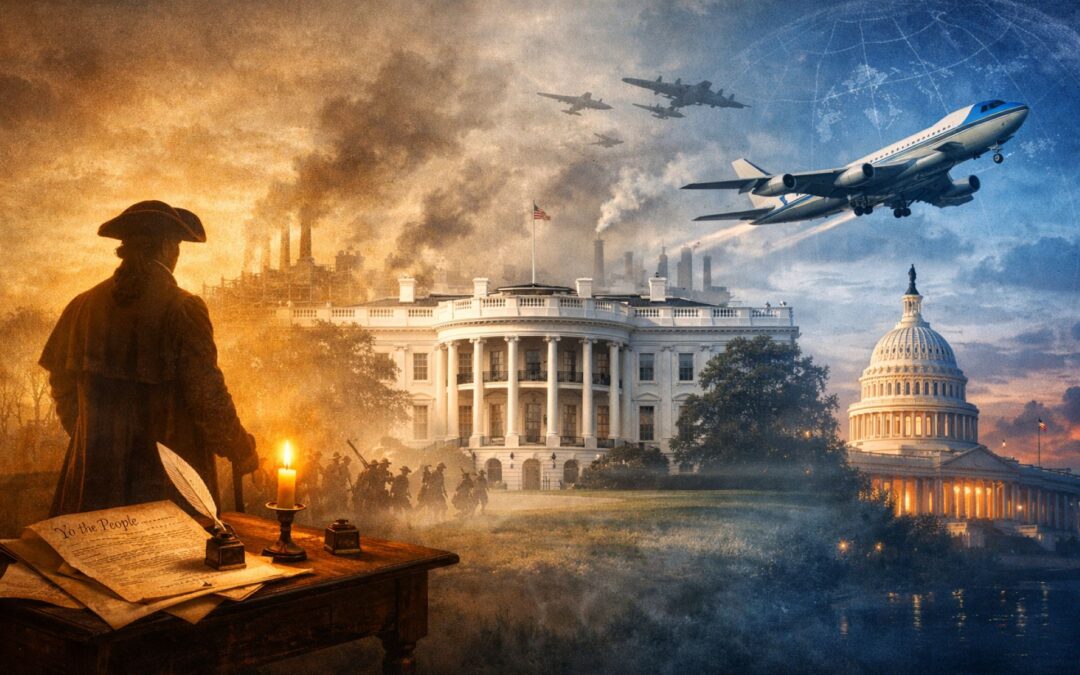
The presidency of the United States was never meant to become what it is today.
In 1789, the idea of placing executive power in the hands of a single individual felt dangerously close to the monarchy Americans had just fought to escape. The framers of the Constitution were not trying to create a powerful leader. They were trying to contain one. What emerged instead was a carefully engineered compromise—an office designed to act, but not dominate; to lead, but not rule.
And yet, over the course of more than two centuries, that restrained experiment transformed into the most powerful political position on the planet.
This transformation did not happen all at once. It was not written into the Constitution, nor was it the result of a single visionary decision. It happened gradually—shaped by war, crisis, ambition, and necessity. Each generation of presidents inherited an office defined by precedent, then stretched it further in response to challenges the founders could never have anticipated. Some expanded its authority deliberately. Others were forced into it by circumstance. Together, they reshaped not just the presidency, but the very nature of American power.
What began as a modest executive role evolved into a command center of global influence—directing wars, stabilizing economies, shaping international alliances, and, increasingly, dominating domestic political life. The presidency became not just an office, but an institution capable of defining entire eras.
But this evolution came with trade-offs. Every expansion of authority raised new questions about limits, accountability, and the balance between leadership and overreach. The same office that could preserve a nation in crisis could also test the boundaries of democracy itself.
To understand the United States, you have to understand how its presidency changed—how it moved from cautious restraint to expansive power, from symbolic leadership to decisive force.
Because the story of American presidents is not just about the men who held the office.
It is about how power itself evolved.
The Founding Experiment: Inventing the Presidency From Scratch
When the United States created the presidency, it wasn’t building on a proven model. It was improvising.
The founders were navigating a paradox. They needed a leader strong enough to hold a fragile union together, yet weak enough to avoid the tyranny they had just overthrown. Monarchies offered power without accountability. The early American system, under the Articles of Confederation, offered accountability without power. Both had failed in different ways.
The presidency was the solution—a deliberate balancing act.
The Constitution outlined the basics: a single executive, elected indirectly, with authority over the military, foreign policy, and administration of federal law. But beyond these skeletal provisions, much was left undefined. There was no detailed instruction manual for how a president should behave, how far their authority should extend, or how the office should function in practice. That ambiguity was intentional. The founders expected the presidency to evolve.
What they could not predict was how much that evolution would depend on the first man to occupy the role.
George Washington did not just serve as the first president. He defined the presidency itself.
At a time when every action carried symbolic weight, Washington approached the office with almost obsessive restraint. He rejected grand titles that hinted at monarchy, insisting instead on the simple “Mr. President.” He understood that the tone of the office mattered as much as its powers. If the presidency looked like a crown, it would eventually behave like one.
Yet restraint did not mean passivity. Washington quietly established precedents that would shape the office for generations. He formed a cabinet, not because the Constitution required it, but because governance demanded consultation. He asserted executive authority in foreign policy, most notably through the Neutrality Proclamation, signaling that the president could act decisively beyond domestic politics. And when faced with internal rebellion, he demonstrated that the federal government would enforce its laws, even against armed resistance.
Perhaps his most consequential decision, however, was also the simplest: he stepped down.
After two terms, Washington voluntarily relinquished power. In a world where leaders clung to authority until death or overthrow, this act was revolutionary. It transformed the presidency from a potential lifetime position into a temporary stewardship. Power, in the American system, would be held—but not owned.
This single decision established a norm that endured for nearly 150 years before being codified into law.
The early presidents who followed—John Adams, Thomas Jefferson, James Madison, and James Monroe—did not radically redefine the office, but they tested its boundaries. They faced foreign threats, internal divisions, and constitutional uncertainties, gradually shaping the presidency through practice rather than theory. Jefferson’s Louisiana Purchase, for example, expanded both the nation’s territory and the implied powers of the executive, demonstrating that opportunity could stretch constitutional interpretation. Madison’s leadership during the War of 1812 reinforced the president’s role in times of national crisis.
At the same time, the emergence of political parties introduced a new dynamic. The presidency was no longer just a constitutional role; it became a political prize. Elections grew contentious, rival factions sharpened their ideologies, and the peaceful transfer of power—first tested in the election of 1800—proved that the system could survive intense internal conflict.
By the end of this founding era, the presidency was no longer an abstract concept.
It was an institution—still limited, still evolving, but undeniably central to the survival of the republic.
The Birth of Political Conflict and Executive Identity
The presidency was never meant to be partisan.
At least, not in the way it quickly became.
The founders had warned against factions, seeing political parties as corrosive forces that would divide the nation and distort governance. In theory, the president was supposed to rise above these divisions—a unifying figure acting in the interest of the whole republic. In practice, that vision unraveled almost immediately.
By the 1790s, political conflict was no longer a possibility. It was a defining feature.
Two competing visions of America emerged. On one side were the Federalists, led by figures like John Adams and Alexander Hamilton, who believed in a strong central government, industrial growth, and closer ties to Britain. On the other were the Democratic-Republicans, led by Thomas Jefferson, who championed agrarianism, states’ rights, and alignment with revolutionary France.
This ideological divide transformed the presidency.
John Adams, the first president to operate within this emerging partisan landscape, quickly discovered that executive authority was no longer just about governance—it was about navigating political hostility. His administration faced external pressure from France and internal dissent at home, culminating in the controversial Alien and Sedition Acts. Intended to protect national security, they instead exposed a deeper tension: how far could a president go in suppressing opposition without undermining the very freedoms the nation was built on?
The backlash was swift and unforgiving.
Adams’ defeat in the election of 1800 marked a turning point—not just for him, but for the presidency itself. Power transferred peacefully to his political rival, Thomas Jefferson, in what became known as the “Revolution of 1800.” It was a moment that tested the durability of the American system. In many parts of the world, such a transition would have sparked instability, even violence. In the United States, it reinforced a radical idea: that leadership could change hands through law, not force.
But the election also revealed something more enduring.
The presidency was now inseparable from politics.
Jefferson’s time in office further blurred the lines between principle and pragmatism. A strict constitutionalist in theory, he faced a dilemma when the opportunity to purchase the Louisiana Territory arose. The Constitution did not explicitly grant the president authority to acquire foreign land. Yet Jefferson moved forward anyway, doubling the size of the nation and quietly expanding the scope of executive power.
This contradiction became a pattern.
Presidents would campaign on ideology, then govern through necessity.
As political parties solidified, elections became more contentious, more personal, and more consequential. The rise of partisan newspapers amplified this shift, turning public discourse into a battleground of competing narratives, accusations, and propaganda. The presidency was no longer just an office—it was a focal point of national identity, shaped as much by perception as by policy.
By the early 19th century, one thing was clear.
The presidency had acquired a new dimension—not just as an instrument of governance, but as a political force. It was no longer defined solely by constitutional limits or individual restraint. It was shaped by rivalry, ideology, and the constant struggle to define what America itself should become.
And that struggle was only beginning.
The Rise of Populism and the Expansion of Presidential Power
By the time Andrew Jackson entered the White House in 1829, the presidency had already evolved into a political office.
Jackson turned it into something else entirely.
He transformed it into a weapon.
Until this point, presidents had largely operated within an elite political framework—men of education, wealth, and established pedigree, governing with a degree of restraint shaped by the founding generation. Jackson shattered that mold. He was not just another president. He was a signal that the balance of power in America was shifting—from institutions and elites to the electorate itself.
For the first time, the presidency claimed to speak directly for “the people.”
Jackson understood something his predecessors had not fully embraced: legitimacy could come not just from the Constitution, but from mass support. And once that door opened, the presidency was no longer merely an executor of law. It became an extension of popular will.
That shift changed how power was used.
One of Jackson’s most significant innovations was his aggressive use of the veto. Earlier presidents had treated the veto as a constitutional safeguard, reserved for clearly unconstitutional legislation. Jackson redefined it as a political tool. If he believed a law contradicted the interests of the people—or his interpretation of them—he would reject it outright, regardless of congressional support.
This was a subtle but profound change.
It elevated the president from a reactive figure into an active counterweight to Congress, capable of shaping policy not just through execution, but through direct opposition. The executive branch was no longer secondary. It was assertive.
Jackson’s battle against the Second Bank of the United States made this transformation unmistakable. Viewing the bank as an institution that favored elites at the expense of ordinary citizens, he vetoed its recharter and dismantled it entirely. To his supporters, this was a triumph of democracy over concentrated power. To his critics, it was reckless, destabilizing, and dangerously personal.
Both interpretations were correct.
Because what Jackson truly established was not just policy change—but precedent.
The presidency could now act forcefully, even disruptively, in the name of the public.
At the same time, his embrace of the spoils system—rewarding political supporters with government positions—further embedded the presidency within the machinery of party politics. What Jackson saw as democratizing government access also entrenched patronage and loyalty as defining features of political power.
But the expansion of presidential authority came with darker consequences.
Jackson’s approval of the Indian Removal Act revealed the peril of populist power unchecked by moral restraint. Framed as necessary for national growth, it led to the forced displacement of Native American populations and immense human suffering. It was a stark reminder that when the presidency claimed to act on behalf of the people, it also gained the ability to define who counted—and who did not.
Even in moments of constitutional crisis, Jackson’s assertiveness reshaped expectations. During the nullification crisis, when South Carolina attempted to reject federal tariffs, Jackson responded not with hesitation, but with force. He made it clear that the Union would be preserved, and that federal authority would not be optional.
The message was unmistakable.
The presidency was no longer cautious. It was decisive.
By the end of Jackson’s era, the office had undergone a transformation. It was no longer just a constitutional role bounded by precedent. It had become a political engine powered by public support, capable of driving—and imposing—national direction.
But this expansion came at a cost.
The more power the presidency claimed in the name of the people, the more it risked becoming untethered from the very limits designed to contain it.
And as the nation expanded westward, those tensions would only intensify.
Manifest Destiny and the Cost of Expansion
If Jackson transformed the presidency into an instrument of popular power, the next phase of its evolution turned it into an engine of expansion.
The idea driving this shift was simple, seductive, and dangerous: Manifest Destiny—the belief that the United States was destined to stretch across the North American continent. It wasn’t just a policy. It was a justification. For growth, for conflict, and increasingly, for executive action that pushed beyond traditional limits.
And no president embodied this more completely than James K. Polk.
Polk entered office with a clear, almost transactional agenda: expand the nation’s borders, secure key territories, and reshape the map of North America. Unlike many presidents before him, he did not merely react to events. He pursued them with intent.
Within a single term, he delivered.
Through negotiation, he secured the Oregon Territory, avoiding war with Britain while expanding American influence in the northwest. But diplomacy alone could not satisfy the larger vision. The southwestern border dispute with Mexico escalated into open conflict, and Polk seized the moment.
The Mexican-American War was not an accident of history—it was, in many ways, a calculated expansion of executive ambition.
By provoking and then justifying military engagement, Polk demonstrated how the presidency could drive territorial growth through both strategy and force. When the war ended, the United States gained vast territories—California, New Mexico, Arizona, and beyond—effectively completing its continental footprint.
It was one of the most successful expansions of national territory in modern history.
But success came with consequences the presidency could not contain.
Every new piece of land raised the same volatile question: would it permit slavery?
The presidency, once focused on governance and survival, now found itself at the center of an increasingly irreconcilable conflict. Expansion did not unify the nation. It exposed its fractures. Each territorial gain deepened the divide between North and South, turning geographic growth into political instability.
And the executive branch, having helped accelerate that growth, was now entangled in its fallout.
Presidents who followed Polk struggled to manage these tensions. Compromises were drafted, negotiated, and signed—temporary solutions designed to delay confrontation rather than resolve it. The Compromise of 1850 attempted to balance competing interests, but in doing so, it introduced measures like the Fugitive Slave Act, which inflamed public opinion and intensified resistance in the North.
Then came the Kansas-Nebraska Act, a decision that pushed the crisis further.
By allowing settlers to decide the issue of slavery through popular sovereignty, the federal government effectively outsourced a moral and political conflict to local populations. The result was chaos—violent clashes between pro- and anti-slavery factions in what became known as “Bleeding Kansas.” The presidency, rather than stabilizing the nation, appeared increasingly unable—or unwilling—to control the forces it had helped unleash.
By the time James Buchanan took office, the situation had deteriorated beyond repair.
Southern states openly discussed secession. Political compromise had collapsed into mutual distrust. And the presidency, once envisioned as a stabilizing force, seemed paralyzed. Buchanan’s inability to act decisively—declaring secession illegal, yet claiming he lacked authority to stop it—highlighted a critical weakness.
Power had expanded. But clarity had not.
The presidency could drive expansion, initiate conflict, and shape the nation’s trajectory. But when faced with existential division, it struggled to define its own limits.
Manifest Destiny had fulfilled its promise of growth.
What it left behind was a nation on the brink of collapse—and a presidency about to face its greatest test.
Civil War and the Reinvention of Executive Authority
When Abraham Lincoln took office in 1861, the presidency was no longer an experiment.
It was a pressure point.
Seven states had already seceded. The Union was unraveling in real time. And for the first time in American history, the survival of the nation depended not on constitutional theory, but on executive action.
Lincoln did not inherit a stable office. He inherited a crisis that would force the presidency to become something it had never been before.
A wartime command center.
From the outset, Lincoln expanded presidential authority in ways that would have been unthinkable just decades earlier. When Confederate forces attacked Fort Sumter, he responded not with hesitation, but with immediate mobilization—calling for tens of thousands of troops without waiting for congressional approval. It was a decisive assertion of executive power, justified by urgency rather than precedent.
And it didn’t stop there.
Faced with internal dissent and fears of sabotage, Lincoln suspended habeas corpus, allowing the military to detain individuals without trial. It was a move that cut directly against core civil liberties, sparking fierce debate about constitutional limits. Critics accused him of overreach. Supporters argued that extraordinary circumstances demanded extraordinary measures.
Lincoln himself framed the dilemma with stark clarity.
Could a nation survive if its laws were followed so rigidly that it allowed itself to be destroyed?
This was the paradox of the Civil War presidency. To preserve the Constitution, Lincoln was willing to stretch it.
But his leadership was not defined by force alone.
The most transformative moment of his presidency came not through military strategy, but through moral repositioning. The Emancipation Proclamation redefined the purpose of the war. What had begun as a fight to preserve the Union became a struggle against slavery itself. It elevated the presidency from a political office to a moral authority, capable of reshaping the nation’s identity.
At the same time, Lincoln demonstrated a different kind of executive strength—one rooted in political intelligence.
His cabinet was filled with rivals, men who disagreed with him, challenged him, and often competed for influence. Rather than suppressing these tensions, Lincoln managed them, understanding that effective leadership required not uniformity, but control. He balanced competing interests, navigated a divided Congress, and maintained enough cohesion to sustain a war effort that lasted four brutal years.
And throughout it all, he communicated.
In speeches like the Gettysburg Address, Lincoln distilled the meaning of the conflict into something larger than policy or politics. He reframed the war as a test of whether a nation built on equality could endure. In doing so, he expanded the symbolic power of the presidency. The president was no longer just an administrator or a political actor. He became the voice of the nation itself.
By the time the Civil War ended, the presidency had been fundamentally transformed.
It was no longer a limited executive bound tightly by precedent. It had proven capable of unilateral action, wartime expansion, and moral leadership on a national scale. The office had acquired a new dimension—one defined not just by its constitutional powers, but by its capacity to act decisively in moments of existential crisis.
But this transformation came at a cost.
The same expansion of authority that preserved the Union raised new questions about limits. If the presidency could stretch its powers in times of crisis, what would prevent that expansion from continuing in times of peace?
Lincoln never had to answer that question.
Just days after the war ended, he was assassinated.
And the presidency he left behind—stronger, more powerful, and more flexible than ever before—would face a new challenge.
Rebuilding a nation it had just helped save.
Reconstruction and the Limits of Presidential Power
If the Civil War expanded the power of the presidency, Reconstruction exposed its limits.
The conflict had been decisive. The Union survived. Slavery was abolished. But victory on the battlefield did not translate into clarity in peace. The question now was not how to preserve the nation—but how to rebuild it.
And for the first time, the presidency faced a challenge it could not solve through force alone.
When Abraham Lincoln was assassinated, the responsibility of reconstruction fell to Andrew Johnson—a man profoundly unsuited to the moment. Where Lincoln had balanced firmness with political nuance, Johnson approached the task with rigidity and resentment. His vision of reconstruction was simple: restore the Union quickly, with minimal conditions for the former Confederate states.
On paper, it seemed practical.
In reality, it was explosive.
Johnson granted widespread pardons to former Confederate leaders and allowed southern states to reestablish governments with few restrictions. These governments, almost immediately, enacted laws that undermined the rights of newly freed African Americans. The presidency, which had just been the instrument of emancipation, now appeared indifferent—if not hostile—to its consequences.
This triggered a confrontation that would redefine the balance of power in Washington.
Congress refused to accept Johnson’s approach. Determined to enforce a more structured and equitable reconstruction, lawmakers passed legislation aimed at protecting civil rights and reshaping southern society. Johnson vetoed many of these measures. Congress overrode him.
The presidency, for the first time in its history, was no longer the dominant force.
It was being actively challenged—and constrained.
The conflict escalated until it reached a breaking point. When Johnson attempted to remove his Secretary of War in defiance of congressional restrictions, the House of Representatives impeached him. It was a moment of constitutional crisis. Not because the nation was at war, but because its branches of government were.
Johnson survived removal from office by a single vote.
But survival was not the same as authority.
His presidency emerged weakened, stripped of influence, and overshadowed by a Congress that had seized control of reconstruction policy. The executive branch, which had just expanded dramatically under Lincoln, now found itself curtailed by legislative resistance.
It was a sharp reversal—and a critical lesson.
Presidential power, no matter how expansive, was not absolute. It could be checked, limited, and even neutralized under the right conditions.
When Ulysses S. Grant assumed the presidency, the balance shifted again. Unlike Johnson, Grant aligned with congressional efforts to enforce reconstruction. He used federal authority to combat violence in the South, particularly from groups like the Ku Klux Klan, and supported legislation aimed at protecting the rights of freedmen.
For a time, the presidency reclaimed its role as an active force in shaping national policy.
But even this momentum proved fragile.
Scandals within Grant’s administration eroded public trust, weakening support for reconstruction efforts. Political will began to fade. By 1877, a compromise effectively ended federal enforcement in the South, withdrawing troops and leaving civil rights protections vulnerable to dismantling.
What followed was not reconciliation—but retreat.
The promises of reconstruction gave way to segregation, disenfranchisement, and decades of systemic inequality. And the presidency, despite its earlier expansion of power, proved unable—or unwilling—to prevent it.
Reconstruction revealed something fundamental.
The presidency could win wars. It could redefine national purpose. It could even reshape the Constitution in moments of crisis.
But it could not, on its own, reconstruct a society divided against itself.
That required sustained political alignment, public support, and institutional cooperation—none of which could be guaranteed.
In the aftermath, the office did not continue its upward trajectory of power.
Instead, it entered a period of decline.
A time when the presidency would exist, but not lead.
The Gilded Age: When the Presidency Took a Back Seat
After the turbulence of the Civil War and Reconstruction, the presidency did not continue to expand.
It receded.
The late 19th century—often referred to as the Gilded Age—was a period of immense economic growth, industrial transformation, and staggering inequality. Railroads stretched across the continent, corporations amassed unprecedented wealth, and cities expanded at a relentless pace. It was an era of power—but not presidential power.
That distinction mattered.
While the nation surged forward, the presidency became increasingly passive. Real influence shifted elsewhere—to Congress, to political machines, and to industrial magnates whose economic dominance often translated into political control. The executive branch, rather than shaping events, frequently reacted to them.
Presidents during this period—figures like Rutherford B. Hayes, James Garfield, Chester A. Arthur, Grover Cleveland, and Benjamin Harrison—occupied the office, but rarely defined it.
This was not necessarily due to incompetence. It was structural.
The political environment of the time discouraged strong executive leadership. Congress dominated policy-making, and party loyalty often outweighed independent action. The presidency, still carrying the legacy of post-war conflict, operated cautiously, avoiding the kind of assertiveness that had defined Lincoln’s era.
At the same time, corruption permeated the system.
The spoils system, first popularized under Jackson, had evolved into a deeply entrenched mechanism of political patronage. Government positions were routinely awarded based on loyalty rather than merit, reinforcing a cycle of inefficiency and favoritism. Political machines—particularly in major cities—controlled elections, distributed jobs, and blurred the line between public service and private gain.
The presidency, instead of dismantling this system, was often entangled in it.
The assassination of James Garfield in 1881 exposed the dangers of this arrangement. Shot by a disgruntled office seeker who believed he was owed a government position, Garfield’s death became a turning point. It forced a national reckoning with the consequences of patronage-driven politics.
Unexpectedly, reform came from his successor.
Chester A. Arthur, a product of the spoils system himself, signed the Pendleton Civil Service Reform Act, establishing a merit-based framework for federal employment. It was a significant step toward reducing corruption—but also an indication of how reactive the presidency had become. Change was possible, but it often required crisis to trigger it.
Even when presidents attempted to assert themselves, their influence remained limited.
Grover Cleveland, known for his relentless use of the veto, tried to combat wasteful spending and political favoritism. Benjamin Harrison took early steps toward regulating monopolies with the Sherman Antitrust Act. These efforts hinted at a more active executive role, but they lacked the transformative force needed to redefine the office.
The broader reality remained unchanged.
Economic power overshadowed political authority. Industrialists like Rockefeller and Carnegie wielded influence that rivaled, and sometimes exceeded, that of elected officials. The presidency, constrained by political structures and cautious leadership, struggled to assert control over forces that were reshaping the nation.
In many ways, the Gilded Age presidency was defined by absence.
Not of individuals, but of direction.
The office still existed. It still functioned. But it did not lead the country through its most profound transformations. Instead, it drifted alongside them, overshadowed by the rise of corporate power and legislative dominance.
Yet this period of relative weakness would not last.
Because as the 20th century approached, the pressures created during the Gilded Age—inequality, corporate consolidation, and public frustration—would demand a different kind of leadership.
And the presidency, once again, would rise to meet it.
Theodore Roosevelt and the Birth of the Modern Presidency
The Gilded Age left behind a vacuum.
The country had grown wealthier, larger, and more complex—but its leadership had not kept pace. Power had drifted into the hands of corporations and political machines, while the presidency remained restrained, almost hesitant.
Theodore Roosevelt changed that overnight.
He did not inherit a strong presidency.
He rebuilt it.
When Roosevelt took office in 1901 following the assassination of William McKinley, he was only 42 years old—the youngest president in American history. But what he lacked in age, he made up for in clarity. Roosevelt believed something fundamentally different from his predecessors: the president was not merely an administrator of laws.
He was a driver of national direction.
Roosevelt reframed the presidency as a bully pulpit—a platform from which to shape public opinion, rally support, and force action. This was not just rhetorical. It was strategic. He understood that in a democratic system, influence did not come solely from constitutional authority. It came from the ability to mobilize the public.
And he used that power aggressively.
At the center of Roosevelt’s domestic agenda was the challenge of corporate dominance. The massive trusts that had flourished during the Gilded Age controlled entire industries, often at the expense of competition and consumer welfare. Previous presidents had tolerated them. Roosevelt confronted them.
Through the Sherman Antitrust Act, he launched a series of legal battles against monopolies, earning the nickname “trustbuster.” His actions signaled a new expectation: the presidency would not stand aside while economic power concentrated unchecked. It would intervene.
This was a fundamental shift.
The executive branch was no longer passive in the face of structural change. It became an active regulator of the national economy.
Roosevelt’s influence extended beyond economics.
Public outrage over unsafe food production and unsanitary industrial conditions provided an opportunity to push through sweeping reforms. The Pure Food and Drug Act and the Meat Inspection Act established federal oversight in areas previously left to private industry. Once again, the presidency positioned itself as a guardian of public welfare—not just a manager of government operations.
But Roosevelt’s most enduring contribution may have been his expansion of presidential responsibility beyond immediate policy concerns.
He saw the presidency as a moral force.
His conservation efforts, which protected vast areas of land as national parks and reserves, reflected a long-term vision that transcended electoral cycles. He acted not just for present needs, but for future generations. In doing so, he broadened the scope of what presidential leadership could mean.
And he didn’t limit that vision to domestic affairs.
Roosevelt’s foreign policy embodied his famous principle: “speak softly and carry a big stick.” He combined diplomacy with a willingness to project power, asserting American influence on the global stage. The construction of the Panama Canal demonstrated both strategic ambition and executive initiative, while his role in mediating the Russo-Japanese War earned him a Nobel Peace Prize.
For the first time, the presidency was not just a national office.
It was an international one.
Roosevelt’s approach redefined expectations. The president was no longer judged solely by adherence to constitutional boundaries, but by effectiveness, energy, and vision. Leadership became synonymous with action.
And once that expectation took hold, it could not be reversed.
Future presidents could choose to act cautiously, but they could no longer claim that restraint was the natural state of the office. Roosevelt had expanded both its capabilities and its perceived responsibilities.
The presidency had entered a new phase.
Not as a reactive institution, but as a proactive force—capable of shaping the nation and influencing the world.
What followed would test just how far that power could go.
Wilson, War, and the Moral Presidency
If Theodore Roosevelt transformed the presidency into a platform for action, Woodrow Wilson attempted to turn it into something even more ambitious.
A vehicle for moral purpose.
Wilson did not see the presidency merely as an instrument of policy. He saw it as a means to guide the nation—and even the world—according to higher principles. Where Roosevelt emphasized energy and execution, Wilson emphasized vision and ideology.
And that distinction mattered.
Domestically, Wilson expanded the federal government’s role in the economy in ways that permanently altered its relationship with American society. The creation of the Federal Reserve System restructured the nation’s financial architecture, placing monetary policy under centralized control. The Clayton Antitrust Act strengthened efforts to regulate corporate power, while new labor protections signaled a shift toward balancing economic growth with worker rights.
These were not isolated reforms.
They reflected a presidency increasingly comfortable with shaping the structural foundations of the nation.
But Wilson’s most defining moments came not at home, but abroad.
When World War I erupted in 1914, Wilson initially resisted involvement. He framed neutrality not just as a strategic choice, but as a moral position—arguing that the United States should remain above the chaos of European conflict. It was an idealistic stance, rooted in the belief that America could serve as a mediator rather than a participant.
That position did not hold.
As the war intensified and German actions increasingly threatened American interests, Wilson shifted course. In 1917, he asked Congress to declare war, presenting the conflict as a moral crusade—to make the world “safe for democracy.”
With that decision, the presidency crossed another threshold.
It was no longer just reacting to global events. It was defining them.
During the war, Wilson’s administration centralized power on an unprecedented scale. The federal government mobilized industry, controlled resources, and shaped public opinion through coordinated propaganda efforts. At the same time, measures like the Espionage Act and the Sedition Act restricted dissent, raising fundamental questions about the balance between security and liberty.
Once again, crisis justified expansion.
And once again, that expansion blurred constitutional boundaries.
But Wilson’s ambitions extended beyond victory.
At the war’s end, he proposed a vision for lasting global order—his Fourteen Points, anchored by the creation of the League of Nations. It was an attempt to institutionalize diplomacy, prevent future conflicts, and position the United States as a leader not just in power, but in principle.
It was, in many ways, the most ambitious vision ever put forward by an American president.
And it failed.
Despite Wilson’s international influence, he could not secure support at home. The Senate rejected the League of Nations, unwilling to commit the United States to an international framework that might limit its autonomy. The presidency, for all its growing power, could not override domestic political resistance.
This failure revealed a critical constraint.
The president could lead, persuade, and even reshape global dynamics—but he could not act alone. Institutional limits still mattered.
By the end of Wilson’s presidency, another reality became clear.
The burden of moral leadership was immense.
Wilson’s idealism elevated the presidency, but it also exposed its vulnerabilities. His inability to reconcile vision with political reality, combined with his declining health in his final years, left the office strained and, in some ways, overextended.
Yet the transformation was undeniable.
The presidency was no longer just an engine of action or a tool of governance. It had become a platform for defining national—and global—purpose.
And in the years that followed, that sense of purpose would give way to something very different.
Retreat.
The Quiet Presidency and the Road to Collapse
After the intensity of Theodore Roosevelt and the idealism of Woodrow Wilson, the presidency did something unexpected.
It pulled back.
The 1920s were defined not by ambition, but by restraint. After years of war, reform, and global entanglement, Americans wanted stability. They wanted predictability. And the presidents of this era—Warren G. Harding, Calvin Coolidge, and Herbert Hoover—promised exactly that.
A return to normalcy.
But what looked like stability on the surface concealed a deeper problem.
The presidency, once again, was stepping away at a moment when the nation required direction.
Harding’s administration embodied this retreat. His philosophy favored minimal government intervention, allowing businesses to operate with little oversight. In theory, this would unleash economic growth. In practice, it created an environment where corruption flourished. The Teapot Dome scandal—where government officials secretly leased federal oil reserves in exchange for bribes—became a symbol of what happened when executive leadership failed to enforce accountability.
Harding himself recognized the limits of his control.
He was not driving the presidency. He was struggling to manage it.
After his sudden death, Calvin Coolidge took over and doubled down on the philosophy of restraint. Quiet, reserved, and deeply committed to limited government, Coolidge believed that prosperity came not from federal action, but from economic freedom. “The business of America is business,” he famously declared.
And for a time, it seemed like he was right.
The economy boomed. Industries expanded. Consumer culture exploded. The Roaring Twenties lived up to its name. But beneath the surface, structural weaknesses were building—unchecked speculation, uneven wealth distribution, and a financial system operating without sufficient safeguards.
The presidency, once again, was not intervening.
It was observing.
Coolidge’s leadership style reinforced the idea that the executive branch should remain distant from economic management. While this approach preserved short-term growth, it left the system vulnerable. The presidency had the authority to act—but chose not to.
And then came Herbert Hoover.
Hoover did not lack intelligence or experience. He entered office with a reputation as a capable administrator and humanitarian. But when the stock market crashed in 1929, triggering the Great Depression, the limitations of the restrained presidency became impossible to ignore.
Hoover believed in voluntary cooperation and limited intervention. He encouraged businesses to maintain wages and employment, supported modest public works, and resisted direct federal relief to individuals. His approach was consistent with the philosophy of the time.
It was also insufficient.
As banks failed, unemployment soared, and economic collapse spread, the presidency appeared increasingly disconnected from the scale of the crisis. What had once been seen as restraint now looked like inaction. The public, facing unprecedented hardship, demanded leadership that could match the moment.
They did not get it.
Hoover’s presidency became a symbol—not of failure in intent, but of failure in approach. It revealed a fundamental truth about the evolving executive role: in times of systemic crisis, passivity was no longer an option.
The expectations of the presidency had changed.
The nation no longer wanted a caretaker. It needed a problem-solver.
And that demand would usher in one of the most dramatic transformations in the history of the office.
Because the next president would not retreat from power.
He would redefine it entirely.
Franklin D. Roosevelt and the Explosion of Federal Power
The presidency had been passive.
Franklin D. Roosevelt made it dominant.
When Roosevelt took office in 1933, the United States was in collapse. Banks were failing. Unemployment was soaring. Confidence—in both the economy and the government—had evaporated. This was not a crisis that could be managed through restraint or incremental policy.
It required intervention on a scale the presidency had never attempted.
Roosevelt did not hesitate.
Within days of taking office, he declared a national bank holiday, temporarily shutting down the financial system to prevent further panic. It was a bold, unilateral move—one that signaled immediately that the presidency would act decisively, even dramatically, in the face of crisis.
And it was only the beginning.
The New Deal fundamentally redefined the relationship between the federal government and American society. Through a sweeping series of programs and reforms, Roosevelt expanded the scope of executive power into nearly every aspect of economic life. Agencies were created to regulate industries, stabilize markets, and provide direct relief to citizens. Programs like the Civilian Conservation Corps and the Works Progress Administration put millions to work, while Social Security established a long-term safety net for the elderly and unemployed.
This was not just policy.
It was transformation.
For the first time, the presidency was not simply responding to crisis—it was restructuring the system itself. The federal government became an active participant in economic management, and the president became the central architect of that involvement.
Roosevelt also changed how presidents communicated.
Through his fireside chats, he spoke directly to the American people, explaining complex policies in simple, human terms. This wasn’t just messaging—it was trust-building. In a moment of fear and uncertainty, Roosevelt used communication as a tool of governance, reinforcing the idea that the president was not distant, but present.
Accessible. Reassuring. In control.
This connection amplified his power.
Because authority in a democracy is not only exercised—it is granted. And Roosevelt secured it by aligning policy with public confidence.
But the expansion of presidential power did not stop at domestic policy.
World War II pushed the office even further.
As global conflict intensified, Roosevelt transformed the presidency into a command center for both military and economic mobilization. He coordinated industrial production, managed alliances, and positioned the United States as a central force in the fight against fascism. The executive branch, already expanded by the New Deal, now operated at a scale that touched every aspect of national life.
The presidency had become indispensable.
Yet this expansion came with controversy.
Roosevelt’s attempt to reshape the Supreme Court—by adding justices to secure favorable rulings—raised alarms about executive overreach. The internment of Japanese Americans during the war exposed the darker side of concentrated authority, where fear and power combined to override civil liberties.
These actions underscored a growing tension.
The presidency could solve problems at an unprecedented scale—but it could also create them.
By the time Roosevelt died in 1945, the office he left behind was almost unrecognizable compared to the one he inherited. It was larger, more powerful, and more deeply embedded in the daily lives of Americans. The expectations placed on it had expanded accordingly.
The president was no longer just a leader.
He was a manager of the economy, a commander in global conflict, and a central figure in national identity.
Roosevelt did not just respond to crisis.
He permanently altered the trajectory of presidential power.
And once expanded to that level, it could never fully contract.
The question now was not whether the presidency would remain powerful.
It was how that power would be used in a world where the stakes had become global—and, for the first time, existential.
Truman and the Dawn of the Nuclear Presidency
When Franklin D. Roosevelt died in 1945, the presidency did not pass smoothly into experienced hands.
It dropped—suddenly and without warning—onto Harry S. Truman.
Truman had been vice president for just 82 days. He had not been fully briefed on critical wartime decisions. And most importantly, he had no knowledge of the single most destructive weapon ever created.
The atomic bomb.
Within weeks of taking office, Truman was forced to confront a reality no president had ever faced: the ability to end a war—and potentially reshape humanity itself—with a single decision.
He chose to use it.
The bombings of Hiroshima and Nagasaki brought World War II to a swift and decisive end. Japan surrendered. The conflict that had consumed the globe was over. But the consequences extended far beyond victory. With that decision, the presidency entered a new era—one defined not just by power, but by the scale of its consequences.
The executive branch now possessed the capacity to destroy entire cities in moments.
This was not an incremental expansion of authority.
It was a transformation.
The presidency had moved from commanding armies to commanding annihilation.
And that shift redefined everything.
Truman’s role did not end with the war. In many ways, it had only begun. The immediate aftermath of World War II gave way to a new kind of conflict—one without formal declarations, clear battlefields, or definitive endings.
The Cold War.
In response, Truman established a framework that would define American foreign policy for decades. The Truman Doctrine committed the United States to supporting nations resisting communism, effectively positioning the presidency as the central driver of global ideological conflict. This was not a temporary wartime stance. It was a long-term strategic commitment.
And it expanded the scope of executive responsibility beyond anything seen before.
To support this new reality, Truman oversaw the creation of institutions that consolidated power within the executive branch. The Department of Defense unified military command. The National Security Council coordinated strategic decision-making. The CIA introduced a permanent intelligence apparatus operating largely under presidential authority.
The presidency was no longer just a political office.
It was the hub of a national security state.
Even in military engagement, Truman pushed the boundaries of executive power. When the Korean War began in 1950, he committed American troops under the banner of the United Nations—without seeking a formal declaration of war from Congress. This set a precedent that would echo through future conflicts.
War, increasingly, could be initiated by the president alone.
At the same time, Truman demonstrated that presidential authority extended beyond foreign policy. His decision to desegregate the armed forces marked a significant federal intervention in civil rights, signaling that the presidency could also act as a force for social change.
But these actions came with tension.
The more power the presidency accumulated, the more it raised questions about oversight, accountability, and limits. Truman’s dismissal of General Douglas MacArthur during the Korean War reinforced the principle of civilian control over the military—but it also highlighted how much authority rested in a single individual.
By the end of Truman’s presidency, the office had entered a new phase.
It was no longer just expanded—it was centralized.
Power flowed through it. Decisions radiated outward from it. And the consequences of those decisions were no longer confined to national borders.
The presidency had become global.
And more importantly, it had become permanent in its reach.
The question was no longer whether the president could shape the world.
It was how to manage that power in a world where miscalculation could have irreversible consequences.
The Cold War would provide the answer—or at least, test the limits of that power in ways no one had yet imagined.
The Cold War Presidency: Power on a Global Scale
By the time the Cold War fully took shape, the presidency was no longer just powerful.
It was indispensable.
The United States had emerged from World War II not only as a victor, but as a superpower. Opposing it was the Soviet Union—equally formidable, equally determined. The conflict between them would not be fought through direct confrontation alone, but through influence, deterrence, and the constant threat of escalation.
And at the center of it all stood the president.
This era demanded a new kind of leadership—one capable of managing global strategy, nuclear risk, and ideological competition simultaneously. The presidency was no longer reactive. It was continuously engaged, operating on a global stage where decisions carried consequences far beyond American borders.
Dwight D. Eisenhower exemplified this shift.
A former general, Eisenhower approached the presidency with strategic restraint. He understood the dangers of direct conflict in a nuclear age and sought to balance strength with caution. His “New Look” defense policy emphasized nuclear deterrence over conventional warfare, reducing costs while maintaining a credible threat against the Soviet Union.
This was a new kind of power.
Not exercised through action, but through the possibility of it.
At the same time, Eisenhower expanded the use of covert operations, relying on intelligence agencies to influence global events without direct military involvement. This approach allowed the presidency to shape outcomes behind the scenes, reinforcing its role as a quiet but decisive force in international affairs.
Yet even as the presidency extended its reach abroad, it remained responsible for stability at home.
Eisenhower’s enforcement of school desegregation in Little Rock demonstrated that the executive branch could intervene directly to uphold constitutional authority. It was a reminder that presidential power, while global, still carried domestic obligations.
By the early 1960s, the presidency had entered a new phase—one defined not just by power, but by perception.
John F. Kennedy brought a level of visibility and immediacy to the office that had never existed before. Through television, the president became a constant presence in American life. Leadership was no longer just exercised—it was performed, communicated, and scrutinized in real time.
And nowhere was this more evident than during the Cuban Missile Crisis.
For thirteen days in 1962, the world stood on the edge of nuclear war. Soviet missiles in Cuba placed the United States under direct threat, and Kennedy faced a choice with no safe outcome. Military action risked escalation. Inaction risked vulnerability.
The presidency became the point of decision.
Through a combination of pressure, negotiation, and restraint, Kennedy navigated the crisis without triggering catastrophe. It was a defining moment—not just for his administration, but for the presidency itself. It demonstrated that the office was now responsible for managing risks that could determine the survival of humanity.
The stakes had never been higher.
But the Cold War presidency was not defined solely by external threats.
Lyndon B. Johnson expanded the role of the federal government at home through his Great Society programs, pushing through landmark civil rights legislation and social reforms. In doing so, he reinforced the idea that the presidency could drive transformative domestic change.
At the same time, his escalation of the Vietnam War revealed the limits of that power.
As the conflict dragged on, public trust eroded. The presidency, once seen as a stabilizing force, became a focal point of national division. Protests, dissent, and disillusionment reshaped the relationship between the president and the public.
This tension reached its peak under Richard Nixon.
Nixon’s presidency embodied both the height and the danger of executive power. His diplomatic breakthroughs with China and the Soviet Union demonstrated the presidency’s ability to reshape global dynamics. But his actions during the Watergate scandal revealed how that power could be abused.
The presidency, for all its authority, was not beyond accountability.
Nixon’s resignation marked a turning point. It reinforced a critical principle: even at its most powerful, the presidency remained subject to limits—legal, institutional, and political.
By the end of the Cold War era, the presidency had become something the founders could never have envisioned.
A permanent center of global power.
It managed alliances, deterred nuclear war, directed economic strategy, and shaped domestic policy—all at once. The scope of the office had expanded to match the complexity of the world it governed.
But with that expansion came a new reality.
The presidency was no longer judged solely by what it did.
It was judged by how it managed power itself.
And as the Cold War came to an end, that challenge would only grow more complicated.
Television, Image, and the Modern Leader
By the mid-20th century, the presidency had accumulated immense power.
Now it acquired something equally transformative.
Visibility.
For most of American history, the presidency operated at a distance. Citizens read about presidents in newspapers, heard about them through intermediaries, and experienced their leadership indirectly. That distance created a kind of insulation—both for the office and for the individual occupying it.
Television erased that distance.
And in doing so, it changed the presidency forever.
John F. Kennedy was the first president to fully understand this shift. His rise was not just political—it was visual. The 1960 televised debates demonstrated that perception could shape reality. Kennedy’s composure, confidence, and presence contrasted sharply with his opponent, establishing a new standard: leadership would now be judged not only by decisions, but by how those decisions were presented.
The presidency became a performance.
This was not superficial—it was structural. Communication was no longer secondary to governance. It became central to it. A president who could command attention, project clarity, and connect emotionally with the public gained a significant advantage in shaping national discourse.
Kennedy mastered this balance.
His speeches carried weight not just because of their content, but because of their delivery. He understood that in a media-driven environment, words had to resonate instantly. His ability to communicate urgency during crises and optimism during uncertainty reinforced the idea that the president was not just a decision-maker, but a symbol.
And symbols require constant reinforcement.
Lyndon B. Johnson approached this new reality differently. Less concerned with image, more focused on outcomes, Johnson relied on his legislative mastery—the “Johnson treatment”—to push through sweeping reforms. Yet even his presidency could not escape the influence of television.
The Vietnam War unfolded on screen.
For the first time, Americans witnessed the consequences of presidential decisions in real time. Images of combat, casualties, and unrest entered living rooms across the country, reshaping public perception of the war—and of the presidency itself. The executive branch could no longer control the narrative. It had to respond to it.
This marked a turning point.
The presidency was no longer just about exercising power. It was about managing perception of that power.
Richard Nixon understood this, but in a different way.
Where Kennedy used television to build trust, Nixon became increasingly wary of it. His presidency operated with a sense of control—over information, over messaging, over exposure. But the very medium he sought to manage ultimately contributed to his downfall. The Watergate hearings, broadcast into millions of homes, transformed a political scandal into a national reckoning.
Transparency, once optional, became unavoidable.
The modern presidency had entered a new phase—one defined by constant scrutiny.
Every decision could be analyzed in real time. Every misstep could be amplified. The president was no longer a distant authority figure, but a continuous presence in public life, subject to judgment not just on policy, but on character, tone, and credibility.
This evolution carried both advantages and risks.
On one hand, it strengthened accountability. A visible presidency was harder to hide behind institutions or intermediaries. On the other, it created new pressures—forcing leaders to balance substance with presentation, long-term strategy with immediate reaction.
By the late 20th century, the presidency had become inseparable from media.
Power was no longer exercised solely through policy or command. It was shaped, reinforced, and sometimes undermined by how effectively a president could communicate.
The office had always been about leadership.
Now it was also about narrative.
And as technology continued to evolve, that narrative would become even harder to control.
Crisis, Scandal, and the Limits of Power
If the Cold War expanded presidential power, the late 20th century tested how far that power could stretch before breaking.
Because power, once accumulated, inevitably invites scrutiny.
Richard Nixon’s resignation in 1974 did more than end a presidency—it shattered an illusion. For decades, the office had grown in authority, particularly in foreign policy and national security. But Watergate revealed something fundamental: the presidency, no matter how powerful, was not immune to exposure, investigation, or consequence.
The aftermath reshaped expectations.
Trust in the presidency declined sharply. Congress, reacting to years of executive overreach, moved to reassert its authority. Laws like the War Powers Act sought to limit the president’s ability to engage in military conflict without legislative approval. Oversight increased. Skepticism became the default.
The presidency was still powerful.
But it was no longer unquestioned.
Gerald Ford inherited this fractured landscape. Tasked with restoring stability, he made one of the most controversial decisions in presidential history—pardoning Nixon. Ford believed it would allow the country to move forward, to close a chapter of political turmoil. Instead, it deepened public distrust.
The presidency, once seen as a symbol of national unity, now carried the weight of recent betrayal.
And that weight proved difficult to lift.
Jimmy Carter entered office as a corrective figure. An outsider with no ties to Washington’s entrenched political culture, he positioned himself as a leader of integrity and transparency. In many ways, he represented what the public thought it wanted—a president who would operate with honesty rather than calculation.
But integrity alone was not enough.
Carter’s presidency revealed another limitation of executive power: it could not easily overcome structural and economic challenges. Inflation surged. Energy shortages disrupted daily life. The Iran hostage crisis exposed the difficulty of managing international crises without decisive leverage.
The presidency could command authority.
But it could not guarantee outcomes.
By the end of the 1970s, a new understanding had taken hold.
The office was immensely powerful—but also inherently constrained. It could shape events, but not fully control them. It could project strength, but not always deliver resolution. And perhaps most importantly, it depended on public confidence to function effectively.
Without trust, power weakened.
This realization set the stage for a shift.
If the presidency could no longer rely solely on authority, it would need something else to maintain influence.
Clarity. Confidence. Communication.
The next president would understand this instinctively.
And in doing so, he would redefine the relationship between leadership and perception once again.
The Conservative Shift and the End of the Cold War
By the time Ronald Reagan took office in 1981, the presidency faced a credibility problem.
The previous decade had exposed its limits, weakened public trust, and raised doubts about its effectiveness. Americans no longer feared presidential overreach as much as they feared presidential inadequacy.
Reagan understood this shift immediately.
He didn’t try to restore confidence through policy alone.
He restored it through belief.
Reagan’s presidency marked a decisive ideological turn. Where earlier administrations had expanded the role of government, Reagan sought to reduce it—at least in theory. His economic philosophy, later dubbed “Reaganomics,” emphasized tax cuts, deregulation, and a belief that growth would emerge from unleashing private enterprise rather than expanding federal control.
This was not just a policy change.
It was a reframing of what the presidency should represent.
The president was no longer positioned as the primary manager of economic life, as under Roosevelt. Instead, Reagan cast the office as a facilitator—removing barriers, setting direction, and allowing the market to operate with minimal interference.
But even as Reagan spoke of limited government, he expanded presidential influence in other ways.
Most notably, in foreign policy.
Reagan took a hardline stance against the Soviet Union, dramatically increasing military spending and positioning the United States as an unapologetic force against communism. His rhetoric—labeling the Soviet Union an “evil empire”—reflected a clear, confrontational approach.
Yet this was only one phase.
In his second term, Reagan shifted toward diplomacy, engaging directly with Soviet leader Mikhail Gorbachev. Through a series of negotiations, the two leaders moved toward de-escalation, reducing nuclear arsenals and easing tensions that had defined global politics for decades.
This dual strategy—pressure followed by negotiation—played a critical role in the eventual collapse of the Soviet Union.
And with it, the end of the Cold War.
For the presidency, this was a defining moment.
For nearly half a century, the office had been shaped by a singular global rivalry. Now, that framework was gone. The United States emerged as the world’s sole superpower, and the presidency became the central node of that dominance.
Reagan also reinforced another evolving aspect of the office: the importance of communication.
Known as the “Great Communicator,” he understood how to translate complex ideas into simple, persuasive narratives. His speeches did more than explain policy—they created momentum, aligning public perception with presidential intent.
This ability to connect restored something the presidency had lost.
Confidence.
But the era was not without contradictions.
Reagan’s administration was marked by the Iran-Contra affair, a scandal involving secret arms sales and unauthorized funding of foreign groups. It revealed that even as the presidency regained public trust, it still operated in ways that pushed against legal and institutional boundaries.
The lesson was familiar.
Power, even when restored, remained prone to overreach.
By the end of Reagan’s presidency, the office had regained much of its authority—both domestically and internationally. It was once again seen as decisive, influential, and capable of shaping global events.
But the world it now operated in was fundamentally different.
Without the structure of the Cold War, the presidency no longer had a single defining adversary.
Instead, it faced something more complex.
A world without clear boundaries—and power without clear limits.
The Post-Cold War Presidency and Global Dominance
When the Cold War ended, the presidency did not lose power.
It lost its framework.
For nearly half a century, American leadership had been defined by a single organizing principle: containment of the Soviet Union. Every decision—military, economic, diplomatic—fit within that structure. It provided clarity. It imposed limits. It simplified the role of the presidency into a binary contest between two superpowers.
And then, suddenly, that structure disappeared.
The United States emerged as the world’s only superpower. There was no rival to balance it, no ideological counterpart to define it. The presidency now operated in a world where American power was unmatched—but also less constrained.
This created a new kind of challenge.
Not how to compete—but how to lead.
George H. W. Bush was the first to navigate this shift. A seasoned diplomat, he approached the moment with caution rather than triumphalism. When Iraq invaded Kuwait in 1990, Bush assembled a broad international coalition and secured United Nations backing before launching Operation Desert Storm.
The strategy was deliberate.
Rather than acting unilaterally, Bush used American power to reinforce a rules-based international order. The presidency, in this moment, acted not just as a national authority, but as a coordinator of global response.
It was a glimpse of what post-Cold War leadership could look like.
But the clarity of that moment did not last.
Domestically, Bush faced economic challenges that eroded public confidence. His decision to raise taxes—despite a campaign promise not to—highlighted a recurring tension of the presidency: governing required compromise, even when it contradicted political messaging.
The office could project strength abroad.
But it remained vulnerable at home.
Bill Clinton inherited a different landscape.
Where Bush had focused on geopolitics, Clinton emphasized economic growth and domestic policy. His presidency coincided with rapid technological advancement, globalization, and one of the longest peacetime economic expansions in American history.
The presidency adapted.
It became less about managing existential threats and more about navigating complexity—trade agreements, financial markets, and a rapidly integrating global economy. Clinton’s approach reflected this shift. He balanced fiscal discipline with social policy, positioning the presidency as both pragmatic and flexible.
But even in a period of prosperity, the office could not escape scrutiny.
The Monica Lewinsky scandal and Clinton’s subsequent impeachment demonstrated that personal conduct had become inseparable from presidential legitimacy. The presidency was no longer judged solely on policy outcomes. Character, behavior, and perception now carried equal weight.
The modern presidency was fully exposed.
At the same time, America’s role in the world continued to evolve. Without a single dominant adversary, the presidency faced a series of smaller, fragmented conflicts. Interventions in the Balkans, expansion of NATO, and the promotion of global trade reflected an attempt to shape a new international order—one defined less by rivalry and more by influence.
But influence is harder to maintain than opposition.
The absence of a clear enemy created ambiguity. The presidency had more freedom to act—but fewer guidelines on how to act effectively. Decisions became more situational, less predictable, and often more contested.
By the end of the 1990s, one thing was clear.
The presidency had reached a new peak of global dominance.
But with that dominance came uncertainty.
Without the structure of the Cold War, power became more diffuse, more complex, and more difficult to manage. The office remained at the center of global decision-making—but the rules governing that role were no longer clear.
And that ambiguity would define the next phase of its evolution.
Because the next crisis would not be geopolitical in the traditional sense.
It would be sudden, asymmetric, and unlike anything the presidency had faced before.
The War on Terror and the Expansion of Executive Authority
The post-Cold War presidency was uncertain.
September 11, 2001 changed that overnight.
The attacks were not just a national tragedy—they were a structural shock to the presidency itself. In a matter of hours, the focus of American leadership shifted from economic management and global influence to security, survival, and response.
And in moments like that, power consolidates.
George W. Bush entered office with a relatively conventional agenda—tax cuts, education reform, domestic priorities. After 9/11, those priorities became secondary. The presidency was thrust back into a wartime role, but this time, the conflict was fundamentally different.
There was no clear enemy state. No defined battlefield. No predictable endpoint.
The War on Terror redefined what presidential power looked like in practice.
Bush responded quickly and decisively. The invasion of Afghanistan aimed to dismantle al-Qaeda and remove the Taliban from power. It was a direct, conventional response to an unconventional threat. But the strategy expanded.
In 2003, the United States invaded Iraq, based on claims that Saddam Hussein possessed weapons of mass destruction. Those claims would later prove unfounded—but the decision itself reflected a broader shift in presidential doctrine.
Preemption.
For the first time, the presidency openly embraced the idea that it could initiate war not just in response to attack, but to prevent potential threats before they materialized. This was a significant expansion of executive authority—one that lowered the threshold for military engagement and reshaped how power could be used globally.
At the same time, the presidency expanded its reach domestically.
The Patriot Act granted sweeping surveillance powers to the federal government, enabling intelligence agencies to monitor communications, track activity, and prevent future attacks. Supporters argued it was necessary for security. Critics warned it eroded civil liberties.
The tension was familiar.
Security versus freedom. Power versus restraint.
But now, the scale was larger.
The presidency operated with increased autonomy in both foreign and domestic spheres, often justified by the urgency and unpredictability of the threat. Decisions were made quickly, sometimes with limited oversight, reflecting the belief that traditional processes were too slow for modern risks.
This created a new version of the executive.
Not just powerful—but proactive, preemptive, and constantly engaged.
Yet, as the wars dragged on, the limits of this approach became clear.
The Iraq conflict, in particular, exposed the difficulty of translating military victory into political stability. Prolonged occupation, rising casualties, and regional instability eroded public support. What began as decisive action gradually became a source of national fatigue.
The presidency, once again, faced a credibility challenge.
It could initiate action—but not always control its consequences.
Domestically, the expansion of surveillance and executive authority sparked ongoing debates about privacy, legality, and the boundaries of presidential power. The office had grown more capable—but also more controversial.
By the end of Bush’s presidency, the War on Terror had fundamentally reshaped the executive role.
The presidency was now expected to anticipate threats, act swiftly, and operate across a wide spectrum of domains—military, intelligence, and domestic security. It had become more flexible, more responsive, and more far-reaching than ever before.
But it had also become more contested.
The balance between power and accountability, always present, now sat at the center of national debate.
Because the question was no longer whether the presidency could expand in times of crisis.
It was how far that expansion should go—and whether it could ever be fully reversed.
The next phase of the presidency would not be defined by a single external threat.
It would be shaped by something more persistent.
Division.
The Digital Age Presidency and Rising Polarization
If television made the presidency visible, the digital age made it immediate.
And uncontrollable.
By the early 21st century, the relationship between the president and the public had undergone another fundamental shift. Information no longer flowed through a handful of controlled channels. It moved instantly, constantly, and from everywhere at once. News cycles compressed from days to minutes. Narratives formed and fractured in real time.
The presidency did not just operate in this environment.
It was consumed by it.
Barack Obama was the first president to fully harness the digital landscape. His 2008 campaign demonstrated the power of online mobilization—leveraging social media, data analytics, and direct communication to build a broad, engaged coalition. Once in office, this approach extended into governance. The presidency became more accessible, more connected, and more responsive to public sentiment.
But that connectivity came with a cost.
The same tools that enabled engagement also accelerated division. Information ecosystems fragmented. Audiences self-selected into ideological spaces. Consensus became harder to build, and opposition more entrenched.
The presidency, once a unifying symbol, now operated within a fractured public sphere.
Obama’s presidency reflected this tension.
On one hand, it achieved significant milestones—from economic stabilization after the 2008 financial crisis to the passage of the Affordable Care Act. On the other, it faced persistent gridlock, partisan resistance, and an increasingly polarized electorate. The executive branch adapted by relying more heavily on executive orders, reinforcing a pattern that had been developing for decades.
When legislative pathways closed, the presidency acted alone.
This trend intensified under Donald Trump.
Trump did not merely operate within the digital environment—he dominated it. Through direct, unfiltered communication on social media, he bypassed traditional institutions, speaking directly to millions of followers without mediation. The presidency became immediate, personal, and highly reactive.
This was a new model of leadership.
One where narrative could be shaped in real time, but also one where volatility increased. Messages could mobilize support instantly—but also amplify conflict just as quickly. The line between governance and communication blurred, sometimes disappearing entirely.
Polarization deepened.
Supporters saw a president breaking through institutional constraints. Critics saw an erosion of norms and stability. The presidency, already powerful, now carried an additional dimension—its ability to influence public discourse at scale, moment by moment.
At the same time, institutional tensions reached new heights.
Trump’s presidency included two impeachments, reflecting not just individual controversies, but broader struggles over the limits of executive behavior. The events surrounding the 2020 election and its aftermath further intensified these divisions, raising questions not just about policy, but about democratic processes themselves.
The presidency was no longer just a governing body.
It had become a focal point of national identity and conflict.
Joe Biden entered office in this environment of fragmentation and instability. His presidency has emphasized restoration—of norms, alliances, and institutional trust. Yet the challenges remain. Political divisions persist, amplified by the same digital forces that reshaped the office.
The presidency now operates under constant pressure.
Every decision is immediate. Every message is scrutinized. Every action is interpreted through deeply entrenched perspectives. The margin for error has narrowed, even as the expectations placed on the office remain expansive.
This is the modern presidency.
Not just powerful, not just visible—but continuous.
Always on. Always contested.
And increasingly, defined as much by division as by leadership.
The Presidency in an Era of Division and Uncertainty
The presidency has never been more powerful.
And never more constrained.
This is the paradox of the modern era.
On paper, the office commands unmatched authority. It directs the military, influences the global economy, shapes domestic policy, and communicates instantly with millions. It sits at the center of a vast administrative state, backed by intelligence networks, executive agencies, and decades of accumulated precedent.
But in practice, that power is harder to exercise than ever before.
Because the environment around it has changed.
Political polarization has reached levels that make sustained consensus increasingly rare. Congress, once a partner or adversary in shaping policy, now often functions as a gridlocked arena where progress stalls. The presidency, in response, leans more heavily on executive action—orders, directives, and administrative rulemaking—to move policy forward.
But these tools are inherently fragile.
What one president builds, the next can dismantle.
This creates a cycle of instability. Policies shift with administrations. Long-term strategy gives way to short-term positioning. The presidency retains the ability to act—but struggles to create permanence.
At the same time, global challenges have grown more complex.
Unlike the Cold War, there is no single defining conflict. Instead, the presidency must navigate a landscape of overlapping crises—rising geopolitical tensions, economic interdependence, technological disruption, and transnational threats that do not fit neatly within traditional frameworks.
Power is still central.
But clarity is not.
The expectations placed on the presidency have also expanded beyond what the office was ever designed to handle. It is expected to manage crises, unify the nation, drive economic growth, respond to global events, and embody national values—all simultaneously.
No single institution was built for that.
And no individual can consistently meet those demands without friction.
Public trust, once a stabilizing force, has become more volatile. Confidence in leadership rises and falls quickly, shaped by immediate outcomes, media narratives, and partisan interpretation. The presidency, despite its authority, depends on that trust to function effectively.
Without it, power becomes contested.
And when power is contested, governance becomes uncertain.
Yet, for all these constraints, the presidency remains central.
It is still the focal point of decision-making in moments of crisis. Still the voice the nation looks to—whether in confidence or skepticism. Still the office where the weight of national and global responsibility ultimately converges.
That has not changed.
What has changed is the margin for error.
In earlier eras, the presidency evolved through expansion—gaining power in response to necessity. Today, it operates within that accumulated power, but under conditions that make its use more difficult, more scrutinized, and more contested than ever before.
The office has reached a point where its strength is undeniable.
But so are its limits.
And that tension—between capability and constraint—defines the presidency today.
It is no longer just a story of how power grows.
It is a story of how power is managed.
Conclusion
The presidency was never designed to become what it is today.
It began as a cautious compromise—an office built to lead, but not dominate. The founders imagined a restrained executive, constrained by law, balanced by institutions, and limited by design. Power was meant to be distributed, not concentrated.
History had other plans.
War expanded it. Crisis accelerated it. Ambition refined it. With each turning point—from Jackson’s populism to Lincoln’s wartime authority, from Roosevelt’s economic intervention to the Cold War’s global reach—the presidency absorbed new responsibilities. It evolved not through theory, but through necessity.
By the 20th century, it had become the central force in American governance.
By the 21st, it had become something more complex.
A position of immense authority operating within an environment of constant scrutiny, division, and uncertainty. The presidency today holds the capacity to shape economies, influence global stability, and respond instantly to crisis. Yet at the same time, it faces constraints that earlier presidents did not—polarization, institutional resistance, and a fragmented public sphere that challenges its ability to unify.
This is the modern paradox.
The presidency is at once stronger and more limited than ever before.
Its evolution tells a broader story—not just about leadership, but about the shifting nature of power itself. Power expands in response to pressure, adapts to new realities, and accumulates over time. But it is never absolute. It is shaped by the structures around it, the expectations placed upon it, and the limits imposed—both formally and informally.
What began as an experiment has become an institution unlike any other.
And yet, the question that defined its creation still lingers.
How much power can a democracy place in the hands of one individual—without losing what makes it a democracy in the first place?
The answer has never been fixed.
It continues to evolve, with every presidency that follows.