
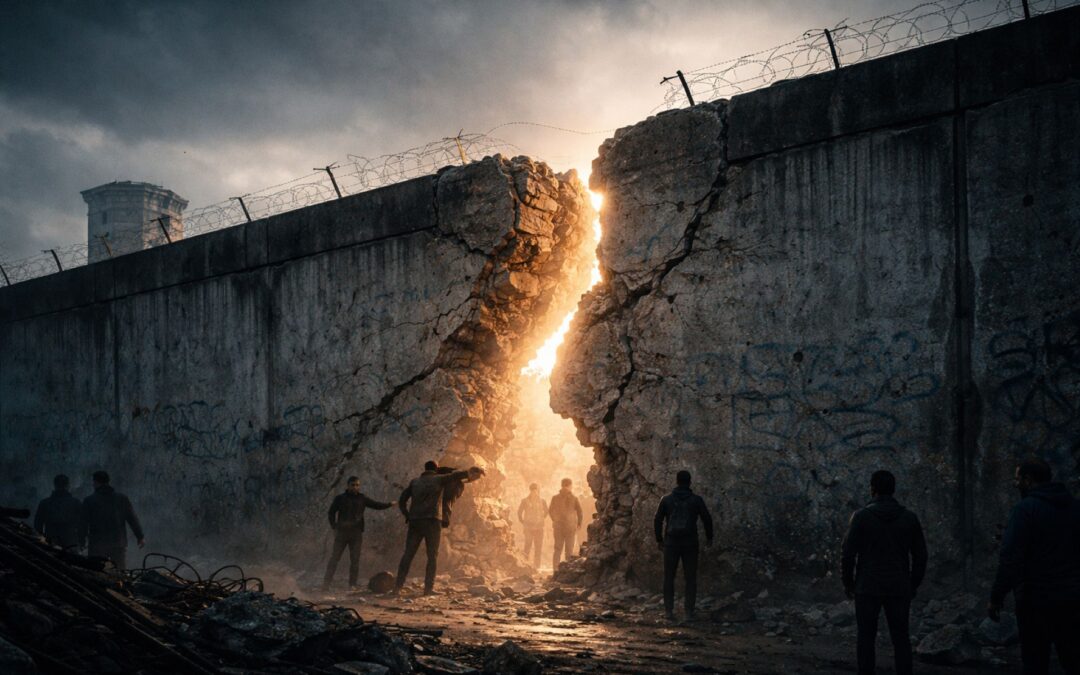
How a World of Fear Finally Broke Apart
For nearly half a century, the world lived under a strange and suffocating paradox. Two superpowers possessed the ability to destroy civilization many times over, yet neither could afford to strike first. War, in its most catastrophic form, was unthinkable. Peace, in any meaningful sense, was impossible. The result was something in between—a prolonged standoff defined not by open battle, but by tension, suspicion, and the constant possibility of annihilation.
This was the Cold War: not a single conflict, but a global condition.
It shaped politics, economics, culture, and human psychology across continents. It fueled proxy wars in distant lands, sustained authoritarian regimes, and forced entire populations to live under systems they did not choose. It also produced a world order built on fear—a fragile stability maintained by the doctrine of mutually assured destruction, where survival depended on restraint.
And yet, for all its power, the Cold War did not end in a climactic confrontation. There was no final battle between the United States and the Soviet Union. No decisive moment where one side defeated the other.
Instead, it unraveled.
It cracked from within. It loosened at the edges. It collapsed under the weight of its own contradictions—economic strain, political rigidity, rising dissent, and a growing inability to control the very systems it had created. What began as a struggle for global dominance ended as a story of internal failure, popular resistance, and unintended consequences.
This is the story of that ending.
Not just how the Cold War concluded, but how a world built on fear began to dismantle itself—and what remained when it was over.
A World Frozen in Fear: The Logic of the Cold War
To understand how the Cold War ended, you first have to understand why it lasted so long.
At its core, the Cold War was not simply a geopolitical rivalry. It was a structural deadlock. Two incompatible systems—American capitalism and Soviet communism—faced each other across the globe, each convinced not only of its superiority, but of the other’s existential threat. This wasn’t competition in the ordinary sense. It was ideological totality. One system had to outlast the other.
And yet, neither could risk outright war.
The reason was brutally simple: nuclear weapons changed the rules. By the late 1940s and early 1950s, both sides had developed arsenals capable of catastrophic destruction. By the 1960s, those arsenals had grown into something far more terrifying—systems that could wipe out human civilization several times over. The concept that emerged from this reality was known as mutually assured destruction. If one side launched a nuclear strike, the other would retaliate. The result would not be victory, but mutual extinction.
This logic imposed a kind of forced stability. It prevented direct conflict between the United States and the Soviet Union, but it did not eliminate conflict altogether. Instead, it displaced it.
Wars were fought elsewhere.
Korea. Vietnam. Afghanistan. Parts of Africa and Latin America. These were not isolated conflicts; they were extensions of the Cold War, proxy battlegrounds where influence was contested without triggering nuclear escalation. Millions died in these theaters, often far removed from the capitals where decisions were made.
At the same time, both superpowers invested enormous resources into maintaining their position. Military spending soared. Technological competition intensified. Intelligence networks expanded into vast surveillance and espionage operations. Entire economies were shaped around the demands of this rivalry.
But beneath the surface, this system carried a hidden cost.
For the Soviet Union in particular, the burden was unsustainable. Enormous portions of its economic output were directed toward military capability—missiles, tanks, satellites—while the civilian economy lagged behind. Basic goods became scarce. Infrastructure stagnated. A state that could project power globally struggled to meet the everyday needs of its own population.
Still, the system endured. Not because it was efficient, but because it was rigid.
Fear held it together. Fear of war. Fear of collapse. Fear of the unknown alternative.
For decades, that was enough.
Until, slowly and unevenly, it wasn’t.
Cracks in the Eastern Bloc: Why Communism Began to Fail
By the late 1980s, the Cold War still appeared intact on the surface. The Soviet Union remained a superpower. Eastern Europe was firmly within its sphere of influence. The ideological divide between East and West persisted.
But beneath that surface, the system was beginning to fracture.
The most immediate problem was economic. Communist states across Eastern Europe were stagnating, and in some cases, collapsing outright. Centralized planning had created rigid economies that struggled to adapt, innovate, or respond to basic consumer needs. Industrial output often looked impressive on paper, but it masked a deeper dysfunction—shortages of food, medicine, and everyday goods were becoming increasingly common.
In countries like Romania, the situation had deteriorated to extremes. What had once been one of the more prosperous states in the region had been reduced to widespread deprivation. People queued for hours for basic supplies. Malnutrition spread, even among children. Entire communities lived under conditions that felt less like a modern state and more like a system in slow decay.
But economic failure alone does not bring down a political system. It creates pressure. What mattered was how that pressure began to interact with something far more dangerous: loss of control.
For decades, the Soviet model had depended on strict enforcement. Dissent was suppressed. Borders were sealed. Surveillance was pervasive. The message was clear—deviation from the system would not be tolerated.
That message began to weaken.
People started to test the limits. Protests emerged, at first small and contained, then larger and more coordinated. Underground movements, once easily crushed, began to find wider support. Workers, intellectuals, and ordinary citizens alike started to question not just specific policies, but the legitimacy of the system itself.
What made this moment particularly volatile was uncertainty.
In previous decades, any serious challenge to communist authority would likely have been met with Soviet military intervention, as it had been in Hungary in 1956 or Czechoslovakia in 1968. That expectation still lingered. Reformers and dissidents alike understood the risks. The possibility of tanks rolling in was not theoretical—it was historical precedent.
But something had changed in Moscow.
The Soviet Union, for the first time, seemed hesitant.
And that hesitation altered everything.
Once it became unclear whether the Soviet military would intervene, the entire structure of control began to unravel. Governments that had relied on the implicit threat of Soviet force suddenly found themselves exposed. Protest movements gained confidence. Opposition figures stepped forward more openly. The idea that change was possible—unthinkable for decades—began to take hold.
This was the beginning of the end, though it did not look like it at the time.
It looked like instability. Like unrest. Like isolated crises.
In reality, it was something much larger: a system losing its grip, one country at a time.
Romania: The Brutal Face of a Dying System
If the Eastern Bloc was beginning to crack, Romania revealed just how violent that collapse could become.
Under Nicolae Ceaușescu, the country had evolved into one of the most repressive regimes in Europe. This was not merely authoritarian governance—it was a deeply intrusive police state. Surveillance was constant. Dissent was punished harshly. Individual identity itself was treated as a threat. Entire villages were marked for demolition under grand social engineering schemes designed to erase rural life and reshape society according to the regime’s vision.
What made Romania distinct was not just control, but extremity.
While other Eastern European states were struggling economically, Romania had descended into outright deprivation. The state’s obsession with repaying foreign debt led to aggressive austerity measures that stripped resources from its own population. Food shortages became routine. Electricity and heating were restricted. Malnutrition spread, particularly among children and pregnant women. A country that had once held relative promise was reduced to conditions more commonly associated with the developing world.
And yet, for years, the system held.
Fear was still doing its work.
Crossing the border was considered treason. Those who tried were shot. Others were imprisoned, tortured, or simply disappeared into the machinery of the state. The message remained brutally clear: resistance was not just futile—it was fatal.
But by December 1989, something shifted.
What began as a localized protest in the city of Timișoara quickly escalated. Demonstrations spread. Crowds grew. The regime, accustomed to controlling isolated dissent, found itself facing a mass uprising. The response was immediate and predictable—the army was ordered to fire.
People were killed.
Yet unlike earlier moments in the Cold War, repression did not restore order. It accelerated collapse.
The violence exposed the regime’s fragility rather than its strength. Protests intensified. Control slipped. And most critically, the loyalty of the military itself began to waver. Soldiers who had once enforced the regime’s authority hesitated, then refused, and in some cases turned against it.
Within days, the structure that had seemed immovable began to fall apart.
Ceaușescu attempted to flee. He failed.
On Christmas Day, 1989, he and his wife were captured, subjected to a rapid trial, and executed by firing squad. It was a stark, almost surreal ending—one of the most brutal regimes in Eastern Europe collapsing not through gradual reform, but through sudden, violent overthrow.
Romania’s revolution stood apart from the largely peaceful transitions unfolding elsewhere in the region. It was a reminder that while the Cold War might end without a global war, it did not end without blood.
For many, the price of change was immediate and personal.
And Romania made that cost impossible to ignore.
Poland and Hungary: The First Break from Soviet Control
While Romania’s collapse was sudden and violent, elsewhere in Eastern Europe, change took a different form—slower, more deliberate, but no less transformative.
Poland and Hungary were the first to move.
In Poland, the foundations of change had been laid years earlier. The emergence of the Solidarity movement in 1980 marked a turning point. What began as a labor union in the Gdańsk shipyards quickly evolved into something much larger—a nationwide challenge to communist authority. It was organized, persistent, and, most importantly, rooted in ordinary people.
For a time, the state pushed back. Martial law was imposed. Leaders were arrested. The movement was suppressed.
But it wasn’t eliminated.
By the late 1980s, Solidarity had become impossible to ignore. The government, weakened by economic crisis and growing public dissatisfaction, was forced into negotiations. What followed was unprecedented: partially free elections.
The result was decisive. The communist system, once rigid and untouchable, was openly rejected at the ballot box. Within months, Poland had its first non-communist government in decades. It was a quiet revolution, but a profound one. For the first time, a country inside the Soviet sphere had broken away without direct military intervention.
Hungary followed a different but equally significant path.
Instead of a mass political movement, change in Hungary began within the system itself. Reform-minded officials inside the Communist Party started to push for liberalization. Restrictions were eased. Public discourse opened up. Even history was rewritten—figures once condemned as traitors were reburied as national heroes.
This shift was not just symbolic. It signaled that the system was losing confidence in its own narrative.
Then came a decision with far-reaching consequences: Hungary began dismantling its border defenses with Austria.
At first, it seemed like a minor technical failure—rusted fences, neglected barriers. But the effect was immediate. People began to cross. What started as a trickle became a flow, particularly for East Germans seeking a path to the West. The Iron Curtain, long treated as an immovable boundary, had been breached.
Hungary did not stop them.
That choice mattered. It demonstrated that Soviet-aligned governments were no longer uniformly committed to enforcing the old order. It also created a chain reaction. As more people escaped, pressure mounted on neighboring states. The illusion of containment—the idea that populations could be permanently sealed within their systems—began to dissolve.
Both Poland and Hungary revealed something crucial.
The Soviet bloc was not collapsing all at once. It was loosening, unevenly, from within. Some states resisted. Others adapted. But the pattern was clear: once one country moved, others began to follow.
And with each step, the possibility of a different future became harder to suppress.
Gorbachev’s Gamble: Reforming a System That Could Not Be Saved
At the center of this transformation stood a man who did not set out to end the Cold War—but whose decisions made its end possible.
Mikhail Gorbachev inherited a system that was visibly strained but still intact. The Soviet Union remained a global superpower, yet internally it was burdened by stagnation, inefficiency, and a growing disconnect between the state and its people. Reform was not optional. It was necessary.
What made Gorbachev different from his predecessors was not just his willingness to reform, but the direction of those reforms.
He introduced perestroika—a restructuring of the Soviet economy—and glasnost—a policy of openness that relaxed censorship and encouraged public discussion. These were not cosmetic adjustments. They were attempts to fundamentally change how the Soviet system functioned, to make it more flexible, more responsive, and ultimately more sustainable.
But reforming a rigid system carries a unique risk.
The very mechanisms that allow change also weaken control.
As censorship eased, criticism spread. As political openness increased, demands grew louder. As limited economic reforms exposed inefficiencies, they also revealed how deep those inefficiencies ran. What had once been hidden became visible. What had once been tolerated became unacceptable.
Gorbachev was trying to modernize communism without dismantling it.
The problem was that the system did not bend easily—it fractured.
One of his most consequential decisions was his refusal to use force to maintain control over Eastern Europe. Unlike previous Soviet leaders, he did not send tanks to crush reform movements in Poland, Hungary, or elsewhere. This was partly strategic, partly ideological. He believed the Soviet Union could not sustain endless intervention, and that change, if managed carefully, could strengthen rather than destroy the system.
Instead, it did the opposite.
By removing the threat of military enforcement, Gorbachev unintentionally removed the foundation on which Soviet authority in Eastern Europe had long rested. Governments that had relied on that backing suddenly found themselves exposed. Reform movements accelerated. Communist regimes fell, one after another, without Soviet intervention.
Meanwhile, inside the Soviet Union, the situation was becoming increasingly unstable.
Elections were introduced. Multiple candidates were allowed. For the first time in decades, political competition—however limited—became possible. Gorbachev himself rose to the position of president through this new system, a move that signaled both progress and uncertainty.
At the same time, economic conditions worsened. The transition from a command economy toward something more open created disruption without delivering immediate relief. Shortages persisted. Expectations rose faster than results. The gap between promise and reality widened.
And then came nationalism.
Across the Soviet republics—Lithuania, Estonia, Ukraine, Georgia, and others—movements for independence began to gather strength. These were not abstract political debates. They were mass mobilizations, rooted in identity, history, and a desire for self-determination. The Soviet Union, once held together by centralized control, now faced fragmentation from within.
Gorbachev tried to manage this process. He tried to reform the union, to renegotiate its structure, to preserve it in a looser, more flexible form.
But by then, the forces he had unleashed were no longer fully under his control.
His gamble had been that reform would save the system.
Instead, it exposed its limits.
The West Responds: From Rivalry to Cautious Partnership
For decades, the Cold War had been defined by suspicion. Every move was interpreted through the lens of competition. Every signal was treated with skepticism. The United States and the Soviet Union did not simply disagree—they assumed the worst of each other.
By the late 1980s, that dynamic began to shift.
Gorbachev’s reforms did not just change the Soviet Union internally; they altered how it was perceived abroad. His willingness to engage, to negotiate, and to reduce tensions created an opening that Western leaders could not ignore. But neither could they fully trust it.
This was not a moment of sudden friendship. It was a recalibration.
When George H. W. Bush became president of the United States in 1989, he inherited a relationship in transition. On one hand, there was growing optimism. The Soviet Union appeared less aggressive, more open, even cooperative. On the other hand, decades of rivalry had left deep caution. The risk of misreading intentions remained very real.
Bush’s approach reflected that balance.
He did not rush into sweeping declarations or symbolic breakthroughs. Instead, he moved carefully—acknowledging the potential for change while maintaining a guarded stance. He supported Gorbachev’s reforms, but he also kept strategic pressure in place. The goal was not to dismantle American leverage, but to test whether the Soviet shift was genuine and sustainable.
What followed was a gradual warming of relations.
Summits between the two leaders became more frequent and more substantive. These were not merely ceremonial meetings—they were working sessions focused on reducing nuclear arsenals, easing trade restrictions, and redefining the terms of engagement between the two superpowers.
Arms control, in particular, became a central area of progress.
Agreements were negotiated to limit and reduce nuclear weapons, addressing the very systems that had made the Cold War so dangerous. These were not just technical arrangements; they were symbolic of a broader shift. For the first time, both sides were actively working to scale back the tools of mutual destruction rather than expand them.
There was also a visible change in tone.
Public interactions between American and Soviet leaders, once stiff and formal, became more relaxed. Exchanges that would have been unthinkable in earlier decades—informal conversations, public appearances, even moments of humor—began to signal that the relationship was evolving beyond pure hostility.
But beneath this shift, realism remained.
Western leaders understood that the Soviet Union was undergoing a transformation that could either stabilize or collapse. Supporting reform was one objective. Preparing for uncertainty was another. Economic assistance was discussed, but not without hesitation. The scale of the Soviet system’s problems was immense, and it was unclear whether external support could meaningfully address them.
Still, the direction was unmistakable.
The Cold War was no longer escalating. It was de-escalating.
Not through a decisive victory, but through a gradual recognition—on both sides—that the existing confrontation was unsustainable. The rivalry that had defined global politics for decades was giving way to something more ambiguous: a cautious partnership, built not on trust, but on shared necessity.
And that shift would soon accelerate in ways few had fully anticipated.
The Fall of the Berlin Wall: When History Turned Overnight
For decades, the Berlin Wall stood as the most visible symbol of the Cold War. It was not just a barrier of concrete and barbed wire—it was a line drawn through a city, a continent, and an ideology. On one side stood the promise of freedom. On the other, the enforcement of control.
It was meant to be permanent.
And yet, when it fell, it did so with astonishing speed.
The events leading up to November 9, 1989, did not resemble a carefully planned revolution. They looked chaotic, almost accidental. Pressure had been building for months—mass protests in East Germany, growing numbers of citizens fleeing through neighboring countries like Hungary and Czechoslovakia, and a mounting sense that the government could no longer contain the situation.
But the immediate trigger was something far less dramatic: a miscommunication.
At a press conference in East Berlin, a government official attempted to explain new travel regulations that were meant to ease restrictions on movement. The policy itself was still unclear, and its implementation was not supposed to be immediate. Yet when pressed by journalists on when the new rules would take effect, the official hesitated, shuffled through his notes, and gave an answer that would change history.
“Immediately.”
The statement spread quickly.
Within hours, crowds began gathering at border crossings. People demanded to be let through. Border guards, trained to enforce strict control—even to the point of using lethal force—were suddenly faced with a situation they had not been prepared for. Orders were unclear. The crowd was growing. The world was watching.
And then, something remarkable happened.
The guards did not fire.
They opened the gates.
What followed was not just a political event, but a moment of collective release. East and West Berliners flooded across the border, embracing, celebrating, climbing onto the wall itself. Strangers became participants in a shared experience that had seemed impossible just days before.
Within days, bulldozers arrived.
Sections of the wall were physically torn down, not just as an act of demolition, but as a statement. The structure that had defined division for nearly three decades was being dismantled in real time, in full view of the world.
The fall of the Berlin Wall did not end the Cold War on its own.
But it changed its trajectory irreversibly.
It demonstrated that the systems holding Eastern Europe in place were no longer stable. It showed that control, once absolute, could collapse almost overnight. And perhaps most importantly, it shifted perception. What had once seemed fixed now appeared fragile.
The psychological barrier had been broken.
And once that happened, the rest of the structure was only a matter of time.
The Domino Effect: Eastern Europe Breaks Free
Once the Berlin Wall fell, the illusion of permanence vanished.
For decades, the Eastern Bloc had appeared stable—not because it was thriving, but because it was contained. Borders were enforced. Dissent was managed. Change, when it came, was suppressed before it could spread. But now, that containment had failed. And without it, events began to accelerate.
What followed was not a single revolution, but a chain reaction.
Across Eastern Europe, regimes that had once seemed immovable began to collapse in rapid succession. The pattern varied from country to country, but the underlying dynamic was the same: once it became clear that the Soviet Union would not intervene militarily, the balance of power shifted decisively toward the people.
In East Germany, the fall of the Wall triggered a political unraveling. The government, already weakened by protests and mass emigration, could not recover. Within months, the path to German reunification was underway—a transformation that would have been unthinkable just a year earlier.
In Czechoslovakia, change came through what would later be called the Velvet Revolution. Massive demonstrations filled the streets of Prague, but unlike earlier uprisings in the Cold War, they were not crushed. The regime, lacking both legitimacy and external backing, gave way with minimal violence. A new political order emerged almost as quickly as the old one had dissolved.
Bulgaria followed a quieter trajectory. Internal pressures within the Communist Party itself led to leadership changes, which in turn opened the door to broader reform. Even here, where the shift appeared more controlled, the direction was unmistakable—the system was loosening, then yielding.
What made this moment extraordinary was its speed.
For decades, the Cold War had been defined by rigidity. Borders held. Systems endured. Change was slow, if it happened at all. Now, within the span of months, entire political structures were being dismantled.
But this was not just a political transformation—it was a human one.
Refugees moved in large numbers, particularly from East to West. Families separated for years were reunited. People who had lived under restrictions on travel, speech, and opportunity suddenly found those constraints lifting. The sense of possibility was overwhelming. For many, it felt like stepping into a different world.
And yet, this transition was not without uncertainty.
The collapse of centralized systems left gaps—economic, administrative, and social. The shift toward market economies introduced new challenges. Institutions had to be rebuilt, often from scratch. The optimism of liberation was real, but so was the complexity of what came next.
Still, the broader trajectory was clear.
Eastern Europe was moving out of the Soviet sphere.
Not through a single decisive event, but through a cascading series of changes—each one making the next more likely, each one reinforcing the sense that the old order was no longer sustainable.
The Cold War had been built on division.
Now, that division was dissolving, one country at a time.
The Soviet Union Unravels: Crisis, Nationalism, and Collapse
While Eastern Europe was breaking free, the more consequential transformation was happening inside the Soviet Union itself.
For decades, the USSR had maintained control not just through ideology, but through structure—a vast centralized system that held together multiple republics, ethnic groups, and political identities under a single authority. It was never a simple union. It was an arrangement sustained by power, coordination, and, when necessary, coercion.
By the late 1980s, that structure was beginning to fail.
The economic crisis deepened first. The Soviet system, already strained by decades of military spending and inefficiency, was now facing the disruptive effects of reform. Partial liberalization created instability without delivering immediate improvement. Supply chains faltered. Basic goods remained scarce. The state, which had once projected control, now struggled to meet even fundamental needs.
But the economic problem, serious as it was, was only part of the story.
The more destabilizing force was political awakening.
Gorbachev’s policies had opened space for expression—limited, but enough to trigger something larger. Across the Soviet republics, long-suppressed identities began to reassert themselves. Nationalist movements emerged, drawing on histories that predated Soviet rule and grievances that had never fully disappeared.
In the Baltic states—Lithuania, Estonia, and Latvia—the push for independence was particularly strong. These were societies that had been incorporated into the Soviet Union under contested circumstances, and they retained a clear sense of distinct identity. Mass demonstrations, political organization, and public declarations began to challenge Moscow’s authority directly.
Elsewhere, the situation was more volatile.
In regions like the Caucasus and Central Asia, ethnic tensions that had been contained under centralized rule began to surface. Disputes over territory, resources, and political control escalated into violence. In some cases, these conflicts took on the characteristics of civil war—localized, intense, and difficult to contain.
The Soviet leadership found itself in a difficult position.
Too much force would contradict the reformist direction Gorbachev had set and risk international backlash. Too little force would allow the situation to spiral further. The result was inconsistency—periods of restraint followed by sudden crackdowns, neither of which restored stability.
Meanwhile, public expectations continued to rise.
People who had been given a glimpse of political participation and openness now demanded more. Elections, once tightly controlled, became arenas of real contestation. Leaders were challenged. Authority was questioned. The idea that the Soviet Union could continue in its existing form became increasingly difficult to sustain.
By this point, the crisis was no longer confined to the periphery.
It had reached the center.
The Soviet Union was not just facing pressure from outside or from its constituent republics—it was experiencing a breakdown of coherence. The mechanisms that had once held it together—economic control, political authority, ideological unity—were weakening simultaneously.
What had begun as reform was turning into fragmentation.
And the question was no longer whether the system could be improved.
It was whether it could survive at all.
The 1991 Coup and the Rise of Boris Yeltsin
By 1991, the Soviet Union was no longer a stable state attempting reform. It was a system on the brink of disintegration.
For those within the Communist establishment who had built their power under the old order, this moment was intolerable. Gorbachev’s reforms had weakened central authority, encouraged dissent, and allowed nationalist movements to gain momentum. To them, the situation was not evolving—it was slipping out of control.
So they acted.
In August 1991, while Gorbachev was away from Moscow, a group of hardline officials launched a coup. Their objective was clear: halt the reforms, restore centralized control, and preserve the Soviet Union in its traditional form. They declared a state of emergency, deployed troops into the capital, and announced that Gorbachev was unable to perform his duties.
On paper, it was a decisive move.
In reality, it exposed how much had already changed.
The coup leaders expected compliance. Instead, they encountered resistance—not just from political figures, but from the public. Crowds gathered in Moscow. Protesters blocked military movements. The atmosphere, while tense, was not one of fear alone. It was defiance.
At the center of that resistance was Boris Yeltsin.
Yeltsin, then president of the Russian Soviet Federative Socialist Republic, had already positioned himself as a critic of the old system. Unlike Gorbachev, who sought to reform the union, Yeltsin was increasingly aligned with the idea of breaking away from it. He represented a different direction—more radical, more confrontational, and more willing to abandon the structures that had defined Soviet power.
During the coup, he emerged as its most visible opponent.
In one of the defining moments of the crisis, Yeltsin climbed onto a tank outside the Russian parliament building and publicly denounced the coup. It was a symbolic act, but a powerful one. It signaled that the authority of the old guard could be challenged openly—and that such a challenge could rally support.
The military hesitated.
Some units refused to act against civilians. Others remained passive, waiting for clarity that never came. The unity the coup leaders depended on simply wasn’t there.
Within three days, the coup collapsed.
Gorbachev returned to Moscow, but the damage had been done. The attempted takeover did not restore the Soviet system—it accelerated its unraveling. The Communist Party, already weakened, was discredited further. Its authority, once unquestioned, now appeared fragile and out of step with the reality on the ground.
Yeltsin, by contrast, emerged stronger.
He capitalized on the moment to push for greater autonomy for Russia itself. Institutions began shifting away from Soviet structures toward national ones. The balance of power was changing, not gradually, but decisively.
The coup had been an attempt to stop history.
Instead, it revealed that history had already moved on.
And from that point forward, the collapse of the Soviet Union was no longer a distant possibility.
It was imminent.
The End of the USSR: A Superpower Disappears
After the failed coup of August 1991, the Soviet Union entered its final phase—not a sudden collapse, but a rapid and irreversible unraveling.
What had once been a centralized superpower was now fragmenting into its constituent parts.
Republic after republic began to declare independence. The Baltic states had already moved in that direction, but now the momentum spread further—to Ukraine, Belarus, and beyond. These were not symbolic gestures. They were decisive political acts, backed by popular support and, increasingly, by functioning national institutions that operated independently of Moscow.
At the center, authority was evaporating.
Gorbachev remained president, but of what, exactly, was becoming unclear. The structures he had tried to reform were no longer intact. The Communist Party had lost its grip. The idea of a unified Soviet state was being replaced, in real time, by a collection of emerging sovereign nations.
And then came the formal end.
In December 1991, leaders of Russia, Ukraine, and Belarus signed an agreement that effectively dissolved the Soviet Union. It was a quiet document for such a monumental shift—no dramatic declaration, no final confrontation, just a recognition that the union no longer existed in any meaningful sense.
Soon after, additional republics joined in confirming the dissolution.
The Soviet Union, a state that had defined global politics for nearly half a century, ceased to exist.
On Christmas Day, 1991, Mikhail Gorbachev resigned as president. It was a symbolic moment, but also a deeply personal one. The man who had tried to preserve and reform the system now presided over its end. His vision of a restructured, more open Soviet Union had given way to something else entirely—the emergence of independent states, each charting its own path.
Power shifted quickly.
Boris Yeltsin became the president of the Russian Federation, now the largest successor state. The red flag of the Soviet Union was lowered from the Kremlin and replaced with the Russian tricolor. It was a visual marker of a deeper transformation: the transition from a union defined by ideology to a set of nations defined by sovereignty.
For the rest of the world, the implications were immediate and profound.
The Cold War, as a geopolitical structure, was over. The bipolar world—two superpowers locked in opposition—had given way to something far less defined. The United States stood as the dominant global power, but without a clear counterpart. The balance that had once governed international relations had disappeared.
Yet the end of the Soviet Union was not a clean resolution.
It left behind unresolved questions—economic instability, political uncertainty, and new conflicts that would emerge in the space once held together by centralized control. The transition from one system to another was not seamless. It was uneven, often painful, and in many places, incomplete.
Still, one fact remained undeniable.
A superpower had vanished.
Not through invasion or defeat in war, but through internal collapse—an outcome that, for much of the Cold War, had seemed almost impossible to imagine.
The Hidden Cost: Lives, Wars, and Silent Suffering
The Cold War is often remembered as a conflict that never turned “hot” between its two main actors. No direct war between the United States and the Soviet Union. No final battlefield. No decisive military victory.
But that framing hides a deeper reality.
The Cold War was not bloodless.
It simply displaced its violence.
Across Asia, Africa, Latin America, and parts of Europe, the struggle between the two superpowers played out through proxy wars, political interventions, and ideological alignments that turned local conflicts into global battlegrounds. Korea and Vietnam are the most well-known, but they were only part of a much broader pattern—Afghanistan, Central America, and numerous African states became arenas where influence was contested at enormous human cost.
Millions died.
Entire regions were destabilized. Governments rose and fell not always because of internal dynamics, but because they aligned with—or against—one side of the Cold War divide. In many cases, populations had little say in the systems imposed upon them. What mattered was not legitimacy, but strategic positioning.
Even where there was no open conflict, the cost was still profound.
In Eastern Europe, entire generations lived under restricted movement, controlled information, and limited political freedom. Surveillance was routine. Dissent carried consequences. The absence of open war did not mean the presence of peace—it meant a different kind of pressure, one that shaped daily life in quieter but persistent ways.
Inside the Soviet Union, the burden took another form.
The state’s focus on military strength came at the expense of civilian well-being. Resources were directed toward weapons, space programs, and strategic infrastructure, while basic consumer needs often went unmet. Housing shortages, limited access to goods, and declining living standards were not temporary setbacks—they were systemic outcomes of a model that prioritized power projection over domestic comfort.
And then there were the personal costs.
People who fled their countries—swimming across dangerous waters, crossing fortified borders, risking imprisonment or death—were not abstract figures. They were individuals forced to make impossible choices between safety and freedom. For some, escape meant survival. For others, it meant permanent separation from family, culture, and identity.
Even at the highest levels, the Cold War carried its own psychological weight.
Leaders operated under constant pressure, aware that miscalculation could trigger catastrophe. The concept of mutually assured destruction was not just theoretical—it shaped decision-making at every level. Entire populations lived with the knowledge, however distant, that a single moment of escalation could lead to global annihilation.
And yet, paradoxically, that same fear may have prevented the worst outcome.
The very existence of nuclear weapons—so destructive, so absolute—created a boundary that neither side was willing to cross. The cost of total war was so high that restraint became the only viable strategy.
But survival is not the same as absence of suffering.
The Cold War left behind a world marked by loss—lives cut short, societies disrupted, and histories shaped by forces far beyond individual control. Its end did not erase that cost.
It simply closed one chapter of it.
The Cold War Didn’t End Everywhere: North Korea and Lingering Tensions
When the Cold War ended, it did not end uniformly.
In much of Europe, the transformation was dramatic and visible—walls fell, regimes collapsed, and new political systems emerged. But elsewhere, the structures shaped by the Cold War remained intact, frozen in place even as the broader conflict dissolved.
Nowhere is this more evident than in North Korea.
The Korean Peninsula had been one of the earliest flashpoints of the Cold War, divided after the Second World War into two opposing systems. The war that followed in the 1950s never formally ended with a peace treaty—only an armistice. That unresolved conflict left behind a heavily fortified border, one of the most militarized zones in the world, and a political division that persists to this day.
While the Soviet Union disappeared, North Korea did not follow the same path.
Instead, it maintained—and in many ways intensified—the characteristics of a Cold War state. Centralized control, strict ideological enforcement, and isolation from the outside world continued to define its system. Leadership passed through generations, but the structure remained consistent: a tightly controlled regime built around loyalty, surveillance, and resistance to external influence.
The nuclear dimension also persisted.
What had once been the defining feature of the Cold War—the existence of weapons capable of catastrophic destruction—did not disappear with the collapse of the Soviet Union. It evolved. North Korea developed its own nuclear capabilities, transforming from a participant in a broader ideological conflict into an independent actor with significant strategic leverage.
This continuity matters.
It challenges the idea that the Cold War ended cleanly in 1991. While the superpower rivalry that defined it came to a close, many of its underlying dynamics—militarization, ideological rigidity, and geopolitical tension—remained embedded in specific regions.
North Korea is not the only example, but it is one of the clearest.
The demilitarized zone between North and South Korea still functions as a boundary between two fundamentally different systems. Military forces remain on high alert. Diplomatic relations are fragile. The possibility of conflict, while often contained, has never fully disappeared.
More broadly, the Cold War’s legacy continues to shape global politics.
Nuclear arsenals still exist. Strategic alliances formed during the Cold War era continue to influence international relationships. In some cases, tensions between major powers have re-emerged in new forms, echoing patterns that once defined the earlier conflict.
The Cold War, then, did not simply end.
It transformed.
In some places, it gave way to new systems and new possibilities. In others, it lingered—embedded in institutions, borders, and unresolved conflicts that continue to define the present.
The world moved on.
But not all of it moved on in the same direction.
The Nuclear Shadow: Mutually Assured Destruction and Its Legacy
If there was a single idea that defined the Cold War more than any other, it was this: the world could end at any moment.
Not gradually. Not through a slow decline. But instantly—through a chain of decisions that could unfold in minutes and leave no time for correction.
This was the logic of mutually assured destruction.
By the height of the Cold War, both the United States and the Soviet Union possessed nuclear arsenals capable of annihilating each other many times over. These were not symbolic weapons. They were operational systems—missiles ready to launch, submarines patrolling oceans, bombers on standby. Entire command structures existed to ensure that, even in the event of a first strike, retaliation would be guaranteed.
The balance this created was deeply unsettling.
Peace was not maintained because the system was stable or cooperative. It was maintained because the consequences of failure were absolute. Any direct conflict between the superpowers would escalate beyond control. Victory, in any meaningful sense, was impossible.
And yet, paradoxically, this same logic prevented total war.
The fear of mutual destruction imposed restraint. Leaders on both sides understood that escalation had limits—that beyond a certain point, there would be no winners. This awareness shaped strategy, diplomacy, and even moments of crisis. It forced caution into decisions that might otherwise have spiraled into catastrophe.
But the presence of nuclear weapons did more than prevent war.
It reshaped how the world thought about power.
Military strength was no longer measured solely by armies or territory, but by the capacity to destroy. Security became tied to deterrence—the idea that possessing overwhelming destructive capability would discourage others from using theirs. It was a system built not on trust, but on the credible threat of devastation.
Even after the Cold War ended, that system did not disappear.
Nuclear arsenals were reduced, but not eliminated. The knowledge required to build such weapons remained. New states developed their own capabilities. The logic of deterrence persisted, adapted to a different global landscape but still rooted in the same fundamental principle.
There is a certain irony in this legacy.
The most dangerous weapons ever created may have helped prevent the most destructive war in human history. At the same time, they ensured that the possibility of such a war never fully vanished. The world learned to live with that contradiction—to accept a form of security that depended on the constant presence of existential risk.
Even today, that shadow remains.
It appears in strategic calculations, in international negotiations, in the quiet acknowledgment that the capacity for global destruction still exists. The Cold War may have ended, but the conditions it created—the technologies, the doctrines, the underlying logic—continue to shape the present.
What changed was not the possibility of catastrophe.
It was how the world chose to manage it.
Conclusion
The Cold War did not end with a decisive victory.
There was no final battle, no formal surrender, no singular moment where one side stood over the other and claimed dominance. Instead, it ended the way complex systems often do—not with a clear break, but with a gradual unraveling that, in hindsight, feels inevitable.
What held the Cold War together for decades was not strength alone, but structure. A balance built on fear. A rivalry sustained by ideology. A world order defined by two opposing centers of power. When that structure began to weaken—economically, politically, psychologically—the system could no longer sustain itself.
And so it gave way.
Eastern Europe broke free, not through coordinated revolution, but through a cascade of change that spread faster than it could be contained. The Soviet Union attempted to reform itself, only to discover that reform exposed deeper fractures. Leaders who sought to preserve the system instead accelerated its collapse. What had once seemed permanent dissolved in the span of a few years.
Yet the end of the Cold War was not a clean resolution.
It left behind a world that was less rigid, but also less predictable. Old tensions faded, but new ones emerged. Some regions moved toward openness and integration. Others remained shaped by the structures and conflicts of the past. The nuclear shadow persisted. The memory of division lingered.
In that sense, the Cold War did not simply end—it transformed.
What remains is a reminder of how close the world came to destruction, and how much of that outcome depended not on inevitability, but on restraint. For decades, humanity lived with the capacity to erase itself, and somehow did not. That alone is worth understanding.
Because the forces that defined the Cold War—competition, ideology, power, fear—have not disappeared.
They have only changed form.