
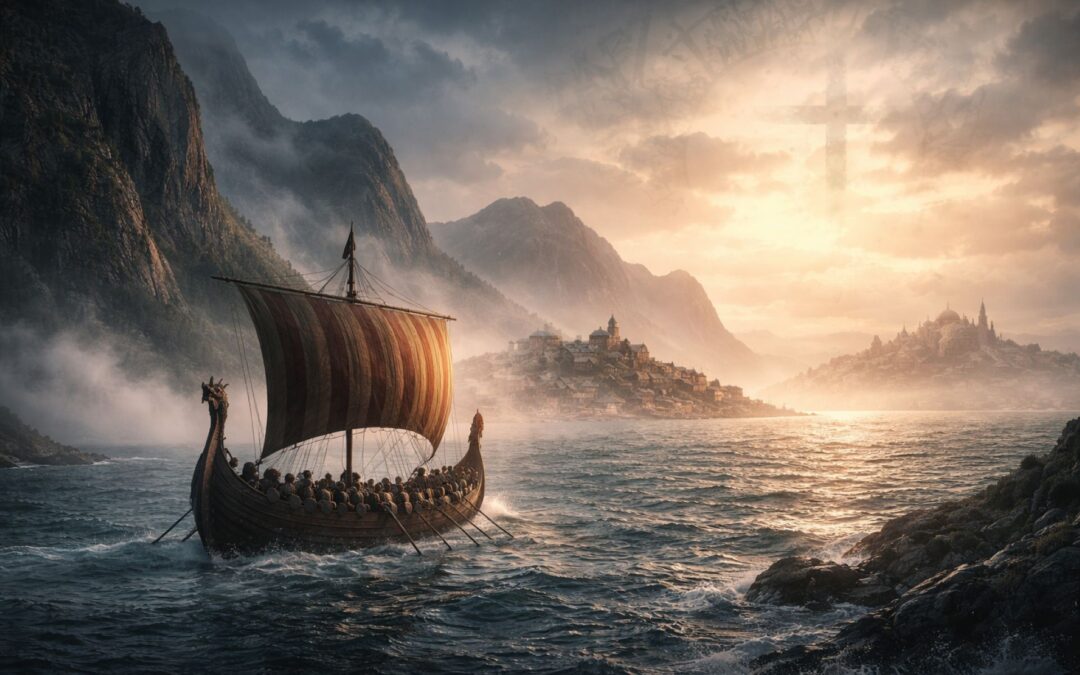
Few groups in history have captured the popular imagination as strongly as the Vikings. In modern culture, they are often portrayed as fierce warriors sailing across stormy seas in dragon-headed ships, raiding helpless villages and leaving destruction in their wake. While this image contains a kernel of truth, it only tells part of the story. The Vikings were not merely raiders. They were explorers, traders, settlers, and state-builders whose activities reshaped large parts of Europe and beyond.
Emerging from the rugged landscapes of Scandinavia during the late eighth century, the Vikings launched a wave of maritime expansion that would stretch from the icy coasts of Greenland to the rivers of Russia and the bustling markets of Constantinople. Their swift longships carried them across oceans and deep into continental river systems, allowing them to strike unexpectedly, establish trade routes, and found new communities across distant lands.
Over the course of nearly three centuries, the Viking world expanded in multiple directions at once. In the west, Norse settlers transformed the political and cultural landscape of the British Isles and explored the far edges of the North Atlantic. In the east, Swedish Vikings known as Varangians opened vast trade networks linking Scandinavia to the Byzantine Empire and the Islamic world. Meanwhile, at home in Scandinavia, the very success of Viking expansion helped reshape their own societies, gradually replacing fragmented tribal systems with centralized Christian kingdoms.
By the time the Viking Age came to an end in the eleventh century, the Norse had not disappeared. Instead, they had become woven into the fabric of medieval Europe itself. Their descendants ruled kingdoms, founded cities, influenced languages, and helped shape the political order of the emerging medieval world.
The story of the Vikings, therefore, is not simply one of raids and battles. It is the story of how a collection of seafaring societies from the northern edge of Europe reshaped the continent through exploration, commerce, migration, and cultural exchange.
Scandinavia Before The Viking Age
In the centuries before the Viking Age began, Scandinavia lay at the far northern edge of the known European world. Unlike regions closer to the Mediterranean, it had little direct contact with the powerful civilizations that had shaped ancient Europe, such as the Greeks and Romans. Yet this relative isolation did not mean the region was stagnant. Instead, Scandinavia developed its own distinctive social structures, cultural traditions, and economic networks long before the first Viking raids took place.
The landscape of Scandinavia played a decisive role in shaping the societies that lived there. Dense forests, rugged mountains, and limited areas of fertile farmland made large centralized settlements difficult to sustain. Communities were scattered across coastal villages, river valleys, and inland farms, each largely self-sufficient and tied closely to the surrounding environment.
Travel over land was often slow and difficult due to the terrain. As a result, water became the most reliable means of communication and movement. Scandinavia’s long coastline, deep fjords, island chains, and interconnected rivers created natural maritime highways that linked distant communities together. Over time, these waterways encouraged the development of strong seafaring traditions and an economy that relied heavily on travel by boat.
Politically, early Scandinavian society was fragmented and decentralized. Power rested primarily in the hands of local chieftains who controlled land, commanded loyalty from warrior followers, and maintained influence through success in warfare, trade, and gift-giving. These leaders presided over kinship-based communities where loyalty to family and clan remained the central organizing principle of social life.
Competition among these regional elites was constant. With limited agricultural land and resources available, rival chieftains frequently struggled for influence and prestige. In such an environment, success in trade, raiding, and exploration could dramatically enhance a leader’s reputation and attract followers seeking wealth and opportunity.
By the early medieval period, Scandinavians had already begun participating in trade networks that extended across the Baltic Sea and into northern Europe. Traders exchanged local products such as furs, amber, honey, and walrus ivory for metals, luxury goods, and silver from distant markets. These early commercial contacts gradually exposed Scandinavian sailors to the political landscapes and wealth of lands far beyond their homelands.
This combination of environmental conditions, decentralized political structures, competitive warrior elites, and expanding trade connections created the perfect conditions for a dramatic outward expansion. All that remained was a technological breakthrough that would allow Scandinavians to travel further, faster, and more efficiently than ever before.
That breakthrough came in the form of the Viking longship.
The Maritime Revolution That Made The Vikings Possible
At the heart of Viking expansion lay a technological and maritime breakthrough that fundamentally changed what Scandinavian societies were capable of achieving at sea. This breakthrough was the development of advanced shipbuilding techniques that produced vessels unlike anything else in Europe at the time.
By the eighth century, Norse shipbuilders had perfected the clinker-built ship, a design in which overlapping wooden planks were fastened together along the hull. This construction method made ships both strong and flexible, allowing them to absorb the stresses of rough seas without breaking apart. The result was a vessel that was remarkably durable while remaining light enough to travel quickly across water.
The most famous of these vessels was the Viking longship. Long, narrow, and built with a shallow draft, the longship was designed for speed and maneuverability. It could be powered by both sail and oars, giving crews the flexibility to travel efficiently across open seas or navigate narrow rivers where winds were unreliable. Because of their shallow hulls, longships could also sail in surprisingly shallow waters and even be dragged across short stretches of land between rivers.
These capabilities gave the Vikings extraordinary mobility. A fleet of longships could cross the open waters of the North Sea, slip into a river mouth, and travel deep into the European interior. Towns and monasteries located hundreds of kilometers inland—previously considered safe from seaborne attack—suddenly became vulnerable.
Yet longships were not used exclusively for warfare. They were equally important tools for trade, migration, and exploration. Scandinavian merchants sailed along the Baltic and North Sea coasts, visiting emerging markets and trading centers where goods and information circulated between different cultures. Through these journeys, the Norse learned where wealth was concentrated, which routes were most profitable, and which regions were politically unstable.
Over time, this combination of commerce and mobility gave rise to a culture in which trading and raiding existed side by side. What began as peaceful commercial contact could easily transform into opportunistic plunder if circumstances allowed it. Wealth gained through these expeditions flowed back into Scandinavian society, where successful leaders distributed treasure to loyal followers, strengthening their reputations and attracting even larger retinues.
In this way, maritime technology did more than simply improve transportation. It reshaped the entire social and economic structure of Scandinavian society. Ships made it possible for ambitious chieftains to seek wealth beyond their limited homelands, and they gave ordinary warriors the chance to participate in expeditions that promised both riches and prestige.
With the longship at their command, the Norse were no longer confined to the fjords and coastlines of Scandinavia. They now possessed the means to project their power across vast distances—and the first targets would soon send shockwaves across the Christian world.
The First Viking Raids And The Shock To Europe
The Viking Age is traditionally dated to the year 793, when a violent raid on a small island monastery off the northeastern coast of England shocked the Christian world. The monastery of Lindisfarne had long been an important center of learning and worship, but its wealth and isolation also made it a tempting target. When Viking raiders descended upon the island, they killed many of the monks and carried off valuable treasures, leaving behind devastation that reverberated across Europe.
To Christian observers of the time, the attack seemed almost apocalyptic. Monasteries were sacred spaces, places dedicated to prayer and scholarship rather than warfare. The idea that pagan warriors from distant northern lands would storm such a site appeared not only shocking but sacrilegious. Contemporary chronicles described the event with horror, portraying the attackers as barbaric heathens sent to punish a sinful world.
Yet from the perspective of the Vikings themselves, the raid followed a clear logic. Monasteries were often wealthy institutions that accumulated precious metals, manuscripts, and religious artifacts over generations. At the same time, they were usually lightly defended and located along accessible coastlines or rivers. For seaborne raiders searching for quick wealth, such sites represented easy targets.
Following the attack on Lindisfarne, Viking raids quickly spread across the coastal regions of northern Europe. Throughout the 790s and early ninth century, Scandinavian raiders struck monasteries and settlements around the British Isles, the Irish Sea, and the North Sea. Small fleets of longships would appear suddenly along the shoreline, launch swift assaults, seize valuable goods and captives, and disappear just as quickly back into the open water.
In these early years, Viking expeditions were largely seasonal. Warriors set sail during the warmer months, when calmer seas made travel easier. After completing their raids, they returned home to Scandinavia before winter set in. These seasonal attacks allowed the Vikings to acquire wealth while still maintaining their farms and communities back home.
The success of these early raids demonstrated just how vulnerable many European coastal regions were to maritime attack. Wealthy but poorly defended religious centers and towns offered lucrative opportunities for ambitious Viking leaders and their followers. As news of these successes spread throughout Scandinavia, more expeditions set sail each year, and the scale of Viking activity steadily increased.
What had begun as opportunistic raids would soon evolve into something far more transformative. As Viking warriors gained experience and confidence, they began to realize that plundering coastal communities was only the beginning of what their ships and seafaring skills made possible.
From Seasonal Raiding To Permanent Settlement
During the early decades of the Viking Age, most Scandinavian expeditions followed a predictable pattern. Fleets of longships sailed out during the summer months, raided coastal settlements, monasteries, and trading centers, and then returned home before the winter season began. These operations were quick, opportunistic, and highly mobile, allowing Viking warriors to strike unexpectedly and withdraw before organized resistance could form.
Over time, however, the nature of Viking activity began to change. The enormous wealth generated by early raids encouraged larger and more ambitious expeditions. Instead of simply appearing for brief attacks and retreating, Viking leaders increasingly sought ways to maintain a longer presence in the regions they targeted.
One of the most important developments in this transformation was the decision to overwinter abroad. In 850, Viking forces in England remained through the winter for the first time rather than returning to Scandinavia. This shift allowed them to launch raids throughout the year, dramatically increasing the pressure on local kingdoms that had previously relied on winter to bring a temporary reprieve from attacks.
In Ireland, a similar development had already taken place. Viking fleets began sailing up the island’s major rivers and establishing fortified ship enclosures known as longphorts along the riverbanks. These bases served as both military strongholds and trading centers, enabling the Norse to maintain control over important waterways while organizing further expeditions into the surrounding countryside.
Some of these Viking bases eventually grew into permanent settlements. One of the most notable examples was Dublin, which originated as a Viking longphort established in the ninth century. From this base, Norse rulers dominated much of the Irish Sea region, engaging in both trade and warfare while building connections with neighboring communities.
Over time, interaction between Vikings and local populations became increasingly complex. While violent conflict remained common, alliances also emerged between Norse warlords and regional rulers. Political partnerships, trade relationships, and intermarriage gradually blurred the boundaries between Scandinavian settlers and the societies they had once raided.
These cultural exchanges gave rise to hybrid communities in several regions. In Ireland and parts of Scotland, Norse settlers mixed with local Gaelic populations, creating a distinct cultural group often referred to as the Norse-Gaels. These communities controlled important maritime trade routes and played a significant role in shaping the politics of the Irish Sea world.
As Viking activity expanded, settlement and colonization began to accompany raiding more frequently. Scandinavian communities appeared across the North Atlantic fringe, including the Shetland and Orkney Islands, the Hebrides, and the Isle of Man. These outposts strengthened the Viking presence throughout the region and provided strategic bases for further expansion.
What had begun as seasonal raids for wealth and prestige was now evolving into something much more enduring. Vikings were no longer simply visitors to foreign lands. In many places, they were becoming settlers, rulers, and participants in the political struggles of the societies they had once attacked.
The Viking Conquest Of England And The Danelaw
By the middle of the ninth century, Viking ambitions in England began to shift dramatically. What had once been a pattern of raids and temporary encampments gradually gave way to full-scale military campaigns aimed at conquering and settling land. This transformation reached a turning point in the year 865, when a large Viking force landed on the eastern coast of England.
Known in Anglo-Saxon sources as the Great Heathen Army, this formidable Viking host arrived not merely to plunder but to establish permanent control. According to later tradition, the army was led by the sons of the legendary Viking warlord Ragnar Lodbrok, who supposedly sought revenge against the Northumbrian king who had executed their father. While the exact details of this story remain uncertain, there is little doubt that the invading army represented one of the most organized Viking campaigns ever seen in England.
After landing, the Vikings rapidly moved inland and began attacking the Anglo-Saxon kingdoms that dominated the region. In 866, they captured the city of York, transforming it into the capital of a powerful Scandinavian kingdom known as Jórvík. From this strategic base, Viking forces launched campaigns across northern and eastern England, defeating several Anglo-Saxon rulers and steadily expanding their territory.
One by one, the kingdoms of East Anglia and parts of Mercia fell under Viking control. Only the southern kingdom of Wessex managed to resist the Norse advance. Its ruler, Alfred the Great, proved to be one of the few leaders capable of mounting an effective defense against the invaders.
After years of struggle, Alfred achieved a decisive victory over the Vikings at the Battle of Edington in 878. The conflict ended with a negotiated settlement that divided England between the Anglo-Saxons and the Vikings. The regions under Scandinavian rule came to be known as the Danelaw, an extensive territory covering much of northern and eastern England.
Under the Danelaw, Scandinavian settlers established farms, towns, and local administrations that blended Norse customs with existing Anglo-Saxon institutions. Over time, thousands of settlers from Scandinavia migrated into the region, transforming the cultural and demographic landscape of England.
The influence of these settlers left a lasting mark on English society. Many Old Norse words entered the English language during this period, including everyday terms such as sky, egg, window, take, and give. Place names across northern and eastern England also reveal the depth of Viking settlement, with endings like “-by,” “-thorpe,” and “-thwaite” reflecting their Scandinavian origins.
Although the Anglo-Saxon kingdoms would eventually regain control of much of this territory, the Viking presence in England permanently reshaped the region’s language, culture, and political development. What had begun as an invasion had become a profound transformation of English society.
Viking Trade Networks Across Eastern Europe
While Viking raids and settlements transformed much of western Europe, an equally important expansion was taking place in the east. Swedish Vikings, often known as Varangians, began exploring the vast river systems that connected the Baltic Sea to the interior of Eastern Europe. These waterways opened up enormous opportunities for trade and cultural exchange, linking Scandinavia to regions far beyond the boundaries of the Viking world.
Unlike the coastal raiders who terrorized monasteries in the British Isles, many of these eastern Vikings focused primarily on commerce. Traveling along rivers such as the Dnieper and the Volga, they established long-distance trade routes that connected northern Europe with the Byzantine Empire and the Islamic world.
Along these routes, Scandinavian traders exchanged goods from the northern forests and coasts for luxury items from distant markets. Furs, amber, honey, and wax were carried southward, while silver coins, silk fabrics, glassware, and other valuable commodities flowed back toward the Baltic. Through this network, Viking traders gained access to some of the wealthiest economies of the medieval world, including the great markets of Constantinople and even the Abbasid Caliphate centered in Baghdad.
As had occurred in western Europe, Viking traders in the east gradually began settling among local populations. Rather than simply passing through, they integrated into existing Slavic communities and became part of the political structures of the region. Over time, this interaction produced mixed Norse-Slavic societies that blended elements of both cultures.
According to historical tradition, a Viking leader named Rurik established control over the city of Novgorod in 862, laying the foundation for a powerful new political entity. A few decades later, one of his successors named Oleg seized the city of Kiev in 882 and turned it into the center of a growing state known as the Kievan Rus. This realm would dominate large parts of Eastern Europe for centuries, controlling vital trade routes that linked the Baltic with the Black Sea.
The Vikings who traveled these eastern routes also developed a close relationship with the Byzantine Empire. Scandinavian warriors frequently entered the service of the Byzantine emperors, forming an elite military unit known as the Varangian Guard. Renowned for their discipline and loyalty, these warriors served as the personal bodyguards of the emperor and played a crucial role in the empire’s military campaigns.
Through trade, settlement, and military service, Viking activity in the east helped create a vast network of cultural and economic exchange stretching from Scandinavia to the heart of the Mediterranean and the Islamic world. In doing so, the Varangians demonstrated that the Viking Age was not defined solely by raiding and conquest, but also by commerce, diplomacy, and integration with distant civilizations.
Viking Expansion Across The North Atlantic
While Vikings pushed eastward through the river systems of Eastern Europe, another wave of expansion was unfolding across the cold waters of the North Atlantic. Unlike the raiding campaigns that characterized Viking activity elsewhere in Europe, this western expansion was driven primarily by settlement and exploration.
One of the first major destinations was Iceland. Norse sailors had likely reached the island earlier, but large-scale settlement began in the late ninth century, around the 870s. Many of the settlers came directly from Norway, while others arrived from Norse-controlled regions in the British Isles. For some, Iceland offered an opportunity to escape political pressures at home, particularly as emerging Norwegian kings attempted to consolidate power and impose greater authority over local chieftains.
Because Iceland had no existing centralized government, the settlers created their own political system. They organized society around a general assembly known as the Althing, which met annually to create laws, resolve disputes, and maintain social order. This institution became one of the earliest forms of parliamentary governance in Europe and served as the foundation of Icelandic political life for centuries.
From Iceland, Norse expansion continued even further west. In 985, an Icelandic chieftain named Eric the Red was exiled from the island after a series of disputes. Determined to find a new home, he sailed westward and discovered the vast, rugged island of Greenland. Despite its harsh climate, Eric successfully convinced a group of settlers to join him, and several small Norse communities were established along Greenland’s southwestern coast.
These settlements represented the furthest permanent reach of the Viking world. Yet the Norse did not stop there. Around the year 1000, exploratory voyages from Greenland carried Viking sailors even further west across the Atlantic. Led by Leif Erikson, these expeditions reached the coasts of North America, likely in what is now eastern Canada.
At a location known today as L’Anse aux Meadows in Newfoundland, the Vikings established a small base that served as a temporary settlement and staging point for exploration. Archaeological evidence suggests that the Norse remained there only briefly, probably due to the immense distance from their other settlements and conflicts with the indigenous peoples they encountered, whom they called Skrælings.
Although the North American colony was ultimately abandoned, the voyages demonstrated the remarkable maritime capabilities of the Vikings. Nearly five centuries before Christopher Columbus crossed the Atlantic, Norse sailors had already reached the shores of the New World.
This era of exploration showed that Viking expansion was not limited to raiding wealthy lands or establishing trade networks. It also involved pushing the boundaries of the known world, driven by a mixture of ambition, necessity, and the seafaring expertise that had become the hallmark of Viking society.
Viking Religion, Society, And Culture
Despite their wide-ranging expeditions across Europe and beyond, the Vikings shared a common cultural and religious framework that tied together their scattered communities. At the center of this worldview stood the traditions of Old Norse religion, a belief system that explained the natural world through a complex pantheon of gods, mythological beings, and heroic legends.
Among the most prominent of these gods was Odin, associated with wisdom, poetry, magic, and war. Often portrayed as a wandering figure who sacrificed much in pursuit of knowledge, Odin embodied the values of cunning and insight that were admired in Norse society. Another central deity was Thor, the god of thunder and protector of both gods and humans. Armed with his legendary hammer Mjölnir, Thor symbolized strength, courage, and protection against chaos.
These gods existed within a vast mythological universe filled with other supernatural beings such as elves, dwarves, giants, and trolls. The cosmos itself was imagined as a great interconnected structure centered on the world tree Yggdrasil, which bound together the various realms of gods, humans, and other creatures.
Religion in Viking society was deeply intertwined with everyday life. Rituals and sacrifices were conducted to seek the favor of the gods, ensure successful harvests, or gain victory in battle. Seasonal festivals and communal gatherings reinforced shared beliefs and social bonds, while stories of heroic deeds and legendary ancestors were passed down through oral tradition.
Viking society itself was organized into a hierarchy of social classes. At the top were powerful chieftains and kings who controlled land, commanded warriors, and accumulated wealth through trade and raiding. Beneath them stood free farmers and craftsmen who formed the backbone of Scandinavian communities. At the lowest level were thralls, or enslaved individuals, who were often captured during raids or acquired through trade.
Despite this hierarchy, Scandinavian society retained elements of participatory governance. Important decisions were often discussed and resolved at assemblies known as things, where free men gathered to debate disputes, establish laws, and negotiate political alliances. These assemblies provided a forum where authority could be challenged and community consensus maintained.
Language also served as a powerful cultural bond. Across Scandinavia and Viking settlements abroad, people spoke dialects of Old Norse, a language that facilitated communication across vast distances. Through trade, settlement, and interaction with other societies, Old Norse influenced several European languages, leaving traces that can still be found in modern English and other Germanic tongues.
Much of what is known about Viking mythology and cultural traditions comes from later written sources, particularly the Norse sagas and poetic works recorded in Iceland centuries after the Viking Age. Although these texts were written down after the spread of Christianity, they preserved many of the myths, legends, and social values that had shaped Viking society.
Over time, however, the cultural landscape of Scandinavia began to shift. Contact with Christian Europe, combined with the growing authority of emerging kings, gradually introduced new religious and political ideas. These changes would play a crucial role in transforming the Viking world during the centuries that followed.
The Rise Of Scandinavian Kingdoms
As Viking expeditions carried Norse warriors and traders across vast distances, the Scandinavian homelands themselves were undergoing profound internal transformation. For centuries, Denmark, Norway, and Sweden had been politically fragmented landscapes dominated by competing chieftains and small regional kingdoms. Yet by the tenth century, the balance of power was beginning to shift as ambitious rulers sought to consolidate authority and establish more centralized states.
Denmark was the first region where this process gained significant momentum. Royal power had already begun to coalesce toward the end of the ninth century, but it was during the reign of Harald Bluetooth in the mid-tenth century that the transformation became unmistakable. Harald succeeded in uniting much of Denmark under a single ruler and played a key role in introducing Christianity to the region. His famous runestones declared that he had “made the Danes Christian,” symbolizing the growing integration of Scandinavian kingdoms into the wider Christian world of medieval Europe.
In Norway, the path toward unification was far more turbulent. According to later tradition, the Viking leader Harald Fairhair united the country after the Battle of Hafrsfjord in the late ninth century. While the historical details remain debated, it is clear that the consolidation of Norway occurred gradually over the following century as rival chieftains competed for dominance. Resistance to royal authority remained strong in many regions, particularly among local elites who valued their independence.
These struggles had an unexpected consequence. Many chieftains who opposed the growing power of Norwegian kings chose to leave rather than submit. Their migrations contributed directly to the settlement of new territories across the North Atlantic, particularly Iceland, where settlers sought to create a society free from centralized royal rule.
Sweden’s political development unfolded more slowly than that of its neighbors. Throughout the ninth and tenth centuries, power remained divided among various regional leaders. The process of consolidation accelerated only toward the end of the tenth century when rulers such as Olof Skötkonung embraced Christianity and began issuing coinage that reflected a more organized royal authority.
The spread of Christianity played a crucial role in strengthening these emerging monarchies. Conversion connected Scandinavian rulers to the powerful political and religious networks of medieval Europe. Christian kings could claim divine legitimacy for their authority, establish church institutions that supported their rule, and integrate their realms into the broader diplomatic framework of the continent.
At the same time, the old social structures of the Viking world were slowly changing. Warrior bands that had once followed independent chieftains increasingly became part of royal armies. Raiding expeditions declined in importance as rulers sought more stable forms of revenue through taxation and trade.
By the end of the tenth and early eleventh centuries, Scandinavia was no longer merely a collection of competing tribal communities. Denmark, Norway, and Sweden had begun to emerge as recognizable medieval kingdoms with defined territories, centralized rulers, and growing connections to the rest of Europe. These political changes would soon reshape the final phase of the Viking Age.
The North Sea Empire And The Last Viking Kings
Although the Viking Age is often associated with raiding and settlement during the ninth century, Viking power did not disappear as quickly as many assume. In fact, the late tenth and early eleventh centuries witnessed a final resurgence of Scandinavian influence, particularly in the British Isles.
By this time, much of the territory once controlled by the Danelaw had gradually been reconquered by Anglo-Saxon rulers. In 927, the Kingdom of England was formally unified under King Æthelstan, bringing most of the former Viking lands back under English authority. While this seemed to mark the decline of Viking influence in England, the connection between the island and Scandinavia remained strong.
Toward the end of the tenth century, Danish Vikings began launching renewed raids against England. Political instability within the English kingdom created opportunities for Scandinavian rulers to intervene. These raids intensified during the reign of the English king Æthelred II, whose attempts to deal with the threat often proved ineffective and sometimes disastrous.
In 1013, the Danish king Sweyn Forkbeard launched a full-scale invasion of England. Unlike earlier Viking expeditions that focused on plunder, this campaign sought permanent control of the kingdom. Sweyn’s forces rapidly overwhelmed English resistance, forcing Æthelred to flee and allowing the Danish ruler to claim the English throne.
Sweyn’s reign was short-lived, however, as he died the following year. Yet the conquest of England was completed by his son, Cnut the Great, who secured control of the kingdom in 1016 after a prolonged struggle. Under Cnut’s rule, England became the centerpiece of a powerful political union often referred to as the North Sea Empire.
At its height, this empire united England, Denmark, and Norway under a single ruler. Cnut governed his territories through a combination of Scandinavian traditions and established English institutions, demonstrating how Viking leaders had evolved from raiders into kings who ruled complex states.
Despite its impressive reach, the North Sea Empire proved difficult to maintain. After Cnut’s death in 1035, disputes over succession weakened the fragile political structure that held the empire together. Within a few years, control over its territories began to unravel.
By 1042, the English throne returned to the Anglo-Saxon dynasty under Edward the Confessor, marking the end of Scandinavian rule in England. Nevertheless, the political and cultural connections between England and Scandinavia remained deeply intertwined.
This final phase of Viking power showed how far the Norse world had evolved. The descendants of seafaring raiders now ruled kingdoms and commanded empires. Yet even as Viking rulers reached the peak of their political influence, the forces that would soon bring the Viking Age to an end were already beginning to take shape.
1066 And The End Of The Viking Age
By the middle of the eleventh century, the Viking world had already begun to change dramatically. Scandinavian kingdoms were becoming more centralized and increasingly integrated into the Christian political order of medieval Europe. Large-scale raiding expeditions had become less common, replaced by organized monarchies and formal systems of governance. Yet one final dramatic episode would come to symbolize the closing chapter of the Viking Age.
In 1066, the English king Edward the Confessor died without leaving a direct heir, creating a fierce struggle over who would claim the throne. The English noble Harold Godwinson was quickly crowned king, but two powerful rivals soon emerged to challenge his rule.
One of them was Harald Hardrada, the king of Norway and one of the last great Viking warlords. Hardrada believed he possessed a legitimate claim to the English throne based on earlier agreements tied to the former North Sea Empire. Determined to assert his claim, he assembled a large invasion force and sailed across the North Sea to England.
Hardrada’s army landed in northern England and initially achieved success, defeating local forces at the Battle of Fulford. However, Harold Godwinson responded swiftly. Marching his army north with remarkable speed, he surprised the Norwegian invaders near the village of Stamford Bridge on September 25, 1066.
The resulting battle was fierce and decisive. Harald Hardrada was killed in the fighting—according to later accounts by an arrow that struck him in the throat. With his death, the Norwegian invasion collapsed, and the surviving Viking forces retreated across the North Sea.
The defeat at Stamford Bridge is widely regarded as the final major Viking invasion of England and a symbolic end to the Viking Age. Yet the story of 1066 was not finished.
Only a few weeks later, another claimant arrived on English shores: William, Duke of Normandy. Ironically, Normandy itself had been founded by Vikings more than a century earlier when the Norse leader Rollo was granted land by the Frankish king in exchange for defending the region and converting to Christianity.
By the eleventh century, Rollo’s descendants had become culturally French and spoke the Norman dialect of Old French. Nevertheless, their distant Scandinavian origins remained part of their history. When William invaded England and defeated Harold Godwinson at the Battle of Hastings on October 14, 1066, a dynasty descended from Viking settlers ultimately secured the English throne.
In this sense, the Viking Age ended not with a single defeat but with a transformation. The descendants of Viking raiders had become kings, nobles, and rulers embedded within the political structures of medieval Europe. The era of seaborne Viking expeditions had passed, but the legacy of the Norse world would continue to shape European history for centuries to come.
The Enduring Legacy Of The Vikings
Although the Viking Age formally came to an end in the eleventh century, the influence of the Norse world did not disappear with it. Instead, the Vikings gradually became absorbed into the societies they had once raided, traded with, and settled among. Over time, their descendants blended into the broader populations of Europe, leaving behind cultural and political legacies that continue to shape the continent today.
One of the most visible remnants of Viking influence can be found in language and place names. Across large parts of England, Ireland, and Scotland, settlements founded during the Viking Age still carry Scandinavian-derived names. English towns ending in “-by,” “-thorpe,” and “-thwaite” often trace their origins to Norse settlements. The English language itself also absorbed a remarkable number of Old Norse words during centuries of interaction between Scandinavian settlers and Anglo-Saxon communities.
Beyond language, Viking expansion helped establish new trade networks that connected distant parts of the medieval world. Scandinavian merchants and explorers linked the Baltic Sea with the markets of Byzantium and the Islamic world, contributing to the movement of goods, ideas, and cultural influences across continents. These connections played a role in shaping the commercial foundations of medieval Europe.
The Vikings also influenced patterns of settlement and state formation. Cities such as Dublin, originally founded as Viking trading bases, grew into major urban centers. In Eastern Europe, the early rulers of the Kievan Rus established political structures that would influence the later development of Russian and Ukrainian states. Meanwhile, in the North Atlantic, Norse settlers created lasting societies in places like Iceland, whose political institutions and literary traditions preserved much of the Viking cultural heritage.
Even in regions where Norse communities eventually disappeared as distinct groups, their impact endured through cultural exchange and assimilation. In Normandy, Viking settlers evolved into a powerful aristocratic society that would later conquer England. In Ireland and Scotland, Norse settlers blended with Gaelic populations to create hybrid cultures that shaped local politics and trade for generations.
Perhaps the most profound transformation occurred in Scandinavia itself. Over the centuries following the Viking Age, Denmark, Norway, and Sweden developed into centralized Christian kingdoms that became fully integrated into the political and economic systems of medieval Europe. The warrior societies that had once launched longships across the seas gradually gave way to monarchies governed by laws, taxation systems, and established institutions.
In this way, the Vikings did not vanish from history. Instead, they adapted and evolved. The very forces that had once driven their expansion—trade, migration, and cultural exchange—ultimately led to their assimilation into the wider medieval world.
The Viking Age therefore ended not because the Vikings were destroyed, but because they transformed. Their descendants no longer lived as seaborne raiders or wandering adventurers. Instead, they became farmers, merchants, nobles, and rulers within the emerging societies of medieval Europe, carrying forward a legacy that still echoes in the languages, cultures, and histories of the modern world.