
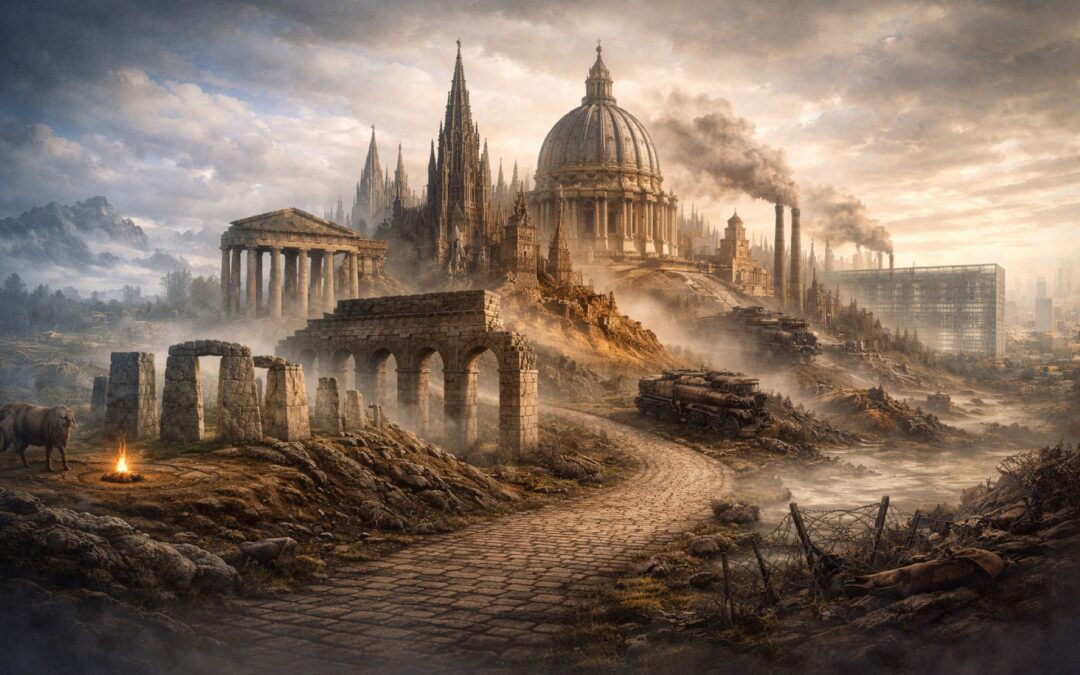
Europe’s history is often told as the story of a civilization that shaped the modern world. From ancient philosophy and Roman law to the scientific revolution, industrialization, and modern democracy, the continent has produced ideas and institutions that profoundly influenced global history. Yet Europe’s past is far more complex than a simple narrative of progress. Its development has been marked by repeated cycles of expansion and collapse, unity and fragmentation, innovation and catastrophe.
For tens of thousands of years, Europe has served as a crossroads of peoples, cultures, and ideas. The first humans arrived during the Paleolithic era, gradually spreading across a landscape shaped by ice sheets, forests, and vast river systems. Over time, these early communities transitioned from nomadic hunter-gatherer societies into settled agricultural cultures, laying the foundations for more complex social structures. From these beginnings emerged the continent’s earliest civilizations, particularly around the Mediterranean, where cultural exchange with the Near East helped stimulate technological and intellectual advancement.
Across the centuries that followed, Europe became a stage for extraordinary transformations. The intellectual achievements of ancient Greece introduced philosophical inquiry, political experimentation, and cultural traditions that would influence generations to come. Rome later united much of the continent within a single imperial framework, spreading law, infrastructure, and administrative systems that left a lasting imprint on European society.
After the collapse of Roman authority in the West, Europe entered a long period of fragmentation and reorganization. New kingdoms emerged from the ruins of empire, while Christianity rose to become a central force shaping culture, politics, and everyday life. The medieval centuries witnessed both turbulence and creativity as invasions, religious conflicts, and economic shifts gradually reshaped the continent’s political landscape.
In later centuries, Europe experienced waves of intellectual awakening and technological innovation. The Renaissance revived classical knowledge, the Reformation fractured religious unity, and the scientific revolution transformed humanity’s understanding of the natural world. These developments coincided with European expansion across the globe, which connected distant continents through trade, empire, and conflict.
The modern era brought unprecedented change. Industrialization altered the rhythms of daily life, while nationalism and ideological movements reshaped politics. Two devastating world wars in the twentieth century nearly destroyed the continent’s global dominance, yet the aftermath also gave rise to new forms of cooperation and integration that sought to prevent such catastrophes from happening again.
Today, Europe remains a diverse mosaic of cultures, languages, and political systems. Its long history reveals a continent constantly evolving, shaped by the forces of migration, belief, power, and ideas. To understand Europe is therefore to explore not a single civilization, but a dynamic historical landscape that has repeatedly reinvented itself across millennia.
From Ice Age Frontiers to Early Settled Societies
Europe’s earliest history stretches back tens of thousands of years, long before the emergence of cities, kingdoms, or written language. Around 50,000 years ago, the first modern humans began migrating into the continent from western Asia. These Paleolithic hunter-gatherers encountered a landscape dramatically different from the one known today. Much of northern Europe was buried beneath vast ice sheets during the last Ice Age, while the southern regions offered more habitable environments of forests, grasslands, and river valleys.
These early communities lived in small, mobile groups that relied on hunting animals, gathering wild plants, and adapting to shifting climates. Despite the apparent simplicity of their way of life, they produced remarkable cultural artifacts. Cave paintings discovered in places such as Lascaux in France and Altamira in Spain reveal sophisticated artistic traditions and spiritual symbolism, suggesting that even these early societies possessed complex belief systems and forms of cultural expression.
As the Ice Age gradually came to an end around 12,000 years ago, Europe underwent profound environmental transformation. Retreating glaciers opened vast new territories for human settlement, allowing populations to spread northward into regions that had previously been uninhabitable. Forests expanded across the continent, and river systems became important corridors for travel and trade. Over time, human groups came to inhabit nearly every corner of Europe, from the Atlantic coasts in the west to the Ural Mountains in the east.
For thousands of years, however, daily life continued to revolve around hunting and gathering. The next major turning point arrived during the seventh millennium BC, when a revolutionary development spread into Europe from the Near East: agriculture. Farming practices—including the cultivation of crops and the domestication of animals—gradually replaced the nomadic lifestyle of earlier populations. This transformation reshaped human society in fundamental ways. Permanent villages began to appear, food production became more reliable, and populations grew larger and more stable.
The shift toward settled life also produced new forms of cultural and social organization. Communities constructed impressive megalithic monuments—large stone structures used for ritual, burial, or ceremonial purposes. Among the most famous of these is Stonehenge in England, though similar monuments appeared across much of western and northern Europe, indicating shared religious practices and collective labor on a scale previously unseen.
Technological innovations soon followed. By the fifth millennium BC, Europeans had begun working with copper, marking the early stages of metallurgy. Tools, ornaments, and weapons made from metal gradually supplemented earlier stone implements, contributing to increased productivity and more complex social hierarchies.
Another transformative influence arrived around 4500 BC with the migration of Indo-European peoples from the Eurasian steppe. These groups introduced new technologies, cultural traditions, and languages that would spread widely across the continent. Their linguistic legacy remains visible today, as many of Europe’s major language families—including Latin, Greek, Germanic, and Slavic—trace their roots to these early Indo-European tongues.
By the beginning of the Bronze Age around 3000 BC, Europe had already undergone thousands of years of cultural development. Agricultural societies, emerging technologies, and expanding networks of exchange were gradually shaping a more interconnected world. These foundations would soon support the rise of the continent’s earliest civilizations, particularly in the Mediterranean, where contact with the advanced cultures of the Near East would accelerate Europe’s entry into recorded history.
The First Civilizations and the Classical Inheritance
The Bronze Age Mediterranean and the Rise of Early Greek Civilization
By the beginning of the Bronze Age around 3000 BC, Europe was no longer a continent of isolated agricultural communities. Trade networks had begun to link regions across the Mediterranean, enabling the exchange of metals, pottery, textiles, and ideas. This growing connectivity brought Europe into closer contact with the advanced civilizations of the Near East and North Africa, whose influence helped shape the continent’s earliest complex societies.
One of the first literate civilizations to emerge in Europe developed on the island of Crete. Known as the Minoan civilization, it flourished from roughly 2000 to 1400 BC and was heavily oriented toward maritime trade. The Minoans built elaborate palace complexes such as the famous site of Knossos, decorated with vibrant frescoes and sophisticated architectural designs. Their economy was based on commerce throughout the eastern Mediterranean, linking them to Egypt, Anatolia, and the Levant.
The Minoans were eventually followed by the Mycenaean civilization on the Greek mainland. Emerging around 1600 BC, the Mycenaeans spoke an early form of the Greek language and established powerful fortified cities such as Mycenae and Tiryns. Unlike the relatively mercantile Minoans, Mycenaean society was more militarized and aristocratic. Their influence extended across the Aegean and into parts of the eastern Mediterranean, and they likely formed the historical backdrop to many later Greek myths, including the legendary Trojan War.
However, the Bronze Age world experienced a sudden and dramatic collapse around 1200 BC. Across the eastern Mediterranean, several major civilizations—including the Mycenaeans and the Hittites—disintegrated within a short period of time. The causes remain debated, but scholars suggest a combination of invasions, internal unrest, climate pressures, and disruptions to long-distance trade networks. In Greece, this upheaval ushered in a period known as the Greek Dark Ages, during which population declined, literacy disappeared, and many aspects of earlier civilization were lost.
The Greek Revival and the Birth of Western Intellectual Traditions
Despite this collapse, the foundations for a new cultural flowering gradually emerged during the early first millennium BC. Greek communities reorganized themselves into independent city-states, known as poleis, such as Athens, Sparta, Corinth, and Thebes. These city-states became the political and cultural centers of the Greek world.
Contact with the Phoenicians helped reintroduce writing through the adoption of a modified alphabet, which allowed the recording of laws, literature, and historical accounts. This revival of literacy coincided with the development of shared religious traditions, artistic styles, and political institutions.
Among the most influential innovations of the Greek world was the concept of participatory government. In Athens during the fifth century BC, citizens were directly involved in political decision-making through a system that later became known as democracy. While limited in scope—excluding women, slaves, and foreigners—it represented a significant departure from earlier forms of monarchic rule.
Greek thinkers also laid the intellectual foundations for many branches of Western thought. Philosophers such as Socrates, Plato, and Aristotle explored questions of ethics, politics, metaphysics, and knowledge that would shape philosophical inquiry for centuries. Greek scholars made important contributions to mathematics, astronomy, medicine, and natural science, while dramatists, poets, and historians developed enduring literary traditions.
At the same time, Greek city-states expanded outward. Between the eighth and sixth centuries BC, they founded colonies throughout the Mediterranean and Black Sea regions, spreading Greek culture, language, and trade networks far beyond the Aegean.
Rome and the Political Unification of Much of Europe
While Greek civilization flourished in the eastern Mediterranean, another power was rising in the Italian peninsula that would eventually dominate much of Europe. According to tradition, the city of Rome was founded in 753 BC by the twin brothers Romulus and Remus. In its early centuries, Rome was ruled by kings, but in 509 BC the monarchy was replaced by a republic governed by elected officials and a powerful senate.
Over the next several centuries, Rome steadily expanded its influence across the Italian peninsula through a combination of military conquest, strategic alliances, and the extension of citizenship rights to conquered peoples. By the third century BC, Rome had emerged as a major regional power.
Its rise to dominance was cemented through a series of conflicts with the North African city of Carthage known as the Punic Wars. After decades of brutal warfare during the third and second centuries BC, Rome defeated its rival and secured control of the western Mediterranean.
During the late Republic and early Empire, Rome expanded even further. By the second century AD, under emperors such as Trajan, the Roman Empire reached its greatest territorial extent. It encompassed much of southern and western Europe, including modern-day Spain, France, Britain, the Balkans, and large parts of central Europe.
Roman rule brought a remarkable degree of political integration to these diverse territories. Roads, aqueducts, cities, and administrative institutions created networks that facilitated trade, communication, and governance across vast distances. Latin served as a common administrative language, and Roman law established legal principles that would influence European legal systems long after the empire itself disappeared.
Urban life also flourished under Roman rule. Cities such as London, Paris, Cologne, Vienna, and Barcelona trace their origins to Roman settlements established during this period. These urban centers became hubs of commerce, culture, and administration, embedding Roman civilization deeply into the fabric of European society.
For several centuries, this imperial system maintained relative stability across much of Europe in a period often referred to as the Pax Romana. Yet beneath this surface of order, new religious movements, political pressures, and external threats were gradually reshaping the empire in ways that would ultimately transform the continent’s future.
Christianity, Collapse, and the Remaking of Europe
The Christianization of the Roman World
By the third century AD, the Roman Empire had reached an immense scale but was increasingly strained by internal instability and external pressures. Amid this environment of uncertainty, a religious movement that had begun centuries earlier in the eastern provinces of the empire began to spread rapidly across Roman society: Christianity.
Originally emerging in Roman Judea during the first century AD, Christianity began as a small sect centered on the teachings of Jesus of Nazareth. Early Christians faced periodic persecution from Roman authorities, who often viewed the faith with suspicion due to its refusal to participate in traditional Roman religious practices. Nevertheless, Christian communities steadily expanded throughout the empire, establishing churches in major cities such as Rome, Athens, and Lyon.
The decisive turning point came in the early fourth century. In 313 AD, Emperor Constantine issued the Edict of Milan, which granted legal status to Christianity and ended official persecution of its followers. Over the following decades, the faith spread rapidly through both urban and rural communities. By 380 AD, Emperor Theodosius I formally declared Christianity the official religion of the Roman Empire.
This transformation reshaped European society in profound ways. Christianity gradually replaced the polytheistic traditions that had dominated Roman religious life for centuries. Church institutions developed structures of authority, doctrine, and organization that would endure even as the political framework of the empire began to weaken.
The Fall of the Western Roman Empire and the Rise of Barbarian Kingdoms
While Christianity was gaining strength, the political stability of the Western Roman Empire was steadily deteriorating. Beginning in the late fourth century, large groups of peoples from beyond the empire’s northern and eastern frontiers began moving into Roman territory. These migrations were partly driven by their own search for land and opportunity, but also by pressures from other groups pushing westward across Eurasia.
Many of these migrating peoples—such as the Goths, Vandals, and Franks—had long interacted with the Roman world through trade and military service. However, as the empire weakened, these movements increasingly took the form of invasions and settlements.
During the fifth century, Germanic groups carved out new kingdoms across former Roman territories. The Visigoths established a realm in Spain, the Vandals seized North Africa, and the Franks expanded into Gaul. In Britain, Roman authority collapsed entirely as Angles and Saxons from northern Europe began settling across the island.
The symbolic end of the Western Roman Empire arrived in 476 AD when the young emperor Romulus Augustulus was deposed by the Germanic leader Odoacer. Although Roman institutions and traditions did not disappear overnight, the political unity that Rome had once imposed across much of Europe was gone.
In its place emerged a patchwork of new kingdoms, each combining elements of Roman governance with the customs of their own societies. Over time, these hybrid political systems would form the foundation for many of Europe’s medieval states.
Byzantium, Islam, and Europe’s Emerging Religious Frontiers
While the Western Roman Empire fragmented, the eastern half of the empire continued to survive. Known to modern historians as the Byzantine Empire, this state preserved many aspects of Roman political administration and classical learning.
Centered on the capital of Constantinople, Byzantium remained a powerful and sophisticated civilization for centuries. The city itself became one of the largest and wealthiest urban centers in the world, serving as a crucial hub connecting Europe and Asia. Byzantine scholars preserved and transmitted much of the knowledge of ancient Greece and Rome that might otherwise have been lost.
However, the eastern Mediterranean also faced new challenges. During the seventh century, the rise of Islam dramatically altered the political and religious landscape of the region. Muslim armies rapidly expanded out of Arabia, conquering vast territories that had once belonged to Byzantium and Persia.
Within a few decades, much of the Middle East and North Africa came under Muslim rule. In 711 AD, Islamic forces crossed the Strait of Gibraltar and conquered most of the Iberian Peninsula, establishing a powerful Muslim presence in Europe that would endure for centuries.
By the early eighth century, Europe had effectively become divided into distinct religious zones. Roman Catholic Christianity dominated western and central Europe, Orthodox Christianity prevailed in the Byzantine east, and Islam ruled large portions of Iberia and the Mediterranean world.
These religious and cultural frontiers would shape the political conflicts and alliances of the medieval era. Yet even as Europe appeared fragmented and unstable, new political structures were slowly emerging that would begin to restore a measure of order to the continent in the centuries ahead.
Medieval Europe Between Disorder and Consolidation
Charlemagne, Feudalism, and the Growth of Medieval Order
In the centuries following the collapse of the Western Roman Empire, Europe gradually reorganized itself into a new political and social structure. Although the continent remained fragmented into numerous small kingdoms and territories, certain rulers attempted to restore a measure of unity and stability reminiscent of the Roman past.
One of the most significant figures in this process was Charlemagne, the king of the Franks. Ascending to power in 768, Charlemagne embarked on a series of military campaigns that expanded his realm across much of Western and Central Europe. His conquests brought territories including modern France, western Germany, northern Italy, and parts of the Low Countries under a single political authority.
On Christmas Day in the year 800, Charlemagne was crowned Emperor of the Romans by Pope Leo III in Rome. This dramatic act symbolically revived the idea of a Western Roman Empire, though the reality was quite different from the centralized imperial system of ancient Rome. Nevertheless, Charlemagne’s empire represented the largest political entity in Western Europe since the fall of the Roman Empire.
Although the Carolingian Empire did not survive long after Charlemagne’s death in 814, its legacy was profound. The empire’s division among his grandsons in 843 created the political foundations from which many later European states would emerge, including the regions that eventually developed into France and Germany.
During this period, the structure of medieval society also took on a distinctive form known as feudalism. This system was based on a hierarchy of obligations between rulers, nobles, and warriors. Kings granted land to powerful nobles in exchange for loyalty and military support, while these nobles in turn distributed portions of their lands to knights who served them in battle.
Below this warrior aristocracy stood the vast majority of the population: peasants who worked the land. In exchange for protection and access to farmland, peasants provided labor, crops, and various services to their lords. Although conditions varied across regions, this hierarchical structure shaped much of European social and economic life during the medieval period.
The Christian church played a crucial role within this system. Monasteries, bishoprics, and religious institutions owned extensive lands and exercised considerable political influence. At the same time, the church provided spiritual guidance, education, and administrative continuity in a world where centralized authority was often weak.
Vikings, Magyars, and the Reshaping of the European Periphery
While new political structures were taking shape in Western Europe, the continent’s northern and eastern frontiers were experiencing waves of dramatic upheaval. From the late eighth century onward, Scandinavian seafarers—known as Vikings—began launching raids across the coasts and rivers of Europe.
Initially feared as ruthless attackers who targeted monasteries and coastal settlements, the Vikings soon proved to be far more than simple raiders. They were also traders, explorers, and settlers. Norse groups established communities across the British Isles, Iceland, and Greenland, and even briefly reached the shores of North America.
In Eastern Europe, Swedish Vikings known as Varangians traveled along major river systems connecting the Baltic Sea to the Black Sea. Through trade and settlement among Slavic populations, they helped establish the early political structure known as the Kievan Rus, which would later play a significant role in the historical development of Russia and Ukraine.
At roughly the same time, other groups were pressing into Europe from the Eurasian steppe. Among them were the Magyars, nomadic horsemen who entered Central Europe during the late ninth century. After initial campaigns of raiding across the continent, they eventually settled in the Carpathian Basin and formed the Kingdom of Hungary around the year 1000.
These migrations and incursions initially brought instability to large parts of Europe. Yet over time, many of these groups assimilated into the existing political and religious landscape. Viking descendants became rulers in regions such as Normandy and England, while the Magyars adopted Christianity and integrated into the European state system.
The High Middle Ages: Growth, Trade, and Christian Expansion
By the beginning of the second millennium, many of the external pressures that had destabilized Europe during earlier centuries began to subside. As raids declined and political institutions strengthened, Europe entered a period of relative stability known as the High Middle Ages.
Several developments contributed to this transformation. Advances in agricultural technology, including the heavy plow, horse collar, and improved crop rotation methods, significantly increased food production. Combined with a favorable climate, these innovations supported a dramatic rise in population across the continent.
As populations grew, new towns and cities emerged. These urban centers became hubs of commerce, craft production, and long-distance trade. Merchants established trading networks that connected regions across Europe and beyond, linking markets from the Mediterranean to the Baltic Sea.
The expanding influence of the Christian church also played a major role in shaping medieval society. By the late eleventh century, Christianity had become the dominant religious force throughout most of Europe. The church organized spiritual life, mediated political authority, and influenced everything from education to law.
Religious zeal also fueled military campaigns known as the Crusades. Beginning in 1095, European armies launched expeditions to the eastern Mediterranean with the aim of capturing Jerusalem and other sacred sites from Muslim control. These campaigns resulted in the establishment of short-lived Crusader states in the Levant and intensified contact between Europe and the broader Islamic world.
At the same time, Christian kingdoms in the Iberian Peninsula gradually pushed southward against Muslim-ruled territories in a process known as the Reconquista. In northern and eastern Europe, crusading orders conducted campaigns against pagan populations in the Baltic region.
Despite the violence associated with many of these conflicts, the High Middle Ages also witnessed remarkable cultural achievements. Gothic cathedrals rose above cities such as Paris, Chartres, and Canterbury, symbolizing both religious devotion and architectural innovation. Universities were established in places like Bologna, Oxford, and Paris, creating institutions dedicated to scholarship and learning.
By around 1300, Europe had reached a level of economic development, cultural production, and population growth unprecedented in its history. Yet this prosperity would soon be shattered by a series of devastating crises that plunged the continent into one of its darkest periods.
Catastrophe and Renewal in Late Medieval Europe
By the beginning of the fourteenth century, Europe had reached a remarkable peak of development. Agricultural expansion had transformed much of the landscape into productive farmland, towns and cities were flourishing as centers of trade and craftsmanship, and long-distance commerce connected markets across the continent. The institutions of medieval society—feudal monarchy, the landed nobility, and the powerful Christian church—appeared firmly established.
Yet this stability proved fragile. During the early decades of the fourteenth century, Europe entered a prolonged period of crisis that would shake the foundations of medieval civilization. A combination of environmental pressures, disease, warfare, and social upheaval converged to create one of the most devastating eras in European history.
The first major shock came in the form of widespread famine. Between 1315 and 1317, unusually cold and wet weather across much of northern Europe destroyed harvests and caused livestock to perish. Known as the Great Famine, this disaster left millions malnourished and weakened populations already living close to subsistence levels. In many regions, starvation, disease, and social unrest followed as food supplies collapsed.
Only a generation later, Europe faced an even more catastrophic event. In 1347, a deadly epidemic known as the Black Death began spreading across the continent. Likely originating in Central Asia before traveling west along trade routes, the disease—caused by the bacterium Yersinia pestis—moved rapidly through European cities, towns, and villages.
Within just a few years, the plague had devastated nearly every region of the continent. Historians estimate that between one-third and one-half of Europe’s population died between 1347 and 1352. Entire communities vanished, agricultural land went untended, and many contemporaries believed that the apocalypse had arrived.
The demographic shock produced enormous social and economic consequences. With so many workers dead, surviving laborers suddenly found themselves in high demand. Peasants and artisans were able to negotiate higher wages and improved working conditions, undermining the rigid hierarchies that had characterized feudal society for centuries.
However, these shifts also triggered tensions between elites and common people. Landowners and governments attempted to impose restrictions on wages and labor mobility in an effort to maintain traditional social structures. These measures often provoked resistance and rebellion. One of the most famous examples was the English Peasants’ Revolt of 1381, in which thousands of laborers rose up against taxation and social inequality.
Alongside famine and plague, Europe was also plagued by prolonged warfare. The most significant of these conflicts was the Hundred Years’ War between England and France, fought intermittently from 1337 to 1453. The war devastated large portions of the French countryside as armies marched through villages and towns, destroying crops, looting settlements, and displacing entire populations.
The conflict also introduced new military technologies and tactics that transformed warfare. The longbow, professional infantry forces, and the increasing use of gunpowder artillery gradually undermined the traditional dominance of heavily armored knights and fortified castles. These innovations marked the beginning of the end for many medieval military systems.
Despite the scale of these disasters, the crises of the fourteenth century also set in motion profound transformations. The weakening of feudal structures allowed greater economic mobility and stimulated the growth of urban economies. Intellectual life began to shift as scholars and artists increasingly questioned inherited traditions and looked back to classical sources for inspiration.
Out of the devastation of plague, famine, and war emerged a society gradually moving away from the rigid structures of the medieval world. In the centuries that followed, Europe would witness a remarkable cultural and intellectual revival that reshaped its political and artistic landscape. This transformation would come to be known as the Renaissance.
The Renaissance, the Reformation, and the Fracturing of Christendom
The Renaissance and the Recovery of Classical Learning
By the fifteenth century, Europe was slowly emerging from the devastation of the late medieval crises. Although many regions still struggled with political instability and economic recovery, a remarkable cultural transformation was taking shape, particularly in the wealthy city-states of northern and central Italy. This movement, later known as the Renaissance, marked a rebirth of interest in the intellectual and artistic traditions of ancient Greece and Rome.
Several factors contributed to this revival. Italian cities such as Florence, Venice, and Genoa had grown prosperous through Mediterranean trade, banking, and manufacturing. Wealthy merchant families—most famously the Medici of Florence—became patrons of artists, scholars, and architects who sought to revive classical learning and aesthetics.
The fall of Constantinople to the Ottoman Turks in 1453 further accelerated this cultural shift. As the Byzantine Empire collapsed, many Greek scholars fled westward to Italy, bringing with them valuable manuscripts containing the works of ancient philosophers, historians, and scientists. These texts reintroduced European scholars to classical knowledge that had long been neglected in the Latin West.
Renaissance thinkers, often referred to as humanists, placed renewed emphasis on the study of literature, philosophy, history, and rhetoric drawn from classical antiquity. They believed that human creativity, reason, and potential should be celebrated rather than subordinated entirely to religious authority.
This intellectual shift was accompanied by extraordinary artistic achievements. Painters and sculptors experimented with perspective, anatomy, and naturalism in ways that transformed European art. Figures such as Leonardo da Vinci, Michelangelo, and Raphael produced works that combined technical mastery with a renewed interest in the human form and classical ideals of beauty.
Architecture also underwent a dramatic transformation. Inspired by Roman designs, architects such as Filippo Brunelleschi revived classical elements like domes, columns, and harmonious proportions. These innovations reshaped the skylines of Italian cities and established architectural principles that would influence European design for centuries.
Print Culture and the Spread of New Ideas
While artistic and intellectual renewal flourished in Italy, a technological innovation was simultaneously transforming how knowledge circulated across Europe. In the 1440s, the German inventor Johannes Gutenberg developed the movable-type printing press, a device that made it possible to produce books and pamphlets on an unprecedented scale.
Before the printing press, manuscripts had to be copied by hand, a process that was slow and expensive. As a result, books were rare and literacy was largely confined to religious institutions and elite scholars. Printing dramatically reduced the cost of producing texts, allowing knowledge to spread far more rapidly.
Within decades, printing presses appeared in major cities across Europe. Books covering theology, science, philosophy, and literature circulated widely, while pamphlets and broadsheets enabled public debate on political and religious issues. Literacy gradually increased as more people gained access to written material.
This explosion of printed information created a new intellectual environment in which ideas could spread quickly across national and linguistic boundaries. It also made it far more difficult for traditional authorities—particularly the church—to control the circulation of controversial or dissenting views.
The Protestant Reformation and Europe’s Wars of Religion
The growing circulation of new ideas eventually contributed to one of the most dramatic religious transformations in European history: the Protestant Reformation.
In 1517, a German monk named Martin Luther publicly criticized the Catholic Church by publishing his famous Ninety-Five Theses. Luther condemned practices such as the sale of indulgences, which allowed individuals to purchase remission from punishment for sins. More broadly, he challenged the authority of the papacy and argued that salvation came through faith alone rather than through church rituals and hierarchy.
Thanks to the printing press, Luther’s writings spread rapidly across the German lands and beyond. Many rulers and communities across northern Europe embraced his ideas, seeing both spiritual and political advantages in breaking away from papal authority.
As Protestant movements spread, Western Christendom fractured into competing religious traditions. Lutheranism gained influence across parts of Germany and Scandinavia, while other reformers such as John Calvin developed alternative Protestant doctrines that spread to Switzerland, the Netherlands, and parts of France.
The Catholic Church responded with its own internal reforms and a determined effort to defend traditional doctrine. This movement, known as the Counter-Reformation, included the establishment of new religious orders such as the Jesuits and the reaffirmation of Catholic teaching through councils and theological debates.
The religious divisions unleashed by the Reformation soon escalated into a series of violent conflicts across Europe. In France, wars between Catholics and Protestant Huguenots erupted during the sixteenth century. In the Netherlands, Protestant rebels fought for independence against Catholic Spanish rule.
The most destructive of these conflicts was the Thirty Years’ War, which began in 1618 within the fragmented territories of the Holy Roman Empire. What started as a religious struggle between Catholic and Protestant states gradually evolved into a wider political conflict involving many European powers.
By the time peace was finally achieved in 1648 with the Peace of Westphalia, vast regions of central Europe—particularly in the German lands—had been devastated by warfare, famine, and disease. Millions of people had died, and the political map of Europe had been permanently altered.
The Reformation ultimately shattered the religious unity that had once bound Western Europe together. Yet in doing so, it also accelerated the emergence of a more pluralistic and politically fragmented continent—one in which competing states and ideologies would increasingly shape the course of European history.
Europe Expands Outward: Empire, Commerce, and Scientific Change
Overseas Expansion and the Making of European Global Power
By the fifteenth century, European societies were beginning to look beyond the boundaries of their own continent. Motivated by a mixture of economic ambition, religious zeal, and political competition, European rulers sponsored voyages of exploration that would dramatically reshape global history.
The so-called Age of Discovery began with maritime expeditions undertaken primarily by Spain and Portugal. Portuguese sailors gradually pushed south along the western coast of Africa during the fifteenth century, establishing trading posts and mapping new sea routes. In 1498, the Portuguese navigator Vasco da Gama reached India by sailing around the southern tip of Africa, opening a direct maritime connection between Europe and Asia.
Meanwhile, in 1492, Christopher Columbus—sailing under the patronage of the Spanish crown—crossed the Atlantic Ocean in search of a westward route to Asia. Instead, he encountered the previously unknown continents of the Americas, initiating a new era of transatlantic exploration and colonization.
In the decades that followed, Spanish conquistadors conquered vast territories in Central and South America, defeating powerful indigenous civilizations such as the Aztec and Inca empires. These newly acquired lands were extraordinarily rich in precious metals, particularly gold and silver, which began flowing back to Europe in enormous quantities.
Portugal pursued a slightly different imperial strategy, establishing a network of trading ports and colonies stretching from Brazil to Africa, India, and Southeast Asia. Through these maritime outposts, Portuguese merchants participated in the lucrative trade of spices, textiles, and other valuable goods.
Other European powers soon joined the competition for overseas territories. During the seventeenth century, the Dutch, English, and French established their own colonial empires across the Americas, Africa, and Asia. Chartered trading companies, such as the Dutch East India Company and the English East India Company, became powerful economic institutions that managed long-distance trade and colonial expansion.
Through exploration, conquest, and commerce, Europe became increasingly connected to a global network of exchange. This expansion transformed the continent’s economic foundations and dramatically increased European influence across the world.
Trade, Slavery, and the Foundations of Early Capitalism
The growth of overseas empires was closely tied to the emergence of new economic systems. One of the most significant was the development of transatlantic trade networks linking Europe, Africa, and the Americas.
This system, often referred to as the triangular trade, involved the exchange of goods and people across three continents. European manufactured goods were transported to Africa, where they were traded for enslaved individuals. These captives were then transported across the Atlantic Ocean in brutal conditions to the Americas, where they were forced to labor on plantations producing crops such as sugar, tobacco, cotton, and coffee.
The products harvested by enslaved labor were shipped back to Europe, where they were sold for profit and consumed by rapidly growing populations. Commodities such as sugar and tobacco became staples of European life, while profits from colonial trade helped finance further economic development.
The transatlantic slave trade represented one of the darkest chapters in European and global history. Between the sixteenth and nineteenth centuries, millions of Africans were forcibly transported across the Atlantic under conditions of extreme suffering. This system of exploitation became deeply embedded within the economic structures of European colonial empires.
At the same time, expanding global trade encouraged the development of new financial institutions. Banking networks, insurance systems, and joint-stock companies emerged to manage the risks and investments associated with long-distance commerce. These developments laid the foundations for an early form of global capitalism that would continue to evolve in the centuries ahead.
The Scientific Revolution and a New Understanding of the World
While European powers were expanding their economic reach across the globe, intellectual life within the continent was undergoing a transformation of equal importance. During the sixteenth and seventeenth centuries, a series of breakthroughs in science fundamentally changed how Europeans understood the natural world.
For centuries, European scholarship had relied heavily on classical authorities such as Aristotle and Ptolemy. However, a new generation of thinkers began to challenge these traditional explanations by emphasizing observation, experimentation, and mathematical analysis.
One of the earliest figures associated with this transformation was Nicolaus Copernicus, who proposed that the Earth revolved around the Sun rather than occupying the center of the universe. His heliocentric theory challenged long-standing cosmological assumptions and sparked further investigation by later astronomers.
Scientists such as Galileo Galilei and Johannes Kepler expanded upon these ideas through detailed observations of planetary motion. Their work revealed a universe governed by precise mathematical laws rather than by inherited philosophical doctrines.
Other scholars explored the workings of the natural world closer to home. William Harvey demonstrated how blood circulates through the human body, while Robert Boyle conducted experiments that laid the foundations of modern chemistry.
Perhaps the most influential figure of the scientific revolution was Isaac Newton. In the late seventeenth century, Newton formulated the laws of motion and universal gravitation, providing a mathematical framework that explained the behavior of both earthly objects and celestial bodies.
Together, these discoveries transformed European intellectual culture. Scientific societies were established to promote research and collaboration, while academic journals allowed scholars to share their findings across national boundaries.
The scientific revolution did more than produce new knowledge; it reshaped the way Europeans approached inquiry itself. Observation, experiment, and rational analysis increasingly replaced the unquestioned authority of tradition. This intellectual shift would soon inspire an even broader philosophical movement that sought to apply reason not only to science but also to politics, society, and human nature.
Revolution, Industry, and the Rise of Modern Europe
Enlightenment Thought and the Crisis of Absolute Rule
By the eighteenth century, the intellectual transformations brought about by the scientific revolution had begun to influence broader debates about politics, society, and human nature. This new wave of thinking became known as the Enlightenment. Philosophers and writers across Europe sought to apply reason, evidence, and critical inquiry not only to science but also to the structures of government and social organization.
Thinkers such as John Locke, Voltaire, Montesquieu, and Jean-Jacques Rousseau questioned long-standing assumptions about authority and power. Many criticized absolute monarchy and the close alliance between church and state that had characterized European politics for centuries. Instead, they argued for principles such as constitutional government, religious toleration, individual rights, and the idea that political authority ultimately derived from the consent of the governed.
These ideas spread through books, pamphlets, and conversations in coffeehouses and salons, which became important centers of intellectual exchange. Although some European rulers attempted to incorporate elements of Enlightenment thinking into their governance—earning the title of “enlightened despots”—most monarchies remained firmly committed to preserving traditional systems of authority.
Nevertheless, Enlightenment ideas were already beginning to reshape political expectations across Europe and beyond. They would soon contribute to revolutionary upheavals that fundamentally transformed the continent’s political landscape.
The French Revolution and the Napoleonic Upheaval
The most dramatic expression of Enlightenment ideals occurred in France at the end of the eighteenth century. French society at the time was marked by deep inequalities between the privileged aristocracy and clergy and the vast majority of the population, who bore the burden of heavy taxation and limited political representation.
In 1789, mounting financial crises and social tensions triggered a series of political events that quickly escalated into the French Revolution. Within a few years, the monarchy was abolished, and France was declared a republic. The revolutionaries sought to dismantle the hierarchical structures of the old regime by abolishing feudal privileges and promoting ideals of liberty, equality, and citizenship.
However, the revolution soon descended into turmoil. Internal political struggles, combined with war against neighboring monarchies fearful of revolutionary ideas spreading beyond France, produced a period of intense violence known as the Reign of Terror. Thousands of perceived enemies of the revolution were executed as radical factions competed for control.
Out of this instability emerged one of Europe’s most formidable leaders: Napoleon Bonaparte. A talented military commander, Napoleon rose rapidly through the ranks and eventually seized political power in France. In 1804, he crowned himself emperor and embarked on a series of campaigns that brought much of continental Europe under French influence.
Although Napoleon was ultimately defeated by a coalition of European powers at the Battle of Waterloo in 1815, the revolutionary ideas unleashed during this period had already transformed European politics. Concepts such as nationalism, legal equality, and the modern nation-state continued to shape political developments throughout the nineteenth century.
The Industrial Revolution and the Social Transformation of Europe
While revolutionary politics were reshaping European governments, an equally transformative process was unfolding in the realm of economic life. Beginning in Britain during the late eighteenth century, the Industrial Revolution introduced new technologies that radically altered methods of production.
The introduction of steam-powered machinery allowed goods to be produced on a scale far beyond traditional handicraft industries. Textile mills, iron foundries, and other factories emerged in rapidly expanding industrial towns. At the same time, the invention of the railway revolutionized transportation by enabling goods and people to move across long distances with unprecedented speed.
Industrialization triggered profound social changes. Millions of people migrated from rural areas to urban centers in search of employment, creating rapidly growing industrial cities. This shift disrupted traditional patterns of village life and created new social classes within European society.
One of these groups was the industrial working class, composed of factory laborers who often endured long hours, low wages, and hazardous working conditions. In contrast, factory owners, merchants, and financiers formed a growing middle class whose wealth and influence increased alongside industrial expansion.
These social inequalities became a central focus of political debate. In the mid-nineteenth century, thinkers such as Karl Marx and Friedrich Engels argued that capitalism inherently exploited workers and predicted that industrial laborers would eventually rise up against their employers. Their writings helped inspire socialist movements that would influence European politics for generations.
Nationalism, Socialism, and the New Mass Politics
Alongside industrialization and social change, the nineteenth century also witnessed the rise of powerful political ideologies that reshaped Europe’s political landscape. Nationalism became one of the most influential forces of the era, promoting the idea that people sharing a common language, culture, or history should be united within their own independent state.
This ideology played a central role in the unification of Italy and Germany during the 1860s and 1870s. Leaders such as Giuseppe Garibaldi and Otto von Bismarck orchestrated campaigns that consolidated numerous smaller states into unified national kingdoms.
At the same time, political participation expanded across much of Europe. Gradual reforms extended voting rights to larger portions of the male population, bringing new groups into the political process. Workers’ movements, socialist parties, and labor unions emerged as influential actors advocating for economic and political reforms.
Yet these developments also intensified rivalries among the continent’s increasingly powerful nation-states. Industrial capacity, military strength, and national prestige became key measures of international power. By the late nineteenth century, these forces were pushing Europe toward an era of heightened competition and imperial ambition that would ultimately lead to one of the most destructive conflicts in human history.
Empire, Rivalry, and the Descent Into Total War
Imperial Expansion and the Global Reach of European Power
By the late nineteenth century, Europe had become the dominant center of global political and economic power. Industrialization had strengthened European economies, while technological advances in transportation and military equipment allowed European states to project influence far beyond their own borders. This period witnessed a renewed wave of imperial expansion as European powers sought territory, resources, and prestige across the globe.
The most dramatic example of this expansion was the so-called “Scramble for Africa.” During the final decades of the nineteenth century, European nations rapidly divided nearly the entire African continent among themselves. At diplomatic conferences and through military conquest, borders were drawn with little regard for the cultural, linguistic, or political realities of the societies already living there.
Britain and France acquired the largest colonial domains, but other powers such as Belgium, Germany, Italy, Portugal, and Spain also established colonies across Africa. In Asia, European influence expanded as well. Britain consolidated its rule over India and extended its reach into Burma and Malaya. France built a colonial empire in Southeast Asia known as French Indochina, while the Dutch strengthened their control over Indonesia.
Even in regions where direct colonization did not occur, European powers often imposed unequal treaties that granted them commercial privileges and political influence. China, for example, was forced to accept foreign concessions and spheres of influence after a series of conflicts with Western powers.
This era of imperialism dramatically reshaped global trade networks and political relationships. European industries relied heavily on raw materials extracted from colonies, while colonial markets provided outlets for manufactured goods produced in European factories.
However, imperial expansion also intensified competition among European states themselves. Colonies became symbols of national prestige, and rival powers increasingly viewed each other with suspicion as they raced to secure strategic territories around the world.
The Crisis of the Old Order and the Outbreak of World War I
As the twentieth century approached, Europe was divided among several powerful nation-states whose ambitions and rivalries created an increasingly unstable international environment. Nationalism, militarism, and imperial competition all contributed to rising tensions across the continent.
Two major alliance systems emerged during this period. On one side stood the Triple Entente, composed of Britain, France, and Russia. Opposing them was the Triple Alliance of Germany, Austria-Hungary, and Italy. Although these alliances were intended to maintain balance and deter aggression, they instead created a situation in which a conflict between two states could quickly draw multiple powers into war.
Tensions were particularly high in southeastern Europe, where the weakening Ottoman Empire had left a political vacuum that competing powers sought to fill. Nationalist movements among Slavic populations in the Balkans challenged the authority of the Austro-Hungarian Empire, while Russia positioned itself as a protector of Slavic interests in the region.
The immediate trigger for war occurred on June 28, 1914, when Archduke Franz Ferdinand of Austria-Hungary was assassinated in Sarajevo by a Serbian nationalist. What might have remained a localized crisis rapidly escalated as alliances were activated and mobilization orders were issued.
Within weeks, Europe was engulfed in the First World War. The conflict soon spread beyond the continent as colonial troops and global resources were drawn into the struggle.
The war quickly demonstrated the devastating potential of modern industrialized warfare. On the Western Front, trench systems stretched across hundreds of kilometers as opposing armies fought brutal battles that produced enormous casualties but little territorial gain. New technologies such as machine guns, heavy artillery, poison gas, tanks, and aircraft contributed to unprecedented destruction.
After four years of fighting, the war ended in 1918 with the defeat of Germany and its allies. Yet the consequences of the conflict were profound. Several long-standing empires—including the German, Austro-Hungarian, Ottoman, and Russian empires—collapsed, leaving behind a radically altered political landscape.
Revolution, Extremism, and the Collapse of Interwar Stability
The peace settlements that followed the First World War attempted to reshape Europe by creating new nation-states and establishing a framework intended to prevent future conflicts. The Treaty of Versailles imposed heavy reparations and territorial losses on Germany while recognizing the independence of new states such as Poland, Czechoslovakia, and Yugoslavia.
Although these arrangements temporarily stabilized parts of the continent, they also generated deep resentment and political instability. Many of the newly created states struggled with ethnic divisions, fragile democratic institutions, and economic difficulties.
The situation worsened dramatically with the onset of the Great Depression during the early 1930s. Economic collapse triggered mass unemployment, financial crises, and social unrest across Europe. In many countries, confidence in liberal democratic governments eroded as extremist political movements gained support.
Authoritarian regimes emerged in several states. In Italy, Benito Mussolini established a fascist dictatorship that emphasized aggressive nationalism and centralized power. In the Soviet Union, Joseph Stalin consolidated control over a communist state through rapid industrialization and brutal repression.
Perhaps the most dangerous development occurred in Germany, where Adolf Hitler and the National Socialist Party rose to power in 1933. Exploiting public anger over economic hardship and resentment toward the Treaty of Versailles, Hitler dismantled democratic institutions and established a totalitarian regime built on extreme nationalism and racist ideology.
World War II and the Destruction of European Supremacy
During the late 1930s, Hitler pursued an increasingly aggressive foreign policy aimed at expanding German territory. Several European powers initially attempted to avoid conflict through a policy of appeasement, hoping that concessions might satisfy Germany’s demands.
However, these efforts ultimately failed. In September 1939, Germany invaded Poland, prompting Britain and France to declare war. The Second World War in Europe had begun.
German forces achieved rapid victories during the early years of the conflict, conquering much of continental Europe and establishing a vast network of occupied territories. Under Nazi rule, millions of civilians across Europe experienced repression, forced labor, and mass violence.
The most horrific crime of the Nazi regime was the Holocaust—the systematic attempt to exterminate Europe’s Jewish population. Over six million Jews, along with millions of others including Roma, disabled individuals, and political prisoners, were murdered in concentration camps and mass shootings.
The tide of the war began to shift after 1941, when Germany invaded the Soviet Union and the United States entered the conflict following the attack on Pearl Harbor. Major battles such as Stalingrad and the Allied invasion of Normandy gradually pushed German forces back on multiple fronts.
By May 1945, the Allied armies had captured Berlin, and Nazi Germany surrendered unconditionally. Europe emerged from the war devastated. Cities lay in ruins, economies were shattered, and tens of millions of people had lost their lives.
Perhaps most significantly, the war marked the end of Europe’s centuries-long dominance of global affairs. In its place, two new superpowers—the United States and the Soviet Union—would shape the international order of the postwar world.
Cold War Europe: Division, Recovery, and Integration
A Continent Divided Between East and West
In the aftermath of the Second World War, Europe found itself physically devastated and politically transformed. Much of the continent’s infrastructure had been destroyed, millions of people were displaced, and many cities lay in ruins. Yet the most profound change was geopolitical. Europe was no longer the center of global power. Instead, two non-European superpowers—the United States and the Soviet Union—emerged as the dominant forces shaping the postwar world.
The wartime alliance between these two powers quickly dissolved into ideological rivalry. The Soviet Union sought to secure its influence across Eastern Europe, installing communist governments in countries such as Poland, Hungary, Czechoslovakia, Romania, Bulgaria, and East Germany. These states became politically and economically aligned with Moscow through institutions such as the Warsaw Pact and the Council for Mutual Economic Assistance.
In contrast, Western Europe moved toward democratic governance and economic reconstruction under the protection of the United States. The creation of the North Atlantic Treaty Organization (NATO) in 1949 established a collective defense alliance designed to deter Soviet expansion.
Germany became the most visible symbol of Europe’s division. The country was split into two states: West Germany, aligned with Western democracies, and East Germany, governed by a communist regime supported by the Soviet Union. Berlin, located deep within East German territory, was itself divided between the two systems.
In 1961, the East German government constructed the Berlin Wall, physically separating East and West Berlin. This barrier became the most recognizable symbol of the Iron Curtain—a term used to describe the political, military, and ideological boundary dividing Europe during the Cold War.
Throughout the following decades, Europe remained a central theater of the global confrontation between capitalism and communism. Although direct military conflict between the superpowers was avoided, the possibility of nuclear war remained a constant concern.
Prosperity, Welfare, and the Western European Project
Despite these tensions, Western Europe experienced an extraordinary period of economic recovery and growth during the decades following the war. One of the most important factors in this recovery was the Marshall Plan, an American initiative that provided substantial financial aid to rebuild European economies.
Reconstruction efforts modernized infrastructure, revived industrial production, and stimulated international trade. By the 1950s and 1960s, many Western European countries were experiencing rapid economic growth, rising living standards, and expanding consumer economies.
Governments across the region also developed comprehensive welfare systems designed to provide healthcare, education, unemployment benefits, and social security. These policies helped reduce poverty and stabilize societies that had been deeply shaken by decades of war.
Another key development during this period was the gradual movement toward European economic integration. Leaders in Western Europe believed that closer cooperation between former rivals could help prevent future conflicts.
The first step in this process came in 1951 with the creation of the European Coal and Steel Community, which placed key industries under shared management. This initiative later evolved into the European Economic Community in 1957, an organization designed to promote free trade and economic cooperation among member states.
Over time, these institutions would expand and eventually develop into the European Union, representing one of the most ambitious political and economic integration projects in modern history.
Decolonization and Democratic Transformation
While Western Europe was rebuilding its economies and institutions, its global empires were rapidly dissolving. In the decades following the Second World War, independence movements across Asia, Africa, and the Caribbean forced European powers to relinquish control over their colonial territories.
Countries such as India, Indonesia, and numerous African nations gained independence, dramatically reshaping the international political landscape. Decolonization not only transformed global politics but also altered European societies themselves. Migration from former colonies brought new cultural influences and demographic changes to many European countries.
At the same time, political change was occurring within Europe. During the 1970s, several authoritarian regimes that had survived the earlier postwar decades collapsed. Greece, Portugal, and Spain transitioned from dictatorship to democracy, joining the growing community of democratic states in Western Europe.
In Eastern Europe, however, communist regimes continued to dominate political life. These governments often relied on strict censorship, secret police, and political repression to maintain control. Attempts at reform were repeatedly crushed by Soviet intervention, as seen in Hungary in 1956 and Czechoslovakia in 1968.
Despite these tensions, the Cold War eventually began to lose momentum during the late twentieth century. Economic stagnation and political dissatisfaction weakened communist regimes across Eastern Europe, setting the stage for a dramatic transformation that would bring the long era of division to an end.
Europe After 1989: Unity, Strain, and the Return of Conflict
The Fall of Communism and the Reunification of Europe
By the late 1980s, the communist regimes that had dominated Eastern Europe for decades were facing mounting pressure. Economic stagnation, political repression, and declining living standards had steadily eroded public confidence in the system. Meanwhile, the Soviet Union itself was undergoing a period of reform under the leadership of Mikhail Gorbachev, whose policies of glasnost (openness) and perestroika (restructuring) attempted to revitalize the struggling Soviet economy and political structure.
Crucially, Gorbachev also signaled that the Soviet Union would no longer use military force to maintain control over its satellite states in Eastern Europe. This shift dramatically altered the balance of power across the region.
In 1989, a wave of largely peaceful revolutions swept through the Eastern Bloc. Communist governments collapsed one after another as mass protests, political negotiations, and democratic movements forced ruling parties to relinquish power. The most iconic symbol of this transformation occurred in November 1989 when the Berlin Wall—long the defining symbol of Europe’s division—was opened and rapidly dismantled by citizens from both sides of the city.
Within a year, Germany was reunified, ending more than four decades of separation between East and West. Shortly afterward, the Soviet Union itself dissolved in 1991, bringing the Cold War to a definitive close.
The collapse of communist rule created a new political landscape across Europe. Many formerly socialist countries began transitioning toward democratic governance and market-based economies. At the same time, they sought integration with Western institutions such as NATO and the European Union.
Over the following decades, both organizations expanded eastward. Former Warsaw Pact members—including Poland, Hungary, and the Czech Republic—joined NATO and the EU, while other states followed in subsequent rounds of enlargement. This process was widely seen as the reunification of Europe after decades of ideological division.
The Limits of the Post-Cold War Settlement
Despite the optimism that accompanied the end of the Cold War, the transition to a new European order proved complex and sometimes violent. One of the most serious crises occurred in the Balkans following the collapse of Yugoslavia.
During the early 1990s, Yugoslavia fragmented into several independent states amid rising nationalist tensions. The breakup triggered a series of brutal wars, particularly in Bosnia and later in Kosovo. Ethnic cleansing, mass atrocities, and large-scale displacement of civilians shocked the international community and exposed the fragility of peace in post-Cold War Europe.
International intervention—led by NATO and supported by United Nations peacekeeping missions—eventually helped bring an end to the worst of the violence. Over time, several of the successor states of Yugoslavia stabilized and began integrating into European political structures.
Elsewhere in Eastern Europe, the transition from centrally planned economies to market systems proved challenging. Privatization, economic restructuring, and institutional reforms created both opportunities and hardships. Some countries experienced rapid economic growth and political stabilization, while others struggled with corruption, inequality, and weak democratic institutions.
Nevertheless, the overall trend during the late twentieth and early twenty-first centuries was toward greater European integration. The European Union expanded to include many former communist states, while cooperation among European governments deepened in areas such as trade, travel, and regulatory policy.
Crisis in the 21st Century
Entering the twenty-first century, Europe appeared more stable and unified than at almost any other time in its history. Yet new challenges soon began to test the resilience of the continent’s political and economic systems.
The global financial crisis of 2008 exposed vulnerabilities within the European economy, particularly within the eurozone. Several countries—most notably Greece—faced severe sovereign debt crises that threatened the stability of the shared currency. Economic austerity measures imposed in response to the crisis generated widespread political debate and social unrest.
Migration also emerged as a major political issue. Conflicts and instability in regions such as the Middle East and North Africa contributed to large numbers of refugees and migrants seeking entry into Europe during the 2010s. The arrival of these populations sparked intense debates about immigration policy, national identity, and the responsibilities of European states.
At the same time, populist and nationalist political movements gained influence in several countries. These movements often criticized aspects of European integration and challenged established political institutions.
One of the most dramatic examples of this trend occurred in 2016 when the United Kingdom voted to leave the European Union in a referendum known as Brexit. The decision highlighted growing divisions within Europe over the future direction of integration.
Geopolitical tensions also reemerged. In 2022, Russia launched a full-scale invasion of Ukraine, marking the largest conventional war in Europe since the Second World War. The conflict not only caused immense human suffering but also reignited concerns about security, territorial sovereignty, and the future stability of the European continent.
These developments underscore a fundamental reality about Europe’s long history. Despite periods of unity and cooperation, the continent has always remained a complex mosaic of cultures, nations, and competing interests. The challenges of the twenty-first century demonstrate that Europe’s political and historical evolution remains ongoing, shaped by forces that continue to redefine its future.
Conclusion
Europe’s history is not the story of a single civilization unfolding along a smooth and predictable path. Instead, it is the story of a continent continually reshaped by migration, conflict, cultural exchange, and intellectual transformation. From the first hunter-gatherer communities that spread across its landscapes to the complex political institutions of the present day, Europe has undergone countless cycles of upheaval and renewal.
Many of the foundations of modern global society can be traced to developments that took place within Europe. The philosophical traditions of ancient Greece encouraged critical inquiry into ethics, politics, and the nature of knowledge. The Roman Empire introduced systems of law, governance, and infrastructure that influenced generations of societies long after its political collapse. Christianity shaped cultural identity and moral frameworks across the continent for centuries, while the Renaissance revived classical learning and sparked new forms of artistic and intellectual expression.
Later transformations—including the scientific revolution, the Enlightenment, and the Industrial Revolution—expanded humanity’s understanding of the natural world and reshaped economic and political systems. These movements helped generate modern concepts such as individual rights, constitutional government, and technological progress.
At the same time, Europe’s history has been marked by immense violence and human suffering. Religious conflicts, imperial conquests, colonial exploitation, and the catastrophic world wars of the twentieth century demonstrate the destructive consequences of rivalry, nationalism, and ideological extremism. The devastation of these conflicts ultimately forced European nations to reconsider the structures of power that had defined the continent for centuries.
In the aftermath of the Second World War, many European states pursued an unprecedented experiment in cooperation. Institutions such as the European Union sought to bind former rivals together through economic integration and shared political frameworks, creating a region that has enjoyed a prolonged period of relative peace and prosperity.
Yet Europe remains far from static. The continent continues to confront new challenges ranging from economic instability and migration pressures to geopolitical tensions and debates over national identity. These ongoing struggles reflect the same forces that have shaped Europe throughout its long past: the tension between unity and fragmentation, cooperation and competition.
Ultimately, Europe’s defining characteristic has been its capacity for transformation. Across thousands of years, the continent has repeatedly reinvented itself in response to crisis and change. Understanding this long and complex history reveals not only how Europe became what it is today, but also why its future—like its past—will continue to evolve in ways that are both unpredictable and deeply interconnected with the wider world.