
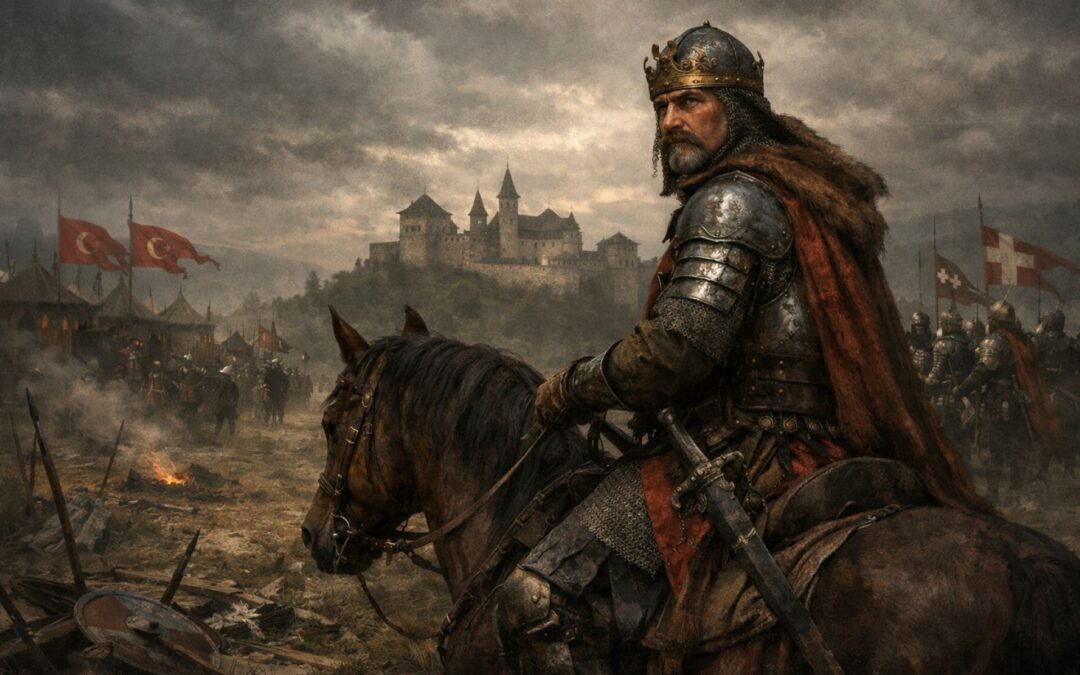
History rarely produces rulers who can survive, let alone dominate, in a world designed to destroy them. Stephen III of Moldavia—better known as Stephen the Great—was one of those rare exceptions.
Born into a landscape where thrones were temporary, loyalties were transactional, and borders were written in blood, Stephen did not inherit stability. He built it. Over nearly five decades of rule, he navigated a geopolitical minefield defined by three relentless forces: the expansion of the Ottoman Empire, the ambitions of neighboring kingdoms like Hungary and Poland, and the ever-present threat of internal betrayal.
He was not merely a defender of his land. He was a strategist who understood that survival required more than strength—it required timing, manipulation, and an almost surgical ability to shift alliances without losing control. At times, he paid tribute to the Ottomans. At others, he defied them outright. He installed rulers in Wallachia, removed them when necessary, and played kings against one another with calculated precision.
And yet, for all his political ruthlessness, Stephen would be remembered as something far more enduring—a champion of Christianity, a builder of churches, and eventually, a canonized saint.
This is not just the story of a man who fought battles. It is the story of a ruler who turned chaos into control, and in doing so, carved out one of the most resilient reigns in Eastern European history.
The Making Of A Prince In A Violent World
The exact year of Stephen’s birth remains uncertain, placed somewhere between 1433 and 1440. That ambiguity is fitting. He was born into a world where records were fragile, power was unstable, and certainty itself was a luxury few could afford.
He was the grandson of Alexander the Good, one of Moldavia’s more capable rulers, and the son of Bogdan II—a prince whose reign would be as brief as it was consequential. From the beginning, Stephen’s life was shaped not by comfort, but by proximity to power and the dangers that came with it. This was not a childhood of gradual preparation. It was an early immersion into a system where authority was constantly contested and rarely secure.
Dynastic politics in Moldavia were unforgiving. Legitimacy was often blurred by a web of marriages, affairs, and rival claims. Sons were many, but succession was never guaranteed. Violence was not an exception—it was a mechanism of transition. In such an environment, survival required more than lineage. It demanded awareness, adaptability, and a willingness to act decisively when the moment arrived.
Stephen’s introduction to power came early. His father named him co-ruler before he had even reached adulthood, a move that signaled both intent and urgency. It was a recognition that in Moldavia, succession could not be left to chance. It had to be enforced.
Around this time, another figure entered his orbit—his cousin, Vlad III Dracula. Recently ousted from the Wallachian throne, Vlad sought refuge under Bogdan’s protection. The relationship between the two young men appears to have been strong, forged not just by blood, but by shared circumstance. Both were heirs navigating unstable political landscapes. Both would learn, very quickly, what it meant to lose everything.
That lesson came with brutal clarity. Bogdan II was murdered by his own brother, Peter Aaron—a betrayal that was as typical as it was devastating. For Stephen, this was not just a personal loss. It was a defining moment. The illusion of familial loyalty shattered, replaced by a far more useful understanding: power, in this world, belonged to those willing to take and defend it.
Stephen and Vlad fled together, escaping a fate that would have likely ended his story before it began. Their destination was the court of John Hunyadi, one of the most formidable military leaders in Eastern Europe. What followed is partially obscured by time, but its outcome is clear. Both young men would find their way back into power—Vlad reclaiming Wallachia through force, and Stephen positioning himself for a return to Moldavia.
This period did not simply shape Stephen. It hardened him.
By the time he would eventually claim his throne, he was no longer just a displaced prince seeking restoration. He was a product of betrayal, exile, and political calculation—a ruler in the making who understood that in Moldavia, survival was not inherited.
It was earned.
Blood, Betrayal, And The Fight For The Moldavian Throne
Stephen did not inherit Moldavia. He took it back.
By the mid-1450s, the path before him was clear. His father’s murderer—his own uncle, Peter Aaron—still occupied the Moldavian throne. This was not merely a political problem. It was unfinished business. In a system where legitimacy was enforced through action, Stephen’s claim meant nothing until he proved he could defend it.
He would not do it alone.
By this time, Vlad Dracula had already reclaimed Wallachia with the backing of John Hunyadi. Power, in this region, rarely moved without support, and Stephen understood that securing allies was the first step toward reclaiming his position. With Vlad’s assistance—whether direct military support or strategic backing—Stephen launched his campaign against Peter Aaron in 1457.
The result was decisive. Peter Aaron was overthrown, and Stephen was crowned Voivode of Moldavia.
But taking the throne was only the beginning.
In a more stable kingdom, victory might have ended the conflict. In Moldavia, it simply shifted its form. Peter Aaron fled rather than face execution, seeking protection in Poland. That alone made him dangerous. A pretender with foreign backing was not a defeated enemy—it was a delayed threat.
Stephen understood this instinctively. He had seen what unchecked rivals could do. His father’s death had made that lesson permanent.
Rather than wait, he moved.
His early reign was defined by an aggressive effort to neutralize Peter Aaron’s chances of return. This meant confronting not just the man himself, but the political structures that could support him. Poland, under King Casimir IV, had the power to either shield or abandon the fugitive prince. Stephen chose to force a resolution.
The campaign of 1458 pushed Moldavian pressure into Polish territory, not as an act of reckless expansion, but as a calculated signal. Stephen was making it clear: supporting his rival would come at a cost.
The strategy worked.
By 1459, a treaty was signed. Casimir agreed to prevent Peter Aaron from returning to Moldavia, while Stephen pledged support in Poland’s conflicts with the Tatars. It was a pragmatic exchange—protection traded for military cooperation—but more importantly, it removed the immediate threat to Stephen’s rule.
For the moment.
Peter Aaron would continue to move, shifting between regions in search of backing, but his position weakened with each failed attempt to regain relevance. Stephen, meanwhile, remained consistent in one regard—he did not forgive.
Eventually, the conflict reached its inevitable conclusion. Peter Aaron was captured and executed, eliminating the last serious internal challenge to Stephen’s authority.
This was more than revenge. It was consolidation.
By removing his uncle permanently, Stephen sent a message that would define his reign: Moldavia would no longer be a revolving door of claimants. Power would not change hands through opportunistic betrayal. It would be defended, relentlessly, by the man who held it.
But even as internal threats were eliminated, a more complex reality began to take shape.
Stephen was no longer fighting for the throne.
He was now fighting to keep it—against forces far larger than Moldavia itself.
The Vlad Dracula Connection: Alliance, Fracture, And Rivalry
Few relationships in Stephen’s life were as consequential—or as volatile—as the one he shared with his cousin, Vlad Dracula.
In the beginning, their bond was forged through shared adversity. Both had been displaced, both had relied on external powers to reclaim their thrones, and both understood the brutal mechanics of rule in Eastern Europe. Vlad helped Stephen secure Moldavia. Stephen, in turn, operated in a political landscape where Wallachia’s stability directly affected his own survival. Their interests aligned, and for a time, so did their actions.
But alignment in this region was never permanent.
As Stephen consolidated power, his priorities began to shift. Moldavia’s security required more than loyalty to old allies—it demanded territorial control, strategic positioning, and a willingness to act against anyone who threatened that balance, even if that person had once been a benefactor.
One such point of tension was the region of Chilia, a strategically vital port that had once belonged to Moldavia but was now under the influence of Hungary and Wallachian interests. For Stephen, reclaiming it was not optional. It was essential. Control of Chilia meant access to trade routes, economic leverage, and a stronger defensive position against external powers.
For Vlad, however, the situation was different. Wallachia’s position was deeply entangled with Hungarian interests, and any shift in territorial control threatened that balance. What had once been a shared understanding of survival now became a conflict of objectives.
Distrust began to grow.
By the early 1460s, the relationship had deteriorated to the point where cooperation was no longer viable. Stephen made a decisive choice—he would pursue Moldavian interests, regardless of the personal or historical cost. When the opportunity arose to challenge the existing control over Chilia, he took it, even if it meant confronting forces aligned with his cousin.
The consequences were immediate.
Stephen joined forces with the Ottomans in an attempt to seize the fortress, a move that revealed just how far the relationship had shifted. This was no longer a disagreement between allies. It was a strategic divergence that placed them on opposing sides of a broader conflict.
The campaign failed.
The siege of Chilia did not deliver the victory Stephen sought. Instead, it left him with a severe leg injury—one that would never fully heal. It was a rare and painful setback, both physically and politically. More importantly, it marked a turning point. The cost of pursuing his ambitions had been high, and the fracture with Vlad was now complete.
Yet, history rarely moves in straight lines.
A few years later, circumstances forced another shift. Vlad Dracula, once a ruler and rival, had been imprisoned by the Hungarians. Wallachia itself had fallen under leaders more closely aligned with Ottoman interests—an outcome that directly threatened Moldavia’s position.
Stephen adjusted.
The same pragmatism that had driven him into conflict with Vlad now led him back toward cooperation. Recognizing the strategic value of restoring a familiar and fiercely anti-Ottoman ruler in Wallachia, Stephen sought Vlad’s release. The past was, for the moment, irrelevant. What mattered was the present balance of power.
When Vlad was freed, the two men reconciled.
Together, they moved to reclaim Wallachia, successfully placing Vlad back on the throne after years of imprisonment. It was a calculated reunion—less about restoring a personal bond and more about rebuilding a strategic alliance that served both of their interests.
But once again, stability proved elusive.
Vlad’s restored rule was short-lived. Within months, he was killed during an Ottoman-backed resurgence, and the fragile balance Stephen had tried to construct collapsed almost as quickly as it had formed.
For Stephen, this was more than the loss of an ally.
It was the end of a chapter defined by one of the few relationships that had truly shaped his rise to power. What remained was a harsher reality—one where familiar faces could no longer be relied upon, and where every future alliance would be built not on shared history, but on immediate necessity.
The bond with Vlad Dracula had begun with mutual survival and ended in the same unforgiving logic that governed everything else in Stephen’s world.
Usefulness determined loyalty.
And loyalty, in the end, was always temporary.
Playing Empires Against Each Other: Poland, Hungary, And The Ottomans
If Stephen had relied purely on military strength, his reign would have been short-lived.
Moldavia was not a great power. It sat uncomfortably between them.
To the south loomed the Ottoman Empire, expanding with relentless momentum under Mehmed II. To the west stood Hungary, powerful but politically complex. To the north, Poland offered both protection and pressure, depending on circumstance. Any one of these forces, acting decisively, could have overwhelmed Moldavia. All three, at once, would have crushed it.
Stephen’s survival depended on ensuring that never happened.
His strategy was not rooted in loyalty. It was rooted in balance.
Early in his reign, he chose pragmatism over defiance. Rather than provoke the Ottomans prematurely, he agreed to pay tribute. It was not submission in the traditional sense—it was a calculated delay. By acknowledging Ottoman authority on paper, he bought time to stabilize his position internally and manage threats elsewhere.
At the same time, he cultivated ties with Poland. His agreement with King Casimir IV was more than a defensive arrangement—it was a recognition of Moldavia’s vulnerability. Poland could shield him from certain threats, but it also expected cooperation in return. Stephen accepted that exchange, knowing that alliance did not mean dependence.
Hungary, however, required a different approach.
Relations with Matthias Corvinus were tense, shaped by competing interests and territorial disputes. When Stephen seized key positions that Hungary considered within its sphere, retaliation followed. The Hungarian invasion of Moldavia, including the capture of Baia, was a direct response to Stephen’s assertiveness.
But even here, Stephen adapted.
He did not attempt to match Hungary’s strength head-on in open conflict for long. Instead, he absorbed the pressure, struck back when opportunities emerged, and gradually recalibrated the relationship. Over time, confrontation gave way to cautious cooperation, especially as larger threats began to dominate the region.
This constant recalibration defined his rule.
When Poland grew unreliable, he leaned toward Hungary. When Hungary hesitated, he reopened channels with the Ottomans. When the Ottomans became too aggressive, he sought Christian alliances again. There was no fixed alignment—only a continuous assessment of risk and advantage.
To an outsider, this might appear inconsistent, even opportunistic.
In reality, it was survival.
Stephen understood something many rulers did not: in a contested region, rigid loyalty is a liability. The moment you commit fully to one power, you inherit all of its enemies. For Moldavia, that was a risk it could not afford.
Instead, he positioned himself as a necessary variable—too useful to ignore, too difficult to replace, and too unpredictable to easily control.
Even his enemies were forced to negotiate with him.
The Ottomans accepted tribute when it suited them. Poland recognized his authority when it benefited their own stability. Hungary, despite moments of hostility, found value in cooperation when facing larger threats. Stephen ensured that every major power had a reason—however temporary—to keep Moldavia intact.
This was not diplomacy in the traditional sense.
It was controlled instability.
Stephen did not aim to create lasting peace between these empires. He aimed to prevent any one of them from achieving total dominance over him. As long as they remained divided in their interests, Moldavia had room to breathe.
And for a ruler in his position, breathing room was everything.
It allowed him to choose when to fight.
And more importantly, when not to.
The Battle Of Vaslui: Outsmarting An Empire
By the mid-1470s, Stephen’s careful balancing act began to break.
The Ottoman Empire was no longer content with tribute and shifting loyalties. Under Mehmed II, it had grown too powerful, too expansive, and too confident to tolerate defiance on its frontier. Stephen’s refusal to continue payments—and his repeated interference in Wallachian politics—made confrontation inevitable.
War was no longer a possibility. It was a certainty.
The scale of what he faced was staggering.
The Ottoman army, led by Hadım Suleiman Pasha, marched into Moldavia with a force that significantly outnumbered Stephen’s own. Estimates vary, but the imbalance is clear. Even with support from Hungary and Poland—limited as it was—Stephen was facing an opponent with superior manpower, resources, and experience.
He could not win a conventional battle.
So he didn’t try.
Instead, Stephen turned the entire campaign into a trap.
Before the Ottomans even reached the battlefield, he began weakening them. Supplies were destroyed. Wells were poisoned. Villages were emptied or burned. It was a classic scorched-earth strategy, designed not to defeat the enemy directly, but to exhaust them before the real confrontation began.
As the Ottomans advanced deeper into Moldavia, they found less and less to sustain them. Hunger, fatigue, and confusion began to take hold. Stephen followed this with relentless harassment—small, mobile attacks that disrupted movement and prevented any sense of stability within the invading force.
By the time they approached the area near Vaslui, they were already under pressure.
And that was exactly where Stephen wanted them.
He chose the battlefield with precision. The terrain was narrow, marshy, and difficult to navigate, surrounded by forested hills. Movement would be slow. Visibility would be limited. Coordination—especially for a large army—would be difficult.
Then came the final element.
Fog.
Whether by chance or careful timing, the battlefield was covered in thick mist on the day of the engagement. It transformed the terrain into something far more dangerous for the Ottomans. They could not see clearly. They could not gauge the size or position of Stephen’s forces. Every movement carried uncertainty.
Stephen used that uncertainty as a weapon.
He deployed part of his army forward, accompanied by musicians—drums and horns echoing through the fog. The sound suggested a concentrated force, drawing Ottoman attention toward a specific point. It was a deliberate misdirection, designed to pull them into a position of vulnerability.
It worked.
As the Ottomans moved toward the sound, expecting to engage the main Moldavian force, they instead walked into a layered defense. Archers and artillery, concealed by terrain and fog, opened fire. Cavalry engagements followed, chaotic and disorienting in the limited visibility.
At a critical moment, Stephen committed his reserves.
What had seemed like a localized engagement suddenly expanded. Moldavian forces appeared across the battlefield, overwhelming the Ottomans who were already struggling to maintain formation. Panic spread. Communication broke down. The situation unraveled quickly.
Even the environment turned against them.
The narrow crossing points, including fragile bridges, could not sustain the movement of a large, pressured army. As retreat began, these choke points became liabilities. Soldiers were trapped, scattered, or cut down as they attempted to escape.
What followed was not just a defeat.
It was a collapse.
Stephen’s forces pursued the retreating army relentlessly, turning withdrawal into rout. Casualties mounted into the tens of thousands. What had begun as a confident Ottoman campaign ended as one of the most devastating defeats they had suffered in the region.
The Battle of Vaslui was not won through brute force.
It was won through design.
Stephen had taken every disadvantage—smaller numbers, fewer resources, limited support—and inverted them. He controlled the environment, dictated the pace, and manipulated perception itself. By the time the battle began, the outcome was already leaning in his favor.
The victory echoed across Europe.
Pope Sixtus IV would later recognize Stephen as a defender of Christendom, granting him the title Athleta Christi. Yet beyond titles and recognition, Vaslui established something far more important.
It proved that the Ottoman Empire could be beaten.
Not easily. Not often. But decisively—if the conditions were right, and the commander understood how to create them.
Stephen had done exactly that.
And for a moment, he stood not just as a survivor of empires—but as their equal on the battlefield.
War Without End: Retaliation, Defeat, And Survival
Vaslui was a masterpiece.
But it was not an ending.
For the Ottomans, defeat was not something to accept—it was something to answer. Mehmed II, a ruler who had taken Constantinople and reshaped the balance of power in Europe, was not going to let a Moldavian prince define the limits of his empire.
Retaliation was inevitable. And when it came, it came with force.
In 1476, the Ottomans returned—this time under Mehmed himself. The scale of the campaign was larger, more deliberate, and far more dangerous. This was not a probing invasion. It was a statement.
Stephen faced them again, but the conditions had changed.
He no longer held the same strategic advantages that had defined Vaslui. The element of surprise was gone. The Ottomans had adapted. They were prepared for scorched earth tactics, aware of the terrain, and determined not to be drawn into another carefully constructed trap.
The two forces met at Valea Albă.
This time, Stephen could not dictate the battle in the same way.
Despite early resistance, the Moldavian army was eventually overwhelmed. The Ottomans pressed forward with sustained force, breaking through defenses and inflicting heavy losses. The battlefield turned brutal. Accounts speak of widespread slaughter, a stark contrast to the controlled chaos Stephen had engineered at Vaslui.
For once, he was on the back foot.
Stephen was forced to retreat.
It was not a collapse of leadership, but a recognition of reality. Staying on the field would have meant annihilation—not just of his army, but of Moldavia’s ability to resist at all. He chose survival over pride, withdrawing to preserve what remained of his strength.
The Ottomans advanced.
At first glance, it appeared that Mehmed had achieved what he came for. Moldavian territory was exposed, resistance had been broken in open battle, and the path forward seemed clear.
But occupation is not the same as victory.
The same factors that had weakened the Ottomans before now began to work against them again. Disease spread through their ranks. Supply lines stretched thin. The land, already stripped of resources, offered little to sustain a prolonged campaign. And most importantly, Stephen was still alive.
He regrouped.
Drawing on remaining forces and local support, he began to rebuild his position. Reinforcements arrived. Pressure mounted. The Ottomans, despite their battlefield success, found themselves in a hostile environment that refused to stabilize.
Eventually, they withdrew.
Not in panic, not in rout—but without the decisive control they had intended to establish. Moldavia had not been broken. Stephen had not been removed. The campaign, despite its initial success, failed to deliver a lasting result.
And that, in Stephen’s world, was enough.
This sequence—defeat followed by recovery—reveals something essential about his rule.
He was not invincible.
He lost battles. He made miscalculations. He faced moments where the odds turned sharply against him. But unlike many rulers of his time, defeat did not define him. It did not unravel his authority or fracture his state.
He absorbed it.
Where others might have collapsed after facing the full force of the Ottoman war machine, Stephen endured. He understood that survival, not perfection, was the true measure of strength in his position. A lost battle could be recovered from. A lost state could not.
And so, even after one of his most significant defeats, the larger reality remained unchanged.
Moldavia still stood.
And as long as it did, Stephen remained in the fight.
The Endless Struggle For Wallachia
If Moldavia was Stephen’s domain, then Wallachia was his problem.
It was the space where his broader strategy either held together—or collapsed.
Control over Wallachia was never just about influence. It was about security. Whoever ruled there determined whether Moldavia faced a buffer or a threat to the south. And in a region where the Ottomans were constantly pushing forward, that distinction was everything.
Stephen understood this early.
But what made Wallachia uniquely unstable was not just external pressure. It was internal volatility. Rulers rose and fell with alarming speed, often backed by competing foreign powers. Loyalty was temporary. Allegiances shifted as soon as the balance of power changed.
For Stephen, this created both opportunity and risk.
He intervened repeatedly, installing rulers he believed would align with Moldavian interests. Basarab III, Basarab IV, Vlad Dracula—each, at different points, was placed on the Wallachian throne with Stephen’s backing. Each, in theory, was meant to stabilize the region in his favor.
In practice, none of them held.
The pattern became almost predictable.
A ruler would be installed with Stephen’s support, only to later bend toward the Ottomans once in power. Pressure from the empire was immense, and few could resist it for long. Submission, even if temporary, was often the only way to survive as a Wallachian ruler.
For Stephen, this was unacceptable.
Every time a ruler shifted allegiance, it forced him to act again. Another invasion. Another campaign. Another attempt to reshape the political landscape just beyond his border. It was a cycle that consumed time, resources, and attention—but one he could not ignore.
The stakes were too high.
If Wallachia fell completely under Ottoman control, Moldavia would be exposed. There would be no buffer, no space to maneuver, no early warning. The Ottomans would stand directly at his doorstep, with far greater capacity to strike.
So Stephen kept intervening.
Even when it failed. Even when the same patterns repeated. Even when his own protégés betrayed him.
There was a certain harsh logic to it.
Stephen did not expect loyalty. He expected utility.
If a ruler could hold the line against Ottoman influence, even briefly, it was worth the effort. If they failed, they would be replaced. The system was not designed to create stable allies—it was designed to prevent a permanent enemy from taking root.
But this constant interference came at a cost.
It strained his relationships with other powers. Hungary had its own interests in Wallachia. The Ottomans viewed every intervention as provocation. Poland watched carefully, calculating how these shifts might affect its own position. Each campaign risked triggering a wider conflict.
Yet Stephen persisted.
Because for him, Wallachia was not optional.
It was the front line of a larger struggle—one that defined the limits of his control and the reach of his influence. As long as it remained contested, Moldavia had a chance to maintain its independence. The moment it stabilized under a hostile power, that advantage would disappear.
And so the cycle continued.
Rulers installed, rulers removed. Alliances formed, alliances broken. Victories followed by reversals, and then renewed efforts to regain control.
It was not elegant.
But it was effective enough.
For decades, despite constant pressure and repeated setbacks, Stephen prevented Wallachia from becoming a fully secure extension of Ottoman power. That alone was a strategic achievement—one that cannot be measured in single battles or individual victories.
It was measured in time.
Time that Moldavia continued to exist on its own terms.
Time that Stephen continued to rule.
And in his world, that was the closest thing to success.
A Master Of Political Survival
By the later decades of his reign, Stephen had become something rare in his world—a constant.
While kings died, empires shifted, and thrones changed hands with alarming frequency, he remained. Not because he was the strongest ruler in Eastern Europe, but because he understood something more important than strength: continuity.
Stephen did not seek decisive, final victories.
He sought durability.
Every major power around him went through cycles of instability. The Ottomans faced succession struggles after Mehmed II’s death. Hungary was thrown into uncertainty following Matthias Corvinus. Poland, too, transitioned through shifting leadership under Casimir IV’s successors. Each of these moments created openings—brief windows where the balance of power loosened.
Stephen was always watching.
He did not rush into these moments recklessly. Instead, he adjusted his position with precision. When the Ottomans were distracted, he moved to reassert control in contested regions. When Hungary weakened, he recalibrated his alliances. When Poland grew unpredictable, he distanced himself just enough to maintain flexibility.
This was not opportunism in the careless sense.
It was timing as a discipline.
He understood that in a fragmented political landscape, survival depended on reading momentum. Knowing when a power was rising, when it was distracted, and when it was vulnerable allowed him to act without overextending. He rarely committed fully unless the conditions justified it.
Even his contradictions were deliberate.
At times, he paid tribute to the Ottomans. At others, he defied them outright. He swore loyalty to Poland, then pivoted toward Hungary when necessary. He supported one claimant to a throne, then replaced him when that support became a liability.
To a rigid observer, this might appear inconsistent.
To Stephen, it was control.
He refused to be locked into a single alignment because he understood the cost of predictability. If his enemies could anticipate his choices, they could corner him. By remaining fluid, he made it difficult for any one power to plan decisively against him.
He became, in effect, a moving target—politically and strategically.
This adaptability extended beyond diplomacy.
Internally, Stephen reinforced his authority in ways that ensured stability within Moldavia itself. He strengthened central control, reduced the influence of rebellious elites, and ensured that loyalty to him translated into tangible rewards. While some boyars viewed him as harsh or even tyrannical, others—particularly those who benefited from his policies—saw him as a stabilizing force.
This internal control mattered.
External strategy is meaningless if the state itself is unstable. Stephen ensured that Moldavia, unlike many of its neighbors, did not fracture under pressure. That gave him a foundation from which to operate, even when external threats intensified.
Over time, this combination of flexibility and control produced something remarkable.
Stephen became difficult to remove.
Not because he could not be defeated in battle—he could, and at times he was—but because defeating him once was never enough. He would retreat, reorganize, renegotiate, and return. His rule was not dependent on a single victory or alliance. It was built on a system that could absorb shocks and continue functioning.
That is what made him dangerous.
Not his ability to win every fight, but his refusal to be finished by any one loss.
In a region defined by volatility, Stephen turned endurance into strategy.
And in doing so, he achieved something far more valuable than dominance.
He achieved longevity.
The Cost Of Power: Tyrant, Defender, Or Both
Longevity always comes at a price.
For Stephen, that price was not paid in a single moment. It accumulated over decades—through decisions that secured his rule, but also shaped how he would be remembered. To some, he was a guardian. To others, he was something far less forgiving.
The divide is not accidental.
Stephen ruled through control, and control in his world required force. The Moldavian nobility—the boyars—were not passive actors. They had their own ambitions, their own networks, and their own history of removing rulers when it suited them. Left unchecked, they could destabilize the state from within as easily as any foreign army could from without.
Stephen did not leave them unchecked.
He strengthened central authority, often at the expense of traditional elites. Those who supported him were rewarded. Those who opposed him were dealt with decisively. This was not subtle governance. It was direct, and at times, brutal.
From the perspective of the boyars, this made him a tyrant.
From the perspective of the peasantry and lower-ranking nobility, it often made him something closer to a protector. By limiting the unchecked power of elite families, Stephen created a system where authority flowed more directly from the center. That did not make his rule gentle, but it did make it more predictable for those outside the highest ranks.
This contrast shaped his reputation.
He was not universally loved. But he was respected—sometimes out of loyalty, sometimes out of necessity.
His treatment of certain groups adds another layer to that complexity.
Stephen’s reign included periods of persecution, particularly toward communities he viewed as politically or religiously problematic. Hussites, Roma, and Jewish populations all faced varying degrees of pressure or hostility under his rule. These actions were not unusual for the period, but they are part of his record nonetheless.
At the same time, he was not isolated from the outside world.
Stephen frequently relied on foreign expertise when it served his interests. He sought knowledge beyond his borders, engaged with external advisors, and demonstrated a willingness to incorporate ideas that could strengthen his position. This duality—selective openness paired with targeted exclusion—reflects the same pragmatic mindset that defined his diplomacy.
Nothing was ideological for its own sake.
Everything was measured against utility.
Even his harsher decisions followed that logic.
Executions, suppression of dissent, and strategic intimidation were not expressions of uncontrolled cruelty. They were tools—used to prevent the kind of instability that had defined Moldavia before his rule. In a system where weakness invited challenge, visible strength was often the only deterrent.
But that does not neutralize the consequences.
Stephen’s rule imposed order, but it did so through pressure. Stability was achieved, but not without cost. The very mechanisms that protected Moldavia also limited internal freedom and reinforced a hierarchy built on loyalty to the ruler above all else.
This is where his legacy becomes difficult to simplify.
He was not a purely benevolent defender, nor was he simply a tyrant.
He was both.
A ruler who could protect his people from external domination while enforcing strict control internally. A leader who built a resilient state while ensuring that challenges to his authority were swiftly and often harshly eliminated.
And perhaps that is the most accurate way to understand him.
Not as a contradiction—but as a product of his environment.
In a world where power was constantly contested, moderation rarely survived.
Stephen did.
And the cost of that survival is written into every part of his reign.
Faith, Churches, And The Making Of A Saint
For a man defined by war, Stephen’s legacy is inseparable from faith.
This is not a contradiction. It is part of the same system.
Throughout his reign, Stephen positioned himself not just as a ruler of Moldavia, but as a defender of Christianity on its eastern frontier. This identity was not purely symbolic. It served a strategic function—aligning his rule with a broader religious cause that extended beyond his borders. In a region where alliances were fragile, shared faith offered a different kind of legitimacy.
But Stephen did not rely on rhetoric alone.
He built.
Dozens of churches and monasteries were constructed during his reign, many of them tied directly to moments of victory or survival. These were not casual acts of piety. They were deliberate statements—physical markers of both devotion and authority. Each structure reinforced the idea that his rule operated under divine favor, that his victories were not merely tactical, but sanctioned.
Over time, this narrative took hold.
Stephen’s image as a Christian champion grew stronger, especially in the aftermath of major conflicts with the Ottomans. Victories like Vaslui were not just seen as military successes. They were framed as defenses of the faith itself, elevating Stephen’s role from regional ruler to something more symbolic.
Recognition followed.
Pope Sixtus IV granted him the title Athleta Christi—Champion of Christ—a rare acknowledgment that placed him within a larger European context. It signaled that his struggles, though fought on Moldavian soil, were part of a wider confrontation between Christian Europe and the Ottoman Empire.
Yet, as with much of Stephen’s life, this identity was layered.
He was a defender of Christianity, but he was also a pragmatic ruler who paid tribute to the Ottomans when necessary. He built churches, but he also engaged in relentless warfare and political manipulation. His faith did not replace his strategy—it existed alongside it.
This duality did not diminish his reputation.
If anything, it strengthened it.
Within Moldavia, and later across Romania, Stephen came to be viewed as more than a historical figure. Stories of his victories, his resilience, and his devotion merged into something closer to legend. His church-building efforts reinforced this perception, embedding his memory within the religious and cultural landscape itself.
After his death, that perception did not fade.
In fact, it intensified.
For centuries, Stephen was remembered as a ruler who had protected both his land and his faith against overwhelming odds. The idea of him as a saint began to circulate long before any formal recognition. It was a reputation built not through official declaration, but through collective memory.
The formal canonization would come much later—in 1992.
By then, the image was already established.
Stephen the Great was no longer just a prince of Moldavia. He was a symbol—of resistance, of endurance, and of a particular vision of leadership where faith and power were not separate forces, but reinforcing ones.
And in that sense, his legacy achieved something rare.
It moved beyond history.
It became belief.
The Final Years: Decline, Compromise, And Legacy
By the end of his reign, Stephen was no longer the rising force reshaping the balance of power.
He was the one holding it together.
Decades of war, diplomacy, and constant recalibration had taken their toll. The energy that once drove relentless campaigns and bold interventions began to give way to something more measured—more restrained. Not because Stephen had lost his edge, but because the realities around him had shifted.
The Ottomans were still there.
Stronger, more entrenched, and now controlling key Moldavian ports like Chilia and Cetatea Albă. These were not minor losses. They represented access, leverage, and years of effort undone. Stephen had fought for them repeatedly—had bled for them—and yet, in the end, they remained out of his grasp.
It was a bitter reality.
And one he could not reverse.
Stephen adapted, as he always had. Tribute payments resumed. Agreements were made. Conflicts were avoided where they could be. This was not surrender in the traditional sense—it was recognition. After decades of resistance, the limits of what Moldavia could achieve had become clear.
Survival still mattered more than pride.
At the same time, his focus began to turn inward.
Succession—so often a source of instability in Moldavia—had to be managed carefully. Stephen had seen what happened when power passed without control. He had lived it. He had built his entire reign in response to it. He would not leave that same chaos behind.
His son, Bogdan, was brought into power as co-ruler.
This was not symbolic. It was preparation. Bogdan was involved in negotiations, exposed to the mechanics of governance, and positioned to inherit not just the throne, but the system that sustained it. By the late 1490s, he was already playing a role in securing peace agreements, including the formal end of Polish suzerainty over Moldavia.
Stephen was ensuring continuity.
Even as his own health declined.
The wounds he carried—both visible and otherwise—began to catch up with him. The leg injury from earlier campaigns never fully healed, but it was only one part of a larger deterioration. Age, exhaustion, and the accumulated weight of his reign began to limit what he could do.
He sought help.
Physicians were requested from abroad, including Venice, in an attempt to extend his life and maintain his ability to rule. It was a final effort to hold onto control just a little longer. But by this point, the trajectory was set.
The man who had spent decades shaping events was now being overtaken by them.
Yet even in decline, his system held.
Peace agreements stabilized the region, at least temporarily. Relations with major powers were managed carefully. Bogdan stood ready to assume full control. The structure Stephen had built—through war, diplomacy, and relentless adjustment—remained intact.
And that, more than any final victory, defined his success.
Stephen died on July 2, 1504.
After 47 years of rule.
In a region where rulers were often replaced within years, sometimes months, that alone was extraordinary. He did not die in exile. He did not lose his throne. He did not leave behind a fractured state. Moldavia, though pressured and constrained, still existed under its own authority.
There was, however, one unfinished thread.
Chilia remained outside his control.
For a man who had fought so hard, so often, for that single strategic prize, it stood as a quiet reminder of the limits even he could not overcome. If he carried any regret, it likely rested there.
But legacies are not built on what remains undone.
They are built on what endures.
And Stephen left behind something few rulers of his time could claim—a state that survived him, a reputation that outlasted him, and a story that refused to fade into obscurity.
Conclusion
Stephen’s life does not fit neatly into a single category.
He was not simply a defender of Christianity, nor merely a regional warlord fighting for survival. He was something far more complex—a ruler who understood that power, in his world, was never absolute and never secure. It had to be maintained, adjusted, and defended constantly, not just on the battlefield, but in every alliance, every treaty, and every calculated betrayal.
What makes his reign remarkable is not that he won every conflict.
It is that he endured them.
For nearly half a century, Stephen navigated a political landscape that consumed lesser rulers. He faced the Ottomans at their height, managed volatile relationships with Hungary and Poland, and intervened repeatedly in Wallachia to prevent strategic collapse. He lost battles, recovered from them, and continued forward without allowing any single defeat to define his rule.
That kind of resilience is not accidental.
It is the result of a mindset that prioritizes survival over pride, flexibility over rigidity, and long-term control over short-term victory. Stephen understood that domination was unrealistic for a state like Moldavia. But persistence—carefully managed, strategically executed persistence—was not.
And that is what he achieved.
At the same time, his legacy cannot be separated from the cost of that achievement. His rule imposed order, but through pressure. It created stability, but not without force. He was capable of both protection and severity, often within the same decision. The image of the saint and the reality of the ruler coexist, neither fully canceling the other.
Perhaps that is why his story has endured.
It does not rely on simplicity.
Stephen the Great represents a form of leadership that is rarely comfortable but often effective—a leadership shaped by constraint, sharpened by conflict, and defined by the ability to outlast everything that seeks to replace it.
In the end, that is what sets him apart.
Not that he conquered empires.
But that he refused to be conquered by them.