
Reading Time: 28 Minutes
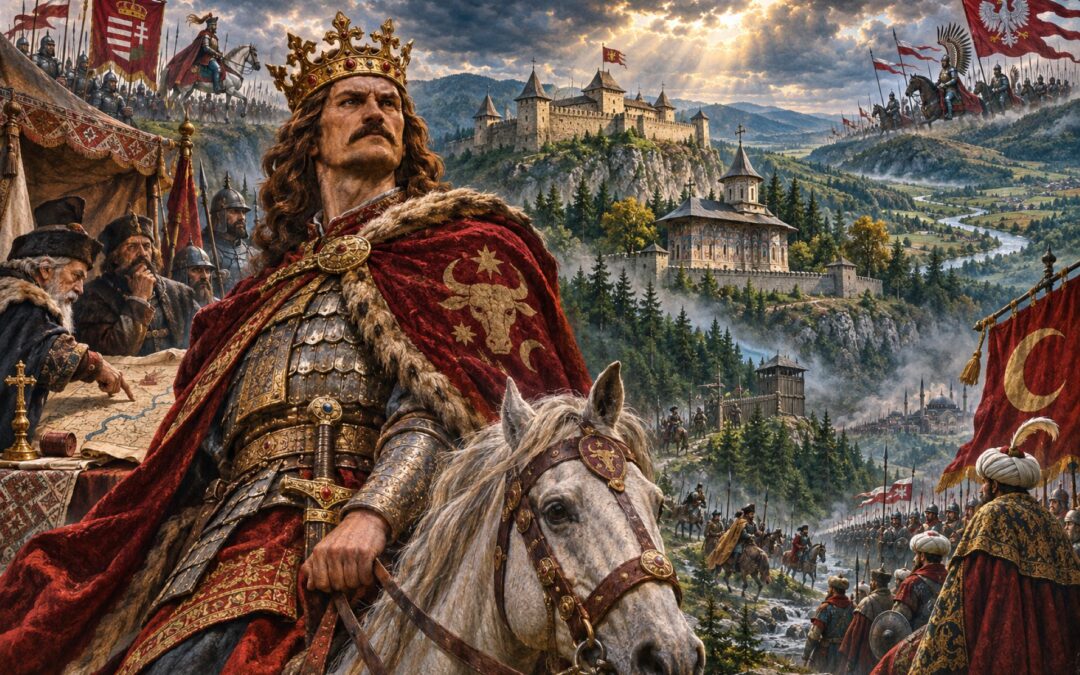
Stephen the Great ruled Moldavia for forty-seven years, from 1457 until his death in 1504. During those decades, he fought the kings of Hungary and Poland, defeated a large Ottoman army, survived an invasion led by Sultan Mehmed II, and repeatedly intervened in the politics of neighboring Wallachia. His victories earned him a reputation that extended far beyond his small principality.
Yet the record of his reign is not one long procession of triumphs. Stephen lost important battles, surrendered the Black Sea ports he had struggled to secure, accepted powerful rulers as overlords at different moments, and paid tribute to the Ottomans. Those compromises did not cancel his achievements. They help explain them.
Moldavia occupied a vulnerable stretch of eastern Europe between the Carpathian Mountains and the approaches to the Black Sea. Hungary, Poland, the Ottoman Empire, and powers from the steppe all had reasons to influence it. Stephen’s central challenge was not how to defeat every adversary, but how to prevent any one of them from deciding Moldavia’s fate. His answer combined armed resistance, stronger princely government, territorial defense, commerce, and a remarkable willingness to change diplomatic course.
The Murder That Put Stephen on the Road to Power
Stephen was born into a dynasty in which possessing a claim to the throne was not the same as being able to keep it. The exact year of his birth remains uncertain, with modern estimates placing it in the 1430s, often around 1438. His father, Bogdan II, was a son of Alexander the Good, the prince whose earlier reign had given Moldavia a measure of stability. But Alexander’s death in 1432 opened decades of succession disputes among relatives, each seeking recognition from powerful nobles or neighboring rulers.
Moldavia’s boyars, the landholding aristocracy, could supply soldiers, influence appointments, and decide whether a claimant could govern effectively. Their alliances were not necessarily permanent. Rival princes sought support in Poland, Hungary, or Wallachia, while those states could use an internal Moldavian dispute to extend their influence without conquering the territory outright.
Bogdan II briefly secured the throne in 1449. In October 1451, he was killed at Reuseni by forces associated with Petru Aron, commonly identified as Bogdan’s half-brother and Stephen’s uncle. The killing is often retold as a shocking betrayal during a wedding feast, sometimes with the young Stephen made to witness his father’s beheading. The basic political murder is established; the vivid eyewitness scene belongs to a more uncertain storytelling tradition.
Stephen escaped the struggle for the succession and spent years outside Moldavia. His movements cannot be reconstructed in every detail, but his future became bound up with the politics of Transylvania and Wallachia. The family and political connections linking him to Vlad III, later called Vlad the Impaler, were especially important. Both men had direct experience of how swiftly the balance of power could change when a prince lost military backing.
The Hungarian commander John Hunyadi’s campaigns on the Ottoman frontier defined much of that regional environment. Hunyadi had fought in Wallachia and across the Balkans, and his victory at Belgrade in 1456 checked a major Ottoman offensive. His career also showed that alliances among Christian rulers did not remove rival dynastic claims, local grievances, or competition over border strongholds.
The stakes had risen sharply after Mehmed II captured Constantinople in 1453. The Byzantine Empire’s last capital was gone, and the Ottoman sultan possessed a base for further expansion in southeastern Europe. For a claimant seeking Moldavia’s throne, avoiding Ottoman pressure was no longer a problem that could safely be postponed.
In 1457, with support associated with Vlad III’s position in Wallachia, Stephen returned to challenge Petru Aron. His forces prevailed in engagements remembered in connection with Doljești and Orbic, and his accession is conventionally dated to 12 April 1457. Petru Aron fled and remained a dangerous potential rival. Stephen had regained his father’s position, but acquiring the princely title did not settle the question of how its holder could survive another conspiracy, raid, or foreign intervention.
The State He Had to Hold Together
Stephen inherited neither a helpless backwater nor a fully unified kingdom. Moldavia had towns, monasteries, commercial routes, landed elites, established institutions, and a ruling tradition. What it lacked was a guarantee that these resources would serve the prince when powerful boyars or neighboring monarchs had conflicting interests. Building a more dependable government was consequently inseparable from the business of defending its borders.
The prince exercised authority through his court, appointed officials, controlled lands belonging to the princely domain, and negotiated with noble families whose influence extended into local society. Stephen rewarded loyal service and confiscated holdings from some opponents, strengthening his position against factions that might support another claimant. He also relied on lesser nobles and military servants whose careers could be advanced through princely patronage. The viteji, often translated as brave men or warriors, belonged to this world of military service and reward, not to a modern system of competitive recruitment open equally to everyone.
The boyars did not disappear under his rule. Wealthy families retained estates and political importance, and the prince still needed their resources. Stephen’s achievement was to make resistance to his rule more costly and his capacity to reward service more effective. The outcome was firmer personal government within a medieval social order, rather than a bureaucracy operating independently of class and dynasty.
Stephen’s consolidation could also be ruthless. Accounts describe the punishment of nobles implicated in plots after the Hungarian invasion of 1467, including executions and confiscations. The precise number of victims is debated, and later stories of mass punishment should not be mistaken for a complete judicial record. Such reprisals helped deter rival factions and redistribute influence toward men dependent on the prince, but they also reveal a harsher dimension of his government: obedience was enforced through personal authority as well as established institutions.
That distinction also matters for the army. Moldavia could call upon a smaller force associated with the prince and his immediate military establishment, but major invasions required a wider host. Free peasants as well as nobles could be mobilized, bringing local knowledge and a strong interest in preventing fields and settlements from being devastated. Such troops were not a national army in the modern sense: obligations, equipment, experience, and political loyalties varied, and mobilization disrupted the agricultural labor on which survival depended.
What Stephen could do was bring different military resources into action together. Horsemen served alongside foot soldiers, archers, garrison troops, and men using artillery or other gunpowder weapons. Cavalry remained valuable for raiding, reconnaissance, and pursuit, while infantry could defend difficult ground and fortifications. The precise composition changed with circumstances; it was not a standing force of identical professional soldiers maintained throughout the reign.
Geography shaped the defensive system. Suceava was the political capital, while strongholds such as Neamț and Hotin guarded important approaches. Chilia controlled access near the Danube Delta, and Cetatea Albă stood on the Black Sea-facing trade network near the Dniester estuary. Their military importance came partly from their economic importance: fortresses could protect markets, river crossings, supplies, and customs income, not just sheltered soldiers.
Stephen repaired, reinforced, reorganized, or expanded important defenses, although it is misleading to credit him with founding every fortress associated with his name. Garrisons and stout walls could force an invader to spend precious time and resources on sieges. Even after a field army lost a battle, surviving castles could prevent the attacker from converting a tactical success into permanent control of the principality.
Trade helped finance this resilience. Routes linking Poland and the interior of eastern Europe with the Danube and Black Sea carried goods and customs revenue. Merchants from different communities, including Armenian and Italian commercial networks, connected Moldavia to a much wider economy. These relationships benefited the court, towns, and landowners unevenly, but they gave the principality resources that could be converted into military supplies, diplomacy, and patronage.
The combination was practical rather than revolutionary. Historical accounts of Stephen’s reign place his military achievements beside his efforts to secure fortresses and manage relations with neighboring powers. Stronger princely authority mattered because troops, roads, ports, nobles, and diplomacy belonged to one connected problem: how to keep Moldavia governable while stronger neighbors disputed its future.
Chilia, Vlad the Impaler, and the Hungarian Invasion
An early test of Stephen’s foreign policy was control of Chilia. The fortified port near the Danube’s mouth linked inland commerce with the Black Sea and mattered to Moldavia, Hungary, Wallachia, and the Ottomans. Losing control of the approaches to these routes threatened both revenue and defense.
Stephen’s early reign was therefore full of shifting accommodations. In 1459, he reached an understanding with the Polish king Casimir IV that helped reduce the danger posed by Petru Aron. The arrangement involved Polish overlordship in a medieval diplomatic sense, although its practical obligations and enforcement depended on events. Stephen also made arrangements concerning tribute to the Ottomans. These policies show that his later wars cannot be reduced to a lifelong refusal to bargain with any foreign power.
Meanwhile, his relationship with Vlad III of Wallachia deteriorated. Vlad had helped create the circumstances in which Stephen could seize Moldavia, but cooperation did not settle disputes over territory and the region’s competing allegiances. In 1462, when Vlad was engaged in his famous struggle against Mehmed II, Stephen attempted to seize Chilia. Some historical accounts connect the operation with Ottoman pressure on Wallachia and describe Stephen as cooperating with the sultan’s forces. The extent and character of that cooperation, however, remain disputed.
In Sergiu Iosipescu’s reassessment of the 1462 campaign, the supposed Moldavian–Ottoman collaboration is interpreted more narrowly as an incursion shaped by Stephen’s obligations to Poland and his tributary relationship with the Ottomans. Iosipescu also reconstructs the sequence of the wider campaign differently, giving greater importance to subsequent fighting and the strategic contest around Chilia. This is a competing historical interpretation rather than a universally accepted replacement for earlier narratives. What remains clear is that Stephen pursued a territorial objective that brought him into conflict with Vlad at a moment when the Wallachian prince was confronting Mehmed.
The attack on Chilia failed. Accounts associate Stephen with a serious leg wound during the operation, an injury remembered as a burden in his later years. The episode is difficult to reconcile with a legend in which Stephen and Vlad always fought shoulder to shoulder against the sultan. Yet it makes sense in the political conditions of their time. Neither was acting as the elected representative of a united Christian bloc. Each ruled or sought to rule a vulnerable principality, and their interests could collide sharply even when their broader enemies sometimes overlapped.
Vlad was subsequently detained in Hungary under King Matthias Corvinus. In Wallachia, his brother Radu the Handsome emerged as an Ottoman-supported ruler, changing the balance around Chilia. Stephen renewed his effort in January 1465 and succeeded in capturing the fortress. The victory strengthened his access to the Danube’s commercial world, but it also aggravated powers that claimed an interest in the port. A territorial gain could improve Moldavia’s strategic position and simultaneously make a larger war more likely.
Hungary’s response was the most immediate danger. Matthias Corvinus had his own ambitions for the region and reasons to resist Stephen’s independence of action. His kingdom possessed greater material resources than Moldavia and could draw on experienced soldiers and powerful aristocratic networks. But it was also vulnerable to local resistance, long supply lines, and the difficulty of imposing a preferred ruler across the mountains.
In 1467, Matthias invaded Moldavia. The campaign culminated in fighting at Baia in December, where Stephen attacked the Hungarian army during the night. Fire and confusion played a role in accounts of the engagement, and Matthias was wounded before withdrawing from Moldavia. The precise nature of the king’s injuries and the tactical sequence vary between sources; the popular story of exactly three arrows and armored knights trapped like prisoners in burning ovens should not be treated as an eyewitness report.
What mattered politically was that the invasion failed to remove Stephen. His forces had used familiar terrain and the invader’s difficulties to challenge a more resource-rich opponent. Baia did not end Hungarian influence in the region, nor did it make Moldavia a state free from every form of external obligation. It strengthened Stephen’s position in subsequent bargaining by showing that intervention carried risks even for a king with a formidable army.
Baia did not, however, end the danger posed by the claimant who had killed Stephen’s father. Petru Aron remained in exile and continued seeking powerful backers, including among political circles in Transylvania. In December 1470, he mounted another attempt to recover the throne with Székely support. Stephen defeated his forces, captured Aron, and had him executed. Historian Jonathan Eagles’s study of Stephen’s reign also describes action against the pretender’s supporters, connecting the episode to the prince’s broader struggle with opposition within Moldavia. This was more than the settling of an old family grievance. While Aron lived, dissatisfied nobles and neighboring rulers could invoke his claim as a reason to intervene. His death removed one recurring dynastic threat, though it did not make Stephen immune to new conspiracies or foreign interference.
The conflict also illustrates a difference between the two rulers’ methods. Matthias Corvinus’s consolidation of Hungarian power rested heavily on fiscal reform and the use of professional paid troops. Stephen drew more extensively on mobilization within a smaller agrarian principality and on the defensive value of local geography. Both pursued stronger government, but neither was developing a universal blueprint for a modern state.
Wallachia and the Crisis on Moldavia’s Southern Frontier
Moldavia’s southern frontier could not be defended solely by guarding its own rivers and mountain approaches. Wallachia stood between Moldavia and important routes by which Ottoman influence could move northward. A friendly Wallachian prince could provide warning, cooperation, and a measure of strategic distance. An Ottoman-backed rival could instead give the sultan a convenient partner close to Moldavia’s borders.
This made Wallachian succession politics a continuing preoccupation. The principalities were related through family connections and shared institutions, but their rulers faced separate pressures and ambitions. Stephen repeatedly supported candidates who promised to challenge Ottoman dominance, only to find that a newly installed prince might make his own accommodation with the sultan. Such reversals were frustrating, but they were not unusual betrayals of a settled national alliance. They reflected the vulnerability of rulers who had to survive between competing powers.
An eastern threat complicated matters further. Tatar raiding forces from the wider steppe could strike settlements, seize captives, and threaten trade and cultivation. In 1470, Stephen defeated an incursion in fighting remembered at Lipnic or Lipinți, near the Dniester. Later accounts embellish the story with dramatic details about captured members of a khan’s family. The essential point is less contentious: Moldavian defense demanded attention to more than one frontier at a time.
Wallachia became particularly important in the early 1470s. Radu the Handsome, Vlad III’s brother, maintained close ties to Ottoman power. Stephen intervened to replace him, supporting Basarab Laiotă, whose own political loyalties proved changeable. In 1473, Stephen’s forces invaded Wallachia and temporarily installed Basarab. Radu returned with Ottoman backing, and competing factions again contested the principality. Military success in one campaign could not guarantee the next ruler’s obedience.
The repeated struggle was tied to Stephen’s deteriorating relationship with Mehmed II. Tribute had helped Moldavia buy time, but Ottoman expectations concerning Wallachia, Moldavia, and contested ports narrowed the room for independent action. Stephen stopped or withheld tribute in the early 1470s as conflict escalated, though sources differ on the precise sequence and timing of the break. The decision exposed Moldavia to a much larger confrontation.
Stephen sought support from Hungary, Poland, the papacy, and other Christian powers. Appeals could invoke religion and shared fear of Ottoman expansion, but assistance depended on the separate calculations of each court. Kings who valued Stephen as a buffer against the sultan might still hesitate to commit their own resources, especially if they were managing other wars or disputes. Their cooperation could be useful without being reliable.
The broader context was the Ottoman Empire’s expansion into southeastern Europe, which combined conquest with tribute arrangements and relationships with local rulers. Ottoman influence did not always require the outright annexation of a neighboring principality. A prince who acknowledged the sultan, paid money, or cooperated militarily could help secure Ottoman interests while continuing to rule his own territory.
For Stephen, that system presented both danger and opportunity. He could sometimes maneuver within it, but his campaign to prevent a hostile Wallachian government pushed him toward open confrontation. By the end of 1474, diplomacy and border warfare were converging on the same question: whether Moldavia could resist a major Ottoman expedition without the large allied army its prince had hoped to assemble.
The Battles of Vaslui and Valea Albă
Stephen’s military reputation rests above all on two campaigns fought eighteen months apart. At Vaslui in January 1475, a Moldavian-led army defeated a large Ottoman invasion. At Valea Albă in July 1476, Stephen lost a battle against an army led by the sultan himself. Taken together, these events reveal both the effectiveness of his defensive system and the limits of victory when the opposing empire could return with new resources.
Vaslui, 10 January 1475
The Ottoman force invading Moldavia was commanded by Süleyman Pasha, not personally by Mehmed II. It included experienced troops and drew support from the political arrangements the Ottomans maintained in the region. Sources disagree considerably about the army’s size, the exact Moldavian numbers, and the balance of auxiliary contingents. Figures sometimes repeated as precise totals—120,000 against 40,000, for example—should be treated as claims from a contested historical record rather than verified battlefield counts.
Stephen faced an opponent whose advantages in manpower and resources were most useful on ground where large formations could advance and maneuver effectively. He instead prepared to fight in the difficult landscape around Vaslui, using marshes, wooded slopes, narrow approaches, and the winter weather to constrain the invaders. His soldiers knew the local ground, and the enemy had already faced a long and demanding march. The defensive plan depended as much on the choice of battlefield as on courage once fighting began.
Accounts describe Moldavian efforts to deny food and supplies to the advancing troops, along with harassment and ambushes. Scorched-earth tactics imposed a cruel cost on local people: crops and goods that could sustain an enemy army might have to be destroyed or moved before it arrived. Such methods were not invented by Stephen, nor did they make him a practitioner of modern total war. They were established ways for weaker forces to make campaigning more expensive for an invader.
Fog, sound, and deception feature prominently in narratives of the battle. According to traditional descriptions, Stephen used instruments or buglers to misdirect Ottoman troops, while archers, artillery, cavalry, and infantry attacked from advantageous positions. Some particulars are hard to verify independently and differ from one account to another. The credible strategic picture is that confused movement through constricted terrain allowed the Moldavians to reduce the invaders’ advantage and deliver a severe defeat.
The Ottoman withdrawal became a rout, with pursuit adding to the losses. Contemporary reports and later histories supply impressive casualty figures, sometimes exceeding forty thousand, but the numbers are uncertain. More significant than any single total is the scale of the reversal: an Ottoman expedition intended to compel Moldavian submission had been defeated by the ruler it sought to punish.
Stephen understood that such a victory offered a diplomatic opening. In letters and appeals, he presented Moldavia’s resistance as a defense of wider Christendom and sought the support that would make another invasion less dangerous. Pope Sixtus IV praised him, and the honorific Athleta Christi, champion or athlete of Christ, became associated with his reputation. Yet religious acclaim was not the same thing as sufficient money, troops, or long-term commitments from neighboring rulers.
Historian Ovidiu Cristea’s study of the diplomacy following the victory at Vaslui emphasizes Stephen’s attempts to translate battlefield success into foreign support, particularly through contacts involving Venice and the papacy. The distinction matters. He had proved that an Ottoman army could be beaten under favorable conditions; he had not yet solved the problem of what would happen when the sultan came in person.
Valea Albă, 26 July 1476
Mehmed II returned the following year with a major invasion. Stephen faced pressure not only from the Ottoman main force but also from Tatar incursions that threatened other parts of Moldavia. His available troops and strategic freedom were affected by the need to defend families and settlements, while the enemy could campaign on a scale that exceeded his own resources.
At Valea Albă, also associated with Războieni, the Moldavian defenders were defeated after fierce fighting. Stephen survived and withdrew, but the battle cost him experienced men and created an immediate danger to the principality’s political center. It would be misleading to disguise this loss as a cleverly planned victory. Mehmed had defeated Stephen’s army in the field and advanced into Moldavian territory.
Nevertheless, winning a battlefield was not the same as acquiring a country. Stephen’s fortified sites remained difficult to reduce, and the invaders encountered problems of supply, disease, resistance, and the need to sustain an extended campaign. The Moldavian ruler could draw on surviving forces and support from the surrounding political environment. The Ottomans eventually withdrew without placing Moldavia under direct and permanent administration.
No single explanation can be isolated with certainty as the sole reason for the withdrawal. Some narratives stress scorched earth and food shortages, others the resilience of the fortresses or the appearance of allied forces. Together, these pressures demonstrate why the principality’s defensive arrangements mattered even after its main army lost. A fortress that held out could buy time for diplomacy and for the limits of an invading army to become apparent.
The result was therefore mixed but important. Stephen had suffered a grave defeat and remained exposed to Ottoman pressure, yet he kept his throne. The Ottomans retained the power to intervene again, and the threat to Moldavia’s vital trading routes had not disappeared. The next phase of the reign would show that preserving the dynasty sometimes required concessions more painful than losing a battle.
The Black Sea Losses That Changed Stephen’s Strategy
The survival of 1476 did not produce lasting security. Stephen still needed a friendly ruler in Wallachia and dependable relations with the powers that could either assist or isolate Moldavia. He increasingly saw the restoration of Vlad III as a way to strengthen the southern frontier, despite their earlier disagreement over Chilia. Their political relationship was never an uninterrupted alliance, but changing circumstances once again gave them overlapping interests.
Stephen had survived Mehmed’s invasion without eliminating the danger of renewed Ottoman pressure. Hungary, too, had reasons to prevent the sultan from securing a dependable government in Wallachia, whose territory stood along important approaches to the Danube frontier. Supporting a friendly Wallachian prince offered a way to challenge Ottoman influence without attempting to annex or administer the principality directly. For both Stephen and Matthias Corvinus, Vlad was a possible instrument of that strategy, although his long years away from power made the durability of a restoration uncertain.
The military cooperation of 1476 was more substantial than a diplomatic promise. Matthias sent Stephen Báthory, one of his royal captains, into Moldavia during the summer campaign. Hungarian assistance became part of the struggle following Stephen’s defeat at Valea Albă, when the Moldavians were attempting to survive the sultan’s invasion and protect their remaining defensive positions. The operation involved an organized military mission rather than a spontaneous gathering of neighboring Christian forces.
In Liviu Cîmpeanu’s study of Stephen Báthory’s campaigns in 1476, the Hungarian mission and the subsequent cooperation between Matthias and Stephen receive greater emphasis than in accounts concentrating almost exclusively on Moldavian resistance. Cîmpeanu reconstructs the Hungarian force’s mobilization, its movements and its participation in fighting after Valea Albă. He then examines the autumn operations in which the armies commanded by Báthory and Stephen advanced into Wallachia and succeeded in restoring Vlad to power.
The campaign did not mean that Hungary and Moldavia had suddenly overcome every disagreement between them. Matthias had invaded Moldavia in 1467, and Stephen had defeated him at Baia. Both rulers understood the value of cooperation against Ottoman pressure, but each continued to pursue his own security and political influence. Their alliance was effective in 1476 precisely because their immediate interests converged, not because the previous decade’s rivalries had ceased to matter.
The allied forces succeeded in regaining control of Wallachia from Ottoman-aligned opponents and reinstalling Vlad III late in 1476. From Stephen’s perspective, the restoration promised a prince who could resist Ottoman intervention along Moldavia’s southern frontier. Matthias likewise stood to gain a useful political partner in the region. Vlad recovered the throne he had lost fourteen years earlier, but he depended heavily on military assistance from rulers whose soldiers could not remain permanently committed to protecting him.
His return exposed the difference between gaining a throne through an expedition and sustaining a government afterward. Wallachia’s nobles had developed new interests and loyalties during Vlad’s long absence, and some favored claimants willing to reach an accommodation with the Ottoman court. The memory of Vlad’s earlier coercion also complicated his efforts to rebuild a dependable following. The same foreign assistance that made his return possible could not eliminate these domestic vulnerabilities.
Accounts describe Moldavian soldiers remaining with Vlad to help secure his position, but the precise size of the supporting force should not be treated as certain without stronger evidence. Vlad was killed soon afterward, probably during fighting against forces associated with an Ottoman-backed rival around the turn of 1476–1477. The exact date, location and circumstances remain disputed. His death therefore does not establish a reliably documented assassination by Ottoman agents at a particular site, even though later narratives often supply that kind of definitive ending.
The result was a sharp reversal of the allies’ apparent success. Stephen and Matthias had demonstrated that coordinated military action could change the government of Wallachia and challenge Ottoman influence there. They had not established the lasting political conditions needed to keep Vlad on the throne. The struggle illustrated a recurring limitation of Stephen’s strategy: a victorious intervention could install a friendly ruler, but the loyalties and survival calculations of that ruler’s subjects remained beyond Moldavia’s control.
Stephen continued to back rival claimants in Wallachia, including Basarab the Younger and other members of the region’s dynastic networks. Yet rulers who depended on Moldavian help could later conclude that terms with the sultan offered better protection. Some of the princes Stephen favored were deposed, restored, or replaced within a short period. The cycle exposed a structural weakness in his strategy: Moldavia could influence the throne next door, but it could not permanently determine how Wallachia would respond to Ottoman power.
Mehmed II died in 1481, and the resulting Ottoman succession struggle gave neighboring rulers some breathing room. His successor Bayezid II, however, soon resumed pressure on the Black Sea approaches. The political environment was also changing in Hungary, where Matthias Corvinus’s priorities were increasingly tied to campaigns and rivalries farther west. Stephen could not assume that Hungarian interest in containing the Ottomans would translate into a commitment to defend Moldavia’s coastal possessions.
In 1484, Ottoman forces captured Chilia and Cetatea Albă, the two strategic ports whose survival had been a central concern of Stephen’s rule. The losses were devastating precisely because the fortresses were more than military landmarks. They helped control access to trade routes, customs revenues, and the movement of goods through the Danube and Dniester regions. Their capture reduced the prince’s resources and strengthened Ottoman influence over commerce and defense around the Black Sea.
The setback also exposed the limitations of a network of fortified places. Strong walls could complicate an invasion, but they could not guarantee that every isolated port would receive relief in time. Once the Ottomans held both sites, Stephen could not recover them through raids alone. The challenge was no longer merely to prevent conquest of his heartland; it was to sustain a principality that had lost two of its most valuable gateways to the wider economy.
Stephen turned again to Poland. In 1485, he traveled to pay homage to Casimir IV, hoping Polish recognition and assistance could strengthen his claim to the ports. Polish interests partly aligned with his own because Ottoman control threatened commercial and strategic routes important beyond Moldavia. But Warsaw and Kraków did not simply subordinate their policies to the needs of the Moldavian prince. Poland had other priorities and its own history of claiming suzerainty over Moldavia.
Military efforts in the following years failed to recover the ports. Stephen also fought incursions remembered at Cătlăbuga in 1485 and Șcheia in 1486, victories that defended the interior without dislodging the Ottoman garrisons from the coast. He resisted further attacks but also entered or renewed tribute arrangements with the Ottoman court. In 1489, a Polish-Ottoman settlement weakened his prospects of using Polish support to reverse the conquests. The appearance of a unified Christian resistance had never corresponded to the actual range of interests at the neighboring courts.
In a reassessment of Stephen’s relationships with the Ottomans, historian Liviu Câmpeanu stresses how much of the reign involved accommodation rather than uninterrupted war. His interpretation challenges the habit of reducing the period to a heroic series of clashes between two religions. Stephen sometimes fought Ottoman forces, sometimes cooperated with them, and sometimes acknowledged their superior position through tribute.
These compromises require neither romantic praise nor automatic condemnation. Tribute was expensive and politically restrictive; accepting it could also preserve a ruling dynasty and the institutions on which local autonomy depended. Moldavia remained exposed to Ottoman demands, and its ports remained lost. But Stephen could still govern much of the country, negotiate with neighboring courts, and seek better opportunities when the regional balance shifted.
The Polish War and the Last Years of His Reign
The last phase of Stephen’s rule was shaped by changing monarchs and unresolved questions of overlordship. Matthias Corvinus died in 1490, leaving Hungary’s succession contested. The Jagiellonian dynasty, already central to Polish politics, acquired the Hungarian crown through Vladislaus II. Stephen had to consider whether the concentration of family interests across Poland, Lithuania, and Hungary might constrain his ability to bargain with one power against another.
Casimir IV of Poland died in 1492, and his son John I Albert became king. Other members of the family held important neighboring thrones and territories, creating new possibilities for cooperation as well as rivalry. For Stephen, the main question was what these dynastic arrangements would mean for Moldavia’s political status. The principality had a long history of acknowledging Polish overlordship while defending considerable freedom of action, and competing interpretations of those obligations could become causes for war.
The Black Sea ports were another unresolved grievance. Poland had interests in Ottoman expansion and regional commerce, while Stephen wanted Chilia and Cetatea Albă restored to Moldavian control. The borderland of Pocutia, or Pokuttya, was also contested. Local territorial claims, diplomatic grievances, and royal ambitions made the relationship increasingly difficult. None of these tensions can be adequately explained by describing Poland as a loyal ally that suddenly turned against Stephen for no reason.
The danger became more specific at a meeting of Jagiellonian rulers at Levoča in 1494. John I Albert’s plans reportedly included replacing Stephen with his own brother Sigismund, turning Moldavia into a more dependable part of the family’s regional strategy. But Vladislaus II of Hungary was not prepared to support every ambition of his Polish brother. Control of Moldavia mattered to Hungary as well as Poland, and an agreement that enlarged one brother’s influence might diminish another’s. Stephen could not rely on family quarrels to protect him, but he could exploit the fact that his potential opponents had no single policy for the principality.
The episode helps explain why the invasion of 1497 was not simply a failed crusading expedition that happened to march through Moldavia. It emerged from years of negotiation over who could determine the principality’s ruler, its strategic affiliations, and the fate of the Ottoman-held ports. Stephen’s contacts with Moscow, Hungary, and other courts therefore formed part of the defense: they made it harder for John Albert to count on a united coalition behind his ambitions. Even when outside soldiers arrived to help, they did so because the outcome mattered to their own governments.
An initiative presented as a campaign against Ottoman-held territory developed into a direct Polish invasion in 1497. John I Albert marched into Moldavia and laid siege to Suceava, the princely capital. Stephen resisted with his own forces and assistance from political partners who also had reasons to prevent an expanded Polish position. Hungarian diplomacy and military support mattered, while Stephen’s changing contacts with Ottoman and Tatar powers complicated any simple religious division of the opposing camps.
The siege failed to deliver the political outcome John Albert sought. His army faced mounting difficulties, including disease, shortages, and the challenge of operating deep inside hostile territory. As the Polish forces withdrew, Stephen attacked them in the wooded terrain of the Cosmin Forest in October 1497. The engagement inflicted serious losses and turned a retreat into a humiliating defeat for the invaders.
Like Baia thirty years earlier, the Cosmin Forest demonstrated the defensive value of choosing ground that reduced an adversary’s advantages. Yet the battle is more revealing when placed in the decade that preceded it. Historian Liviu Pilat’s examination of the origins of the Moldavian-Polish conflict connects the war to tensions following the Ottoman seizure of the ports, shifting diplomacy, and the deterioration of relations with Poland. The victory mattered because it forced a stronger neighbor to reconsider the cost of imposing its wishes on Moldavia.
The defeat did not end every dispute with Poland. The peace of 1499, associated with the Treaty of Hârlău, improved relations and Stephen’s recognition as a political partner. It is often described as ending Polish suzerainty, although medieval diplomatic dependence cannot be reduced neatly to a modern declaration of independence.
Stephen also cultivated connections farther east, including with Ivan III of Moscow, and had to watch the changing relationships among Hungary, Lithuania, the Tatars, and the Ottoman court. These ties were not pieces in a chess game that the Moldavian prince could move at will. Each court pursued its own priorities. Stephen’s skill lay partly in recognizing when circumstances opened room for maneuver and when a costly war would leave Moldavia in a worse position than negotiated terms.
The closing years brought renewed efforts to recover the lost Black Sea ports, diplomatic contacts with Venice, and concerns about Stephen’s declining health. His earlier leg injury remained part of the biographical tradition, but surviving accounts also indicate that age and illness affected his ability to govern. Diplomatic and military arrangements continued to shift. By 1503, accommodation with the Ottoman sultan again offered a way of preserving Moldavia’s existing political order when renewed campaigning had not restored the coastal fortresses.
Stephen had also tried to reduce the succession uncertainty that had shaped his youth. His son Bogdan was increasingly prepared to assume responsibility, appearing in the political and diplomatic work of the later reign. Stephen died on 2 July 1504 after forty-seven years as prince. Bogdan III succeeded him, providing a continuity that Stephen’s own father had not enjoyed. But the lost ports remained outside Moldavian hands, and the next generation inherited both the independence of action Stephen had preserved and the limits imposed by stronger neighbors.
How Stephen Became Both a Saint and a National Hero
Stephen left more than chronicles of battles and treaties. Religious buildings, foundations, endowments, and surviving works of art made his reign visible long after the political arrangements of the fifteenth century had disappeared. Putna Monastery became especially important as a place of princely patronage and, eventually, his burial. Voroneț, founded during his reign, likewise entered the memory of Stephen’s victories and piety.
Such institutions served religious purposes, but also expressed authority. A monastery could receive land, secure prayers for a ruling family, preserve written records, and connect the dynasty to a sacred landscape. Its construction also made princely resources visible to subjects who would never attend a diplomatic negotiation or witness a battlefield command. Patronage was part of the language through which a ruler presented legitimate government.
Tradition credits Stephen with dozens of churches and monasteries, often repeating a total of forty-four or asserting that he erected one after every victory. The literal arithmetic is less secure than the broader pattern of substantial religious foundation and rebuilding. Buildings associated with his patronage came from different moments of the reign, and later generations continued to modify and decorate them. The celebrated exterior frescoes of several Moldavian churches cannot all be attributed to painters working under Stephen himself.
The UNESCO account of the Churches of Moldavia situates their remarkable painted surfaces within a broader sixteenth-century artistic history. Voroneț’s famous exterior painting is especially associated with work after Stephen’s death. Treating every surviving mural as his personal commission would obscure the later princes, artists, monastic communities, and patrons who maintained and transformed this visual tradition.
His marriages also belonged to the politics of connection and legitimacy. Stephen married Evdokia of Kyiv, Maria of Mangup, and Maria Voichița, linking his court through kinship to regional aristocratic and princely networks. Marital alliances could create expectations of support, provide prestigious ancestry for children, and help position heirs within a competitive dynastic environment. They did not guarantee friendly relations or allow Stephen to control his in-laws’ decisions.
Accounts of Stephen’s children are complicated by uncertainty around dates, relationships, and legitimacy. Later genealogies sometimes present disputed partners and offspring with unwarranted confidence. The essential political fact is that succession remained a central concern and that Bogdan III was positioned to inherit the throne. That preparation was an achievement in itself after so many Moldavian successions had been settled by rivalry and outside intervention.
The state Stephen governed was not equally benign to everyone. The boyars could experience confiscation, coercion, or execution when they were judged dangerous to the ruler. Lesser nobles might benefit from his rewards, while peasants bore the burdens of war, levies, disrupted cultivation, and obligations to their social superiors. Contemporary praise and later memories of a just prince do not establish that every subject enjoyed his government in the same way.
Claims about Stephen’s treatment of religious minorities and enslaved people also require greater care than celebratory narratives usually provide. Medieval Moldavia was a socially unequal society in which captives, dependent groups, and coerced labor existed. But assigning every institution or alleged episode directly to Stephen’s personal policy needs evidence specific to the claim. The strongest account of his rule can recognize the harshness of princely power without inventing undocumented acts to balance the record artificially.
One documented controversy is more specific. In a study of Venetian plans to finance anti-Ottoman fighting in spring 1475, historian Alexandru Simon describes proposals to levy taxes on Jewish communities in Hungary and Moldavia, with Stephen among the intended beneficiaries. He argues that the measures appear to have contributed to conflict between Stephen and Jewish communities, including around commercially important Moldavian ports. A Venetian-Jewish chronicle written early in the sixteenth century even linked persecution in Moldavia to Mehmed II’s campaign in 1476. Simon finds some additional evidence for that interpretation, but the connection should not be treated as a settled explanation for an invasion with several political and strategic causes. Nor do these records establish a single comprehensive policy toward every religious or ethnic minority. They show that the religious and commercial politics of Stephen’s state could create tensions obscured by later celebrations of his piety.
His religious reputation grew partly from military resistance to the Ottomans, partly from foundation and patronage, and partly from the narratives preserved by later generations. In Orthodox tradition he became a pious defender of the faith, while his royal and princely standing also made him a convenient symbol of collective endurance. The Romanian Orthodox Church canonized him in 1992, formalizing a reverence that had much older roots. Religious veneration and historical inquiry can address the same life while asking very different questions of the evidence.
Modern national memory added another layer. Stephen became an important figure in Romanian and Moldovan historical identity, often depicted as a ruler who defended the land against empires. Those meanings are significant parts of his legacy, but they should not be projected unchanged onto the fifteenth century. Stephen ruled a dynastic principality whose inhabitants had varied statuses and allegiances, not a modern nation defined by citizenship, democratic institutions, or the borders of present-day states.
Stephen’s reign did not bring permanent freedom from foreign demands, secure every frontier, or create institutions that made future rulers independent of diplomacy. It left a principality whose dynasty survived, whose political center had resisted repeated intervention, and whose cultural foundations helped preserve his name. The Ottoman victories, the lost ports, the negotiations with Poland and Hungary, and the monasteries all belong to that same history.
His distinction was not that he won every conflict. It was that he understood—sometimes through painful defeat—that survival required more than winning battles. Armed resistance could make domination expensive; fortresses could buy time; trade could finance defense; alliances and tribute could preserve room for government when force was insufficient. That combination sustained Moldavia through a reign in which far larger powers continually tested its limits. The legend of Stephen the Great grew from a real achievement, even as the legend made that achievement look simpler than it was.
Last Updated on November 4, 2026 by Aseem Gupta