
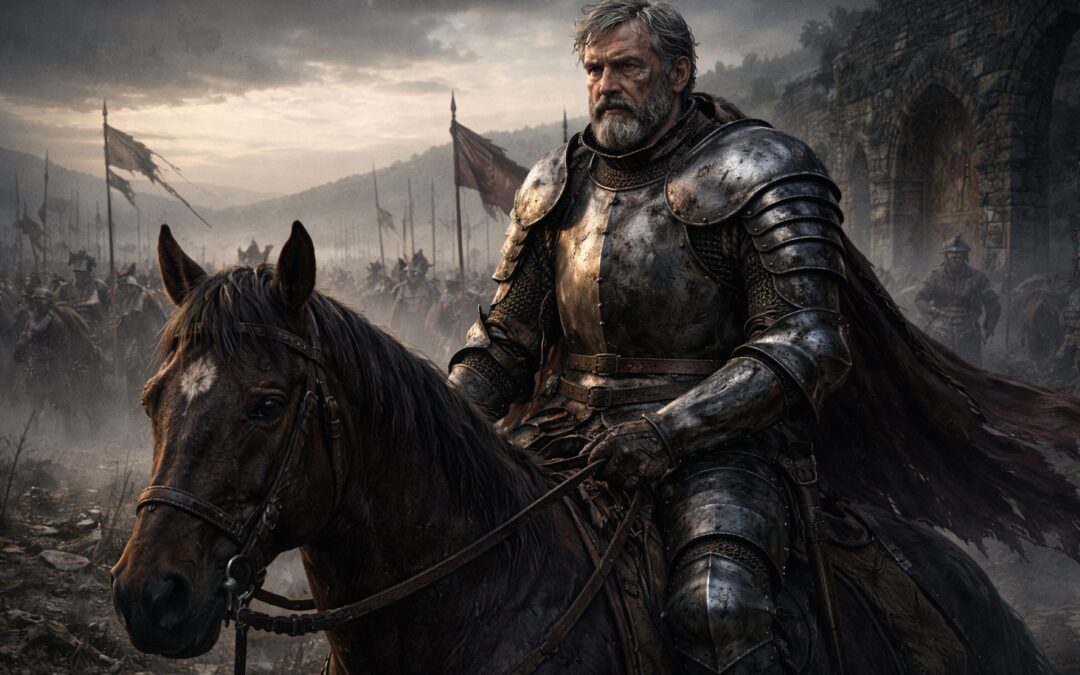
History remembers its greatest warriors through monuments, chronicles, and carefully guarded tombs. Pal Kinizsi has none of those certainties. His armor survives. His victories are documented. His name echoes across three nations. But his body—like so much of the world he fought to defend—has been lost.
Hungarians call him their greatest general. Romanians claim him as a national hero rooted in Transylvania. Serbian traditions tie him to noble bloodlines of their own past. Each version insists on ownership, yet none can point to where he lies. His tomb was broken open in the early eighteenth century. His remains were scattered, unmarked, and forgotten. Even today, archaeologists search the hills where he was once buried, chasing fragments of a man who once commanded entire armies.
But Kinizsi’s story is not just about a missing grave. It is about a system that created him—and then collapsed without him. He rose not through birth, but through merit, in a kingdom that briefly rewarded ability over lineage. Under King Matthias Corvinus, Hungary built one of the most formidable military machines in Europe: a professional army that reshaped the balance of power on the continent. And at the center of that transformation stood Kinizsi, a commander who, by every surviving account, never lost a battle.
Yet his life carries a deeper contradiction. The same man who helped build this system would later be ordered to dismantle it. The general who held the Ottoman advance at bay would watch the foundations of his own kingdom fracture from within. His victories were absolute on the battlefield—but history is not decided by battles alone.
Pal Kinizsi’s life sits at the fault line between strength and decay, between merit and privilege, between a state that almost reinvented itself—and the forces that ensured it could not last.
The General No One Can Find
Pal Kinizsi’s story begins with an absence.
Not with a battlefield, not with a coronation, not even with a clear origin—but with a missing body. Few figures in medieval European history occupy such a strange position: widely celebrated, deeply documented in action, yet physically untraceable. His armor survives in museum collections. His campaigns are preserved in chronicles. His name is etched into the historical memory of multiple nations. And still, the man himself cannot be found.
His original tomb stood in the Pauline monastery he founded near his fortress at Nagyvázsony. It was not an obscure burial. Kinizsi was one of the most powerful military figures of his time, a commander entrusted with the defense of Hungary’s southern frontier at its most dangerous moment. His resting place reflected that stature—a carved sarcophagus in a religious institution he had personally endowed.
For over two centuries, it remained intact.
Then, in 1708, everything changed. Treasure hunters broke into the tomb, not out of reverence, but greed. They tore it apart, searching for valuables buried with the dead. What they found—his armor, his weapons—was taken. What they did not value—his remains—was discarded. His bones were removed from their resting place and dumped into an unmarked grave in a nearby church.
In that moment, Kinizsi became something rarer than a fallen general. He became unmoored from the physical world. A figure without a grave. A legacy without a body.
Centuries later, the story has not been resolved. In 2022, archaeological teams began excavations in the region, attempting to locate what remains of his burial. The effort is meticulous, uncertain, and ongoing. The expectation is not discovery, but fragments—scattered evidence that might confirm what history already knows but cannot prove materially.
This absence matters.
Because history often anchors itself in places—in tombs, monuments, relics that make the past tangible. Kinizsi resists that. His story survives entirely through action, through the written memory of what he did rather than where he rests. It forces a different kind of engagement. You cannot visit him. You can only reconstruct him.
And that reconstruction becomes even more complicated when you consider that no single nation can claim him without dispute. Hungary, Romania, and Serbia all assert ownership over his origins and identity. Each tradition places him within its own historical narrative, its own geography, its own lineage.
Three nations. One man. No grave.
It is a fitting beginning. Because everything about Pal Kinizsi—his rise, his loyalty, his legacy—exists in tension. Between fact and folklore. Between belonging and ambiguity. Between permanence in memory and disappearance in reality.
And before we understand what he became, we have to confront what he is: a legend built on certainty of action, and uncertainty of origin.
Between Legend and History
Every enduring figure accumulates myth. In Pal Kinizsi’s case, the myth arrives before the man.
The most famous story begins in a forest. King Matthias Corvinus, out hunting, stops at a mill and asks for water. A young apprentice brings it—not in his hands, but balanced effortlessly on a millstone. The king, astonished by the display of strength, takes the boy into his service. The miller’s apprentice becomes a general.
It is a perfect story. Simple. Symbolic. Instantly memorable. Strength recognized by power. Talent lifted from obscurity. The kind of narrative that compresses an entire life into a single, decisive moment.
It is also almost certainly not true.
Modern historical research paints a far more grounded picture. Kinizsi did not emerge from peasant obscurity, nor was he discovered by chance. His family can be traced back to at least the 13th century, part of the lower nobility of the Kingdom of Hungary. Not powerful, not wealthy, but not invisible either. His father is believed to have served in the campaigns of John Hunyadi, the father of Matthias Corvinus and one of the most important military leaders of the era.
In other words, Kinizsi was not a miracle discovery. He was a man positioned at the edge of opportunity—close enough to the structures of power to enter them, but far enough removed that advancement was never guaranteed.
This distinction matters.
Because the legend simplifies his rise into something almost accidental, while history reveals something more significant: he was a product of a system that allowed men of ability to rise beyond their birth. Not from nothing—but from just enough.
Even his origins are contested. Hungarian scholars link him to regions in northern Hungary. Romanian traditions place his birth in areas that now fall within modern Romania. Serbian narratives connect him to noble dynasties with deep historical roots. Each claim reflects less about certainty and more about significance. To claim Kinizsi is to claim a piece of his reputation.
And his reputation is worth claiming.
In the 15th century, identity was not yet bound to modern national borders. Loyalties were shaped by service, faith, and proximity to power. What mattered was not where you were born, but who you served—and how well you fought. Kinizsi’s life unfolded in a frontier zone where the Ottoman Empire pressed constantly against the boundaries of Christian Europe. In that environment, lineage could open doors, but survival and success depended on something else entirely.
Skill. Discipline. Loyalty. Violence, applied effectively and repeatedly.
The legend of the miller’s apprentice persists because it captures a deeper truth, even if it distorts the facts. Kinizsi did rise beyond his station. He did command attention through physical and military prowess. He did become indispensable to a king who valued results over pedigree.
But he was not discovered in a moment. He was shaped over years—by family tradition, by military exposure, and by a political system that, for a brief period, allowed men like him to matter more than the titles they did not possess.
Understanding that distinction is essential. Because Pal Kinizsi’s story is not about a miracle rise from nothing.
It is about what happens when a state decides that ability matters more than birth—and what it can achieve, for as long as that decision holds.
A Kingdom Built on Merit: Matthias Corvinus and the Black Army
Pal Kinizsi’s rise cannot be understood in isolation. It begins with a king who broke the rules.
In 1458, Matthias Corvinus was elected king of Hungary under circumstances that would have seemed improbable just decades earlier. He was young, only fifteen. He was not the heir to a stable royal dynasty. His claim rested not on unquestioned legitimacy, but on the reputation of his father, John Hunyadi, and the backing of powerful supporters who saw opportunity in his ascent.
From the beginning, Matthias understood something that many rulers before him had ignored: the traditional feudal system was unreliable.
Noble armies were inconsistent. Magnates could refuse to fight, delay campaigns, or pursue their own interests. Peasant levies lacked training and discipline. In a region facing constant pressure from the Ottoman Empire, this was not just inefficient—it was dangerous.
So Matthias did something radical.
He built a professional standing army.
Known as the Black Army, it was one of the first of its kind in Europe. These were not temporary levies raised for a season. They were full-time soldiers, paid directly by the crown, trained for sustained campaigns, and organized with a level of discipline that set them apart from traditional feudal forces. Infantry, cavalry, artillery—each component operated as part of a coordinated whole.
More importantly, this army changed the rules of advancement.
In a feudal system, rank was tied to birth. Command followed lineage. In the Black Army, effectiveness mattered more. Officers were promoted based on competence, loyalty, and performance in the field. For men like Kinizsi—capable, experienced, but not part of the highest aristocracy—this created an opening that had rarely existed before.
This was not accidental. Matthias cultivated it deliberately.
He built a new elite, one that depended on him personally rather than on inherited power. Men who rose through merit had fewer independent bases of authority. They owed their positions to the king, not to ancient family networks. In return, they offered something the old nobility often did not: reliability.
Kinizsi fit perfectly into this system.
He was not powerful enough to challenge the crown. He was not entrenched enough to resist it. But he was capable enough to excel within it. In a different era, he might have remained a minor noble, one among many. Under Matthias, he became something else entirely—a professional commander in an army designed to reward exactly that kind of ability.
The Black Army itself quickly proved its worth.
It fought across Central Europe—against Bohemia, Austria, and various internal threats—demonstrating a level of effectiveness that few contemporary forces could match. It allowed Hungary to project power beyond its borders, to contest territory, and to hold back Ottoman incursions with a consistency that had previously been impossible.
But this system had a weakness built into its foundation.
It depended entirely on the king.
A professional army required money—steady, reliable funding to pay soldiers who would not fight for free. It required centralized authority strong enough to override noble resistance. It required a ruler willing to challenge the existing order and capable of enforcing that challenge.
As long as Matthias lived, the system worked.
Men like Kinizsi rose. The army held. The kingdom projected strength.
What Matthias created was not just a military force, but a temporary reordering of how power functioned within Hungary. For a brief period, ability could outweigh ancestry, and results could silence resentment.
But systems like that do not disappear gradually.
They collapse.
And when they do, the men who rose within them are often left standing in the ruins, forced to confront a reality they were never meant to survive.
The Rise of Pal Kinizsi
The first time Pal Kinizsi appears clearly in the historical record, he is not yet a legend. He is one name among many, serving under more established commanders in a campaign that, at the time, mattered far more than he did.
In January 1467, a renegade Czech mercenary captain had seized a fortress in northern Hungary and was terrorizing the surrounding countryside. King Matthias responded with a sizable force—thousands of soldiers, experienced commanders, and the emerging structure of his professional army. Among them was a young officer: Pal Kinizsi.
He was not leading the campaign. He was not making strategic decisions. He was serving under Balázs Magyar, a senior general who would become one of the most important figures in his early career. The siege was harsh, fought in winter conditions, and lasted weeks. When the enemy finally attempted to break out, they were pursued, defeated, and captured.
Kinizsi’s role in this campaign was not extraordinary.
And that is precisely the point.
His rise was not built on a single dramatic moment. There was no sudden leap from obscurity to command. Instead, it followed a pattern that is far more consistent with how real military careers develop—gradual exposure, increasing responsibility, and sustained performance across multiple campaigns.
By 1468, he had moved beyond the margins.
Matthias launched a major campaign into Bohemia, a complex and prolonged conflict that would stretch across years and multiple fronts. Here, Kinizsi appears in a significantly more important position—as a vice-general under Balázs Magyar during operations in Moravia. This was not a symbolic title. It meant coordinating troops, executing orders across large formations, and managing the realities of sustained warfare.
He was now operating at scale.
Throughout the following decade, the pattern repeated itself. Campaign after campaign, theater after theater—Moravia, defensive operations against Polish and Bohemian incursions, engagements in Austria—Kinizsi was present, active, and consistently effective. The sources do not dwell on dramatic setbacks or failures. Instead, they show continuity. He was trusted, deployed, and retained.
In a system built on merit, that continuity is its own form of proof.
By 1472, the king rewarded him with something more permanent: land. The castle of Nagyvázsony, situated near Lake Balaton, became his base of power. This was not just a residence. It was a strategic asset—fortified, expandable, and positioned within a region that mattered both economically and militarily.
Kinizsi did not treat it as a passive reward.
He invested in it. He expanded the defenses, added structures, and transformed it into a functioning stronghold. More tellingly, he founded a Pauline monastery nearby and settled monks there. This was not the behavior of a transient soldier. It was the behavior of a man consolidating his position—military, social, and religious—within the kingdom.
The contrast is striking.
On one hand, he was a career soldier shaped by constant warfare. On the other, he was building institutions, patronizing religious orders, and embedding himself into the local structure of authority. He was no longer just part of the system Matthias had created. He was becoming one of its pillars.
And then came the appointment that changed everything.
In 1478, the defensive system along Hungary’s southern frontier required reorganization. The pressure from the Ottoman Empire had not disappeared—it had shifted, adapted, and continued to threaten the region. This frontier was not symbolic. It was the line between stability and collapse.
Matthias chose Kinizsi to command it.
He was appointed Count of Temes County and Captain General of the Lower Parts—the supreme military authority in southern Hungary. From his headquarters in Timișoara, he would oversee the defense of one of the most volatile and strategically critical regions in Europe.
This was not a routine promotion.
It was a statement.
Among all the high-born magnates, all the established nobles with deeper lineage and broader networks, Matthias selected a man of comparatively modest origin. Not because of status. Not because of alliances. But because of performance.
The system was working exactly as intended.
And now, it was about to be tested under conditions that would define Kinizsi’s legacy permanently.
War Without Defeat: Campaigns Across Central Europe
By the late 1470s, Pal Kinizsi was no longer an emerging commander. He was a fixture of Hungary’s military machine—tested across multiple fronts, trusted with independent command, and consistently deployed where results were not optional.
What defines this phase of his career is not a single campaign, but accumulation.
Kinizsi fought in wars that stretched across Central Europe, often overlapping in purpose and complexity. The Bohemian conflicts drew him into prolonged engagements against forces that were experienced, organized, and politically entangled with multiple powers. These were not frontier skirmishes. They were multi-year wars requiring coordination, endurance, and adaptability.
He operated in Moravia, then shifted to defensive operations when Polish and Bohemian forces pushed into Hungarian territory. Later, he was involved in campaigns against Austria, where Matthias sought to expand influence and assert dominance beyond Hungary’s borders.
Each theater presented different challenges.
Bohemia demanded sustained campaigning over difficult terrain and against entrenched opponents. Defensive operations required speed, reaction, and the ability to stabilize volatile situations before they escalated. Austrian campaigns involved projecting power outward—longer supply lines, deeper incursions, and higher political stakes.
Through all of this, Kinizsi remained consistent.
There are no accounts of catastrophic defeats attached to his name. No records of failed commands that ended his career or diminished his standing. Instead, what emerges is something quieter but more significant: reliability under pressure. He was sent where he was needed, and the outcomes reinforced the decision to send him again.
In a merit-based system, that pattern matters more than isolated brilliance.
Kinizsi was not operating alone, of course. He was part of a broader command structure that included experienced generals, regional forces, and the institutional strength of the Black Army. But within that structure, he distinguished himself by persistence. He did not fade after early success. He did not plateau. He continued to perform across years of warfare that would have exhausted or exposed weaker commanders.
This is where his reputation begins to shift.
Not yet into legend, but into something approaching inevitability. When campaigns were planned, his presence became expected. When operations required execution, his name appeared among those responsible. He was no longer proving himself—he had been proven.
And yet, this period also reveals an important boundary.
For all his success, Kinizsi’s reputation at this stage remained largely internal to the military and political structures of Hungary. He was respected, rewarded, and trusted, but he had not yet become the figure that chroniclers would elevate into broader European awareness.
That required something else.
A moment where success was not just repeated, but concentrated. A battle that would crystallize his reputation into something undeniable, something that could not be contained within the routine language of campaigns and reports.
That moment came in 1479.
And it would transform Pal Kinizsi from a reliable commander into one of the most feared military figures in Europe.
The Battle of Breadfield and the Making of a Legend
In October 1479, the system Matthias Corvinus had built faced one of its most serious tests.
With the Ottoman–Venetian war concluded, Ottoman forces were free to redirect their attention. A large raiding army assembled in Serbia and moved toward Transylvania—fast, destructive, and designed to destabilize rather than occupy. These were not forces intended to hold territory. They were meant to burn, plunder, and withdraw, leaving economic damage and psychological fear in their wake.
Estimates of their size vary. Contemporary accounts inflated the numbers dramatically, while modern historians place them lower. The exact figure matters less than the reality: it was a substantial force, capable of overwhelming local defenses if left unchecked.
They crossed into Transylvania near the Maros River and began their work.
Villages were burned. Populations were captured for slave markets. Livestock and goods were seized. This was the standard rhythm of frontier warfare, repeated across decades—but no less devastating for its familiarity.
Matthias responded by assigning two commanders to intercept them: István Báthory, voivode of Transylvania, and Pal Kinizsi.
Together, they had fewer troops than the invading force. Their strength lay not in numbers, but in timing and coordination.
Báthory made a calculated decision. Instead of confronting the Ottomans immediately, he allowed them to raid for several days. It was a risky move, but a deliberate one. As the raiders gathered loot and prisoners, their mobility decreased. Their formations loosened. Their attention shifted from combat readiness to extraction.
By the time they encamped on a broad plain near the Maros—later known as Kenyérmező, the Breadfield—they were heavier, slower, and less cohesive.
That is when Kinizsi and Báthory struck.
The Hungarian-led force was divided into three parts. Báthory held the center with Transylvanian and Saxon troops. The flanks were reinforced by cavalry, including Serbian light horse under experienced commanders. Kinizsi took command of the right—heavy cavalry, positioned for decisive impact.
The battle began in the afternoon, and at first, it did not go well.
The Ottoman forces pressed hard against the center. Báthory was unhorsed in the chaos and nearly captured. The formation wavered. For a moment, the engagement tilted toward collapse.
Then Kinizsi moved.
He drove his cavalry into the Ottoman flank with force and precision. This was not a probing attack—it was a full commitment, designed to break momentum and create space where none existed. The impact destabilized the Ottoman line. One flank began to give way. Kinizsi did not pause. He wheeled his forces and struck again, this time targeting the center.
What had been pressure became fracture.
Once the Ottoman formation began to collapse, the rest followed quickly. Units broke apart. Command cohesion dissolved. Retreat turned into rout. Survivors fled toward the mountains, where many were cut down or captured.
The scale of the defeat was severe. Thousands were killed, including key commanders. The raiding force that had entered Transylvania with confidence was effectively destroyed.
For Hungary, the significance was immediate.
This was not just a successful defense. It was one of the first major open-field victories against Ottoman forces in decades. Since the late 14th century, the Ottomans had built a reputation for dominance in pitched battle. That perception mattered as much as their actual strength. It shaped strategy, morale, and expectation across Europe.
At Breadfield, that perception cracked.
And Kinizsi stood at the center of that moment.
The aftermath amplified the effect. Reports of the victory spread quickly, carried through diplomatic correspondence and chronicled accounts. Matthias ensured that European courts understood exactly what had happened—and who had made it happen.
Then came the legend.
According to later stories, Kinizsi celebrated the victory in a manner as extreme as his reputation—dancing on the battlefield with the bodies of fallen enemies, one in each hand, another clenched between his teeth. The image is grotesque, exaggerated, and almost certainly embellished.
But it endured.
Because it captured something that formal accounts could not: the perception of Kinizsi as a force beyond ordinary limits. Not just effective, but overwhelming. Not just victorious, but relentless.
After Breadfield, he was no longer simply a capable commander within Hungary.
He became a name recognized across Europe.
And with that recognition came a shift in how he would be remembered—not just as a participant in campaigns, but as a symbol of what those campaigns could achieve when everything aligned: leadership, timing, discipline, and force applied at exactly the right moment.
The system had produced its clearest proof.
Now it would have to sustain it.
From General to Governor: Power on the Southern Frontier
Victory at Breadfield did more than elevate Pal Kinizsi’s reputation. It confirmed Matthias Corvinus’s judgment.
The southern frontier of Hungary was not a ceremonial posting. It was the most dangerous line in the kingdom—a shifting boundary where Ottoman pressure was constant, unpredictable, and often devastating. Raids could turn into invasions. Weakness could invite escalation. Stability, when it existed, was temporary and fragile.
Kinizsi was placed in charge of that line.
As Count of Temes County and Captain General of the Lower Parts, he held authority that extended beyond battlefield command. He was not just leading armies—he was managing a region that functioned as both shield and buffer. From his base in Timișoara, he oversaw fortifications, coordinated troop movements, and responded to incursions that could emerge with little warning.
This required a different kind of leadership.
Campaign warfare is episodic. Frontier command is continuous. There are no clear beginnings or endings—only cycles of tension, disruption, and response. Kinizsi had to maintain readiness over years, not just win individual battles.
And he did.
In 1481, Ottoman forces under Pasha İskender launched raids into the region around Timișoara. Kinizsi did not settle for defense. He pursued. Crossing into Serbian territory, he located the enemy force and engaged it directly. The result was decisive. The Ottoman contingent was destroyed, its commander killed, and its operational momentum broken.
This pattern repeated.
In 1482, he pushed deeper into contested territory, securing victories that extended beyond immediate defense. These were not reactive actions—they were demonstrations of control. Kinizsi was not merely holding the line; he was shaping it.
But his role extended beyond combat.
The frontier was not empty. It was populated by communities constantly exposed to the consequences of war—displacement, loss, and instability. After his campaigns in Serbia, waves of refugees sought safety within Hungarian territory. Kinizsi allowed them to settle, relocating tens of thousands across the southern counties.
This was not an act of charity alone.
It was strategy.
Populated land is defensible land. Settlers could stabilize regions, support supply lines, and reinforce the social structure needed to sustain long-term resistance. In integrating these communities, Kinizsi was strengthening the frontier in ways that pure military force could not.
At the same time, he continued to build.
His stronghold at Nagyvázsony was expanded further, reinforcing its defensive capabilities while also serving as a center of administration. The Pauline monastery he had founded grew into a significant religious institution. Under his patronage, it became a site of cultural and spiritual activity, producing manuscripts of remarkable quality—objects that reflected not warfare, but refinement.
This duality defines this phase of his life.
He was both destroyer and builder. A commander capable of crushing enemy forces in the field, and a governor capable of organizing territory, supporting institutions, and managing populations. The frontier demanded both, and Kinizsi provided them without visible contradiction.
By the early 1480s, he had become more than a general.
He was one of the key figures sustaining Hungary’s southern defense—militarily, administratively, and socially. His authority rested not on inherited prestige, but on demonstrated effectiveness. He had been tested repeatedly, and each time, he had reinforced the logic that had elevated him in the first place.
Matthias’s system still held.
But systems built on performance carry an inherent tension. They produce results that justify themselves—but they also provoke resentment from those displaced by their success.
That tension had not yet broken.
But it was building.
Why Kinizsi Was Chosen: Merit Over Nobility
Pal Kinizsi’s appointment to the most critical military command in Hungary was not an accident. It was a deliberate decision that reveals how Matthias Corvinus understood power—and how far he was willing to push against tradition to secure it.
On paper, Kinizsi was not the obvious choice.
Hungary was filled with powerful magnates—families with deep lineage, extensive landholdings, and long-established influence over both politics and warfare. These were men who expected command as a matter of right. Their authority was inherited, their networks entrenched, and their expectations shaped by generations of privilege.
Kinizsi had none of that.
He came from minor nobility. He did not command a vast independent power base. He did not belong to a faction strong enough to pressure the crown. In a conventional system, that would have limited him. Under Matthias, it made him ideal.
Because Matthias was not trying to preserve the existing order.
He was trying to control it.
The traditional nobility presented a problem. They were powerful, but unreliable. Their loyalty was conditional, often shaped by personal interest rather than state necessity. In moments of crisis, they could delay, resist, or undermine decisions that did not align with their own priorities.
A frontier threatened by the Ottoman Empire could not afford that kind of hesitation.
So Matthias built an alternative.
He elevated men whose authority came directly from him—men whose careers depended on royal favor rather than inherited status. This created a new layer of leadership that was more responsive, more disciplined, and more aligned with the crown’s objectives.
Kinizsi was a perfect expression of that strategy.
He had proven his ability across years of campaigning. He had demonstrated loyalty not through words, but through consistent execution. He did not bring competing interests into his command. His position was tied entirely to the system Matthias had created, and that made him dependable in a way the old nobility often was not.
But this strategy came with consequences.
Every promotion of a man like Kinizsi was a direct challenge to those who believed such positions belonged to them by right. Every castle granted, every title assigned, every command entrusted to a lower-born officer reinforced a message the magnates could not ignore: lineage was no longer enough.
Resentment followed.
It did not erupt immediately. Matthias was strong enough to suppress open opposition, and his successes made it difficult to argue against the results. The Black Army delivered victories. The frontier held. Expansion into neighboring regions demonstrated the effectiveness of the system.
As long as the king lived, the balance held.
But beneath that surface, the tension was constant. The old elite had not disappeared. It had been sidelined, constrained, and forced to operate within a system that reduced its influence.
Kinizsi’s rise was both a product of that system and a symbol of its disruption.
He represented what was possible when merit replaced inheritance—but also what was intolerable to those who had built their identity around inherited privilege. His success was not neutral. It carried implications for everyone who had not been chosen.
This is why his appointment matters beyond his personal story.
It marks a moment when Hungary briefly redefined how authority could be distributed—when effectiveness outweighed pedigree, and the state prioritized results over tradition. For a time, that shift produced extraordinary outcomes.
But it also ensured that the system would face resistance the moment its central force—Matthias Corvinus—was removed.
Kinizsi thrived because that force existed.
What followed would reveal what happened when it did not.
The Death of Matthias and the Collapse of the System
On April 6, 1490, Matthias Corvinus died in Vienna.
He was forty-seven years old. For over three decades, he had held together a system that depended almost entirely on his presence—his authority, his will, and his ability to impose order on forces that did not naturally align.
The moment he was gone, that system began to unravel.
There was no seamless transition. No uncontested heir ready to step into his place with equal authority. Matthias had intended for his illegitimate son, John Corvinus, to succeed him. But intention was not enough. John was young, politically inexperienced, and lacked the support needed to secure the throne against powerful opposition.
The nobility moved quickly.
This was the moment they had been waiting for. Years of suppressed resentment toward Matthias’s centralization and his promotion of lower-born commanders now found an opening. Without the king to enforce discipline, the balance shifted immediately back toward those who had never accepted his reforms.
For men like Pal Kinizsi, the situation was not just unstable—it was existential.
Everything that had enabled his rise was tied to Matthias. The merit-based structure, the authority of the Black Army, the redistribution of power away from entrenched elites—all of it depended on a ruler strong enough to maintain it. Without that anchor, the system did not weaken gradually. It fractured.
The succession crisis exposed that fracture in full.
John Corvinus had legitimacy in theory, but little in practice. Other claimants emerged, backed by factions of the nobility who saw an opportunity to shape the future of the kingdom in their favor. Among them was Vladislaus II of Bohemia—a candidate whose greatest advantage was not strength, but acceptability.
He was known for yielding to the demands of those around him. A king who would not challenge the nobility, who would not rebuild the centralized authority Matthias had enforced. For many magnates, that was not a flaw. It was the point.
The question was no longer who deserved to rule.
It was what kind of rule would follow.
A continuation of Matthias’s system—centralized, merit-driven, and controlled—or a return to a more fragmented structure where noble power could reassert itself without constraint.
For Kinizsi, this was the moment where loyalty and reality collided.
He had risen under Matthias. He had benefited from the system the king created. He had fought to defend it, to enforce it, and to expand its reach. But that system was now collapsing around him, and the choices available were no longer aligned with the principles that had defined his career.
What remained was a calculation.
Not about ideals, but about survival—of the state, of stability, and perhaps of himself within a structure that was rapidly changing shape.
The death of Matthias did not just remove a ruler.
It removed the only force capable of holding together a system that had never been designed to outlive him.
And for the first time in his career, Pal Kinizsi faced a situation where victory was not defined on a battlefield—but in a political landscape where the rules had already shifted beyond his control.
Betrayal or Necessity: Turning Against John Corvinus
With Matthias Corvinus gone, the question of succession did not unfold as a matter of loyalty—it became a matter of consequence.
John Corvinus, the king’s son, represented continuity. Supporting him meant attempting to preserve the system Matthias had built: a centralized monarchy backed by a professional army and a merit-based command structure. On paper, it aligned with everything Pal Kinizsi had lived and fought for.
In reality, it was far more complicated.
John was young, untested, and politically vulnerable. He lacked the authority to command immediate obedience from the nobility, and more importantly, he lacked the network required to enforce it. The magnates who had tolerated Matthias had no intention of accepting a weaker version of the same system—especially not under a ruler they could outmaneuver.
Backing John was not simply a question of principle. It carried the risk of civil war.
And civil war, in a kingdom positioned on the Ottoman frontier, was not an abstract danger. It was an invitation. Internal division would fracture defenses, weaken coordination, and create precisely the conditions an external power could exploit. A contested throne could become a breached border.
This is where Kinizsi’s decision becomes difficult to simplify.
He did not support John Corvinus.
Instead, he aligned with Vladislaus II—the candidate favored by the nobility, a ruler known less for strength than for compliance. It was a choice that, on the surface, looks like betrayal. A general turning against the son of the king who had elevated him. A man abandoning the very structure that had defined his rise.
But there is another way to read it.
John Corvinus may have represented continuity, but he did not represent stability. His claim was contested. His authority was uncertain. A prolonged struggle for the throne could weaken the kingdom at the exact moment it needed cohesion the most.
Vladislaus, by contrast, offered something different.
He was acceptable. Not powerful enough to dominate the nobility, but acceptable enough to avoid immediate fragmentation. His weakness was a feature, not a flaw, for those who supported him. And in a fractured political landscape, acceptability could prevent escalation.
Kinizsi’s decision, then, may not have been about abandoning Matthias’s vision.
It may have been about recognizing that the conditions required to sustain that vision no longer existed.
In July 1490, the conflict reached a decisive point. Forces aligned with Kinizsi and István Báthory confronted John Corvinus’s army near Szabaton. Neither side was eager for a full-scale battle. The soldiers understood what was at stake—not just a crown, but the stability of the kingdom itself.
To limit bloodshed, the confrontation was resolved through a controlled engagement. John’s position collapsed. He surrendered his claim to the throne and relinquished the royal insignia. The succession was settled—not through prolonged war, but through a decisive moment that avoided wider destruction.
With that, the last realistic chance of preserving Matthias’s system ended.
Kinizsi had made his choice.
Whether it was betrayal or necessity depends on what you believe mattered more in that moment: loyalty to a legacy, or the prevention of a collapse that could have been far worse.
But what followed makes one thing clear.
The system he helped protect did not survive the compromise.
The Destruction of the Black Army
Once Vladislaus II secured the throne, the consequences of that choice became immediate—and irreversible.
The nobility, now firmly in control of the political direction of the kingdom, moved quickly to reshape it in their favor. Their priorities were clear. Lower taxes. Greater autonomy. Reduced royal authority. The centralizing force that had defined Matthias Corvinus’s reign was systematically dismantled.
At the center of that system stood the Black Army.
It was expensive. It required consistent funding, centralized control, and a ruler willing to maintain both. Under Matthias, those conditions had existed. Under Vladislaus, they did not. The new king lacked both the authority and the inclination to impose the financial burden necessary to sustain a professional standing army.
The result was predictable.
The flow of money stopped.
At first, the effects were gradual. Delayed payments. Reduced provisions. Growing dissatisfaction among troops who had been accustomed to regular compensation. But a professional army cannot operate on expectation alone. These were not feudal levies bound by obligation. They were soldiers who fought because they were paid.
When that payment ceased, the structure began to collapse.
Units disbanded. Discipline eroded. What had once been one of the most formidable military forces in Europe began to fragment into something far more dangerous—not to external enemies, but to the kingdom itself.
Unpaid soldiers turned to survival.
They looted villages. They extorted resources from the very populations they had once defended. The Black Army, built to project strength outward, began to consume the interior of Hungary. It was not a sudden transformation, but an inevitable one. Remove the system that sustains a professional force, and it will sustain itself by other means.
The nobility, having pushed for the conditions that caused this collapse, now faced its consequences.
And they turned to the one man capable of resolving it.
Pal Kinizsi.
The order was direct. Suppress the remnants of the Black Army. Restore order. Eliminate the threat.
It was a command that cut through the core of his career.
This was the army he had served in, risen through, and helped shape. The institution that had enabled his ascent. The force that had carried Hungary to its greatest military successes under Matthias. Now it had become a liability—and he was being asked to destroy it.
There was no alternative.
In 1492, Kinizsi moved against the remnants of the Black Army at Halesfalva. The confrontation was not a battle in the traditional sense. It was a dismantling. Disorganized, unpaid, and lacking central coordination, the former soldiers could not match the structure and authority Kinizsi still commanded.
He defeated them.
With that, the Black Army ceased to exist as a meaningful force.
What had taken decades to build was dismantled in a matter of months. Not by external enemies, but by internal decision—by a political shift that removed the conditions necessary for its survival.
Kinizsi had carried out the order.
In doing so, he completed one of the most profound reversals in his own life. The general who had helped demonstrate the effectiveness of a professional army had now overseen its destruction. Not because it had failed, but because the system around it had.
The implications extended far beyond the army itself.
Without the Black Army, Hungary lost more than a military instrument. It lost the mechanism that had enforced central authority, projected power, and held the frontier with consistency. What remained was a weakened structure, increasingly dependent on the same feudal dynamics Matthias had tried to overcome.
And on that frontier, the pressure had not disappeared.
It had only been waiting.
Saving Belgrade and Holding the Line
Even after the destruction of the Black Army, the dangers facing Hungary did not diminish. If anything, they became more acute.
The frontier still existed. The Ottoman Empire had not retreated. And now, the kingdom that had once held the line with discipline and coordination was relying on a weakened structure, stripped of the very system that had made its defense possible.
In this environment, the greatest threat did not always come from the outside.
It came from within.
One of the last remaining concentrations of former Black Army soldiers was stationed at Nándorfehérvár—modern-day Belgrade. This was not just another fortress. It was one of the most strategically critical positions in southeastern Europe. Decades earlier, it had been the site of a decisive victory under John Hunyadi, halting an Ottoman advance that could have reshaped the region.
Now, it was in danger again—but for a different reason.
The garrison, unpaid and increasingly desperate, had reached a breaking point. These were not undisciplined men by nature. They had once been part of Europe’s most effective professional army. But months of neglect had changed their priorities. Loyalty had eroded. Survival had taken precedence.
They began to consider the unthinkable.
A plan emerged to sell the fortress to the Ottomans.
Not out of ideology. Not out of allegiance. But out of necessity—or at least the perception of it. If the kingdom would not pay them, would not feed them, would not sustain them, then the value of what they held could be converted into something immediate.
Money. Security. Escape.
It was a decision that, if carried out, would have had catastrophic consequences. Belgrade was a gateway. Its fall would not just represent the loss of a fortress—it would open a direct path deeper into Central Europe.
Kinizsi acted quickly.
In May 1494, he uncovered the conspiracy and moved to suppress it before it could be executed. The leaders of the plot were arrested, including the captain responsible for organizing the betrayal. There was no negotiation, no attempt at reconciliation.
The punishment was severe.
They were executed—reportedly by starvation, a method that mirrored the slow desperation that had driven them to their decision. It was not just a sentence. It was a message.
The line would hold.
Belgrade remained under Hungarian control. The immediate threat was neutralized. But the incident revealed something deeper than a single act of treason. It exposed the extent to which the internal collapse of the system had begun to affect even its most critical defensive positions.
Kinizsi had prevented disaster.
But he had not reversed the conditions that made such a disaster possible.
The soldiers who had once defended the kingdom with discipline and cohesion were now capable of turning against it—not because they had changed, but because the structure that sustained them had disappeared. The loyalty of a professional army had been replaced by the instability of neglect.
And yet, even within that instability, Kinizsi continued to function as a stabilizing force.
He enforced order where it was breaking down. He maintained the frontier where it was weakening. He acted decisively in situations where hesitation could have been fatal.
But there is a limit to what one man can hold together.
Belgrade would eventually fall to the Ottomans in 1521—less than three decades later. Not because Kinizsi failed, but because by then, no one remained who could do what he had done.
He was still holding the line.
But the structure behind him was already gone.
The Final Campaign: A General Bound to the Saddle
By the mid-1490s, Pal Kinizsi was no longer the man who had charged across the Breadfield.
Years of campaigning had taken their toll. He had suffered a stroke that left him partially paralyzed. His strength—once the subject of legend—had diminished to the point where even basic movement was difficult. Riding was nearly impossible. Fighting, in the physical sense, was no longer an option.
Under ordinary circumstances, his career would have ended there.
It did not.
In 1494, as Ottoman pressure resumed along the frontier, Kinizsi was once again called to lead a campaign. The target was Smederevo, a key stronghold in Serbia. The situation demanded action, and despite his condition, the responsibility fell to him.
There is a difference between authority and ability.
Kinizsi no longer possessed the latter in its original form. But he retained the former completely. His reputation, his experience, and his command over the forces under him had not disappeared. The army still followed him—not because he could fight, but because he could lead.
So he adapted.
Unable to ride unaided, he was strapped to his horse.
It is an image that would have seemed implausible if it were not so well attested. A general physically bound to the saddle, unable to dismount, unable to wield a weapon, yet still directing an army in active campaign. He could not charge into battle, but he could still issue orders, coordinate movements, and impose structure on the chaos of war.
And his men obeyed.
This moment captures something essential about Kinizsi’s authority. It was no longer rooted in physical dominance or battlefield ferocity. It rested on accumulated trust—years of consistent leadership that had convinced those under him that even in diminished form, he remained the best option.
He led from necessity, not from strength.
The campaign moved forward. The army advanced into contested territory, operating under the same pressures that had defined every frontier engagement—uncertainty, resistance, and the constant threat of escalation. Kinizsi remained at its center, not as a combatant, but as a commander whose presence continued to organize the force around him.
Then, on November 24, 1494, during the campaign, he died.
He was approximately sixty-two years old.
The manner of his death was not dramatic in the way his life had been. There was no final charge, no decisive battle marking his end. Instead, there was continuity—he died as he had lived, in the middle of a campaign, still engaged in the work that had defined him for decades.
Strapped to a horse, leading an army he could no longer physically fight beside.
It is difficult to separate the symbolism from the reality.
A man who had built his reputation on strength, endurance, and relentless effectiveness reduced to immobility, yet still functioning within the same role. A general who had never lost a battle confronting a condition he could not defeat. A life defined by control over outcomes ending in a situation where control no longer applied.
And yet, even in that state, he did not withdraw.
He did not relinquish command.
He remained in motion until the end.
That, more than any legend, defines him.
Death, Desecration, and the Lost Tomb
Pal Kinizsi was buried where he had chosen to be remembered.
At Nagyvázsony, near the fortress he had transformed and the monastery he had founded, his body was placed in a carved sarcophagus within the Pauline monastery. It was a fitting resting place—built under his patronage, sustained by the institutions he had supported, and tied directly to the life he had constructed beyond the battlefield.
For a time, that resting place held.
Unlike many figures of his era, Kinizsi was not forgotten immediately after death. His reputation endured. His role in defending the southern frontier, his victories against the Ottomans, and his position within Matthias Corvinus’s system ensured that his memory remained active within Hungarian historical consciousness.
But memory does not protect stone.
In 1543, the Ottoman advance reached the region. As their forces closed in, the defenders of Nagyvázsony made a decision that mirrored the logic of the frontier Kinizsi had spent his life defending—they denied the enemy what they could not hold. The monastery he had built was destroyed, blown up rather than allowed to fall intact into Ottoman hands.
Even in death, the war reached him.
The site of his burial was damaged, its original structure compromised. Yet the tomb itself, or what remained of it, survived for another century and a half.
Then came the final break.
In 1708, long after the battles that had defined his life had faded into history, treasure hunters entered the ruins. They were not historians. They were not preservers of memory. They were looking for valuables—objects buried with the dead that could be extracted, sold, or repurposed.
They found what they wanted.
Kinizsi’s armor, his weapons, items associated with his status and identity as a warrior—these were taken. The material symbols of his life were preserved, but only because they had value beyond the man himself. Today, those objects survive in museum collections, detached from their original context.
What they did not preserve was him.
His tomb was broken open. His remains were removed, handled without ceremony, and ultimately discarded. The bones of one of Hungary’s most important military figures were dumped into an unmarked grave in a nearby church, stripped of identity and location.
In that moment, the connection between the man and his resting place was severed completely.
What followed was not immediate recovery, but gradual obscurity.
Over time, the exact location of his remains was lost. The monastery was gone. The tomb destroyed. The grave unmarked. What remained was a historical figure without a physical anchor—a life preserved in records, but not in place.
Centuries later, that absence remains unresolved.
In 2022, archaeological efforts began with a clear objective: to locate what remains of Pal Kinizsi. The search is careful, methodical, and uncertain. The expectation is not a complete recovery, but fragments—evidence that can be linked, identified, and confirmed.
So far, the search continues.
There is a certain inevitability to this outcome.
Kinizsi spent his life in a world defined by instability—frontiers that shifted, structures that collapsed, systems that depended on force to survive. The institutions he built were destroyed. The army he served was dismantled. The kingdom he defended weakened after his death.
It is perhaps fitting, then, that even his burial did not remain intact.
The general who never lost a battle could not preserve his own resting place.
And so, what remains of him exists not in stone or bone, but in the continuity of memory—a legacy reconstructed from action, not from remains.
Legacy: The Man Three Nations Claim
Pal Kinizsi’s life did not end with his death. It fragmented—and then expanded.
In the centuries that followed, his story was absorbed into multiple historical traditions, each reshaping him to fit its own narrative. Hungary remembers him as one of its greatest generals, a central figure in the military system of Matthias Corvinus and a defender of the kingdom at its most vulnerable frontier. Romania places him within the geography of Transylvania, tying his origins and influence to a region that has long been contested and culturally layered. Serbia connects him to noble lineages and the broader struggle against Ottoman expansion.
These claims are not easily reconciled.
They do not converge into a single, agreed-upon identity. Instead, they overlap, diverge, and coexist. Each reflects a different perspective on the same figure—one shaped by geography, historical memory, and the need to anchor significance within a national framework.
In Kinizsi’s time, that framework did not exist in the way it does today.
Identity in the 15th century was fluid. It was defined less by fixed national categories and more by allegiance, service, and position within a broader political structure. Kinizsi served the Kingdom of Hungary, but that kingdom itself encompassed diverse regions and populations. The modern borders that now divide Hungary, Romania, and Serbia did not define his world.
That is why his legacy resists singular ownership.
He belongs to all three traditions—and fully to none.
What unites these perspectives is not agreement on origin, but recognition of impact. Regardless of where he is placed, the core of his story remains consistent. He was a commander of exceptional effectiveness. He operated at the highest level of military authority. He played a decisive role in holding back Ottoman incursions at a critical moment in Central European history.
Beyond historical writing, his legacy extends into cultural memory.
His name has been used in institutions, remembered in local traditions, and referenced in ways that reflect enduring respect. His armor and weapons, preserved in museum collections, serve as tangible connections to a figure whose physical remains have been lost. They stand as artifacts of a life defined by action, even as the man himself cannot be located.
There is also a deeper layer to his legacy.
Kinizsi represents a particular kind of historical figure—one shaped by a system that briefly allowed talent to override hierarchy. His rise is tied to a moment when merit was elevated, when ability could translate into authority without the full backing of inherited power. That moment did not last. But while it existed, it produced individuals who would not have emerged under different conditions.
He is one of them.
At the same time, his later life complicates that image. He did not simply benefit from the system; he also participated in its dismantling. Whether by necessity or decision, he became part of the process that ended the very structure that had enabled his success.
That duality defines how he is remembered.
Not just as a victorious general, but as a figure caught within a transition he could not control. A man who embodied the strengths of a system—and lived long enough to see its weaknesses exposed.
Three nations claim him because his significance extends beyond any single boundary.
But what they claim is not just a general.
They claim a moment in history when power briefly worked differently—and the man who proved what that difference could achieve.
Conclusion: The Only Battle He Could Not Win
Pal Kinizsi’s life reads like a contradiction resolved through force.
A man of minor nobility rises to command one of Europe’s most formidable armies. A general fights across decades of warfare without a recorded defeat. A frontier commander holds back one of the most powerful empires of the age. By every conventional measure, his career is defined by control—over outcomes, over enemies, over the chaos of war itself.
And yet, the most important forces shaping his life were never on the battlefield.
They were structural. Political. Inevitable.
Kinizsi was a creation of Matthias Corvinus’s system—a system that prioritized merit over lineage, discipline over privilege, and centralized authority over fragmented power. Within that framework, he thrived. His ability aligned perfectly with the opportunities the system provided. His loyalty reinforced it. His victories justified it.
But the system was never stable beyond the man who built it.
When Matthias died, the balance he had imposed dissolved almost immediately. The nobility reclaimed influence. The financial foundation of the Black Army collapsed. The centralized structure that had enabled coordinated defense gave way to competing interests and reduced authority.
Kinizsi adapted, as he always had.
He chose stability over continuity, aligning with a ruler who could prevent immediate fragmentation rather than one who might prolong conflict. He carried out orders that ran counter to his own past, dismantling the army that had defined his career. He enforced discipline in a kingdom that was already losing the ability to sustain it.
He continued to act decisively.
But this time, decisiveness was not enough.
Because what he was confronting was not an enemy that could be defeated through strategy or strength. It was a shift in how power functioned—a reversion to structures that did not support the kind of system he had risen within.
There was no charge that could break that. No maneuver that could outflank it.
The frontier he had defended began to weaken. The army he had led disappeared. The institutions he had helped sustain lost their foundation. Even his own resting place would not survive intact.
In the end, Kinizsi did what he had always done.
He held the line as long as he could.
He enforced order where it was breaking down. He responded to threats as they emerged. He continued to lead, even when his body no longer allowed him to fight. He remained within the system, even as it unraveled around him.
But some battles are not decided by those who fight them.
They are decided by the conditions that make fighting possible in the first place.
Pal Kinizsi never lost a battle.
Except the one that no general, no matter how capable, could win alone.