
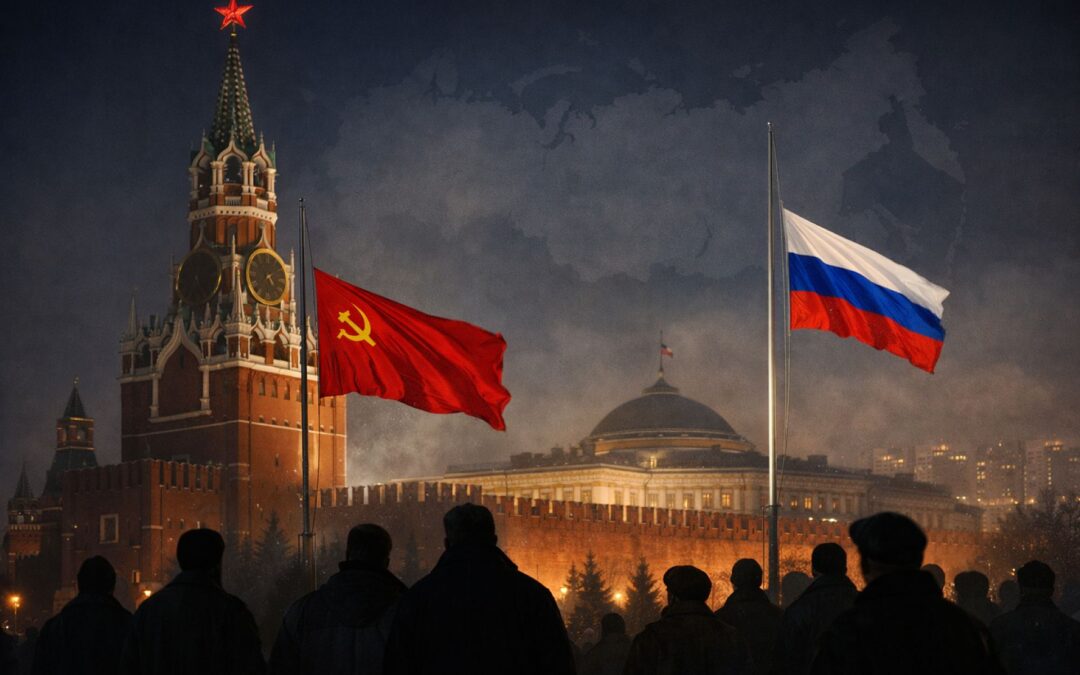
The collapse of the Soviet Union is one of the most consequential events of the modern world. It ended a superpower. It brought the Cold War to a close. It redrew the political map across Europe and Asia almost overnight. And yet, for something so transformative, it is surprisingly poorly understood.
Most people know the ending. December 1991. The Soviet flag comes down. Fifteen independent states emerge. The Cold War is over. But the collapse itself—how a vast, heavily controlled system unraveled from within—is rarely explained with any real clarity.
Because the Soviet Union did not fall in a single moment. It weakened gradually, fractured unevenly, and ultimately dissolved through a chain reaction of reforms, unintended consequences, and political upheavals. It was not simply defeated by external pressure. In many ways, it collapsed under the weight of its own structure.
At its core, the Soviet Union was built on an idea. A promise that society could be organized around collective prosperity rather than individual competition. A belief that economic planning, rather than markets, could deliver stability, equality, and progress. For decades, that idea sustained one of the most powerful states in history.
But by the late twentieth century, the gap between the promise and the reality had become impossible to ignore.
The story of the Soviet Union’s collapse is not just about political decisions or economic failures. It is about what happens when a system designed to control everything begins to loosen its grip. It is about how reforms meant to fix a broken structure can instead expose its deepest weaknesses. And it is about how, once those weaknesses are visible, they cannot be contained again.
To understand why the Soviet Union collapsed, we have to start with what it was supposed to be—and what it actually became.
The Soviet Dream and Its Reality
At its foundation, the Soviet Union was not just a state—it was an ideological project.
It emerged from the wreckage of the Russian Empire with a radical ambition: to build a society without class divisions, without exploitation, and without the inequalities that had defined previous systems. Inspired by Marxist theory, the Bolsheviks believed that by placing the means of production in collective hands, they could create a system where everyone contributed according to their ability and received according to their need.
In theory, it was a vision of extraordinary coherence. A society organized around the “greater good.” A system where economic planning would eliminate waste, competition, and crisis. A world where prosperity was not unevenly distributed, but deliberately engineered.
But the reality diverged almost immediately.
The Soviet system required central control to function. If the state was responsible for managing production, distribution, employment, and prices, then power had to be concentrated. Decisions could not be left to individuals or local actors—they had to be coordinated from above. What began as economic coordination quickly became political centralization.
And centralization, in practice, demanded enforcement.
Under leaders like Vladimir Lenin and, more decisively, Joseph Stalin, the Soviet Union transformed into a highly controlled state where dissent was not merely discouraged—it was punished. The apparatus of governance expanded into surveillance, censorship, and repression. Loyalty to the system became a requirement for survival, not just participation.
This was not an accidental development. It was, in many ways, a structural outcome. A system that aimed to control economic life at every level inevitably extended that control into social and political life as well.
The cost was immense. Millions were subjected to forced labor through the Gulag system. Political purges eliminated perceived threats, often arbitrarily. Entire populations lived under a constant awareness that deviation from the accepted line could carry severe consequences.
And yet, despite this, the Soviet Union endured—and even appeared successful for a time.
It industrialized at a remarkable pace. It emerged from the Second World War as one of two global superpowers. It expanded its influence across Eastern Europe. To many outside observers, it seemed like a viable alternative to capitalism, particularly in a world still grappling with economic instability and colonial legacies.
But beneath that surface strength, the contradiction remained unresolved.
The Soviet Union promised a system that would serve its people. In practice, it created a system that required its people to serve it.
From Revolution to Superpower: What the Soviet Union Became
The Soviet Union did not begin as a global power. It had to become one—through upheaval, consolidation, and war.
Its origins lie in the Russian Revolution of 1917, when the centuries-old rule of Nicholas II was overthrown amid widespread unrest, economic collapse, and military failure during World War I. Out of that chaos, the Bolsheviks—led by Vladimir Lenin—seized power with a clear ideological goal: to construct a Marxist state from the ruins of empire.
What followed was not immediate stability, but conflict. A brutal civil war between the Bolsheviks and their opponents forced the new regime to consolidate power quickly and decisively. By 1922, the Union of Soviet Socialist Republics was formally established—a federation in name, but increasingly centralized in practice.
After Lenin’s death, power shifted to Joseph Stalin, under whom the Soviet Union underwent a profound transformation. Through rapid industrialization and forced collectivization, the country was reshaped into a heavily controlled economic and political system. These policies dramatically increased industrial output, but at an enormous human cost, including famine, repression, and widespread suffering.
By the 1940s, the Soviet Union had been forged into something far more formidable than its revolutionary origins might have suggested.
World War II was the turning point.
The Soviet Union bore the brunt of the war against Nazi Germany, suffering immense losses while ultimately playing a decisive role in defeating Hitler. In the aftermath, it emerged not only victorious, but dominant across Eastern Europe.
Rather than directly annexing all conquered territories, the Soviet Union established a sphere of influence. Countries like Poland, Hungary, East Germany, Czechoslovakia, Romania, and Bulgaria became aligned with Moscow—politically, economically, and militarily. This alignment was formalized through the Warsaw Pact, which ensured both cooperation and compliance.
This expansion transformed the Soviet Union into a superpower—but also locked it into a global rivalry.
Opposing it was the United States, leading a bloc of capitalist democracies. The result was the Cold War: not a direct military confrontation between the two powers, but a prolonged ideological, political, and economic struggle that divided the world into competing systems.
In Europe, this division became physical. The so-called Iron Curtain split the continent into two spheres—one under Soviet influence, the other aligned with the West.
By the mid-twentieth century, the Soviet Union had achieved what it set out to become: a centralized, industrialized, globally influential state. It had military power, ideological reach, and geopolitical leverage.
But this transformation came with a hidden cost.
The same mechanisms that enabled rapid industrial growth and tight political control also created rigidity. Decision-making was concentrated, innovation was constrained, and dissent was suppressed. These traits were not immediately destabilizing—in fact, they helped maintain order during periods of crisis.
But over time, they would become liabilities.
The Soviet Union had built a system capable of becoming a superpower. It had not built one capable of adapting once it got there.
The System Begins to Stall: Stagnation in the 1970s and 1980s
For a time, the Soviet system appeared to work.
In the 1950s and 1960s, the USSR experienced steady economic growth. Living standards improved modestly. Industrial output expanded. The state could point to tangible achievements—space exploration, military parity with the United States, and a functioning welfare structure that provided housing, employment, and basic services.
But beneath that surface, the system was already losing momentum.
By the 1970s, the Soviet Union entered what would later be described as an era of stagnation. Growth slowed noticeably. Innovation lagged. And perhaps most importantly, the leadership became increasingly resistant to change.
This stagnation was not the result of a single crisis. It was the cumulative effect of how the system was designed.
The Soviet economy was centrally planned, meaning that production targets, resource allocation, and pricing were determined by government agencies rather than market forces. In theory, this allowed for efficiency and coordination. In practice, it created a system that struggled to respond to real-world conditions.
Enterprises were judged based on whether they met state quotas, not whether they produced useful or high-quality goods. Managers focused on hitting numerical targets, often at the expense of practicality. If a factory was told to produce a certain weight of nails, it might produce fewer, heavier nails rather than more useful ones—because the quota measured weight, not utility.
Over time, this distorted incentives across the entire economy.
At the same time, the leadership itself had become entrenched. Many of the officials governing the Soviet Union in the 1970s and early 1980s had risen through the system decades earlier. They had been shaped by an environment where stability was valued over experimentation, and where deviation from established norms carried risk.
The result was a political culture that avoided reform even when reform was clearly needed.
While the Soviet Union stagnated, the world around it did not.
Western economies—particularly in countries like the United States, Japan, and West Germany—were becoming more dynamic, more innovative, and more consumer-oriented. Technological advancement accelerated. Living standards rose. Consumer goods became more varied and accessible.
The contrast became increasingly visible.
Inside the Soviet Union, everyday life improved far more slowly. Housing was often standardized and poorly constructed. Consumer goods were limited in both quantity and quality. Food shortages and long queues became a familiar part of daily existence in many areas.
What made this situation more destabilizing was not just the material gap, but the awareness of that gap.
People could see that the system was not delivering what it had promised. And as limited reforms in earlier decades had already loosened the most extreme forms of repression, dissatisfaction no longer existed entirely in silence.
By the early 1980s, the Soviet Union was not collapsing—but it was no longer progressing in any meaningful way.
It had become a system that could sustain itself, but not improve itself.
And that distinction would prove fatal.
The Structural Weakness of the Soviet Economy
By the time stagnation became visible in the 1970s, the deeper problem was already embedded in the system itself.
The Soviet economy was not simply underperforming—it was structurally flawed.
At its core was the command economy: a system in which the state determined what would be produced, how much would be produced, where resources would go, and at what price goods would be sold. This required an enormous bureaucratic apparatus to plan and coordinate economic activity across an entire continent-spanning state.
In theory, this centralization was meant to eliminate inefficiency. In practice, it created it.
The fundamental issue was information. No central authority, no matter how large, could accurately track the needs, capacities, and constraints of millions of workers, factories, and consumers. Decisions made in Moscow often had little connection to local realities. Shortages in one region could coexist with surpluses in another, not because resources were lacking, but because they were misallocated.
To compensate, the system relied on targets and quotas.
These targets shaped behavior in predictable ways. Enterprises focused on meeting quotas rather than meeting demand. Quality was secondary to quantity. Innovation was discouraged because it introduced uncertainty. It was safer to follow established procedures and meet targets than to experiment and risk failure.
And failure, in this system, was not allowed to function as a corrective force.
In a competitive market, inefficient businesses eventually collapse, freeing up resources for more effective ones. In the Soviet system, inefficient enterprises were not eliminated—they were sustained. If a factory failed to meet its goals, it was often given more resources, not less, to ensure that future targets could still be met.
This created a perverse feedback loop: inefficiency did not lead to reform, it led to reinforcement.
Over time, this drained the system.
Resources were continuously diverted into unproductive sectors. Waste accumulated. Productivity stagnated. And because the system lacked meaningful competition, there was little internal pressure to improve.
At the same time, the Soviet Union was committing vast resources to maintaining its status as a superpower.
The arms race with the United States demanded enormous military spending. The USSR also subsidized allied states and client regimes across the globe, not necessarily because it was economically viable, but because it was ideologically and strategically important.
These commitments placed additional strain on an already inefficient system.
What made the situation more precarious was the role of ideology.
Economic decisions were not always made based on what worked, but on what aligned with the principles of the system. Policies were implemented because they fit the ideological framework, even when their practical outcomes were poor. This limited the leadership’s ability to respond pragmatically to emerging problems.
The result was a system rich in resources—natural, industrial, and human—but increasingly incapable of using them effectively.
By the early 1980s, the Soviet Union was not a poor country in terms of potential. It had vast reserves of oil and gas, a highly educated population, and a large industrial base.
But it was a country that could no longer convert that potential into sustained growth or improved living standards.
And that gap—between what the system had, and what it could actually deliver—was growing wider with each passing year.
Enter Gorbachev: A System in Need of Rescue
By the mid-1980s, it was becoming increasingly clear—even within the Soviet leadership—that the system could not continue as it was.
The economy was stagnating. The bureaucracy had become bloated and resistant. The gap between the Soviet Union and the developed world was widening. And perhaps most dangerously, the system had lost its sense of direction. It was no longer advancing toward its original goals—it was merely maintaining itself.
In 1985, a new leader came to power: Mikhail Gorbachev.
He represented something fundamentally different.
Gorbachev was part of a younger generation of Soviet officials, shaped not by the revolutionary fervor of the early USSR, but by the lived reality of its contradictions. He had grown up within the system, seen its strengths, and—more importantly—its failures. Unlike many of his predecessors, he did not view reform as a threat. He saw it as a necessity.
And by the time he assumed leadership, the need for change was no longer debatable.
The Soviet Union faced a set of interconnected crises. Economically, it was inefficient and falling behind. Politically, it was rigid and disconnected from its population. Internationally, it was locked in an expensive and exhausting rivalry with the West. None of these issues could be solved in isolation.
Gorbachev’s challenge was not to adjust the system at the margins. It was to fundamentally rethink how it functioned.
But his goal was not to dismantle the Soviet model.
This is a critical distinction.
Gorbachev did not believe that communism itself had failed. He believed that the version practiced in the Soviet Union had become distorted—overly centralized, overly bureaucratic, and disconnected from the people it was meant to serve. In his view, the system had drifted away from its original ideals.
Reform, then, was not about abandoning the Soviet project. It was about saving it.
He envisioned a Soviet Union that was more open, more responsive, and more efficient. A system where the state still played a central role, but where power was less concentrated and more accountable. A society where citizens could speak more freely, participate more actively, and contribute more meaningfully.
To move in that direction, Gorbachev understood that change had to begin at the top.
One of his first steps was to reshape the leadership itself. Many long-standing officials who had resisted reform were removed or sidelined. In their place, Gorbachev elevated individuals who were more open to new ideas—people who recognized that the status quo was unsustainable.
Among them was Boris Yeltsin, a figure who would later play a decisive role in the final stages of the Soviet Union’s collapse.
At the same time, Gorbachev sought to reduce tensions with the outside world.
He moved to improve relations with Western countries, particularly the United States. This was not merely diplomatic—it was strategic. By easing the Cold War confrontation, the Soviet Union could reduce military spending and redirect resources toward domestic reform.
The logic was clear: the Soviet Union could no longer afford to compete globally while struggling internally.
Gorbachev also signaled a shift in foreign policy by reducing military involvement abroad, including the decision to withdraw from prolonged conflicts such as the war in Afghanistan. He indicated that Eastern European states would no longer be held in place by force—a departure from decades of Soviet intervention.
At the time, these decisions were seen as pragmatic and forward-looking.
But they would have consequences that extended far beyond what the Soviet leadership anticipated.
Because once the system began to loosen—internally and externally—it became much harder to control where that process would lead.
Gorbachev had set out to reform the Soviet Union.
What followed would test whether the system could survive that attempt.
Perestroika: Restructuring a Broken Economy
Gorbachev’s central diagnosis was clear: the Soviet Union could not survive without fixing its economy.
Decades of central planning had created a system that was stable on the surface but deeply inefficient underneath. It produced enough to sustain itself, but not enough to improve. It allocated resources, but often in the wrong places. It avoided collapse, but at the cost of stagnation.
Perestroika was meant to change that.
Rather than abandoning socialism, Gorbachev aimed to reform it—to make it more flexible, more responsive, and more productive. The goal was to preserve the foundations of the Soviet system while removing the rigidities that were holding it back.
This required loosening central control.
For the first time in decades, enterprises were given greater autonomy. Instead of following highly detailed production plans from Moscow, businesses could make some of their own decisions—what to produce, how much to produce beyond state quotas, and how to respond to demand.
At the same time, the financial structure began to shift.
Under the old system, inefficient enterprises were often protected. If they failed to meet targets, the state would compensate by allocating more resources. Under Perestroika, that guarantee weakened. Businesses were expected to become more self-sufficient—to cover their own costs and operate with a degree of financial discipline.
Limited forms of private and cooperative activity were also introduced.
This was a significant departure from orthodox Soviet economics. While the state retained control over key sectors, smaller-scale enterprise and worker participation in ownership were now permitted in certain areas. The idea was to introduce incentives without fully transitioning to a capitalist model.
On paper, these reforms addressed real problems.
They aimed to reduce waste, improve efficiency, and encourage initiative—qualities the Soviet system had long suppressed. But they also disrupted the mechanisms that had kept the system functioning.
And that disruption revealed just how dependent the economy had become on central control.
What Perestroika Actually Changed
What made Perestroika particularly unstable was not just the scale of change, but its partial nature.
The Soviet economy was no longer fully planned—but it was not fully market-driven either. It became a hybrid system, operating under conflicting rules.
Enterprises had more freedom, but still faced state-imposed obligations. Prices were partially liberalized, but not consistently. Ownership structures began to diversify, but key assets remained under central control.
This created a situation where responsibility was shifting faster than capability.
Factories were now expected to behave like independent economic actors, but they had no real experience operating in such an environment. Supply chains that had once been coordinated centrally began to fragment, as different enterprises made decisions based on local priorities rather than system-wide planning.
Information gaps widened.
Without a central authority coordinating every step, there was no clear mechanism to match supply with demand. Some goods became scarce. Others piled up unused. The system had lost its coherence—but had not yet gained a new one.
Perestroika did not replace the old model with a new, functioning alternative.
It placed the Soviet economy in transition—without a stable endpoint in sight.
Why Economic Reform Made Things Worse
The most immediate consequence of this transition was not improvement, but decline.
As state support was reduced, many inefficient enterprises could no longer sustain their previous levels of production. Instead of becoming more efficient, they produced less. This led to shortages—sometimes more severe than before.
At the same time, the government’s financial position deteriorated.
Economic slowdown reduced tax revenues, while state spending—particularly on social programs—remained high or even increased. The result was a growing budget deficit, placing additional pressure on an already strained system.
For ordinary citizens, the effects were tangible.
Goods became harder to find. Queues grew longer. Prices, where they were no longer strictly controlled, became less predictable. The promise of reform—greater prosperity, better living standards—was not being realized in daily life.
This gap between expectation and reality was politically dangerous.
Perestroika had raised hopes. It had signaled that change was coming, that the system could improve. But as conditions worsened in the short term, those hopes began to turn into frustration.
And perhaps most critically, the reforms exposed something the system had long concealed.
The Soviet economy was not just inefficient—it was far more fragile than its stability had suggested.
Gorbachev would later reflect that the old system collapsed before the new one had time to take hold. That assessment captures the core problem.
Perestroika did not fail because reform was unnecessary.
It destabilized the Soviet Union because reform was both necessary—and too late to be controlled.
Glasnost: Freedom That Undermined the System
If Perestroika was meant to repair the Soviet economy, Glasnost was meant to repair the relationship between the state and its people.
For decades, the Soviet system had relied on control—not just of resources and institutions, but of information itself. What people could read, say, publish, and even think in public was tightly regulated. This created a surface-level stability. Dissent existed, but it was fragmented, private, and often suppressed before it could spread.
Gorbachev believed that this was one of the system’s core weaknesses.
A government that could not be criticized could not improve. A society that could not openly discuss its problems would remain trapped in them. Glasnost, meaning “openness,” was introduced to change that dynamic—to make the Soviet Union more transparent, more accountable, and ultimately more effective.
Restrictions on speech and publication were gradually loosened. Journalists gained more freedom to investigate failures. Previously banned books, films, and ideas began to circulate. Sensitive topics—once buried under layers of denial—were brought into public discussion.
This included subjects that struck at the moral foundation of the Soviet state itself.
The crimes of the Stalin era, long obscured or minimized, were revisited with increasing honesty. Government failures, corruption, and systemic inefficiencies were no longer shielded from scrutiny. Even major disasters, such as Chernobyl, were discussed with a level of openness that would have been unthinkable a decade earlier.
This was not just a policy shift. It was a cultural rupture.
For the first time in generations, people could begin to speak openly about the gap between what the Soviet Union claimed to be and what it actually was.
Gorbachev expected that this openness would strengthen the system by exposing what needed to be fixed.
Instead, it exposed how deeply the system had lost credibility.
The Opening of Society and Information
Glasnost changed more than laws—it changed how information moved through society.
Before, knowledge was constrained not only by censorship, but by isolation. People might suspect that conditions elsewhere were better, or that official narratives were incomplete, but those suspicions rarely coalesced into a shared, public understanding.
With Glasnost, that changed rapidly.
Information began to circulate more freely. Media outlets published stories that would previously have been suppressed. Intellectuals, writers, and ordinary citizens began engaging in public discussions that challenged long-standing assumptions about the Soviet system.
What had once been private doubt became collective awareness.
This had a compounding effect.
As more information became available, it validated existing frustrations. People who had once questioned the system quietly could now see that others shared those doubts. The sense of isolation diminished, and with it, one of the key mechanisms that had sustained conformity.
At the same time, exposure to the outside world increased.
Greater openness meant that comparisons between the Soviet Union and Western societies became harder to avoid. Differences in living standards, consumer availability, and political freedoms were no longer abstract—they were visible, discussable, and increasingly difficult to justify within the existing ideological framework.
The narrative of Soviet superiority, which had been maintained for decades, began to erode.
And once that narrative weakened, so did the system’s ability to command belief.
Why Openness Led to Disillusionment
The paradox of Glasnost is that it succeeded in making the Soviet Union more honest—but in doing so, it made the system less sustainable.
Gorbachev and his allies believed that openness would encourage constructive criticism. The expectation was that citizens, once given more freedom to speak and engage, would help refine and strengthen the socialist system.
But this assumption underestimated the depth of public dissatisfaction.
Glasnost did not just reveal problems—it revealed how long those problems had been denied, misrepresented, or ignored. For many people, this was not an invitation to reform the system. It was confirmation that the system itself was fundamentally flawed.
And this realization did not occur in isolation.
It unfolded alongside worsening economic conditions. As Perestroika disrupted the economy, shortages became more visible, daily life more difficult, and expectations more uncertain. People were experiencing hardship at the same time that they were gaining the freedom to question why that hardship existed.
This combination was destabilizing.
Criticism expanded faster than reform could deliver results. Trust in institutions declined. National and regional grievances, long suppressed, found new space to emerge. Movements that had once been marginal gained momentum, now operating in an environment where dissent was no longer immediately crushed.
In effect, Glasnost removed the barriers that had contained dissatisfaction—without resolving the causes of that dissatisfaction.
It allowed people to speak, but it also gave them more reasons to do so.
What was intended as a controlled opening became something far less predictable.
Because once a system built on managed perception becomes transparent, it cannot easily return to opacity. And once people begin to question the legitimacy of that system openly, it becomes much harder to sustain it through authority alone.
Glasnost did not cause the Soviet Union to collapse on its own.
But it ensured that when the system began to weaken, it would do so in full view of the people it was trying to hold together.
The Eastern Bloc Breaks Away: Revolutions of 1989
By the late 1980s, the Soviet Union was weakening internally—but the first visible fractures appeared outside its borders.
For decades, Eastern Europe had been held within the Soviet sphere through a combination of political alignment, economic integration, and, when necessary, military force. The message had been clear: reform could go only so far, and any attempt to leave the communist system would be suppressed.
That precedent had been established repeatedly.
In 1956, Hungary’s uprising was crushed by Soviet tanks. In 1968, Czechoslovakia’s attempt to liberalize its system was halted through invasion. The so-called “Brezhnev Doctrine” made it explicit that the Soviet Union reserved the right to intervene in any socialist country to preserve communism.
But under Gorbachev, that logic quietly changed.
As part of his broader reform agenda, he signaled that the Soviet Union would no longer enforce control over Eastern Europe through military intervention. This was not always announced in absolute terms, but it became clear through action—or rather, inaction.
And that single shift altered the entire political landscape.
Because once it became evident that Moscow would not send in troops, the cost of rebellion dropped dramatically.
What followed in 1989 was not a single revolution, but a chain reaction.
Poland and the First Crack in the System
The first major breakthrough came in Poland.
Long a center of worker unrest, Poland had seen the rise of independent trade unions—most notably Solidarity—which challenged the authority of the communist government. By 1988, widespread strikes and protests forced the regime into negotiations.
What made this moment significant was not just the unrest, but the outcome.
The government agreed to partially free elections, allowing non-communist candidates to compete. When those elections were held in 1989, opposition groups won overwhelmingly. For the first time since World War II, a country within the Soviet bloc had a non-communist government.
And the Soviet Union did nothing.
That silence was noticed across Eastern Europe.
Hungary and the Opening of the Iron Curtain
Hungary followed a similar path, but with an additional geopolitical consequence.
Already one of the more liberal states in the Eastern Bloc, Hungary began negotiating political reforms in 1989. It moved toward free elections, restructured its legal system, and gradually dismantled the institutional foundations of one-party rule.
But its most consequential action was physical.
Hungary removed its border restrictions with Austria—effectively opening a gap in the Iron Curtain. For the first time in decades, people in Eastern Europe could cross into the West through Hungary.
This had immediate consequences.
Citizens from East Germany began traveling through Hungary to reach West Germany, where they were granted full citizenship. What had once been a tightly controlled system of borders was now porous.
The idea that the Eastern Bloc could be contained was rapidly unraveling.
East Germany and the Fall of the Berlin Wall
Nowhere was that unraveling more visible than in East Germany.
The government of the German Democratic Republic attempted to maintain control through restrictions and repression, but it was increasingly out of step with the changes happening around it. As more citizens fled through Hungary and protests intensified at home, pressure mounted.
The state expected Soviet support if the situation escalated.
That support never came.
As demonstrations grew, the East German leadership attempted a controlled response—announcing that travel restrictions would be eased in the near future. But due to a miscommunication during a press conference, it was announced that the borders would open immediately.
The effect was instantaneous.
Crowds gathered at border crossings. Guards, lacking clear instructions and facing overwhelming numbers, eventually allowed people through. What followed was not a coordinated policy, but a spontaneous collapse of the border regime.
Citizens themselves began dismantling the Berlin Wall.
The symbol of Cold War division, which had stood for decades, fell not through military action, but through the momentum of public movement and the absence of enforcement.
Czechoslovakia and the Velvet Revolution
In Czechoslovakia, change came rapidly—and with relatively little violence.
Protests began in November 1989, initially led by students and intellectuals. When authorities attempted to suppress them, the movement expanded. Within days, demonstrations grew from thousands to hundreds of thousands.
The government, facing overwhelming public pressure and lacking external support, chose not to escalate.
Instead, the communist leadership resigned. Political reforms were implemented. Free elections were scheduled. Within weeks, the system had effectively transformed.
The speed of the change gave the movement its name: the Velvet Revolution.
Bulgaria’s Quiet Transition
Bulgaria’s transition was less dramatic, but no less significant.
Rather than waiting for mass unrest to force change, elements within the ruling elite acted preemptively. Shortly after the fall of the Berlin Wall, Bulgaria’s long-standing leader was removed by his own party.
Reforms followed—lifting restrictions on speech, allowing political organization, and eventually holding elections.
The transition was negotiated rather than imposed, but the direction was the same: away from one-party rule.
Romania’s Violent Collapse
Romania stood apart from the rest.
Its leader, Nicolae Ceaușescu, refused to concede power or implement meaningful reforms. Unlike other Eastern European regimes, his government attempted to suppress unrest through force.
Protests began in December 1989 and were met with violence. Demonstrators were shot. The regime attempted to reassert control through intimidation.
But the situation escalated.
The military, initially aligned with the government, shifted its position amid confusion and internal fractures. Within days, the balance of power collapsed. Ceaușescu was captured, subjected to a rapid trial, and executed.
It was the bloodiest of the 1989 revolutions.
But it ended in the same outcome.
By the beginning of 1990, every major Eastern European state within the Soviet sphere had undergone political transformation.
Communist governments had fallen or restructured. Elections were being held. Borders were opening. The Iron Curtain—once a defining feature of the Cold War—was effectively gone.
And throughout all of this, the Soviet Union had not intervened.
That absence was decisive.
Because it signaled, unmistakably, that the old rules no longer applied.
And once that became clear, the question was no longer whether change would reach the Soviet Union itself.
It was how—and how quickly.
The Crisis Moves Inward: Unrest Inside the Soviet Union
By the start of 1990, the Soviet Union stood in a strange and increasingly fragile position.
Externally, its empire in Eastern Europe had effectively dissolved. Satellite states that had once been held firmly within its sphere were now independent, reforming, or transitioning away from communism entirely. And the Soviet Union had allowed it to happen.
Internally, however, the system still formally held together.
The USSR was not a single nation-state, but a union of multiple republics—each with its own identity, language, and historical experience. For decades, these republics had been bound together by centralized authority, enforced unity, and limited political autonomy.
Now, those constraints were loosening.
And the same forces that had reshaped Eastern Europe—greater openness, declining fear, and weakening central control—began to take hold within the Soviet Union itself.
The first signs of instability appeared at the edges.
In several republics, long-suppressed tensions resurfaced. These tensions were not always purely political—they were often rooted in ethnic divisions, historical grievances, and competition over resources and territory. Under a tightly controlled system, such conflicts had been contained. With that control weakening, they began to re-emerge.
In some regions, unrest took the form of protest.
In others, it turned violent.
In Azerbaijan, demonstrations escalated into direct confrontation. Protesters dismantled state infrastructure along the border and challenged local authority. The Soviet response was inconsistent—at times restrained, at times forceful—but ultimately ineffective in restoring long-term stability.
In Central Asia, particularly in places like Kyrgyzstan and Tajikistan, tensions erupted around issues such as land distribution and economic inequality. These conflicts often followed ethnic lines, revealing how fragile social cohesion had become beneath the surface of Soviet unity.
Violence broke out. Casualties followed.
These were not isolated incidents—they were symptoms of a broader unraveling.
Elsewhere, the challenge to Soviet authority was more organized and political.
In Ukraine, protests initially focused on reform—greater cultural recognition, economic autonomy, and the easing of restrictions on religious and public life. But as the political environment opened, these demands evolved. Movements began to articulate a clearer goal: sovereignty, and eventually independence.
The same pattern appeared in other republics.
What began as calls for reform within the system gradually transformed into calls for separation from it.
And crucially, the Soviet response remained limited.
Unlike in earlier decades, there was no immediate, overwhelming military crackdown to restore order. The leadership in Moscow, shaped by Gorbachev’s reforms and wary of escalating violence, hesitated. In some cases, it attempted negotiation. In others, it relied on partial measures that failed to resolve the underlying tensions.
This hesitation was interpreted in a very specific way.
It was seen as weakness—or at least as the absence of enforcement.
And once that perception took hold, it changed the calculations of both protesters and political leaders across the union.
Because if the Soviet Union would not intervene decisively, then the risks of challenging it were significantly lower than they had ever been before.
By 1990, the Soviet Union was no longer a system defined by strict control.
It was a system in transition—loosening in some places, unstable in others, and increasingly unable to impose a consistent response.
The crisis that had begun at the edges of the Soviet sphere was now moving inward.
And it was beginning to test whether the union itself could still hold together.
Elections, Nationalism, and the Rise of Independence Movements
If unrest exposed the weakening grip of the Soviet center, elections made that weakness measurable.
For the first time, the Soviet Union allowed a form of political competition. The reforms introduced under Gorbachev opened space for multiple candidates and, in practice, multiple political directions. The expectation was that this would revitalize the system—introducing accountability, improving governance, and reconnecting leadership with public sentiment.
Instead, it revealed how far public sentiment had already drifted.
Across the Soviet republics, voters did not simply use elections to demand better communism. In many cases, they used them to reject it.
Non-communist candidates, reformists, and nationalist movements began to gain ground. In republic after republic, the old political structures—once dominant and unchallenged—found themselves displaced or overtaken by new forces that were far less interested in preserving the union.
Nowhere was this clearer than in the Baltic states.
In Lithuania, a reform movement effectively took control of the local political structure through electoral success. Once in position, it moved quickly. In March 1990, Lithuania declared independence from the Soviet Union.
This was a direct challenge to the integrity of the state.
And yet, the Soviet response was restrained.
Rather than immediate military intervention, the leadership imposed economic pressure—attempting to force compliance through embargoes rather than force. Soviet troops already present in the region did not withdraw, but they also did not immediately move to suppress the declaration.
This response sent a powerful signal.
If a republic could declare independence and avoid immediate, overwhelming retaliation, then the precedent had changed.
And others were watching closely.
In Estonia, Latvia, Armenia, Georgia, and Moldova, similar political shifts were underway. Elections brought new leaderships into power—leaderships that were increasingly willing to assert sovereignty, challenge central authority, and, in some cases, move toward outright independence.
Not all of these movements followed the same path or timeline.
Some proceeded cautiously, testing the limits of Moscow’s tolerance. Others moved more decisively, declaring independence or setting clear trajectories toward it. But the underlying dynamic was consistent: the Soviet Union was no longer dictating the political direction of its constituent republics.
It was reacting to them.
Nationalism, long suppressed or carefully managed within the Soviet framework, now re-emerged as a dominant political force.
This was not simply a rejection of communism. It was a reassertion of identity—cultural, historical, and political. Many republics had been incorporated into the Soviet Union under conditions that were, at best, contested. With the weakening of central authority, those historical questions resurfaced.
And they did so in a new environment—one where expression was allowed, and enforcement was uncertain.
Even within Russia itself, the center of the Soviet system, change was underway.
In 1991, a new political structure emerged with the creation of a Russian presidency. Boris Yeltsin was elected to that position, representing a shift in power away from the traditional Soviet hierarchy.
This was a critical development.
For the first time, the largest and most influential republic within the USSR had its own elected leadership, separate from—and increasingly independent of—the central Soviet government.
The implications were profound.
If Russia itself was asserting autonomy, then the cohesion of the entire union was in question.
At the same time, the Soviet leadership attempted to stabilize the situation through reform.
One of the most significant efforts was a nationwide referendum held in March 1991. Citizens were asked whether they supported preserving the Soviet Union as a renewed federation of sovereign republics—essentially a looser, more decentralized structure that would grant greater autonomy while maintaining unity.
The results appeared, at first glance, encouraging.
A majority of those who participated voted in favor of preserving the union in this new form.
But the reality was more complicated.
Several republics boycotted the referendum entirely. Others participated while simultaneously pursuing their own paths toward sovereignty. Even among those who voted in favor, support was often conditional—based on expectations of significant reform that had yet to materialize.
The referendum did not resolve the crisis.
It revealed it.
The Soviet Union was no longer a unified political entity moving in a single direction. It had become a collection of regions, each with its own priorities, its own leadership, and increasingly, its own vision of the future.
And those visions were diverging rapidly.
What had once been a centralized state was now fragmenting from within—not through a single act of rebellion, but through a series of political decisions that collectively undermined the very idea of the union itself.
The Failed Attempt to Save the Union
By 1991, the Soviet Union was no longer collapsing in theory—it was actively coming apart in practice.
Republics were asserting sovereignty. Political authority was fragmenting. Economic conditions were deteriorating. And the central government in Moscow was losing its ability to impose coherence on a system that had once depended entirely on it.
Gorbachev’s final strategy was to formalize what was already happening.
If the Soviet Union could no longer function as a tightly centralized state, perhaps it could survive as something looser—a federation of largely autonomous republics. The goal was not to restore the old system, but to redesign it in a way that would preserve unity while acknowledging reality.
It was, in many ways, the last viable compromise.
The New Union Treaty and the Referendum of 1991
The proposed solution took shape as the New Union Treaty.
This agreement would transform the Soviet Union into a federation of sovereign republics, each with significant autonomy over its internal affairs. Power would shift away from the center. Local governments would gain authority. The union itself would remain—but in a far more decentralized form.
To support this transition, a nationwide referendum was held in March 1991.
Voters were asked whether they supported preserving the Soviet Union as a renewed federation of equal sovereign republics, guaranteeing rights and freedoms across nationalities. The results showed majority support among participating regions.
On the surface, this appeared to validate Gorbachev’s approach.
But the reality was more fragile.
Several republics—particularly those already moving toward independence—boycotted the vote entirely. Others participated while continuing to distance themselves from central authority. Even where support existed, it often reflected a preference for stability rather than a commitment to a shared future.
The referendum did not unify the Soviet Union.
It exposed how uneven that unity had become.
Still, the treaty was scheduled to be signed in August 1991. It represented the final attempt to hold the system together—by redefining it before it dissolved completely.
But not everyone supported this direction.
Within the Soviet leadership itself, there were powerful figures who saw the treaty not as a solution, but as surrender.
The August Coup and the Collapse of Central Authority
In August 1991, those tensions reached a breaking point.
A group of hardline officials—including senior members of the government, military, and security apparatus—attempted to seize control. Their goal was to prevent the signing of the New Union Treaty, restore centralized authority, and preserve the Soviet Union in its traditional form.
They moved quickly.
Gorbachev, who was on holiday at the time, was placed under house arrest. The conspirators announced a state of emergency, restricted the press, and deployed military forces into key areas, including Moscow.
They expected public support—or at least compliance.
What they encountered instead was resistance.
Citizens gathered in large numbers, particularly around the Russian parliament building. Rather than dispersing, they confronted the military presence directly. Barricades were formed. Demonstrations grew. The assumption that the population would accept a return to hardline control proved to be deeply flawed.
At the center of this resistance was Boris Yeltsin.
Positioning himself as a defender of reform and legality, Yeltsin publicly condemned the coup. In a moment that became symbolic of the crisis, he addressed crowds while standing atop a tank outside the parliament building, calling for opposition to the takeover.
The military, faced with uncertain orders and visible public resistance, hesitated.
Within days, the coup began to unravel.
By August 21st, it had effectively failed. The conspirators lost control. Gorbachev was released and returned to Moscow. The attempt to restore the old system had collapsed almost as quickly as it had begun.
But the damage was irreversible.
The coup did not save the Soviet Union—it destroyed what remained of its authority.
It demonstrated that the central government was vulnerable, divided, and no longer capable of enforcing its will. It accelerated the loss of confidence among the republics. And it strengthened the position of leaders, like Yeltsin, who were already moving toward greater independence from the Soviet structure.
Most importantly, it eliminated the last realistic path for preserving the union in any form.
After August 1991, the question was no longer whether the Soviet Union could be reformed.
It was how quickly it would cease to exist.
The Final Collapse: Independence and Dissolution in 1991
After the failure of the August coup, the Soviet Union entered its final phase.
What had previously been a gradual unraveling now became a rapid and irreversible disintegration. The coup had shattered whatever remained of central authority. It had exposed the weakness of the system, divided the leadership, and convinced many republics that there was no future in remaining part of the union.
From that moment forward, events accelerated.
Republic after republic began declaring independence—no longer cautiously, but decisively. The Baltic states moved first, followed by others across the union. Ukraine, one of the largest and most strategically important republics, declared independence in August 1991, a move that fundamentally altered the balance of the union.
Once Ukraine left, the idea of a cohesive Soviet state became increasingly untenable.
In the weeks that followed, declarations continued. Belarus, Moldova, the Central Asian republics, and others followed the same path. Even Russia—the core of the Soviet Union itself—began to assert its sovereignty in ways that undermined the very existence of the USSR as a unified entity.
At this point, the Soviet Union existed more on paper than in reality.
Institutions remained, but their authority had eroded. The central government still functioned, but it no longer controlled the political direction of its constituent parts. The union was dissolving from within, not through a single act, but through a cascade of independent decisions.
Faced with this reality, the remaining leadership moved toward formalizing the inevitable.
In December 1991, leaders of Russia, Ukraine, and Belarus met and agreed that the Soviet Union would be dissolved. In its place, they proposed a looser association of independent states, marking the definitive end of the USSR as a unified political entity.
Within weeks, the process was complete.
On December 25, 1991, Mikhail Gorbachev resigned as President of the Soviet Union. His resignation was not accompanied by ceremony or spectacle. It was a quiet acknowledgment that the state he had tried to reform no longer existed in any meaningful sense.
The following day, on December 26, 1991, the Soviet Union was officially dissolved.
It had lasted 69 years.
There were no grand finales. No decisive battle. No formal surrender. The end came through administrative decisions, political agreements, and the simple fact that the structures holding the union together had already collapsed.
What had once been one of the most powerful states in the world ceased to exist—not through external conquest, but through internal disintegration.
The Soviet Union did not fall in a single moment.
It ended because, piece by piece, there was nothing left to hold together.
What the Collapse Meant for the World
The dissolution of the Soviet Union did more than end a state—it ended an entire era.
For nearly half a century, global politics had been defined by the Cold War: a bipolar world divided between two superpowers, each representing a competing ideological and economic system. The United States led a bloc of capitalist democracies. The Soviet Union led a bloc of communist states. Nearly every major international conflict, alliance, and strategic decision was shaped by that rivalry.
With the Soviet Union gone, that structure disappeared almost overnight.
The Cold War ended not with a decisive confrontation, but with the quiet collapse of one side. The United States emerged as the sole superpower, ushering in what many at the time described as a unipolar world. For a brief period, it appeared as though liberal democracy and market capitalism had no serious global alternative.
But the consequences of the collapse were far more complex than a simple “victory.”
In Eastern Europe, the end of Soviet control opened the path toward political and economic transformation. Former communist states began transitioning to democratic systems and market economies. Some integrated into Western institutions. Others struggled through unstable transitions marked by economic hardship and political uncertainty.
Within the former Soviet Union itself, the situation was even more turbulent.
The newly independent republics faced the immediate challenge of state-building—creating political institutions, economic systems, and national identities, often from fragmented or unstable foundations. The transition away from a centrally planned economy was particularly disruptive, leading in many places to sharp declines in living standards, inflation, and the collapse of existing social structures.
In Russia, the successor state to the Soviet Union, the 1990s were defined by economic upheaval and political volatility. The rapid shift toward a market economy created new opportunities, but also deep inequalities and widespread instability. The legacy of that period would shape Russian politics for decades to come.
Elsewhere, unresolved tensions led to conflict.
In parts of the former Soviet space, ethnic and territorial disputes that had been suppressed under centralized control resurfaced. Some of these escalated into violence, highlighting how fragile the post-Soviet transition could be when underlying divisions were no longer contained.
At the same time, the ideological impact of the collapse was profound.
For many, the failure of the Soviet Union was seen as a failure of the communist project itself—at least in the form it had taken in the twentieth century. It reshaped global political thought, influencing how governments, institutions, and societies approached questions of economic organization, governance, and individual freedom.
And yet, the end of the Soviet Union did not produce a stable or unified global order.
Instead, it marked the beginning of a new phase—one characterized by shifting power dynamics, regional conflicts, and the gradual re-emergence of multipolar competition.
In that sense, the collapse of the Soviet Union was both an ending and a beginning.
It closed the chapter on one of the most ambitious political experiments in modern history.
And it opened a new, far less predictable world in its place.
Conclusion
The collapse of the Soviet Union was not a sudden failure. It was the result of a system that could no longer sustain itself once its internal contradictions were exposed.
For decades, the Soviet model had relied on control—over the economy, over information, over political life. That control allowed it to function despite deep inefficiencies and growing dissatisfaction. It masked problems rather than resolving them. It preserved stability, but at the cost of adaptability.
Gorbachev’s reforms changed that balance.
Perestroika attempted to fix an economy that had become structurally inefficient. Glasnost attempted to make a closed system more honest and responsive. Both were necessary. But together, they removed the mechanisms that had been holding the system together—before new ones could take their place.
What followed was not a single collapse, but a chain reaction.
Eastern Europe broke away once Soviet enforcement disappeared. Internal unrest spread as control weakened. Elections revealed that many no longer believed in the system. Independence movements gained momentum. And the final attempt to preserve the union failed when the state itself proved unable to maintain authority.
By the time the Soviet Union was formally dissolved, the outcome had already been decided.
There was no longer a shared system to preserve. No central power capable of holding it together. No consensus among its constituent parts about what the future should look like.
In the end, the Soviet Union did not fall because it was defeated from the outside.
It fell because, once it began to change, it could no longer remain what it had been—and could not become something new fast enough to survive.