
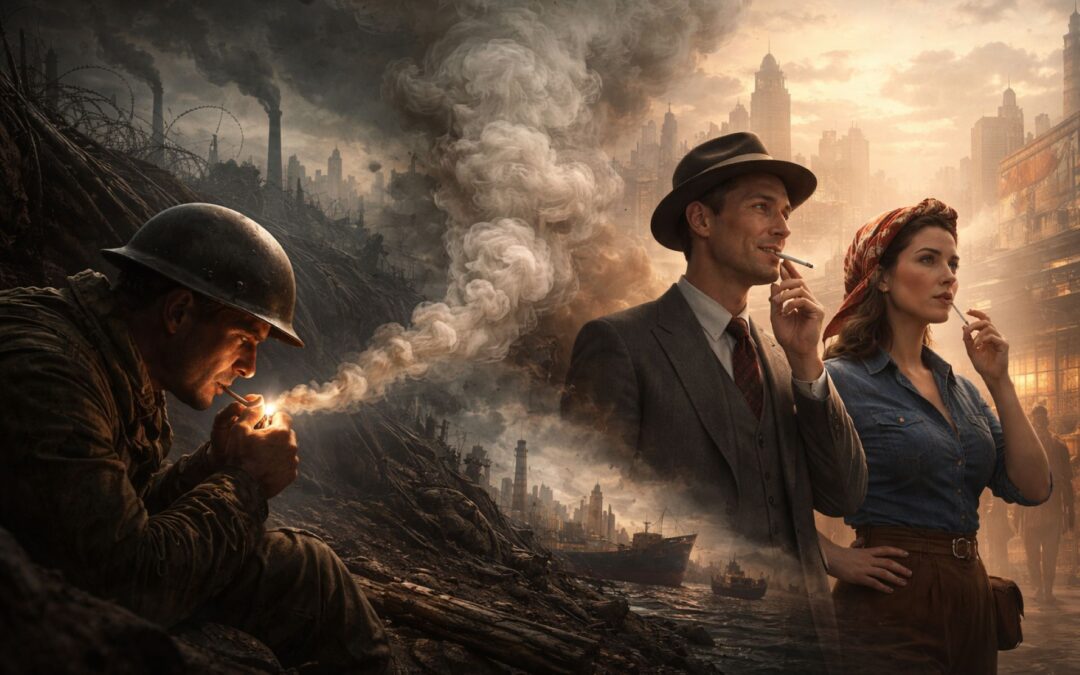
At the dawn of the twentieth century, the cigarette was not a cultural icon. It was not glamorous, not aspirational, not even particularly respectable. It belonged to the margins—to the kinds of people polite society preferred not to acknowledge. If anything, it was seen as a symptom of decline, a small, smoldering sign that something had gone wrong in the moral fabric of modern life.
And yet, within a single generation, that perception inverted completely.
By the end of the Second World War, the cigarette had embedded itself into the very identity of the modern world. It was in the hands of soldiers and civilians, men and women, laborers and elites. It was rationed by governments, distributed by armies, and immortalized in advertising. What had once been condemned as a vice was now wrapped in the language of patriotism, masculinity, and even freedom.
This transformation did not happen organically. It was not the result of gradual cultural acceptance or a spontaneous shift in taste. It was engineered—accelerated by forces far larger than any single company or social movement.
War did not merely popularize the cigarette. It created the conditions for its dominance.
In the trenches of the First World War, the cigarette became more than a habit—it became a coping mechanism. In the bureaucracies of wartime states, it became a logistical tool. In the aftermath of conflict, it became a commercial opportunity of unprecedented scale. What began as a way to steady the nerves of soldiers under fire evolved into one of the most successful—and destructive—consumer products in history.
To understand how the cigarette conquered the world, you don’t start with advertising agencies or corporate boardrooms.
You start with war.
Before the War: A Vice of the Marginalized
Long before it became a cultural staple, the cigarette existed under a cloud of suspicion and disdain. It was not merely unpopular—it was actively distrusted. Across both Europe and the United States, it carried a set of associations that placed it firmly outside the bounds of respectable society.
Part of this came from unfamiliarity. Unlike pipes or cigars, which had long histories and were embedded in established social rituals, the cigarette felt new, foreign, and oddly transient. It lacked tradition, and in that absence, people projected their anxieties onto it. What they saw was not just a different way of consuming tobacco, but a symbol of something destabilizing.
In Britain, cigarettes were linked with softness—seen as an effeminate alternative to the pipe, which was associated with stoicism and masculine control. In the United States, the perception was harsher. The cigarette was tied to delinquency, to urban decay, to immigrants and outsiders whose customs were viewed with suspicion by the middle class. It was, in many ways, a social marker—one that signaled not belonging.
This anxiety quickly translated into moral panic.
Public figures and institutions began to frame the cigarette not just as unhealthy, but as socially corrosive. Reformers warned that it would weaken the youth, dull the mind, and erode discipline. Industrialist Henry Ford went so far as to argue that cigarette smoking was a common trait among criminals, turning the act into a kind of behavioral red flag. Temperance activists, already mobilized against alcohol, folded cigarettes into their broader campaign against vice, drawing parallels between nicotine and the destructive habits they sought to eliminate.
The rhetoric could be extreme, even apocalyptic. Commentators warned that widespread cigarette use could contribute to national decline, as though the habit itself carried within it the seeds of societal collapse. It wasn’t just about health—it was about identity, morality, and the perceived fragility of modern civilization.
And yet, beneath all this resistance, something else was happening.
Consumption was rising.
Even as lawmakers attempted to curb its spread—fifteen U.S. states enacted bans on cigarette sales between the late nineteenth and early twentieth centuries—the cigarette quietly gained ground. These bans proved temporary, and ultimately ineffective. By the 1920s, they had all been repealed. Meanwhile, usage surged dramatically, with per capita consumption increasing by orders of magnitude in just a couple of decades.
This contradiction is important.
The cigarette did not emerge from a place of acceptance. It forced its way into society against resistance, growing stronger even as it was condemned. By the time the First World War began, it was already on an upward trajectory—still controversial, still stigmatized, but undeniably present.
What it lacked was legitimacy.
War would provide it.
The First Shock: How World War I Normalized Smoking
When the First World War began in 1914, it did not just redraw borders or topple empires—it reorganized everyday life at a scale the world had never seen before. Entire societies were mobilized. Economies were restructured. Millions of men were pulled out of civilian life and placed into an environment where normal rules no longer applied.
In that environment, the cigarette found its opening.
Before the war, smoking a cigarette could mark you as suspect. During the war, it became something else entirely—a small, practical comfort in an otherwise unlivable reality. Soldiers were not operating within the moral frameworks of peacetime society. They were enduring conditions that made concerns about propriety, long-term health, or social image feel almost irrelevant.
What mattered was survival. And just as importantly, psychological endurance.
Military leadership recognized this quickly. The trench was not just a physical battlefield—it was a psychological one. Constant artillery fire, the ever-present threat of death, the monotony punctuated by terror—it created a kind of sustained stress that few had ever experienced before. Keeping soldiers functional meant finding ways to manage that stress, however temporarily.
The cigarette proved to be an efficient solution.
It was small, portable, easy to distribute, and quick to consume. Unlike pipes or cigars, it required no preparation, no maintenance, no time. In a setting where every moment could be interrupted, that mattered. More importantly, nicotine had a tangible effect—it calmed nerves, reduced anxiety, and provided a brief sense of control in an environment defined by chaos.
So militaries began to supply them.
Cigarettes were included in rations across multiple armies—American, British, French, German. They were handed out not as luxuries, but as necessities. Commanders spoke of tobacco in the same breath as food and ammunition, recognizing its role in maintaining morale. It wasn’t framed as indulgence; it was framed as utility.
And that distinction changed everything.
Because once the cigarette was sanctioned by the military, it shed its previous identity. It was no longer the habit of the outsider—it was the habit of the soldier. And the soldier, in wartime, occupies a very specific place in society. He is not marginal. He is central. He represents sacrifice, duty, and national purpose.
That association carried weight.
At the same time, institutions that had once opposed smoking began to reverse their positions. Organizations like the YMCA, which had previously criticized cigarettes as a social ill, started distributing them to troops. The logic was pragmatic. In the hierarchy of vices available to soldiers—alcohol, prostitution, gambling—cigarettes seemed like the least destructive option. If smoking could keep men away from more destabilizing behaviors, then it became not just acceptable, but desirable.
Health concerns, which had once dominated the conversation, were pushed aside. In the context of industrialized warfare, where death could arrive at any moment, the long-term risks of smoking seemed abstract, almost trivial. The calculus had shifted from prevention to immediate coping.
By the time the war ended, something fundamental had changed.
The cigarette had not just spread—it had been legitimized.
The Trench as an Incubator of Addiction
If the First World War normalized the cigarette, the trench turned it into something far more enduring.
Life in the trenches was defined by extremes—long stretches of suffocating boredom interrupted by sudden, violent chaos. There were few outlets, fewer comforts, and almost no sense of control. In that environment, even the smallest ritual could take on outsized importance. The act of lighting a cigarette, inhaling, exhaling—it became structure in a place where structure had collapsed.
But more than that, it became dependency.
Nicotine is not just calming; it is habit-forming. And the conditions of trench warfare were perfectly suited to accelerate that process. Soldiers smoked to steady their nerves before an attack, to fill the emptiness between engagements, to cope with exhaustion, to blunt fear. The behavior repeated itself day after day, under stress levels far beyond anything in civilian life. What might have been an occasional indulgence in peacetime became a constant presence.
The military did not just allow this—it facilitated it.
Cigarettes were distributed regularly, often embedded directly into daily rations. Supply chains were built to ensure their availability. Requests for tobacco were treated with urgency, sometimes rivaling essential provisions. Commanders understood that a soldier without cigarettes was a soldier harder to manage—more anxious, more restless, less predictable.
In effect, the system reinforced the habit at every level.
There is a tendency to view addiction as a personal failing or an individual choice. But what happened in the trenches was something different. It was systemic. Entire armies were exposed to the same stimuli, given the same tools, and pushed into the same patterns of behavior. The result was predictable: mass habituation.
By some estimates, the overwhelming majority of soldiers used tobacco in one form or another during the war. Cigarettes, in particular, became the dominant form—not because of cultural preference, but because they fit the constraints of war better than any alternative.
And then the war ended.
Millions of men returned home, carrying with them not just memories of the front, but the habits formed there. Habits reinforced daily, under extreme psychological conditions, and supported by institutional supply. What had been learned in the trenches did not stay in the trenches.
It followed them back into civilian life.
This is the critical pivot point.
Because once the cigarette left the battlefield, it did not return to its old status as a marginal vice. It arrived embedded in the routines of a generation—men who were now reintegrating into society, bringing their behaviors into homes, workplaces, and social circles.
The trench had done its work.
It had taken a controversial product and transformed it into a deeply ingrained habit—one that was about to scale far beyond the battlefield.
From Soldiers to Civilians: The Postwar Spillover
When the war ended, the machinery that had sustained cigarette consumption did not simply switch off. It changed form.
Millions of soldiers returned home carrying habits that had been forged under extreme conditions. These were not casual users. They had been smoking daily, often heavily, in environments where cigarettes were both abundant and encouraged. The behavior was no longer experimental—it was routine. And routines, once established at that intensity, rarely dissolve on their own.
What followed was not a gradual diffusion of smoking into civilian life, but a rapid spillover.
Former soldiers reentered society and resumed ordinary roles—workers, husbands, fathers—but they did not leave their habits behind. Cigarettes moved with them into homes, into public spaces, into social interactions. Smoking became visible in a way it had never been before, not confined to the margins, but embedded in everyday life.
This visibility mattered.
Social behaviors are often contagious not because they are imposed, but because they are observed. When large numbers of men—many of them seen as veterans, as participants in a national effort—smoked openly, it shifted perception. The cigarette no longer signaled deviance. It signaled experience. Endurance. In some cases, even quiet authority.
The stigma that had once surrounded it began to erode.
At the same time, there was a numerical reality that made this transformation almost inevitable. The scale of the war meant the scale of exposure was unprecedented. Entire generations had passed through the same system, been given the same product, and formed the same dependency. When they returned, they did not exist in isolation—they were part of a critical mass.
That critical mass created demand.
And where there is demand, supply follows quickly.
Cigarette companies understood this almost immediately. They were not introducing a new product to an unfamiliar market; they were stepping into a landscape already primed for consumption. The challenge was not to convince people to start smoking—it was to capture those who already were.
Timing became crucial.
Within months of the war’s end, advertising campaigns began to appear, explicitly targeting returning soldiers and the society around them. The message was subtle but effective: this habit, formed in war, belonged in peace as well. The cigarette was not an aberration of extraordinary circumstances—it was a continuation of them.
This is where the transformation deepened.
Because once the habit was anchored in civilian life, it began to expand beyond its original base. Friends, family members, coworkers—people who had not been in the trenches—were now exposed to smoking not as a questionable act, but as something normalized by those they trusted or admired.
The spillover became a spread.
What had been seeded in the trenches started to propagate through society, no longer dependent on military distribution or wartime necessity. It had crossed the threshold into culture.
And once a behavior becomes cultural, it becomes far harder to contain.
Manufacturing Patriotism: The Birth of Cigarette Marketing
By the time soldiers returned home, the cigarette no longer needed to fight for relevance. It had something far more valuable—an embedded user base. What it lacked, however, was narrative control.
That is where the industry stepped in.
Cigarette companies were quick to recognize that they were not just selling a product; they were inheriting a story. Millions of men had smoked through war, under conditions that lent the act a certain weight. The opportunity was not to create meaning from scratch, but to capture and reshape the meaning that already existed.
So they did something subtle, but powerful.
They linked the cigarette to the soldier.
Early postwar advertisements began to depict servicemen—uniformed, composed, unmistakably associated with sacrifice and national service—smoking casually. There was no need for heavy messaging. The imagery alone carried the implication: this is what they smoke. And if they smoke it, what does that say about the cigarette?
It was a strategic reframing.
Before the war, cigarettes had been associated with outsiders, with moral weakness, with questionable character. Now, through careful positioning, they were aligned with discipline, courage, and patriotism. The same object, entirely different meaning.
This shift did not happen through argument. It happened through repetition.
Advertising rarely persuades by logic—it persuades by familiarity. By consistently placing cigarettes in the hands of soldiers, the industry normalized the association. Over time, it became intuitive. The cigarette did not just coexist with patriotism; it appeared to embody it.
And once that connection was established, it expanded.
The soldier became a proxy for broader ideals—freedom, democracy, resilience. Smoking, by extension, inherited those associations. What had once been condemned as a social ill was now reframed as part of a modern identity, aligned with progress and national strength.
There was another layer to this as well.
The war had already disrupted older social hierarchies. Class distinctions blurred in the trenches. Shared experience replaced inherited status, at least temporarily. Cigarette marketing tapped into that shift, presenting smoking as something universal—accessible, unifying, almost egalitarian. It was not the preserve of elites or outcasts anymore. It was for everyone.
This universality made the product scalable.
But perhaps the most effective element was how seamlessly the transition was executed. There was no abrupt pivot, no obvious break from the past. The industry simply extended the wartime context into peacetime, allowing the associations formed under pressure to persist without resistance.
It felt natural.
And that is what made it so effective.
Because by the time people began to notice the shift, it had already taken hold.
Redefining Masculinity and Social Identity
If patriotism gave the cigarette legitimacy, masculinity gave it permanence.
Before the war, the hierarchy of tobacco consumption was relatively stable. Pipes and cigars occupied the upper tiers—associated with maturity, control, and tradition. The cigarette, by contrast, was seen as a lesser substitute. It was quick, disposable, and, in the eyes of many, lacking in character. In some circles, it was even dismissed as something unserious, bordering on effeminate.
War disrupted that hierarchy.
The soldier did not carry a pipe into the trenches. He did not have the time, the space, or the conditions for ritual. What he carried was a cigarette—something that could be lit quickly, consumed quickly, and discarded just as fast. Over time, that practicality became identity. The cigarette was no longer just convenient; it was what the soldier used.
And the soldier, in the cultural imagination, became the defining figure of masculinity.
This shift had profound implications.
Masculinity is not static—it is constructed, reinforced, and performed. When millions of men returned from war embodying a particular set of behaviors, those behaviors gained weight. Smoking was no longer a questionable habit; it was part of the lived experience of men who had endured something extraordinary.
That association carried into civilian life.
Lighting a cigarette began to signal more than consumption. It suggested composure under pressure, a kind of quiet resilience. It implied that the individual belonged to a group that had seen something of the world, something difficult. Even for those who had not served, adopting the habit became a way of aligning with that image.
In this sense, smoking functioned as a social shorthand.
It communicated identity without words. It placed the smoker within a broader narrative—of toughness, of modernity, of participation in something larger than oneself. The cigarette became a small but visible marker of belonging.
Advertising amplified this dynamic.
Campaigns did not need to explicitly redefine masculinity; they simply reflected and reinforced the new standard. Men in uniform, men at work, men in moments of calm after exertion—all depicted with cigarettes in hand. The message was consistent, even when unspoken: this is what men do.
But the shift extended beyond masculinity alone.
The cigarette also began to reshape social identity more broadly. It became a tool of inclusion, a shared behavior that cut across class lines. In workplaces, in social gatherings, in public spaces, smoking created moments of informal connection. Offering a cigarette, sharing a light—these became small rituals that facilitated interaction.
In a rapidly changing world, that mattered.
Industrialization, urbanization, and the aftermath of war had disrupted traditional social structures. The cigarette, in its simplicity, provided a new kind of social glue—something that could be adopted quickly, understood universally, and performed publicly.
This dual role—both as a marker of masculinity and a facilitator of social cohesion—made the cigarette uniquely adaptable.
It was no longer just a product.
It was part of how people understood themselves, and how they related to others.
The Second World War: From Growth to Explosion
By the time the world slid into the Second World War, the cigarette no longer needed introduction. It was already embedded in civilian life, normalized by the previous conflict, and supported by a growing commercial ecosystem. If the First World War had legitimized smoking, the second would scale it to levels that had once seemed unimaginable.
This was not a repeat of the earlier pattern—it was an escalation.
The infrastructure was already in place. Supply chains had been refined. Production capabilities had expanded. Advertising had matured into a more sophisticated industry. What the Second World War did was pour unprecedented demand into a system that was now fully capable of meeting it.
And that demand was enormous.
Cigarettes were once again integrated into military life, but this time at a far greater scale. Shipments that had been measured in billions during the First World War ballooned into tens of billions annually. The sheer volume reflects something important: this was no longer an improvised morale tool. It was a standardized component of military provisioning.
In practical terms, that meant saturation.
Soldiers did not just have access to cigarettes—they had consistent, abundant access. Smoking became woven into the rhythm of daily life, reinforced not just by stress or habit, but by availability. When something is both desired and constantly present, consumption tends to rise to meet it.
At the same time, the war placed additional strain on civilian markets.
Resources were redirected toward the war effort, production priorities shifted, and yet demand for cigarettes continued to grow—not only among soldiers, but among civilians navigating the uncertainties of wartime life. The result was pressure on supply, leading in some cases to shortages, hoarding, and heightened competition for access.
This dynamic had a predictable effect.
Instead of dampening consumption, scarcity often intensified it. The cigarette took on an added layer of value—not just as a habit, but as something worth securing, worth holding onto. In some contexts, it even functioned as a form of informal currency, exchanged and traded in environments where traditional systems broke down.
Meanwhile, production did not stand still.
Manufacturers ramped up output aggressively, pushing the limits of what had previously been considered feasible. Industrial capacity expanded to meet wartime demand, and in doing so, it established a new baseline. Once production reaches a certain scale, it rarely contracts fully. The system adapts to sustain it.
This is where the Second World War diverges sharply from the first.
The earlier conflict had created the habit and normalized it. The second embedded it within a fully industrialized framework—one capable of producing, distributing, and sustaining cigarette consumption on a global scale.
By the end of the war, the cigarette was no longer just a widely used product.
It was a mass-produced, globally distributed commodity, backed by systems that ensured its continued dominance.
Selling War, Selling Smoke: Advertising at Full Power
If the First World War gave the cigarette its legitimacy, and the Second World War gave it scale, then advertising gave it permanence.
By the 1940s, cigarette companies were no longer experimenting—they were executing. The lessons of the interwar years had refined their approach, and wartime conditions provided the perfect narrative to exploit. The goal was no longer just to associate cigarettes with soldiers. It was to fuse smoking with the very idea of supporting the war effort.
And they did this with remarkable precision.
Advertisements began to blur the line between consumption and contribution. Buying cigarettes was no longer framed as a personal choice—it was subtly positioned as participation. Campaigns encouraged civilians to purchase cigarettes alongside war bonds, as if both acts belonged to the same moral category. One supported the soldier directly, the other indirectly—but both, the messaging implied, were part of the same national duty.
This was not accidental.
It was a calculated merging of identities: the consumer as patriot.
At the same time, cigarette brands competed aggressively for symbolic ownership of the military. Each wanted to be seen as the cigarette of the armed forces—the one most preferred by soldiers, the one most closely tied to life at the front. Advertisements frequently claimed that their brand was the “choice” of servicemen, creating a feedback loop where civilian buyers, wanting to align with soldiers, gravitated toward those same products.
It was a powerful dynamic.
Because the soldier was no longer just a user—he was a marketing asset.
There was also an expansion in emotional tone. Earlier advertising had relied heavily on association—placing cigarettes in certain hands and letting the viewer draw conclusions. Wartime advertising became more direct. It invoked sacrifice, longing, separation. Campaigns encouraged women on the home front to send cigarettes to their husbands, sons, and partners overseas, framing the act as a gesture of care and connection.
The cigarette became a bridge.
A small, physical link between the battlefield and the home, between those who fought and those who waited. In this framing, smoking was no longer just about the individual—it was embedded in relationships, in emotional exchange.
And then there was the illusion of sacrifice.
Some of the most effective campaigns positioned cigarette companies themselves as participants in the war effort. Changes in packaging or production were framed as contributions to national needs. One of the most famous examples involved a brand claiming to alter its packaging to conserve materials for the military, presenting the shift as a patriotic decision rather than a commercial one.
The reality, in many cases, was more pragmatic.
But perception mattered more than intent.
Because once consumers believed that a brand was aligned with the war effort, purchasing its products felt justified—甚至 virtuous. The act of smoking became layered with meaning, extending beyond habit into something that appeared socially and nationally significant.
By the end of the war, this machinery was operating at full capacity.
The cigarette was no longer just present in wartime culture—it was embedded in its messaging, its symbolism, and its emotional landscape.
Expanding the Market: Women, Civilians, and Global Reach
Up to this point, the cigarette’s rise had been anchored primarily in one demographic: soldiers, and by extension, men. But a product built on that base alone has limits. The real breakthrough came when the cigarette escaped those boundaries and entered the broader fabric of civilian life.
The Second World War accelerated that shift.
Wartime economies pulled millions of women into roles they had not previously occupied—factories, logistics, administration. The social landscape was changing in real time. Women were no longer confined to traditional domestic spaces; they were participating directly in the machinery of the war effort.
And where social roles expand, markets follow.
Cigarette companies recognized this immediately. Advertising began to reflect a new kind of woman—active, capable, modern—and crucially, smoking. This was not framed as rebellion, but as alignment. If women were contributing to the war like men, why shouldn’t they share in the same habits?
The messaging was subtle but effective.
Smoking became a symbol of participation in modern life, a visual shorthand for independence without explicitly positioning itself as political. It did not challenge norms directly; it evolved alongside them. For many women, the cigarette became part of this transition—a small but visible marker of changing identity.
At the same time, civilian consumption more broadly continued to rise.
War does not just affect those on the front lines. It reshapes the emotional and psychological landscape of entire societies. Anxiety, uncertainty, disruption—these create fertile ground for coping mechanisms. The cigarette, already normalized and widely available, fit easily into that role. It required no explanation, no introduction. It was simply there.
Accessible. Familiar. Reinforced by both military and media.
But the most consequential expansion was geographical.
The Second World War and its aftermath created conditions for an unprecedented level of global integration. Supply lines stretched across continents. Political alliances reshaped trade networks. And in the wake of the conflict, reconstruction efforts opened entire regions to external influence.
The cigarette moved through these channels.
It followed soldiers, aid shipments, commercial exports. It entered markets that had previously been isolated or less saturated. In many cases, it arrived not as a novelty, but as a fully formed cultural product—complete with branding, identity, and the implicit endorsement of the most powerful nations in the world.
This is where scale becomes self-reinforcing.
Once a product is embedded across multiple demographics and geographies, it no longer depends on any single group for its survival. It becomes resilient. Expansion in one area compensates for stagnation in another. Growth feeds on itself.
By the end of the war, the cigarette had achieved something rare.
It was no longer confined by class, gender, or geography. It had become universal.
The Politics of Tobacco: Germany, Propaganda, and Perception
Not every country followed the same trajectory, and Germany offers a useful counterpoint—not because it resisted cigarettes entirely, but because its relationship with them was more complicated.
On paper, the Nazi regime positioned itself against smoking. Anti-tobacco rhetoric was woven into broader ideas about public hygiene, discipline, and social purity. Restrictions were introduced in certain public spaces, and officials spoke openly about the dangers of smoking, framing it as a habit that weakened the individual and, by extension, the state.
In isolation, this might have slowed the spread of cigarettes.
But wartime reality introduced a contradiction.
Despite its ideological stance, the regime still supplied cigarettes to soldiers. As in other armies, tobacco served a practical function—managing stress, stabilizing morale, maintaining a degree of psychological control in environments defined by uncertainty and fear. Attempts to fully suppress smoking clashed with the immediate needs of a military engaged in total war.
So the system adapted.
Public opposition coexisted with private distribution. Anti-smoking messaging remained part of the official narrative, but in practice, cigarettes continued to circulate—especially among those on the front lines. The result was a fragmented approach, one that neither fully embraced nor effectively eliminated the habit.
At the time, this inconsistency may have seemed insignificant.
But its long-term effects were anything but.
After the war, Germany underwent a profound transformation. The collapse of the Nazi regime did not just dismantle a political system—it discredited many of the ideas associated with it. This created a kind of cultural vacuum, where anything linked, even indirectly, to the previous regime became suspect.
Anti-smoking campaigns fell into that category.
Because the Nazis had publicly criticized smoking, postwar efforts to curb tobacco use risked being interpreted through that same lens. Opposition to cigarettes, however well-intentioned, could be framed as echoing an authoritarian past. That association made public health messaging more difficult to advance, particularly in a society actively distancing itself from its recent history.
Cigarette advocates were quick to exploit this.
By drawing implicit parallels between anti-smoking efforts and authoritarian control, they reframed the debate. Smoking was no longer just a personal choice or a health issue—it became entangled with ideas of freedom, autonomy, and resistance to imposed discipline.
This reframing had consequences.
It weakened the momentum of early health campaigns and allowed smoking to expand with less resistance than it might have otherwise faced. In effect, the political context had reshaped the cultural meaning of the cigarette once again—this time not through direct promotion, but through the discrediting of its opposition.
Germany’s case highlights an important point.
The spread of the cigarette was not driven solely by supply, demand, or marketing. It was also shaped by perception—by the way societies interpreted the habit in relation to broader political and cultural narratives.
And in that arena, even opposition could be turned into advantage.
The Marshall Plan and the Globalization of Smoking
By the end of the Second World War, much of Europe was physically shattered and economically exhausted. Infrastructure lay in ruins, industries had collapsed, and entire populations were struggling to return to any semblance of normal life. Into this vacuum stepped the United States—not just as a military victor, but as an economic architect.
The Marshall Plan was designed to rebuild Europe. On paper, it was a recovery program—capital, goods, and resources flowing into war-torn nations to stabilize economies and prevent political collapse. But embedded within that flow was something less obvious, yet deeply consequential.
Tobacco.
A non-trivial portion of aid shipments consisted of tobacco products, including cigarettes. On the surface, this might seem incidental—just another commodity among many. But in practice, it carried disproportionate cultural weight. Cigarettes were not merely consumables; they were already loaded with meaning—associated with American soldiers, wartime resilience, and a certain image of modern life.
So when they arrived in Europe, they did not arrive as neutral goods.
They arrived as symbols.
In a continent grappling with scarcity, cigarettes took on immediate value. They were traded, hoarded, exchanged—not just for consumption, but as a kind of informal currency in economies where formal systems were still fragile. Their portability and universal demand made them uniquely suited to this role. In some places, they became as valuable as cash.
This accelerated their integration.
At the same time, the influx of American tobacco reshaped local markets. Domestic producers, already weakened by war, struggled to compete with the volume and pricing of imported goods. In countries where tobacco had been a significant industry, this created tension. Local economies were being undercut by the very aid meant to stabilize them.
But the flow continued.
Political considerations often outweighed economic objections. The broader goal of the Marshall Plan was to anchor Western Europe within a capitalist framework, countering the influence of the Soviet Union. Consumer goods—especially those associated with American life—played a role in that strategy. They were not just rebuilding economies; they were shaping preferences, habits, and expectations.
The cigarette fit perfectly into that equation.
It was easy to distribute, immediately desirable, and already culturally primed by years of wartime exposure. As a result, smoking rates in many European countries rose sharply in the postwar period, reinforcing patterns that had begun during the conflict.
There was also a feedback loop at play.
The expansion of smoking created new tax bases for governments struggling to rebuild. Tobacco taxes became a reliable source of revenue, further entrenching the product within national economies. What began as aid evolved into dependency—not just at the level of individuals, but at the level of states.
This is where the cigarette’s transformation reaches a new phase.
It is no longer just a habit, or even a global commodity.
It becomes part of the economic and political infrastructure of the postwar world.
How Governments Became Dependent on Cigarettes
By the late 1940s, the cigarette was no longer just a widely consumed product—it had become fiscally significant.
Governments emerging from the war faced a difficult balancing act. Reconstruction required massive spending, yet economies were still fragile, industrial output uneven, and traditional revenue streams unreliable. In that context, the cigarette offered something rare: a product with consistent demand, easy distribution, and a tax base that could be expanded without immediate resistance.
So states leaned into it.
Tobacco taxes began to occupy an increasingly important place in government finances. The logic was straightforward. Cigarettes were already embedded in daily life, consumption was rising, and taxation could be layered on top without disrupting supply. Unlike other goods, taxing cigarettes did not meaningfully reduce demand in the short term. If anything, it generated predictable, stable revenue.
This created an incentive structure that was difficult to unwind.
On one hand, governments had a public interest in reducing smoking—concerns about health were not entirely absent, even if they were often secondary. On the other hand, they had a financial interest in maintaining, or at least not aggressively curbing, consumption. The more people smoked, the more revenue flowed in.
That tension defined the relationship.
It is easy to think of regulation as something that naturally follows from harm. But in the case of cigarettes, regulation was complicated by dependency—not just at the individual level, but at the institutional one. Governments were no longer neutral observers. They were participants in a system that benefited from the very behavior they might otherwise discourage.
This dependency was reinforced over time.
As smoking rates rose, so did tax revenues. As revenues grew, they became integrated into national budgets—funding public services, infrastructure, and social programs. Removing or significantly reducing that income would create gaps that were not easily filled by alternative sources.
In effect, the cigarette became a financial instrument.
Not designed as one, but functioning like it—generating steady returns through widespread, repeated consumption. And because those returns were tied to behavior that had already been normalized and reinforced over decades, they proved remarkably resilient.
There was also a political dimension.
Taxing cigarettes was often seen as more acceptable than taxing other goods or income. It targeted a specific behavior, one that could be framed as discretionary. This made it easier to justify increases, especially in times of fiscal pressure. Over time, this further entrenched the relationship between governments and tobacco revenue.
The result was a kind of equilibrium.
The cigarette persisted not just because people wanted it, or because companies marketed it effectively, but because entire systems had adapted around it. Economies accounted for it. Budgets relied on it. Policies accommodated it.
What had begun as a wartime convenience had become structurally embedded.
And once something reaches that level of integration, removing it becomes far more complex than simply recognizing its harm.
War, Identity, and the Social Psychology of Smoking
By the time the dust settled on the mid-twentieth century, the cigarette had moved far beyond utility, beyond marketing, even beyond economics. It had entered something more durable—identity.
War had not just distributed cigarettes or normalized their use. It had embedded them into the psychological fabric of entire societies.
At the most basic level, smoking had become a shared experience. In the trenches, it functioned as a quiet ritual—something done collectively, often in silence, binding individuals together in moments of tension or exhaustion. That dynamic did not disappear when soldiers returned home. It translated into civilian life, where the cigarette retained its role as a social connector.
Lighting a cigarette was rarely just an individual act.
It invited interaction. It created pauses in conversation. It established moments of informal connection between strangers and acquaintances alike. In workplaces, on streets, in homes—it became a kind of social shorthand, signaling openness, familiarity, and a willingness to participate in a shared behavior.
This is where the psychology deepens.
Humans are not just influenced by what they consume, but by what that consumption represents. The cigarette had accumulated layers of meaning—resilience, camaraderie, modernity, even rebellion depending on context. These meanings were not imposed all at once; they were built gradually, through repeated association across different environments.
War accelerated that process.
It compressed experiences that would normally unfold over decades into a few intense years. It exposed millions of people to the same behavior under similar conditions, creating a kind of collective imprint. When those individuals reintegrated into society, they carried that imprint with them, reinforcing it through repetition.
The result was normalization at scale.
But normalization alone does not explain persistence. Many behaviors become common and then fade. The cigarette endured because it became tied to belonging.
To smoke was, in many contexts, to be part of something.
Part of a group, part of a moment, part of a broader cultural rhythm. It reduced friction in social interactions, provided an easy entry point into conversation, and offered a visible marker of participation. Even for those who were aware of its risks, these social benefits were immediate and tangible in ways that long-term consequences were not.
There was also an element of conformity.
Once a behavior becomes widespread, abstaining from it can carry its own social cost. In environments where smoking was common, not smoking could mark someone as different, as outside the norm. Over time, this subtle pressure reinforced the habit, drawing in individuals who might not have otherwise engaged with it.
War did not create this psychology, but it amplified it.
It took a behavior that had once been marginal and embedded it within the core mechanisms of social interaction. It made smoking not just something people did, but something that meant something.
And meaning, once attached, is difficult to strip away.
Conclusion
The rise of the cigarette is often told as a story of corporate ambition or consumer choice. But that framing misses the scale of what actually happened.
This was not just a product finding its market.
It was a system being built around it.
War provided the conditions. It stripped away social resistance, replaced stigma with necessity, and introduced the cigarette to millions under circumstances where habit formation was almost inevitable. Militaries distributed it. Institutions endorsed it. Soldiers internalized it.
Then came the transition.
Those habits did not disappear when the wars ended—they expanded. Industries moved in, not to create demand, but to capture and amplify it. Advertising reshaped perception, attaching meaning to the act of smoking. Governments, whether intentionally or not, reinforced the system through taxation and policy. International programs carried the cigarette across borders, embedding it in economies still struggling to recover.
At each stage, the cigarette became harder to disentangle.
What began as a coping mechanism in the trenches evolved into a cultural norm, then into a global commodity, and finally into a structural dependency. Individuals relied on it. Markets scaled around it. States profited from it.
And throughout this process, its identity kept shifting—vice to necessity, necessity to patriotism, patriotism to lifestyle.
That fluidity was its greatest advantage.
Because the cigarette never had to justify itself in a single, fixed way. It adapted to context, absorbing whatever meaning made it easier to sustain. In war, it was survival. In peace, it was identity. In economics, it was revenue.
The result is something that still persists today.
Even as awareness of its health risks has grown, even as regulations have tightened, the legacy of that earlier transformation remains. The cigarette is no longer ascendant in the same way it once was, but the structures that enabled its rise—mass distribution, behavioral reinforcement, cultural embedding—continue to shape how products spread and endure.
In that sense, the story of the cigarette is not just about tobacco.
It is about how environments—especially extreme ones like war—can accelerate adoption, normalize behavior, and reshape society in ways that outlast the events themselves.
The cigarette burned brightest in the chaos of the twentieth century.
And long after the smoke cleared, the habit remained.