
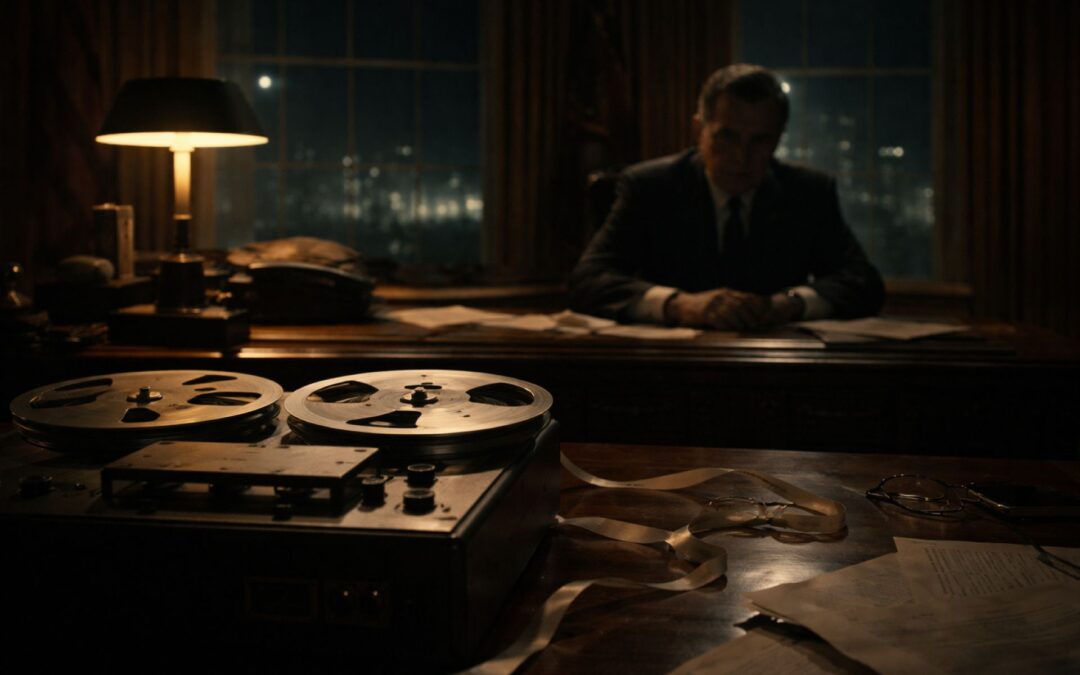
It began, as many historic collapses do, with something that seemed almost trivial.
A strip of tape on a door latch. A security guard doing his rounds. A quiet call to the police in the early hours of the morning. There was no spectacle, no grand announcement—just a small irregularity in an otherwise routine night. And yet, from that moment, a chain of events was set in motion that would unravel the presidency of Richard Nixon and permanently alter the relationship between the American public and its government.
The Watergate scandal was not merely a story about a failed burglary. It was a story about power exercised in the shadows, about a political system pushed to its limits, and about how institutions respond when confronted with abuse at the very top. What made it extraordinary was not just the crime itself, but the scale and audacity of the cover-up that followed—a coordinated effort that reached into the highest levels of the White House.
At the time, few could have predicted how far the consequences would reach. The president at the center of the storm was fresh off major diplomatic victories, commanding strong public support, and heading toward what appeared to be an inevitable reelection. From the outside, the system looked stable—secure, even.
But beneath that surface lay a different reality: one shaped by suspicion, secrecy, and a growing willingness to use the machinery of government for political survival. Watergate exposed that reality in slow, relentless detail, not through a single revelation, but through a steady accumulation of facts that became impossible to ignore.
This is the story of how that process unfolded—how a minor break-in escalated into a constitutional crisis, how journalists, investigators, and institutions pieced together the truth, and how, in the end, the most powerful office in the world was forced to confront its own limits.
The Illusion of Control: Nixon at the Height of His Power
By the time 1972 arrived, Richard Nixon appeared to have achieved what few presidents ever do: dominance across both domestic and international arenas.
Abroad, he had reshaped the geometry of the Cold War. His administration engineered détente with the Soviet Union, culminating in landmark agreements like the Strategic Arms Limitation Talks. Even more dramatically, Nixon had opened diplomatic relations with the People’s Republic of China—an audacious geopolitical maneuver that no American president had attempted in over two decades. These moves did not just stabilize tensions; they redefined America’s position in the global order.
At home, the long and deeply unpopular Vietnam War was beginning to wind down under his policy of “Vietnamization.” While far from universally accepted, it created the perception that Nixon was bringing an end to a conflict that had fractured the nation for years. For many Americans, that alone was enough.
The result was political capital of the highest order. Approval ratings climbed. Opposition fractured. As the 1972 election approached, Nixon was not merely favored—he was expected to win decisively. His Democratic opponent, George McGovern, struggled to build momentum against an incumbent who seemed firmly in control of both narrative and reality.
But that sense of control was, in many ways, an illusion.
Beneath the public image of strategic brilliance and political strength was a presidency increasingly defined by insecurity. Nixon did not see his position as secure; he saw it as constantly under threat. Critics were not just opponents—they were enemies. Dissent was not just disagreement—it was sabotage. In this mindset, political success did not eliminate fear; it intensified it.
This contradiction—unmatched power paired with deep suspicion—would prove to be the defining tension of Nixon’s presidency. It shaped how decisions were made, how rivals were treated, and how far the administration was willing to go to maintain its advantage.
At the very moment when Nixon seemed untouchable, the conditions for his downfall were already in place.
Paranoia in the Oval Office: The Enemies List and Abuse of Power
Power, in Nixon’s case, did not produce confidence. It produced vigilance—constant, consuming, and deeply personal.
Inside the White House, this mindset took on a formal structure. What began as political caution evolved into something far more systematic: the identification and targeting of perceived enemies. The so-called “enemies list” was not a metaphor or a piece of political rhetoric. It was an actual document—compiled, updated, and quietly circulated among senior officials—containing the names of journalists, activists, politicians, and public figures who had, in one way or another, challenged or criticized the administration.
But the significance of the list was not in its existence alone. It was in what the administration did with it.
The machinery of government—agencies designed to operate above partisan conflict—was increasingly drawn into political strategy. The Internal Revenue Service was used to initiate audits against individuals on the list. The Federal Bureau of Investigation and the Central Intelligence Agency were pressured, directly and indirectly, to monitor or disrupt those seen as threats.
This was not governance in the traditional sense. It was the blending of state power with political survival.
From Nixon’s perspective, these actions were defensive. He believed he was surrounded by hostile forces—within the media, within the bureaucracy, even within his own government. Leaks, protests, and opposition were interpreted not as the byproducts of a democratic system, but as coordinated efforts to undermine his presidency.
That belief justified escalation.
What might have once been handled through political messaging or electoral competition began to shift into covert action. Surveillance, intelligence gathering, and institutional pressure became tools not just of national security, but of domestic politics. The lines that typically separate the two began to blur, then fade.
In this environment, restraint became a liability. The logic was simple and dangerous: if opponents were willing to operate aggressively, then the administration had to be even more aggressive in response.
It was only a matter of time before that logic crossed a boundary that could not be contained.
CREEP and the Machinery of Political Espionage
By 1972, the mindset inside Nixon’s orbit had found its operational arm.
The reelection campaign of Richard Nixon was formally run by the Committee to Re-elect the President—a name that sounded bureaucratic, almost forgettable. In practice, it became something else entirely. The press quickly gave it a nickname that stuck: “CREEP.” What began as a convenient acronym soon felt like an accurate description.
Officially, the committee existed to secure Nixon’s second term. Unofficially, it evolved into a hub for activities that went far beyond conventional campaigning.
Standard political tactics—advertising, rallies, voter outreach—were still in play. But running parallel to them was a shadow campaign built on disruption, surveillance, and manipulation. Democratic candidates found themselves dealing with forged documents designed to fracture their campaigns from within. False letters were circulated to create internal divisions. Sensitive information, when obtained, was used strategically to weaken opposition at critical moments.
These were not isolated excesses carried out by rogue operatives. They were part of a broader culture that encouraged results over restraint.
At the center of this effort were individuals with backgrounds that blurred the line between politics and covert operations. Some had ties to intelligence work. Others were simply willing to operate in legal gray zones if it meant securing an advantage. What united them was a shared assumption: that the stakes justified the methods.
That assumption reshaped the campaign.
Information became a weapon, and acquiring it—by any means necessary—became a priority. The idea of physically entering an opponent’s space, copying documents, or installing listening devices no longer seemed unthinkable. It was framed as proactive, even necessary, in a political environment perceived as hostile and unforgiving.
Within this logic, escalation did not feel like a risk. It felt like strategy.
And so, when the decision was made to target the Democratic National Committee headquarters, it did not emerge from a moment of desperation. It was the natural extension of a system that had already normalized intrusion, secrecy, and control.
What followed would reveal just how fragile that system really was.
The Watergate Break-In: A Burglary That Should Have Meant Nothing
In the early hours of June 17, 1972, five men entered the Watergate Complex with a clear and limited objective.
The building itself was unremarkable in political terms—a modern complex overlooking the Potomac River, housing offices, apartments, and a hotel. But on its sixth floor sat the headquarters of the Democratic National Committee. That made it a target.
The men who moved through its corridors that night were not amateurs. They wore business suits to blend in, rubber gloves to avoid leaving fingerprints, and carried professional-grade equipment: lock picks, cameras, and electronic surveillance devices. They also carried cash—hundreds of dollars in neatly organized bills—suggesting preparation, planning, and a degree of confidence that this operation would go smoothly.
And in a sense, it already had.
This was not their first entry into the building. Weeks earlier, the same group had successfully broken in and installed listening devices. The operation had gone unnoticed. The system had worked exactly as intended. What brought them back was not ambition, but maintenance. One of the bugs was malfunctioning, and they intended to fix it.
That detail matters.
This was not a desperate gamble or a reckless one-time intrusion. It was part of an ongoing effort—routine, almost procedural. The kind of operation that becomes invisible to those carrying it out because it has already succeeded once before.
But success, in operations like this, often breeds complacency.
The men retraced their steps, entered the offices, and began their work under the assumption that nothing had changed. No alarms had been triggered the first time. No suspicions had been raised. There was no reason to expect anything different now.
They were wrong.
What should have been another quiet, unnoticed entry—another small piece in a much larger political machine—was about to collapse under the weight of a single, overlooked detail.
A Small Suspicion: How Frank Wills Changed History
The operation did not fail because of sophisticated counterintelligence or a coordinated federal response. It failed because one person paid attention.
Frank Wills was a 24-year-old security guard working the night shift at the Watergate Complex. His job was routine—walk the building, check doors, ensure everything was secure. It was the kind of work that depends less on authority and more on consistency.
Sometime after midnight, during one of his rounds, Wills noticed something out of place.
A door leading from the parking garage into the building had been tampered with. A piece of tape had been placed over the latch to prevent it from locking. It was a small detail, easy to overlook, and for a moment, it could have been dismissed as a harmless irregularity. Instead, Wills removed the tape and continued his patrol.
When he returned later, the tape was back.
That changed everything.
The significance of the moment lies not in the discovery itself, but in the decision that followed. Wills did not rationalize it away. He did not assume it was someone else’s responsibility. He recognized the pattern—interference, correction, and then repetition—and treated it as a potential threat.
He called the police.
Within minutes, plainclothes officers arrived and began a methodical sweep of the building. Floor by floor, they moved upward, checking offices and hallways that should have been empty at that hour. When they reached the sixth floor, the headquarters of the Democratic National Committee, they found what Wills had unknowingly set in motion.
Five men, hiding in the dark, surrounded by equipment they could not explain.
They were arrested on the spot.
At that moment, the event still appeared contained—a failed burglary, unusual but not unprecedented. There was no immediate indication that it would lead beyond the individuals in custody. No clear connection to the White House. No sense of an expanding crisis.
But the question had already been triggered.
Who sent them?
Once that question entered the public sphere, it became impossible to contain.
The White House Response: Dismissal, Denial, and a Landslide Victory
In the immediate aftermath of the arrests, the incident was treated as something small—contained, almost insignificant.
The White House moved quickly to establish that framing. Press briefings downplayed the break-in, describing it as a “third-rate burglary,” an isolated act with no meaningful connection to the administration. There was no urgency, no sign of concern. The message was deliberate: this was not a story that deserved attention.
And for a time, that strategy worked.
The broader political environment favored Richard Nixon. His administration’s foreign policy successes still dominated headlines. The opposition remained fragmented. The idea that a minor burglary could threaten a sitting president, especially one heading into an election, seemed implausible.
As a result, the issue struggled to gain traction beyond a narrow circle of journalists and investigators.
When Election Day arrived in November 1972, the outcome reinforced that perception. Nixon defeated George McGovern in one of the most decisive victories in American history, carrying 49 out of 50 states. It was not just a win—it was a demonstration of overwhelming political strength.
From the outside, the scandal appeared to have evaporated.
But beneath that victory, the underlying questions remained unresolved. The arrests had established that the break-in was not random. The equipment suggested planning. The money raised suspicions. And the connections, though still unclear, pointed upward.
The administration’s response—dismissal combined with distance—bought time. It did not eliminate risk.
Because while the public had largely moved on, a small number of individuals had not.
And they were beginning to ask the same question, with increasing precision:
Where did the trail actually lead?
Follow the Money: How the Investigation Began to Unravel the Truth
The break-in might have faded into obscurity if it had remained a question of who broke into the building.
Instead, it became a question of who paid them.
From the beginning, the details surrounding the arrested burglars did not align with a typical criminal operation. These were not men acting out of desperation or opportunism. They were well-dressed, organized, and carrying equipment that suggested coordination rather than improvisation. More importantly, they had cash—large amounts of it, in carefully structured denominations.
That detail became the entry point.
Investigators and journalists began tracing the origin of the money found on the burglars. What initially appeared as routine evidence soon revealed something far more significant: the funds were not random. They were connected to political contributions, moving through channels that obscured their source but left behind a traceable pattern.
That pattern led to the Committee to Re-elect the President.
The implications were immediate and serious. If campaign funds had been used to finance the break-in, then the operation was not an isolated act. It was part of a broader, coordinated effort tied directly to the president’s reelection apparatus.
But the trail did not stop there.
The money had been routed through multiple intermediaries, including accounts outside the United States, before reaching the individuals involved in the burglary. This layering was not accidental. It was designed to conceal origin, to create distance between the act and those responsible for authorizing or funding it.
Yet the very act of concealment created complexity—and complexity leaves traces.
As reporters and investigators followed each link, the structure of the operation began to take shape. What had been dismissed as a minor crime was now connected to a network of financial transactions that pointed toward deliberate planning at higher levels.
The investigation was no longer about proving that a crime had occurred. That was already established.
It was about mapping responsibility.
And as that map expanded, it became increasingly difficult to maintain the original narrative that the White House had nothing to do with it.
Woodward, Bernstein, and the Shadow of Deep Throat
If the money trail provided direction, it was journalism that sustained momentum.
At a time when much of the political establishment was willing to accept the official explanation, two reporters at The Washington Post refused to let the story settle. Bob Woodward and Carl Bernstein were not the most senior figures in their newsroom. They were relatively young, still building their reputations. What set them apart was not status, but persistence.
They treated the Watergate break-in not as an isolated incident, but as the visible edge of something larger.
Working methodically, they began connecting fragments—court records, financial disclosures, off-the-record conversations, and quiet confirmations from sources who could not speak publicly. Each piece, taken alone, was inconclusive. Together, they began to suggest a pattern: the burglars were not acting independently, and the connections leading back toward the Nixon campaign were too consistent to ignore.
But the deeper they went, the more resistance they encountered.
Sources grew cautious. Officials denied involvement. The administration maintained its distance, reinforcing the idea that the story lacked substance. In that environment, progress depended on access to information that could not be obtained through official channels.
That access came from a source who would remain anonymous for decades.
Known only by the codename “Deep Throat,” the informant provided guidance rather than direct answers. Meetings were conducted in secret, often in a dimly lit parking garage, away from attention. The instructions were precise but restrained—confirm this detail, pursue that connection, verify before publishing.
The identity behind that name would not be revealed until 2005, when Mark Felt, a senior official within the Federal Bureau of Investigation, confirmed that he had been the source.
At the time, however, the significance of Deep Throat was not who he was, but what he enabled.
His most enduring contribution was a principle rather than a revelation: follow the money.
That guidance reinforced the direction the investigation was already taking, encouraging Woodward and Bernstein to focus on verifiable links rather than speculation. It anchored their reporting in evidence, allowing them to build a case that could withstand scrutiny even as official denials continued.
The result was a gradual shift.
What had once been dismissed as a marginal story began to re-enter public consciousness, not through dramatic breakthroughs, but through steady accumulation. Each article added weight. Each confirmed detail narrowed the space for denial.
The story was no longer fading.
It was advancing—quietly, but with increasing force.
The Expanding Conspiracy: From Campaign Crime to Presidential Cover-Up
As the investigation deepened, the nature of the scandal began to change.
What started as a question about a burglary—and then about campaign financing—evolved into something far more serious: an organized effort to conceal the truth. The focus shifted from the crime itself to what happened after it, and that is where the real scale of the crisis began to emerge.
Inside the Nixon administration, the response to Watergate was not transparency or distance. It was coordination.
Senior officials moved quickly to contain the damage. Payments were arranged to keep the arrested burglars silent—hush money disguised through intermediaries to avoid detection. Testimonies were shaped. Narratives were aligned. The objective was not to clarify events, but to control them.
At the center of this effort were some of the most powerful figures in the administration. H. R. Haldeman and John Ehrlichman operated as key gatekeepers within the White House, managing both information flow and internal response. John Mitchell, who had previously overseen the Justice Department, was also drawn into the orbit of the investigation, further blurring the line between law enforcement and political defense.
The methods used to contain the scandal reflected the same logic that had enabled the break-in.
Federal agencies were pressured to limit the scope of their inquiries. The Central Intelligence Agency was invoked in an attempt to block aspects of the Federal Bureau of Investigation investigation, under the pretext of protecting national security. Documents were withheld or destroyed. Statements to Congress were crafted to mislead rather than inform.
Each action, taken individually, might have been defensible as political damage control.
Taken together, they formed a pattern of obstruction.
This marked a critical turning point in the scandal. The question was no longer whether individuals connected to the campaign had committed a crime. It was whether the presidency itself was being used to prevent accountability.
And that question carried consequences far beyond the original break-in.
Because once a cover-up begins, it creates its own momentum. Every effort to suppress information requires additional actions to maintain the narrative. Every new layer introduces more participants, more risks, and more points of failure.
The system becomes increasingly fragile.
By mid-1973, the strain was beginning to show. The circle of those involved was widening. The pressure from investigations—both journalistic and governmental—was intensifying. And within the administration, not everyone was willing to carry the burden indefinitely.
The first major break was coming—from someone who had been at the center of it all.
The First Crack: John Dean and the “Cancer on the Presidency”
Every cover-up depends on alignment—on the assumption that everyone involved will continue to protect the structure, even as the pressure builds.
That assumption failed.
At the center of the administration’s legal and strategic response to Watergate was John Dean. As White House Counsel, Dean was not a peripheral figure. He was directly involved in managing the fallout, coordinating responses, and understanding the full scope of what had been done to contain the scandal.
Which meant he also understood the risk.
As investigations intensified and the circle tightened, Dean came to a realization that altered the trajectory of the entire crisis. The strategy that had been designed to protect the presidency was beginning to shift inward. Responsibility was not being contained—it was being redistributed. And those closest to the operation were increasingly exposed.
Dean saw where that logic led.
If the situation escalated further, there was a real possibility that the burden would be placed on a limited group of individuals, allowing the president to distance himself from the consequences. Loyalty, in that context, became a liability.
So Dean made a decision that no one at the center of the operation had yet made.
He cooperated.
In June 1973, Dean appeared before the Senate Watergate Committee, testifying under oath in hearings that were broadcast live to millions of Americans. For the first time, the internal mechanics of the cover-up were described not by investigators or journalists, but by someone who had participated in it.
His testimony was controlled, methodical, and precise.
At one point, Dean described the situation in terms that would become central to the public understanding of Watergate. He warned that there was a “cancer on the presidency”—a problem that, if left untreated, would continue to grow and consume the administration from within.
But the impact of his testimony went far beyond metaphor.
Over the course of hours, Dean outlined the structure of the cover-up: the coordination of hush money payments, the attempts to influence federal investigations, the deliberate effort to manage and suppress information. More significantly, he placed the president within that structure—not as a distant observer, but as someone who had been informed and involved.
This was the first direct, detailed allegation linking Richard Nixon to the obstruction itself.
The effect was immediate.
The narrative that the White House had maintained—that the scandal was limited, contained, and disconnected from the president—began to collapse under the weight of insider testimony. Public attention intensified. Congressional scrutiny deepened. The issue was no longer abstract or speculative. It had names, actions, and a coherent timeline.
But there was still a gap.
Dean’s account was powerful, but it remained testimony—one individual’s word against that of the president. For the crisis to reach its full consequence, something more was needed.
Not interpretation.
Proof.
The Tapes Revelation: Nixon’s Secret Recordings Exposed
For months, the scandal had advanced through testimony, documents, and inference.
Then, unexpectedly, it acquired something far more decisive: the possibility of an exact record.
During the Senate hearings in July 1973, a relatively low-profile witness, Alexander Butterfield, introduced a detail that had not previously entered public discussion. In response to a line of questioning that seemed almost routine, Butterfield revealed that the White House operated a secret recording system.
The implication was immediate and profound.
At the direction of Richard Nixon, a voice-activated taping system had been installed in key locations, including the Oval Office. The system automatically recorded conversations—meetings, phone calls, discussions—without the need for manual activation. It had been in operation since 1971.
What this meant, in practical terms, was that the central question of the investigation might no longer depend on memory or interpretation.
It might be preserved in audio.
The scope of the recordings was extensive. Thousands of hours of conversations had been captured, documenting the internal workings of the presidency in real time. If those tapes contained discussions related to Watergate—and there was every reason to believe they might—they would provide a level of detail that no testimony could match.
The dynamic of the crisis shifted instantly.
Until this point, the investigation had been constrained by competing narratives. The administration could challenge testimony, question motives, and deny specific claims. But recordings, if they existed and were accessible, would not rely on credibility. They would speak for themselves.
Which raised a new and urgent question.
Who controlled the tapes?
The answer, of course, was the president.
That placed Nixon in a position with no easy resolution. Turning over the recordings risked confirming the most damaging allegations. Refusing to do so risked escalating the situation into a direct confrontation with Congress and the legal system.
Nixon chose to resist.
He invoked executive privilege, arguing that presidential communications were confidential and protected from disclosure. From a constitutional perspective, the claim was not trivial. It raised legitimate questions about the balance of power between the executive branch and the institutions investigating it.
But in the context of Watergate, it also carried a different meaning.
It suggested that the recordings, if released, would not support the administration’s version of events.
What had begun as a political scandal was now moving toward a constitutional crisis—one in which the central evidence existed, but remained just out of reach.
And as pressure mounted to obtain the tapes, the conflict between the presidency and the investigation was about to escalate dramatically.
The Saturday Night Massacre: A President Against His Own Government
By the autumn of 1973, the struggle over the tapes had reached a breaking point.
The investigation was no longer advancing gradually. It had become a direct confrontation between the presidency and the legal system tasked with examining it. At the center of that confrontation was Archibald Cox, the special prosecutor appointed to pursue the case with a degree of independence from the administration.
Cox’s position was clear: the tapes were essential evidence, and they had to be turned over.
For Richard Nixon, the demand posed an existential threat. Compliance risked exposing the full extent of his involvement. Refusal risked appearing obstructive—but still allowed him to maintain control over the evidence, at least temporarily.
Initially, Nixon attempted a compromise.
He proposed a partial solution in which summaries of the tapes would be provided instead of the recordings themselves. The summaries, he argued, would preserve confidentiality while satisfying the needs of the investigation. Cox rejected the proposal. From a legal standpoint, secondhand interpretations could not replace primary evidence.
The standoff hardened.
On October 20, 1973, Nixon made a decision that would redefine the crisis.
He ordered the removal of the man investigating him.
The directive was first given to Elliot Richardson, who refused to carry it out. Richardson had previously assured Congress that the special prosecutor would be allowed to operate independently. Firing Cox would violate that commitment. Rather than comply, he resigned.
The order then passed to William Ruckelshaus. He also refused—and resigned.
Only when the instruction reached Robert Bork, the third-ranking official in the Justice Department, was it carried out. Bork dismissed Cox, effectively terminating the investigation in its current form.
The sequence unfolded within a single evening.
Three senior officials gone. The special prosecutor removed. The chain of command within the Justice Department abruptly broken.
The event became known as the Saturday Night Massacre, and its impact was immediate.
What had previously been a complex and developing scandal was now unmistakable. The president had intervened directly in an investigation concerning his own conduct, overriding institutional resistance in the process. The question was no longer whether Nixon was attempting to contain the situation. It was whether he was willing to dismantle parts of the government to do so.
Public reaction shifted sharply.
Confidence eroded. Support within Congress—particularly among Republicans who had previously remained aligned with the administration—began to weaken. The perception that the presidency was acting above the law was no longer abstract. It had been demonstrated, visibly and decisively.
And yet, the attempt to halt the investigation did not succeed.
A new special prosecutor would be appointed. The demand for the tapes would return. And the legal battle over executive authority would move beyond the administration’s control.
The crisis had entered a phase where individual decisions could no longer contain it.
It was now moving toward a final judgment.
The Supreme Court Steps In: United States v. Nixon
By 1974, the conflict had moved beyond politics and into the core of the American constitutional system.
The question was no longer simply whether Richard Nixon would comply with investigators. It was whether a sitting president could refuse a direct legal demand for evidence in a criminal investigation. At stake was not just the outcome of Watergate, but the limits of executive power itself.
The case reached the highest authority capable of resolving that question: the Supreme Court of the United States.
Formally titled United States v. Nixon, the dispute centered on Nixon’s claim of executive privilege—the idea that presidential communications must remain confidential to preserve the functioning of the executive branch. It was a serious argument, grounded in concerns about separation of powers and the need for candid internal discussion at the highest levels of government.
But the counterargument was equally clear.
If executive privilege could be used to withhold evidence in a criminal investigation, then the presidency would effectively be placed beyond the reach of the law. The principle of accountability—central to the constitutional system—would be compromised.
The Court’s decision came on July 24, 1974.
It was unanimous.
In an 8–0 ruling, the Court rejected Nixon’s claim that executive privilege could be used to block the release of the tapes. While acknowledging that some level of confidentiality was necessary for presidential functions, the justices concluded that it could not override the demands of due process in the context of a criminal investigation.
The ruling was precise, but its implication was sweeping.
The president was not above the law.
Nixon was ordered to turn over the recordings.
At that moment, the final barrier between the investigation and direct evidence collapsed. The tapes—long contested, long withheld—were no longer a matter of political negotiation. They were a legal obligation.
And once they were released, the remaining ambiguity surrounding the scandal would not survive.
The Smoking Gun: Proof of Direct Presidential Involvement
When the tapes were finally released, the ambiguity that had sustained the presidency disappeared almost immediately.
For months, Richard Nixon had relied on a narrowing line of defense. Even as the scandal expanded, it remained possible—at least in theory—to argue that the president had been misled by subordinates or informed too late to bear direct responsibility. That argument required uncertainty. It depended on the absence of definitive proof.
The recordings eliminated that uncertainty.
Among the thousands of hours of audio, one conversation stood out above all others. Dated June 23, 1972—just six days after the break-in—it captured a discussion between Nixon and his Chief of Staff, H. R. Haldeman. In that conversation, Nixon approved a plan to use the Central Intelligence Agency to interfere with the ongoing Federal Bureau of Investigation inquiry.
The objective was clear: limit the scope of the investigation before it reached the White House.
This recording became known as the “smoking gun.”
Its significance lay not only in what it revealed, but in when it revealed it. The conversation took place at the very beginning of the crisis, before public scrutiny had intensified, before the narrative had fully formed. It demonstrated that the effort to obstruct the investigation was not a reactive measure taken under pressure.
It was a deliberate strategy, initiated at the highest level.
With that, the remaining defenses collapsed.
The idea that Nixon had been unaware of the cover-up was no longer credible. The suggestion that misconduct had been confined to lower-ranking officials could not be sustained. The distinction between the presidency and the actions under investigation effectively disappeared.
The political consequences followed quickly.
Support within Congress, particularly among Republicans who had previously hesitated to break with the administration, began to dissolve. The issue was no longer partisan. It was evidentiary. The facts, now publicly available, left little room for reinterpretation.
The presidency, once shielded by uncertainty, was now exposed by its own record.
What had been a prolonged crisis was suddenly approaching its conclusion.
Impeachment and Isolation: When Allies Turn Away
Once the evidence became undeniable, the political equation changed with remarkable speed.
For much of the scandal, Richard Nixon had relied on a critical advantage: the support—or at least the hesitation—of his own party. As long as Republican lawmakers remained uncertain, divided, or cautious, impeachment remained a possibility rather than an inevitability.
The release of the “smoking gun” tape removed that uncertainty.
Inside Congress, the United States House Judiciary Committee had already been examining the case. In the weeks leading up to the tape’s release, the committee had moved forward with formal proceedings, reviewing evidence and debating the constitutional grounds for impeachment.
The charges under consideration were severe and specific: obstruction of justice, abuse of power, and contempt of Congress.
Initially, there had been room for political calculation. Lawmakers could weigh public opinion, party loyalty, and the strength of the evidence. But once the recordings confirmed direct presidential involvement, those calculations narrowed into a single question: could the president remain in office under these circumstances?
The answer, increasingly, was no.
Support began to erode not at the margins, but at the core. Senior Republican figures—individuals who had defended or tolerated the administration through earlier stages of the crisis—reassessed their position. The issue was no longer about protecting a presidency. It was about preserving institutional credibility.
That shift became unmistakable when a group of Republican leaders visited the White House.
Among them were Barry Goldwater and Hugh Scott, figures whose support carried significant weight within the party. Their message to Nixon was direct: the votes were not there. If impeachment proceeded in the House, conviction in the Senate would follow.
In practical terms, the presidency had lost its political foundation.
Isolation set in quickly. The mechanisms that had once sustained Nixon—party alignment, institutional loyalty, public support—were no longer sufficient to counter the weight of the evidence. The path forward narrowed to a set of outcomes that all led to the same conclusion.
Removal was no longer a possibility.
It was an approaching certainty.
And for the first time, the end of the presidency was not a question of if, but when.
The Fall: Nixon’s Resignation and Final Exit
By early August 1974, the outcome was no longer in doubt.
The convergence of legal pressure, political abandonment, and irrefutable evidence had reduced the presidency of Richard Nixon to a single decision. Impeachment in the House was imminent. Conviction in the Senate was virtually certain. The mechanisms of removal were already in motion.
What remained was whether Nixon would force that process to its conclusion—or step aside before it did.
On the evening of August 8, 1974, he chose the latter.
From the Oval Office, seated behind the Resolute Desk, Nixon addressed the nation in a televised speech watched by tens of millions of Americans. His tone was controlled, but the weight of the moment was unmistakable. He did not frame his departure as an admission of guilt. Instead, he presented it as a practical necessity—an acknowledgment that he no longer possessed the political support required to govern effectively.
At 9:01 p.m. Eastern Time, he delivered the central line:
He would resign the presidency, effective at noon the following day.
No American president had ever done so before.
The announcement marked a constitutional turning point. For the first time in the nation’s history, the office of the presidency was being vacated not through election or death, but through resignation under the pressure of investigation and impending removal.
The next morning, the transition unfolded with a sense of finality.
Nixon delivered a farewell address to White House staff, reflecting on his career in a speech that moved between personal memory and political reflection. Those present described a mixture of loyalty, emotion, and exhaustion—an administration witnessing its own end in real time.
Then, accompanied by his wife, he walked across the South Lawn toward a waiting helicopter.
At the top of the steps, Nixon turned back toward the assembled cameras. He raised both arms, forming a pair of V-shaped gestures—a symbol he had used throughout his political career. The image was brief, but it would become one of the most enduring visuals associated with the era: a president leaving office under circumstances that had once seemed impossible.
With that, he departed the White House.
Moments later, Vice President Gerald Ford was sworn in, bringing the Watergate presidency to an official close.
The office endured.
But the perception of it had changed permanently.
The Pardon: Gerald Ford’s Controversial Decision
The resignation of Richard Nixon brought the presidency to an end, but it did not resolve the question of accountability.
That responsibility now fell to his successor, Gerald Ford.
When Ford took office, the country was politically exhausted. The Watergate scandal had stretched over two years, dominating headlines, fracturing public trust, and straining institutional relationships. The immediate challenge facing the new president was not just governance—it was stabilization.
But there was an unresolved issue at the center of that task.
Nixon, now a private citizen, remained potentially liable for criminal prosecution. The evidence that had driven his resignation could, in principle, form the basis of legal action. A trial would extend the scandal further, keeping it at the center of national life and forcing the country to confront the question of presidential criminality in a courtroom.
Ford had to decide whether that process should proceed.
On September 8, 1974, just one month after Nixon’s resignation, he made his choice.
Ford granted Nixon a full and unconditional pardon for any crimes he may have committed during his presidency.
The decision was sweeping in scope. It did not address specific charges. It did not require an admission of guilt. It preemptively closed the door on any future prosecution related to Watergate-era actions.
Ford justified the pardon as an act of national interest.
He argued that continuing legal proceedings would prolong division and prevent the country from moving forward. In his view, the priority was to end the crisis, not extend it. The presidency, and the nation more broadly, needed closure.
But the public response was sharply divided.
Critics saw the pardon as a denial of accountability—an outcome in which the central figure of the scandal avoided the consequences that others had already begun to face. The fact that dozens of officials connected to Watergate would later be charged or convicted only reinforced that perception.
Supporters, on the other hand, accepted Ford’s argument. They viewed the pardon as a pragmatic decision, one that prioritized institutional recovery over retribution.
Politically, the cost to Ford was immediate.
Public approval dropped. Questions arose about whether there had been an understanding between the two men prior to Nixon’s resignation—an allegation that Ford consistently denied. Regardless of intent, the decision became one of the defining aspects of his presidency.
In effect, the pardon closed one chapter of Watergate while opening another.
It ended the possibility of a legal reckoning for Nixon himself, but it ensured that the debate over justice, accountability, and presidential power would continue long after he had left office.
The Cost: Convictions, Consequences, and a Broken Inner Circle
While Richard Nixon avoided prosecution, the same was not true for many of those around him.
As the investigations continued and the legal process moved forward, the network that had supported, enabled, and executed the cover-up began to face direct consequences. What had once functioned as a tightly controlled inner circle—coordinated, disciplined, and loyal—was now exposed to the full force of the judicial system.
The scale of accountability was significant.
Dozens of individuals connected to the Watergate operation were indicted. Senior officials who had once operated at the highest levels of government found themselves in courtrooms, defending actions that had been taken under the assumption of protection and political necessity.
Among them were figures central to the administration’s decision-making structure.
H. R. Haldeman and John Ehrlichman—both key architects of internal strategy—were convicted for their roles in the cover-up. John Mitchell, who had once led the Justice Department, was also found guilty. John Dean, whose testimony had helped expose the operation, pleaded guilty and cooperated with prosecutors.
In total, 69 individuals were charged, and 48 were convicted.
These were not peripheral actors. They included senior aides, legal advisers, and campaign officials—people who had operated within the core of presidential power. Their convictions underscored the extent to which the scandal had permeated the administration.
The consequences were not limited to legal outcomes.
Reputations collapsed. Careers ended. Individuals who had once held positions of influence and authority became symbols of misconduct and overreach. The institutional damage extended beyond the presidency, affecting public perception of government more broadly.
What made the outcome particularly stark was the contrast.
The president, whose involvement had ultimately been confirmed through the tapes, was shielded by a pardon. Many of those who had acted in coordination with or under the authority of the administration were not.
That imbalance became part of Watergate’s legacy.
It raised enduring questions about responsibility—about where accountability begins and ends in a hierarchical system, and about how justice is applied when power is unevenly distributed.
By the time the legal process concluded, the structure that had once sustained the presidency was gone.
Not gradually, but completely.
The Lasting Impact: How Watergate Reshaped American Trust and Power
The immediate crisis ended with a resignation, a pardon, and a series of convictions.
The deeper consequences unfolded over decades.
Before the Watergate scandal, public trust in government—while not absolute—was relatively stable. The presidency, in particular, was still viewed as an institution that operated with a degree of integrity, even when political disagreements existed. Watergate disrupted that perception in a way few events had before.
It revealed that the misuse of power was not theoretical.
It could originate at the highest level of government, be coordinated across institutions, and persist until exposed by external pressure. The idea that internal safeguards alone would prevent abuse was replaced by a more cautious understanding: accountability depended on oversight, transparency, and, at times, confrontation.
The shift was measurable.
Public confidence declined sharply in the years following the scandal, and it never fully returned to pre-Watergate levels. Skepticism toward government became more ingrained, shaping how future administrations were viewed and how political information was received.
Institutionally, the response was deliberate.
Congress moved to reassert its authority, passing legislation designed to limit executive overreach. The War Powers Act sought to constrain the president’s ability to engage in military action without congressional approval. Amendments to the Freedom of Information Act expanded access to government documents, reinforcing the principle that transparency was essential to accountability.
Oversight mechanisms were strengthened. Investigative powers were clarified. The balance between branches of government—tested during the crisis—was recalibrated with greater emphasis on restraint.
Culturally, Watergate left a different kind of mark.
The term itself became shorthand. The suffix “-gate” entered political language as a way of signaling scandal, controversy, or misconduct. It reflected more than linguistic convenience. It indicated that Watergate had become a reference point—a standard against which future events would be measured.
Even the role of the press was redefined.
The work of investigative journalists demonstrated that sustained, evidence-based reporting could challenge official narratives and influence national outcomes. The relationship between media and government grew more adversarial, shaped by the understanding that scrutiny was not optional, but necessary.
At the center of all of this was a broader realization.
The system had been tested—and it had not failed.
The press investigated. Congress conducted hearings. The courts enforced legal limits. Each institution, under pressure, fulfilled its role. The process was imperfect, often slow, and at times uncertain, but it ultimately produced an outcome that reaffirmed a core principle.
No office, not even the presidency, exists beyond the reach of the law.
Watergate did not end political misconduct.
But it changed how it is confronted—and how it is remembered.
Conclusion
The Watergate scandal did not begin as a defining moment in American history. It began as a miscalculation—one operation too many in a system that had grown accustomed to operating without limits.
What followed was not a sudden collapse, but a gradual exposure.
Each layer of the scandal revealed something deeper: not just the actions of individuals, but the mindset that made those actions possible. A presidency that saw opposition as threat. A political apparatus that prioritized control over accountability. A belief that power, once secured, could be managed without consequence.
That belief did not survive contact with reality.
What ultimately brought the system back into alignment was not a single institution, but the interaction between them. Investigative reporting forced the story into public view. Congressional inquiry transformed suspicion into formal scrutiny. Judicial authority converted resistance into obligation. Each step narrowed the space for evasion until there was none left.
The result was unprecedented.
A sitting president resigned under the weight of evidence and the certainty of removal. The office endured, but its boundaries were clarified in a way that had not been necessary before.
Watergate’s lasting significance lies in that clarification.
It demonstrated that the strength of a political system is not measured by the absence of abuse, but by its ability to confront it. The process was slow, imperfect, and at times dangerously close to failure. But it held.
And in doing so, it established a standard that continues to shape how power is understood, exercised, and challenged.