
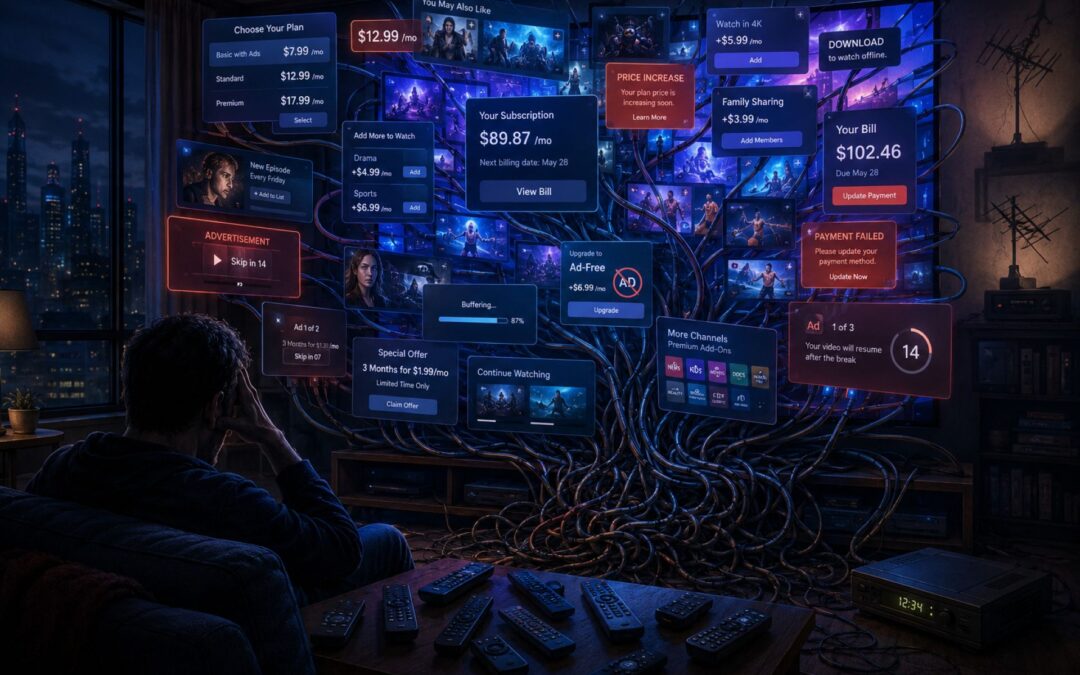
Streaming was supposed to save us from cable.
No long contracts. No bloated channel bundles. No waiting for shows to air at a fixed time. No paying for dozens of channels you never watched. Just open an app, choose what you want, and watch it instantly.
For a while, it felt like television had finally been liberated.
Netflix was cheap. The library was deep. The experience was simple. You could watch old sitcoms, prestige dramas, documentaries, foreign films, stand-up specials, and original shows from the same clean interface. Compared to cable, it felt almost utopian.
Then everyone else showed up.
Disney wanted its characters back. Warner wanted HBO and its film library back. NBCUniversal wanted The Office back. Paramount wanted its franchises back. Apple and Amazon wanted streaming to strengthen their wider ecosystems. Every major company began asking the same question: why should Netflix own the future of television using our content?
So the studios pulled their shows back and launched their own platforms.
At first, that looked like competition.
Then it became chaos.
Consumers who had cut cable to save money found themselves juggling Netflix, Disney+, Max, Hulu, Prime Video, Apple TV+, Peacock, Paramount+, and more. Prices rose. Ads returned. Password sharing was restricted. Bundles came back. Shows disappeared from platforms. Some movies skipped theaters. Others went back to theaters. The simple streaming dream became another monthly expense puzzle.
The streaming wars did not become expensive because people stopped watching.
They became expensive because the entertainment industry tried to replace a profitable bundled TV system with a direct-to-consumer model that demanded constant content spending, global scale, pricing power, low churn, and endless subscriber growth.
The future of television arrived.
It just turned out to need many of the same things the old system already had.
Streaming Was Supposed to Make TV Cheaper
The original promise of streaming was not complicated.
Cable had become annoying. People were paying for large bundles of channels when they only cared about a few shows, live sports, and maybe the news. The schedules were rigid. The interfaces were clunky. The bills were full of fees. The customer experience felt designed by companies that knew you had nowhere else to go.
Streaming offered an escape.
You paid a smaller monthly amount. You watched whenever you wanted. You canceled whenever you wanted. You did not need a cable box, installation appointment, or two-year contract. The power shifted from distributor to viewer.
That was the emotional core of the streaming revolution.
It was not just about technology. It was about control.
For viewers, streaming felt like a rebellion against forced bundling. For Netflix, it was a brilliant opening. The company did not need to own the entire entertainment industry. It only needed to make television feel easier than television.
And for a long time, it did.
The early streaming era gave viewers an almost impossible bargain. Netflix licensed massive libraries from studios that still saw streaming as a secondary revenue stream. Old shows found new life. Viewers found forgotten favorites. Studios collected licensing checks without realizing they were helping build the company that would later threaten their own distribution power.
That arrangement was too good to last.
Once streaming became the future instead of a side business, every major media company had to decide whether it wanted to keep feeding Netflix or compete with it.
That is when the cheap, simple version of streaming began to disappear.
Netflix Broke the Old Model Before Anyone Else Was Ready
Netflix did not defeat cable all at once. It changed viewer habits first.
That was more dangerous.
It trained audiences to expect television without schedules. It made binge-watching normal. It turned recommendation algorithms into programming executives. It showed that old shows could become valuable again when placed inside the right platform. Most importantly, it owned the customer relationship directly.
In the old TV business, studios often depended on distributors. Cable companies controlled access to households. Networks controlled programming schedules. Advertisers helped fund the system. Revenue moved through a complicated chain.
Netflix simplified the relationship.
The viewer paid Netflix. Netflix delivered the content. Netflix collected the data. Netflix learned what people watched, when they stopped watching, what they rewatched, and what kept them subscribed.
That gave Netflix a huge advantage.
While traditional media companies were still protecting cable networks, theatrical windows, syndication deals, and affiliate fees, Netflix was building a pure streaming business. It did not have to worry about damaging an old cable channel. It did not have to protect a legacy schedule. It could organize the company around one central question: how do we keep subscribers watching?
That focus allowed Netflix to move faster than the studios that supplied much of its early library.
Then Netflix began spending heavily on originals.
House of Cards and Orange Is the New Black signaled that Netflix did not want to be only a digital warehouse for other people’s shows. It wanted to become a studio, a network, a distributor, and a global platform at the same time.
Legacy media eventually understood what was happening.
Netflix was no longer just a customer.
It was becoming the front door to entertainment.
The Studios Panicked and Took Their Content Back
Once the studios realized Netflix was using their content to build a direct relationship with audiences, the logic changed.
Licensing old shows to Netflix had once looked like easy money. A studio could earn revenue from a series that had already aired elsewhere. Netflix got a better library. Viewers got convenience. Everyone seemed to win.
But that calculation became more dangerous as Netflix grew.
If viewers associated their favorite shows with Netflix rather than with the studios that made them, the studios risked losing long-term power. If Netflix controlled the interface, the data, the recommendation engine, and the subscription relationship, the studios could become suppliers to someone else’s empire.
So they took their content back.
Disney launched Disney+. WarnerMedia built HBO Max, later rebranded as Max. NBCUniversal launched Peacock. Paramount pushed Paramount+. Each company wanted its own app, its own subscribers, its own data, and its own place in the future.
Strategically, this made sense.
Economically, it was brutal.
When every company pulled content into its own walled garden, streaming became fragmented. Viewers who once found many shows in one place now needed multiple subscriptions. Companies that once earned licensing revenue now had to spend heavily to build platforms, market them, produce exclusives, and persuade people to stay subscribed.
The industry moved from one profitable system to many expensive experiments.
The old model had hidden advantages that became clearer only after companies began dismantling it.
The Cable Bundle Was More Profitable Than It Looked
Consumers hated the cable bundle for understandable reasons.
But for media companies, it was beautiful.
The cable bundle allowed networks to get paid even by households that barely watched them. If a channel was included in a package, the channel could receive affiliate fees from millions of subscribers. Popular networks benefited, but so did weaker ones. Big hits mattered, but the bundle softened failure.
It was an economic shock absorber.
A household might subscribe to cable mainly for ESPN, news, or a few favorite channels, but the monthly bill supported a much wider universe of networks. That gave media companies predictable revenue. It also helped fund programming, sports rights, news operations, scripted shows, and niche channels.
Advertising added another layer. Cable networks earned from both viewers and advertisers. The system was not always loved, but it was remarkably effective.
Streaming attacked that structure.
Instead of getting paid through a bundle, each service had to persuade viewers to pay directly. That sounds fairer from the consumer’s perspective. But it also removed the cross-subsidy that had supported much of the TV ecosystem.
In the cable era, a mediocre channel could survive inside the bundle.
In streaming, a mediocre service gets canceled.
That is a very different business.
As Michael Nathanson explained in a Yale Insights discussion of the streaming wars, the shift to streaming forced media companies to move away from an older distribution model where the bundle supported many players. In the direct-to-consumer world, every company had to fight for attention, payment, and retention much more visibly.
Consumers thought they were escaping cable’s inefficiency.
Media companies were losing cable’s protection.
Streaming Replaced Guaranteed Revenue With Constant Competition
The core problem with streaming is simple: subscribers are free.
That sounds like a good thing. And for consumers, it is. You can subscribe for one month, watch the show you care about, cancel, and come back later when something else appears.
For companies, that flexibility creates a leaky business.
Cable customers were sticky because cancellation was annoying and replacement options were limited. Streaming customers are fickle by design. They can leave with a few clicks. They can rotate services. They can share passwords. They can wait until an entire season is available, binge it, and disappear.
That changes the economics of entertainment.
A streaming service does not only need good content. It needs a constant reason for people to stay. One hit show can attract subscribers, but what happens after they finish it? Another big release is needed. Then another. Then another.
The platform becomes hungry.
This is why streaming created such an expensive content cycle. Companies were no longer just programming channels. They were feeding subscription machines.
A traditional TV network could survive with a schedule, reruns, advertising, carriage fees, and a few hits per season. A streaming service has to maintain the illusion of abundance at all times. The homepage must always feel alive. The library must always feel worth paying for. The next big thing must always be coming soon.
That pressure is expensive even when a service is growing.
It becomes punishing when growth slows.
For years, Wall Street rewarded subscriber growth above almost everything else. Streaming companies were encouraged to spend aggressively because the future seemed to belong to whoever reached the largest scale first.
Then investors began asking a less glamorous question:
Where are the profits?
That question changed the entire industry.
Original Content Became an Arms Race
Once every company had its own platform, exclusive content became the weapon of choice.
Netflix needed originals because studios were pulling back licensed shows. Disney needed originals because Disney+ had to feel like more than a vault. Warner needed HBO-quality programming to justify premium pricing. Apple needed prestige. Amazon needed video to make Prime more valuable. Paramount, Peacock, and others needed enough recognizable content to avoid becoming afterthoughts.
The result was a content arms race.
Big-budget fantasy series. Prestige dramas. Superhero shows. True-crime documentaries. Celebrity documentaries. Reality franchises. International originals. Expensive films. Sports rights. Library acquisitions. Reboots. Sequels. Spin-offs. Universe-building.
Everyone needed exclusives because exclusives gave people a reason to subscribe.
But exclusives also made the system more expensive for everyone.
A show that once might have been licensed widely became locked behind one service. A studio that once sold content to the highest bidder now kept it in-house to support its own platform. The opportunity cost was enormous. Companies gave up licensing revenue in the hope of building long-term subscription value.
That bet worked better for some than for others.
Netflix, as a global pure-play streamer, had the clearest model. Its entire business was built around streaming scale. The company could spread content spending across a massive international subscriber base and use viewing data to guide investment. Its investor materials show the advantage of being structurally focused on streaming rather than trapped between old and new businesses.
Legacy media companies had a harder problem.
Disney, Warner Bros. Discovery, Paramount, and NBCUniversal were not only building streaming platforms. They were also trying not to destroy their cable networks, theatrical windows, licensing businesses, and existing distribution relationships too quickly.
They had to run toward the future while dragging the past behind them.
That is costly.
Churn Turned Streaming Into a Leaky Bucket
The most underrated problem in streaming is churn.
Churn is what happens when subscribers cancel. In streaming, churn is not a minor inconvenience. It is a structural feature of the model.
Viewers subscribe when a show arrives. They cancel when it ends. They return when a new season drops. They rotate among services depending on what they want to watch. Some keep only one or two subscriptions at a time. Others sign up for a free trial, binge a series, and leave.
This behavior makes perfect sense for consumers.
It is maddening for companies.
Every lost subscriber has to be replaced. Every replacement costs money. Marketing costs rise. Promotional pricing becomes tempting. Services have to keep releasing new content not only to attract users, but to stop existing ones from walking away.
AlixPartners has described this pattern as a major streaming challenge, noting how fragmentation and subscriber switching have intensified the battle over the next generation of television. Its analysis of the streaming wars and serial churn captures the central tension: consumers like flexibility, but flexibility makes revenue less predictable.
Cable had inertia.
Streaming has restlessness.
That restlessness also changes how people value entertainment. A viewer who pays for one cable bill might tolerate a lot of mediocre programming because the bundle feels like a utility. A viewer paying for eight separate apps judges each one more sharply.
If a service does not feel useful this month, it goes.
That puts every streaming company under constant pressure to justify its place on the household budget.
The Price Hikes Were Inevitable
Streaming was cheap in the beginning partly because companies were buying growth.
Low prices attracted subscribers. Ad-free viewing made the product feel better than television. Password sharing increased cultural reach. Huge content libraries made services feel like bargains.
But bargains are not the same as sustainable businesses.
Eventually, streaming companies had to raise prices, reduce losses, and prove that they could generate profit. That meant the consumer-friendly early era had to end.
Price hikes became common. Ad-supported tiers returned. Password-sharing crackdowns accelerated. Bundles reappeared. Platforms began removing some shows to reduce costs or avoid residual payments. The industry became more disciplined, but also less magical from the viewer’s perspective.
This was not hypocrisy. It was economics.
If a service spends billions on content, technology, marketing, and global operations, it cannot remain cheap forever. Either subscribers pay more, advertisers pay more, costs come down, or the business fails to generate adequate returns.
Disney’s streaming trajectory shows this shift clearly. The company’s fiscal 2025 earnings release reported stronger Direct-to-Consumer operating income, showing that streaming profitability improved after years of heavy investment, price changes, cost control, and bundling strategy.
That is good for Disney as a business.
But for consumers, it reveals the larger irony.
Streaming became more like cable because it needed cable-like economics: scale, advertising, bundling, and pricing power.
The cheaper future was never going to stay cheap once every company needed it to become profitable.
Big Tech Was Playing a Different Game
Not every streaming competitor entered the war with the same goal.
For Netflix, streaming is the business. For Disney, streaming is central to the future of entertainment. For Warner Bros. Discovery and Paramount, streaming is tied to survival in a collapsing cable world.
But for Amazon and Apple, streaming plays a different role.
Amazon does not need Prime Video to behave like a standalone media company. It can use video to make Prime more valuable, reduce churn in the broader Prime ecosystem, support advertising, and deepen customer loyalty. If a show helps someone keep a Prime subscription that also drives e-commerce behavior, the economics are different.
Apple has its own version of this advantage. Apple TV+ can support the company’s broader services strategy, strengthen the Apple ecosystem, and associate the brand with premium entertainment. Apple does not need streaming to carry the whole company.
That changes the competitive landscape.
A traditional media company may need its streaming platform to generate direct profit. A tech giant can treat streaming as one piece of a much larger strategic puzzle. It can afford patience. It can absorb losses differently. It can use hardware, commerce, cloud infrastructure, or services revenue to support its entertainment ambitions.
This is why the streaming wars were never a fair fight.
Legacy media companies were trying to replace old profit pools. Netflix was trying to defend and expand a pure streaming model. Big Tech was using streaming to reinforce ecosystems that were already profitable elsewhere.
Same screen.
Different games.
YouTube Became the Rival No One Could Ignore
While traditional media companies fought one another, YouTube became impossible to ignore.
YouTube is not a streaming service in the same way Netflix or Disney+ is. It does not rely mainly on expensive scripted shows, theatrical franchises, or prestige dramas. It is a creator-driven video platform with enormous scale, endless variety, and a cost structure that looks very different from Hollywood’s.
That makes it dangerous.
Netflix, Disney, Max, and others have to spend heavily to create or acquire premium content. YouTube gets millions of creators to upload content continuously. Viewers do not open YouTube only for polished shows. They open it for tutorials, podcasts, commentary, music, gaming, children’s videos, reviews, news clips, documentaries, shorts, and background entertainment.
It competes for the same thing every streaming service wants most:
time.
And time is the real battlefield.
A household may pay for Netflix and Disney+, but a viewer might still spend more daily attention on YouTube. That matters because entertainment economics increasingly follow attention. Advertising, subscriptions, cultural relevance, and habit all depend on whether people keep returning.
A Guardian report noted that YouTube had overtaken Netflix in average daily viewing across major international markets, reflecting how powerful the platform has become in global entertainment behavior.
That trend should worry every premium streamer.
YouTube does not need to beat Netflix by making a better prestige drama. It can win by being more useful, more abundant, more habit-forming, and more present in daily life.
The streaming wars were expensive partly because companies thought they were fighting each other.
They were also fighting a free video universe.
The Streaming Wars Are Turning Back Into Cable
The great irony of streaming is that the industry is slowly rebuilding many of the things it once promised to destroy.
Ads are back.
Bundles are back.
Price increases are normal.
Sports packages are becoming essential.
Platform aggregation is becoming more important.
Mergers and consolidation are constantly discussed because many services are too small to compete alone.
The old cable bundle was frustrating, but it solved real business problems. It reduced churn. It spread costs across many channels. It made revenue more predictable. It gave consumers one bill, even if that bill was too high. It allowed strong content to subsidize weaker content. It made distribution simpler.
Streaming broke the bundle apart.
Now the industry is trying to recreate some version of it without admitting that cable had advantages.
This does not mean streaming will literally become cable again. The technology is different. The user control is greater. On-demand viewing is here to stay. Global distribution is far easier. Personalized recommendations, mobile viewing, and flexible subscriptions are real improvements.
But the business logic is circling back.
Companies need bundles because consumers are tired of managing too many services. They need ads because subscriptions alone are not enough. They need scale because content is expensive. They need sports because live events still create urgency. They need consolidation because not every platform can survive as a standalone destination.
Recent consolidation pressure in the media industry points in the same direction. The Guardian’s reporting on regulatory scrutiny around Paramount Skydance’s proposed takeover of Warner Bros. Discovery shows how streaming economics continue to push major players toward greater scale and combination.
Fragmentation created the problem.
Rebundling is becoming the answer.
Conclusion
Streaming did not become expensive because the idea failed.
It became expensive because the idea worked too well.
Viewers changed their habits. Netflix proved that television could be delivered directly, globally, and on demand. Studios realized they could not let another company own the future of their content. Tech giants entered with different economics. Consumers embraced flexibility. The old cable bundle weakened.
But once everyone rushed into streaming, the hidden costs became impossible to ignore.
Someone had to pay for the platforms. Someone had to fund the originals. Someone had to replace licensing revenue. Someone had to fight churn. Someone had to market every service. Someone had to carry the cost of global competition. And eventually, that someone became both the companies and the consumers.
The streaming wars were supposed to free television from cable.
Instead, they revealed why cable had been so profitable in the first place.
The future of TV did arrive. It is more flexible, more global, and more personalized than before.
But it is not simple.
And it was never going to stay cheap.
Last Updated on June 9, 2026 by Aseem Gupta