
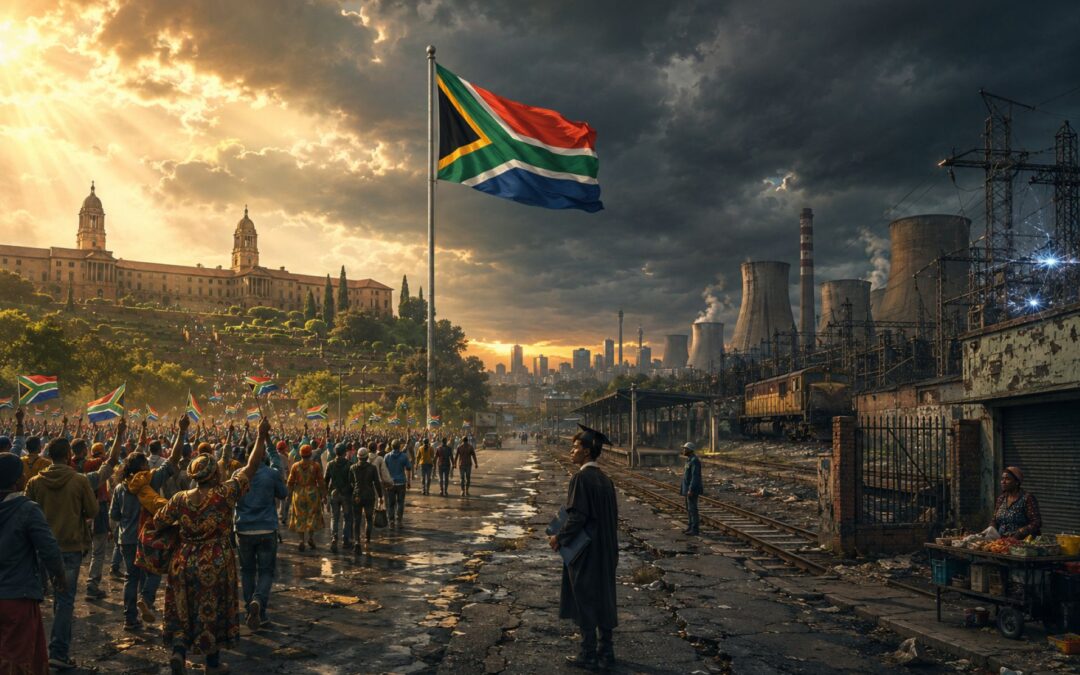
In 2023, South Africa was struggling to keep its lights on. Electricity shortages disrupted factories, forced businesses to spend heavily on generators and batteries, and made scheduled power cuts a routine part of daily life. Three years later, the situation looked remarkably different. The country had gone hundreds of consecutive days without national load shedding, and its state-owned electricity company was reporting substantial improvements in generation reliability.
Yet South Africa’s broader economic crisis had not disappeared. Unemployment remained above 30%, economic growth was disappointingly weak, and millions of people continued to live in poverty despite the country’s considerable mineral wealth, sophisticated financial institutions and developed industrial base. The recovery of electricity generation demonstrated that major institutional failures could be reversed, but it also exposed how deeply the country’s economic problems extended beyond any single failing institution.
The contrast is especially striking when measured against the expectations surrounding South Africa’s democratic transition in 1994. Nelson Mandela’s election marked the end of a political system that had denied the Black majority basic rights and economic opportunities for generations. Democracy promised not merely political freedom but a society in which prosperity would no longer be determined overwhelmingly by race.
More than three decades later, South Africa remains a functioning constitutional democracy, but it has struggled to translate that political achievement into sufficiently broad economic progress. Understanding why requires examining the economy apartheid created, what democratic governments accomplished, how growth stagnated, and how corruption and institutional deterioration compounded problems that were already extraordinarily difficult to solve.
The Unequal Economy Democracy Inherited
South Africa’s economic inequalities did not begin with apartheid in 1948. They developed over centuries of colonial conquest, land dispossession and the creation of an economy built around the unequal distribution of property, political authority and labour.
The discovery of diamonds in the nineteenth century, followed by enormous gold deposits, transformed South Africa into a major mining economy. Mining companies needed large numbers of workers, while colonial authorities and white commercial interests sought to maintain access to inexpensive African labour. Land restrictions, taxation and controls on movement increasingly pushed Black Africans into wage employment while limiting their opportunities to accumulate land, wealth or independent businesses.
The Natives Land Act of 1913 formalised a particularly consequential element of this system. It restricted African land acquisition and occupation across much of the country, initially reserving roughly 7% of South Africa’s territory for the Black majority. Subsequent legislation expanded the designated areas but preserved the essential principle that access to land and economic opportunity could be allocated according to race.
These arrangements helped establish a migrant-labour economy in which workers travelled from rural reserves to mines, farms and industrial centres without enjoying the same property rights and residential security as white South Africans. Families were separated, opportunities for independent farming were constrained, and wealth accumulated disproportionately among those who controlled land, mines and commercial enterprises.
After the National Party came to power in 1948 under D. F. Malan, apartheid made racial segregation the organising principle of government. The state classified people into racial categories, prohibited interracial marriage, segregated residential areas and public facilities, and restricted political representation. Pass laws regulated the movement of Black Africans, while the Group Areas Act and forced removals displaced communities from valuable urban locations.
Education reinforced the economic hierarchy. The Bantu Education system deliberately limited the quality and opportunities available to Black pupils, while white children benefited from substantially better-funded institutions. Occupational restrictions and discriminatory employment practices prevented many Black workers from entering skilled professions, managerial positions and industries that offered higher wages and opportunities for advancement.
The consequences accumulated across generations. White households were more likely to acquire valuable property, receive better education, establish businesses, build pensions and pass assets to their children. Black households were systematically excluded from many of the mechanisms through which families normally improve their economic circumstances.
Apartheid also left a physical geography of inequality. Townships and segregated settlements were often located far from employment centres, creating a pattern of expensive and time-consuming commuting that persisted even after residential restrictions disappeared. The distance between where people lived and where economic opportunities existed became an enduring obstacle to participation in the labour market.
Resistance to apartheid intensified through mass political mobilisation, strikes, civil disobedience and international pressure. Organisations such as the African National Congress challenged white minority rule, while international sanctions and growing domestic instability increased pressure for a negotiated settlement.
President F. W. de Klerk began dismantling the political restrictions of apartheid and released Nelson Mandela from prison in February 1990. Negotiations ultimately led to South Africa’s first national election based on universal adult suffrage on 27 April 1994. The ANC emerged victorious, and Mandela was inaugurated as president on 10 May.
The achievement was historic, but the incoming government inherited a deeply divided economic system. Racially discriminatory laws could be repealed through legislation, whereas disparities in education, property ownership, professional experience and accumulated wealth required changes extending across generations. The task confronting South Africa’s new democracy was therefore more demanding than replacing one government with another.
What Changed After Apartheid—and What Did Not
The years following apartheid brought substantial improvements that are sometimes overlooked in accounts of South Africa’s economic difficulties. Political freedom itself transformed the relationship between citizens and the state. Black South Africans could vote, organise politically, hold public office and challenge government decisions under a democratic constitution rather than live under a system explicitly designed to exclude them.
The new government also expanded access to public services that had historically been distributed according to race. Housing programmes provided homes to millions of previously disadvantaged people, electricity connections reached communities that had long been neglected, and access to water, sanitation, healthcare and education improved. Social grants became an important source of support for pensioners, children, people with disabilities and households with little reliable employment income.
These changes mattered considerably to ordinary families. A household receiving electricity for the first time could improve its living conditions, while access to education and healthcare opened possibilities previously denied to much of the population. The expansion of social protection also helped prevent deeper deprivation in communities facing persistent unemployment.
The early democratic period included economic achievements. South Africa maintained relatively disciplined monetary and fiscal policies through significant parts of the 1990s and 2000s, reduced public debt during favourable economic conditions and benefited from international investment. A growing Black professional and middle class entered universities, corporate management, the civil service and industries from which apartheid had excluded them.
Nevertheless, progress was uneven because access to services did not necessarily guarantee their quality or produce a corresponding expansion in productive employment. Building schools was not equivalent to ensuring that pupils acquired strong literacy, numeracy and technical skills. Extending electricity connections did not guarantee that the electricity system would remain reliable, and constructing affordable housing did not necessarily place residents near viable employment opportunities.
Housing policy sometimes reproduced the spatial problems inherited from apartheid. Affordable land was frequently available on the outskirts of cities, so new developments could leave residents far from businesses, universities and industrial areas. Families gained formal housing without necessarily gaining better access to economic opportunity.
South Africa’s education system revealed another persistent division. Well-resourced schools and universities produced highly skilled graduates, while many institutions serving poorer communities struggled with weak foundations in reading, mathematics and science. Employers consequently reported shortages of qualified workers even as millions of people remained unemployed.
Ownership inequalities were even harder to change. Removing racial restrictions could not erase decades of unequal access to land, pensions, business equity and financial assets. Wealth generates additional opportunities through investment income, inheritance, collateral and access to credit, so households that begin with substantial assets often enjoy advantages extending well beyond their current earnings.
South Africa also possessed an unusually concentrated corporate economy. Large firms dominated important parts of banking, retail, mining, telecommunications and other industries. These companies provided sophisticated services and valuable employment, but concentrated markets could make entry difficult for smaller competitors without sufficient capital, distribution networks or regulatory expertise.
The World Bank’s assessment of South Africa describes an economy containing advanced, highly productive businesses alongside a much larger population facing low incomes and limited opportunities. The difficulty was not a complete absence of development, but the failure to connect modern economic capabilities to sufficiently broad participation.
Political equality expanded dramatically after 1994. Economic participation improved for some groups, but the combination of unequal assets, weak schooling, distant housing and concentrated markets prevented those gains from spreading nearly as widely as the democratic transition had promised.
How South Africa’s Growth Engine Stalled
South Africa initially appeared capable of overcoming many of these obstacles through economic expansion. During the early 2000s, strong global demand for minerals supported exports and investment, while rising incomes and government revenue helped finance public services. The country benefited from its established banking system, mineral resources, manufacturing industries and access to international capital.
The global financial crisis of 2008 disrupted that momentum. South Africa’s subsequent recovery proved weak, with private investment slowing, productivity improving too slowly and manufacturing struggling to generate employment on the scale required. Mining continued to face volatile commodity markets, rising costs and operational challenges, while competition from other economies made industrial expansion increasingly difficult.
South Africa also had a demographic problem in economic terms: its working-age population needed employment opportunities faster than the economy was creating them. Modest increases in total production could therefore coexist with stagnant or declining output per person. Over much of the period after the financial crisis, the economy failed to sustain growth sufficient to produce broad improvements in living standards.
The weakness was visible even after the immediate disruptions of the COVID-19 pandemic receded. South Africa recorded modest growth in 2024 and 2025, but the recovery lacked momentum. In the second quarter of 2026, economic output contracted by 0.2%, illustrating how fragile expansion remained despite improvements in electricity supply.
Several factors contributed to the slowdown. Businesses confronted weak domestic demand, crime, regulatory uncertainty, shortages of skilled labour and difficulties expanding in concentrated markets. International conditions and fluctuations in commodity prices mattered, but domestic constraints increasingly undermined South Africa’s ability to benefit when global conditions were favourable.
Infrastructure became especially important because modern economies depend on interconnected systems. A manufacturer needs reliable electricity to operate machinery, a logistics network to receive materials and deliver products, and workers who can travel to the factory. A mining company may have access to valuable deposits but still struggle to export its output if electricity, railways or ports fail.
When these systems deteriorate, their effects extend beyond immediate production losses. Businesses must spend money on generators, transport alternatives and private security instead of expanding capacity or hiring workers. Uncertainty about future operating conditions discourages investment, while declining investment reduces the productivity gains required for higher wages and long-term growth.
The relationship between public finances and infrastructure creates another difficulty. Weak growth limits tax revenue, making it harder for the government to maintain services and undertake major investments. Poor services then discourage further economic activity, producing a cycle in which institutional weakness and slow growth reinforce one another.
South Africa was therefore vulnerable to a prolonged economic slowdown even before the worst governance scandals became apparent. Its structural inequalities and industrial challenges were substantial, but the deterioration of state institutions made overcoming them considerably more difficult.
State Capture, Eskom, and a Country That Could Not Move
South Africa’s economic decline cannot be understood without examining what happened to the public institutions responsible for electricity, rail transport, ports and essential infrastructure. These organisations occupied central positions in the economy because their services allowed private businesses, municipalities and households to function.
During the presidency of Jacob Zuma, from 2009 to 2018, corruption and political interference increasingly undermined several state-owned enterprises. Weak appointments, questionable contracts and deteriorating operational management damaged institutions whose performance was fundamental to economic growth. The consequences became particularly severe at Eskom and Transnet, where political influence, criminal activity and poor maintenance compounded longstanding investment problems.
How State Capture Worked
Ordinary corruption often involves an official demanding money or favours in exchange for a particular decision. State capture operates at a deeper institutional level because politically connected groups seek influence over who occupies important positions, how organisations make decisions and which businesses receive public contracts.
Under Zuma, allegations of state capture centred on relationships between political figures, senior officials and private business interests. The Gupta family, whose businesses operated across mining, media, technology and other industries, became the most prominent example of how proximity to political power could create opportunities for private enrichment.
The Gupta brothers arrived in South Africa in the early 1990s and developed an extensive business network. Their relationship with Zuma and members of his family attracted particular scrutiny as evidence emerged of attempts to influence senior appointments and secure favourable treatment from state institutions.
The Zondo Commission’s investigation into state capture documented extensive abuses involving public procurement, appointments and governance at institutions including Eskom and Transnet. Its findings showed that the problem extended beyond individual officials accepting bribes. Institutional decisions had sometimes been shaped to benefit particular commercial and political networks.
One significant case involved Tegeta Exploration and Resources, a Gupta-linked mining company seeking to acquire Optimum Coal Mine. Eskom approved a large prepayment connected to coal purchases at a crucial point in the transaction, effectively helping finance the acquisition. Investigators concluded that the arrangements favoured private commercial interests while exposing the public utility to financial and operational risks.
The broader mechanism was particularly destructive. Political influence could help determine who managed a state-owned enterprise, those managers could influence procurement and contract decisions, and public resources could then be directed towards connected businesses. Competent officials who resisted questionable arrangements risked being marginalised or removed.
The Commission associated approximately R57 billion in state expenditure with contracts tainted by state capture. That figure should not be confused with a precisely established amount of money stolen, but it illustrates the enormous scale of public resources implicated in the system.
Financial losses were only one part of the damage. Manipulated appointments weakened expertise, procurement irregularities damaged commercial discipline, and institutional instability discouraged capable administrators. Public companies increasingly struggled to perform the services for which they existed, while taxpayers and businesses ultimately bore the consequences.
How Eskom Lost—and Began to Restore—Reliable Power
For decades, Eskom was central to South Africa’s industrial development. Its electricity supported mining, manufacturing, commerce and household consumption, helping the country develop one of Africa’s largest and most sophisticated economies. Much of its generating capacity came from large coal-fired stations, reflecting South Africa’s substantial coal reserves.
The system began experiencing serious strain as demand increased and older power stations required maintenance or replacement. Investment in new capacity came too late, leaving the country vulnerable to shortages. Construction of the Medupi and Kusile power stations was intended to strengthen electricity generation, but both projects suffered major delays, design problems and cost overruns.
Poor maintenance compounded the problem. Generating units frequently became unavailable because of breakdowns, while repeated operational disruptions made planning increasingly difficult. Political interference, unstable management and questionable procurement practices further weakened Eskom’s ability to address its technical problems.
Corruption also became embedded in parts of the electricity supply chain. Coal, fuel, cables and equipment were stolen, while contractors and criminal networks could profit from inflated prices, poor-quality supplies and repeated repairs. In some cases, failures created financial opportunities for those supplying emergency services or replacement materials.
André de Ruyter, who became Eskom’s chief executive in 2020, attempted to address corruption and improve operations. In December 2022, he became seriously ill following what he described as suspected cyanide poisoning. Although the incident was investigated as an alleged attempted murder, responsibility was not established through a judicial finding, and speculation about the perpetrators should not be treated as proven fact.
By 2023, electricity shortages had become one of the country’s most visible economic problems. Eskom relied heavily on load shedding, deliberately cutting electricity to different areas at scheduled times to prevent the national grid from becoming unstable.
The effect on businesses was substantial. Factories lost production time, restaurants and retailers had to protect refrigerated goods, and telecommunications systems and municipal water infrastructure faced additional disruptions. Small enterprises often had to choose between expensive backup systems and interrupted operations.
Wealthier households and established companies could partly protect themselves with generators, batteries and rooftop solar installations. Poorer households and informal businesses had fewer options, making unreliable electricity especially damaging to those already facing financial insecurity.
Electricity shortages therefore magnified South Africa’s existing inequalities. People with capital could purchase alternatives to failing public services, while people without capital experienced greater disruption to their work, education and daily lives.
Although corruption contributed to Eskom’s deterioration, it would be misleading to attribute the entire crisis to theft. Ageing infrastructure, delayed investment, technical defects, maintenance failures, municipal debt and weak management all played important roles. The eventual restoration of greater reliability required addressing several of these problems simultaneously rather than focusing on corruption alone.
Why South Africa’s Railways and Ports Also Failed
Electricity shortages received enormous public attention, but South Africa’s freight transport system was deteriorating during much of the same period. Transnet, the state-owned company responsible for major rail, port and pipeline infrastructure, became another obstacle to the country’s ability to produce and export goods.
This was particularly damaging for mining and agriculture. South Africa’s mineral wealth can generate income only when extracted materials can move from mines to processing facilities, ports and international customers. When railways become unreliable, valuable resources may remain stranded or become significantly more expensive to export.
Transnet struggled with ageing equipment, weak maintenance, shortages of functional locomotives and procurement controversies. Cable theft and vandalism disrupted railway lines, while congestion and equipment failures delayed cargo movement through ports.
Some mining and logistics companies increasingly relied on road transport when rail capacity became unavailable. Moving large quantities of bulk commodities by truck raised costs, increased congestion and contributed to deterioration on heavily used roads. Other producers reduced exports because available transport could not accommodate their output.
The Zondo Commission also investigated major procurement irregularities at Transnet, including locomotive purchases and the influence of politically connected intermediaries. As with Eskom, corruption contributed to a broader deterioration that included operational weaknesses, poor investment decisions and failures of management.
Electricity and freight shortages reinforced one another. Mines needed power to operate and railways to move their output; manufacturers required both reliable production facilities and functioning supply chains. When several essential networks failed together, the cost of conducting business increased throughout the economy.
South Africa’s infrastructure crisis consequently became much more than a problem confined to state-owned companies. It constrained investment, weakened exports and reduced the ability of otherwise competitive businesses to expand.
The Promise and Limits of Black Economic Empowerment
Ending apartheid created a difficult economic question that political democracy could not resolve on its own. How could South Africa establish a genuinely inclusive economy when much of its corporate ownership, financial capital and senior management remained concentrated among groups that had benefited from generations of racial privilege?
One response was Black Economic Empowerment, later developed into Broad-Based Black Economic Empowerment, or B-BBEE. The policy sought to increase Black participation in business ownership, management, professional employment, skills development, procurement and enterprise creation.
Under the B-BBEE framework, companies are assessed through measures covering different aspects of economic transformation. Ownership and management representation matter, but so do training, enterprise development and procurement from qualifying suppliers. Compliance ratings can influence eligibility for government contracts and commercial relationships with other firms.
The rationale was substantial. An economy whose ownership and leadership continued overwhelmingly to reflect apartheid could not reasonably claim that the removal of discriminatory laws had completed economic transformation. Businesses needed incentives to open opportunities that might otherwise remain concentrated among established networks.
BEE did contribute to the emergence of Black executives, investors and business owners. However, critics questioned whether the structure of many transactions genuinely widened economic participation or primarily benefited a relatively small group of people with access to capital and influential relationships.
Cyril Ramaphosa’s business career became an important example in this debate. After gaining prominence as a trade-union leader and negotiator during South Africa’s transition, he entered the business world through Shanduka Group. The investment company acquired interests in mining, telecommunications, finance, consumer businesses and other sectors, helping Ramaphosa build substantial personal wealth before returning to senior political office.
Some businesses viewed partnerships with prominent Black investors as a means of meeting empowerment objectives and navigating South Africa’s changing commercial environment. Such arrangements could create legitimate opportunities, but they also raised questions about whether ownership transfers among established investors were sufficient to transform the wider economy.
A transaction that creates wealth for a politically connected investor is not automatically corrupt. Nevertheless, it does not necessarily create the same long-term economic benefits as helping thousands of workers acquire skills, establishing competitive Black-owned suppliers or enabling new enterprises to enter previously closed markets.
B-BBEE compliance has also attracted criticism for its administrative demands. Businesses may incur costs documenting ownership, management practices, procurement and training. Supplier requirements can affect commercial decisions, while some firms face difficulties balancing empowerment objectives against price, reliability and operational capability.
Another concern is fronting, where companies present Black individuals or businesses as genuine participants without transferring meaningful authority or economic benefits. These arrangements undermine the stated purpose of empowerment while creating opportunities for manipulation.
The costs of compliance have become a subject of political and economic debate. Some business surveys report that firms have reduced investment, employment or expansion plans because of BEE requirements. Such findings warrant attention, but self-reported responses from limited samples cannot establish the total nationwide economic effect of the policy.
Evidence from academic research is more qualified than the claim that BEE destroyed South Africa’s economy. A 2025 study published in the Journal of Comparative Economics examined listed South African companies and found a small positive association between improved BEE performance and turnover, no clear effect on profits, and labour-productivity findings that were not robust enough to establish a causal improvement. Because the research focused on listed companies, its conclusions cannot automatically be extended to smaller businesses or the entire economy.
The B-BBEE Commission’s assessment of South Africa’s transformation between 2013 and 2023 likewise identifies progress in areas such as ownership, enterprise development and skills empowerment, alongside uneven compliance, incomplete information and persistent structural weaknesses. The institutional assessment and independent criticism illuminate different aspects of the same policy challenge.
The central problem is that changing ownership and procurement arrangements cannot compensate for inadequate education, unreliable infrastructure, weak competition or persistent unemployment. Empowerment can improve representation within the existing economy, but lasting economic transformation also requires the economy itself to create substantially more opportunities.
BEE therefore presents South Africa with a difficult but necessary policy question. The country needs to correct inherited racial inequalities without allowing compliance systems, political connections or narrow ownership transactions to become substitutes for broader productive development.
Why So Many South Africans Remain Out of Work
South Africa’s unemployment crisis is one of the clearest indications that economic transformation remains incomplete. According to Statistics South Africa’s second-quarter 2026 Labour Force Survey, the official unemployment rate reached 33.6%, with approximately 8.5 million people unemployed. The expanded measure, which includes discouraged job seekers, was substantially higher.
The problem is especially severe among young people, many of whom struggle to obtain their first meaningful work experience. Without opportunities to build skills and employment histories, job seekers can remain disconnected from the formal economy for years.
Labour regulation is one part of the explanation. The Labour Relations Act of 1995 strengthened protections against unfair dismissal, supported collective bargaining and established procedures governing employment disputes and retrenchment. These reforms responded to a labour system in which Black workers had historically been denied meaningful rights and bargaining power.
Greater employment protection, however, can also make some businesses cautious about hiring when future demand is uncertain. The financial and administrative consequences of dismissals may discourage firms from taking risks on inexperienced employees or expanding rapidly.
This concern is particularly relevant for smaller enterprises operating with limited capital. Businesses may be reluctant to increase their workforce if additional regulatory requirements impose substantial costs or make future adjustments difficult.
Nevertheless, labour legislation cannot explain unemployment on this scale by itself. Companies hire workers when they expect their output to justify the associated costs, and those expectations depend on demand, productivity, electricity, logistics, access to finance and the competitive environment.
South African firms have faced persistent constraints in several of these areas. Weak economic growth limits opportunities for expansion, while unreliable infrastructure and high operating costs discourage investment. Smaller businesses may struggle with licensing, administrative requirements and access to credit, especially when competing against established companies with greater financial resources.
Education further restricts employment opportunities. Employers in specialised industries may struggle to recruit engineers, technicians, skilled artisans and capable managers, even while millions of people seek employment. The existence of unemployed workers does not automatically resolve a shortage of workers with the qualifications required for particular jobs.
Apartheid’s geographic legacy also raises the practical cost of employment. Someone living far from commercial centres may face expensive transport, long journeys and unreliable commuting options. A low-paying job can become economically unattractive when travel absorbs a substantial portion of earnings.
These difficulties affect young workers particularly severely because they often have little savings, limited professional networks and no previous employment experience. Long periods without work can reduce skills, weaken confidence and make subsequent recruitment even more difficult.
The consequences extend far beyond the unemployed themselves. In households where several adults depend on one wage or social grant, the loss of employment has implications for nutrition, schooling, housing and financial security. Families may be unable to accumulate savings or provide the support that helps younger generations pursue education and entrepreneurship.
Racial income disparities remain striking. The 2022–2023 Income and Expenditure Survey reported average annual household incomes of approximately R676,375 for white-headed households and R143,632 for Black African-headed households. The former figure was roughly 4.7 times the latter, illustrating how strongly historical inequalities continue to influence economic outcomes.
These are averages rather than descriptions of every household. South Africa has a substantial Black middle and upper class, and economic circumstances differ considerably within every racial group. Even so, the aggregate disparity reveals how unevenly income-generating opportunities and accumulated advantages remain distributed.
Poverty statistics require similar care because estimates vary according to the threshold and measurement year. Under a relatively high international poverty threshold appropriate for upper-middle-income countries, the World Bank has estimated that a majority of South Africans live below the poverty line. This does not mean that everyone below that threshold experiences identical deprivation, but it demonstrates how limited economic security remains for a large part of the population.
Weak public services further intensify inequality. When municipal water systems fail, households with sufficient resources may install tanks and filtration equipment. When schools underperform, wealthier families can purchase private education or additional tutoring. When crime becomes a persistent threat, established businesses and affluent households can invest in security systems and private protection.
Poorer households are much less able to protect themselves through these alternatives. Consequently, failing public institutions can make existing wealth even more valuable while deepening the disadvantages faced by people with few assets.
South Africa’s employment crisis therefore requires more than changes to wage regulation or a redistribution of existing jobs. It requires sustained investment, better education, functioning infrastructure, more competitive markets and a business environment in which new firms can emerge and grow.
The 2024 Political Break and the First Signs of Recovery
For three decades, the African National Congress dominated democratic South Africa’s political system. Its authority was closely associated with the liberation struggle and the leadership of figures such as Nelson Mandela, Oliver Tambo and Walter Sisulu. For many voters, support for the ANC reflected both political allegiance and recognition of its central role in ending apartheid.
Over time, however, liberation credentials became less effective protection against public dissatisfaction. Persistent unemployment, corruption scandals, unreliable services and declining confidence in state institutions damaged the party’s reputation. Internal divisions and disputes over leadership further complicated its ability to govern effectively.
The May 2024 election marked a historic change. The ANC lost its parliamentary majority for the first time since the establishment of democracy, remaining the largest party but no longer possessing enough seats to govern independently.
Negotiations produced a Government of National Unity that brought together parties with substantially different political and economic positions. Among its participants were the ANC, the Democratic Alliance and the Inkatha Freedom Party, alongside several smaller parties.
The arrangement did not transform South Africa into a uniformly pro-market government. Coalition members continued to disagree over empowerment policies, healthcare, land reform, public spending, foreign relations and the appropriate role of the state. Nevertheless, the ANC’s loss of its majority changed the political incentives surrounding governance and reform.
The party now had to negotiate with other political organisations, while coalition partners were required to demonstrate that participation in government could produce tangible improvements. The change also showed that voters were willing to reduce the political dominance of a party historically identified with national liberation.
Some important economic reforms had already begun before the election, particularly under President Cyril Ramaphosa. Electricity reforms reduced restrictions on private generation, encouraging companies and independent producers to invest in additional capacity. Rooftop solar installations expanded rapidly as households and businesses sought alternatives to unreliable grid electricity.
Eskom simultaneously undertook operational improvements through its Generation Recovery Plan. Maintenance practices improved, unplanned outages declined, and generating capacity returned to service. These changes combined with additional private supply and reduced demand from some grid customers to improve the balance between electricity generation and consumption.
By October 2, 2026, Eskom reported 504 consecutive days without national load shedding, beginning on May 16, 2025. Its financial-year-to-date energy availability factor had reached 68.11%, reflecting a substantial improvement in the performance of its generating fleet.
This achievement was significant, although it did not mean every South African household enjoyed uninterrupted electricity. Local network failures, municipal infrastructure problems and deliberately reduced supply in overloaded areas continued to affect some communities.
Reform also extended into freight transport. South Africa began opening opportunities for private participation in rail operations and separating aspects of infrastructure management from train services. Transnet announced capacity allocations intended to increase freight volumes, although restoring reliable transport would require sustained investment and operational improvements.
These initiatives formed part of Operation Vulindlela, a joint reform programme involving the Presidency and National Treasury. Its purpose was to remove specific structural obstacles in electricity, freight logistics, water, telecommunications, visa administration and other areas of the economy.
The programme’s approach was relatively practical. Rather than relying on a single sweeping economic transformation strategy, it focused on identifying barriers, coordinating institutions and implementing changes intended to improve economic activity.
South Africa also recorded improvements in some fiscal indicators. The 2026 National Budget Review projected a primary budget surplus, meaning that government revenue would exceed expenditure before interest payments. This was an important sign of fiscal consolidation, although the government continued to face an overall deficit once debt-servicing costs were included.
Credit-rating agencies responded to signs of improved fiscal management and reform. In November 2025, S&P Global upgraded South Africa’s sovereign credit rating, while Moody’s subsequently revised its outlook to positive in May 2026 without increasing the rating itself. Such developments indicated improving assessments of financial risk, but they did not establish that the country’s underlying growth problems had been solved.
Indeed, the contraction in economic output during the second quarter of 2026 demonstrated that greater electricity reliability and institutional improvement had not yet translated into sustained economic expansion.
The political and operational changes nevertheless challenged the assumption that South Africa’s deterioration was irreversible. Better management, practical reform and increased competition had begun to restore essential services, creating opportunities that prolonged infrastructure failures had previously suppressed.
What Would Turn Recovery Into Broad-Based Prosperity?
South Africa’s immediate economic prospects have improved in important respects, but recovering from institutional deterioration is not equivalent to building a prosperous, inclusive economy. Ending national load shedding removes a serious obstacle to production; it does not automatically create the industries, skills and investment necessary to employ millions of people.
The distinction matters because infrastructure recovery can produce an initial improvement in economic activity without resolving the underlying reasons growth has remained weak for so long. Businesses that already exist may operate more efficiently, but broader prosperity requires new investment, stronger productivity and the expansion of enterprises capable of employing additional workers.
Institutional competence is therefore a central requirement. Public companies, regulators and government departments need leadership selected for professional expertise and integrity rather than political loyalty. Procurement systems must become more transparent, and officials involved in corruption must face credible investigation and accountability.
The lessons of state capture extend beyond recovering stolen resources. Institutions must be structured so that decisions about investment, contracts and appointments are difficult to manipulate for private political benefit. South Africa’s economic recovery will remain vulnerable if improved management depends entirely on the goodwill of particular leaders.
Electricity reform also needs to move beyond restoring existing generating units. Much of Eskom’s coal fleet is ageing, and the country requires substantial investment in transmission infrastructure, especially to connect new generation projects located away from established power networks. Distribution systems must become more reliable and financially sustainable if the benefits of national improvements are to reach households and businesses.
Freight reform presents a similar challenge. Allowing additional operators to use rail infrastructure may improve efficiency and investment, but functioning competition requires reliable tracks, locomotives, ports and clear regulatory arrangements. Mining, manufacturing and agriculture cannot expand their exports indefinitely through an unreliable transport system.
Municipal government may prove particularly difficult to reform. Many local authorities struggle with revenue collection, financial management and maintenance of essential infrastructure. Water shortages, deteriorating pipes, sewage failures and unreliable local electricity distribution can undermine national reforms by making particular cities or industrial areas unattractive for investment.
Water infrastructure deserves particular attention because it could become another major economic bottleneck. Businesses cannot function effectively without reliable water supplies, and households already experience serious difficulties when ageing municipal systems fail. Addressing this problem will require technical expertise, maintenance funding, accountable local administration and better coordination between levels of government.
South Africa must also improve the environment for new businesses. Established corporations contribute important investment and employment, but an economy dominated by existing firms cannot easily generate the competition and entrepreneurial opportunities necessary for broad participation. Simplified regulations, improved access to finance and stronger competition can make it easier for smaller businesses to enter markets and expand.
Black Economic Empowerment should be evaluated through the same objective of increasing productive opportunity. Ownership and representation remain important, but policy should place greater emphasis on genuinely competitive Black-owned enterprises, employee ownership, technical skills, entrepreneurship and the development of productive assets beyond a narrow circle of established investors.
Labour-market policy needs to balance worker protection with the creation of entry-level opportunities. Employees should retain meaningful protections against exploitation and arbitrary dismissal, while young people need practical routes into employment through apprenticeships, training and jobs that allow them to acquire experience. Greater flexibility may help some employers expand, but it must operate alongside stronger demand, better education and functioning infrastructure.
Improving basic education is especially important because its economic effects accumulate over decades. Schools must produce stronger literacy, numeracy and analytical capabilities, while vocational and technical training should connect students more effectively to industries that need skilled workers. Better school leadership, teacher support, accountability and early-childhood education can generate benefits extending across the entire labour market.
Urban development also needs to address the geography inherited from apartheid. Housing, transport planning and economic development should bring people closer to employment rather than continuing to expand distant settlements. Reliable and affordable commuting can make existing jobs accessible to people who would otherwise find them financially impractical.
Social protection remains necessary during this transition. In a country experiencing prolonged mass unemployment, pensions, child-support grants and other forms of assistance prevent considerable hardship. Reducing those protections before employment opportunities expand would risk deepening poverty without addressing its underlying causes.
Fiscal constraints complicate the process. South Africa must maintain essential public services while managing a substantial debt burden and expensive interest payments. A primary surplus is useful, but the overall deficit and debt-servicing costs limit how much the government can spend without strengthening revenue and economic growth.
The International Monetary Fund’s 2025 Article IV assessment, published in February 2026, emphasised the importance of fiscal sustainability, electricity and logistics reform, stronger governance, labour-market improvements and higher inclusive growth. It also warned about political and economic risks that could delay reform, including weak implementation and reform fatigue.
The Government of National Unity introduces another layer of uncertainty. Coalition politics can strengthen accountability by requiring negotiation and compromise, but disagreements over economic transformation, public spending and institutional reform can also delay decisions. Electoral competition may encourage parties to claim credit for successful policies while distancing themselves from unpopular measures.
For South Africa’s recovery to endure, reforms must become institutional practices rather than temporary achievements associated with particular politicians or coalitions. Businesses need confidence that electricity, transport, public administration and the rule of law will remain dependable beyond the next election.
Ultimately, the country does not need to choose between correcting historical inequality and encouraging economic growth. Its central challenge is to design policies that make these objectives reinforce each other. Greater economic participation requires better education, more competitive enterprises and access to productive assets, while sustained growth becomes politically and socially meaningful when its benefits extend to people historically excluded from opportunity.
South Africa’s democratic transition in 1994 was an extraordinary political achievement. It ended a system in which the majority of citizens had been denied political representation and basic freedoms, establishing the constitutional foundation for a more inclusive society.
The economic transformation that followed was far more uneven. Democratic governments improved access to services and opportunities, but they struggled to overcome inherited structural inequalities, create sufficient employment and maintain the institutions necessary for sustained growth. State capture and infrastructure deterioration then compounded those difficulties, weakening an economy that already faced serious challenges.
Recent improvements demonstrate that institutional decline need not be permanent. Electricity generation has become more reliable, infrastructure reform has advanced, and political competition has created new pressures for accountability. Yet these achievements will matter most if they encourage investment, strengthen public services and allow millions of South Africans to participate productively in the economy.
The promise of 1994 was never simply that South Africans would be free to choose their government. It was that political freedom would create the conditions for a society in which opportunity and prosperity were no longer determined so heavily by the circumstances of birth. South Africa’s recovery will ultimately be judged by how much closer it brings the country to fulfilling that promise.
Last Updated on October 18, 2026 by Aseem Gupta