
F. Scott Fitzgerald’s The Great Gatsby is short enough to read in a few sittings, yet its compactness can make the novel deceptively easy to simplify. It is often described as a doomed romance between Jay Gatsby and Daisy Buchanan or as a parable about the failure of the American Dream. Both descriptions capture something important, but neither is sufficient. Fitzgerald builds Gatsby’s tragedy from several forces operating at once: romantic idealization, class hierarchy, self-invention, money, memory, social privilege, moral irresponsibility, and the human desire to make the future deliver what the past once promised.
The novel is also inseparable from the person telling it. Nick Carraway does not simply report Gatsby’s story; he reconstructs it after the events have ended, deciding what deserves admiration, what deserves contempt, and what the summer ultimately meant. Gatsby therefore reaches the reader through rumors, performances, testimony, recollection, and Nick’s retrospective imagination. That layered method allows Fitzgerald to expose Gatsby’s illusions while preserving something moving in his extraordinary capacity to hope.
The Great Gatsby was first published in 1925, and the novel’s publication and textual history have since received extensive scholarly attention, including in the Cambridge Centennial Edition of The Great Gatsby. The University of South Carolina’s Fitzgerald chronology records its original publication in April 1925. What matters most here, however, is the finished nine-chapter novel itself: a precisely constructed story set largely during the summer of 1922.
Spoiler warning: This article covers the entire novel, including Myrtle Wilson’s death, Gatsby’s murder, George Wilson’s suicide, the funeral, and the meaning of the final pages.
The Great Gatsby: Complete Plot Summary
The plot unfolds through Nick Carraway’s memory of one summer in the East. Fitzgerald deliberately withholds much of Gatsby’s past until the reader has first encountered him as a rumor, a host, a spectacle, and an object of fascination. That order matters because the novel is not merely asking what happened to Gatsby; it is showing how a person can become a myth before becoming understandable as a human being.
Nick Carraway Arrives in the East and Enters the Buchanans’ World
Nick Carraway begins by remembering advice from his father: before criticizing anyone, he should remember that not everyone has enjoyed the advantages he has. Nick says this has encouraged him to reserve judgment, making him the recipient of other people’s confidences. Almost immediately, however, he qualifies that tolerance. The events of the previous year have left him exhausted by moral disorder, and only Gatsby remains exempt from his general disgust.
Nick comes from a prosperous Midwestern family, attended Yale, served in the First World War, and returned home restless. In the spring of 1922 he moves East to work in the bond business. He rents a small house in West Egg, one of two wealthy communities facing each other across a bay on Long Island. His modest home stands beside an enormous mansion belonging to a man named Gatsby.
The physical similarity of East Egg and West Egg conceals an important social difference. West Egg is associated with newer, more conspicuous wealth, while East Egg represents a more established and socially secure elite. Nick’s cousin Daisy Buchanan lives in East Egg with her husband, Tom Buchanan, whom Nick knew at Yale. Tom comes from enormous inherited wealth and carries himself with the physical confidence of a man accustomed to having money, strength, and status reinforce one another.
Nick visits the Buchanans for dinner. There he meets Jordan Baker, a professional golfer and friend of Daisy’s. The evening initially seems elegant and languid, but the household’s instability quickly appears. Tom has become obsessed with racist ideas about civilization and white supremacy, loudly promoting a pseudo-scientific theory that the “dominant” race is in danger of being displaced. His anxiety reveals that privilege does not necessarily create security; Tom possesses enormous advantages yet remains preoccupied with threats to his place in the hierarchy.
The deeper crisis is marital. A telephone call interrupts dinner, and Jordan makes clear that Tom’s mistress is calling from New York. Daisy knows about the affair. When she speaks privately with Nick, she describes the despair she felt after the birth of her daughter and says she hopes the girl will grow up to be a “beautiful little fool.” The remark expresses genuine bitterness about the options available to women in her world, but Nick also detects theatricality in Daisy’s performance of sophistication. From the beginning, she is difficult to reduce to either victim or manipulator.
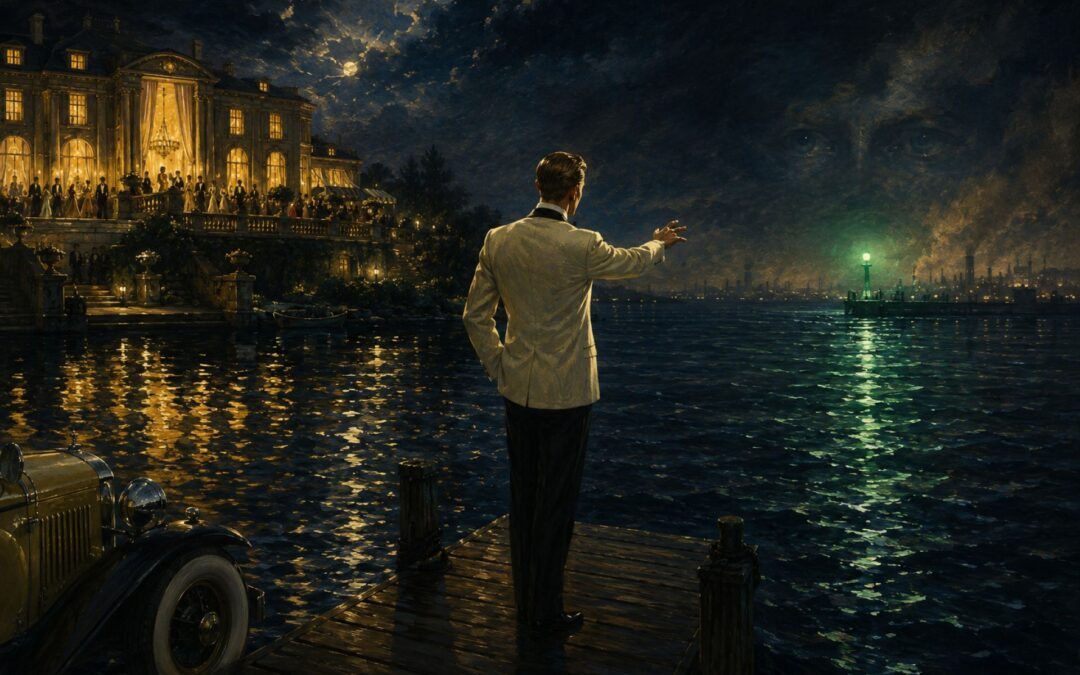
Nick leaves East Egg troubled by the Buchanans’ marriage. He initially imagines that Daisy ought to leave Tom, but nothing in her behavior suggests she intends to do so. When he returns home, he sees a solitary figure standing on Gatsby’s lawn. Gatsby stretches his arms toward the water, trembling as he reaches toward something Nick can barely make out: a tiny green light across the bay.
Nick does not yet know that the light is at the end of Daisy’s dock. At this stage it appears only as the object of Gatsby’s mysterious longing.
The next major movement of the novel takes Nick away from the insulated wealth of the Eggs. Between Long Island and Manhattan lies the valley of ashes, a desolate industrial wasteland covered in dust and dominated by an old advertising billboard showing the enormous eyes of Doctor T. J. Eckleburg. The area is not simply poor; it seems physically produced by the waste of the richer world surrounding it.
Tom abruptly insists that Nick leave the train with him to meet his mistress. Her name is Myrtle Wilson. She lives above a failing garage with her husband, George Wilson, who is pale, exhausted, economically insecure, and hopeful that Tom will sell him a car. George does not understand that Tom is sleeping with his wife.
Myrtle possesses the vitality George lacks. She and Tom arrange to meet in New York, where Tom keeps an apartment for their affair. Nick reluctantly goes with them. Myrtle changes clothes before entertaining her sister Catherine and the McKees, a couple who live nearby. As she settles into the apartment, her personality seems to change with her costume. She becomes louder, more affected, and increasingly disdainful toward anyone she considers socially beneath her.
Her affair with Tom is therefore not only sexual. Myrtle wants access to the world she associates with wealth, style, leisure, and social importance. She describes George with contempt, saying she married him because she believed he was a gentleman but lost respect for him after discovering that he had borrowed the suit he wore to their wedding. Her humiliation is tied to class as much as marriage.
The apartment party becomes increasingly drunken and chaotic. Catherine repeats an elaborate lie that Tom and Myrtle cannot marry because Daisy is Catholic and therefore opposed to divorce. The fabrication makes the affair sound like a tragic romance obstructed by external rules, when in reality Tom has shown no intention of abandoning Daisy.
Myrtle eventually begins repeating Daisy’s name during an argument with Tom. Tom responds by striking her and breaking her nose. The scene strips away any fantasy that Myrtle’s association with Tom is an escape into a better world. She may temporarily imitate its consumption and manners, but she remains vulnerable to Tom’s violence in a way Daisy is not.
Nick experiences the afternoon through alcohol and moral confusion. He describes himself as simultaneously inside the scene and outside it, both fascinated and repelled. That position will define much of his role throughout the novel: he participates in the lives he later judges, but rarely controls them.
Gatsby’s Parties, Rumors, and Secret Purpose
Nick’s first extended experience of Gatsby comes not through an intimate conversation but through Gatsby’s parties. Every weekend, Gatsby’s mansion fills with music, alcohol, food, lights, celebrities, strangers, opportunists, and people who have barely heard their host’s name. His cars carry guests from the city; his servants clean up the wreckage afterward; his grounds become a temporary world of extravagant consumption.
Most guests have not actually been invited. They simply arrive, drink Gatsby’s liquor, enjoy his property, and invent stories about him. Some say Gatsby has killed a man. Others believe he was a German spy. Still others propose connections to European royalty or wartime intrigue. Gatsby’s wealth is visible, but its origins are unknown, so rumor fills the gap.
Nick, unusually, receives a formal invitation. He goes to the party and finds Jordan Baker there. While searching for Gatsby, they encounter a drunken middle-aged man whom Nick later calls Owl Eyes. He is astonished by Gatsby’s library because the books are real rather than fake decorations. Yet some are uncut, suggesting that Gatsby has purchased not merely books but the appearance of an established gentleman’s library.
The scene captures something important about Gatsby. His world is artificial, but artificiality does not mean laziness. The books are genuine; the mansion is real; the parties cost real money; the clothes are expensive; the gestures are rehearsed. Gatsby’s performance succeeds because he invests enormous energy in making it materially convincing.
Nick eventually begins talking with a courteous man about their service in the war. The stranger seems familiar with Nick’s military division and invites him to go up in a hydroplane. Nick casually mentions that he has not yet met his host. The man smiles and reveals that he is Gatsby.
The moment deliberately undermines the grandiose rumors. Gatsby is younger, more controlled, and less physically imposing than Nick expected. What immediately distinguishes him is his smile, which seems to offer complete reassurance to whoever receives it. Nick recognizes that Gatsby carefully constructs his speech and manner, but the effect is nevertheless powerful.
Gatsby does not behave like his guests. He drinks little, remains somewhat isolated from the excess surrounding him, and seems to observe the party as much as participate in it. Later he asks to speak privately with Jordan. When she emerges, she says Gatsby has told her something astonishing but refuses to reveal it.
The party ends with a comic but ominous car accident outside Gatsby’s estate. A vehicle has crashed and lost a wheel, yet the intoxicated people involved barely understand what happened. The event anticipates the novel’s later connection between cars and moral carelessness. People with wealth and mobility move quickly through the world while expecting consequences to fall elsewhere.
The chapter also develops Nick’s relationship with Jordan. He remembers the scandal attached to her first major golf tournament, when she was accused of moving her ball from a bad position. Although the incident was never conclusively proved, Nick comes to see Jordan as someone who dislikes being at a disadvantage and responds through evasion.
Their conversation about driving makes the idea explicit. Nick tells Jordan she is a careless driver. Jordan replies that other people will be careful enough to avoid her. When Nick asks what would happen if she met someone equally careless, she says she hopes she never does. The exchange appears casual, but it gives the novel one of its central moral metaphors: privilege becomes dangerous when people assume that someone else will always compensate for their recklessness.
Nick nevertheless grows attracted to Jordan. He thinks of himself, with revealing confidence, as one of the few honest people he has ever known.
The mystery surrounding Gatsby begins to open when Gatsby arrives at Nick’s home one morning and takes him to lunch in Manhattan. During the drive Gatsby abruptly asks Nick what he thinks of him, then launches into an autobiography that sounds suspiciously polished. He claims to be the son of wealthy Midwestern parents, all now dead; to have been educated at Oxford; to have lived like a wealthy adventurer in Europe; and to have received military decorations after extraordinary service in the war.
Nick finds the performance difficult to believe, especially Gatsby’s claim about Oxford. Gatsby then produces a medal from Montenegro and a photograph apparently showing him at Oxford. These objects do not prove the entire story, but they force Nick to reconsider his skepticism. Gatsby’s fabrications often contain fragments of truth, making it difficult to know exactly where biography ends and self-invention begins.
Their journey also demonstrates Gatsby’s connections. When a policeman stops his speeding car, Gatsby shows him a card and is immediately allowed to continue. Gatsby explains that he once did the police commissioner a favor.
At lunch, Nick meets Meyer Wolfshiem, a gambler and underworld figure whose presence begins to reveal the darker machinery behind Gatsby’s wealth. Wolfshiem reminisces about criminal violence and wears cuff links made from human molars. Gatsby later identifies him as the man who fixed the 1919 World Series.
Nick is stunned not only by the scale of the crime but by the idea that a single person could deliberately manipulate an event of such public importance. Gatsby’s association with Wolfshiem suggests that his ascent is connected to networks operating outside legitimate business.
The more important revelation comes later through Jordan. She tells Nick that Daisy knew Gatsby years earlier in Louisville. In 1917, Daisy Fay was a popular young woman surrounded by admirers and young military officers. Gatsby, then an officer before going overseas, fell in love with her.
Their relationship ended not because their feelings immediately disappeared but because war interrupted it. Daisy eventually moved back into the social rhythm of her class. Before her marriage to Tom, she received a letter—strongly implied to be from Gatsby—and became drunk and hysterical, apparently wanting to cancel the wedding. She tried to return the enormously expensive pearls Tom had given her.
The crisis passed. Daisy put the pearls back on and married Tom. Soon afterward, Tom was already involved in another affair. Daisy nevertheless remained within the marriage, and the couple continued moving through the world of wealthy leisure.
Jordan explains that when Daisy heard Gatsby’s name again years later, she reacted intensely. Gatsby has spent those same years arranging his life around the possibility of reunion. He bought his mansion specifically because Daisy’s house stands across the bay.
This revelation changes the meaning of everything Nick has seen. Gatsby’s parties are not purely expressions of social ambition. He has partly filled his house with strangers because he hopes Daisy might someday appear among them. The green light is no longer an abstract distant object; it marks the place where Daisy lives.
Gatsby now wants Nick to invite Daisy to tea without telling her Gatsby will be there. Gatsby’s enormous public spectacle narrows into an unexpectedly modest private request: he wants to enter Nick’s small house and see a woman he has not spoken to in years.
Gatsby and Daisy Reunite—and the Dream Begins to Strain
Gatsby’s behavior before the reunion reveals how fragile his confidence becomes when the dream approaches reality. He has Nick’s grass cut, sends an enormous quantity of flowers, and arrives dressed carefully for the occasion. Yet he is so nervous that he almost abandons the plan moments before Daisy arrives.
He also makes Nick a financial offer. Gatsby suggests that Nick could earn money through one of his side businesses, apparently as compensation for arranging the meeting. Nick refuses, sensing that accepting would compromise the personal favor by turning it into a transaction.
Daisy arrives in heavy rain. Gatsby initially disappears, then returns to Nick’s front door soaked and terrified. The reunion is painfully awkward. Gatsby attempts to look casual while leaning against Nick’s mantel and nearly knocks over a clock.
The clock is a small object, but the scene gives it obvious thematic force. Gatsby is a man trying to recover lost time, and at the moment he meets Daisy again he literally struggles to steady a clock that almost falls.
Nick eventually leaves them alone. When he returns, the mood has completely changed. Daisy has been crying, and Gatsby seems transformed by happiness. For a brief period, the reunion appears capable of delivering everything he has imagined.
Gatsby takes Daisy and Nick through his mansion. He shows Daisy the rooms, the grounds, the furnishings, and finally his clothes. In his bedroom he throws piles of expensive shirts before her until Daisy begins crying into them, overwhelmed by their beauty.
Her response should not be flattened into a simple demonstration that she loves money. The shirts combine several realities at once. They prove how far Gatsby has risen economically, embody the world he has built in her absence, and make visible the years that have passed between them. Daisy is confronting wealth, beauty, lost time, and the physical evidence of a life that might have been different.
The tour also reveals what Gatsby’s possessions mean to him. He repeatedly watches Daisy’s reaction, as though the value of each object depends on whether it impresses her. His mansion is not simply a home; it has been constructed as evidence. Gatsby has accumulated a material argument that is finally being presented to its intended audience.
At a window Gatsby points out the green light at Daisy’s dock. Nick realizes that the light has lost some of its former enchantment. When Daisy was physically distant, the light condensed Gatsby’s longing into something almost cosmic. Now that she is beside him, it becomes an ordinary lamp again.
This does not mean Gatsby no longer wants Daisy. It means that desire changes once the object imagined from afar becomes physically present. Nick already senses a problem: Gatsby has spent five years enlarging Daisy inside his imagination, and no actual person can fully equal an ideal that has been perfected in absence.
The next chapter finally explains Gatsby’s origins. His legal name was James Gatz, and he was born to poor farmers in North Dakota. Gatsby rejected not merely his circumstances but the identity those circumstances assigned him. At seventeen he invented “Jay Gatsby,” a version of himself shaped by what Nick describes as an almost religious conception of personal destiny.
His ambition predates Daisy. He briefly attends St. Olaf College but leaves after becoming disgusted by the janitorial work required to pay his expenses. He drifts around Lake Superior doing hard labor until he sees the yacht of Dan Cody, a wealthy older man who has made a fortune from mining.
Gatsby rows out to warn Cody about dangerous weather. Cody takes him on, gives him clothes, and eventually employs him in several capacities. Gatsby spends years traveling with him, learning the habits, possibilities, and dangers of extreme wealth. Cody’s drunkenness also helps explain Gatsby’s later restraint around alcohol.
Cody eventually dies, apparently leaving Gatsby twenty-five thousand dollars. Gatsby never receives the inheritance because Cody’s companion Ella Kaye gains control of the money. What Gatsby retains is not Cody’s fortune but an education in wealth and the conviction that he belongs in its world.
The novel then returns to the present. Tom arrives unexpectedly at Gatsby’s house with a wealthy riding party. A woman in the group casually invites Gatsby to dinner, and Gatsby fails to understand that the invitation is not meant sincerely. Tom immediately recognizes the social mistake.
The episode shows the limitation of Gatsby’s transformation. He can purchase a mansion, speak carefully, wear expensive clothes, and become rich enough to host celebrities, but he has not fully absorbed the unspoken rules of inherited social status. Wealth can purchase the objects of class, but not necessarily the instinctive confidence of people who have never needed to earn membership.
Tom becomes increasingly suspicious of Gatsby’s relationship with Daisy and attends one of Gatsby’s parties with her. Gatsby tries to impress them by introducing celebrities and presenting Tom as a polo player, but Daisy is uncomfortable with much of West Egg. The spectacle that once seemed magical to Nick now appears vulgar when viewed through Daisy’s perspective.
Gatsby is devastated that she did not enjoy the evening. His disappointment is larger than the party itself because Daisy’s reaction threatens the entire project he has constructed. He wants her not simply to love him now but to validate everything he has done in her name.
Eventually Gatsby tells Nick what he expects: Daisy must tell Tom that she never loved him. Gatsby wants their five years apart erased, not merely forgiven. Nick tells him that the past cannot be repeated.
Gatsby rejects the idea immediately. His confidence in repetition exposes the central impossibility of his dream. He does not merely want Daisy; he wants reality to return to an earlier point and resume from there as if everything that followed had never occurred.
The Plaza Confrontation, Myrtle’s Death, and Gatsby’s Collapse
As Gatsby’s affair with Daisy intensifies, he stops hosting parties. The strangers were useful when they increased the possibility that Daisy might enter his orbit, but they have become unnecessary and potentially dangerous now that she visits him directly. Gatsby also dismisses his servants and replaces them with people connected to Wolfshiem, reducing the risk of gossip.
The decisive day begins at the Buchanans’ house during the brutal summer heat. Nick and Gatsby visit while Jordan is present. Daisy’s young daughter, Pammy, appears briefly, and Gatsby seems startled by her existence.
Pammy matters because she is proof that the years Gatsby wants to erase were real. Daisy did not simply wait in suspended animation while Gatsby built his fortune. She married, became a mother, developed a shared history with Tom, and accumulated experiences that cannot be undone by declaring them false.
The tension between Daisy and Gatsby becomes increasingly obvious. At one point Gatsby tells Nick that Daisy’s voice is “full of money.” The observation crystallizes something Gatsby has sensed all along. Daisy is attractive not merely because she possesses money but because security, status, leisure, desirability, and social belonging are embedded in the way she moves and speaks.
Her voice does not prove that Gatsby only loves wealth. Instead, it shows why his love for Daisy can never be neatly separated from what she represents. Daisy is simultaneously a person Gatsby once loved and the embodiment of the world from which James Gatz originally felt excluded.
Daisy proposes that the group go to New York, and Tom realizes what is happening between her and Gatsby. The journey itself rearranges the relationships through an exchange of cars. Gatsby and Daisy take Tom’s coupe, while Tom drives Gatsby’s conspicuous yellow car with Nick and Jordan.
They stop at George Wilson’s garage. George looks sick and tells Tom that he has discovered something about Myrtle and plans to take her West. He does not yet know the identity of her lover, but he knows enough to understand that his marriage is collapsing.
Myrtle watches from upstairs and misreads the people below. She sees Tom with Jordan and assumes Jordan is Daisy. The network of secrecy, jealousy, and mistaken identity is tightening around the same cars that symbolize wealth and freedom.
The group eventually takes a suite at the Plaza Hotel. There, Tom openly confronts Gatsby. Gatsby declares that Daisy never loved Tom and tells Daisy to confirm it.
For a moment, Daisy tries. She says she never loved Tom, but Tom responds by recalling moments from their marriage, forcing her to confront memories Gatsby’s version of the past cannot accommodate. Under increasing pressure, Daisy admits that she once loved Tom as well as Gatsby.
That admission destroys the absolute structure of Gatsby’s dream. Daisy may still have powerful feelings for Gatsby, but she cannot truthfully provide what he requires: a past in which Tom never mattered and the intervening years possess no emotional reality.
Tom then attacks Gatsby’s social legitimacy. He reveals that Gatsby and Wolfshiem bought drugstores and used them to sell illegal alcohol, and he suggests that Gatsby has participated in other criminal enterprises. Gatsby tries to defend himself, but Daisy begins withdrawing from him emotionally as Tom’s confidence returns.
Tom’s victory is not a moral victory. He is a violent adulterer who has spent the novel deceiving Daisy while expecting complete control over her behavior. What Tom understands better than Gatsby is how power works. Gatsby believes wealth can allow him to rewrite history; Tom knows that established privilege can absorb scandal, hypocrisy, and even cruelty without surrendering its social position.
Tom eventually becomes so certain that Gatsby has lost that he tells Daisy to return home with him in Gatsby’s car. Around the same time, Nick suddenly remembers that it is his thirtieth birthday. The detail quietly emphasizes time’s movement. Gatsby is still demanding a return to an earlier moment while Nick crosses an age he associates with adulthood and irreversible change.
On the journey back, Myrtle escapes George and runs into the road. She sees Gatsby’s yellow car and moves toward it, apparently believing Tom is inside. The car strikes her and continues without stopping. Myrtle is killed instantly and violently.
Later Nick learns the crucial fact: Daisy was driving.
Gatsby nevertheless intends to take responsibility if necessary. His willingness to protect Daisy demonstrates loyalty, but it also exposes how completely he remains captive to the ideal he has built around her. Even after the Plaza confrontation proves that Daisy cannot fulfil his imagined past, Gatsby reorganizes reality again to preserve her.
Outside the Buchanan house, Gatsby tells Nick that he intends to remain nearby in case Tom harms Daisy. Nick eventually looks through a window and sees Tom and Daisy sitting together over food. They are not happy in any romantic sense, but they seem to have re-entered a private understanding.
The scene matters because Gatsby is still guarding Daisy from outside while Daisy has already retreated into the security of her marriage. Tom and Daisy possess something Gatsby never does: a shared social fortress strong enough to survive infidelity, confrontation, and death.
Gatsby’s Death, Funeral, and Nick’s Return West
Nick cannot sleep after Myrtle’s death and goes to Gatsby’s mansion before dawn. Gatsby has remained outside the Buchanan house for hours, but Daisy has given him no message. Nick tells Gatsby that the yellow car will probably be traced and suggests that he leave Long Island temporarily.
Gatsby refuses to go because Daisy might call.
During their conversation, Gatsby finally tells Nick more about his early relationship with Daisy. She was the first wealthy young woman whose world he entered intimately. Her home seemed full of beauty, status, security, and possibilities that he had previously known only from the outside.
Gatsby allowed Daisy to believe he belonged naturally to that world. In reality he was a poor young officer with no secure financial future. His deception was therefore inseparable from aspiration: he presented the man he intended to become as if that man already existed.
The relationship deepened, but Gatsby eventually went overseas. Time passed. Daisy, surrounded by the expectations and rhythms of her own class, could not indefinitely organize her life around a distant possibility. She married Tom.
Gatsby’s later accumulation of wealth becomes easier to understand in this context. He is not simply trying to become rich or even merely to win Daisy back. He is attempting to make his earlier self-presentation retroactively true. If he can acquire enough money, build the right house, and recover Daisy, then James Gatz’s promise might appear to have been reality all along.
Before Nick leaves Gatsby that morning, he gives him his only explicit compliment. He tells Gatsby that he is worth more than the surrounding crowd. Nick immediately remembers that he has disapproved of Gatsby from beginning to end in many practical respects, but he nevertheless sees something in Gatsby that Tom, Daisy, and their social world lack.
Nick’s admiration is not an endorsement of Gatsby’s crimes or fantasies. It is admiration for the intensity with which Gatsby commits himself to a possibility. That distinction becomes central to Nick’s final judgment of the summer.
George Wilson, meanwhile, has spent the night in shock. His neighbor Michaelis stays with him as Wilson tries to understand Myrtle’s death and infidelity. Wilson has discovered signs that she had another man, including an expensive dog leash he could not have afforded.
In his grief, Wilson looks at the enormous eyes of Doctor T. J. Eckleburg and interprets them as evidence that God sees everything. Michaelis responds that the eyes are only an advertisement. The scene does not establish that Eckleburg literally represents God inside the fictional world. Instead, it shows Wilson trying to impose moral order on a landscape whose most commanding “eyes” belong to abandoned commercial advertising.
Wilson eventually leaves the garage and begins tracing the yellow car. Tom later admits that Wilson came to him and asked about it. Tom told him that Gatsby owned the car and also convinced himself that Gatsby must have been Myrtle’s lover and the driver who killed her.
At Gatsby’s house, Gatsby continues waiting for Daisy to telephone. No call comes. He decides to use his swimming pool before it is drained for the season, despite having hardly used it all summer.
Wilson arrives at the estate. He shoots Gatsby and then kills himself.
Nick returns to find Gatsby dead in the pool. In Gatsby’s final moments, Nick can only imagine what Gatsby might have felt. The narration becomes openly speculative, reminding readers that Nick does not possess direct access to Gatsby’s consciousness even when his language becomes most intimate.
After Gatsby’s death, Nick finds himself almost alone in accepting responsibility for the aftermath. Newspapers sensationalize the murder. Reporters and curious strangers descend on the estate. People who once treated Gatsby’s house as a public playground vanish.
Daisy and Tom leave town without giving Nick an address. Meyer Wolfshiem distances himself from the funeral, arguing that he has learned not to become involved after a man dies. Klipspringer, who had practically lived at Gatsby’s mansion, calls not to mourn Gatsby but to recover belongings he left behind.
Gatsby’s father, Henry C. Gatz, arrives from Minnesota. Unlike Gatsby’s glamorous acquaintances, he is genuinely proud of his son. He marvels at the mansion and shows Nick an old book containing a childhood schedule Gatsby had written for himself.
The schedule reveals a program of exercise, study, work, elocution, and self-improvement. It is one of the novel’s most important late revelations because it proves that Gatsby’s self-invention did not begin with Daisy. James Gatz had long believed disciplined effort could turn him into another person.
Almost nobody attends the funeral. Owl Eyes, the drunken man who once marveled at Gatsby’s real books, unexpectedly appears. His presence gives the funeral a strange dignity because one of the few people who recognized the odd mixture of authenticity and performance in Gatsby’s world also acknowledges him after the spectacle has disappeared.
The emptiness of the funeral changes the meaning of the parties. Gatsby had been surrounded by crowds, but those crowds were never a community. He provided entertainment, access, alcohol, celebrity, and the fantasy of belonging, yet very few people felt any responsibility toward him.
Nick grows increasingly disgusted with the East and begins thinking of himself, Gatsby, Tom, Daisy, and Jordan as Westerners who came East and became distorted there. His nostalgia for the Midwest is partly another act of interpretation, but it signals his desire to leave the moral landscape associated with the summer.
His relationship with Jordan ends. She reminds him of their earlier conversation about careless drivers and suggests that she once believed Nick was different from the people he condemned. Her accusation complicates Nick’s preferred image of himself as uniquely honest and careful. He may judge others perceptively, but he has not passed through the summer without creating pain or contradiction of his own.
Before leaving, Nick encounters Tom in New York. Tom admits that he told Wilson Gatsby owned the yellow car. He still believes Gatsby killed Myrtle and thinks his own actions were justified.
Nick sees more clearly than ever how Tom and Daisy survive. They can create damage and then retreat behind money, marriage, and social protection while other people absorb the consequences. Tom loses Myrtle and briefly risks losing Daisy, yet the structure of his life remains intact.
Nick eventually returns to Gatsby’s empty property one last time. Looking across the bay, he imagines the land as it might have appeared to European sailors seeing the American continent for the first time. Their wonder becomes connected to Gatsby’s private experience of the green light.
The novel ends by expanding Gatsby’s personal dream into a meditation on human aspiration. People continually imagine a future capable of completing what has remained unfinished, yet the past does not disappear simply because the future is desired intensely enough. Like boats attempting to move forward against a current, people strive toward what lies ahead while being pulled backward by memory, history, and everything that has already made them who they are.
Setting and Social World: East Egg, West Egg, New York, and the Valley of Ashes
The geography of The Great Gatsby is never merely decorative. Fitzgerald arranges the major locations so that characters repeatedly move through a social system organized by wealth, status, labor, consumption, and exclusion. The physical journey between Gatsby’s mansion, the Buchanan estate, Wilson’s garage, and Manhattan also becomes a journey through different levels of American economic life.
East Egg represents the confidence of inherited wealth. Tom and Daisy do not need to prove that they belong among the rich because their status predates the events of the novel. Their house is luxurious, but unlike Gatsby’s mansion it does not function as an argument for their legitimacy. They can leave one city for another, travel abroad, buy horses, employ servants, and withdraw after catastrophe because wealth has become an assumed condition of existence.
West Egg is wealth without the same social security. Gatsby possesses an enormous estate and can host hundreds of guests, yet Tom regards him as socially inferior. Fitzgerald does not present everyone in West Egg as admirable or everyone in East Egg as uniquely wicked. The difference concerns the kind of power money carries. Gatsby has enough wealth to imitate the visible world of old money but not enough pedigree to make Tom regard him as an equal.
That distinction becomes clearest in the Sloane episode. Gatsby is materially rich enough to entertain people from Tom’s social circle, but he misreads a polite invitation because he does not instinctively recognize the codes that determine who is genuinely welcome. Daisy’s reaction to Gatsby’s party exposes the same boundary from another direction. What Gatsby considers dazzling abundance strikes her as socially uncontrolled and vulgar.
Manhattan offers apparent freedom from these fixed domestic arrangements. Tom brings Myrtle there to conduct his affair, Gatsby conducts business through connections like Wolfshiem, and the characters repeatedly treat the city as a space in which ordinary restrictions can be suspended. Yet the freedom is temporary. Tom still controls Myrtle, Gatsby’s criminal associations remain dangerous, and the consequences generated in the city eventually return to Long Island.
The valley of ashes reveals the underside of both worlds. George and Myrtle Wilson live amid the waste created by a richer economy, and their garage depends on people with enough money to own automobiles. They are geographically positioned between elite Long Island and Manhattan, yet they do not meaningfully belong to either.
The valley makes class inequality material. The people of East and West Egg travel through it while George remains trapped there, repairing machines owned by people whose mobility he cannot share. Myrtle tries to escape through Tom, but her attempt ultimately leads to her death on the road outside the garage.
Automobiles connect all these spaces while emphasizing unequal power. Cars allow Tom, Gatsby, Daisy, Nick, and Jordan to move rapidly between social worlds, but George and Myrtle experience cars from the position of those who repair them, desire them, or are endangered by them. Myrtle’s death is therefore not simply an accident inserted for tragedy. It occurs within a landscape where wealth possesses mobility while the socially vulnerable bear disproportionate consequences.
The Library of Congress describes The Great Gatsby in relation to Jazz Age wealth, social status, ambition, greed, and new beginnings. Those concerns are embedded in Fitzgerald’s map of the novel. Gatsby’s tragedy could not operate in the same way without the Eggs, the city, and the ashes because each location represents a different answer to the question of who gets to move, who gets to belong, and who pays for someone else’s freedom.
Character Analysis
Fitzgerald’s characters often appear larger than ordinary realism because Nick renders them through memorable physical details, gestures, voices, colors, and moral impressions. Yet the major figures cannot be understood only as symbols. Their power comes from the tension between their human desires and the larger ideas they come to represent.
Jay Gatsby: Self-Invention, Hope, and Fatal Idealism
Jay Gatsby is compelling because Fitzgerald makes admiration and criticism difficult to separate. Gatsby is a criminal businessman, a liar about his past, a status seeker, and a man who attempts to impose an impossible narrative on Daisy. At the same time, he possesses an intensity of aspiration that Nick finds almost absent from everyone else.
His defining act occurs long before the summer of 1922: James Gatz invents Jay Gatsby. The transformation is not simply a con designed to deceive strangers. Gatsby creates a future identity and then devotes himself to making reality catch up with it.
Henry Gatz’s discovery of the childhood schedule reinforces this interpretation. Young Gatsby already believed that disciplined self-management could create greatness. His exercises, study plans, and self-improvement program are almost comic in their earnestness, but they show that his ambition does not begin with criminality or romance.
Dan Cody gives Gatsby his first sustained encounter with the world his imagination has already desired. Gatsby learns the forms of wealth without receiving permanent financial security from Cody. When the inheritance disappears, Gatsby is left with knowledge, aspiration, and the conviction that he should belong to a higher social world.
Daisy eventually fuses that ambition with romantic desire. She is not simply a rich woman Gatsby happens to love; she becomes the human embodiment of everything his invented identity was designed to reach. Her house, voice, beauty, and social confidence belong to a world James Gatz had admired from outside.
This fusion explains why Gatsby’s love becomes so absolute. If Daisy chooses Gatsby entirely and declares that she never loved Tom, then Gatsby gains more than a partner. He receives confirmation that the five-year struggle was meaningful, that his invented identity has triumphed, and that the past can be revised until it agrees with his dream.
His greatest strength and greatest flaw are therefore related. Gatsby can imagine possibilities with unusual force, but he struggles to accept anything that contradicts the ideal once it has been created. Daisy’s actual complexity becomes a problem because Gatsby needs her to conform to a role larger than any ordinary person could sustain.
The Plaza confrontation exposes this limitation. Daisy cannot erase her marriage or truthfully say that Tom meant nothing to her. Gatsby is defeated not because Tom suddenly becomes worthy of Daisy but because reality refuses to become as absolute as Gatsby’s imagination.
His loyalty after Myrtle’s death is similarly double-edged. Gatsby’s willingness to accept responsibility for Daisy is generous, but it also shows his refusal to revise his image of her. He protects a woman who is already withdrawing toward Tom and continues waiting for a telephone call that never comes.
Nick’s admiration survives these failures because Gatsby remains fundamentally oriented toward possibility. Tom and Daisy protect what they already possess; Gatsby continually reaches toward what he believes life might still become. The novel’s tragedy lies in the fact that this admirable capacity for hope has attached itself to an impossible project, compromised methods, and a woman whom Gatsby increasingly treats as the proof of his dream rather than as an independent person.
Nick Carraway: Observer, Participant, and Moral Judge
Nick is often described as the narrator of Gatsby’s story, but his role is more active than that description suggests. He chooses the evidence, rearranges chronology, repeats testimony, imagines scenes he did not witness directly, and ultimately determines the moral language through which Gatsby is remembered.
His opening claim that he reserves judgment should therefore be read cautiously. Nick is capable of sympathy, but he is also intensely judgmental. Tom appears to him as physically brutal, Jordan as incurably dishonest, Myrtle’s circle as vulgar, and Gatsby as simultaneously ridiculous and magnificent.
That contradiction is not necessarily a flaw in the narration. It establishes Nick as a person trying to reconcile his preferred identity with his actual responses. He wants to be tolerant but discovers limits to tolerance. He wants to consider himself honest but becomes involved in secret meetings, affairs, gossip, and emotionally ambiguous relationships.
His attraction to Jordan illustrates this tension. Nick recognizes her dishonesty and carelessness yet continues the relationship. When he eventually judges the East for moral irresponsibility, Jordan is able to turn part of that judgment back on him by reminding him that she once believed he was a safer person.
Nick is also socially better positioned than his apparent modesty suggests. His house is small compared with Gatsby’s mansion, but he comes from a prosperous family, attended Yale, knows Tom from college, and is related to Daisy. He can move between Gatsby’s world and the Buchanans’ world because neither is completely foreign to him.
His relationship with Gatsby develops because Gatsby confides in him while remaining strange to him. Nick is skeptical of Gatsby’s stories and disapproves of his criminality, but he becomes emotionally committed to Gatsby as the rest of Gatsby’s social world disappears.
By the end, Nick’s account has become an act of preservation. The newspapers reduce Gatsby to scandal, the party guests vanish, Wolfshiem refuses involvement, Daisy never calls, and Tom interprets Gatsby as a criminal who deserved his fate. Nick becomes the person who insists that Gatsby cannot be understood only through the circumstances of his death.
This does not make Nick perfectly reliable. His deepest descriptions of Gatsby’s final consciousness are openly imaginative, and his final historical enlargement from one man’s dream to America itself is interpretation rather than neutral reporting. The novel gains power precisely because Nick’s account is both observant and shaped by need. He is telling the story in order to decide what kind of person Gatsby was and what the summer taught him about the world.
Daisy and Tom Buchanan: Desire Protected by Privilege
Daisy and Tom are often discussed together because the novel ultimately returns them to the shelter of their marriage, but they should not be treated as interchangeable. Their forms of power are different, as are the constraints under which they operate.
Daisy’s most obvious gift is social and emotional magnetism. Her voice makes ordinary statements seem intimate and promising. Gatsby’s observation that it is “full of money” is so effective because her charm cannot be separated from the security and desirability of the world that produced her.
She is also more perceptive than a purely superficial reading allows. Her speech about hoping her daughter becomes a beautiful fool recognizes the gendered logic of her environment. Daisy understands that awareness does not necessarily give a woman control and that appearing untroubled can function as a form of adaptation.
At the same time, awareness does not absolve her choices. Daisy participates in Gatsby’s affair, allows him to believe she can fulfil his demand for total recovery, drives the car that kills Myrtle, and then withdraws without accepting public responsibility. Her vulnerability within a patriarchal marriage exists alongside immense class privilege.
The Plaza confrontation is important because Daisy finally refuses Gatsby’s demand to simplify her past. She cannot say she never loved Tom. That admission makes her more psychologically credible than Gatsby’s ideal version of her, but it also reveals why Gatsby’s dream cannot survive contact with her actual history.
After Myrtle’s death, Daisy retreats into Tom’s world. The novel never gives the reader direct access to the full reasoning behind that decision, so it would be excessive to say she simply chooses money over love. What is clear is that when crisis arrives, Daisy returns to the structure that offers her established security.
Tom’s power is less subtle. From his first appearance he is physically dominant, socially arrogant, and accustomed to entitlement. He cheats on Daisy while treating her relationship with Gatsby as an intolerable violation.
His racism reveals another aspect of his personality. Tom is obsessed with losing dominance despite already occupying the top of several social hierarchies. His white-supremacist ideas are part of a broader fear that people he considers inferior might cross boundaries that protect his status.
The same mentality shapes his attitude toward Gatsby. Tom does not merely object because Gatsby is sleeping with his wife. He despises Gatsby as newly rich, socially illegitimate, and criminally connected. Investigating Gatsby’s business allows Tom to transform romantic jealousy into class policing.
His relationship with Myrtle exposes his hypocrisy most brutally. Tom uses her as a mistress, lies about the possibility of marriage, and physically assaults her. After her death, however, he feels genuine grief and later tells Nick that seeing the dog biscuits associated with Myrtle made him cry.
That grief does not produce moral responsibility. Tom directs Wilson toward Gatsby and convinces himself that Gatsby was both Myrtle’s lover and killer. He can therefore understand himself as a wounded husband and bereaved lover while avoiding the fact that his own affair helped create the conditions of the tragedy.
Daisy and Tom finally reunite not because their marriage has become admirable but because their shared class position allows them to absorb damage together. Nick’s final judgment of them is severe because their wealth turns consequences into something other people experience.
Jordan Baker: Detachment, Dishonesty, and Nick’s Mirror
Jordan Baker initially appears as one of the novel’s most modern figures. She is professionally successful, mobile, unmarried, and less visibly dependent on male approval than Daisy or Myrtle. Her coolness contrasts with Daisy’s emotional performance and Gatsby’s intense longing.
Yet Jordan’s self-possession is linked to dishonesty. Nick remembers the accusation that she cheated during a golf tournament and later interprets her behavior as part of a broader unwillingness to accept disadvantage.
The driving conversation makes her moral philosophy almost explicit. Jordan expects other people to avoid her mistakes. She can remain careless because she assumes the world contains enough cautious people to prevent disaster.
Her relationship with Nick matters because Nick initially sees himself as the opposite kind of person. He thinks he is honest, controlled, and careful. Their breakup allows Jordan to challenge that self-image.
When she tells Nick that she believed he was a careful driver, the metaphor returns with a different force. Nick has spent much of the novel identifying carelessness in others, yet Jordan suggests he has also failed to account for another person’s emotional position. She therefore operates not only as a secondary romance but as a mirror for the narrator’s moral confidence.
Myrtle and George Wilson: Aspiration, Powerlessness, and Tragedy
Myrtle and George occupy the social world that Tom, Daisy, and Gatsby can usually pass through without inhabiting. Their marriage is unhappy, but Fitzgerald gives each spouse a different response to economic confinement.
Myrtle wants escape. Her affair with Tom offers access to money, clothing, an apartment, consumer goods, and the feeling of social importance. Her transformation at the Manhattan party shows how quickly consumption becomes performance: she begins speaking and behaving as though possession of expensive objects has changed her position.
Her contempt for George is rooted partly in the discovery that he lacks the status she thought he possessed. The borrowed wedding suit becomes a symbol of disappointment because Myrtle interprets poverty as evidence that she married beneath the life she deserved.
Yet Tom never offers genuine social elevation. He can buy Myrtle gifts and maintain an apartment while still treating her as disposable. His violence makes the hierarchy unmistakable.
Myrtle’s death completes the cruelty of her aspiration. She runs toward the yellow car because she associates it with Tom and escape, only to be killed by a vehicle owned by Gatsby and driven by Daisy. Several forms of wealth converge in the instrument that destroys her.
George responds to deprivation differently. He is physically diminished by the valley of ashes and economically dependent on customers like Tom. Once he discovers Myrtle’s secret, he tries to reclaim control by taking her West.
After Myrtle dies, grief overwhelms him. His interpretation of the Eckleburg billboard reveals his need to find a moral witness in a world that has offered him little justice. Tom then gives his grief a direction by identifying Gatsby with the yellow car.
George becomes a murderer, but his violence occurs within a chain of misinformation and unequal power. Tom can point him toward Gatsby and disappear. George, already psychologically shattered, carries out the irreversible act.
Myrtle and George should not therefore be treated merely as symbols of poverty. Their specific marriage, frustrations, weaknesses, and desires matter. At the same time, their fate demonstrates how differently catastrophe operates across classes: wealthy characters create much of the danger, while the Wilsons die inside it.
Meyer Wolfshiem, Henry Gatz, Owl Eyes, and the Supporting Cast
Meyer Wolfshiem is important because he makes Gatsby’s criminal connections visible. His association with the fixed 1919 World Series tells Nick that Gatsby’s fortune exists near organized corruption rather than within the respectable business world Gatsby sometimes implies.
Wolfshiem also exposes one of the novel’s clearest ethical limitations. Fitzgerald presents him through conspicuously antisemitic physical and linguistic stereotypes, even while using him to represent a criminal milieu. Scholarship on Fitzgerald’s ethnic stereotyping, including Suzanne del Gizzo’s work, is useful because it prevents readers from treating every prejudicial element as automatically redeemed by satire.
Henry Gatz serves an almost opposite function. He reconnects Gatsby with the family and childhood Gatsby tried to transcend. His pride is touching because it recognizes Gatsby’s achievement without understanding the full moral cost.
Dan Cody belongs to Gatsby’s formative history. He provides a model of wealth and introduces Gatsby to the lifestyle he later recreates more theatrically on Long Island. Cody is therefore important less as a fully developed character than as a bridge between adolescent fantasy and adult self-construction.
Owl Eyes appears only briefly, but his two major scenes form a meaningful pair. At the party, he recognizes that Gatsby’s library contains real books. At the funeral, he is one of the few former guests who actually appears. He becomes a minor witness to the strange mixture of reality and performance Gatsby created.
Klipspringer represents the opposite response. He benefits from Gatsby’s hospitality so thoroughly that he becomes known as the boarder, yet after Gatsby dies his main concern is recovering property he left behind.
Pammy, Daisy’s daughter, has little narrative space but considerable thematic importance. Her existence is the most concrete evidence that Daisy’s five years with Tom cannot simply be removed from history. Michaelis, meanwhile, performs a quiet but important role after Myrtle’s death by staying with George and rejecting Wilson’s attempt to transform the Eckleburg billboard into literal divine surveillance.
Together these characters thicken Gatsby’s world. They show the difference between people who use him, shape him, misunderstand him, exploit him, recognize something genuine in him, or remain as evidence against the fantasy he wants to preserve.
Themes and Ideas
The Great Gatsby becomes less interesting when its themes are separated into simplistic lessons. Fitzgerald repeatedly allows one idea to contain its opposite: aspiration can be admirable and destructive, wealth can be glamorous and morally insulating, love can be sincere and possessive, and self-invention can be creative while resting on denial. The novel’s richness comes from these tensions rather than from a single moral formula.
The American Dream, Self-Making, and the Limits of Reinvention
Gatsby’s life naturally invites interpretation through the idea of the American Dream. James Gatz comes from poverty, invents a new identity, disciplines himself, pursues wealth, and appears to transform his social position through extraordinary ambition.
Yet Fitzgerald complicates every part of that narrative. Gatsby does not achieve wealth through a straightforward story of legitimate enterprise. His fortune is connected to bootlegging and Wolfshiem’s criminal networks. More importantly, even great wealth does not erase class origins.
Gatsby can become richer than many people who despise him without acquiring the invisible inheritance of social legitimacy. Tom’s contempt demonstrates that the social order does not operate according to money alone. Birth, education, manner, family, and historical belonging remain powerful.
The American Dream interpretation is important, but it should not be treated as though Fitzgerald hands readers a simple thesis labeled with that phrase. Laura Goldblatt’s history of the novel’s American Dream interpretation shows how strongly that framework became attached to the book during its later reception.
The novel itself is more specific. Gatsby believes identity can be remade through will and performance. His rise proves that reinvention is partly possible: James Gatz really does become Jay Gatsby in the eyes of the world.
The tragedy is that Gatsby eventually asks reinvention to accomplish something no amount of money or discipline can guarantee. He wants it to rewrite another person’s history. His dream fails not because change is impossible but because he refuses to recognize what cannot be transformed by desire alone.
The childhood schedule discovered by Henry Gatz deepens this interpretation. Gatsby has always believed in self-directed improvement. Daisy does not create that impulse; she gives it a final object.
The result is both inspiring and disturbing. Gatsby’s refusal to accept inherited limits allows him to achieve an astonishing transformation, yet the same refusal becomes destructive when he treats reality itself as something that must submit to his imagined design.
Old Money, New Money, and Class Closure
The distinction between East Egg and West Egg demonstrates that economic wealth and social class are related but not identical. Gatsby’s enormous fortune gives him visibility without complete acceptance.
Tom represents inherited wealth at its most secure. He does not need to explain where his money came from or prove that he deserves his lifestyle. Gatsby, by contrast, continually performs legitimacy through architecture, clothing, vocabulary, possessions, and stories.
His mansion looks like an imported European estate. His library contains real books. His clothes come from England. He calls people “old sport.” He claims Oxford connections. Each detail attempts to convert money into a recognizable social identity.
The performance is often convincing enough for outsiders but not for people like Tom. The Sloane episode shows Gatsby missing a social cue that inherited elites understand without effort. Daisy’s discomfort at his party similarly reveals a distinction that no amount of champagne can eliminate.
Daisy’s voice being “full of money” expresses this difference perfectly. Gatsby can purchase nearly every external sign of wealth, but Daisy’s social confidence has been formed over an entire lifetime. Money exists not simply in what she owns but in what she assumes.
Tom eventually defeats Gatsby partly by turning class difference into moral accusation. Gatsby’s bootlegging allows Tom to present him as criminal and therefore unworthy, even though Tom’s own behavior is deeply immoral. Old money protects itself by treating the illegitimate origins of new money as proof that social exclusion is justified.
The novel therefore does not merely condemn wealth. It distinguishes between wealth as possession and wealth as protection. Gatsby has enormous possessions but fragile protection; Tom and Daisy have both.
That difference explains the ending. Gatsby’s house cannot save him. Daisy and Tom can leave town.
Love, Desire, Possession, and Idealization
The relationship between Gatsby and Daisy contains genuine emotional history. Reducing Gatsby’s love to greed misses the intensity of their earlier connection and the pain of separation.
At the same time, Gatsby’s desire has changed during the five years they spend apart. He no longer loves only the remembered Daisy. He loves an ideal built from memory, longing, social ambition, and imagined possibility.
Nick recognizes this during the reunion. Daisy cannot fully equal the image Gatsby has accumulated because the image has been developing without resistance from reality. The longer Gatsby waits, the more completely the dream can be perfected.
This helps explain his demand at the Plaza. A person interested only in building a future with Daisy might accept that she once loved Tom. Gatsby cannot. He needs the past itself to confirm his interpretation.
His desire consequently becomes possessive in a philosophical sense. Gatsby wants Daisy’s history to belong to his dream. Her statement that she loved Tom is intolerable because it establishes a part of her life he cannot absorb.
Daisy’s behavior is also complicated. She clearly responds powerfully to Gatsby after their reunion, but she does not become the woman Gatsby imagined. Her emotional life includes Tom, her daughter, memory, fear, comfort, class identity, and present attraction.
Tom’s concept of love is different but no less possessive. He repeatedly cheats on Daisy while reacting furiously when she desires someone else. His outrage depends on the assumption that his own freedom does not alter his ownership of the marriage.
His relationship with Myrtle follows the same structure. Tom can keep a mistress, lie to her about divorce, control the conditions of the affair, and physically assault her. He wants access without equality.
The novel’s romantic tragedy therefore involves more than choosing between two men. It asks what happens when love becomes inseparable from ownership, status, memory, and the stories people tell about who another person must be.
Carelessness, Responsibility, and Moral Escape
Carelessness appears early as a joke about driving, but by the end it has become the novel’s clearest moral accusation. Jordan expects other drivers to avoid her. The drunken guests at Gatsby’s party crash a car and barely understand the damage. Daisy kills Myrtle while driving Gatsby’s automobile and does not stop.
The pattern matters because the problem is not simply making mistakes. It is making mistakes while assuming that someone else will absorb the result.
Daisy’s decision after Myrtle’s death is the most obvious example. Gatsby is prepared to accept responsibility for her, and Daisy allows him to remain exposed while she withdraws with Tom.
Tom’s role is even more deliberate. By telling Wilson that Gatsby owned the yellow car and encouraging Wilson’s belief that Gatsby was responsible, Tom directs a grieving and unstable man toward someone else. Gatsby dies, while Tom leaves town.
Nick’s final judgment of Tom and Daisy therefore gathers several earlier patterns into one idea. Their money acts as insulation. They can behave destructively and then retreat from the wreckage because wealth provides distance from consequences.
Gatsby is not innocent of carelessness in every sense. His criminal businesses, enormous parties, and obsession with recovering Daisy all depend on disregarding certain realities. Yet he differs from the Buchanans in one important respect: when catastrophe comes, he remains.
He waits outside Daisy’s house. He is willing to take responsibility for the car. He waits for her call. This loyalty does not make his actions wise, but it helps explain Nick’s moral distinction between Gatsby and the people who ultimately abandon him.
Nick himself cannot stand completely outside the theme. He criticizes carelessness yet participates in relationships and secrets throughout the summer. Jordan’s final accusation ensures that the novel does not allow him to become a perfectly clean moral authority.
Gender, Race, and the Boundaries of Belonging
Gender shapes the choices available to Daisy, Myrtle, and Jordan in different ways. Daisy possesses extraordinary class privilege but recognizes that women in her world are often rewarded for beauty, charm, and strategic ignorance. Her wish that her daughter become a beautiful fool is therefore bitter social commentary as well as self-dramatization.
Myrtle has far less protection. Her attempt to improve her circumstances through Tom leaves her dependent on a man who can hit her without meaningful social consequence. She seeks agency through sexual and consumer freedom but discovers that both operate within a hierarchy she does not control.
Jordan appears comparatively independent. She has a career, travels, and does not organize her identity around marriage. Yet even Jordan’s cool independence exists within a culture that judges and describes women differently from men. Nick’s own comments about her dishonesty sometimes reveal the gendered assumptions of his perspective.
Race appears most explicitly through Tom’s white-supremacist anxiety. His fear that white dominance is threatened fits his wider obsession with preserving hierarchy. Tom interprets social change as invasion because his identity depends on remaining securely above others.
It would be too easy, however, to conclude that the novel has solved the problem of racism merely because Tom is clearly presented as arrogant and foolish. Fitzgerald’s treatment of Wolfshiem relies on antisemitic stereotypes that operate at the level of physical description, speech, and criminal association. The distinction between exposing a racist character and participating in ethnic stereotype matters to a responsible modern reading.
These issues connect with the novel’s broader concern with belonging. Gatsby tries to cross a class boundary. Myrtle tries to cross one from another direction. Tom responds to racial and class mobility as threats. Daisy remains protected within an inherited elite.
The world of The Great Gatsby is therefore not open simply because characters can move geographically or acquire money. Its boundaries are constantly enforced through gender, race, ethnicity, family background, reputation, and social codes that some people inherit while others must attempt to decipher.
Time, Memory, and Why Gatsby Cannot Repeat the Past
Time is the deepest obstacle Gatsby faces because nearly everything else appears negotiable to him. Poverty can be escaped. Identity can be changed. Manners can be learned. Money can be acquired. A mansion can be purchased. Even criminal origins can be disguised behind elegant stories.
The past is different. Gatsby refuses to accept that difference because his entire life has trained him to believe reality can be transformed through determination.
The mantel clock during the reunion condenses that conflict into a physical scene. Gatsby nearly knocks it down while trying to appear composed, then catches and steadies it. He can prevent the clock from falling, but he cannot literally restore the five years it represents.
His relationship with Daisy becomes possible again only after he has acquired the financial position he lacked before the war. This creates the illusion that the problem has been solved. Gatsby interprets delayed success as evidence that history can resume where it was interrupted.
Daisy’s actual life disproves that assumption. Her marriage to Tom, birth of Pammy, memories, disappointments, and adaptations all belong to the years Gatsby mentally treats as an error.
The Plaza confrontation forces those years into the room. When Daisy admits that she once loved Tom, she does more than hurt Gatsby romantically. She confirms that the intervening period possesses emotional reality.
Nick’s thirtieth birthday quietly reinforces the point. While Gatsby insists that life can move backward, Nick becomes conscious of moving forward into another stage of adulthood. The unbearable heat of the day eventually gives way to autumnal imagery, Gatsby’s unused pool, and the approaching end of the season.
The final pages universalize the problem. Human beings imagine the future as a place where unfinished desires might finally be completed, but every act of imagining is produced by a past that cannot simply be discarded.
Gatsby’s error is therefore more subtle than nostalgia. He does not merely miss what happened. He loves what he believes should have happened and organizes the future around forcing history to confirm that version.
His tragedy emerges when reality proves that memory can inspire action but cannot be made sovereign over other people, other choices, and elapsed time.
Symbols and Motifs in The Great Gatsby
Fitzgerald’s symbols are powerful because their meanings change with the narrative rather than remaining fixed. The green light does not signify exactly the same thing before and after Gatsby reunites with Daisy, and the eyes of Eckleburg do not possess a single objective religious meaning simply because George Wilson interprets them that way. The novel’s imagery works best when treated as a developing system rather than a codebook.
The Green Light
The green light first appears before Nick understands Gatsby. Gatsby stands alone at night and reaches toward it across the bay. At that moment, the light represents distance more than any specific interpretation.
After Jordan explains Gatsby’s history, the reader learns that the light stands at the end of Daisy’s dock. The abstract longing acquires a literal object.
Yet the light is never reducible to Daisy alone. Gatsby has attached years of desire to that distant point. Daisy’s location allows the light to contain romantic hope, social aspiration, memory, and the possibility of another life.
The reunion alters its meaning. When Daisy stands beside Gatsby and he points out the light, Nick realizes that some of its significance has disappeared. The distance that allowed Gatsby to invest it with enormous imaginative power has collapsed.
That loss is revealing. Gatsby’s enchantment depends partly on separation. Once he possesses proximity, the symbol must either become ordinary or acquire a new object beyond the immediate reality.
The final chapter returns to the green light after Daisy has left, Gatsby is dead, and the mansion stands empty. Nick now connects Gatsby’s reaching with a larger human pattern of imagining a future that seems close enough to pursue but continually recedes.
The green light therefore moves from physical object to romantic symbol to broader image of futurity. Its power comes from that progression. Reducing it to “money,” “Daisy,” or “the American Dream” alone loses the way Fitzgerald deliberately enlarges it.
The Valley of Ashes and the Eyes of Doctor T. J. Eckleburg
The valley of ashes represents a world of residue. The wealth enjoyed elsewhere in the novel exists beside a landscape covered in the waste of industrial modernity.
George and Myrtle do not merely happen to live there. Their economic vulnerability is embedded in the place. The Wilson garage survives by servicing the mobility of people richer than its owners.
The eyes of Doctor T. J. Eckleburg hang above this landscape on an old advertising billboard. They are enormous, faded, and detached from a human face. Their original purpose was commercial, not religious.
George eventually interprets the eyes as evidence that God sees everything. In his grief, he needs a moral witness capable of seeing Myrtle’s betrayal and the injustice surrounding her death.
Michaelis responds that the billboard is only an advertisement. That response is essential. The novel does not straightforwardly announce that Eckleburg equals God.
The symbol is more unsettling because the landscape offers no obvious divine judgment. A grieving man looks for transcendent meaning and finds the remnants of advertising.
Eckleburg therefore brings together commerce, surveillance, moral emptiness, and the human need for interpretation. The eyes appear to watch, but whether anyone is truly judging the events remains uncertain.
Cars, Houses, Clothes, Clocks, Weather, and Books
Cars are among the novel’s most consistent motifs because they unite wealth, speed, modernity, freedom, and recklessness. Gatsby’s enormous yellow car advertises his success, but it also becomes the vehicle that kills Myrtle and ultimately directs Wilson toward Gatsby.
The earlier car crash outside Gatsby’s party and Jordan’s careless driving conversation prepare this development. Fitzgerald repeatedly associates movement with the assumption that someone else will manage the danger.
Houses function as expressions of identity. The Buchanan home represents inherited security; Gatsby’s mansion represents created identity. Gatsby buys not simply a large residence but a structure capable of announcing that he has arrived.
Yet the mansion is strangely empty at crucial moments. It is crowded with strangers during parties but cannot create durable social bonds. After Gatsby dies, its scale becomes almost absurd against the small number of people who genuinely care about him.
Clothing performs similar work on a more intimate level. Gatsby’s imported shirts demonstrate the material success of his transformation. Daisy’s tears before them connect beauty, wealth, time, and emotional loss.
The mantel clock makes time briefly physical, while weather tracks emotional pressure without becoming a simplistic code. Gatsby and Daisy reunite in rain that later clears; the Plaza confrontation occurs under oppressive heat; the end of Gatsby’s story approaches with changing seasonal conditions.
Books and reading also carry an understated tension between knowledge and appearance. Gatsby’s library is full of authentic volumes, yet many are unread. The detail captures the paradox of his self-construction: his props are not necessarily fake, but their primary function is performance.
Even the parties operate as a recurring motif. They appear to represent abundance and sociability, yet Gatsby remains unusually alone within them. Their true meaning becomes clear only after his death, when the crowd disappears and the funeral is nearly empty.
Nick’s Narration, Fitzgerald’s Style, and the Novel’s Structure
One reason The Great Gatsby feels larger than its plot is Fitzgerald’s control over narrative revelation. The story of Gatsby could have been told chronologically: James Gatz grows up poor, meets Dan Cody, becomes an officer, falls in love with Daisy, loses her, becomes rich, buys a mansion, and tries to win her back. Fitzgerald refuses that order because mystery is essential to Gatsby’s meaning.
Readers first encounter Gatsby as a distant gesture toward a green light. Next comes public rumor. Then Nick meets him without recognizing him. After that Gatsby offers an unreliable autobiography, Jordan supplies the Daisy history, Nick reveals James Gatz, and Gatsby later provides still more information about his early relationship with Daisy.
The structure continually replaces one Gatsby with another. Murderer, spy, Oxford man, millionaire, lover, bootlegger, James Gatz, self-made visionary, abandoned corpse: none of these descriptions alone is complete.
Nick’s position makes the method possible. He is close enough to enter Gatsby’s confidence but distant enough to remain fascinated by him. He also has access to Daisy, Tom, Jordan, and eventually Henry Gatz.
The narration is retrospective, which means the opening has already been shaped by the ending. Nick tells readers very early that Gatsby “turned out all right” in some moral sense, even though he also says Gatsby represented much that he ordinarily despises. The tension creates a question the rest of the novel answers: what did Nick discover in Gatsby that survived everything he learned about him?
Fitzgerald also allows Nick to rearrange chronology openly. Chapter 6 pauses the present plot to explain James Gatz, and later chapters incorporate Gatsby’s recollections of Daisy. This construction makes biography arrive precisely when it changes the meaning of current events.
The University of South Carolina’s discussion of Fitzgerald’s life and work describes The Great Gatsby as a significant advance in Fitzgerald’s controlled narrative technique. That control can be seen in the novel’s management of point of view, withheld information, and recurring imagery.
Nick is not omniscient. He often admits uncertainty, reconstructs scenes from what others told him, or imagines what Gatsby might have thought. These limits should not automatically be converted into the claim that Nick is so unreliable that the events become unknowable.
His unreliability is more interesting at the level of emphasis and judgment. Nick is persuasive because he can observe himself observing others, but he is still deciding which contradictions to excuse, which to condemn, and which to transform into meaning.
Fitzgerald’s prose similarly combines lyricism with satire. Gatsby reaching toward the green light is rendered with romantic intensity, while party guests, drunken quarrels, social climbers, and awkward displays of status are often described with comic sharpness. The two modes depend on each other.
If the entire novel were elegiac, Gatsby might become sentimental. If it were purely satirical, his longing would have little emotional force. Fitzgerald continually lets beauty appear inside absurdity and absurdity inside beauty.
Foreshadowing works with the same economy. Jordan’s driving conversation, the drunken car wreck, Tom’s physical violence, Gatsby’s yellow car, and the repeated movement between the Eggs and the valley of ashes all prepare the final catastrophe without making it feel mechanically predetermined.
The result is a novel in which form shapes interpretation. Gatsby becomes “great” partly because Nick’s narration constructs the conditions under which his flawed life can be understood as something more than fraud or scandal.
The Ending Explained: Gatsby, the Green Light, and the Current of the Past
The ending of The Great Gatsby works because the novel does not stop when Gatsby dies. The final chapter reveals what his death means socially before Nick enlarges it philosophically.
Gatsby’s funeral is the first decisive judgment. The hundreds of people who consumed his hospitality disappear. His parties created visibility but not loyalty.
Daisy’s absence is especially important. Gatsby spends years arranging his life around her, protects her after Myrtle’s death, and waits for her call. She never comes back.
Tom later tells Nick that he directed Wilson toward Gatsby by identifying the yellow car. Tom continues to believe that Gatsby was responsible for Myrtle’s death and perhaps her affair, which allows him to treat his own role as self-defense.
Nick’s disgust comes from recognizing how completely Tom and Daisy have escaped. Their social position allows them to leave the site of destruction and resume life elsewhere.
Yet Nick does not conclude that Gatsby and the Buchanans are morally equivalent. Gatsby’s dream is foolish, possessive, criminally financed, and impossible, but Nick believes Gatsby’s capacity to hope distinguishes him from people whose wealth exists mainly to protect what they already possess.
This distinction explains why the final pages do not simply condemn Gatsby’s dream. Nick returns to the shoreline and imagines European sailors encountering the American continent before its later history existed for them.
The image moves the novel beyond Gatsby’s private love story. The continent itself once appeared as an enormous promise, something capable of receiving imagined futures before history accumulated over it.
Gatsby’s green light belongs to the same structure of desire. The future appears ahead, vivid enough to pursue, while the act of pursuing it is shaped by everything that has already occurred.
This is where the American Dream interpretation becomes especially useful, provided it remains one layer rather than the entire meaning. Gatsby’s self-invention resembles a national faith in beginnings, transformation, and the possibility of becoming something not predetermined by origin.
But the ending is also about time more broadly. Gatsby discovers that the future cannot simply deliver a corrected version of the past.
The final image of boats moving forward while being carried backward by the current captures this contradiction. Human beings do advance. Gatsby genuinely transforms his material life, Nick genuinely changes through the summer, and history does move.
Yet forward motion never begins from nothing. Memory, class, history, previous choices, and lost possibilities continue exerting pressure.
Gatsby’s mistake is not that he hopes. Nick’s admiration makes that clear. His mistake is believing that hope can make the past surrender its reality.
The ending therefore preserves both sides of Gatsby. His dream is impossible, but the impulse that creates it is recognizably human. People continue reaching toward futures that appear capable of redeeming what has already been lost, even while the very past they hope to overcome helps determine the direction in which they move.
Critical Review: What The Great Gatsby Achieves—and Where It Falls Short
A fair evaluation of The Great Gatsby has to account for the gap between its modest size and its enormous cultural reputation. The novel does not offer the breadth of a social epic or the psychological interiority of a much longer realist work. Its achievement lies instead in compression: Fitzgerald makes a handful of locations, relationships, images, and revelations carry unusual narrative and thematic weight.
What the Novel Does Exceptionally Well
The strongest feature of The Great Gatsby is its construction. The nine chapters create a remarkably controlled progression from fascination to revelation to collapse.
Fitzgerald understands that Gatsby would be less interesting if readers met James Gatz before they met the legend. By placing rumors first and biography later, the novel makes the reader experience the same interpretive problem Nick does: Gatsby is continually becoming a different person depending on who is describing him.
That structure also allows the central romance to deepen instead of arriving as exposition. The early green light becomes more meaningful when the reader later discovers Daisy’s location. Gatsby’s parties change once their hidden purpose is revealed. The mansion changes once Gatsby walks Daisy through it. Even his childhood schedule changes the meaning of adult Gatsby because it proves his obsessive self-construction began before his most famous dream.
The prose is equally important. Fitzgerald can render luxury with genuine sensuous appeal rather than making decadence ugly from the beginning. Gatsby’s parties need to feel alluring for their emptiness to matter.
The same is true of Daisy. If her charm were merely announced rather than created through language, Gatsby’s obsession would seem incomprehensible. Fitzgerald gives her voice and presence enough attraction that readers can understand why people project meaning onto her even while recognizing her failures.
The novel’s symbolism is similarly economical. The green light, Eckleburg billboard, ash heaps, automobiles, shirts, houses, clocks, and weather rarely feel like objects imported solely for classroom interpretation. They emerge naturally from the physical world of the plot and gain significance through recurrence.
Gatsby himself remains the novel’s greatest achievement. Fitzgerald avoids choosing between exposing him and admiring him. Gatsby is fraudulent but sincere, criminal but romantic, ridiculous but moving, socially ambitious but genuinely capable of devotion.
That doubleness prevents the story from becoming a simple warning against aspiration. Gatsby’s capacity for hope is part of what destroys him, but its absence in Tom and Daisy is part of what makes them spiritually diminished.
Nick’s narration gives the novel its final depth. The reader is never forced to accept every judgment Nick makes, yet his struggle to understand Gatsby becomes the structure through which the story acquires emotional meaning.
The ending succeeds because it grows out of earlier images instead of suddenly inventing philosophical significance. The green light has already moved from mystery to Daisy to diminished object before Nick enlarges it into a meditation on futurity. The final historical reflection therefore feels like culmination rather than decoration.
The novel’s social criticism is also more precise than the shorthand “money cannot buy happiness.” Gatsby’s wealth does buy extraordinary things: access, property, visibility, entertainment, and temporary proximity to influential people.
What it cannot guarantee is social legitimacy, immunity from origins, or control over another person’s history. Tom and Daisy possess a different form of wealth because theirs is embedded in inherited networks of security. That distinction remains one of the novel’s sharpest observations.
Its continued place in American literary culture is therefore understandable. The Library of Congress’s treatment of the novel emphasizes its continuing association with wealth, status, ambition, and the Jazz Age, but its durability comes from how those subjects are joined to more intimate questions about identity, memory, and desire.
Its Most Important Limitations and Ethical Complications
The novel’s compression inevitably creates limitations. Several secondary figures function more effectively as parts of Fitzgerald’s design than as fully developed people.
Myrtle receives enough characterization to make her aspirations and frustration visible, but the narration often observes her from outside and through class-inflected contempt. George becomes increasingly important to the plot without gaining the psychological complexity given to Gatsby or Nick.
Daisy is more complicated than many dismissive readings suggest, yet the novel still restricts access to her interior life. Almost everything she does is mediated through Nick, Gatsby, or the social atmosphere surrounding her.
That limitation is partly structural. Nick cannot know Daisy’s thoughts, and the narrative benefits from uncertainty about precisely what she wants. Even so, it can encourage readers to treat Daisy as an object in Gatsby’s tragedy rather than as a person whose choices are constrained and compromised in ways the novel only partially explores.
Gatsby presents a related problem. Nick’s admiration is so powerful that readers may romanticize Gatsby more completely than the plot justifies.
Gatsby’s devotion contains genuine tenderness, but he also demands that Daisy erase her emotional history and conform to an ideal built during years of separation. His wealth derives at least partly from criminal activity, and his business relationship with Wolfshiem is not incidental.
The novel is strongest when these contradictions remain intact. Gatsby should neither be transformed into a pure hero destroyed by cruel society nor dismissed as nothing more than a delusional criminal.
The treatment of race and ethnicity presents a more serious ethical problem. Tom’s racist ideology is clearly associated with his arrogance and fear of declining dominance, allowing the novel to expose part of the insecurity underlying white elite power.
Fitzgerald’s depiction of Wolfshiem is different. The character is presented through antisemitic stereotypes that cannot simply be attributed to Tom or another obviously prejudiced figure. As Suzanne del Gizzo’s scholarship on Fitzgerald’s ethnic stereotyping helps contextualize, this aspect of Fitzgerald’s writing belongs to broader problems in his representation of ethnicity.
Acknowledging that limitation does not require dismissing the novel’s achievements. It does require resisting the convenient argument that every offensive representation must be deliberate social criticism simply because the work is canonical.
Nick’s restricted viewpoint can also become a limitation when his preferences determine whose complexity the reader receives. He grants Gatsby extraordinary imaginative depth, while characters he dislikes may be rendered with harsher satirical compression.
This is partly the point of first-person narration, but it means the novel’s moral world should not always be equated with Nick’s judgments. His account becomes more interesting when readers recognize both his perceptiveness and his selectivity.
Some readers may also find the symbolism almost too perfectly integrated. The green light, ashes, cars, clock, heat, pool, and seasonal movement align with the novel’s themes with remarkable precision.
For many readers this is evidence of craft. Others may feel that supporting characters and physical objects sometimes become so tightly incorporated into the design that the world appears arranged around thematic meaning more than ordinary life.
The novel’s famous status creates an additional problem outside the text: familiarity can flatten it. When Gatsby becomes merely “the American Dream,” Daisy merely “money,” Eckleburg merely “God,” and the green light merely “hope,” Fitzgerald’s carefully shifting meanings disappear.
The novel deserves better than its most common classroom formulas because its real strength lies in ambiguity controlled by structure.
Why It Still Matters—and Who Should Read It
The Great Gatsby remains worth reading because its central conflicts have not become obsolete. People still try to reinvent themselves, convert money into belonging, confuse desire with destiny, and imagine that the future might finally correct something unfinished in the past.
The novel is particularly rewarding for readers interested in social class because it distinguishes between acquiring wealth and inheriting the cultural protections that surround wealth. Gatsby’s failure is not proof that mobility is completely impossible; his life demonstrates spectacular mobility. The tragedy lies partly in discovering that mobility has limits invisible from below.
Readers interested in narrative craft will find even more to study. Fitzgerald’s control of revelation, symbolism, foreshadowing, retrospective narration, and compression makes the novel unusually useful for understanding how structure creates meaning.
It also remains compelling as a character study because Gatsby resists simple moral classification. He is simultaneously impressive and misguided, generous and manipulative, authentic in his hope and artificial in his self-presentation.
Readers seeking deep psychological access to every major character may find the novel less satisfying. Daisy, Myrtle, George, and even Gatsby are often filtered through Nick’s consciousness rather than rendered with the sustained interiority a longer novel might provide.
Modern readers should also be prepared for racist and antisemitic material that reflects genuine limitations in the text and its period. Those elements should be confronted rather than ignored or automatically explained away.
Despite those complications, the novel’s literary achievement remains substantial. Its fame has sometimes reduced its complexity, but the book itself is stranger and more morally unsettled than many of the slogans attached to it.
The fairest judgment is that The Great Gatsby succeeds not because it offers a perfect social diagnosis or a single profound message but because Fitzgerald creates an unusually precise relationship between story, image, voice, and idea. Almost every important element returns transformed: the car that represents freedom becomes an instrument of death, the mansion built to attract Daisy becomes empty, the parties become evidence of loneliness, the green light loses one meaning and acquires another, and the narrator who begins by claiming to suspend judgment ends by making one of the harshest moral judgments in the novel.
Gatsby himself undergoes the same transformation. He begins as a silhouette reaching toward something unknown, becomes a celebrity assembled from rumors, emerges as a self-invented millionaire, is exposed as James Gatz and a criminal associate, fails as a lover, dies almost alone, and finally survives inside Nick’s memory as a figure of extraordinary hope.
That final transformation is why the novel remains difficult to dismiss. Fitzgerald does not ask the reader to believe Gatsby’s dream was realistic or morally pure. He asks what it means that a flawed man could believe in a possibility with such intensity while the supposedly respectable people around him protect themselves through cynicism, money, and retreat.
The answer is not that Gatsby should have dreamed harder or that ambition inevitably leads to ruin. His tragedy lies in directing a remarkable imaginative capacity toward an impossible recovery of the past and then mistaking the power of his desire for evidence that reality must eventually yield.
That is also why The Great Gatsby is still worth reading rather than merely knowing about. Its most famous symbols and lines make fuller sense only when placed back inside the complete narrative: Gatsby’s childhood discipline, Daisy’s marriage, Tom’s violence, Myrtle’s aspiration, George’s grief, Nick’s complicity, the empty funeral, and the vanished crowds.
By the final pages, the green light belongs neither only to Gatsby nor only to Daisy. It has become an image of the recurring human conviction that something ahead might finally complete what lies unfinished behind us. Fitzgerald’s lasting achievement is to preserve the beauty of that impulse while showing the danger of demanding that the future restore a past that no longer exists.
Last Updated on August 15, 2026 by Aseem Gupta