
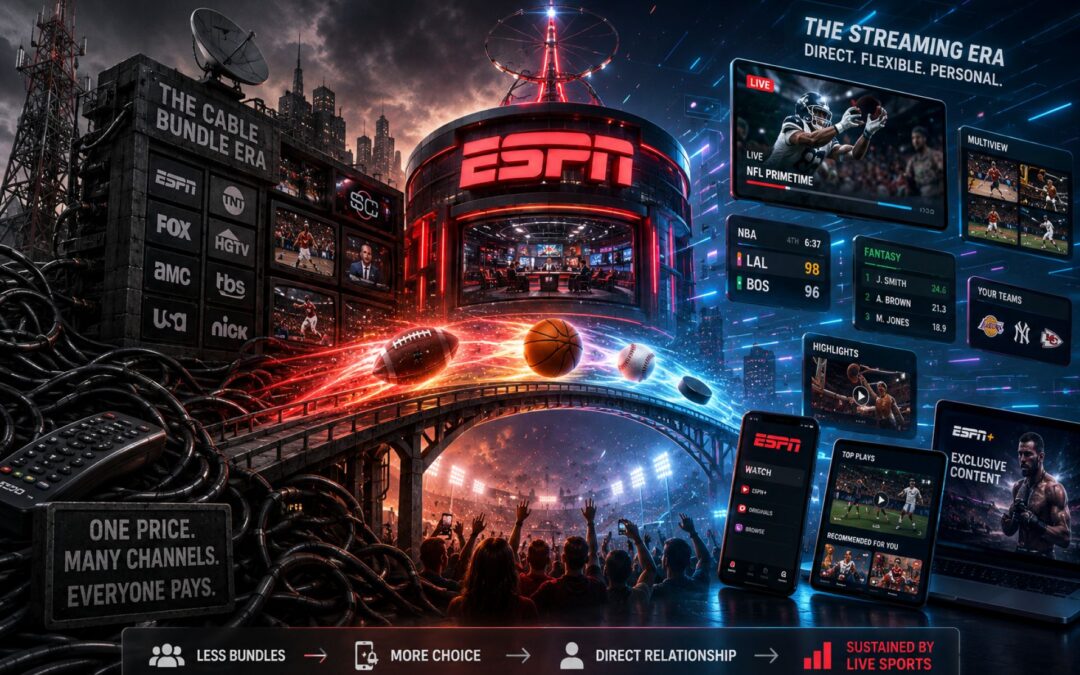
For decades, ESPN was one of the best businesses in television.
It did not merely show sports. It sat at the center of the cable bundle.
If you were a serious sports fan, you needed ESPN. If you were not a serious sports fan, you often paid for it anyway because ESPN was built into your cable package. That was the genius of the model. Millions of households helped fund ESPN’s empire, even if only some of them watched every game, highlight show, debate segment, or late-night edition of SportsCenter.
That made ESPN powerful.
It had live games. It had studio shows. It had anchors who became celebrities. It had relationships with leagues. It had leverage with cable distributors. It had advertising. It had affiliate fees. It had something increasingly rare in entertainment: programming people wanted to watch live.
But the same cable bundle that made ESPN rich is now the system ESPN must learn to outgrow.
Cord-cutting changed the math. Younger sports fans do not organize their lives around cable boxes. Streaming platforms are buying major rights. YouTube TV and other virtual TV services are becoming powerful distributors. Sports rights are getting more expensive. Disney, ESPN’s parent company, is trying to build a streaming future without destroying the old revenue engine too quickly.
That is the tension.
ESPN is not moving beyond cable because cable suddenly became worthless.
It is moving beyond cable because cable no longer guarantees the future.
ESPN Was the Crown Jewel of the Cable Bundle
ESPN became the crown jewel of cable because sports solved a problem most television could not solve.
People could wait to watch a sitcom. They could record a drama. They could catch up on a documentary later. But live sports lost value the moment the result was known.
That made ESPN essential.
In an age before every highlight was available instantly on social media, ESPN was where sports fans went to see what happened. SportsCenter was not just a recap show. It was a nightly ritual. College football, NBA games, NFL coverage, baseball, tennis, boxing, studio debate, draft coverage, and endless highlight loops turned ESPN into the default language of American sports culture.
More importantly, ESPN had leverage.
Cable companies needed ESPN because customers expected it. If a cable package did not include ESPN, many sports fans would not buy it. That gave ESPN the power to demand high carriage fees from distributors. The network became expensive, but it was hard to drop.
That is what made ESPN different from an ordinary channel.
A normal entertainment network depends on hits. ESPN depended on the recurring urgency of live sports. A scripted network might need the next big show to stay relevant. ESPN had seasons, leagues, rivalries, championships, and fan loyalty built into its programming cycle.
The games kept coming.
So did the money.
Cable Made ESPN Rich Because Everyone Paid for It
The cable bundle was frustrating for consumers, but it was beautiful for ESPN.
The model worked because channels were packaged together. A household did not choose only ESPN, only CNN, only Nickelodeon, only Discovery, or only FX. It paid for a bundle. That bundle included channels the household watched constantly, channels it watched occasionally, and channels it barely watched at all.
ESPN benefited enormously from this system.
Even people who were not passionate sports fans helped support ESPN through their monthly cable bills. That gave the network steady revenue far beyond what it might have earned from sports fans alone. Advertising added another stream of money. The result was a highly profitable machine: viewers paid through the bundle, advertisers paid for live audiences, and ESPN used that cash to buy more rights.
Those rights made ESPN even more essential.
This was the old flywheel.
Cable subscribers funded ESPN. ESPN bought premium sports. Premium sports made ESPN indispensable. Distributors paid more to carry ESPN. The network became stronger. The cycle repeated.
For Disney, this was incredibly valuable. ESPN was not just a media brand. It was one of the economic pillars of the company’s television business.
But every powerful bundle has a weakness.
It depends on people staying inside the bundle.
Cord-Cutting Changed the Math
Cord-cutting did not make ESPN irrelevant. It made ESPN’s old distribution model less automatic.
That distinction matters.
People still watch sports. They still care about leagues, teams, rivalries, fantasy sports, sports betting, highlights, and championship moments. But fewer households now treat traditional cable as a necessary utility. Many younger viewers never built that habit in the first place. They are more comfortable with apps, subscriptions, social clips, YouTube highlights, and flexible bundles.
That creates a difficult problem for ESPN.
If traditional pay-TV households decline, ESPN loses some of the broad-based support that made its business so strong. The network can still charge high fees, but the total base becomes less secure. At the same time, ESPN cannot simply abandon cable because cable still produces meaningful revenue.
This is why the shift is so delicate.
ESPN has to reach cord-cutters without encouraging too many remaining cable subscribers to leave too quickly. It needs a streaming future, but it cannot treat the cable present as if it no longer matters.
Recent pay-TV data shows how complicated the transition has become. Axios reported that pay-TV subscriptions saw a rare quarterly increase in 2025, helped by football season and virtual TV providers. But that does not mean the old cable bundle has returned to its prime. It means the market is becoming more hybrid. Traditional providers continue to face pressure, while virtual services such as YouTube TV increasingly act like the new version of cable.
So ESPN’s challenge is not simply cable versus streaming.
It is old cable, virtual cable, direct streaming, bundles, apps, and platform deals all at once.
That is a much messier world.
Live Sports Became More Valuable as Everything Else Fragmented
The irony of modern media is that as almost everything became easier to watch later, live sports became more valuable.
Streaming changed scripted entertainment. Viewers can binge shows whenever they want. Algorithms recommend old series beside new releases. Global libraries compete with fresh premieres. A drama can be watched months after release and still feel complete.
Sports do not work that way.
A game is most valuable while it is happening. The drama depends on uncertainty. The score matters because it is not yet known. The conversation happens in real time. Fans text each other, argue online, check fantasy lineups, place bets, watch highlights, and react instantly.
That makes sports one of the few remaining forms of appointment television.
Advertisers know this. Leagues know this. Platforms know this. That is why live sports remain so coveted even as other forms of television fragment.
For ESPN, this is both an advantage and a burden.
The advantage is obvious: ESPN owns a powerful position in one of the few content categories that still commands urgency. The burden is that everyone else wants that category too.
Amazon has moved into live sports. Apple has bought sports rights. Netflix has experimented with live events and sports-adjacent programming. YouTube TV has become a major live-TV distributor. Peacock, Paramount+, and other streaming services use sports to attract and retain subscribers.
Live sports did not become less important in the streaming age.
They became one of the main reasons the streaming age is so expensive.
Sports Rights Became Too Expensive to Fund the Old Way
Sports rights are valuable because they are scarce.
There is only one NFL. One NBA. One College Football Playoff. One Wimbledon. One UFC. One set of major championship events that fans treat as essential. When leagues control scarce live attention, they can demand enormous fees from media companies that need that attention.
Those fees keep rising.
According to SportsPro, U.S. sports-rights spending reached $30.5 billion in 2025, up dramatically over the previous decade. That single trend explains much of ESPN’s strategic pressure.
If sports rights become more expensive while the cable subscriber base weakens, ESPN needs new revenue channels. It cannot rely forever on the same number of households paying through the same old cable structure.
The NBA deal shows the scale of the issue. The league’s newer media-rights arrangements, involving ESPN, NBC, and Amazon, reflect how sports leagues are spreading premium rights across traditional networks and streaming platforms. For ESPN, keeping major rights is essential because live sports are the core of the brand. But keeping those rights requires money.
Lots of it.
This is why ESPN’s move beyond cable should not be read as a trendy app launch. It is a financial necessity.
The company needs to preserve the value of its existing pay-TV deals while also building direct access to fans who no longer live inside the old bundle. It needs to justify rights fees in a world where distribution is fragmenting. It needs to collect more value from the most passionate sports viewers without losing the broad economics that made ESPN powerful in the first place.
That is a narrow bridge.
ESPN has to cross it carefully.
ESPN’s Streaming Move Is Not a Panic Button
ESPN’s direct-to-consumer move is not a random reaction to cord-cutting. It is a strategic bridge.
The company’s new direct streaming service, launched in 2025, is designed to give fans access to ESPN outside a traditional cable subscription. ESPN’s own direct-to-consumer FAQ describes the service as especially relevant for fans who do not subscribe to cable, satellite, or another service that already includes ESPN. Its Unlimited plan provides access to ESPN’s full portfolio of networks and services.
That is a major shift.
For decades, ESPN’s flagship content was tied closely to the pay-TV ecosystem. ESPN+ existed, but it did not replace the main ESPN networks. The newer direct offering is different because it gives cord-cutters a clearer path to the core ESPN experience.
The product itself also reveals where ESPN wants to go.
ESPN’s own explainer highlights the service’s plans, pricing, and app experience. Coverage from Reuters reported the launch timing and pricing, while AP noted how the service fits into broader Disney bundle options with Disney+ and Hulu.
This is not ESPN simply putting a channel feed online.
It is ESPN trying to become a full sports platform.
That means live events, shows, highlights, stats, personalization, fantasy, betting integrations, and a more direct relationship with fans. TVTechnology’s launch coverage described the updated ESPN app as including features such as personalization and multiview, showing that ESPN wants the app to feel like more than a digital cable box.
The goal is clear.
ESPN does not want to be only a channel inside someone else’s package.
It wants to be the place sports fans open first.
ESPN Cannot Kill Cable Too Quickly
The hardest part of ESPN’s transition is that success in streaming could damage the old business if handled badly.
If the direct ESPN service is too attractive, too cheap, or too complete, it may encourage existing cable subscribers to cancel their pay-TV packages. That would hurt the affiliate-fee model that still matters. But if the streaming service is too weak, younger fans and cord-cutters may ignore it.
That is the central dilemma.
ESPN needs to make its direct product strong enough to matter but not so disruptive that it destroys the remaining value of cable overnight.
This is why the pricing and bundling strategy is so important. A premium ESPN streaming service priced at a meaningful monthly rate does two things. It gives cord-cutters access, but it also avoids making the traditional bundle look foolishly overpriced by comparison. The service must be available without making ESPN’s distribution partners feel completely abandoned.
In other words, ESPN has to serve two worlds at once.
The first world is the old world: cable and satellite providers, affiliate fees, linear channels, and traditional pay-TV economics.
The second world is the new world: direct apps, streaming bundles, mobile viewing, connected TVs, vMVPDs, platform deals, and younger fans who may never subscribe to a traditional cable package.
Most companies would love to move cleanly from old to new.
ESPN cannot.
The old model still produces too much value to casually throw away. The new model is too important to delay. So ESPN is not cutting the cord in one dramatic motion.
It is trying to stretch the cord until the next system can hold more weight.
The Future Is Rebundling, Not Pure Unbundling
Streaming was once sold as unbundling.
Sports media is now proving that the future is rebundling.
The reason is simple: sports fans do not want to hunt across fifteen apps to find their games. They want access. They want reliability. They want their leagues, teams, highlights, and analysis in one place. But leagues sell rights to different partners, platforms compete for exclusives, and media companies need enough content to justify subscription prices.
That creates fragmentation.
Then fragmentation creates demand for bundles.
Disney understands this. ESPN’s streaming move is tied to a wider bundle strategy involving Disney+, Hulu, ESPN, and live-TV offerings. Reuters reported Disney’s deal to combine Hulu + Live TV with Fubo, creating a larger online pay-TV business and resolving litigation connected to the failed Venu Sports venture.
That failed Venu project is revealing.
ESPN, Fox, and Warner Bros. Discovery tried to create a sports streaming bundle, but the effort collapsed before launch after legal and strategic complications. The Verge described how the service was scrapped following challenges including Fubo’s antitrust lawsuit.
The lesson is not that sports bundles are dead.
The lesson is that sports bundles are hard.
Everyone wants the benefits of bundling: scale, convenience, reduced churn, stronger pricing power. But competitors, regulators, leagues, distributors, and consumers all have different incentives.
That is why the future of ESPN will not be pure unbundling. It will be layered access.
Some fans will get ESPN through traditional cable. Some through YouTube TV or another virtual provider. Some through a direct ESPN subscription. Some through Disney bundles. Some through future partnerships that do not yet exist.
The bundle is not disappearing.
It is being rebuilt in pieces.
Tech Platforms Are Becoming the New Gatekeepers
Cable companies used to be the gatekeepers.
Now tech platforms are taking on some of that role.
YouTube TV is one of the clearest examples. It looks different from old cable, but functionally it solves a similar problem: it aggregates live channels, sells a monthly package, and becomes the consumer’s main interface for live television. For many households, YouTube TV is not an alternative to cable. It is cable through a different door.
That gives platforms leverage.
The Disney–YouTube TV carriage dispute showed how familiar the new world can feel. ESPN and other Disney networks went dark on YouTube TV during a fee and distribution fight, with coverage from The Washington Post describing how subscribers lost access during the dispute. A later deal restored ESPN and ABC to the service, with reports from the New York Post noting that subscribers would also gain access to ESPN’s direct app.
Different technology. Same old battle.
The fight was not just about channels. It was about who controls the customer, who captures the economics, and how much flexibility distributors should have in packaging content.
Amazon and Apple create a different kind of platform pressure. They are not merely distributors. They are giant ecosystems with deep pockets, enormous user bases, and strategic reasons to buy sports rights. Amazon can use sports to strengthen Prime. Apple can use sports to deepen its services ecosystem. YouTube can use sports and live TV to increase viewing time and advertising power.
That changes ESPN’s world.
In the cable era, ESPN was often the must-have network negotiating with distributors that needed it. In the streaming era, ESPN still has power, but it faces platforms that have their own scale, data, technology, and consumer relationships.
ESPN cannot afford to be hidden behind someone else’s interface forever.
That is one reason the direct app matters.
ESPN’s Real Challenge Is Owning the Fan Relationship
The future of ESPN is not just about where the games are shown.
It is about who owns the sports fan relationship.
In the old model, ESPN owned attention through television. You turned on the channel. You watched the game. You stayed for highlights. You came back for analysis. The relationship was powerful, but it was still mediated by the cable bundle.
In the new model, ESPN wants a more direct connection.
That means knowing what teams you follow. What leagues you care about. Whether you play fantasy sports. Whether you want betting information. Whether you prefer highlights, live games, analysis, documentaries, studio shows, or alerts. It means turning ESPN from a channel into a personalized sports operating system.
This is where the app becomes strategically important.
A direct ESPN product can gather data, personalize recommendations, promote events, integrate fantasy and betting, and keep fans inside ESPN’s environment throughout the day. The live game may still be the main event, but the surrounding ecosystem matters more than ever.
Highlights matter. Notifications matter. Multiview matters. Personalization matters. Shoulder programming matters. Fantasy and betting matter. Social sharing matters. Mobile access matters.
Sports fandom is no longer confined to a three-hour broadcast window.
It is continuous.
If ESPN owns that continuous relationship, it remains central to sports culture. If it becomes only one content supplier among many, it loses some of the power that made it ESPN in the first place.
That is the deeper reason ESPN is moving beyond cable.
Not just to stream games.
To remain the front door to sports.
Conclusion
ESPN is moving beyond cable because the world that made ESPN powerful is changing.
The cable bundle turned ESPN into a giant. It gave the network reach, recurring revenue, pricing power, and the ability to fund expensive sports rights. But that model depended on a world where millions of households entered television through the same gate.
That world is fading.
Not gone. Not worthless. But no longer guaranteed.
Sports remain incredibly valuable. In some ways, they are more valuable than ever because live attention has become rare. But the distribution of sports is becoming more fragmented, more expensive, and more contested. Fans are moving across cable, apps, bundles, virtual TV services, highlights, social feeds, and tech platforms.
ESPN’s task is not to abandon cable in a panic.
Its task is to carry the power of live sports into a world where fans no longer arrive through one bundle, one box, or one bill.
That is why ESPN’s future will not be purely cable or purely streaming.
It will be hybrid, messy, strategic, and expensive.
The old ESPN won by being indispensable inside the cable bundle.
The next ESPN has to become indispensable outside it.
Last Updated on June 9, 2026 by Aseem Gupta