
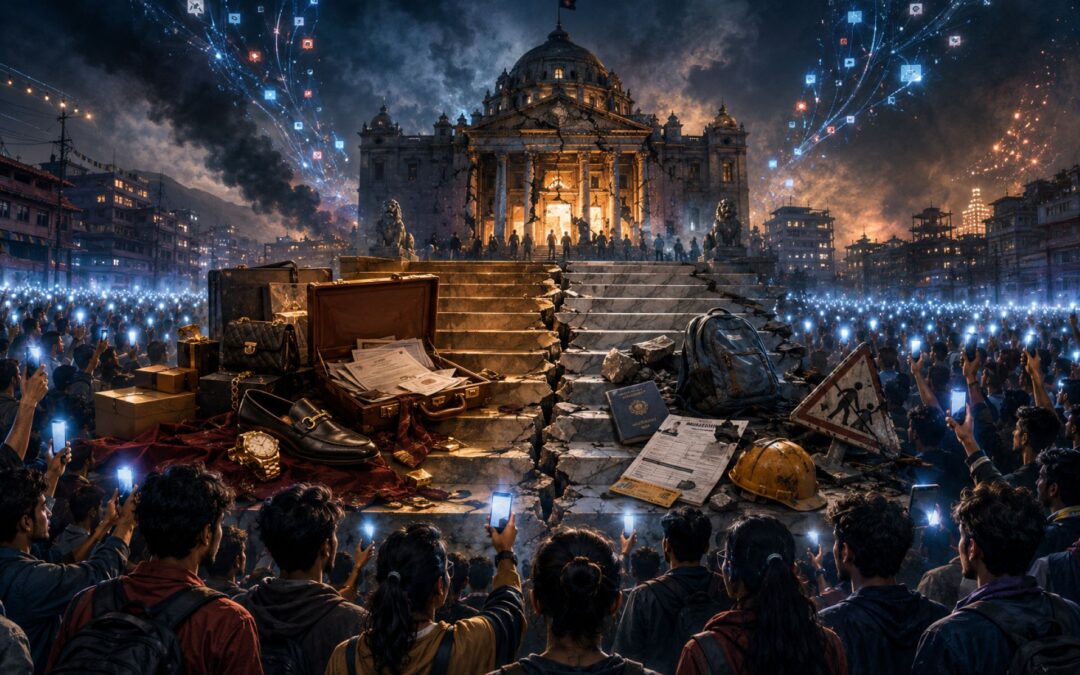
Across South Asia, young people have taken to the streets to challenge governments, political establishments and institutions they believe have failed them. Some have protested against corruption and the wealth of politically connected families. Others have mobilised over unemployment, unfair examinations, economic collapse or the integrity of elections. Despite their different demands, these movements share a frustration with systems that appear to offer privilege to the powerful while making ordinary young people struggle for opportunity.
The consequences have been strikingly different. Mass protests helped remove governments in Sri Lanka, Bangladesh and Nepal, but subsequent elections produced very different political outcomes. In India, the Cockroach Janta Party emerged from an online joke and developed into a youth-led protest movement challenging education authorities and electoral institutions, without bringing down the national government.
Together, these events raise a question that extends beyond the ability to organise demonstrations or remove political leaders. When a generation challenges the institutions governing its future, how much can protest actually change?
Why a Generation Believed Its Future Was Being Taken
South Asia has one of the world’s largest concentrations of young people. For decades, its expanding working-age population has been described as an economic opportunity. More workers, rising education levels, expanding cities and increased access to technology could potentially support sustained economic growth.
But a demographic dividend is not automatic. It depends on whether an economy can create enough productive jobs for its growing workforce. When education expands faster than employment opportunities, the same demographic advantage can become a source of political frustration.
Across the region, economic growth has not always translated into secure employment or better living standards for young people. Graduates compete for limited formal-sector positions, while large numbers of workers depend on agriculture, informal employment or low wages. The gap between educational aspirations and available opportunities is particularly frustrating for families that have invested heavily in qualifications.
Nepal illustrates this contradiction. Migration has become a central livelihood strategy, with young Nepalis frequently seeking employment in India, the Gulf, Malaysia and other overseas destinations. The World Bank’s Nepal Development Update describes migration and remittances as essential economic supports while identifying weak private investment, uneven development and limited domestic opportunities as persistent structural problems.
Remittances provide real benefits. They support household consumption, education, healthcare, housing and poverty reduction. Yet an economy’s dependence on overseas employment also raises questions about why so many citizens find better opportunities outside their own country.
In Bangladesh, frustration has centred partly on access to secure employment. The country’s garment industry generates substantial export earnings, but stable, well-paid jobs remain highly sought after. Public-sector employment offers security and social standing, making disputes about recruitment and preferential treatment especially sensitive.
Sri Lanka experienced a more immediate economic catastrophe. In 2022, shortages of fuel, food, medicine and foreign currency disrupted everyday life. Inflation eroded purchasing power, while households confronted the consequences of an economic crisis associated with policy mistakes, fiscal vulnerabilities, external shocks and mounting debt pressures.
India’s circumstances are different. It has a much larger and more diversified economy, substantial technological capabilities and continued economic growth. Nevertheless, many young Indians experience uncertainty over employment, competitive entrance examinations and the relationship between educational achievement and career opportunities. Examination irregularities can become politically explosive because students often spend years preparing for a limited number of desirable places.
These frustrations do not mean that every young South Asian shares the same political outlook. Economic conditions vary enormously within each country, and many young citizens support established political parties or reject disruptive protest. What connects the movements is a recurring question about whether public institutions offer ordinary people a fair opportunity to build their futures.
How Elite Wealth Became a Symbol of Broken Government
Economic frustration becomes especially politically sensitive when citizens believe the people governing them are insulated from the difficulties everyone else faces.
In Nepal, photographs and social-media posts showing the expensive lifestyles of politicians’ children and relatives became part of the so-called nepo kids campaign. Images of designer clothing, luxury accessories and extravagant possessions circulated alongside accounts of unemployment, migration and neglected infrastructure.
Such photographs do not independently prove corruption. Wealth may come from legitimate business activities, inheritance or other lawful sources. Nevertheless, conspicuous displays can raise questions about the relationship between political connections and private fortunes, particularly when public officials face allegations of patronage or misuse of state resources.
Bangladesh provided more concrete examples of investigations into politically connected wealth. In May 2025, Britain’s National Crime Agency obtained freezing orders covering almost £90 million in luxury London properties associated with Ahmed Shayan Rahman and Ahmed Shahryar Rahman, relatives of Salman F Rahman, a prominent businessman and former adviser to Sheikh Hasina.
The properties included residences in London’s prestigious Grosvenor Square and were held through companies registered in offshore jurisdictions. The Guardian’s reporting on the property freezing orders documented the investigation and the restrictions placed on the assets. The individuals concerned denied wrongdoing, and a freezing order should not be confused with a criminal conviction.
Sri Lanka had its own controversy involving offshore wealth. The International Consortium of Investigative Journalists examined records connecting Nirupama Rajapaksa, a former minister and relative of the country’s ruling family, and her husband, businessman Thirukumar Nadesan, to shell companies, trusts and assets worth more than $18 million.
The Pandora Papers investigation into Rajapaksa-linked offshore holdings identified financial arrangements involving luxury property, artworks and offshore structures. These revelations prompted questions and official scrutiny, although the existence of offshore assets does not itself establish that they were acquired illegally.
Bangladesh’s Rooppur nuclear power project illustrates another form of controversy: the use of public money in enormous infrastructure contracts. The Russian-backed project carried an estimated construction cost of approximately $12.65 billion, much of it financed through Russian lending. Authorities subsequently investigated allegations concerning project costs, corruption and politically connected beneficiaries.
The project also became associated with a notorious procurement scandal involving unusually expensive pillows and other furnishings for workers’ accommodation. Reports of inflated procurement and transportation expenses turned an otherwise technical accounting controversy into something ordinary citizens could immediately understand. The larger corruption allegations, including accusations against Sheikh Hasina and her associates, remained disputed and must be distinguished from documented procurement irregularities.
These cases involve different types of evidence and different legal circumstances. They cannot be treated as proof that every politically connected wealthy family obtained its fortune unlawfully. Their significance to the protest movements lies in the political questions they raised about transparency, public spending and accountability.
An ordinary citizen may struggle to understand the details of a government loan or offshore corporate arrangement. The contrast between highly visible private wealth and poorly maintained roads, underfunded services or scarce employment opportunities is much easier to recognise.
Sri Lanka: A Country Runs Out of Patience
Sri Lanka’s 2022 uprising began amid an economic emergency that made normal life increasingly difficult.
The country faced a severe shortage of foreign currency, making essential imports harder to finance. Fuel queues stretched for hours, electricity shortages disrupted businesses, and medicines became difficult to obtain. Inflation sharply reduced purchasing power, while government finances and external debt obligations had become unsustainable.
The crisis had several causes. Long-standing fiscal weaknesses, tax reductions, declining foreign-exchange earnings, pandemic-related damage to tourism and policy failures contributed to the collapse. Debt-financed infrastructure projects, including those supported by Chinese lending, became part of the wider debate about public investment and economic management, although attributing the entire crisis to Chinese debt would be misleading.
Public frustration developed into the Aragalaya, or struggle, a broad protest movement that brought people from different social and political backgrounds into the streets. Protesters demanded accountability from the government and the resignation of President Gotabaya Rajapaksa.
The Rajapaksa family had dominated Sri Lankan politics for years. Mahinda Rajapaksa had served as president and prime minister, while other relatives held influential public positions. Their political strength had been built through electoral support, nationalism, political networks and the concentration of authority within the family.
As the crisis intensified, protesters occupied prominent public spaces and eventually entered official residences. Gotabaya Rajapaksa fled Sri Lanka and resigned in July 2022. The immediate political objective of removing the president had been achieved, but the economic emergency remained.
Ranil Wickremesinghe subsequently led the government through a period of stabilisation and negotiations with international lenders. Economic recovery involved debt restructuring, fiscal adjustments and reforms accompanied by considerable pressure on households.
The political landscape changed again in 2024 when Anura Kumara Dissanayake, associated with the left-leaning National People’s Power alliance, won the presidency. His victory marked a departure from the long-standing dominance of the country’s traditional political establishments.
Economic conditions have improved significantly since the worst of the crisis. According to the World Bank’s October 2026 Sri Lanka Development Update, real GDP had returned to pre-crisis levels, with output expanding by 4.7% during the first half of 2026. The Bank projected growth of 4.4% for 2026.
However, economic recovery has been uneven. Poverty remained substantially above its pre-crisis level, estimated at 16.9% in 2025, while employment and household incomes had not fully recovered. The country’s continued exposure to external shocks, debt obligations and investment constraints also complicates its prospects.
Sri Lanka demonstrates that protests can produce major political change and contribute to demands for a different economic direction. It also shows why the success of a movement cannot be measured solely by a leader’s resignation or an improvement in national GDP. The deeper question is whether institutions and economic opportunities improve sufficiently to change ordinary citizens’ lives.
Bangladesh: A Student Uprising Meets the Old Party Machine
Bangladesh’s uprising began in 2024 with a dispute over public-sector recruitment quotas.
Students opposed arrangements that reserved portions of government employment for particular categories of applicants, including descendants of veterans of the country’s independence struggle. They argued that the system restricted merit-based opportunities in an already competitive employment market.
The dispute quickly became more than a disagreement over recruitment policy. Confrontations with security forces, deaths, arrests and escalating repression transformed the demonstrations into a national challenge to Prime Minister Sheikh Hasina’s government.
Hasina had led Bangladesh for much of the period since 2009, during which the country experienced considerable economic development alongside growing criticism of political repression, opposition restrictions and institutional control. Her government maintained political support, but critics argued that meaningful competition and accountability had deteriorated.
As demonstrations expanded, the government’s position became increasingly difficult to sustain. Hasina eventually left Bangladesh for India in August 2024, ending her long period in office. An interim administration led by Nobel Peace Prize laureate Muhammad Yunus subsequently took responsibility for overseeing the political transition.
The uprising brought together groups with different priorities. Some primarily wanted reform of the quota system, while others demanded broader political change, accountability for deaths and a more open political system. Agreement on removing the government did not necessarily produce agreement on the country’s future.
Student activists attempted to create a more permanent political vehicle through the National Citizen Party, or NCP. The party sought to convert the movement’s visibility and organisational experience into electoral representation. Yet building a political party required resources, candidates, regional networks and compromises that had not been necessary during the original demonstrations.
The movement also faced disagreements over political alliances, including the NCP’s cooperation with Jamaat-e-Islami. Such arrangements created tensions among activists who differed over ideology and how far they should cooperate with established parties.
The February 2026 parliamentary election illustrated the difficulty of translating street mobilisation into electoral influence. The Reuters report on Bangladesh’s landmark election documented a decisive victory for the Bangladesh Nationalist Party and its allies, who secured at least 212 parliamentary seats. The NCP won six of the 30 seats it contested.
BNP leader Tarique Rahman, the son of former prime minister Khaleda Zia and former president Ziaur Rahman, emerged as the central figure in the new government. His political background highlighted the continuing influence of established parties and families, although the election also demonstrated substantial political competition after Hasina’s removal.
The outcome did not erase the significance of the uprising. The protests ended an entrenched administration, created opportunities for new political organisations and changed public expectations about accountability. The election nevertheless showed that older parties can retain decisive advantages through organisational networks, established supporters and electoral experience.
Bangladesh’s political transition also raised questions about justice, political exclusion and the treatment of former governing-party supporters. Accountability for repression and corruption remains important, but durable democratic reform requires legal safeguards that apply consistently rather than depending on which political faction holds power.
For the student activists who initiated the movement, the challenge therefore changed. They had demonstrated an ability to organise resistance on a national scale, but electoral politics required them to operate within institutions and negotiate with political forces that were not necessarily aligned with their original objectives.
Nepal: Nepo Kids, a Social Media Ban, and Electoral Upheaval
Nepal’s September 2025 upheaval developed from long-standing frustration with political leadership, economic opportunities and perceived corruption.
The country had experienced repeated changes of government involving familiar political parties and leaders. Coalition negotiations and competition for public office frequently dominated political discussion, while young people continued to confront unemployment, migration and inadequate public services.
The nepo-kids campaign gave these frustrations a visible symbol. Posts comparing the expensive lifestyles of political families with the economic struggles of ordinary citizens circulated widely, encouraging debate about how wealth, political connections and public resources were distributed.
Journalist Pranaya Rana, interviewed in Kathmandu for the documentary South Asia: A Stolen Future, explained that many Nepalis already believed corruption was widespread. The difference, in his account, was that young people increasingly saw its possible scale and contrasted the lives of political families with their own limited opportunities.
The immediate confrontation followed the government’s decision to restrict access to major social-media platforms. Officials justified the restrictions through regulatory requirements, including demands that platforms register and establish a presence in Nepal. Critics interpreted the ban as an attempt to suppress political discussion and criticism.
The restrictions intensified rather than contained the demonstrations. Young protesters mobilised against both the platform ban and wider grievances surrounding corruption, government accountability and economic stagnation.
The movement soon became violent. Security-force confrontations resulted in deaths and injuries, while buildings and public property were damaged during the unrest. Initial reports described at least 19 deaths during the early clashes, with the eventual reported death toll rising substantially as the crisis unfolded.
Prime Minister K. P. Sharma Oli resigned, and an interim administration was established ahead of new parliamentary elections. The protests had succeeded in removing a government, but the underlying grievances concerning jobs, infrastructure and institutions remained unresolved.
Student interviews from Kathmandu help explain why those grievances mattered. At Tribhuvan University, an MBA student named Sandip described roads that had remained damaged for years. Poor infrastructure had become part of everyday life, but familiarity did not make it acceptable. In his view, political bargaining and corruption helped explain why basic improvements failed to materialise.
Another student, Rajbir, expressed concern that elections could simply reproduce the existing political system. His pessimism reflected a broader fear within the movement: replacing individual leaders would achieve little if the same political arrangements, administrative practices and patronage networks continued.
Not every participant shared that outlook. Some students believed the protests had created an opportunity for younger leaders to enter politics and assume responsibility for changing the country.
Amit Khanal, a young political organiser involved in negotiations with Nepal’s interim authorities, stressed the importance of good governance, accountability and stronger youth representation. His objective was not limited to removing established leaders. He wanted the movement’s demands translated into institutions and more young people participating in formal political life.
The March 2026 parliamentary election produced a significant political change. The Rastriya Swatantra Party, formed only a few years earlier, secured a sweeping victory. According to Al Jazeera’s reporting on Nepal’s election, the party won 182 of the 275 seats in the House of Representatives.
Balendra Shah, widely known as Balen, became a central figure in this political transformation. A former rapper and independent mayor of Kathmandu, he had cultivated an image distinct from Nepal’s established political leadership. His association with the newer political movement appealed to voters seeking a departure from familiar political arrangements.
The result differed from Bangladesh’s experience. Rather than returning another long-established party to national dominance, Nepal’s election created a parliamentary majority for a newer political force. The old parties retained representation, but the balance of power shifted substantially.
Yet victory introduced a different challenge. Nepal’s new government inherited the same bureaucracy, infrastructure deficits, economic constraints and international relationships that had frustrated voters. Government ministers could no longer rely exclusively on criticising the establishment because they now had responsibility for implementing policy.
The World Bank has emphasised the need for stronger investment, economic diversification, improved public administration and measures addressing corruption. These are institutional and economic problems that cannot be resolved through electoral popularity alone.
Nepal therefore illustrates both the possibilities and difficulties of youth-driven political change. The uprising contributed to a change of leadership, followed by an electoral shift away from established parties. Whether that change produces more reliable public services, productive employment and stronger accountability depends on the government’s decisions and the performance of institutions over time.
India: The Cockroach Janta Party and a Different Kind of Protest
India’s 2026 youth protests developed under a different political and institutional environment.
Unlike Sri Lanka, Bangladesh or Nepal during their respective upheavals, India did not experience the removal of its national government. The country continued to operate through its established constitutional and electoral framework, even as protesters raised concerns about education, employment, voting rights and the conduct of public authorities.
The Cockroach Janta Party, or CJP, emerged in May 2026 after controversial remarks by India’s chief justice were interpreted as comparing unemployed young people to cockroaches. The judge disputed that interpretation, but the controversy resonated with young Indians frustrated by employment and educational opportunities.
Abhijeet Dipke responded by using the term as a form of political satire, asking what might happen if people labelled cockroaches came together. An online joke became the basis of a movement that attracted followers, established a recognisable identity and began organising physical demonstrations.
The Council on Foreign Relations’ examination of the Cockroach Janta Party traces its development from online mobilisation to demonstrations over education and government accountability.
The movement gained momentum amid concerns about national entrance examinations, particularly the National Eligibility cum Entrance Test, or NEET. Allegations of question-paper leaks and administrative failures raised doubts about whether students were competing on fair terms.
These concerns went beyond the inconvenience of a cancelled examination. Students devote substantial time and resources to preparing for medical and other competitive admissions tests. Families may invest savings or borrow money to pay for coaching, often with no guarantee of success.
When the examination process is compromised, students who followed the rules can face delays, uncertainty and additional expenses. For people already worried about employment, such controversies reinforce concerns about whether effort and qualifications are sufficient to secure opportunity.
CJP supporters organised demonstrations at Jantar Mantar in Delhi and attracted attention from activists and political organisations. Education and environmental activist Sonam Wangchuk joined the protests, adding prominence to demands for accountability from the Union government.
The demonstrations expanded during June and July, resulting in confrontations with police. As the movement intensified, Union Education Minister Dharmendra Pradhan resigned on 25 July. The resignation followed sustained protests, although attributing the decision solely to one organisation would overlook the broader political and public pressure surrounding the examination controversy.
CJP demonstrated that a political identity formed through online satire could contribute to organised protest around a concrete public-policy issue. However, the movement did not stop with education.
By October 2026, CJP had become involved in demonstrations concerning the Election Commission of India’s Special Intensive Revision, or SIR, of electoral rolls.
The revision process was intended to identify inaccurate or ineligible entries, including those associated with deaths, changes of residence and duplication. Accurate electoral rolls are necessary for legitimate elections, but the extensive exercise generated disputes about the fairness and transparency of the procedures used.
Opposition parties, activists and CJP supporters alleged that large numbers of eligible voters had been removed or placed at risk of exclusion, particularly among vulnerable groups. They argued that documentation requirements and administrative procedures could disadvantage citizens who lacked easy access to the required records.
The Election Commission defended the exercise as necessary to improve electoral-roll accuracy and rejected allegations that it was being conducted to benefit the ruling Bharatiya Janata Party. Government and BJP representatives also disputed claims of partisan manipulation.
As Reuters explained in its examination of India’s electoral-roll protests, the controversy concerned both the scale of revisions and questions about the fairness of the process.
The distinction between deleted entries and unlawfully disenfranchised eligible voters is crucial. Not every removal from an electoral roll represents the denial of a legitimate voting right. Conversely, a process intended to improve accuracy must provide effective safeguards so that eligible citizens are not excluded through administrative errors or unreasonable requirements.
The controversy increased scrutiny of Chief Election Commissioner Gyanesh Kumar. CJP activists and other protesters demanded his resignation, while authorities defended the Commission’s responsibilities and the legal framework governing electoral administration.
Demonstrations also raised questions about the right to peaceful assembly. Police restricted or denied permission for certain gatherings, citing public-order considerations and applicable rules. Protest organisers challenged these restrictions, arguing that authorities were obstructing legitimate demonstrations.
During the 16 October protests, police detained CJP leaders and supporters in Delhi as demonstrators attempted to gather around Connaught Place. Reuters reported further protests and police interventions across several Indian cities.
The government’s position was that public demonstrations must comply with legal and security requirements, and BJP representatives characterised elements of the agitation as politically motivated. Protesters countered that the restrictions undermined their ability to criticise public institutions and seek accountability.
These events formed part of broader arguments about India’s democratic institutions. As discussed in Indian Democracy: How It Survived and Why It Is Under Strain, the country has a long history of competitive elections, mass political mobilisation and disputes over institutional independence, civil liberties and executive authority.
CJP’s protests should therefore not be confused with an attempt that has already produced a regime change. The movement has challenged government decisions and electoral institutions while operating within a political system where national elections, established parties and constitutional procedures continue to play central roles.
The experience also raises questions about how movements maintain independence when opposition parties support their demands. Cooperation can provide organisational resources and visibility, but it may also complicate the original movement’s identity and priorities.
India’s case expands the regional story precisely because its outcome differs. Youth dissatisfaction can produce mobilisation, ministerial accountability demands and institutional disputes without immediately developing into a government-overthrow movement.
How Social Media Turned Anger Into Street Power
Social media played an important role in all four movements, but calling them social-media revolutions would confuse a method of mobilisation with the reasons people mobilised.
Digital platforms make political information easy to circulate and allow individuals to participate without joining traditional organisations. Photographs, eyewitness recordings, short videos and slogans can reach large audiences before established media or political parties have framed an event.
In Nepal, the nepo-kids campaign relied on the contrast between elite lifestyles and ordinary economic struggles. Images of expensive possessions became politically meaningful because they reinforced existing frustrations about migration, corruption and unequal opportunities.
The government’s decision to restrict major digital platforms then created an additional grievance. Social media was both a channel through which dissatisfaction circulated and an institution whose restriction protesters opposed.
In Bangladesh, online networks helped students coordinate demonstrations and circulate information about the authorities’ response. Digital communications accelerated the movement’s reach, although student organisations, campus networks and broader political mobilisation remained essential.
Sri Lanka’s Aragalaya similarly benefited from online coordination and visibility. Images of fuel queues, public demonstrations and the occupation of official spaces allowed people to follow events as they developed. Yet the movement would not have reached such a scale without the economic emergency affecting households across the country.
India’s CJP movement shows how humour can help create a collective political identity. Its name transformed a controversial comparison into a form of shared defiance, allowing people to identify with the movement before it had developed the organisational structure of a conventional party.
The transition from online satire to demonstrations over examination integrity and electoral procedures was significant. Social media helped draw attention, but sustained protests required organisers, physical gatherings, alliances and participants willing to face the practical consequences of public mobilisation.
Digital movements also encounter difficulties. Online visibility does not necessarily demonstrate broad public support, and viral messages may exaggerate the popularity of particular demands. Political rumours and misleading information can circulate alongside legitimate criticism, making independent verification important.
Moreover, not everyone participating in these movements belonged to Generation Z. Workers, older activists, opposition supporters, professionals and community organisations contributed to demonstrations in different countries.
Social media made political discontent more visible and sometimes easier to coordinate. It did not create the economic grievances, political institutions or material conditions that gave those protests their force.
Why the Four Movements Have Produced Different Outcomes
The four cases share important themes, but their outcomes cannot be measured against a single definition of success.
Sri Lanka’s uprising resulted in the resignation of President Gotabaya Rajapaksa and helped reshape the country’s political landscape. Subsequent elections brought a new governing leadership, while economic reforms contributed to recovery from the 2022 collapse. Persistent poverty and fiscal constraints demonstrate why political change and economic improvement need to be assessed separately.
Bangladesh’s 2024 movement removed Sheikh Hasina’s government and opened space for new political organisations. Yet the February 2026 election returned the long-established BNP to government with a large parliamentary majority. The student-linked NCP gained representation but did not convert its role in the uprising into electoral dominance.
Nepal experienced a different sequence. The September 2025 protests forced a change of government, and the March 2026 election produced a parliamentary majority for the newer Rastriya Swatantra Party. The political shift was more extensive than a simple change between long-established governing parties, although its longer-term policy effects remain to be assessed.
India’s CJP movement has not produced an equivalent change in national government. Its immediate consequences include sustained public demonstrations, a ministerial resignation following the education controversy, increased scrutiny of electoral procedures and disputes about policing and assembly rights.
These differences reflect the nature of the grievances and the institutional environment in which each movement developed.
Sri Lanka faced a national economic emergency that undermined confidence in the government’s ability to provide essential goods and services. Bangladesh’s recruitment dispute escalated amid wider concerns about repression and political legitimacy. Nepal combined dissatisfaction with established leadership and a contentious social-media ban before experiencing an electoral transformation.
India’s movement began with employment and examination concerns before expanding into controversies over electoral administration. Its demands have involved specific institutions and officeholders, while the country’s established parliamentary system has remained in place.
Political organisation also shapes what follows public demonstrations. A movement may attract widespread support for a particular demand without possessing the regional networks, candidates or institutional experience required to win elections.
Bangladesh provides a clear illustration of that distinction. The NCP emerged from a powerful student-led movement, but established parties retained advantages in organisation and political relationships. Nepal’s RSP, by contrast, converted public dissatisfaction into a parliamentary majority through a successful electoral campaign.
The Chatham House analysis of South Asia’s post-uprising governments highlights the difficulties confronting political movements once they move from opposition and mobilisation into the responsibilities of government.
The comparison also shows why changes in political leadership cannot automatically be treated as changes in state institutions. Bureaucracies, courts, economic structures, patronage networks and administrative practices can outlast individual governments.
Likewise, the absence of a government collapse does not mean that a protest has had no political consequences. Demonstrations can change public debate, secure specific policy responses, generate institutional scrutiny or encourage further civic participation without altering the national executive.
The more useful comparison therefore concerns what each movement sought, what it achieved and which institutional problems remain unresolved.
The Challenge After Protest: Political Power and Institutional Change
Mass protest can unite people around an immediate demand, particularly when opposition to a policy or leader brings together groups that otherwise disagree.
Such coalitions become more complicated when they must decide what should happen next. Removing an unpopular government may be a shared objective, but designing economic policy, choosing representatives, addressing corruption and determining the limits of state authority require more detailed agreements.
This tension appears repeatedly in South Asia’s youth movements. Protest organisers may distrust traditional parties while discovering that elections require many of the organisational capabilities those parties have spent decades developing.
Political competition involves local representatives, candidate selection, fundraising, negotiation and maintaining support beyond major cities. It also requires decisions about compromises that may disappoint supporters who entered a movement with different expectations.
The example of Bangladesh’s NCP illustrates these difficulties. Its participation in electoral alliances generated internal disagreements, while its limited parliamentary representation demonstrated the challenges facing a newly created political organisation.
Nepal presents the opposite problem. The RSP’s electoral victory gave it direct responsibility for public administration and economic policy. Its performance must now be assessed through institutional decisions rather than the popularity of its anti-establishment message.
Journalist Deepak Adhikari, interviewed in Kathmandu, expressed concern that established political interests could reassert themselves because they possessed long-standing networks and resources. His observation reflected an important distinction between challenging a political system and replacing the practices through which it operates.
Pranaya Rana offered a different perspective, arguing that the protests could have longer-term consequences even if immediate political changes proved disappointing. In his view, the emergence of a generation that recognised its ability to influence national politics could eventually produce new leadership and political expectations.
Both interpretations address different aspects of the same process. Established institutions and interests can survive immediate upheaval, while the experience of political mobilisation can change how citizens understand their own role in public life.
Historical comparisons help clarify the possibilities without providing a reliable prediction.
The Arab Spring, which began in Tunisia in late 2010, contributed to the removal of several long-serving rulers across North Africa and the Middle East. Its aftermath varied considerably, including renewed authoritarian rule in Egypt, prolonged fragmentation in Libya and devastating conflict in Syria.
Those experiences do not mean that South Asian movements will follow the same trajectories. The countries involved have different political histories, constitutional arrangements, security institutions and social conditions.
India also has its own history of major protest movements. In the 1970s, student-led demonstrations against unemployment, rising prices and corruption developed into a wider movement associated with Jayaprakash Narayan. The confrontation unfolded before Prime Minister Indira Gandhi imposed the Emergency in 1975, followed by an opposition electoral victory in 1977.
That precedent demonstrates that mass mobilisation can interact with constitutional institutions and electoral politics in complex ways. It does not establish that contemporary protests will produce an equivalent confrontation or outcome.
Ultimately, political reform requires more than changing the individuals exercising power. It depends on enforceable rules, transparent procedures, fair political competition, independent oversight and institutions capable of implementing decisions consistently.
Economic demands also require sustained work. Creating productive employment, improving education, strengthening public services and reducing corruption involve investment, administrative capability and policies whose results may take years to become visible.
Protests can accelerate demands for these changes, but citizens must also be able to evaluate whether governments actually deliver them. That accountability may operate through elections, journalism, civil society, legal challenges, peaceful demonstrations and continuous scrutiny of public institutions.
Across Sri Lanka, Bangladesh, Nepal and India, young people have demonstrated that economic frustration and dissatisfaction with political authority can become powerful forms of collective action. Their movements have changed governments, influenced elections, challenged institutions and altered public debate, but they have not produced a single regional political outcome.
The distinction matters because different objectives require different measures of progress. Removing a leader, winning an election, securing a minister’s resignation and reforming an institution are related but separate achievements. None automatically guarantees the others.
The lasting significance of South Asia’s Gen Z protests will depend not only on the moments when people filled the streets, but also on whether the institutions they challenged become more accountable, opportunities become more accessible and citizens retain meaningful ways to influence decisions after the demonstrations end.
Last Updated on October 19, 2026 by Aseem Gupta