
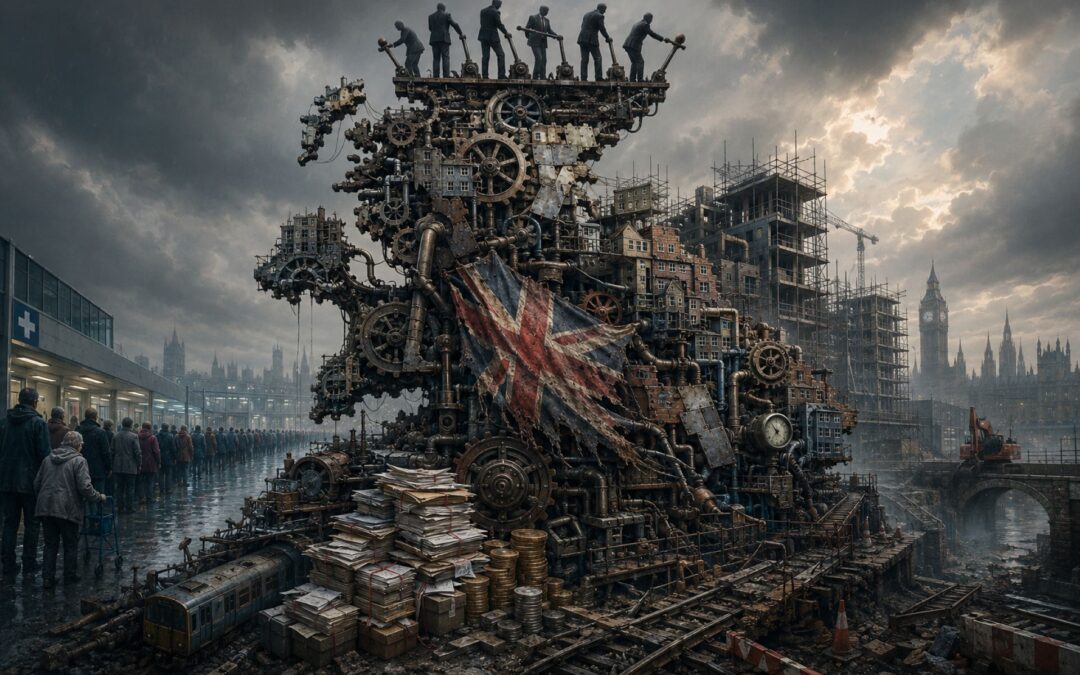
Britain is not a failed country.
It is rich. It has world-class universities, a powerful financial sector, respected institutions, deep cultural influence, advanced industries, and a language that gives it unusual global reach. London remains one of the most important cities on earth. The country still has enormous advantages that most nations would envy.
That is what makes Britain’s crisis so frustrating.
The problem is not that Britain has nothing going for it. The problem is that Britain has become strangely bad at turning its advantages into rising living standards, better public services, cheaper homes, faster infrastructure, and a more confident national future.
Every few years, the country gets a new political diagnosis.
It is austerity.
It is Brexit.
It is immigration.
It is bad prime ministers.
It is greedy landlords.
It is the Treasury.
It is the Bank of England.
It is London.
It is the planning system.
It is the NHS.
It is taxes.
It is debt.
There is truth in many of these explanations. But none of them, alone, is enough.
Britain is hard to fix because its problems now reinforce one another. Weak growth limits tax revenue. Limited tax revenue damages public services. Bad public services make the country feel broken. Expensive housing makes workers poorer and less mobile. Weak investment damages productivity. Weak productivity keeps wages low. Low wages feed political anger. Political anger produces short-term governments. Short-term governments avoid long-term investment. And the cycle begins again.
The deeper problem is not simply that Britain has stopped growing quickly.
It is that Britain has repeatedly blocked, delayed, or underfunded the things that create growth: homes, transport, energy, infrastructure, skills, business investment, and state capacity.
That is why changing prime ministers has not been enough.
Britain does not just need a new leader. It needs to relearn how to build the foundations of prosperity.
Britain’s Crisis Is Bigger Than Starmer
It is tempting to make Britain’s current problems about whoever happens to be in Downing Street.
That is understandable. Politics gives a human face to abstract failure. If public services are struggling, taxes are rising, growth is weak, and voters are angry, the prime minister becomes the obvious target.
But Britain’s crisis is much older than any one government.
Keir Starmer inherited a country already shaped by years of weak growth, strained public services, expensive housing, Brexit disruption, high debt, and collapsing trust in politics. Rishi Sunak inherited much of the same. So did Liz Truss. So did Boris Johnson. So did Theresa May. So did David Cameron, though the shape of the crisis was different then.
This does not mean leaders are irrelevant. Political choices matter. Governments can make things better or worse. But Britain’s current problems are not the result of one bad administration making one bad decision.
They are the result of a country that has spent years avoiding the hard trade-offs that growth requires.
Britain wants European-style public services with American-style tax tolerance. It wants cheap housing but resists building. It wants clean energy but struggles to approve infrastructure. It wants faster trains but cannot control project costs. It wants higher wages but has weak productivity. It wants fiscal discipline but also wants public services to recover. It wants sovereignty after Brexit but also wants frictionless access to nearby markets.
The result is not one dramatic collapse.
It is something slower and more demoralizing: a rich country that feels poorer than it should.
That is why the question is not simply, “Why is Britain struggling?”
The better question is: why has Britain become so difficult to repair even when many of its problems are widely understood?
Britain’s Economy Never Recovered From 2008
The global financial crisis was a turning point for many rich countries, but it hit Britain in a particularly damaging way.
Before 2008, Britain had serious structural problems, but living standards were still rising. Growth was strong enough to hide weaknesses. Credit was flowing. House prices were rising. Public spending was expanding. The City of London was booming. The country could tell itself a story of success.
After the crash, that story broke.
The banking crisis exposed how dependent Britain had become on finance, debt, property, and consumer spending. The economy recovered in a technical sense, but the old growth machine never really came back.
The most important change was productivity.
Productivity sounds like a dry economic statistic, but it is the foundation of living standards. If workers and firms can produce more value per hour, wages can rise without simply creating inflation. Governments can collect more tax without constantly raising rates. Public services can improve because the economy underneath them is getting stronger.
When productivity stalls, everything becomes harder.
Britain’s productivity growth slowed sharply after the financial crisis. The House of Commons Library’s productivity briefing shows that the post-2008 slowdown remains one of the central facts of the British economy. By early 2026, productivity was only modestly above its pre-pandemic level, and the long-term picture was still defined by the sharp break after the financial crisis.
That matters because Britain’s political crisis is, in many ways, a living-standards crisis.
If wages had kept rising strongly, many other problems would feel less severe. Expensive housing would still hurt, but households would have more room to breathe. Taxes would still be unpopular, but voters might tolerate them if public services improved. Immigration would still be debated, but it would not carry the same economic anxiety. Regional inequality would still exist, but people would feel more confident about the future.
Instead, Britain entered a long period where work no longer reliably produced the sense of progress people expected.
That is a dangerous place for a democracy to be.
The Productivity Collapse at the Heart of the Crisis
The simplest way to understand Britain’s problem is this:
The country has not become poor. It has become less dynamic.
People still work. Businesses still operate. The economy still produces. But the system does not generate enough extra value each year to make everyone feel better off.
That is the productivity problem.
For an individual worker, productivity might mean better tools, better training, better management, better technology, or better infrastructure. For a country, it means something broader: the entire environment that allows people and firms to do more valuable work.
A worker in a high-productivity economy is not necessarily more virtuous or hardworking than a worker in a low-productivity economy. They may simply have better transport, better software, better machines, cheaper energy, more efficient institutions, better housing access, and a business culture that invests more confidently.
This is where Britain has struggled.
The OECD’s 2024 Economic Survey of the United Kingdom pointed directly to low business investment as a major reason for sluggish productivity growth. It also highlighted policy uncertainty, lack of continuity, and the need for a more stable long-term strategy around planning and taxation.
That diagnosis is important because it moves the conversation beyond laziness, culture, or vague national decline.
Britain’s productivity problem is not mysterious. It is connected to investment, infrastructure, housing, energy, management, skills, technology diffusion, and government capacity.
The country has had too many years of underinvestment, too many policy resets, too much uncertainty, and too many systems that make productive activity harder than it needs to be.
In a high-growth economy, problems are easier to manage. In a low-growth economy, every problem becomes a fight over scarcity.
That is the Britain of today.
Britain Did Not Just Stop Growing — It Stopped Building
One of the strongest explanations for Britain’s stagnation is also one of the simplest.
Britain does not build enough of what it needs.
Not enough homes where people want to live.
Not enough transport infrastructure at reasonable cost.
Not enough energy infrastructure quickly enough.
Not enough grid capacity.
Not enough reservoirs.
Not enough laboratories, factories, and high-productivity spaces.
Not enough physical foundations for a richer economy.
This is why the argument made by UK Foundations is so useful. Its central claim is that Britain has stagnated because it denied itself the foundations of growth: housing, transport, and energy. That framing cuts through a lot of noise.
A modern economy is not just ideas, apps, and financial services. It is also concrete, steel, wires, roads, homes, railways, substations, ports, laboratories, and power plants.
If those things are too hard to build, growth becomes harder too.
Housing is the clearest example. When homes are scarce in the most productive cities, workers cannot easily move to where the best jobs are. Young people spend too much of their income on rent. Families delay life decisions. Businesses struggle to hire. Cities that should be engines of national prosperity become expensive traps.
Transport is similar. If commuting is slow, unreliable, or expensive, labour markets shrink. People cannot access as many jobs. Firms cannot access as many workers. The economy becomes less efficient.
Energy matters too. If industrial energy costs are high and new infrastructure is slow to approve, manufacturing, data centres, laboratories, and clean industries become harder to scale. A country cannot claim to want a green industrial future while making it painfully slow to connect projects to the grid.
This is not just a planning issue. It is an economic model issue.
Britain often talks about growth as if it can be summoned by speeches, tax tweaks, deregulation slogans, or innovation funds. But growth also requires permission to build the physical systems that make prosperity possible.
If a country blocks homes, delays infrastructure, underbuilds energy, and then wonders why productivity is weak, it is missing the obvious.
You cannot become much richer while refusing to build the foundations of a richer country.
The Productivity Puzzle Is Really an Investment Puzzle
Britain’s productivity problem is often discussed as if it were an abstract mystery.
In reality, much of it comes back to investment.
Investment is what allows workers to produce more value. It gives them better equipment, better systems, better buildings, better technology, better infrastructure, and better training. Without it, an economy can keep people busy without making them much richer.
Britain has been weak on this front for a long time.
The OECD has warned that years of low investment have contributed to sluggish productivity growth in the UK. Businesses have faced repeated shocks, policy uncertainty, and frequent changes in direction, all of which make long-term investment harder.
That matters because firms do not invest seriously when they do not trust the future.
If tax rules keep changing, infrastructure is delayed, planning approvals are uncertain, trade relationships are disrupted, and governments keep rewriting industrial strategy, businesses hesitate. They preserve cash. They postpone expansion. They wait for clarity.
The country then complains that productivity is weak.
But weak productivity is often the result of a weak investment environment.
This is also why Britain’s fiscal debate can become self-defeating. Governments worry about borrowing, so they cut or delay investment. But if cutting investment damages future growth, the debt problem becomes harder, not easier. A country with weak growth has less tax revenue, more pressure on public services, and less room to maneuver.
That does not mean all borrowing is wise. Wasteful spending is still wasteful. Bad projects are still bad projects. Britain has had plenty of expensive failures.
But there is a difference between fiscal discipline and national underinvestment.
A country cannot cut its way to a high-productivity future if the cuts weaken the systems that productivity depends on.
How Austerity Weakened the State’s Ability to Grow
Austerity is often discussed as a moral argument: was it cruel or necessary?
But there is another way to look at it.
Austerity weakened the state’s ability to solve problems.
After the financial crisis, Britain faced a real fiscal challenge. The deficit was large. Debt had risen. The government could not pretend nothing had changed. Some consolidation was inevitable.
The problem was not simply that spending was restrained. The problem was that long years of restraint hollowed out the capacity of public institutions.
Local councils had less room to maintain services. Courts became slower. Prisons became more strained. The NHS faced rising demand with limited flexibility. Public-sector pay pressure made recruitment and retention harder. Preventive services were cut, which often made later problems more expensive.
This matters for growth because the state is not separate from the economy.
A functioning state creates the conditions in which people and businesses can plan. It educates workers. It keeps people healthy. It builds infrastructure. It processes permits. It maintains courts. It provides safety. It supports research. It coordinates long-term projects that markets alone may not deliver.
When the state becomes too weak, the private economy suffers too.
Austerity also changed the psychology of government. It made politics feel like permanent triage. Instead of asking, “What would make the country more productive ten years from now?” governments kept asking, “What can we afford this year without triggering a fiscal crisis?”
That is understandable in the short term.
Over time, it becomes a trap.
A country that constantly postpones maintenance eventually pays more for breakdown. A country that delays investment eventually gets lower growth. A country that weakens local government eventually loses the capacity to deliver national priorities on the ground.
Britain did not just reduce spending.
It reduced its ability to act.
Brexit Made a Weak Economy Even Harder to Repair
Brexit did not create all of Britain’s economic problems.
That point matters because Brexit is often used badly in both directions. Some critics treat it as the single cause of everything wrong with Britain. Some supporters dismiss every concern as elite exaggeration.
Neither view is serious.
Britain’s productivity slowdown began before Brexit. Housing shortages existed before Brexit. Regional inequality existed before Brexit. Public-service strain existed before Brexit. Weak investment existed before Brexit.
But Brexit made a difficult situation harder.
It added trade friction with Britain’s largest nearby market. It created years of uncertainty. It absorbed enormous political energy. It complicated investment decisions. It made the country’s economic model less clear.
The Office for Budget Responsibility’s Brexit analysis has assumed that lower trade intensity will reduce the UK’s potential productivity by around 4% in the long run, with imports and exports both around 15% lower than if Britain had remained in the EU.
The exact size of the effect can be debated. Forecasts are not destiny. Trade data can be interpreted in different ways. But the direction of the problem is hard to ignore: Brexit introduced new barriers into an economy that already had weak productivity and weak investment.
The bigger cost may not even be purely economic.
Brexit consumed years of political attention that could have gone into housing, energy, skills, infrastructure, local government, industrial strategy, and health reform. It also deepened the divide between political promises and governing reality.
Voters were told that sovereignty would make Britain more nimble.
Instead, Britain often became more stuck.
That does not mean Brexit must define Britain’s future forever. Countries can adapt. Policies can change. Trade relationships can improve. Domestic reforms still matter.
But Brexit removed margin for error from a country that already had very little.
Housing Is Not Just a Social Crisis — It Is a Growth Constraint
Britain’s housing crisis is usually described in human terms, and rightly so.
Young people cannot afford to buy. Renters spend too much of their income on housing. Families live in smaller homes than they want. Homelessness pressure rises. Wealth becomes tied to property ownership rather than work.
But housing is not only a social crisis.
It is an economic crisis.
When homes are too expensive in the most productive parts of the country, workers are pushed away from opportunity. People cannot easily move to where wages are higher. Firms struggle to hire. Cities become less dynamic. Talent is wasted because people are trapped by rent, commuting costs, or family housing needs.
This is one reason housing connects so directly to productivity.
A country can invest in education, but if educated workers cannot afford to live near productive jobs, the economy loses some of that benefit. A city can attract businesses, but if workers cannot find housing, growth gets choked. A government can talk about levelling up, but if the most productive areas cannot expand, national output suffers.
Housing also feeds political resentment.
Older homeowners may feel secure because rising house prices increased their wealth. Younger renters experience the same process as exclusion. The result is a society where people’s economic future depends too much on when they were born and whether their parents owned property.
That damages trust.
A country where work no longer feels like a path to security becomes politically unstable. People start looking for someone to blame: migrants, landlords, developers, politicians, central banks, foreign investors, or entire generations.
Some blame is deserved. Much of it is incomplete.
The deeper issue is that Britain has made housing scarcity a feature of its economic model.
It protects existing homeowners while squeezing future workers. It treats new homes as local disruption rather than national infrastructure. It talks about growth while blocking the places where growth could happen.
Until Britain builds more homes in the places people actually need them, the country will keep turning opportunity into frustration.
Energy Costs Are an Economic Strategy Problem
Energy is often treated as a climate issue or a household-bills issue.
It is both. But it is also an economic strategy issue.
A productive modern economy needs abundant, reliable, affordable energy. Not just for homes, but for industry, transport, data centres, laboratories, manufacturing, logistics, and the clean technologies that governments say they want to encourage.
If energy is expensive, firms face higher costs. If grid connections are slow, projects are delayed. If planning rules make infrastructure difficult, the transition becomes more expensive than it needs to be. If the country cannot build quickly, it pays the price in competitiveness.
Britain has ambitious climate goals and real strengths in offshore wind, finance, research, and services. But ambition is not enough. The country must also be able to build the grid, storage, generation, and industrial systems that a cleaner economy requires.
This is where Britain’s problems overlap.
Planning delays affect energy. Underinvestment affects energy. Political short-termism affects energy. Local opposition affects energy. Fiscal caution affects energy. Weak state capacity affects energy.
The result is a familiar pattern: the country agrees on the broad direction, then struggles with delivery.
That delivery failure matters because the next phase of economic growth will be energy-intensive in new ways. Artificial intelligence, electrified transport, advanced manufacturing, heat pumps, green hydrogen, battery production, and data infrastructure all depend on energy systems that can scale.
A country that wants high-tech growth but cannot connect projects to power quickly is not serious about growth.
Britain does not merely need cheaper bills.
It needs an energy system that supports a richer, more productive economy.
The Debt Trap: Britain Needs Investment But Has Little Room to Spend
Britain’s fiscal problem is brutal because both sides of the argument are partly right.
The country needs more investment. It needs better infrastructure, stronger public services, more housing, a healthier workforce, and long-term growth.
But the government also faces high debt, high interest costs, an ageing population, and voters who do not want taxes to rise much further.
That is the trap.
If Britain spends too freely, it risks market panic, inflation pressure, or higher borrowing costs. The memory of the Truss mini-budget still hangs over British politics. No government wants to be seen as reckless.
But if Britain is too cautious, it risks locking in low growth. Low growth then makes the fiscal position worse, because tax receipts disappoint and public-service demand rises.
This creates a politics of permanent constraint.
Every government says growth is the priority. But growth requires investment that may not pay off within one electoral cycle. It requires planning reform that creates local opposition. It requires infrastructure projects that are expensive upfront. It requires public-sector reform that is politically painful. It requires honesty about trade-offs.
Instead, politicians often hunt for painless growth.
They want reforms that produce quick results, offend few people, and cost little money.
Those reforms rarely exist at the scale Britain needs.
The debt trap is not only financial. It is political. Britain needs to invest like a country planning for the next generation, but it governs like a country terrified of the next headline.
That is why the same arguments keep returning. Spend more. Tax less. Borrow more. Cut waste. Reform planning. Protect pensioners. Fix the NHS. Build houses. Control immigration. Grow the economy.
Each demand may be defensible on its own.
Together, they form an impossible wish list.
The Public Services Crisis Is Where the Economy Becomes Personal
Most people do not experience productivity statistics directly.
They experience the GP appointment they cannot get. The hospital waiting list. The pothole. The expensive train. The slow court case. The council service that disappeared. The school struggling with budgets. The police response that comes too late. The rent increase. The energy bill. The sense that everything costs more but works worse.
This is where Britain’s economic crisis becomes emotional.
A weak economy eventually shows up as a weak state. If growth is slow, tax revenue disappoints. If tax revenue disappoints, public services become harder to fund. If public services deteriorate, people feel poorer even when their nominal income rises.
That is why inflation was so politically damaging. It did not just raise prices. It confirmed a feeling many people already had: that the country was no longer delivering the basics.
The NHS is the clearest example.
Britain’s health service is not just another public program. It is part of the country’s identity. When the NHS struggles, people do not interpret it only as administrative failure. They interpret it as national decline.
But the NHS also shows why Britain is hard to fix.
The health service needs more money, but the government has limited fiscal space. It needs more staff, but training takes time. It needs better social care, but that requires local government reform and funding. It needs productivity improvements, but implementation is hard. It needs prevention, but prevention is easy to cut when budgets are tight.
The same pattern appears everywhere.
The solution is not unknown. It is difficult, slow, expensive, and politically unrewarding.
That is the core of Britain’s problem.
The country is full of issues where the answer is obvious in outline but punishing in practice.
Why Reform and the Greens Are Rising
When mainstream parties cannot make the country feel governable, voters look elsewhere.
That is one reason both Reform UK and the Greens have gained attention, despite offering very different diagnoses.
Reform speaks to voters who feel that Britain has lost control: control of borders, taxes, public services, crime, national identity, and political accountability. Its message is emotionally powerful because it gives frustration a target. It says the system is failing because the political class has betrayed ordinary people.
The Greens speak to a different but overlapping sense of disillusionment. They attract voters who think the existing economic model is exhausted, that climate change requires deeper transformation, and that both major parties are too timid, too captured, or too unimaginative.
These movements are not the same. Their voters are not identical. Their solutions are radically different.
But their rise reflects a shared reality: many people no longer believe the old political settlement can solve Britain’s problems.
That should worry Labour and the Conservatives.
For decades, British politics was structured around the assumption that the two major parties were the only plausible governing choices. Voters might be angry, but they would eventually return to one of them.
That assumption is weaker now.
When living standards stagnate, housing feels impossible, public services decline, and taxes rise, voters become more willing to experiment. They may support parties that would once have seemed too risky because the status quo already feels risky.
This is how economic stagnation becomes political fragmentation.
A country that cannot deliver prosperity eventually struggles to maintain trust in moderation.
The Danger of Easy Answers From Both Right and Left
Britain’s crisis invites simple answers.
The right often says the problem is too much government: too many taxes, too much regulation, too much migration, too much welfare, too much net zero, too much bureaucracy.
The left often says the problem is too little government: too little public spending, too little industrial strategy, too little redistribution, too little worker power, too little investment, too little ambition.
Both sides have pieces of the truth.
Britain does have too much bad bureaucracy. It is too hard to build. Infrastructure is too expensive. Planning rules are too restrictive. Public services can be inefficient. The state often blocks growth rather than enabling it.
But Britain also has too little effective state capacity. Local government has been weakened. Public investment has been inconsistent. Health and social care are under strain. Skills policy has been unstable. Industrial strategy has changed too often. The country lacks the institutional patience needed for long-term renewal.
That is why ideological shortcuts fail.
The answer is not simply “more state” or “less state.”
Britain needs a state that is more capable, more focused, and more willing to build. It needs markets that are more competitive, more productive, and less dependent on property scarcity. It needs planning reform and public investment. It needs fiscal discipline and long-term ambition. It needs lower barriers to building and better institutions to manage what gets built.
Those combinations are hard to sell politically because they offend everyone a little.
The right may dislike the need for public investment. The left may dislike the need for planning reform and state efficiency. Homeowners may dislike new housing. Environmentalists may dislike some infrastructure. Fiscal hawks may dislike borrowing. Public-sector unions may dislike reform. Businesses may dislike uncertainty but also resist conditions attached to support.
Serious reform creates enemies.
That is why Britain keeps reaching for easy answers.
And that is why the country remains stuck.
Britain’s Real Crisis Is a Governance Crisis
At the deepest level, Britain’s problem is not only economic.
It is a governance crisis.
A governance crisis does not mean the state has collapsed. Britain still holds elections, collects taxes, runs courts, pays pensions, maintains armed forces, and delivers many services. This is not institutional failure in the dramatic sense.
It is something subtler.
The country can still operate, but it struggles to solve problems at the speed and scale required.
It can announce targets, but not meet them.
It can diagnose shortages, but not build enough.
It can promise reform, but not sustain it.
It can identify growth sectors, but not create the conditions for them to thrive.
It can debate public services endlessly, but not make them feel reliable.
It can change prime ministers, but not change the underlying trajectory.
This is why Britain feels so frustrating.
The country is not short of intelligence. It produces reports, commissions, think-tank papers, expert reviews, and political speeches by the shelf-load. Many of the core problems are well documented. The Resolution Foundation and LSE’s Economy 2030 Inquiry described Britain as being stuck in a toxic combination of slow growth and high inequality after a decade and a half of stagnation.
The diagnosis exists.
The delivery does not.
That gap between knowing and doing is the heart of the crisis.
Britain knows it needs more homes, but does not build enough. It knows productivity is weak, but underinvests. It knows public services need reform, but avoids the hardest trade-offs. It knows infrastructure is too expensive, but repeats the same mistakes. It knows policy uncertainty damages investment, but keeps changing direction. It knows growth is essential, but blocks many of the things that growth requires.
This is not a country that lacks ideas.
It is a country that lacks follow-through.
Conclusion: Changing Prime Ministers Will Not Be Enough
Britain’s crisis is difficult because it is not one crisis.
It is a network of crises.
Weak productivity makes wages sluggish. Sluggish wages make voters angry. Angry voters punish governments quickly. Nervous governments avoid long-term decisions. Short-term decisions weaken investment. Weak investment keeps productivity low.
Housing scarcity makes people poorer. Poorer households demand relief. Relief costs money. But weak growth limits revenue. So public services deteriorate. As services deteriorate, trust falls. As trust falls, reform becomes harder.
Brexit adds friction. Austerity weakens capacity. Debt limits choices. Planning blocks building. Energy costs hurt competitiveness. Regional inequality fuels resentment. Political fragmentation makes consensus harder.
Everything connects.
That is why Britain is hard to fix.
The country does not need one miracle policy. It needs a new governing bargain built around growth, building, investment, and institutional competence.
It needs to build more homes where people need them. It needs to make infrastructure cheaper and faster. It needs an energy system that supports industry and households. It needs stable rules that encourage business investment. It needs public services that prevent problems rather than merely react to collapse. It needs a state capable of delivering long-term priorities. It needs politicians willing to tell voters that prosperity requires trade-offs.
Most of all, Britain needs to stop pretending that stagnation is normal.
The country is still rich enough to recover. It still has talent, institutions, capital, universities, global links, and democratic resilience. Decline is not inevitable.
But renewal will not come from swapping leaders while preserving the same constraints.
Britain became hard to fix because it spent years avoiding the foundations of growth.
It will become easier to fix only when it starts building them again.
Last Updated on June 25, 2026 by Aseem Gupta