
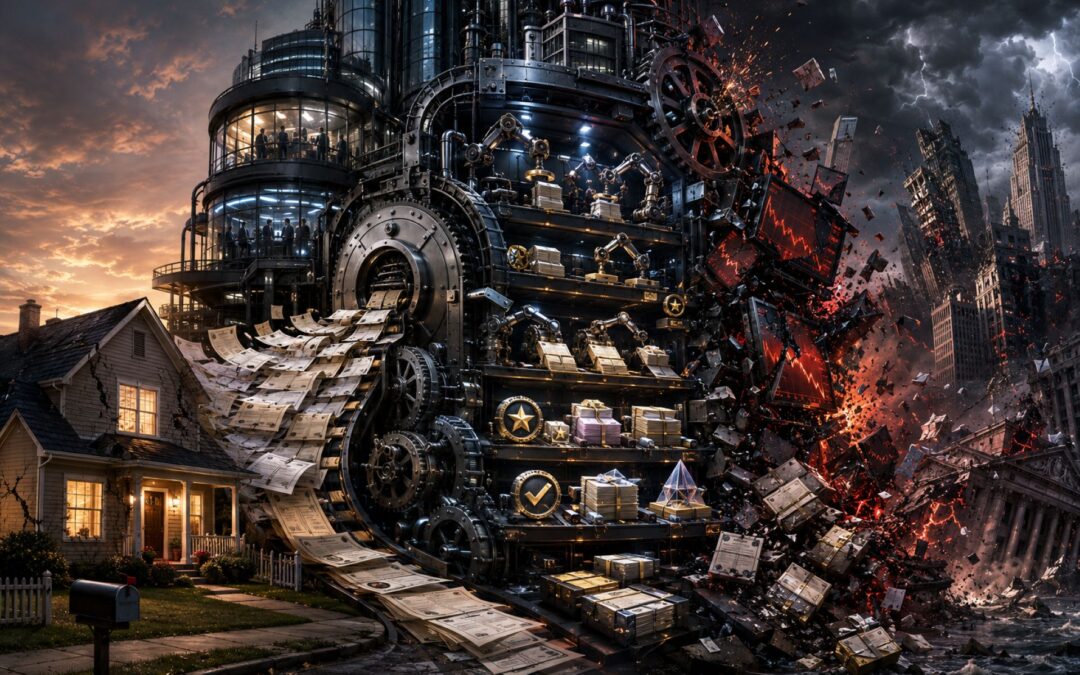
The Crisis Was Bigger Than a Housing Crash
The 2008 financial crisis is often described as a housing crash.
That is true, but only in the same way a heart attack is a blood-flow problem. Technically correct. Not nearly enough.
The crisis began with houses, mortgages, and the seductive belief that home prices could not fall everywhere at once. But it became something much larger because modern finance had turned ordinary home loans into a global web of investments, insurance contracts, borrowed money, and institutional trust.
When that trust broke, it did not only damage Wall Street.
It destroyed jobs, wiped out household wealth, froze credit, reshaped politics, changed how governments think about bailouts, and left an entire generation more skeptical of banks, markets, and the promise that the financial system is smarter than everyone else.
The Financial Crisis Inquiry Commission, created by the U.S. government to investigate the crash, concluded that the crisis was avoidable. That is what makes it so disturbing. This was not a natural disaster. It was not an asteroid. It was the result of choices, incentives, blind spots, and a system that rewarded risk while hiding where the danger really was.
To understand 2008, you have to understand how a simple idea became dangerous:
A mortgage is safe because people pay to keep their homes.
That idea sounded reasonable.
Then Wall Street built an empire on top of it.
The Easy-Money World That Made Risk Look Safe
The roots of the crisis go back to the early 2000s.
After the dot-com bubble burst and the September 11 attacks shook the U.S. economy, the Federal Reserve lowered interest rates to support growth. Cheap money made borrowing easier. Banks could lend more. Households could take on bigger mortgages. Investors, meanwhile, were searching for better returns than they could get from safe assets.
Housing seemed like the perfect answer.
Home prices were rising. Mortgage lending was booming. Politicians liked the idea of expanding homeownership. Banks liked the fees. Borrowers liked the access to credit. Investors liked the steady stream of payments that mortgages appeared to offer.
Everyone seemed to be winning.
But cheap money has a way of making fragile things look strong. When borrowing is easy and asset prices keep rising, caution starts to look unnecessary. People begin to confuse a rising market with proof that the system works.
The U.S. housing market became the center of that illusion.
More buyers entered the market. Home prices rose further. Rising prices made lenders more comfortable issuing mortgages because even if borrowers struggled, the house could be sold at a higher price. That logic worked as long as prices kept going up.
And for a while, they did.
This created a dangerous feedback loop. Higher prices encouraged more lending. More lending pushed prices higher. Rising prices made risk seem smaller. Smaller perceived risk encouraged even looser lending.
By the time the bubble was obvious, too many people had an incentive not to see it.
How Subprime Mortgages Entered the Machine
A traditional mortgage is based on a basic question: can this borrower realistically repay the loan?
During the housing boom, that question became less important.
Lenders increasingly issued mortgages to borrowers with weaker credit histories, unstable income, or limited ability to make large down payments. These were known as subprime mortgages. The Consumer Financial Protection Bureau defines a subprime mortgage as one generally offered to borrowers with impaired or limited credit histories.
Subprime lending was not automatically evil. In theory, it could expand access to homeownership for people who had previously been excluded from the housing market.
The problem was the way the incentives changed.
In older banking models, a lender cared deeply about whether the borrower could repay because the lender often kept the loan on its own books. If the borrower defaulted, the lender suffered.
But in the pre-2008 mortgage machine, many lenders did not plan to hold the loan. They planned to issue the mortgage, collect fees, and sell it onward into the financial system.
That changed everything.
If a loan could be sold quickly, the lender’s main incentive was no longer long-term repayment. It was volume. More mortgages meant more fees. More fees meant more profit.
This helped fuel increasingly reckless lending standards. Some borrowers were offered adjustable-rate mortgages with low initial payments that would later reset at much higher rates. Others were approved with limited documentation. In the most extreme cases, the system almost seemed designed around the assumption that rising home prices would solve every problem.
If a borrower struggled, they could refinance.
If they could not refinance, they could sell.
If they sold, the higher home price would cover the loan.
This logic depended on one thing: home prices could not fall too much.
That assumption turned out to be catastrophic.
How Wall Street Turned Home Loans Into Global Investments
A single mortgage is simple. A homeowner borrows money and repays it over time.
Wall Street made it complicated.
Banks and financial institutions bundled thousands of mortgages together and turned them into securities that could be sold to investors. These were mortgage-backed securities. The basic idea was that investors would receive payments from the pool of homeowners paying their mortgages.
At first glance, this seemed clever. A pool of many mortgages looked safer than one mortgage. Even if a few borrowers defaulted, most would keep paying.
Then the engineering went further.
Financial institutions sliced these mortgage pools into different layers, called tranches. Some layers were supposed to be very safe. Others were riskier but offered higher returns. Through this structure, pools containing risky mortgages could produce securities that received high credit ratings.
This was the magic trick at the heart of the crisis.
Risk did not disappear.
It was rearranged, renamed, and sold.
Investors around the world bought these products because they seemed to offer a rare combination: higher returns than government bonds but with ratings that suggested they were extremely safe.
Pension funds, insurance companies, banks, hedge funds, and global investors all wanted exposure. The demand for mortgage-backed securities encouraged even more mortgage lending, because Wall Street needed more loans to package and sell.
The system became circular.
Lenders created mortgages because Wall Street wanted them. Wall Street packaged them because investors wanted them. Investors wanted them because ratings agencies and financial models suggested they were safe. Rising demand pushed the machine to create more loans, including more questionable ones.
By this point, the housing market was no longer just about people buying homes.
It had become raw material for global finance.
Why Everyone Believed the Risk Had Disappeared
The most dangerous belief in finance is not that risk exists.
It is that risk has been conquered.
Before 2008, many institutions believed that modern finance had made the system safer. Risk could be modeled. Mortgages could be diversified. Securities could be structured. Insurance-like contracts could protect against losses. Banks could use sophisticated tools to manage exposure.
The whole system seemed smarter than old-fashioned banking.
But there was a flaw beneath the sophistication: many people were using models based on a world where nationwide housing prices did not collapse together.
If defaults remained isolated, the system could absorb them. But if home prices fell broadly, defaults would rise together. That meant the diversification was weaker than it looked.
The ratings agencies played a major role in this false confidence. Many mortgage-backed securities and related products received high ratings, making them acceptable to institutions that were supposed to invest conservatively. The Financial Crisis Inquiry Commission later identified failures by credit rating agencies as essential contributors to the crisis.
There was also a deeper psychological problem.
When everyone is making money, skepticism becomes expensive.
A banker who refused to participate looked cautious in the short term but foolish if competitors were earning huge profits. A ratings agency that was too strict risked losing business. An investor who avoided mortgage products missed out on returns. A regulator who warned too loudly could be accused of not understanding financial innovation.
The machine rewarded belief.
It punished doubt.
And so, across the system, people kept treating fragile structures as safe assets.
The Housing Bubble Bursts
The crisis did not begin with a single dramatic collapse.
It began with something quieter: borrowers started missing payments.
As adjustable-rate mortgages reset, many homeowners faced higher monthly payments. Some could no longer refinance because home prices had stopped rising. Others found themselves owing more than their homes were worth.
Defaults increased.
Foreclosures rose.
Home prices weakened.
That weakness created more defaults, because borrowers who might have escaped by selling or refinancing no longer had an easy exit. The same feedback loop that had inflated the bubble now worked in reverse.
Falling prices exposed the weakness of the mortgages. Weak mortgages damaged the securities built on top of them. Falling security prices hit the banks and investors that held them. But because these products were complex and widely distributed, nobody knew exactly where the losses were.
That uncertainty was deadly.
Financial markets can handle bad news. What they struggle to handle is not knowing who is safe.
Banks became suspicious of one another. Investors questioned balance sheets. Institutions that depended on short-term funding suddenly found that lenders were less willing to trust them.
The crisis moved from housing into credit.
And once credit froze, the entire economy was in danger.
Why Lehman Brothers Became the Panic Moment
By 2008, the crisis had already been building for months.
Bear Stearns had collapsed earlier that year and was sold to JPMorgan Chase in a government-backed rescue. Mortgage lenders had failed. Financial institutions were reporting enormous losses. The market knew something was wrong.
But the collapse of Lehman Brothers turned fear into panic.
Lehman was a major investment bank with deep connections across global finance. It was heavily exposed to real estate and mortgage-related assets. As confidence disappeared, the firm could not secure the support it needed to survive.
In September 2008, Lehman filed for bankruptcy.
The symbolic effect was enormous.
If a firm as large and connected as Lehman could fail, then no institution seemed completely safe. Investors and lenders immediately began asking a terrifying question: who is next?
The answer was unclear, which made everyone more cautious at the same time.
That is how panic spreads in finance. It does not require every institution to be insolvent. It requires enough uncertainty that everyone tries to protect themselves simultaneously.
Credit markets seized. Money market funds came under stress. Banks pulled back. Companies that depended on routine access to credit suddenly faced danger. What looked like a Wall Street crisis now threatened ordinary businesses and workers.
The Federal Reserve’s history of the Great Recession describes how financial stress intensified dramatically in 2008, leading to extraordinary policy responses. Lehman was not the only cause, but it was the moment when the crisis became undeniable.
The system had lost faith in itself.
Why AIG Was Too Dangerous to Let Fail
Just after Lehman, another giant stood on the edge: AIG.
At first glance, AIG did not look like a typical crisis villain. It was an insurance company, not an investment bank. But one part of AIG had sold enormous amounts of protection on mortgage-related securities through credit default swaps.
A credit default swap is often described as insurance against a borrower or security defaulting. The problem is that this “insurance” existed inside a highly interconnected financial system. If AIG could not honor its obligations, the losses would spread to many other institutions.
That made AIG dangerous.
When mortgage-related securities declined, AIG had to post more collateral. The pressure became too large. If AIG collapsed, it could have sent shockwaves through banks and investors that believed they were protected.
So the U.S. government rescued it.
This is where the phrase “too big to fail” became central to public anger. The logic of the rescue was that allowing AIG to collapse could make the entire crisis worse. But to ordinary people, the message felt brutal: when large financial institutions made reckless bets, the government found money to save them. When households lost jobs or homes, help was slower, smaller, or harder to access.
That tension still defines how many people remember 2008.
The rescue may have prevented deeper systemic collapse.
It also damaged trust in the fairness of the system.
The Bailouts: Necessary Rescue or Reward for Recklessness?
The most controversial part of the crisis was the bailout.
In October 2008, the U.S. government created the Troubled Asset Relief Program, better known as TARP. The U.S. Treasury explains that TARP was established to stabilize the financial system, support economic growth, and prevent avoidable foreclosures. Congress initially authorized up to $700 billion, though the final structure evolved over time.
The official argument was simple: if the banking system collapsed, everyone would suffer.
Banks are not just private businesses. They are part of the economy’s plumbing. Companies rely on credit to make payroll, manage inventory, and invest. Households rely on credit for homes, cars, education, and emergencies. If banks stop lending and credit markets freeze, the pain spreads quickly into the real economy.
From that perspective, rescuing the financial system was not about kindness to bankers. It was about preventing a depression.
But morally, the bailout was harder to accept.
Many of the same institutions that had profited during the boom were now being rescued during the bust. Executives kept wealth earned during the bubble. Ordinary people lost homes, jobs, savings, and security. The contrast created a lasting sense that capitalism had one rule for the powerful and another rule for everyone else.
Former crisis officials, including Ben Bernanke, Timothy Geithner, and Henry Paulson, later argued in Brookings reflections that the emergency response helped prevent a much worse collapse. Critics, however, argued that the rescue entrenched moral hazard: if institutions believe they will be saved when they become dangerous enough, they may take excessive risks again.
Both things can be true.
The bailout may have been necessary.
It may also have revealed how broken the system had become.
How the Crisis Became the Great Recession
The financial crisis did not stay inside banks.
It became the Great Recession.
As credit tightened, businesses cut investment. Consumers pulled back. Housing construction collapsed. Homeowners lost wealth. Unemployment rose. Retirement accounts suffered. Global trade declined. The fear that began in mortgage securities moved into factories, offices, shops, and households.
This is one reason financial crises are so destructive. They do not merely reduce numbers on bank balance sheets. They change behavior.
A family worried about job loss spends less.
A business worried about demand stops hiring.
A bank worried about losses lends less.
An investor worried about panic sells assets.
When millions of people and institutions become defensive at the same time, the economy contracts.
The Reserve Bank of Australia’s explainer on the global financial crisis highlights excessive risk-taking, increased borrowing, and weaknesses in regulation and supervision as central causes. Those weaknesses did not only hurt the United States. Because financial products had been sold globally and banks around the world were connected, the crisis spread across borders.
This was globalization’s dark side.
The same system that allowed capital to move freely also allowed panic to travel quickly.
The Great Recession left scars that lasted long after stock markets recovered. Many workers who lost jobs struggled to regain their previous income trajectory. Young people entering the labor market faced weaker opportunities. Homeowners who lost houses did not simply lose property; they lost stability and often years of accumulated wealth.
The crisis was not a single event.
It was a before-and-after moment.
What Changed After 2008
After the crisis, governments and regulators tried to make the financial system safer.
Banks were required to hold more capital. Regulators paid more attention to systemic risk. Stress tests became more important. The United States passed the Dodd-Frank Act, which reshaped parts of financial regulation and created the Consumer Financial Protection Bureau. Central banks also became much more willing to use extraordinary tools during emergencies.
Some things did change.
Banks became better capitalized. Mortgage lending standards tightened. Regulators became more aware that the failure of one large institution could threaten the entire system. The idea that markets could regulate themselves without serious oversight lost credibility.
But 2008 did not end financial fragility.
It changed its form.
The post-crisis economy became defined by low interest rates, central bank intervention, and an ongoing search for yield. When safe returns are low, investors often move into riskier assets to make money. That does not automatically create a crisis, but it can create new vulnerabilities.
The crisis also changed politics. It fueled anger at elites, suspicion of globalization, resentment toward bailouts, and distrust of expert-led institutions. Many people concluded that the system had been rescued, but not repaired for ordinary citizens.
That perception mattered.
A crisis is not only about GDP, unemployment, or bank capital.
It is also about legitimacy.
When people believe the rules are rigged, the damage lasts much longer than the recession.
Why the 2008 Financial Crisis Still Affects You
The 2008 crisis still shapes the world because it changed how people think about money, housing, risk, and institutions.
For many millennials, it was the economic trauma that defined early adulthood. They watched parents lose jobs or homes. They graduated into weak labor markets. They became more cautious about debt, more skeptical of homeownership, and more aware that “safe” systems can fail.
For governments and central banks, 2008 created a new crisis playbook. When the COVID-19 shock arrived in 2020, policymakers responded quickly and aggressively partly because they remembered the cost of doing too little too late in 2008.
For investors, the crisis reshaped expectations around central banks. Markets became accustomed to the idea that during severe stress, central banks would step in with rate cuts, liquidity support, and asset purchases. That expectation influenced the behavior of markets for years.
For ordinary households, the biggest legacy may be housing.
The crisis exposed how dangerous housing can become when it is treated not just as shelter, but as a leveraged financial asset. Yet in many countries, housing affordability has only become more strained since then. People who watched a housing bubble destroy the economy now live in a world where homeownership still feels out of reach.
That is one of the bitter ironies of 2008.
The crash proved housing could be dangerously overfinancialized.
The aftermath did not make housing feel secure or affordable for many people.
The crisis also left behind a moral memory: banks were rescued, but many families were not rescued in the same way. Whether that view is complete or not, it became emotionally powerful because it matched what millions of people experienced.
They did not remember liquidity facilities.
They remembered foreclosure signs.
They remembered layoffs.
They remembered watching powerful institutions survive while ordinary people absorbed the pain.
The Real Lesson of 2008
The lesson of 2008 is not simply that bankers were greedy, borrowers were reckless, regulators were asleep, or investors were foolish.
All of those explanations contain some truth, but none is enough.
The deeper lesson is that systems can become dangerous when everyone inside them has a reason to believe the same comforting story.
Borrowers believed home prices would rise.
Lenders believed they could sell the loans.
Banks believed they could package the risk.
Ratings agencies believed the models.
Investors believed the ratings.
Regulators believed the market was managing itself.
Politicians believed homeownership was an unquestionable good.
The public believed the financial system knew what it was doing.
Then the story broke.
And when it broke, the complexity that had made the system look sophisticated made it harder to understand, harder to control, and harder to save without rescuing the very institutions that helped create the disaster.
The 2008 financial crisis was not just a failure of mortgages or banks.
It was a failure of imagination.
Too many powerful people could not imagine that housing prices would fall together. They could not imagine that risk had been concentrated rather than dispersed. They could not imagine that institutions built to manage uncertainty had become engines of it.
That is why 2008 still matters.
Not because the next crisis will look exactly the same.
It probably will not.
It matters because every era has its own version of the same temptation: the belief that this time, the system is smarter, the models are better, the risks are controlled, and the boom is justified.
That belief is comforting.
It is also how bubbles learn to hide in plain sight.
Last Updated on June 25, 2026 by Aseem Gupta