
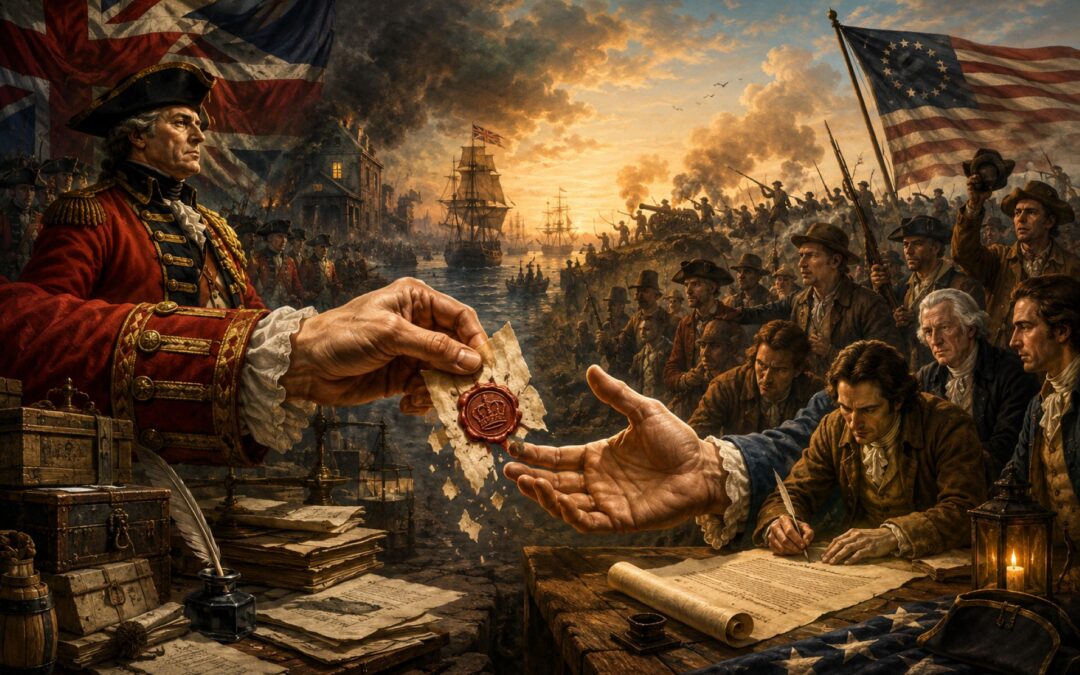
The American Revolution did not begin as a clean, heroic march toward independence.
It began as an argument inside an empire.
For more than a century, Britain’s mainland colonies in North America had lived in an uneasy middle ground. They were British subjects. They traded inside the British imperial system. They fought Britain’s wars. They spoke the language of English liberty and constitutional rights.
But they were also used to governing themselves.
That tension mattered. As long as Britain left the colonies with enough room to manage their own affairs, the relationship could survive. But after a costly imperial war, Britain decided the colonies needed tighter control. Parliament wanted revenue. Colonial assemblies wanted autonomy. British officials saw resistance as disobedience. Many colonists saw new laws and taxes as a threat to the rights they believed they already possessed.
That is what turned a tax dispute into a constitutional crisis.
And once violence entered the story, compromise became harder with every passing year.
The American Revolution was not caused by one tax, one massacre, one pamphlet, or one battle. It was a chain reaction. A war made Britain desperate for money. Taxes raised the question of representation. Protests became riots. Riots brought troops. Troops brought bloodshed. Punishment brought unity. Unity made independence imaginable. Foreign help made victory possible.
By the end, thirteen colonies had not simply defeated Britain.
They had created a new country while leaving behind contradictions that would haunt it for generations.
The Revolution Was Not Inevitable
It is easy to look back at the American Revolution as if independence was always waiting at the end of the road.
It was not.
For much of the crisis, many colonists did not want to leave the British Empire. They wanted their old rights restored. They wanted Parliament to stop taxing them without colonial consent. They wanted British officials to stop interfering with local government. They wanted to be treated as loyal British subjects, not conquered dependents.
That is why the Revolution has to be understood as an escalation, not a sudden awakening.
In the 1760s, the main issue was not independence. It was power.
Who had the right to govern the colonies?
Parliament believed it had ultimate authority over the empire. Colonial leaders increasingly argued that taxes should come only through their own elected assemblies. British officials thought they were asserting order. The colonists thought Britain was violating long-standing political rights.
Both sides believed they were defending the constitution.
That made the conflict especially dangerous. It was not simply about money. It was about legitimacy.
If Parliament could tax the colonies without representation, what could it not do? If colonial resistance succeeded, how could Britain govern the empire at all?
The American Revolution began in that gap between imperial authority and colonial self-rule.
The War That Made Britain Tax America
The road to revolution ran through an earlier war.
Between 1754 and 1763, Britain and France fought for control of North America as part of the wider Seven Years’ War. In the American colonies, the conflict was known as the French and Indian War. It ended with a major British victory. France lost its mainland North American empire, and Britain emerged as the dominant power on the continent.
But victory was expensive.
The war left Britain with a large national debt and a much larger North American empire to defend. From London’s point of view, it seemed reasonable that the colonies should help pay for the cost of their own protection. The National Park Service timeline of the American Revolution makes this sequence clear: the end of the Seven Years’ War in 1763 was followed almost immediately by new imperial efforts to raise revenue and control colonial expansion.
To British officials, the logic was simple.
Britain had spent heavily defending the colonies from France. Britain now had to station troops in North America. The colonies benefited from the empire. Therefore, the colonies should contribute.
To many colonists, the logic looked very different.
They had fought in the war too. They already paid taxes to their own colonial governments. They were not represented in Parliament. And now, with the French threat removed, they had less reason to tolerate British control than before.
That was one of the great ironies of Britain’s victory.
By defeating France, Britain removed the enemy that had made many colonists feel dependent on imperial protection. Then, by trying to make the colonies pay for the war, Britain gave them a new enemy closer to home.
How Taxes Became a Fight Over Power
Britain’s first postwar revenue measures seemed practical in London and provocative in America.
The Sugar Act of 1764 tightened enforcement on sugar and molasses. The Stamp Act of 1765 went further. It required stamps on legal documents, newspapers, licenses, pamphlets, playing cards, and other printed materials.
This was not a minor inconvenience. It touched daily life, business, law, politics, and print culture.
More importantly, it touched the question the colonies cared about most: consent.
The colonists were not simply complaining that taxes were too high. In fact, by modern standards, many of the taxes were not huge. The deeper issue was that Parliament had imposed them without elected colonial representatives. The slogan “no taxation without representation” captured the argument in its simplest form, but the full dispute was bigger than taxation.
If Parliament could tax the colonies directly, then Parliament could govern the colonies directly.
That was the fear.
Resistance spread quickly. Colonial merchants organized boycotts. Political writers attacked the laws. Crowds intimidated stamp distributors. Groups such as the Sons of Liberty turned resistance into organized pressure. British goods became political symbols. Buying them could mark someone as loyal to Britain; refusing them could mark someone as a patriot.
The protests worked.
Britain repealed the Stamp Act in 1766. But it also passed the Declaratory Act, insisting that Parliament had full authority to legislate for the colonies “in all cases whatsoever.”
That sentence mattered.
Britain had backed down on the tax but not on the principle behind it. The colonists had won a victory but not security. So when Britain later imposed new duties on glass, lead, paint, paper, and tea, the conflict returned almost immediately.
The question had not been settled.
It had only been postponed.
Boston Became the Revolution’s Pressure Cooker
No city carried the tension like Boston.
Boston had radical printers, organized resistance networks, confrontational crowds, and British officials determined to prove that imperial authority still meant something. When Britain sent troops to Boston in 1768, the city became a military occupation zone in everything but name.
That made daily life combustible.
Soldiers and civilians clashed in streets and taverns. Workers resented troops who competed for jobs. Patriots used every confrontation as evidence that Britain was turning free subjects into an occupied people.
Then, on March 5, 1770, the pressure broke.
A crowd confronted British soldiers outside the Customs House. Taunts turned into thrown objects. The soldiers, surrounded and panicked, fired into the crowd. Five civilians were killed.
The Boston Massacre became one of the most powerful propaganda moments of the prewar crisis. It did not matter that the event was messy, chaotic, and contested. Patriot writers and printers framed it as proof of British cruelty. Paul Revere’s famous engraving helped turn a confusing street clash into a clear political image: innocent colonists murdered by imperial troops.
That is how revolutions often work.
Events do not speak for themselves. They are interpreted, printed, circulated, and remembered.
The next major crisis came from tea.
In 1773, Britain passed the Tea Act, which helped the struggling East India Company sell tea directly in the colonies. The law actually made tea cheaper in some cases, but that was not the point. Colonists saw it as a trick to make them accept Parliament’s right to tax them.
So, on December 16, 1773, members of the Sons of Liberty boarded ships in Boston Harbor and dumped hundreds of chests of tea into the water.
Britain responded harshly.
The Coercive Acts, known in the colonies as the Intolerable Acts, closed Boston Harbor, altered Massachusetts’s charter, restricted local self-government, and allowed royal officials accused of crimes to be tried elsewhere. Britain intended to punish Massachusetts and isolate the radicals.
Instead, it alarmed the other colonies.
If Britain could do this to Massachusetts, it could do it anywhere.
Boston’s punishment became a continental warning.
The Colonies Tried Reconciliation Before Independence
The colonies did not immediately declare independence after the Intolerable Acts.
They met.
In 1774, delegates from twelve colonies gathered in Philadelphia for the First Continental Congress. They included future revolutionary giants such as George Washington, John Adams, John Jay, Samuel Adams, and Patrick Henry. Their goal was not yet to create a new nation. It was to coordinate resistance and pressure Britain to reverse course.
They petitioned. They debated. They organized boycotts. They urged colonies to prepare.
But the crisis had already moved beyond paperwork.
In Massachusetts, local militias began storing weapons and drilling. British officials saw this as rebellion in preparation. General Thomas Gage, the British commander in Boston, was ordered to restore control.
In April 1775, British troops marched toward Concord to seize colonial military supplies. Patriot riders, including Paul Revere and William Dawes, warned the countryside. Local militia gathered.
At Lexington, British troops and colonial militiamen faced each other in the early morning. Someone fired.
No one knows with certainty who fired first.
But the shot mattered more than the shooter.
The fighting spread to Concord, and then along the British retreat back to Boston. Local militiamen fired from behind trees, walls, and houses. By the time the British returned to Boston, they had suffered a humiliating blow.
The “shot heard round the world” did not instantly create independence.
But it made peace much harder.
The Battle of Bunker Hill soon followed. Technically, Britain won the hill. But it paid a terrible price in casualties. The battle showed that colonial forces could stand against British regulars, at least from strong defensive positions.
Still, even after blood had been spilled, many colonists hoped for reconciliation. The Second Continental Congress sent the Olive Branch Petition to King George III, asking for a peaceful settlement.
The king rejected it.
By late 1775, Britain increasingly treated the colonies as being in open rebellion. The colonies, in turn, began to realize that asking for restored rights might no longer be enough.
The argument was becoming a war.
Common Sense Made Independence Thinkable
Wars need armies. Revolutions need arguments.
Thomas Paine gave the American cause one of its most important arguments in January 1776, when he published Common Sense. The pamphlet attacked monarchy, mocked hereditary rule, and argued that the colonies had no natural reason to remain tied to a distant island.
Paine’s timing was perfect.
Many colonists were angry at Britain, but not all were ready to embrace independence. Common Sense helped push the conversation from protest to separation. It gave ordinary readers a blunt, accessible case for why reconciliation was not only unlikely but foolish.
The Library of Congress discussion of Common Sense describes how Paine’s pamphlet spread through colonial public life, helping turn independence into a mainstream political demand rather than a radical fringe idea.
Its power came from simplicity.
Paine did not write like a cautious lawyer. He wrote like someone trying to win an argument in a tavern, a meeting hall, or a crowded street. He made monarchy look absurd. He made independence look practical. He made delay look dangerous.
That mattered because the Revolution was not only fought with muskets and cannons.
It was fought in newspapers, pamphlets, sermons, speeches, taverns, committees, and town meetings.
By mid-1776, independence had become thinkable.
Soon, it became unavoidable.
The Declaration Changed the Meaning of the War
On July 2, 1776, the Continental Congress voted for independence.
Two days later, it adopted the Declaration of Independence.
The Declaration did more than announce a break with Britain. It changed the meaning of the war. Before independence, the colonists could still describe themselves as British subjects defending inherited rights. After independence, they were claiming the right to form a new political community.
The National Archives transcript of the Declaration of Independence shows the structure of that argument clearly. It begins with universal principles: equality, natural rights, consent of the governed, and the right of a people to alter or abolish a destructive government. Then it lists grievances against King George III to justify separation.
That structure was deliberate.
The Declaration was not just written for Americans. It was written for the world.
It had to explain why the colonies were not merely rioters or traitors. It had to present independence as lawful, moral, and necessary.
Of course, the Declaration also exposed one of the central contradictions of the Revolution. Thomas Jefferson wrote that “all men are created equal” while enslaving human beings himself. The final document spoke the language of liberty while leaving slavery intact.
That contradiction did not destroy the Revolution’s power.
But it did shape its legacy.
The Declaration gave the new United States a founding promise larger than its founding reality. Future generations would use its language to challenge exclusions that the revolutionary generation either tolerated or built into the new nation.
In 1776, however, the immediate consequence was simpler.
There was no going back.
The colonies had declared themselves states. The war was no longer about restoring old rights inside the empire. It was about surviving as a new country.
Washington’s Army Survived Before It Won
George Washington’s early military career in the Revolution was not a string of glorious victories.
It was a lesson in survival.
After taking command of the Continental Army outside Boston, Washington inherited an army that was brave but inexperienced, poorly supplied, and difficult to hold together. Its soldiers enlisted for short terms. Its officers often lacked training. Congress could not reliably provide money or supplies. Disease and desertion were constant threats.
Washington’s first major success came when artillery captured from Fort Ticonderoga was dragged across winter terrain and placed on Dorchester Heights overlooking Boston. The British position became untenable, and in March 1776 they evacuated the city.
That was a victory.
Then came New York.
Britain returned with overwhelming force: warships, professional soldiers, and Hessian mercenaries. Washington tried to defend New York but was badly outmaneuvered. The Battle of Long Island was a disaster. The Americans narrowly escaped destruction under cover of fog, then suffered further defeats as they retreated through New York and New Jersey.
By late 1776, the Revolution looked close to collapse.
Washington’s army was shrinking. Morale was low. Many enlistments were about to expire. The British expected the rebellion to fade.
Washington needed a victory that was dramatic enough to prove the cause was still alive.
He found it at Trenton.
On Christmas night, 1776, Washington led his army across the icy Delaware River and attacked Hessian forces at Trenton the next morning. The victory was small in strategic terms but enormous psychologically. He followed it with another success at Princeton.
The message was clear: the Continental Army could still fight.
That became Washington’s most important contribution. He did not need to defeat Britain in one grand battle. He needed to keep an army in the field long enough for Britain’s costs to rise, its strategy to fail, and foreign powers to enter the war.
In that sense, survival was strategy.
Washington won by not losing.
Saratoga Turned a Rebellion Into a Global War
The turning point came in 1777.
Britain’s plan was to split the colonies by controlling the Hudson River Valley. General John Burgoyne would move south from Canada. British forces from New York were supposed to support the campaign. If successful, the British could cut New England off from the other colonies and damage the rebellion’s ability to coordinate.
But the plan fell apart.
Burgoyne advanced south but became increasingly isolated. American resistance slowed him. His supply lines stretched. Local support did not materialize as expected. Meanwhile, General William Howe pursued Philadelphia instead of fully supporting Burgoyne’s campaign.
The result was Saratoga.
American forces under Horatio Gates, with crucial battlefield aggression from Benedict Arnold, trapped Burgoyne’s army. In October 1777, Burgoyne surrendered.
Saratoga mattered because it changed how the world saw the Revolution.
Until then, France had quietly aided the Americans but hesitated to openly join. France hated Britain and wanted revenge for its losses in the Seven Years’ War, but it did not want to back a doomed rebellion. Saratoga suggested the Americans might actually survive.
That changed the diplomatic calculation.
In 1778, France formally allied with the United States. The Office of the Historian’s account of the French alliance explains how the alliance transformed the conflict by bringing French military, financial, and naval power into the war.
This was the moment the American Revolution became more than a colonial rebellion.
It became part of a global struggle among empires.
Britain now had to fight not only American rebels, but also France. Spain later entered the war against Britain as well. The Dutch provided additional support. British attention, ships, troops, and money had to be stretched across the Atlantic, the Caribbean, Europe, and beyond.
The Americans did not suddenly become stronger than Britain.
But Britain’s problem became much bigger than America.
The Revolution Was Also a Civil War
The American Revolution is often remembered as Americans against the British.
That is too simple.
It was also a civil war inside colonial society.
Patriots supported resistance and independence. Loyalists remained attached to the Crown. Many people tried to stay neutral until neutrality became impossible. Communities split. Families split. Local rivalries became political. Violence did not happen only between armies; it happened between neighbors.
The Revolution also forced Native nations to make impossible strategic choices.
For Native peoples, the central question was not British liberty or American independence. It was land, sovereignty, and survival. Many Native nations saw American expansion as the greater danger and therefore leaned toward Britain. Others allied with the Americans or split internally.
The Haudenosaunee Confederacy, also known as the Six Nations, was divided by the conflict. The National Park Service account of the Six Nations during the American Revolution shows how the war fractured Indigenous diplomacy, with most nations supporting Britain while the Oneida and Tuscarora gave important support to the American side.
The consequences were devastating. American campaigns destroyed Native villages and food supplies. After the war, British defeat left many Native allies exposed to an expanding United States that was hungry for land.
The Revolution also looked very different to enslaved people.
For enslaved African Americans, the language of liberty created both hope and bitter irony. Many enslaved people heard revolutionary talk of freedom and asked the obvious question: freedom for whom?
The British exploited that contradiction. Lord Dunmore’s Proclamation in 1775 offered freedom to enslaved people owned by rebels if they joined the British cause. Thousands sought freedom by fleeing to British lines. Others fought for the Patriot cause, especially after the Continental Army reversed earlier restrictions on Black enlistment.
The National Park Service’s discussion of enslaved soldiers during the Revolution captures the painful reality: Black Americans fought on both sides, but the Revolution’s promise of liberty was applied unevenly and often denied outright.
This is why the Revolution cannot be reduced to a simple freedom story.
It expanded the language of liberty.
It did not extend liberty equally.
Why Britain’s Southern Strategy Failed
By 1778 and 1779, the war in the North had become frustrating for Britain.
The British held New York, but they could not destroy Washington’s army. They had taken Philadelphia, but holding the American capital had not ended the rebellion. France’s entry made the war more expensive and more dangerous.
So Britain shifted strategy.
The South seemed promising. British leaders believed there were more Loyalists in Georgia and the Carolinas. They hoped that if British forces captured key cities, Loyalist militias would rise, restore royal authority, and help roll the rebellion northward.
At first, the strategy looked successful.
Savannah fell in 1778. Charleston fell in 1780, giving Britain one of its biggest victories of the war. Thousands of American troops were captured. British forces pushed into the Carolina backcountry. Commanders such as Banastre Tarleton used harsh tactics to crush resistance and intimidate rebels.
But the strategy had a fatal flaw.
Britain could capture cities more easily than it could control the countryside.
The South became a brutal war of raids, reprisals, militia violence, and local revenge. Loyalists did rise, but not enough to stabilize British rule. Patriot militias fought back. Every British move required supplies, manpower, and local cooperation that were never reliable enough.
Then Nathanael Greene took command of the southern Continental Army.
Greene understood that he did not need to win every battle. He needed to exhaust the British. He split his forces, forced Cornwallis to chase him, stretched British supply lines, and made every British victory costly.
At Cowpens in 1781, Daniel Morgan defeated Tarleton’s force using a clever layered defense. At Guilford Courthouse, Cornwallis technically won the field but lost so many men that the victory damaged him more than it helped.
This became the pattern.
Britain could win battles and still lose the war.
Cornwallis moved into Virginia hoping to disrupt American supply lines and regain control. Instead, he walked into the campaign that would end major fighting.
Yorktown Was Won on Land and Sea
Yorktown was not simply the moment Washington trapped Cornwallis.
It was the moment American persistence, French alliance, British exhaustion, and naval strategy all came together.
Cornwallis established his army at Yorktown, Virginia, expecting support from the British navy. Washington initially wanted to attack British-held New York, but the French pushed for a campaign in Virginia. That decision proved decisive.
Washington and the French commander Rochambeau secretly moved their combined forces south. At the same time, a French fleet under Admiral de Grasse sailed into the Chesapeake.
The key event happened at sea.
In September 1781, the French fleet fought the British in the Battle of the Capes. The British failed to break French control of the Chesapeake. The National Park Service account of the Battle of the Capes explains why this mattered: without naval access, Cornwallis could not be properly reinforced or evacuated.
That sealed the trap.
American and French forces surrounded Yorktown by land. French ships blocked escape by sea. Artillery pounded the British position. Cornwallis waited for rescue that did not arrive.
In October 1781, he surrendered more than 7,000 troops.
The war did not legally end that day. Britain still held New York, Charleston, and Savannah. Fighting continued in some places. But Yorktown broke the political will to continue the war at the same scale.
For Britain, the cost was no longer worth the prize.
The Treaty of Paris in 1783 recognized American independence and gave the new United States territory stretching west to the Mississippi River. Britain removed its troops from American soil. The Spanish regained Florida. France gained revenge against Britain but deepened its own financial crisis.
The Revolution had begun as a dispute inside the British Empire.
It ended by reshaping the Atlantic world.
What the Revolution Created — and What It Left Unresolved
The American Revolution created the United States.
But it did not create a finished nation.
It created independence before unity was secure. It created republican ideals before republican institutions were stable. It declared equality while preserving slavery. It celebrated liberty while expanding onto Native lands. It rejected monarchy but still had to decide what executive power should look like.
That is why George Washington’s final role mattered so much.
Washington could have used his military prestige to dominate the new republic. Many victorious generals in history have done exactly that. Instead, he resigned his commission after the war and returned to Mount Vernon. Later, when he became the first president, he helped define the office through restraint as much as action.
He accepted the title “president,” not king. He built a cabinet. He respected constitutional limits. He gave up power after two terms. As I’ve discussed in Every Presidential First Explained, Washington’s precedents shaped not just the first presidency, but the expectations placed on every president after him.
That was one of the Revolution’s most important achievements.
It did not simply replace one ruler with another.
It created a political culture in which power had to justify itself, limit itself, and eventually transfer peacefully.
Still, the Revolution’s unresolved problems were enormous. Loyalists were displaced or punished. Native nations faced accelerating dispossession. Enslaved people remained enslaved in much of the new republic. Women had participated in boycotts, wartime labor, political discussion, and household resistance, but formal political power remained overwhelmingly male.
The Revolution opened a door.
It did not let everyone through.
That is what makes it so powerful and so complicated. It was both a break from empire and the beginning of new struggles over who counted as part of “the people.” Its ideals were larger than the society that declared them. Its promises were inspiring, but incomplete.
The American Revolution began with an empire trying to make its colonies pay.
It became a fight over who had the right to rule.
It survived because Washington kept an army alive, because colonial resistance became coordinated, because British strategy failed, because France changed the balance, and because ordinary people turned an imperial crisis into a political revolution.
In the end, the colonies did not win because they were stronger than Britain.
They won because they lasted long enough for Britain’s strength to become a burden.
And when the war ended, the harder question began.
Not whether Americans could reject a king.
But whether they could build a republic worthy of the liberty they had claimed.
Last Updated on July 3, 2026 by Aseem Gupta