
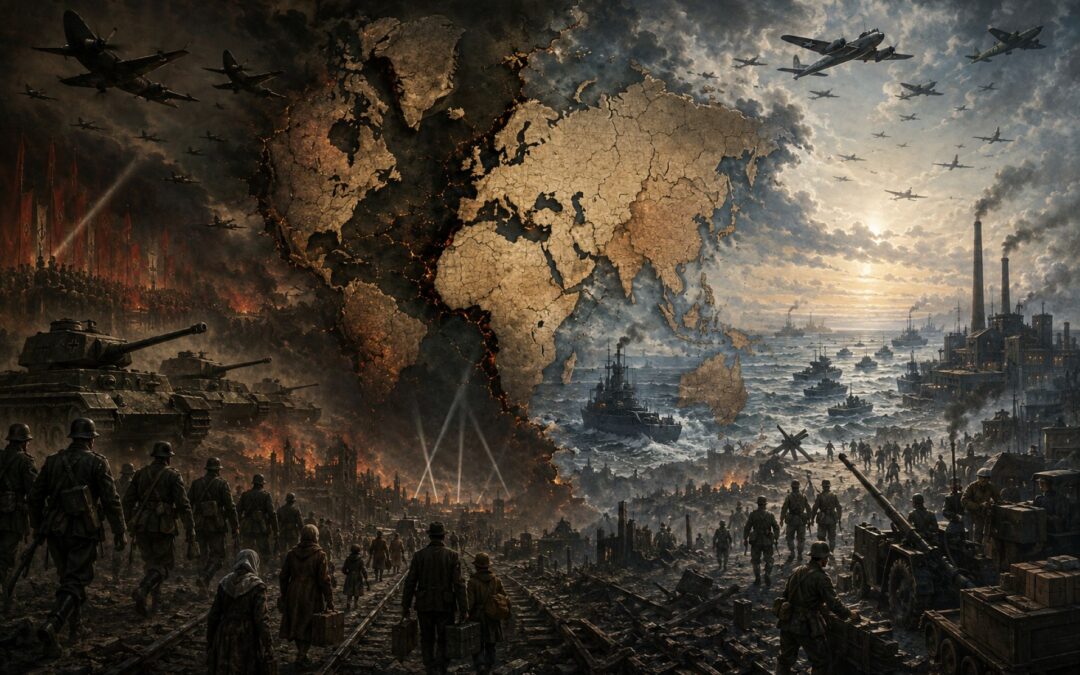
World War II is often remembered through a handful of images: Hitler shouting before a crowd, Churchill refusing to surrender, soldiers landing on Normandy’s beaches, mushroom clouds rising over Japan.
But the war was much bigger than its most famous moments.
It was not just Germany against Britain. It was not just Europe until America showed up. It was not just a series of battles between armies.
World War II was the violent collapse of an already broken world. It grew out of the wreckage of World War I, fed on economic disaster, rewarded dictators who gambled that their enemies were weak, and eventually pulled Europe, Asia, Africa, the Pacific, and the Americas into one connected catastrophe.
By the time it ended in 1945, more than fifty nations had been involved, over 100 million people had been mobilized, and the war had become the deadliest conflict in human history, according to the National WWII Museum.
It destroyed the Axis powers.
It exposed the horror of industrial genocide.
It ended old empires and created new superpowers.
It gave the world the United Nations, the Cold War, nuclear weapons, war crimes trials, decolonization movements, and a new understanding of what modern states could do when ideology, technology, and total war fused together.
To understand World War II, we have to do more than memorize dates and battles.
We have to understand how a broken peace became a global war.
The World Was Already Broken Before World War II Began
World War II did not begin out of nowhere in September 1939.
The shooting started then, but the conditions that made the war possible were created much earlier.
The most obvious starting point is World War I. When that war ended in 1918, Europe was exhausted. Millions were dead. Empires had collapsed. Borders had been redrawn. Germany had been defeated, humiliated, and forced to accept responsibility for the war under the Treaty of Versailles.
The treaty stripped Germany of territory, limited its army, imposed reparations, and left many Germans feeling that the postwar order was not peace but punishment.
That feeling did not automatically make another world war inevitable. Countries can survive humiliation. They can recover from defeat. They can rebuild after terrible wars.
But Versailles created a grievance that extremists could exploit.
Germany was not the only unstable country. The Austro-Hungarian, Ottoman, German, and Russian empires had all collapsed or transformed. New states appeared. Old ethnic tensions remained. Eastern Europe became a patchwork of fragile borders and insecure governments.
The League of Nations was supposed to keep the peace. In theory, collective security would stop aggression before it spread. In practice, the League lacked the power, unity, and credibility to discipline major aggressors. The United States never joined. Britain and France were exhausted and cautious. Many states wanted peace, but few wanted to risk another war to defend it.
Then came the Great Depression.
The global economic crash did not simply create unemployment and poverty. It shattered faith in democratic governments. It made compromise look weak. It made radical answers look attractive. In Germany, economic collapse helped the Nazis turn resentment into mass politics. Across Europe, the crisis strengthened movements that promised order, revenge, national rebirth, or revolution.
As the Council on Foreign Relations explains, Germany’s invasion of Poland was the immediate trigger of World War II, but the deeper causes included the Treaty of Versailles, the weakness of the League of Nations, the rise of Hitler, appeasement, and isolationism.
In other words, Poland lit the match.
But the room had been filling with gas for twenty years.
Why Germany, Italy, and Japan Wanted to Overturn the Existing Order
The Axis powers were not random troublemakers.
Germany, Italy, and Japan were revisionist powers. Each believed the existing world order denied it the greatness, territory, resources, or prestige it deserved.
Germany wanted to overturn Versailles. But Hitler wanted much more than restoring German pride. Nazi ideology imagined a racial empire in Eastern Europe. It demanded Lebensraum, or “living space,” for Germans. It treated Slavs, Jews, Roma, disabled people, communists, and many others as enemies, obstacles, or targets for destruction.
For Hitler, war was not a last resort.
War was the method.
Italy had been on the winning side in World War I, but many Italian nationalists felt cheated by the peace settlement. Benito Mussolini turned that bitterness into fascist theater. He promised a revived Roman greatness, discipline, empire, and national glory. Italy invaded Ethiopia in 1935, intervened in Spain, and dreamed of dominating the Mediterranean.
Japan’s ambitions had a different geography but a similar logic. Japan had modernized rapidly and become a major imperial power. It had already taken Korea, expanded into Manchuria, and fought a brutal war in China. Japanese leaders wanted dominance in East Asia and access to resources such as oil, iron, and rubber. They also believed Western powers had built empires while trying to deny Japan the same privilege.
So World War II had more than one engine.
In Europe, Nazi Germany wanted racial empire and revenge.
In the Mediterranean and Africa, Fascist Italy wanted prestige and expansion.
In Asia and the Pacific, Imperial Japan wanted regional domination and resource security.
The three powers were not identical. They did not always coordinate well. They had different priorities and different enemies.
But they shared one dangerous belief: the world as it existed had to be smashed and remade by force.
Hitler’s Rise Turned German Resentment Into a War Machine
Germany’s anger after World War I did not automatically produce Hitler.
Hitler’s rise depended on a specific mix of crisis, propaganda, fear, violence, and political miscalculation.
The Nazis promised to restore German greatness, destroy communism, reverse Versailles, rebuild the military, and purify the nation. They blamed Germany’s suffering on internal enemies, especially Jews, leftists, and the democratic politicians associated with the Weimar Republic.
Once Hitler became chancellor in 1933, he moved quickly. The Nazis destroyed democratic institutions, crushed opponents, censored the press, built a police state, and turned politics into loyalty to one leader.
Rearmament followed.
Germany rebuilt its army, expanded its air force, and prepared for war in violation of Versailles. The Nazis also built a culture of militarism. Schools, propaganda, rallies, youth organizations, and public ceremonies trained Germans to see national life as struggle.
Hitler’s early foreign policy was a series of tests.
In 1936, Germany remilitarized the Rhineland, a region that was supposed to remain demilitarized under the postwar settlement. Britain and France protested but did not act militarily. Hitler learned that boldness could work.
In 1938, Germany annexed Austria in the Anschluss. Again, there was no serious resistance.
Then came Czechoslovakia.
Hitler demanded the Sudetenland, a border region with many ethnic Germans. Britain and France, desperate to avoid war, accepted his demands at Munich in 1938. Hitler promised that this was his last territorial claim in Europe.
It was not.
In March 1939, Germany occupied the rest of Czechoslovakia. That move exposed the truth. Hitler was not merely trying to unite ethnic Germans or correct Versailles.
He was building an empire.
Appeasement Failed Because It Misread Hitler’s Ambition
Appeasement is often remembered as cowardice.
That is too simple.
Britain and France had reasons for avoiding war in the 1930s. The memory of World War I was still raw. Millions had died in trenches, and no responsible leader wanted to repeat that nightmare. Their economies were strained. Their militaries were not fully ready. Public opinion was deeply antiwar. Many also feared that another European war would benefit communism.
There was another problem: some of Hitler’s early demands sounded, to many people at the time, like revisions to an unfair peace rather than steps toward conquest.
The Rhineland was German territory. Austria had many Germans. The Sudetenland issue could be presented as national self-determination. These arguments helped Hitler make aggression look like correction.
But appeasement failed because it misread the man and the movement.
Hitler did not see concessions as a foundation for peace. He saw them as evidence that his enemies lacked will. Each success made the next gamble easier. Each victory strengthened his domestic image. Each retreat by Britain and France made resistance look less likely.
Munich did not prevent war.
It postponed it while giving Germany more confidence and more resources.
By the time Britain and France finally drew a line over Poland, Hitler had already learned a dangerous lesson: democracies talked, warned, and negotiated, but they usually backed down.
That lesson helped make war more likely.
The Invasion of Poland Turned Crisis Into World War
Poland became the breaking point.
Before invading, Hitler made a shocking deal with Joseph Stalin. Nazi Germany and the Soviet Union were ideological enemies, but in August 1939 they signed the Nazi-Soviet Pact. Publicly, it was a non-aggression agreement. Secretly, it divided Eastern Europe into spheres of influence.
This allowed Hitler to invade Poland without immediately facing a two-front war.
On September 1, 1939, Germany invaded Poland. German forces used aircraft, armor, artillery, and fast-moving infantry to overwhelm Polish defenses. On September 17, the Soviet Union invaded from the east, as agreed in the secret protocol.
Poland was crushed between two dictatorships.
Britain and France had promised to defend Poland. This time, they declared war on Germany. The local crisis became a European war.
But the first months were strange. While Poland was destroyed, the Western Front remained quiet. Britain and France were officially at war with Germany, but they did not launch a decisive offensive. This period became known as the “Phoney War.”
It could not last.
Germany had not started a limited border conflict. It had started a war to reorder Europe.
And in 1940, that war moved west.
Blitzkrieg Made Germany Look Unstoppable
In 1940, Germany seemed to break Europe open.
Denmark and Norway fell first. Then, in May, Germany attacked the Low Countries and France. Many expected a repeat of World War I: slow movement, defensive lines, grinding attrition.
Instead, Germany moved with terrifying speed.
The term “blitzkrieg,” or “lightning war,” is often used to describe Germany’s early method: rapid attacks combining tanks, aircraft, infantry, radio communication, and surprise. The goal was not to slowly push the enemy back. It was to break through, disrupt command, surround armies, and create panic faster than opponents could respond.
The key blow came through the Ardennes, a region many Allied planners believed was difficult terrain for a major armored attack. German forces punched through, raced toward the Channel, and split Allied armies apart.
British and French troops were trapped near Dunkirk. In a desperate evacuation, hundreds of thousands of Allied soldiers were rescued across the English Channel. The evacuation saved men, but not France.
Paris fell. France surrendered in June 1940.
For Hitler, it was a stunning victory. Germany had defeated one of Europe’s great powers in weeks. Nazi propaganda presented this as proof that Germany was unstoppable.
But the victory also created a new problem.
Britain was still in the war.
Britain Survived When Hitler Expected It to Break
After France fell, Hitler expected Britain to negotiate.
Britain did not.
Under Winston Churchill, Britain chose to continue fighting. That decision mattered enormously. Had Britain made peace, Germany could have dominated Western Europe without a major enemy base nearby. Instead, Britain remained a platform for resistance, intelligence, naval warfare, bombing campaigns, and eventually the return of Allied armies to Europe.
To defeat Britain, Germany needed control of the air.
The Battle of Britain became the first major campaign fought primarily by air forces. The German Luftwaffe attacked British airfields, radar stations, cities, and infrastructure. The Royal Air Force resisted with fighter pilots, radar, ground control systems, and home advantage.
Germany failed to destroy the RAF.
The invasion of Britain was postponed, then abandoned. The Blitz devastated British cities, especially London, but bombing did not force surrender. If anything, it hardened British resistance.
Britain did not defeat Nazi Germany alone. It did not yet have the strength to liberate Europe.
But it survived.
And survival was enough to deny Hitler the complete victory he wanted in the west.
World War II Was Already Global Before America Entered
It is tempting to tell World War II as a European war that became global after Pearl Harbor.
That is misleading.
The war was already global because empires were global.
Japan had been at war in China since 1937. Its invasion produced mass violence, occupation, and atrocities, including the Nanjing Massacre. Millions of Chinese civilians and soldiers suffered long before the United States entered the war.
Italy’s ambitions reached into Africa and the Mediterranean. Germany and Italy fought Britain in North Africa. The Suez Canal, Middle Eastern oil, Mediterranean shipping, and colonial possessions all mattered.
European empires pulled colonial subjects into the war. Soldiers, workers, resources, and money came from India, Africa, Southeast Asia, the Caribbean, and beyond. India alone contributed a massive volunteer army to the Allied war effort, with millions serving under British command.
The war was not just fought by white European soldiers on European soil.
It was fought by Chinese civilians under Japanese occupation, Indian soldiers in North Africa and Burma, African troops in imperial armies, Pacific islanders caught between empires, merchant sailors crossing deadly oceans, and civilians bombed in cities from London to Chongqing.
This is one reason World War II became a total war. It was not contained by geography. It spread through imperial networks, trade routes, colonies, oceans, and ideologies.
By the time America officially entered, the world was already burning.
Operation Barbarossa Turned the War Into a Catastrophe for Germany
Hitler’s biggest gamble came in June 1941.
Germany invaded the Soviet Union in Operation Barbarossa. The invasion was massive, brutal, and ideological from the beginning. Hitler wanted land, resources, food, oil, and the destruction of communism. Nazi racial ideology also imagined Eastern Europe as territory to be conquered, colonized, and remade through violence.
At first, Germany achieved enormous gains. Soviet armies were encircled. Hundreds of thousands of prisoners were taken. German forces advanced deep into Soviet territory.
But the scale of the invasion became its own trap.
The Soviet Union was vast. Distances were enormous. Roads were poor. Supply lines stretched. German forces needed fuel, ammunition, food, winter clothing, spare parts, and replacements over impossible distances. The deeper they advanced, the harder it became to sustain momentum.
The Soviets absorbed losses that would have destroyed many other states. They moved factories east. They mobilized manpower. They kept fighting even after catastrophic defeats.
And the German invasion was not just military. It was a war of annihilation. Nazi occupation brought mass shootings, starvation policies, anti-partisan terror, and genocide. This brutality did not pacify the Soviet Union. It deepened resistance.
The Imperial War Museums describes Operation Barbarossa as the beginning of a campaign that would ultimately decide the Second World War. That is not an exaggeration.
By invading the Soviet Union, Hitler opened the largest land war in history.
Germany could win battles there.
It could not survive the war it had created.
Pearl Harbor Brought the United States Fully Into the War
While Germany was fighting in the Soviet Union, Japan faced its own strategic dilemma.
Japan’s war in China was costly. Its empire needed oil and raw materials. The United States, Britain, and the Netherlands controlled or influenced many of the resources Japan wanted. American sanctions and oil restrictions put enormous pressure on Japanese leaders.
Japan had choices. It could pull back. It could negotiate. Or it could strike south into resource-rich territories and try to neutralize American power in the Pacific.
It chose war.
On December 7, 1941, Japan attacked Pearl Harbor, hoping to cripple the U.S. Pacific Fleet and buy time to build a defensive empire across Asia and the Pacific.
The attack was tactically devastating. Battleships were damaged or sunk. Thousands of Americans were killed or wounded.
Strategically, it was a disaster for Japan.
Instead of frightening the United States into compromise, Pearl Harbor unified American public opinion and brought the full weight of American industry into the war. The next day, the United States declared war on Japan. Germany and Italy then declared war on the United States.
Now the war’s major theaters were fully connected.
Germany was fighting Britain, the Soviet Union, and now the United States.
Japan was fighting China, Britain, the United States, and others across the Pacific and Asia.
The Axis powers had expanded the war faster than they could win it.
The War Became a Battle of Industry, Resources, and Endurance
World War II was not won only by famous speeches, heroic charges, or brilliant generals.
It was won by endurance.
The longer the war continued, the more it became a contest of factories, farms, fuel, railways, ships, codebreakers, supply chains, and replacement capacity.
Germany had a powerful military machine, but it lacked the resources to fight Britain, the Soviet Union, and the United States at the same time. Japan built a vast empire, but it depended on vulnerable shipping routes and lacked the industrial depth to replace losses against America.
The Allies had problems too. They disagreed. They had different political systems. Britain was stretched. The Soviet Union suffered unimaginable losses. The United States had to fight across oceans.
But together, the Allies had depth the Axis could not match.
The Soviet Union provided manpower, space, and relentless pressure on Germany’s eastern front.
The United States became the arsenal of the Allies, producing ships, planes, tanks, trucks, weapons, and supplies on a scale the Axis could not equal.
Britain survived, controlled key sea routes, gathered intelligence, and remained a crucial base for the war in Europe.
Allied codebreaking, including efforts against German Enigma communications, helped shape naval warfare, intelligence operations, and battlefield decisions. Allied control of shipping lanes allowed resources to move across oceans. Air power damaged Axis industry and infrastructure. Logistics made distant campaigns possible.
The Axis powers were dangerous because they moved quickly.
The Allies were powerful because they could keep going.
In a long war, that difference became decisive.
The Holocaust Was Not Separate From the War
The Holocaust was not an accident of World War II.
It was central to Nazi ideology and became more radical as Nazi Germany conquered territory.
From the beginning, the Nazi regime persecuted Jews through laws, propaganda, exclusion, violence, and forced dispossession. But the war transformed persecution into mass murder. Conquest gave the Nazis control over millions more Jews and other targeted groups across Europe.
In occupied territories, Jews were forced into ghettos. Mobile killing units carried out mass shootings, especially in Eastern Europe. Concentration camps expanded. Extermination camps were built. Forced labor, starvation, deportation, medical abuse, and industrial killing became part of the Nazi system.
The United States Holocaust Memorial Museum defines the Holocaust as the systematic, state-sponsored persecution and murder of six million European Jews by Nazi Germany and its collaborators. Jews were the central target, but the Nazis also persecuted and murdered Roma, disabled people, Poles, Soviet prisoners of war, political opponents, gay men, Jehovah’s Witnesses, and others.
The Holocaust intensified with the war because Nazi conquest made genocide logistically possible and ideologically urgent to the regime. The invasion of the Soviet Union in particular marked a drastic escalation, with mass shootings and annihilation policies spreading across occupied eastern territories.
This matters because World War II cannot be explained only as a military contest.
It was also a war of occupation, enslavement, racial ideology, and extermination.
Any explanation of the war that treats the Holocaust as a side event misses something essential about what Nazi Germany was fighting for.
The Turning Points That Broke Axis Momentum
There was no single moment when World War II turned.
Instead, Axis momentum broke in stages.
In late 1941, Germany failed to take Moscow. The Soviet Union did not collapse as Hitler expected. The war in the east would continue, and Germany would have to fight a long war of attrition against a state with enormous manpower and strategic depth.
In June 1942, the Battle of Midway damaged Japan’s carrier fleet and shifted the balance in the Pacific. Japan could still fight fiercely, but it had lost the ability to expand with the same confidence.
In North Africa, the British victory at El Alamein helped stop Axis advances toward Egypt and the Suez Canal. Soon after, American and British forces landed in North Africa, squeezing Axis armies from both directions.
Then came Stalingrad.
The battle became one of the most brutal in history. German forces tried to take the city on the Volga. Soviet forces resisted street by street. Eventually, the Soviets encircled the German Sixth Army. In early 1943, the trapped German army surrendered.
Stalingrad was more than a military defeat. It shattered the myth of German inevitability.
After Stalingrad, Germany was still dangerous. The war would continue for more than two years in Europe. But the direction had changed. Germany was increasingly reacting, retreating, and replacing losses it could not afford.
The Axis powers had built empires through speed and shock.
They began to lose when the war became slow, industrial, and grinding.
D-Day Opened the Road Back Into Western Europe
By 1944, Nazi Germany was under pressure from every direction.
The Soviet Union was advancing from the east. Allied bombing was damaging German cities and industry. Italy had been invaded. German resources were stretched.
But Western Europe still had to be liberated.
On June 6, 1944, Allied forces launched Operation Overlord, the invasion of Normandy. D-Day was one of the most complex military operations ever attempted. It required planning, deception, air power, naval support, logistics, engineering, weather judgment, and the coordination of forces from multiple Allied nations.
The landings were bloody, especially at Omaha Beach. But the Allies established a foothold in France.
D-Day did not win World War II by itself. That framing gives one day too much credit and ignores the enormous Soviet struggle in the east, the Mediterranean campaigns, the Battle of the Atlantic, and the Pacific War.
But D-Day mattered because it forced Germany to fight a major land war in the west while already being pushed back in the east.
It opened the road to Paris.
It gave the Western Allies a direct path into Germany.
And it made clear that Nazi-occupied Europe was beginning to collapse.
Germany Collapsed Under Pressure From Every Direction
Germany did not lose because of one mistake.
It lost because it created more enemies than it could defeat.
By late 1944 and early 1945, Germany was being crushed from both sides. The Soviet Union advanced through Eastern Europe and toward Berlin. The Western Allies moved through France, Belgium, the Netherlands, and into Germany. Allied air forces bombed German cities, transport networks, and industrial sites.
Germany’s final major offensive in the west, the Battle of the Bulge, briefly shocked the Allies but failed to reverse the war. It consumed men, fuel, and equipment Germany could not replace.
Inside Germany, Nazi propaganda still promised miracles. Hitler still issued orders detached from reality. Civilians endured bombing, shortages, fear, and the collapse of the state around them.
In April 1945, Soviet forces entered Berlin. Hitler retreated into his bunker and killed himself. Germany surrendered in May 1945.
Victory in Europe ended the Nazi regime.
But it did not end World War II.
Japan was still fighting.
Japan Fought On After Germany Fell
The Pacific War had its own geography, rhythm, and brutality.
Japan’s empire stretched across islands, seas, jungles, and occupied territories. The United States and its allies fought back through a strategy often called island-hopping, capturing key islands while bypassing others. Naval power, aircraft carriers, submarines, amphibious landings, and air bases became central.
The fighting was ferocious.
Battles such as Iwo Jima and Okinawa showed how costly an invasion of Japan itself might be. Japanese forces often fought to near destruction rather than surrender. Civilians were caught in horrific conditions. American firebombing devastated Japanese cities, including Tokyo.
By 1945, Japan was blockaded, bombed, and strategically weakened. But its leadership had not surrendered.
In August, the United States dropped atomic bombs on Hiroshima and Nagasaki. Between those bombings, the Soviet Union entered the war against Japan and attacked Japanese forces in Manchuria. The USHMM’s World War II key dates timeline places these final shocks in rapid sequence: Hiroshima on August 6, the Soviet declaration of war on August 8, Nagasaki on August 9, and Japan’s formal surrender on September 2, 1945.
The morality and necessity of the atomic bombings remain intensely debated. That debate deserves its own full treatment.
For this article, the key point is narrower: Japan surrendered after facing nuclear destruction, Soviet entry into the war, blockade, bombing, and the collapse of any realistic path to victory.
World War II was over.
The world it created was just beginning.
Why the Allies Won World War II
The Allies won because they survived the Axis powers’ early advantages and turned the war into a contest the Axis could not sustain.
Germany, Italy, and Japan were aggressive, fast-moving, and tactically dangerous. They achieved stunning victories. They conquered territory at frightening speed.
But they made enormous strategic mistakes.
Germany failed to defeat Britain. Then it invaded the Soviet Union. Then it found itself at war with the United States too. Japan attacked Pearl Harbor and awakened the industrial power of a country it could not outproduce. Italy overreached beyond its military capacity and became dependent on German support.
The Axis powers also failed to coordinate as effectively as the Allies. Germany and Japan fought largely separate wars. They did not combine their strategies in a way that could defeat their enemies together.
The Allies, despite deep ideological differences, managed to cooperate around the central goal of defeating the Axis. Britain, the Soviet Union, the United States, China, and many other Allied nations carried different burdens, but their combined strength became overwhelming.
The Soviet Union absorbed and inflicted the greatest share of Germany’s land war.
The United States supplied extraordinary industrial power.
Britain kept fighting when Europe seemed lost.
China tied down Japanese forces for years.
Colonial troops, resistance movements, merchant sailors, factory workers, codebreakers, nurses, engineers, farmers, and civilians all became part of the Allied war effort.
World War II was won by armies, but not only by armies.
It was won by production lines, convoys, railways, intelligence networks, oil supplies, food systems, scientific research, and the ability to endure losses without collapsing.
The Axis powers gambled on quick victories.
The Allies won because they could survive long enough to make the war unwinnable for them.
World War II Created a New World Order
When World War II ended, the old world did not return.
Germany was occupied and divided. Japan was occupied and rebuilt under American supervision. Fascist regimes had fallen. The Nazi leadership faced war crimes trials at Nuremberg. Japanese leaders faced trials in Tokyo. The world had to confront, however imperfectly, the idea that leaders and states could be held responsible for crimes against humanity.
The United Nations was created in 1945 to prevent another global catastrophe. Its founding reflected both hope and fear: hope that international cooperation could work better than the League of Nations, and fear that another world war might destroy civilization itself.
But Allied unity did not last.
The United States and the Soviet Union emerged as superpowers. Their wartime alliance had always been uneasy. Once Germany was defeated, their ideological and geopolitical rivalry became impossible to ignore. At the Potsdam Conference, the Allies discussed Germany’s occupation, demilitarization, reparations, and postwar order, but tensions were already visible. The U.S. Office of the Historian notes that after Germany’s surrender, the lack of a common enemy made reaching consensus among the Allies more difficult at Potsdam.
Europe was divided. Eastern Europe came under Soviet domination. Western Europe aligned increasingly with the United States. Germany itself became one of the central fault lines of the Cold War.
Nuclear weapons changed everything. The atomic bombings did not just end the Pacific War. They opened an age in which humanity had the power to destroy itself.
World War II also accelerated decolonization. European empires had been weakened economically, militarily, and morally. Colonial soldiers had fought in a war for freedom while being denied full freedom themselves. In India, Southeast Asia, Africa, and the Middle East, anti-colonial movements gained strength.
The Holocaust also transformed global politics and moral memory. The scale of Nazi genocide reshaped ideas about human rights, international law, Jewish survival, and the need for a Jewish homeland. The creation of Israel in 1948 cannot be understood without the catastrophe that preceded it, though its roots also reach earlier into Zionism, British imperial policy, and Middle Eastern politics.
World War II ended in 1945.
But its consequences shaped almost everything that followed.
The War Ended, but Its Consequences Never Really Did
World War II began because the peace after World War I failed, the global economy collapsed, dictators learned that aggression could succeed, and powerful states misread the ambitions of those who wanted to destroy the existing order.
It spread because Germany, Italy, and Japan did not want limited adjustments. They wanted conquest, empire, revenge, resources, racial domination, and strategic control.
It became a global war because empires were global, economies were connected, oceans mattered, and local conflicts fused into one worldwide struggle.
And it ended because the Axis powers created a war larger than their capacity to win.
Germany could terrorize Europe, but it could not defeat Britain, conquer the Soviet Union, and withstand American industrial power all at once. Japan could strike Pearl Harbor, but it could not survive a long war against the United States, China, Britain, and eventually the Soviet Union. Italy could dream of empire, but it could not sustain the war Mussolini had promised.
The Allies did not win easily. They won through immense sacrifice, brutal fighting, industrial mobilization, and civilian suffering on a scale that is still difficult to comprehend.
But the victory did not restore the old world.
It created a new one.
The United States and the Soviet Union became superpowers. Europe was divided. Nuclear weapons entered history. The United Nations was born. Old empires weakened. New nations emerged. The Holocaust forced the world to confront the reality of industrial genocide. War crimes trials changed the language of justice.
That is why World War II still matters.
Not because it is a collection of famous battles.
Not because it gives us simple stories of good and evil, although there was real evil and real heroism.
It matters because it shows what can happen when humiliation, economic collapse, imperial ambition, racial ideology, failed institutions, and political miscalculation combine.
A broken world became a global war.
And that war built the modern age.
Last Updated on July 2, 2026 by Aseem Gupta