
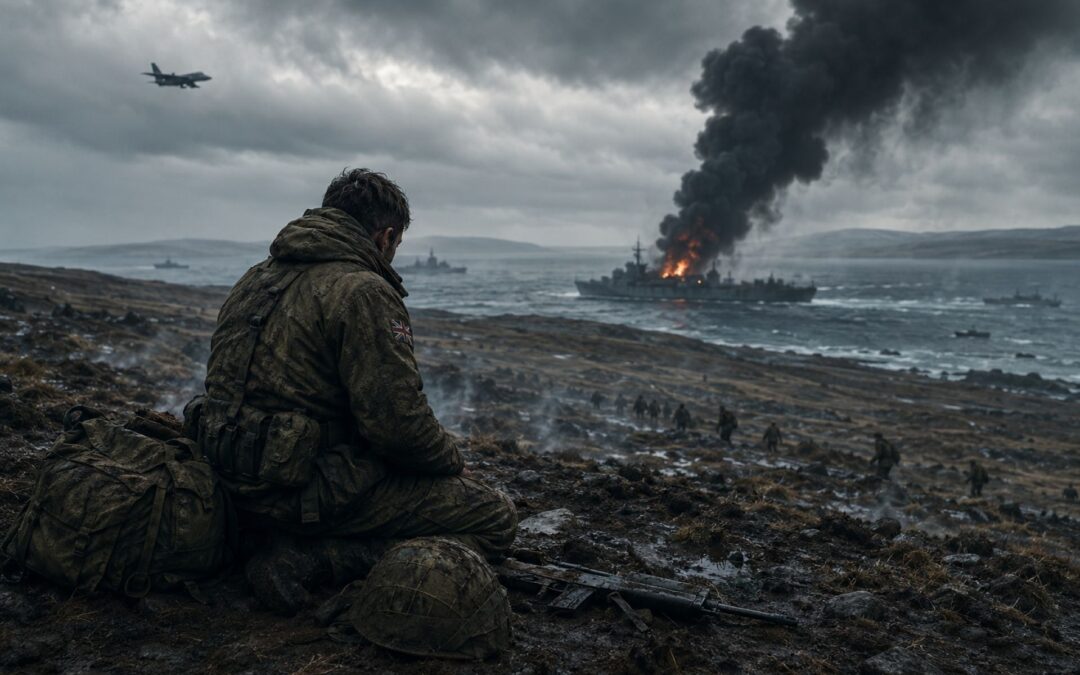
Introduction: A Small War That Was Never Small
At first glance, the Falklands War can look almost absurd.
A short war. A remote archipelago. A British task force sailing 8,000 miles across the Atlantic. An Argentine dictatorship trying to recover islands most of its young conscripts had never seen. A fight over a place that, to outsiders, seemed too small and too distant to justify the loss of hundreds of lives.
But that is exactly why the war still matters.
The Falklands War was never just about geography. It was about sovereignty, pride, humiliation, dictatorship, empire, democracy, identity, and the dangerous speed with which political symbols can turn into military orders.
For Argentina, the islands were the Malvinas: a stolen national inheritance, taught in schools, printed on maps, carried as a wound in the country’s historical imagination. For Britain, they were British territory whose invasion could not be accepted without making the country look weak, diminished, and unable to defend its own people. For the islanders, they were not symbols at all.
They were home.
The war lasted from 2 April to 14 June 1982. According to the Imperial War Museums’ overview of the Falklands Conflict, it cost more than 900 lives across both sides. Britain won. Argentina surrendered. The islanders remained under British sovereignty.
Yet victory did not make the war simple.
The Falklands War was short, but it was not small. It left Argentina’s military regime shattered, strengthened Margaret Thatcher’s government, transformed the islands’ future, and gave Britain one of its last dramatic military victories of the twentieth century.
It also left widows, burned sailors, traumatized soldiers, grieving parents, bitter veterans, and young men on both sides asking the same question in different languages:
Was it worth it?
The Islands Both Sides Thought They Could Not Lose
The Falkland Islands sit in the South Atlantic, hundreds of miles from the Argentine coast and thousands of miles from Britain. That distance was central to the conflict.
To Argentina, Britain’s claim looked like an imperial relic: a European power holding islands near South America long after the age of empire was supposed to have ended. The Argentine claim rested on history, geography, inheritance from Spain, and the belief that Britain had unlawfully occupied the islands in 1833.
To Britain, the issue was different. The islands had been under British control for generations. Their inhabitants spoke English, lived under British institutions, and overwhelmingly wished to remain British. The Falkland Islands Government describes the territory as internally self-governing, with Britain responsible for defence and foreign affairs.
That difference in framing mattered.
Argentina saw the islands as territory. Britain increasingly framed the issue around the wishes of the islanders. Argentina spoke of decolonization. Britain spoke of self-determination. Both sides could point to principles that sounded legitimate in isolation.
The international position was not straightforward either. In 1965, UN General Assembly Resolution 2065 recognized the existence of a sovereignty dispute between Britain and Argentina and invited both governments to negotiate a peaceful solution while taking the interests of the islanders into account.
That wording left room for disagreement.
Argentina saw it as confirmation that the Malvinas question was unresolved. Britain could negotiate, but it would not simply hand over people who did not want to become Argentine. The islanders themselves were often treated by outsiders as an obstacle to diplomacy rather than as a community with their own political will.
By 1982, the dispute had sat unresolved for decades.
That made the Falklands dangerous. They were not important because of their size. They were important because each side had attached something much larger to them.
Argentina attached national dignity.
Britain attached sovereign credibility.
The islanders attached their entire way of life.
Why Argentina Invaded
Argentina’s invasion of the Falklands on 2 April 1982 did not come from nowhere. It came from a military dictatorship in crisis.
The junta ruling Argentina faced economic problems, public anger, and the long shadow of political repression. The dictatorship had tortured, disappeared, and murdered its own citizens during the Dirty War. By early 1982, its legitimacy was weak.
The Malvinas offered a way out.
Recovering the islands was one of the few causes that could unite Argentines across political lines. The claim was not just a government slogan. It was part of national education, memory, and identity. For many Argentines, the islands had been taken from them by Britain and had to be returned.
The Argentine government’s own account of the Malvinas question reflects how central the islands remain to Argentina’s national position: not merely as territory, but as a matter of sovereignty, history, and unfinished decolonization.
That made the invasion politically tempting. A regime hated by many of its own citizens could suddenly present itself as the defender of the nation.
The response in Buenos Aires proved how powerful the symbol was. Crowds celebrated outside the presidential palace. People who had opposed the government only days earlier now cheered the recovery of the Malvinas. For a brief moment, repression, inflation, and political failure were swallowed by patriotic euphoria.
But the junta made a fatal mistake.
It confused emotional unity with strategic strength.
Argentina’s leaders appear to have believed Britain would protest, negotiate, perhaps impose sanctions, but ultimately accept a settlement. They underestimated how strongly Britain would react. They also overestimated their own ability to hold the islands once the British task force arrived.
The invasion gave Argentina a short-term political victory.
It also trapped the junta inside its own symbolism.
Once the islands had been taken, surrendering them became almost impossible without destroying the regime’s credibility. The Malvinas had been declared recovered. The national dream had been fulfilled. The crowds had celebrated.
Now the junta had to defend the dream with conscripts, aircraft, ships, and lives.
Why Britain Chose to Fight
For Britain, the invasion was a shock and a humiliation.
A British territory had been seized by force. The governor had been removed. Royal Marines had been captured. Islanders were under occupation. In London, the political question was immediate: if Britain allowed this to stand, what did British sovereignty mean?
The crisis hit Margaret Thatcher’s government at a vulnerable moment. Britain was struggling with recession, unemployment, and political unrest. Thatcher herself was not yet the dominant historical figure she later became. The invasion created a test of authority.
The resignation of Foreign Secretary Lord Carrington showed the scale of the failure. Britain had not prevented the invasion. It now had to decide whether to reverse it.
The decision to send a task force was extraordinary. Britain would have to project military power across the Atlantic, at enormous distance, without nearby bases, against an enemy operating much closer to home. The war would depend on ships, aircraft carriers, submarines, logistics, weather, luck, and political resolve.
The National Army Museum’s account of the British Army and the Falklands War shows how demanding the campaign became once the task force arrived: the war required not just political determination, but a long-distance military operation under harsh conditions against serious Argentine resistance.
But from Thatcher’s perspective, the basic issue was simple: foreign troops had occupied British territory, and they had to leave.
That clarity mattered. It gave Britain’s response moral and political force. But it also narrowed the space for compromise. If the central demand was Argentine withdrawal before negotiation, then diplomacy could only go so far.
The British public did not necessarily understand the Falklands at first. Many people barely knew where the islands were. Some servicemen sailing south thought the whole thing might be over before they arrived. There was a sense, early on, that the task force itself might be a form of pressure rather than the beginning of a real war.
That illusion did not last.
Britain chose to fight because the alternative looked like national humiliation. Argentina fought because backing down looked like national betrayal.
By the time both positions hardened, the islands had become more than land.
They had become tests of national pride.
The Occupation of Stanley
The Argentine occupation began with fear, confusion, and uncertainty.
For the islanders in Port Stanley, the invasion was not an abstract sovereignty dispute. It was soldiers in the streets, gunfire near homes, radio stations taken over, road rules changed, travel restricted, and daily life suddenly controlled by an army they had not invited.
The occupying authorities promised that normal life would continue. But occupation always changes the meaning of normal. People needed passes. Movement was limited. Stanley became surrounded by thousands of Argentine troops. Islanders who had once lived in a small British community now found themselves inside an armed camp.
There were important limits to the violence. Argentine commanders later emphasized that there were no systematic attacks on civilians and that offenders were punished. That matters. The occupation was not a campaign of mass civilian brutality.
But that does not mean it felt harmless.
To be occupied is to lose control over ordinary life. A person can be treated politely and still be afraid. A town can remain standing and still feel violated. A family can be physically safe and still live under the threat of guns, orders, and uncertainty.
For some Argentine conscripts, arrival in the islands produced its own confusion. They had been told they were recovering Argentine land and defending Argentine people. But when they reached Stanley, they found English signs, British habits, British homes, and islanders who did not see them as liberators.
That created an uncomfortable question.
If the soldiers had come to recover their people, why did the people not welcome them?
The occupation exposed the emotional gap at the center of Argentina’s claim. The Malvinas were deeply Argentine in national imagination. But the Falklands were not Argentine in lived reality.
That gap did not settle the sovereignty dispute.
But it made the war harder to romanticize.
The Task Force and the Illusion of an Easy War
When the British task force sailed south, many on board still hoped there would be no war.
There were diplomatic negotiations underway. The United States was trying to mediate between two allies. The British ships became, in the minds of some, an extension of diplomacy: proof of seriousness rather than instruments of battle.
Life on board could still feel strangely normal. Men played cards, wrote letters, joked, trained, and waited. Some were excited. Some were frightened. Some adopted the bravado soldiers often use to hide fear from each other and themselves.
But the closer the ships came to the South Atlantic, the harder it became to sustain unreality.
The Falklands were not defended by a token force. Argentina had moved thousands of troops to the islands. Its air force and navy were capable of inflicting serious damage. British commanders knew the task force was vulnerable, especially to air attack.
Distance made everything harder. Ships had to carry men, weapons, fuel, helicopters, medical facilities, food, ammunition, and equipment across an ocean. There was little room for error. One lost ship could mean lost aircraft, lost supplies, lost mobility, and lost lives.
The British had professional soldiers and a powerful navy. But Argentina had brave pilots, modern missiles, and the advantage of fighting closer to its mainland bases.
This was not going to be a ceremonial expedition.
It was going to be a war.
When Diplomacy Failed
The United States tried to stop the conflict before it became irreversible.
Secretary of State Alexander Haig shuttled between London and Buenos Aires, searching for a settlement that could remove Argentine forces without forcing either side into total humiliation. But the two governments were operating from incompatible political realities.
In London, the central issue was occupation. Argentine forces had seized British-administered territory. For Thatcher, the withdrawal of those forces had to come first. Negotiating sovereignty while the islands remained occupied would look like rewarding aggression.
In Buenos Aires, withdrawal without a sovereignty breakthrough would look like betrayal. The junta had mobilized national emotion around recovery of the Malvinas. It could not easily tell the crowds that the islands would be handed back to Britain in exchange for talks.
Diplomacy failed because neither government could accept the political meaning of compromise.
This is one of the most important lessons of the Falklands War. Wars do not always begin because leaders want mass death. Sometimes they begin because leaders create positions from which retreat becomes politically unbearable.
Argentina’s junta had raised the stakes beyond its ability to control them.
Britain had made withdrawal the minimum condition for peace.
The islanders were trapped inside the dispute.
The soldiers were already moving.
Once the shooting started, every death made compromise harder. Blood gives political symbols a terrible new weight. After men die for a claim, the claim becomes even harder to soften.
That is how a remote dispute became a war neither side could easily stop.
The Sea War: Belgrano, Sheffield, and the Price of Escalation
The sinking of the General Belgrano changed the emotional temperature of the war.
The Belgrano was an Argentine cruiser, formerly the USS Phoenix, a survivor of Pearl Harbor that had later entered Argentine service. For the Argentine Navy, it was a proud ship. For Britain, it was a threat in a theatre where naval vulnerability could decide the entire campaign.
On 2 May 1982, the British nuclear submarine HMS Conqueror torpedoed the Belgrano. More than 300 Argentine sailors died. Many were killed by the explosions and flooding. Others died in life rafts in freezing seas before rescue arrived.
The sinking was militarily significant. It helped drive the Argentine Navy back to port, reducing the threat to the British task force. But it was also morally and politically explosive. The image of young sailors dying in icy water became one of the war’s defining tragedies.
War turns strategy into grief.
In Argentina, families waited for news. Mothers heard fragments on the radio. Survivors remembered abandoning ship while knowing friends remained trapped below deck. Officers had to give the order no commander wants to give.
For Britain, any sense of success was brief. Two days later, Argentine aircraft struck HMS Sheffield with an Exocet missile. The attack proved that Argentina could hit back hard. British sailors died in fire and smoke. The modern missile age had arrived in the South Atlantic.
The war at sea became a contest of vulnerability. British ships had to stay close enough to support operations but far enough to survive. Argentine pilots had to fly low, fast, and dangerously, often through heavy defensive fire. Men on both sides were doing their jobs inside systems designed to destroy other men doing theirs.
That is what makes the Falklands so difficult to reduce to slogans.
The Belgrano was not just a target.
Sheffield was not just a ship.
Each was full of human beings whose deaths became part of national memory.
San Carlos and the Shock of Modern Air War
Britain’s landing at San Carlos was a turning point.
Instead of attacking directly at Stanley, British forces landed on the western side of East Falkland. This avoided the strongest Argentine defenses and reduced the risk to civilians. It was a tactically clever choice.
But the landing created a new danger.
British ships gathered in Falkland Sound became exposed to Argentine air attacks. The geography of the area, later grimly nicknamed “Bomb Alley,” gave Argentine pilots opportunities to strike ships supporting the landing.
The Argentine pilots flew with extraordinary courage. Many came in at extremely low altitude, under intense pressure, against heavily defended targets. Some bombs failed to explode properly because they were released too low, but enough hit home to cause serious damage.
For British sailors, the attacks were terrifying. Ships burned. Men were trapped below decks. Helicopters pulled casualties from vessels ripped open by bombs. The task force survived, but it did not survive cheaply.
San Carlos showed how close Britain came to disaster.
The British had achieved a landing. That mattered enormously. Once troops were ashore, Argentina faced a land campaign it was poorly prepared to win. But the naval losses revealed the fragility of the entire operation. A few more successful strikes, a few more lost helicopters, a few more supply failures, and the campaign could have become far more difficult.
Modern war did not look heroic from inside a burning ship.
It looked like smoke, metal, screams, shock, and men trying to save each other in darkness.
Goose Green and the Politics of Momentum
After the landings, Britain needed momentum.
The beachhead at San Carlos was secure, but politically and militarily, remaining stuck there was dangerous. The longer the campaign dragged on, the more international pressure for a ceasefire could build. A ceasefire before the recapture of Stanley might freeze the conflict in a way that left Britain short of its objective.
That pressure shaped the attack on Goose Green.
Goose Green was not the shortest route to Stanley, but it became important as proof that British forces could break out and defeat Argentine positions on land. The battle was fierce, confused, and costly.
Lieutenant Colonel H. Jones, commander of 2 Para, was killed while leading an attack. He was later awarded the Victoria Cross. His death became part of the mythology of the war, but the battle itself was not mythological. It was brutal close combat: darkness, trenches, grenades, machine-gun fire, fear, and men making decisions faster than thought.
Goose Green mattered because Britain won.
But the victory carried an uncomfortable question. How much military action was being driven by battlefield necessity, and how much by political pressure to show progress?
In war, those lines blur. Commanders in the field know that political leaders need results. Political leaders know that battlefield delay creates diplomatic danger. Soldiers know only that they have been ordered forward.
The result is a strange moral chain.
A cabinet needs momentum. A commander receives pressure. A battalion attacks. Young men die in trenches.
Goose Green helped Britain move toward victory.
It also revealed how victory is built from decisions that look much cleaner on maps than on hillsides.
Bluff Cove and the Cost of Military Confusion
Bluff Cove was one of the darkest British moments of the war.
As troops advanced toward Stanley, the Welsh Guards were moved by sea aboard Sir Galahad and Sir Tristram. The movement was meant to speed the campaign and avoid an exhausting march across harsh terrain. But delays, confusion, daylight exposure, and disagreement over unloading created a disaster waiting to happen.
Argentine aircraft attacked.
Sir Galahad was hit. The ship became an inferno. Men suffered terrible burns. Some lost limbs. Others were trapped in smoke and flame. The images of burned guardsmen became among the most painful British memories of the war.
Bluff Cove was not simply an enemy success. It was also a failure of coordination, judgment, and urgency. Men who might have been brought ashore sooner remained exposed aboard ship. Those who survived carried physical and psychological scars for the rest of their lives.
The horror of Bluff Cove is important because it cuts against clean victory narratives.
Britain won the war, but not because everything went well. There were mistakes. There was confusion. There were avoidable risks. Courage existed alongside incompetence. Heroism existed alongside preventable suffering.
That is true of many wars, but patriotic memory often edits it out.
Bluff Cove should not be edited out.
It reminds us that the cost of war is not only paid when plans fail completely. Sometimes it is paid when a campaign is still moving toward success.
The Final Battles for Stanley
The final stage of the war was fought across the cold, wet, exhausting landscape around Stanley.
British troops had to march across difficult ground in freezing weather, carrying heavy loads, drinking bad water, enduring sickness, fatigue, and exposure. The advance was physically punishing before the final battles even began.
Argentine troops waited in defensive positions around the mountains overlooking Stanley. Many were young conscripts. Some were poorly supplied and badly led. Others fought hard. They were cold, hungry, frightened, and increasingly aware that the British were coming.
The final battles — including Mount Longdon, Wireless Ridge, and other positions around Stanley — were intimate and savage. Night fighting reduced war to flashes, noise, screams, and sudden death. Soldiers heard bullets strike bodies. Men called for their mothers. The enemy became visible not as an abstract force but as another terrified human being close enough to shoot.
This is where the Falklands War becomes hardest to simplify.
British troops were fighting to liberate occupied territory.
Argentine soldiers were fighting for a national cause many had been taught since childhood.
Some fought bravely. Some broke. Some died without fully understanding why they had been sent there. Some survived and returned to societies that did not know what to do with them.
By mid-June, Argentina’s position had collapsed. British forces were closing in on Stanley. Argentine commanders understood that further resistance would waste lives.
On 14 June 1982, Argentine forces surrendered.
The Union Jack flew again over Stanley.
For Britain, it was liberation.
For Argentina, it was defeat.
For many soldiers, it was something more basic.
It was over.
Victory, Defeat, and the People Who Came Home Changed
The homecomings revealed another divide between public memory and private experience.
In Britain, the returning task force was greeted with pride. Crowds cheered. Flags waved. The war became proof that Britain could still act decisively on the world stage. Thatcher’s standing rose dramatically. The victory fed a national story of resolve after years of decline.
But many servicemen did not experience the return as simple triumph.
Some felt detached from the celebrations. Civilians asked crude questions. Strangers wanted war stories. The public saw victory; veterans remembered fear, burned ships, dead friends, and bodies on cold ground.
For bereaved families, the celebrations could feel unbearable. Other men had come home. Their sons, husbands, and fathers had not.
In Argentina, the return was even more bitter. The junta collapsed in disgrace, and the defeat accelerated the end of military rule. That was historically significant. But for conscripts coming home, the immediate experience was often alienation.
They had been sent to fight for the nation. Many had suffered cold, hunger, fear, and humiliation. Some returned to people who seemed to have moved on almost instantly. Bars were full. Life continued. The patriotic crowds had vanished.
The soldiers were left with memories their societies did not know how to absorb.
This is one of the cruelest patterns of war. Nations demand sacrifice in moments of crisis, then often fail to understand the people who survive it.
The Falklands War lasted ten weeks.
For many who lived through it, it never fully ended.
What the Falklands War Changed
The war changed all three main parties to the conflict.
For Britain, it restored a sense of military and national confidence. After the loss of empire and the humiliation of Suez, the Falklands victory offered a powerful story: Britain could still defend its territory, project force, and win. That story became central to Thatcher’s political image.
But the victory also carried danger. It made the war easier to remember as national revival than as human tragedy. It encouraged a version of the conflict in which resolve mattered more than grief.
For Argentina, defeat discredited the military dictatorship. The junta had gambled on patriotic unity and lost. The return of democracy soon followed. In that sense, the war helped end military rule.
But Argentina’s claim to the Malvinas did not disappear. If anything, the defeat became another layer of national memory. The islands remained a symbol of grievance, sacrifice, and unfinished history.
For the Falkland Islanders, the war transformed their future. Britain’s commitment to the islands became stronger after 1982. The territory developed greater self-confidence, stronger infrastructure, and a clearer political identity. In the 2013 referendum, the Falkland Islands Government records that 99.8% of voters chose to remain a British Overseas Territory.
That result did not end Argentina’s claim.
But it made one thing impossible to ignore: the islanders did not see themselves as a population waiting to be returned to Argentina.
They saw themselves as a people defending their home.
Why the Falklands Still Matter
The Falklands still matter because the underlying dispute remains unresolved.
Argentina continues to claim sovereignty over the Malvinas. Britain continues to administer the islands. The islanders continue to assert their right to determine their own future. Internationally, the issue still appears in diplomatic arguments, especially whenever relations between Britain and Argentina shift.
The dispute also matters because it reveals how modern conflicts can grow from old maps and emotional memory.
The Falklands were not economically central to Britain in 1982. They were not heavily populated. They were not a great industrial prize. Yet once invaded, they became a test of sovereignty that Britain could not ignore.
For Argentina, the Malvinas were not just islands. They were part of a national story about loss, injustice, and identity. That story was powerful enough for a dictatorship to exploit and strong enough to survive the dictatorship’s fall.
The war also remains relevant because it challenges easy thinking about military victory. As historian Helen Parr argues in her work on how Britain remembers the Falklands War, the conflict did not simply end in 1982; it continued to shape memory, identity, and the way the war was publicly understood.
Britain won. That fact matters. The islanders were freed from occupation. That matters too. Argentina’s dictatorship was discredited. That was historically important.
But none of that erases the dead.
The Falklands War shows how a conflict can be justified in political terms and still be devastating in human terms. It shows how leaders can speak of sovereignty while nineteen-year-olds freeze in trenches. It shows how national pride can mobilize courage, but also cloud judgment. It shows how victory can be real and still leave people broken.
That is why the war refuses to become simple history.
Conclusion: The War That Victory Could Not Simplify
The Falklands War began with a claim, an invasion, and a belief that the other side would blink.
Neither side did.
Argentina believed the Malvinas were a national birthright. Britain believed the occupation of British territory could not stand. The islanders believed they had the right to remain who they were. Once those beliefs collided, the remote islands became the center of a war that killed sailors, soldiers, airmen, and civilians’ hopes of safety.
The war ended with a British victory and an Argentine surrender.
But the human meaning of the war did not fit neatly beneath the flags.
For Britain, the Falklands became a story of resolve. For Argentina, a story of loss and betrayal. For the islanders, a story of occupation and liberation. For veterans and families, it was often something quieter and harder to explain: fire, cold, fear, guilt, grief, relief, and memories that did not fade when the ships came home.
That is the truth hidden behind the phrase “short war.”
Some wars last only weeks on the calendar.
Then they live for decades inside nations, families, and the people who survived them.
Last Updated on July 2, 2026 by Aseem Gupta