
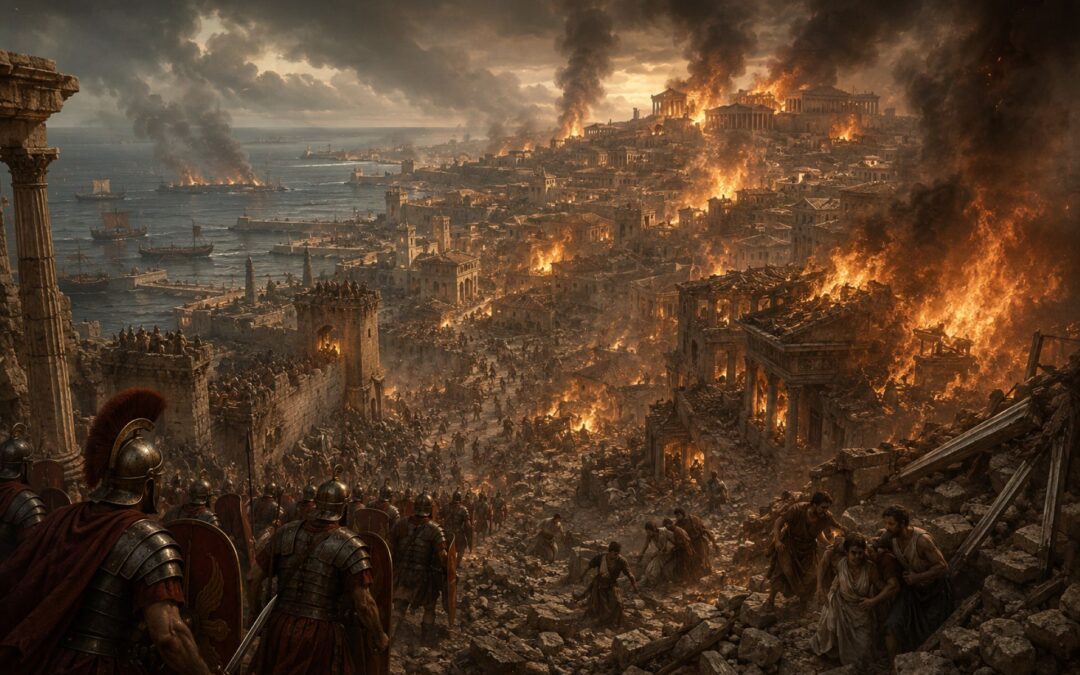
In 149 BC, Rome went to war against an enemy it had already defeated.
Carthage no longer possessed the overseas empire that had once challenged Rome for control of the western Mediterranean. Its navy had been reduced, its army restricted, and its foreign policy placed under Roman supervision. More than fifty years had passed since Hannibal had crossed the Alps and brought war into the heart of Italy.
Yet Rome still decided that Carthage had to disappear.
The Third Punic War was therefore unlike the two conflicts that preceded it. The First Punic War had been a struggle for Sicily and Mediterranean power. The Second Punic War had been an existential contest in which Hannibal came dangerously close to breaking the Roman Republic.
The third war was not a contest between equals. Rome was the dominant power of the Mediterranean. Carthage was a wealthy but politically constrained city that had little realistic chance of invading Italy again.
The central question was no longer whether Rome could defeat Carthage.
It was whether Rome would allow Carthage to survive.
What followed was a sequence of calculated demands, unexpected resistance, Roman military humiliation and, finally, one of the most devastating urban assaults of the ancient world. Carthage resisted for three years before Roman soldiers fought their way through its streets, burned its buildings and ended its existence as an independent state.
Carthage After the Second Punic War
The peace imposed after the Second Punic War transformed Carthage from a great Mediterranean power into a subordinate state.
Under the settlement concluded after the Battle of Zama in 202 BC, Carthage surrendered its remaining territories outside Africa, gave up most of its warships and agreed to pay Rome an enormous indemnity over fifty years. It was also forbidden from waging war outside Africa and could not fight even within Africa without Roman permission.
These restrictions were designed to prevent another Hannibal from emerging.
Militarily, they succeeded. Carthage never again developed the ability to threaten Rome on the Italian peninsula. It lacked the fleet, territorial empire and freedom of action necessary to rebuild its former power.
Economically, however, Carthage recovered.
Its location on the North African coast remained valuable. Its merchants continued to trade, its agricultural lands remained productive and the city retained the commercial experience accumulated over centuries. By the middle of the second century BC, Carthage had paid—or was ready to complete—the indemnity that Rome had expected to burden it for generations.
Prosperity did not make Carthage Rome’s military equal. It did, however, make the city difficult for some Romans to ignore.
The Carthaginians had lost their empire but not their capacity to recover.
That distinction would become increasingly important.
The Treaty That Left Carthage Unable to Defend Itself
The treaty ending the Second Punic War contained a dangerous contradiction.
Carthage remained responsible for governing and protecting its African territory, but it had surrendered the right to defend that territory independently. If attacked, it first needed Roman approval before launching a military response.
In theory, Rome could act as a neutral arbiter between Carthage and its neighbours. In practice, every dispute forced the Carthaginians to appeal to the state that had defeated them.
Carthage’s security therefore depended on Roman willingness to protect Carthaginian interests.
This arrangement became particularly dangerous because Rome’s most important African ally was Masinissa, the king of Numidia. Masinissa had helped Scipio Africanus defeat Hannibal and had emerged from the Second Punic War with a powerful kingdom bordering Carthaginian territory.
As Numidia expanded, Carthage could complain.
It could negotiate.
It could send ambassadors.
What it could not legally do was fight back.
Masinissa and the Expansion of Numidia
Masinissa was one of the greatest beneficiaries of Carthage’s defeat.
During the Second Punic War, he had shifted his allegiance to Rome and supplied the Numidian cavalry that played a decisive role at Zama. Rome subsequently recognised and supported his authority over a large Numidian kingdom.
Over the following decades, Masinissa repeatedly extended his influence into lands claimed by Carthage. Some territories were seized directly. Others became the subject of diplomatic disputes in which Carthaginian and Numidian representatives appealed to Rome.
The traditional account presents Rome as consistently ruling in Masinissa’s favour. The reality may have been more complicated. A modern study of Roman diplomacy with Carthage and Numidia argues that Roman decisions were not uniformly pro-Numidian and that the relationship changed over time.
Even so, the broader imbalance remained.
Masinissa could create facts on the ground. Carthage had to seek permission before reversing them.
The dispute became especially serious when Masinissa occupied the fertile region known as the Great Plains and later claimed territory around Oroscopa. Carthaginian embassies went to Rome, while Roman commissions travelled to Africa to investigate.
The process produced no lasting settlement.
For Carthage, each new incursion exposed the same weakness: the treaty that supposedly preserved the city also prevented it from defending itself.
By the 150s BC, frustration inside Carthage was becoming difficult to contain. A faction that favoured accommodation with Masinissa lost influence, while leaders advocating a more forceful response gained power.
Carthage eventually made the decision Rome had forbidden it to make.
It raised an army.
Why Some Romans Wanted Carthage Destroyed
Carthage’s recovery alarmed some influential Romans, but Roman attitudes were not uniform.
The figure most closely associated with the demand for destruction was Marcus Porcius Cato, better known as Cato the Elder. According to Plutarch’s account of Cato’s life, Cato visited Carthage and was struck by its population, wealth and apparent prosperity.
He returned to Rome convinced that the city remained dangerous.
Cato began ending his interventions in the Senate with a demand that Carthage be destroyed. The familiar Latin phrase Carthago delenda est—“Carthage must be destroyed”—is a later conventional formulation, but it captures the policy associated with him.
Cato’s argument drew its strength from Roman memory.
Hannibal’s invasion was not an ancient legend to the generation that debated Carthage’s fate. Romans still remembered the catastrophic defeats at the Trebia, Lake Trasimene and Cannae. Families had lost fathers, sons and estates during sixteen years of warfare in Italy.
Carthage might no longer possess Hannibal’s army, but the name itself remained connected to fear.
Prosperity could therefore be interpreted as preparation. Commercial recovery could be presented as military revival. A city that had once nearly destroyed Rome might, under favourable circumstances, become dangerous again.
Not every Roman accepted that reasoning.
Plutarch contrasts Cato with Publius Cornelius Scipio Nasica, who reportedly argued that Carthage should be spared. Nasica may have believed that the existence of an external rival restrained Roman arrogance and forced the Republic to maintain discipline.
Behind this disagreement was a larger question.
Did Rome still need enemies to preserve its own character, or had it become powerful enough to eliminate them?
Carthage’s fate was shaped by security fears, memories of Hannibal, political ambition and the expanding logic of Roman power. Cato did not single-handedly cause the war, but he helped make destruction an acceptable Roman policy.
Rome still required an occasion to act.
Carthage soon provided one.
The Battle of Oroscopa Gives Rome Its Pretext
Around 151 BC, Carthage finally responded to Numidian pressure with military force.
A Carthaginian army under Hasdrubal marched against Masinissa near Oroscopa. The decision represented a clear challenge to the treaty because Carthage had not secured Roman permission to wage war.
The campaign ended disastrously.
Masinissa’s forces manoeuvred the Carthaginians into an increasingly desperate position. Cut off from supplies and weakened by hunger and disease, the Carthaginian army negotiated a surrender.
The agreement did not save it.
As the disarmed Carthaginians withdrew, Numidian forces attacked. Much of the army was killed, scattered or captured. Carthage had gained nothing from the campaign except a military defeat and an undeniable treaty violation.
Carthaginian leaders understood the danger. Hasdrubal and others involved in the war were condemned to death in an attempt to distance the government from their actions.
Rome was not satisfied.
The Romans now possessed the justification they required. Carthage had waged an unauthorised war, broken the terms imposed after Zama and demonstrated that it was willing to act without Roman approval.
The treaty violation was real.
Whether it required the destruction of an entire city was another question.
The surviving fragments of Polybius’s account of the Third Punic War suggest that Roman leaders were concerned not only with having a reason for war, but with presenting a defensible pretext to the wider Mediterranean world. Some Romans apparently hesitated because they feared that an unprovoked attack would damage Rome’s reputation.
Oroscopa removed that obstacle.
Rome Declares the Third Punic War
Carthage attempted to prevent the crisis from becoming a war.
Embassies travelled to Rome offering explanations, concessions and punishment for those responsible. Roman answers remained deliberately unclear. The Carthaginians were told that they had made a satisfactory decision but were not told what further measures Rome expected.
Then the nearby city of Utica defected.
Utica was one of the most important ports in North Africa. Its decision to place itself under Roman protection gave Rome a secure base close to Carthage and deprived the Carthaginians of an important regional ally.
By the time another Carthaginian embassy arrived in Rome, war had already been approved and a Roman expedition was preparing to sail.
Carthage had little room left to negotiate.
Its representatives offered an unconditional surrender, placing the city, its territory and its people under Roman authority. In the diplomatic language of the ancient world, this meant that Rome received the legal power to decide what would happen next.
The Senate promised that the Carthaginians could retain their freedom, laws, territory and private property.
There was a condition.
Carthage had to send 300 children from leading families to Sicily as hostages and obey whatever further commands the Roman consuls delivered in Africa.
The omission was ominous.
Rome promised to preserve the Carthaginians and their laws.
It said nothing about preserving Carthage itself.
Carthage Surrenders Its Hostages and Weapons
The selection of the hostages produced scenes of grief throughout Carthage.
Families understood that their children were guarantees of obedience. Resistance could place them in Roman hands permanently—or endanger their lives.
The hostages were surrendered.
The Roman fleet then sailed to Utica, where the Carthaginians were ordered to deliver every weapon in their possession. Once again, Carthage complied.
According to the surviving ancient account, the Romans received more than 200,000 sets of weapons and 2,000 artillery pieces. Ancient figures should be treated cautiously, but the scale of the reported surrender conveys how thoroughly the Carthaginians attempted to demonstrate submission.
Carthaginian representatives reportedly asked what would protect them from Masinissa once they had disarmed.
The consuls replied that Rome would protect them.
By this point, Carthage had surrendered its hostages, weapons and freedom of action. Its representatives believed that these concessions, however humiliating, would preserve the city.
They were wrong.
Only after Carthage had disarmed did the Romans reveal their final demand.
Rome Orders the Carthaginians to Abandon Their City
The consuls praised the Carthaginians for their obedience and then informed them that Carthage must be evacuated.
The population could retain its laws, possessions and territory, but it had to leave the coast and establish a new settlement at least ten miles inland.
To the Romans, this could be presented as the relocation of a population.
To the Carthaginians, it was the destruction of their civilisation.
Carthage was not simply a collection of houses that could be rebuilt elsewhere. Its identity, wealth and history were inseparable from the sea. Its harbours connected it to trading routes across the Mediterranean. Its temples, cemeteries, public buildings and ancestral homes stood inside its walls.
An inland settlement might preserve the lives of the people.
It would not preserve Carthage.
The sequence of Roman demands made the sense of betrayal even stronger. Had Rome announced its intentions before the surrender of the hostages and weapons, Carthage could have chosen resistance while still armed.
Instead, Rome had offered reassurance in stages, obtained each concession and revealed the decisive condition only when the city appeared helpless.
Polybius recorded that observers in the Greek world later debated whether Rome had acted prudently, legally or deceitfully. Some defended the elimination of a historic threat. Others argued that Rome had gradually stripped Carthage of every defence through concealment and manipulation before imposing a demand no community could accept.
The Carthaginians chose not to accept it.
They closed the gates.
Carthage Chooses Resistance
The announcement transformed Carthage.
People who had supported surrender were attacked. Italians trapped inside the city were reportedly killed. Political divisions were temporarily overwhelmed by the common conviction that survival without the city was not survival at all.
The government recalled Hasdrubal, the general it had recently condemned, and placed military authority in his hands. Slaves were freed to serve in the defence. Buildings were converted into workshops. Temples and public spaces became production centres.
The entire population was mobilised.
Men forged swords, spearheads and shields. Women cut their hair to provide fibres for torsion-powered artillery. Craftspeople worked continuously to replace the weapons that had been surrendered to Rome.
The Romans had assumed that an unarmed population could not resist.
They had underestimated both Carthage’s resources and what people were willing to do when faced with the destruction of their home.
Carthage also possessed formidable physical defences. The city stood on a peninsula protected by the sea, a lake, marshy ground and massive walls. The landward approach crossed a narrow isthmus, while the elevated citadel of Byrsa formed a powerful final defensive position.
Its famous harbour complex contained both a commercial port and a circular military harbour. Appian’s description of Carthage emphasises the scale of its docks, walls and naval infrastructure.
Carthage had lost its empire.
It had not lost its ability to turn itself into a fortress.
Why Rome Failed to Capture Carthage
The Roman consuls expected a rapid victory when they approached the city in 149 BC.
Their first assaults proved otherwise.
The Carthaginians met the attackers with newly manufactured weapons and repelled attempts to breach or scale the walls. Roman siege engines damaged sections of the defences, but Carthaginian workers repaired them at night and launched sorties to burn the machinery.
The city’s defenders used every available advantage.
When Roman troops entered one breach, they found Carthaginians waiting in the open ground, on nearby roofs and behind improvised barricades. Projectiles fell from above while defenders attacked from the front.
A young Roman military tribune named Scipio Aemilianus refused to join the reckless advance. He kept his men organised outside the breach and used them to protect the soldiers retreating from the failed assault.
It was one of several occasions on which his caution saved Roman lives.
The Roman position also suffered from disease. One camp had been established near stagnant water beneath the city walls, where poor air and summer heat contributed to an outbreak of sickness. Carthaginian fire ships nearly destroyed part of the Roman fleet.
Outside the city, Carthaginian cavalry under Himilco Phameas attacked Roman foraging parties and exploited the invaders’ weak discipline. Roman commanders launched poorly planned expeditions into difficult terrain and suffered avoidable losses.
The war that Rome had expected to end quickly began to expose serious weaknesses.
Roman superiority in resources did not compensate for careless leadership. Soldiers became more interested in plunder than siege work. Camp followers, traders and opportunists crowded the army. Independent raiding weakened discipline and gave Carthaginian forces opportunities to attack isolated groups.
The campaign of 148 BC brought little improvement. The consul Lucius Calpurnius Piso concentrated on capturing other towns but failed to break Carthaginian resistance. The defenders grew more confident, while communities across Africa watched Rome struggle outside a supposedly helpless city.
By now, the Third Punic War had become embarrassing.
Rome needed a different commander.
The Rise of Scipio Aemilianus
Scipio Aemilianus possessed one of the most politically powerful names in Rome.
He was the biological son of Lucius Aemilius Paullus, the Roman commander who had defeated Macedonia at Pydna, but had been adopted into the family of Scipio Africanus, the victor over Hannibal.
His reputation during the early fighting at Carthage was not based on his name alone.
As a military tribune, Scipio repeatedly displayed qualities missing from senior Roman commanders. He maintained discipline during foraging operations, anticipated ambushes, rescued trapped troops and opposed attacks launched without secure lines of retreat.
Even Carthaginian commanders recognised that he behaved differently from other Roman officers.
When reports of continued failure reached Rome, public opinion turned toward Scipio. He intended to stand for the aedileship, but the Roman people elected him consul for 147 BC despite his being below the normal age for the office.
The legal obstacle was set aside.
Scipio received the African command and sailed for Carthage.
He arrived to find the Roman army demoralised and undisciplined. Soldiers wandered away from camp in search of loot. Merchants and camp followers had turned military operations into a marketplace. Quarrels over plunder further weakened order.
Scipio began by fighting his own army’s habits.
He expelled unnecessary camp followers, prohibited unauthorised expeditions and restored strict discipline. Victory, he insisted, had to come before luxury and spoils.
Only after mastering his soldiers could he master Carthage.
How Scipio Sealed the Siege
Scipio abandoned the expectation that Carthage would fall through a single dramatic assault.
Instead, he began systematically cutting the city off from the world.
He captured the suburb of Megara and forced Carthaginian troops back toward the central defences. Across the isthmus, Roman soldiers constructed a fortified line from sea to sea. The barrier prevented food and reinforcements from reaching Carthage by land.
The consequences were immediate.
Thousands of people from the surrounding countryside had already taken refuge inside the walls. As supplies declined, the city’s population competed with its soldiers for increasingly scarce food.
Some vessels still entered when weather conditions allowed them to evade the Roman fleet. Scipio therefore attempted to close the harbour itself.
Roman troops began building a massive stone mole extending into the water toward the harbour entrance. The Carthaginians initially dismissed the project as impossible. When the barrier continued to grow, they responded with one of the most extraordinary engineering efforts of the siege.
Working out of Roman sight, the population excavated a second channel from the military harbour to the sea. At the same time, Carthaginian shipbuilders constructed a new fleet from whatever materials remained.
When the new entrance opened, dozens of warships unexpectedly sailed into view.
The Romans were astonished.
For a brief moment, Carthage may have possessed an opportunity to strike the unprepared Roman fleet. Instead, the ships made a display, returned to harbour and came out again for battle several days later.
The resulting fighting was fierce but indecisive. During the withdrawal, congestion near the newly cut entrance left Carthaginian vessels vulnerable. Roman attacks damaged the fleet and eventually gave Scipio greater control over the harbour approaches.
The escape route had demonstrated Carthaginian ingenuity.
It had not broken the blockade.
Scipio then turned against the remaining Carthaginian forces outside the city. At Nepheris, Roman troops defeated the field army that had continued to supply and support the defenders. Once Nepheris fell, organised resistance in much of the surrounding territory collapsed.
Carthage was now isolated by land and sea.
Hunger began accomplishing what Roman assaults had failed to do.
The Fall of Carthage in 146 BC
In the spring of 146 BC, Scipio launched the final attack.
Roman troops seized sections of the harbour and pushed into the nearby marketplace. From there, three narrow streets climbed toward the citadel of Byrsa, where much of the remaining population had gathered.
The streets were lined with closely packed multi-storey buildings.
Carthaginian defenders attacked from windows, rooftops and barricades. Roman soldiers captured houses one by one, crossed between rooftops on wooden planks and fought simultaneously above the streets and within them.
The assault became a battle through an inhabited city.
According to Appian’s account of the final fighting, people were struck by missiles, thrown from buildings or trapped inside collapsing structures. When the Romans set fire to the streets, burning homes fell into the advancing path.
Soldiers and labourers cleared the rubble to keep the army moving. The dead and injured were dragged aside with broken timber and masonry as the attack continued toward Byrsa.
The fighting lasted for six days and nights.
Roman units were rotated as exhaustion set in. Scipio moved between positions, overseeing the assault and keeping pressure on the surviving defenders.
On the seventh day, representatives emerged from Byrsa carrying sacred garlands and olive branches. They asked Scipio to spare those willing to surrender.
He agreed, except in the case of Roman deserters who had joined the Carthaginians.
Appian reports that 50,000 men and women came through a narrow gate under Roman guard. The number cannot be verified with certainty, but it indicates a mass surrender after years of siege, hunger and urban combat.
Hasdrubal, the Carthaginian commander, initially remained near the temple of Eshmun with his family and the Roman deserters. He had previously declared that he would die with the city.
Instead, he secretly surrendered to Scipio.
The deserters, knowing that Rome would not pardon them, set fire to the temple. Ancient accounts preserve a dramatic story in which Hasdrubal’s wife appeared with their children, condemned her husband’s betrayal and threw herself and the children into the flames.
The episode may have been shaped by later historical storytelling. Even so, it captured the contrast ancient writers wanted readers to see: Carthage burning while its commander survived at the feet of its conqueror.
Scipio watched the city fall.
He did not celebrate immediately.
Appian records that Scipio wept as he considered the rise and destruction of cities and empires. He quoted lines from Homer describing the future fall of Troy and reportedly told Polybius that he was thinking of the fate that might one day overtake Rome.
At the moment of his greatest victory, Scipio saw not permanence but a warning.
Carthage had once appeared powerful enough to rule the western Mediterranean.
Now it was burning beneath him.
What Rome Did After the Victory
The capture of Carthage did not end with military occupation.
Roman soldiers received permission to plunder, while gold, silver and sacred objects were reserved or returned where they could be identified as property taken from other Mediterranean communities during earlier Carthaginian wars.
The surviving population was enslaved.
Carthaginian leaders were executed, imprisoned or displayed in Scipio’s triumph. Hasdrubal survived but spent the remainder of his life under Roman supervision.
The Senate sent a commission to organise the conquered territory. Towns that had supported Carthage were punished, while communities that had assisted Rome received land and privileges. Utica became the principal beneficiary and an important centre of Roman power in the region.
Much of Carthage’s former territory became the Roman province of Africa, administered by a governor sent from Rome.
The city itself was systematically destroyed. Remaining structures were demolished, and restrictions were placed on rebuilding the central Carthaginian districts of Byrsa and Megara.
A famous story claims that Rome ploughed over the ruins and salted the soil so that nothing would grow there again.
There is no ancient evidence that this happened.
The supposed salting of Carthage is a later legend rather than part of the accounts written by Polybius, Appian or other ancient historians. Academic examinations such as Susan T. Stevens’s study of the destruction legend have traced how the story entered modern retellings despite its absence from the evidence.
Rome did not need salt to communicate its intentions.
The ruined city was message enough.
Carthage Was Destroyed—but the City Returned
Rome destroyed the Carthaginian state, but it could not erase the advantages of the location.
The site remained close to fertile agricultural land and commanded an important position on Mediterranean trade routes. Those qualities had helped Carthage prosper before the Punic Wars, and they remained valuable under Roman rule.
An attempt to establish a colony near the old city was made during the reforms of Gaius Gracchus in the late second century BC, although the project did not last.
Julius Caesar later planned a larger refoundation. After his assassination, Augustus completed the development of a new Roman Carthage.
The city rose again—not as the capital of an independent Punic power, but as one of the most important cities in the Roman Empire.
Roman Carthage became a major administrative, agricultural and commercial centre. It eventually ranked among the largest cities in the western empire and played an important role in the political and religious history of Roman Africa.
The UNESCO description of the Archaeological Site of Carthage reflects this layered history. The site preserves evidence not only of the original Phoenician and Punic settlement, but also of the Roman city and the later civilisations that occupied the same strategic landscape.
The Romans destroyed Carthage in 146 BC.
A century later, they discovered that its geography was too valuable to abandon.
Why the Third Punic War Mattered
The Third Punic War ended more than a century of conflict between Rome and Carthage.
After 146 BC, no western Mediterranean state possessed the resources to challenge Rome on the scale Carthage once had. The rivalry that began in Sicily and reached its most dangerous moment during Hannibal’s invasion ended with the physical destruction of one of the ancient world’s great cities.
The war also exposed the changing character of Roman power.
Earlier Roman wars had often ended with defeated states accepting alliances, surrendering territory or recognising Roman supremacy. Carthage had already done all of those things. It had lost its empire, accepted military restrictions and paid Rome an enormous indemnity.
That was no longer enough.
Rome’s objective in the Third Punic War was not simply to defeat an enemy army or enforce a treaty. Once the population refused evacuation, the survival of the city itself became incompatible with Roman policy.
Ancient observers recognised the significance of this change.
Polybius preserved competing opinions about Rome’s conduct. Some believed the destruction was strategically wise because it eliminated a historic rival. Others saw it as evidence that Roman power had become increasingly driven by domination, severity and deception.
The debate has continued in modern history.
Carthage violated its treaty by fighting Numidia without permission. Rome therefore possessed a formal justification for punitive action. But the severity of Rome’s demands went far beyond restoring the treaty. The evacuation order revealed that the continued existence of Carthage—not merely its unauthorised war—had become the issue.
Fear played a role, particularly the inherited memory of Hannibal.
So did strategic calculation. Destroying Carthage removed a potentially wealthy rival and gave Rome direct control over valuable North African territory.
Domestic politics mattered as well. Cato and others had spent years transforming Carthage into a symbol of unfinished danger. Once the city was framed as an existential threat, compromise could be portrayed as weakness.
The war also reminds us that most surviving accounts were written by Greeks and Romans, not Carthaginians. Carthage’s archives, histories and political arguments largely disappeared with the state. Its final years are known primarily through the traditions of the civilisation that destroyed it.
That imbalance shapes how the story has been remembered.
Carthage is often presented as Rome’s defeated rival, as though its importance existed only in relation to Roman victory. Yet the length and ferocity of the siege reveal something more. Even after losing its empire, fleet, weapons and allies, Carthage mobilised an entire population and resisted the most powerful state in the Mediterranean for three years.
Rome won overwhelmingly.
It did not win easily.
Conclusion
The Third Punic War was not another struggle between two equal superpowers.
Rome had already won that contest decades earlier. Carthage could no longer send armies into Spain, build a fleet capable of challenging Roman control or produce another invasion of Italy.
What Carthage still possessed was wealth, memory, strategic value and an identity Rome no longer trusted.
Masinissa’s expansion placed the city in an impossible position. The treaty prevented Carthage from defending itself, while Roman diplomacy failed to produce a durable settlement. When Carthage finally fought back, it gave Rome a legitimate pretext for war.
Rome then used that pretext to demand something far greater than disarmament.
It demanded the end of Carthage as Carthage.
The population surrendered its hostages and weapons in the hope of preserving the city. Only after it had done so did Rome order the people to abandon their coast, harbours, temples and ancestral homes.
Faced with disappearance, Carthage chose resistance.
For three years, an apparently helpless city frustrated Roman armies, rebuilt its weapons, constructed a fleet in secret and survived behind its walls. Its resistance ended only when Scipio Aemilianus imposed discipline on the Roman army, sealed the land and sea routes and forced his way through the burning streets toward Byrsa.
Rome did not merely conquer Carthage in 146 BC.
It killed, enslaved or dispersed its population, demolished the city and replaced an independent civilisation with a Roman province.
The destruction completed Rome’s rise to dominance in the western Mediterranean. It also raised a question that would follow Roman expansion for centuries:
What happens when a republic becomes powerful enough to decide that submission is no longer sufficient—and that an enemy must cease to exist?
Last Updated on July 14, 2026 by Aseem Gupta