

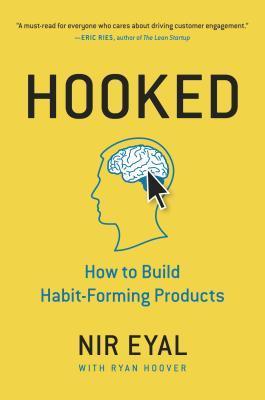
Nir Eyal’s Hooked: How to Build Habit-Forming Products became influential because it gave product teams a compact language for a problem that had become increasingly important in the smartphone era: why do some products become part of daily life while others require constant advertising, reminders, and conscious effort to bring users back? In the Portfolio revised 2014 edition, Eyal answers that question with a four-stage cycle he calls the Hook Model: Trigger, Action, Variable Reward, and Investment. Repeated enough times, he argues, this loop can connect a product to an internal user need until returning to it begins to feel automatic.
That description makes Hooked sound simpler than it actually is. The four boxes are memorable, but the book also contains an economic argument for why habits matter, a taxonomy of triggers, an applied version of B. J. Fogg’s behavior model, three classes of reward, a theory of stored value, an ethical framework for manipulation, a complete Bible App case study, and a method for testing whether habitual behavior is emerging. It also makes psychological claims that vary considerably in strength, from well-supported ideas about cues and friction to broader claims about variable rewards and product habits that work better as design heuristics than as universal scientific rules.
That distinction is central to evaluating the book fairly. Hooked is most useful when treated as a practical vocabulary for asking better product-design questions: What prompts the user? What makes the next behavior easy? What value does the user receive? What makes the product more useful or more personally meaningful with continued use? Its weaknesses appear when that useful sequence is treated as though every successful habit-forming product must follow the same psychological pathway. The result is a book that remains highly valuable for product thinking, but one that benefits from being read with more scientific and ethical caution than its elegant model sometimes encourages.
From Triggers to Investments: A Complete Summary of Hooked
Hooked progresses in a deliberate sequence. Eyal first explains why companies care about habits, then devotes one chapter to each stage of the Hook Model before confronting the moral implications of deliberately shaping behavior. The final two chapters show the model in practice through the Bible App and then convert it into a method for testing products and discovering new opportunities.
The order matters because Eyal is not proposing four unrelated growth tactics. His larger argument is that repeated product use becomes more durable when external prompting gradually gives way to internal cues, easy actions produce satisfying outcomes, and users contribute something that makes the next cycle more valuable or more likely to occur.
Introduction and The Habit Zone: Why Habits Matter to Products
Eyal begins by defining habits as behaviors performed with little or no conscious thought. The significance of that definition is commercial as much as psychological. A company whose product becomes part of a user’s routine does not have to win the user’s attention from scratch every time. The behavior begins to rely less on active deliberation and, ideally, less on paid persuasion.
He develops this idea from his own experience in advertising and social gaming, where he became interested in why certain digital products seemed capable of drawing people back repeatedly. His investigation combines product observation with ideas from psychology, behavioral economics, and human-computer interaction. The Hook Model is presented as a synthesis of patterns he believes recur in successful habit-forming products rather than as a single theory imported wholesale from one research tradition.
The four stages appear early. A Trigger prompts the behavior. An Action is the simplest behavior performed in anticipation of a reward. A Variable Reward satisfies the user’s need while retaining some uncertainty about exactly what will be received. An Investment asks the user to contribute something—time, data, content, social capital, skill, or another form of stored value—that improves the next experience or makes the next trigger more likely.
Pinterest serves as an early illustration of how the loop fits together. A cue draws the user into the service, scrolling requires little effort, the stream of images offers uncertain but potentially interesting rewards, and saving or organizing content creates value that persists into future visits. The example previews an important feature of the model: the final stage is supposed to feed the next cycle rather than merely conclude the current one.
Chapter 1 then asks why a business should care about habitual use. Eyal’s first answer is customer lifetime value. When customers return repeatedly, a company can generate more value from each relationship without paying the same acquisition cost every time. Credit cards provide a straightforward illustration because once a card is integrated into a person’s purchasing routine, repeated use can continue for years.
A second benefit is greater pricing flexibility. Eyal discusses products such as Candy Crush and Evernote to show how habitual or deeply embedded use can make a freemium model more effective. The user begins with low commitment, but as a product becomes useful, familiar, or integrated into routines, paying for additional value becomes easier to justify.
A third advantage is growth. A product used frequently creates more opportunities for users to produce content, share material, invite others, or otherwise contribute to acquisition loops. Facebook is an obvious example because one user’s activity creates reasons for other users to return, and a larger network can make the service more valuable to everyone already inside it.
A fourth advantage is competitive protection. Eyal’s point is not that habitual products become invulnerable, but that existing behavior creates friction for challengers. The persistence of the QWERTY keyboard illustrates how familiarity can outlast debates about optimal design. His comparison of Google and Bing makes a similar point: a technically respectable alternative can struggle to displace a service that users already reach for automatically.
This is where Hooked introduces an important qualification. Eyal does not claim every product must be used constantly. He describes a Habit Zone in which frequency and perceived utility interact. High-frequency products have more opportunities to become automatic because repetition is abundant, while products used less often may still become strong defaults if their perceived value is exceptionally high.
That matters because buying insurance, booking a vacation, or making another occasional high-stakes decision does not occur often enough to become a daily routine. A product serving such needs may therefore succeed without creating the kind of habit Eyal primarily studies. His framework is strongest when a behavior can plausibly recur often enough for associations to form.
The chapter also introduces the distinction between vitamins and painkillers. Painkillers solve an obvious problem, while vitamins can feel like optional improvements whose benefits are less immediate. Eyal argues that some habit-forming products begin more like vitamins but become linked to recurring discomforts until users experience them as a response to a persistent “itch.”
That itch becomes one of the book’s recurring ideas. A user may initially open a social network because of an external message or recommendation, but over time the service may become associated with boredom, loneliness, uncertainty, or a desire for social reassurance. At that point, the user no longer needs the company to create the problem. The internal state itself can become the prompt.
Eyal closes the chapter by forcing makers to become specific. What habit does the product want to create? What problem does that behavior solve? How do people currently address the same need? How frequently can the behavior realistically occur? These questions stop “engagement” from remaining a vague aspiration and establish the conditions that the rest of the Hook Model is supposed to exploit.
Trigger: Moving Users from External Prompts to Internal Cues
Every Hook begins with a trigger, but Eyal divides triggers into two fundamentally different categories. External triggers contain information that tells the user what to do next. Internal triggers arise from a user’s own emotional state, situation, routine, or recurring need.
External triggers are necessary because a new behavior cannot initially depend on an association that does not yet exist. Eyal divides them into four types. Paid triggers include advertising and other exposure the company purchases. They can acquire users but become expensive if the business must keep paying for every return visit.
Earned triggers come from publicity, press attention, rankings, reviews, viral exposure, or other attention that the company does not buy directly. They can produce large bursts of awareness but are difficult to control and rarely provide a dependable long-term mechanism for repeated use.
Relationship triggers come through other people. A friend sends a message, invitation, recommendation, or piece of content, and the social interaction brings another person into the product. These triggers can be powerful because they arrive from trusted relationships rather than from the company itself.
Owned triggers are channels a company can activate repeatedly after receiving permission or access. Notifications, emails, app icons, and similar prompts fall into this category. They matter because the business no longer has to pay for every impression, but they still depend on an external interruption.
Eyal’s real objective is therefore not permanent dependence on external triggers. The goal is for repeated use to create an association between the product and an internal trigger. When that connection becomes strong enough, a user can feel a familiar need and think of the product automatically.
Negative emotions receive particular attention because they often create recurring problems that people want to relieve. Boredom may lead someone to check a feed. Loneliness can lead to messaging or social media. Uncertainty can trigger search. Anxiety about missing updates can produce repeated checking.
Instagram helps Eyal illustrate the process. A user may initially install the app because of social influence or an external prompt, but over time taking or viewing photos can become linked to moments of curiosity, self-expression, social awareness, or fear of missing out. The app gains power not merely because it sends reminders but because daily life itself begins generating cues.
This distinction explains why Eyal encourages qualitative investigation into users’ emotions rather than relying only on surface descriptions. People can usually explain what they do more easily than why a behavior has become compelling. Repeatedly asking “why?” can move a researcher from a visible behavior toward the underlying need that makes the behavior meaningful.
A person might say they use an app to share photographs. Asking why may reveal that sharing preserves memories. Asking again may expose a desire to feel connected, validated, creative, or present in other people’s lives. The exercise is not scientific proof of unconscious motivation, but it is a practical attempt to prevent product teams from confusing a feature with the deeper reason someone values it.
The chapter ends by asking makers to articulate the internal trigger they hope to serve and then identify external triggers that can occur close to the moment when that need arises. The logic is sequential: external triggers teach the behavior, repeated behavior builds association, and the association can eventually allow internal states to bring users back.
Action: Motivation, Ability, and the Simplest Next Step
A trigger does not matter unless the user does something in response to it. Eyal defines the Action stage as the simplest behavior performed in anticipation of a reward, which immediately shifts the designer’s attention from persuasion in the abstract to the practical difficulty of the next step.
The chapter draws heavily on the work of B. J. Fogg. In Eyal’s terminology, behavior occurs when motivation, ability, and a trigger converge. Fogg’s current presentation of the Fogg Behavior Model uses the term Prompt, but the underlying logic remains recognizable: sufficient motivation and ability must coincide with a prompt for a behavior to occur.
Eyal first considers motivation. People can be driven toward pleasure and away from pain, toward hope and away from fear, and toward social acceptance while trying to avoid social rejection. These are intentionally broad motivational categories rather than an exhaustive theory of human desire.
The practical emphasis, however, falls more strongly on ability. Motivation can be difficult and expensive to change. A designer may not be able to make someone desperately want a task, but the designer can often reduce the work required to complete it.
Eyal therefore identifies six factors that can make an action difficult. The first is time: how long does the behavior take? The second is money: what financial cost does it impose? The third is physical effort: how much bodily work is required? The fourth is brain cycles, meaning cognitive effort or mental complexity.
The remaining two factors concern social and behavioral familiarity. Social deviance describes the discomfort of doing something that feels socially abnormal, while non-routine refers to behaviors that are unfamiliar and therefore harder to perform smoothly. The important point is that simplicity depends on the user and situation. Removing the wrong kind of friction may make little difference if another constraint is dominant.
A product team should therefore ask what is currently hardest about the desired behavior. If registration requires too many steps, simplify registration. If a purchase feels risky, reduce financial commitment. If users cannot understand the interface, reduce cognitive load. If the action depends on an unfamiliar habit, attach it to something people already know how to do.
Eyal uses familiar digital examples to make this concrete. Google’s historically sparse search interface minimized competing decisions. Smartphone cameras became more useful when people could reach them without navigating through several screens. Pinterest’s continuous scrolling reduced the friction of repeatedly requesting more content.
Twitter’s product changes provide another illustration. A service may have abundant content but still lose users if the initial experience requires too much effort before value becomes visible. Simplifying onboarding and making useful content easier to encounter can move a user across the threshold from interest to actual behavior.
Eyal then broadens the chapter beyond objective effort to perception. People do not evaluate every decision through careful calculation, so cognitive shortcuts such as scarcity, framing, anchoring, and other biases can change how an action feels even when the underlying choice has not changed. These effects have a broader context in behavioral-decision writing such as The Art of Thinking Clearly, but Eyal uses them narrowly to show that apparent cost and value depend partly on presentation.
Scarcity can make an option feel more desirable because availability appears limited. Framing can make identical outcomes seem different depending on how they are presented. Anchoring can make an initial reference point influence later judgments, while endowed progress can motivate completion by making users feel they have already begun.
The chapter’s actionable lesson is deliberately simple: before trying to make people want a behavior more strongly, make the behavior easier. The exercises ask product teams to identify the action immediately following a trigger, determine what makes it difficult, and remove the most important obstacle. If the action still does not happen, motivation may indeed be insufficient, but friction should not be ignored merely because persuasion feels more glamorous.
Variable Reward: Tribe, Hunt, and Self
Once the user acts, the product must deliver something worth returning for. Eyal argues that predictable feedback alone is often not enough to sustain anticipation, so the third stage introduces Variable Reward: the user receives value, but the exact form or magnitude of that value is not perfectly known in advance.
The chapter draws on reinforcement research and popular accounts of dopamine to explain why uncertainty can heighten anticipation. Eyal distinguishes the enjoyment of receiving something from the motivational pull of wanting and searching. His practical conclusion is that variability can maintain attention because the next outcome might be more interesting, socially validating, informative, or satisfying than the previous one.
He organizes these rewards into three broad categories: rewards of the tribe, rewards of the hunt, and rewards of the self. These categories are not mutually exclusive. A single product can provide several at once.
Rewards of the Tribe come from other people. Humans care about belonging, approval, status, recognition, cooperation, and competition, so social response can become a powerful source of reinforcement. Facebook’s likes, comments, and other feedback exemplify this because a user who posts something does not know exactly how others will respond.
Stack Overflow turns social contribution into reputation. Users ask and answer questions, but the feedback they receive also produces visible status inside the community. The system rewards useful participation with recognition that has value precisely because it comes from other people.
Eyal also discusses the Honor system in League of Legends, which attempted to reinforce desirable social behavior by allowing players to recognize one another. The example demonstrates that social rewards do not have to be limited to popularity. They can also be used to encourage norms a community wants to strengthen.
Rewards of the Hunt involve searching for resources, information, or other desired outcomes. The metaphor comes from the uncertainty of finding what one is pursuing. Slot machines represent an extreme monetary example because the player knows that rewards are possible but cannot predict the next result.
Digital feeds convert the same basic uncertainty into information seeking. A person scrolling Twitter knows most posts will be ordinary, but the next one might be surprising, useful, funny, upsetting, or socially important. Pinterest works similarly because the next image may be exactly the inspiration the user wants.
This does not mean information feeds and slot machines are psychologically identical. Eyal’s point is narrower: both can contain uncertainty about the value of the next outcome. The anticipation created by that uncertainty can motivate continued searching.
Rewards of the Self come from mastery, competence, completion, control, or a sense of personal progress. These rewards do not depend primarily on another person’s approval or on acquiring an external resource. Completing a task can itself feel satisfying.
Games make this obvious. World of Warcraft allows users to improve characters, gain skills, and complete increasingly difficult goals. The progress provides a feeling of competence even when no social audience is involved.
Mailbox, an email application popular at the time of the book, turned clearing an inbox into a manageable progression toward completion. Codecademy similarly reinforced learning through visible advancement. The user returns not because someone else approves but because continued participation strengthens a sense of accomplishment.
Eyal is careful to say that variability cannot compensate for a reward that does not address the user’s underlying need. His comparison of Mahalo Answers and Quora illustrates this. Mahalo experimented with financial incentives, but money did not necessarily match the social and informational reasons people enjoyed answering questions.
Quora’s appeal rested more naturally on curiosity, knowledge sharing, recognition, and access to interesting responses. The lesson is that a designer should not sprinkle uncertain rewards onto an experience and assume engagement will follow. The reward must still solve the emotional or functional problem that prompted the behavior.
The chapter makes a similar point about gamification. Points, badges, levels, and randomness do not automatically transform an activity people dislike into one they want to repeat. If the underlying experience lacks meaning or useful reward, game-like mechanics can become decoration rather than motivation.
Eyal also introduces an important discussion of autonomy. A product can become less appealing when users feel that an engagement mechanism has taken away their freedom. Quora’s earlier decision to broadcast some user activity automatically created discomfort because people lost control over what others could see.
This reaction connects to psychological reactance: people often resist when they feel their freedom is being constrained. Eyal therefore treats user choice as part of effective reward design rather than as an obstacle to engagement. A mechanism intended to increase use can backfire when it makes users feel manipulated.
Another distinction concerns finite and infinite variability. A mystery can remain compelling only until it is solved. The uncertainty in a television series such as Breaking Bad may sustain attention across many episodes, but once the narrative is complete, that particular source of variability ends.
Some games face a similar problem when novelty becomes exhaustible. If users eventually discover every meaningful possibility, the reward landscape can become predictable. Services driven by social interaction or large streams of user-generated content can renew variability much longer because other people continually produce new material.
The chapter ends by asking makers to identify the rewards their product provides and test whether those rewards actually address the internal trigger established earlier in the Hook. Eyal also asks designers to preserve a sense of agency. A reward that draws people back while making them feel trapped undermines the very experience the product is supposed to improve.
Investment: Stored Value and the Next Trigger
The fourth stage is easy to misunderstand because it sounds like another word for Action. Eyal instead defines Investment as something the user contributes after receiving sufficient value, with the expectation that this contribution will improve future use or increase the likelihood of returning.
Timing is important to his formulation. The initial Action should be easy because asking for too much before delivering value can stop the Hook before it begins. Investment comes later, when the user has already received a reward and may therefore be more willing to contribute effort.
Eyal first explores psychological reasons why previous effort can alter later behavior. The IKEA effect describes the tendency to value something more highly after contributing labor to its creation. A product that contains a user’s own work can therefore become more personally valuable than an equivalent product with no such investment.
Commitment and consistency create a related effect. Once people take an action, they often prefer later behavior to remain compatible with that earlier choice. Small commitments can therefore create a path toward larger ones, especially when the initial commitment feels voluntary.
Cognitive dissonance adds another mechanism. When behavior and beliefs conflict, people can reduce discomfort by changing how they interpret the behavior. A person who has invested significant effort in something may come to see the outcome as more valuable partly because abandoning it would make the earlier effort harder to justify.
These psychological mechanisms matter, but the chapter becomes especially strong when it moves from attitude to stored value. A user’s investment can make a product objectively more useful to that particular person over time, which creates a practical reason to stay rather than relying only on psychological commitment.
The first category is content. A note-taking service, photo library, bookmarking system, or creative tool can become more valuable as users fill it with their own material. Leaving means not merely changing software but potentially leaving behind an organized archive.
The second category is data. Products such as LinkedIn and Mint become increasingly personalized as users add professional histories, contacts, financial accounts, preferences, and other information. A competing service may offer similar features but still require the user to rebuild a substantial amount of context.
The third category is followers or network connections. Building an audience on Twitter creates value that cannot simply be transferred to another service. The social network itself becomes part of the product’s usefulness, which raises switching costs.
The fourth is reputation. Marketplaces and communities often assign users ratings, status, transaction histories, or other signals that influence trust. A well-established reputation can be economically valuable, and moving to a new platform may mean starting again without it.
The fifth is skill. Adobe Photoshop is an example of a complex product whose value grows as users become more capable with it. The time spent learning menus, shortcuts, workflows, and concepts is itself an investment, making another tool costly even when its features are attractive.
Stored value therefore explains a form of retention that is stronger than simple familiarity. The user is not merely accustomed to the product; continued use has changed the product-user relationship. More content exists, more data has accumulated, more people are connected, more reputation has been earned, or more expertise has developed.
The final purpose of Investment is to load the next trigger. An action in the present creates a future event that can bring the user back. This gives the Hook its circular structure.
Any.do allows users to create future reminders, so today’s investment becomes tomorrow’s trigger. A Tinder swipe creates the possibility of a later match notification. Sending something through Snapchat creates the possibility of a reply.
Pinterest again functions as a complete example. Browsing yields variable content, but saving an image also builds a personal collection and teaches the service something about the user’s interests. That investment improves future value and provides new reasons to return.
Eyal’s exercises ask product makers what users can contribute, how that contribution makes the service better with continued use, and how the contribution might create a future trigger. The strongest version of Investment is therefore not simply “make leaving painful.” It is “make continued use increasingly valuable because the user has built something worth returning to.”
The Morality of Manipulation
After teaching a system for altering repeated behavior, Eyal stops and confronts the obvious moral question: when does deliberate habit design become manipulation? He does not deny the term. If a product maker intentionally changes what users do, manipulation is part of the activity.
The chapter begins by restating the Hook Model through diagnostic questions. What internal trigger is the product addressing? What external trigger prompts action? What is the simplest behavior the user performs? What variable reward satisfies the need? What investment increases future value and loads the next trigger?
Once those questions are answered, the problem becomes normative rather than mechanical. A product can become more effective at influencing users while still being harmful. Eyal therefore asks whether the maker is improving people’s lives or merely becoming better at extracting attention.
Weight Watchers serves as an example of deliberate behavior change that can plausibly benefit the user. The organization tries to influence what people eat and how they behave, but the intended transformation can align with a goal the user has consciously chosen. This lets Eyal distinguish manipulation from exploitation rather than treating all influence as inherently wrong.
His central ethical framework is the Manipulation Matrix, built from two questions. First, would the maker use the product? Second, does the maker genuinely believe the product materially improves users’ lives? The answers create four categories.
A Facilitator would use the product and believes it improves life. This is Eyal’s preferred position because the maker is both personally familiar with the need and morally invested in creating a beneficial outcome. Firsthand experience can increase empathy and reduce the risk of designing for an imagined user who behaves very differently from the maker.
A Peddler believes the product improves other people’s lives but would not personally use it. Eyal sees this as riskier because a maker can sincerely believe in a solution while lacking direct experience with the problem. The product may become paternalistic, misguided, or poorly matched to what users actually want.
An Entertainer uses the product but does not claim it meaningfully improves life. Entertainment is not therefore condemned. Games, media, and leisure can be legitimate products, but Eyal argues that their novelty may fade and require continual reinvention to keep attracting users.
A Dealer neither uses the product nor believes it materially improves users’ lives. This is the most morally troubling quadrant because the maker knowingly profits from behavior without claiming meaningful benefit. Gambling and intentionally compulsive experiences provide Eyal’s clearest examples.
The chapter also addresses addiction. Eyal distinguishes ordinary habitual users from a smaller population that may experience harmful compulsive use. His argument is that a company cannot ethically ignore those users simply because the majority use the product without severe harm.
This distinction is important because Hooked does not simply celebrate maximum engagement under all circumstances. Eyal recognizes that the same mechanisms capable of creating beneficial routines can be applied to experiences that exploit vulnerabilities. The practical problem is deciding where the boundary lies.
Ian Bogost’s Cow Clicker appears as a satirical warning. Bogost created the game partly to mock the mechanics of social games that reduced participation to empty repetition, and the resulting phenomenon demonstrated how easily systems can encourage clicking without producing proportionate value.
Eyal’s ethical answer is therefore maker-centered: understand the problem personally, believe the product improves the user’s life, and avoid knowingly exploiting harmful compulsions. That answer is more serious than ignoring ethics altogether, but its limitations become clearer when the model is examined from the perspective of user autonomy rather than maker intention alone.
The Bible App: The Hook Model in One Complete Case
Chapter 7 applies the entire framework to YouVersion’s Bible App, associated with Bobby Gruenewald. The example is strategically important because it demonstrates that Eyal does not think the Hook Model belongs only to entertainment, gambling, social media, or advertising-supported products.
The Bible App emerged from an effort to make scripture more accessible through digital technology. An earlier web experience did not create the same level of habitual use that became possible once the product moved onto smartphones. The phone’s constant availability made it possible to connect Bible reading to ordinary moments throughout the day.
Triggers include reminders, notifications, reading-plan prompts, and the user’s own spiritual needs. Over time, a desire for reflection, reassurance, guidance, or continuity in a reading practice can function as an internal cue rather than requiring an external reminder every time.
The Action is straightforward: open the application and read. Mobile access reduces the physical and logistical friction associated with carrying a printed Bible, locating a particular section, or finding enough time for a long study session. Reading plans further simplify the action by dividing a large text into manageable daily segments.
The Reward comes from the content itself. A passage may provide insight, emotional comfort, spiritual meaning, practical guidance, or material for reflection. Because a reader does not know exactly what a particular session will produce emotionally or intellectually, the experience contains a form of informational and personal variability.
The Investment stage includes highlighting passages, saving bookmarks, creating notes, following plans, and building a reading history. These actions make the product more personal and create accumulated value that future visits can recover.
Reading plans also help load future triggers. Progress today creates a reason to continue tomorrow, and a reminder can connect that unfinished plan to the next session. The product therefore creates a cycle in which reading, personal accumulation, and future prompting reinforce one another.
Eyal uses the case to show that the Hook Model is intended as a behavioral architecture rather than a recipe for frivolous compulsion. The Bible App may pursue very different goals from a social network, but its designers can still ask the same four questions about triggers, easy actions, rewarding experiences, and investments that make future use more valuable.
The chapter should not be read as proof that the Hook Model caused the app’s growth. It is instead a worked example showing how Eyal interprets an existing product through his framework.
Habit Testing and Finding New Habit-Forming Opportunities
The final substantive chapter turns the Hook Model from a conceptual framework into a product-development process. Eyal emphasizes that habit formation does not replace the other requirements of a viable business. A habitual product can still fail if nobody discovers it, if the economics do not work, or if the underlying value proposition is weak.
His main practical tool is Habit Testing, an iterative process with three stages: Identify, Codify, and Modify. The purpose is not to declare a product habit-forming because the team wants it to be. The team instead looks for evidence that a subset of users is actually behaving in the desired way.
In Identify, makers decide what frequency would count as habitual for their product and then inspect actual user behavior. The relevant frequency depends on the use case. A communication app and a travel-booking service cannot sensibly share the same threshold.
The objective is to identify users who engage often enough to represent the behavior the product hopes to create. Eyal offers rough rules of thumb for deciding when a devoted group is large enough to study, but these numbers are practical heuristics rather than universal scientific thresholds.
In Codify, the team investigates what those engaged users do differently. Eyal calls the recurring sequence the Habit Path. If highly retained users consistently take particular actions early in their experience, those behaviors may reveal how lasting value is discovered.
Twitter provides an example. The company observed that users who followed enough accounts were more likely to remain engaged, suggesting that an adequately populated feed was important to the service becoming useful. The observation does not prove that a particular follow count mechanically causes retention, but it gives the product team a behavior worth examining.
In Modify, the team changes the product so that more new users encounter the behaviors associated with successful long-term use. Onboarding, recommendations, defaults, prompts, and other interface decisions can be adjusted to make the Habit Path easier to reach.
The process is then repeated. New cohorts provide new data, and the product evolves rather than treating the first design as final. This iterative logic is one of the book’s strongest connections to lean product development because the Hook Model becomes a hypothesis that user behavior must test.
The chapter then asks where makers should look for new habit-forming opportunities. One answer is to scratch your own itch by solving a recurring problem the maker personally understands. This idea overlaps with the maker-centered philosophy discussed in Rework: personal frustration can expose a problem that others share and give the builder firsthand knowledge of the desired solution.
Buffer founder Joel Gascoigne provides an example of building around a problem he personally experienced. The point is not that every founder must be the perfect representative user, but that intimate understanding can reveal use cases that abstract market research misses.
A second source is nascent behavior. Sometimes an apparently niche behavior signals a broader shift that has not yet become obvious. Facebook’s beginnings in a restricted university environment illustrate how behavior visible among a small group can later scale when the underlying need is more general.
A third source is enabling technology. New hardware, interfaces, distribution channels, and infrastructure can make previously difficult behaviors easier enough to become routine. Eyal discusses interface shifts and technologies such as Google Glass, Oculus, and wearables as possible sources of new habits.
Some of those specific forecasts now feel strongly tied to the expectations of the early 2010s. Google Glass did not become the mainstream consumer platform many technologists imagined. Yet the underlying principle remains useful: technological transitions can remove friction and therefore change which behaviors are plausible.
The chapter’s final exercises ask makers to study their own habits, examine products already commanding repeated attention, run Habit Tests, and search for needs exposed by emerging behavior or technology. Eyal’s substantive conclusion is therefore more empirical than the simplicity of the Hook diagram sometimes suggests. The model is supposed to be tested against actual behavior, modified when users do something different, and used as a way of asking questions rather than as a guarantee of success.
The remaining appendix and notes do not introduce another stage of the framework. They provide follow-up material, references, and supporting apparatus rather than extending the book’s central argument.
How the Hook Model Works as a System
Reading Hooked chapter by chapter can make the model look like four separate product-design techniques, but Eyal’s larger claim depends on the connections among them. A trigger that does not produce an action is useless, an easy action that produces no meaningful reward will not sustain use, and a satisfying experience that creates no future value may have to win the user back from the beginning every time.
The Hook Model therefore works best as a theory of reinforcement between product use and recurring user needs. Its strongest elements are not necessarily the individual boxes but the questions generated by moving through the entire cycle: what cue begins the behavior, what prevents the next step, what need is actually satisfied, and what changes because the user has participated?
Why the Four Phases Reinforce One Another
The first connection is between Trigger and Action. A cue is effective only when the requested behavior is easy enough to perform in the moment. If a reminder arrives when the user lacks time, skill, money, motivation, or context, the Hook breaks before value can be delivered.
The Action then creates access to the Reward. This is important because Hooked does not recommend demanding extensive commitment before showing value. The product should usually let the user experience enough benefit to understand why further participation is worthwhile.
The Reward then makes Investment more plausible. Someone who has just received value may be more willing to save an item, create a profile, add data, follow another user, learn a feature, or contribute content. The investment matters because it changes what the product can provide next time.
That change feeds into the next Trigger. A person uploads content and later receives a response. A user follows accounts and later encounters a richer feed. A task is scheduled and later produces a reminder. The loop becomes self-reinforcing because one session creates conditions that make another session easier or more valuable.
Repeated cycles can also strengthen associations between context and behavior. Modern research on the psychology of habit supports the broad proposition that repetition in recurring contexts can make responses increasingly automatic. That gives solid grounding to Eyal’s basic emphasis on cues, repetition, and diminished deliberation.
What the research does not establish is that the exact sequence Trigger → Action → Variable Reward → Investment is necessary for every product habit. A utility can become a default because it reliably solves a recurring problem, even if its rewards are highly predictable. Some products require extensive setup before they become useful, reversing Eyal’s preferred timing of Investment.
The Hook Model is therefore strongest as an operational lens. It helps designers inspect the conditions surrounding repeated use, but it should not be mistaken for a natural law governing every habit.
The Habit Zone: Frequency, Utility, and the User’s Recurring Problem
Chapter 1 is easy to forget once the four Hook stages become memorable, but the Habit Zone provides an important boundary condition. Habit formation depends partly on repetition, which means products with frequent opportunities for use have an obvious advantage.
A messaging app can be opened dozens of times in a day. A mortgage application cannot plausibly become habitual in the same sense because the behavior occurs too rarely. Clever triggers and rewards do not erase that difference.
Perceived utility can compensate for lower frequency to a degree. Amazon may not need every customer to purchase daily if it becomes the default place people think of when they decide to buy something online. The habit may reside in the mental association—“I need a product, so I check Amazon”—rather than in constant transaction frequency.
This is where Eyal’s recurring “itch” becomes especially useful. A product has a better chance of becoming habitual when it solves a need that appears repeatedly. Boredom, communication, information seeking, task management, entertainment, or social reassurance naturally recur more often than many specialized problems.
The implication is that product teams should not begin by asking how to make a low-frequency activity addictive. They should ask whether the underlying problem occurs often enough for a cue-response association to form at all. If not, a different model of retention may be more appropriate.
This boundary condition also prevents an important mistake in interpreting Hooked. The book is not claiming that habit is the only desirable form of customer loyalty. Trust, superior utility, high switching costs, contractual relationships, brand preference, and occasional high-value use can all sustain businesses without producing automatic daily behavior.
The Psychology Behind Hooked: What Holds Up and What Needs Qualification
Hooked draws from several kinds of knowledge at once. Some ideas come from established behavioral research, some from applied models such as Fogg’s, some from famous laboratory findings, and some from Eyal’s observation of successful technology products. These forms of evidence are not interchangeable, and the book becomes more reliable when they are separated rather than treated as though every product example proves the psychological mechanism attached to it.
The broad foundations of cue-based habit formation and friction reduction are persuasive. The more ambitious claims around variable reward, dopamine, and a fixed four-stage sequence require greater caution because products can become habitual for reasons that do not fit the model neatly.
Habits, Cues, Repetition, and Automaticity
The most defensible psychological foundation of Hooked is the idea that repeated behavior in recurring contexts can become increasingly automatic. Wendy Wood and Dennis Rünger’s review of habit psychology describes habits as responses that can become linked to context through repeated performance, allowing behavior to be initiated with less deliberate decision-making.
That supports Eyal’s emphasis on triggers. A person who repeatedly checks a phone while waiting in line can gradually associate waiting with phone use. A person who repeatedly opens a particular tool when uncertain about something can begin reaching for it before consciously comparing alternatives.
The same research also supports the importance of repetition. One highly satisfying experience does not automatically create a habit. The behavior has to recur often enough for context-response associations to strengthen.
This helps explain why Eyal cares about reducing reliance on external triggers. A notification can initiate behavior, but the product becomes more deeply integrated when environmental or internal cues can prompt the same response. The user no longer has to be interrupted by the company every time.
However, “habit” should not be confused with every form of high engagement. A user may open a product frequently because each use requires conscious planning, because work obligations demand it, or because a social relationship requires immediate responses. High frequency can create opportunities for habit formation without proving that behavior has become automatic.
Similarly, recurring use does not establish that the product itself created the underlying need. Social media may become associated with boredom, but boredom existed before the product. Search engines may become associated with uncertainty, but they do not create the human desire to resolve questions.
Eyal generally understands this distinction, which is why internal triggers are framed as existing emotions or situations that products become linked to. The most useful reading of the model is therefore associative: products become default responses to recurring needs. That claim is stronger than saying products manufacture entirely new emotions inside users.
Motivation, Ability, and Friction
The Action chapter remains one of the most practically durable parts of Hooked because its advice does not require a strong claim about subconscious manipulation. If someone wants to perform a behavior but the process is confusing, slow, expensive, socially uncomfortable, or cognitively demanding, reducing that friction can increase the chance that the behavior occurs.
The current Fogg Behavior Model describes behavior as occurring when Motivation, Ability, and a Prompt converge. Eyal’s 2014 use of “trigger” reflects earlier terminology, but the central logic remains similar: even a well-timed prompt fails if the behavior is too difficult or the user lacks sufficient motivation.
This model helps explain why product design can sometimes achieve more through simplification than through persuasion. A user already interested in buying something may abandon the process because checkout is exhausting. Removing unnecessary fields can change behavior without increasing desire for the underlying product.
The six simplicity factors in Hooked are useful because they make “easy” multidimensional. A free product can still be cognitively exhausting. A fast action can still violate a social norm. A simple interface can still demand an unfamiliar routine.
The relevant obstacle is therefore contextual. A highly skilled professional may consider software easy that overwhelms a beginner. A behavior requiring almost no physical effort may still feel psychologically costly if it risks embarrassment or judgment.
This is also why friction reduction has ethical ambiguity. Making a beneficial behavior easier can help users achieve something they already want, but making a harmful behavior frictionless can remove moments in which reflection might otherwise occur. One-click purchasing is convenient when the user knows what they want and less benign when deliberate friction would help prevent impulsive spending.
Eyal’s treatment is primarily product-oriented rather than normative, but the principle remains sound: ability matters because behavior does not occur in an abstract motivational vacuum. Interfaces structure the practical cost of acting.
Variable Rewards, Dopamine, and the Limits of the Reward Claim
The Variable Reward chapter is one of the most memorable parts of Hooked, but it is also where careful qualification matters most. Eyal is right that uncertainty can affect attention and learning, yet popular discussions of dopamine often compress a complicated system into a story about “pleasure chemicals” and unpredictable rewards.
Contemporary reward-prediction-error research provides a more precise account. Dopamine signaling is deeply involved in learning about expected and unexpected outcomes, particularly the difference between what was predicted and what actually occurred. This makes anticipation, prediction, and surprise important without implying that every uncertain reward produces a uniquely addictive dopamine surge.
That distinction matters because a product can become habitual while providing highly predictable value. People may check a weather app every morning precisely because it reliably answers the same question. They may open a calendar because it consistently shows what comes next, not because the result is variable.
Email and messaging contain natural variability because incoming content changes, but the user’s core reason for opening them may still be stable: communication. Search engines produce variable answers, yet people return partly because the process reliably reduces uncertainty.
This weakens any interpretation in which Variable Reward is a necessary ingredient of all product habits. A behavioral-design critique of the Hook Model by Jason Hreha makes this point directly, arguing that many successful utility products become habitual without depending on meaningful variability in the reward stage.
The critique is persuasive against an overly rigid reading of Eyal, but it does not make the reward concept useless. Variable outcomes clearly matter in some domains. Social feedback is uncertain, information feeds continually change, games can create suspense, and marketplaces produce outcomes users cannot know in advance.
The more defensible conclusion is therefore conditional. Variable reward can strengthen anticipation when uncertainty is naturally related to what users value, but variability should not be manufactured merely because a four-stage framework says it belongs in the loop.
Eyal’s own examples occasionally support this more modest interpretation. Quora works not because uncertainty itself is magical but because users care about what other people will say. Pinterest works because an uncertain stream of images can produce inspiration. A meaningless random result would not create the same response.
His warning against superficial gamification is therefore more important than the chapter’s more popular “variable reward” slogan. The reward has to resolve the user’s underlying need. Randomness without relevance is noise.
The chapter’s treatment of autonomy also deserves emphasis. If a product removes user control in pursuit of engagement, reactance can make the experience less attractive. This is a useful reminder that behavioral design cannot assume users are passive subjects who simply respond to reinforcement schedules.
The strongest contemporary interpretation of Variable Reward is therefore not “make everything unpredictable.” It is “understand where anticipation naturally exists in the value users seek, and do not confuse artificial randomness with genuine usefulness.”
Investment, Commitment, and Stored Value
Investment is another concept that becomes clearer when its underlying mechanisms are separated. Eyal combines psychological commitment, effort justification, accumulated content, learned skill, social networks, data, reputation, and future triggers under one stage, but these things do not all operate in the same way.
The IKEA effect and commitment-consistency mechanisms concern how prior effort can influence perceived value or later choices. They may make people more attached to something they helped build, but they do not automatically mean the product has become objectively better.
Stored value is different. A service containing years of personal notes genuinely provides more utility to that user than an empty alternative. A marketplace reputation can affect future transactions. A professional network can produce opportunities that disappear if the user starts from zero elsewhere.
This distinction matters because stored value is one of the most compelling ideas in Hooked. It explains why retention can increase even when the product itself has not changed for the market as a whole. The user-product relationship has changed.
A new user sees a generic platform. An established user sees personal archives, relationships, preferences, history, and learned workflows. Switching therefore requires rebuilding an ecosystem rather than merely choosing a different interface.
At the same time, Investment does not always arrive neatly after Reward. Many products require substantial setup before users receive meaningful value. Creating a financial profile, importing data, building a playlist, configuring professional software, or establishing a network can involve investment long before the experience becomes satisfying.
Hreha’s critique is useful here because it exposes the difference between a practical sequence and a universal sequence. Some products blur Action and Investment. Others require investment during onboarding. Still others accumulate value passively as the user acts.
The strongest way to preserve Eyal’s insight is therefore to relax the timing. Habit-forming products often become more valuable when continued participation creates persistent personal value, but that accumulation does not have to occupy an isolated fourth stage after every reward.
The “load the next trigger” idea remains especially powerful. When an action today naturally creates a future reason to return, a product does not depend on arbitrary reminders. Messages invite replies, tasks produce reminders, collaborative work creates responses, and social contributions generate feedback.
That mechanism links Investment directly to the circular structure of the Hook Model. Even if the stages overlap in practice, the question Eyal asks remains useful: what happens during this session that makes the next session more likely or more valuable?
The Ethics of Habit Design: From the Manipulation Matrix to User Autonomy
Eyal deserves credit for refusing to pretend that behavioral design is ethically neutral. If a designer intentionally changes what users do, then questions about manipulation, welfare, and responsibility are unavoidable. Chapter 6 is therefore more than a disclaimer attached to a growth manual; it is an attempt to establish moral boundaries for the tools the preceding chapters describe.
The problem is that Eyal’s answer is centered primarily on the maker’s intentions and personal relationship to the product. That can encourage reflection, but contemporary concerns about manipulative interfaces reveal cases in which sincere intentions are not enough to protect users.
What Eyal’s Framework Gets Right
The Manipulation Matrix begins from a valuable premise: product makers should ask whether the behavior they are encouraging actually improves users’ lives. This is better than treating engagement, retention, time spent, or conversion as self-justifying metrics.
The Facilitator category also emphasizes firsthand empathy. A maker who experiences the problem personally may understand frustrations, trade-offs, and desired outcomes that are invisible to someone designing only from dashboards and demographic categories.
Eyal is also right to distinguish influence from exploitation. Human behavior is influenced constantly by architecture, defaults, reminders, social norms, and communication. A calendar reminder manipulates behavior in the literal sense that it alters what a person does, but most users actively want that intervention.
The ethical question is therefore not whether design influences behavior. It is whether the influence advances goals users would endorse under reasonable conditions, whether the costs are transparent, and whether users retain meaningful ability to choose differently.
Eyal also deserves credit for acknowledging vulnerable compulsive users. An engagement system that works safely for most people can still produce serious harm for some. Recognizing that distribution of risk is more responsible than assuming average outcomes settle the ethical question.
What the Manipulation Matrix Cannot Decide
The matrix becomes less reliable when maker belief is treated as a sufficient moral safeguard. A person can sincerely believe a product improves users’ lives and still be wrong. Good intentions do not eliminate information asymmetry, cognitive bias, business incentives, or unintended consequences.
The “would I use it?” question is similarly limited. A founder may use a product without sharing the vulnerabilities of every target user. An adult designer’s comfort with a persuasive feature says little about its effects on children. A financially secure employee’s response to a gambling-like reward mechanism may not represent someone experiencing addiction.
A maker can also benefit from a product while users bear costs that remain invisible to the maker. Social platforms can create valuable relationships and still amplify harassment, distraction, misinformation, social comparison, or compulsive checking. Personal use does not resolve the balance.
Externalities create another problem. A product can improve the experience of one participant while imposing costs on other people or society. A driver may value an attention-grabbing navigation or communication feature even when its interface increases risks for people nearby.
The matrix also struggles with long-term versus short-term welfare. A user can genuinely enjoy an experience in the moment while later regretting the amount of time, money, sleep, or attention it consumed. A design optimized around immediate behavior may therefore conflict with preferences the same person endorses over a longer horizon.
Information asymmetry compounds this problem because companies often know more about the persuasive architecture than users do. Designers can test notifications, button placement, defaults, timing, and emotional framing across enormous populations, while an individual user sees only the final interface.
This does not make behavioral experimentation inherently wrong. It means ethical evaluation must consider outcomes and power relationships in addition to the maker’s motives. A sincere Facilitator can still create harmful design if the system consistently steers users toward behavior they would reject under conditions of greater transparency or reflection.
The strongest ethical question is therefore not merely “Would I use this, and do I think it helps?” It is also “Would users understand and endorse the way this design is influencing them, and can they meaningfully resist or reverse the influence without disproportionate cost?”
Dark Patterns and the Changed Regulatory Context
The ethical environment surrounding digital-product design has changed significantly since Hooked appeared in 2014. Terms such as dark patterns have become common for interfaces that steer, pressure, confuse, or obstruct users in ways that benefit the service at the user’s expense.
The European Union’s Digital Services Act reflects that shift by restricting online-platform interface design that deceives, manipulates, or materially distorts users’ ability to make free and informed decisions. The European Commission’s explanation of rules against manipulative interface design shows how regulation has moved beyond asking whether designers themselves believe their products are beneficial.
This perspective places user autonomy closer to the center of ethical analysis. A product should not merely provide an outcome the maker thinks is good; users should retain meaningful control over decisions affecting them.
That does not invalidate the Hook Model. Triggers, simplified actions, rewarding experiences, and stored value can all support products users genuinely want. A medication reminder, language-learning routine, fitness tracker, collaborative tool, or reading application can use recurring cues without becoming exploitative.
The danger appears when the product’s business model benefits from behavior that users would prefer to moderate, while the interface is deliberately optimized to weaken that moderation. Endless feeds, hard-to-cancel subscriptions, misleading defaults, artificial urgency, or obstructive privacy choices illustrate the larger category of problem even when they do not map perfectly onto Eyal’s four stages.
The ethical lesson for a contemporary reader is therefore stricter than the Manipulation Matrix. Product makers should examine not only their intentions but the structure of consent, the reversibility of choices, the vulnerability of users, foreseeable long-term harms, and whether success metrics reward behavior that conflicts with user welfare.
Style and Organization: Why Hooked Is Easy to Apply
One reason Hooked became influential is that Eyal writes like a practitioner trying to give other practitioners a usable tool. The four-stage structure is simple enough to remember, each chapter focuses on one part of the model, and the recurring “Remember & Share” summaries reinforce the main concepts before the reader moves forward.
The “Do This Now” exercises make the book more operational than a conventional popular-psychology text. Eyal repeatedly turns explanation into diagnostic questions: identify the internal trigger, simplify the next action, classify the reward, determine what the user invests, and examine whether the investment improves the next cycle.
His company examples serve the same purpose. Pinterest, Instagram, Facebook, Twitter, Quora, Stack Overflow, Evernote, and other familiar products give readers concrete interfaces to imagine. The examples make abstract behavior-design concepts easier to translate into product decisions.
The Bible App chapter is structurally important because it consolidates the model after four separate mechanism chapters. Instead of introducing another principle, Eyal shows how the same product can contain triggers, easy actions, rewarding experiences, and accumulating investment at once.
Chapter 8 then shifts from explanation to testing. This gives the book a productive ending because the reader is not told merely to believe the framework. Product teams are instructed to examine cohorts, identify habitual users, codify the behavior associated with retention, modify the product, and repeat the process.
The cost of this clarity is simplification. A memorable framework encourages readers to see four distinct stages even when real behavior is messier. Psychological mechanisms with different evidentiary foundations can appear equally established once they occupy neighboring boxes in the same diagram.
The technology examples have also aged unevenly. Some platforms remain recognizable, others disappeared or changed radically, and several emerging technologies Eyal highlighted did not develop as expected. The early smartphone and social-growth era in which the book was written is therefore visible throughout its examples.
That historical aging does not destroy the instructional architecture. In fact, the book’s most durable sections are those least dependent on a specific platform: recurring cues matter, friction matters, actual user value matters, stored value matters, and designers should inspect observed behavior rather than relying only on intention. Those principles survive even when the brand examples become period pieces.
Critical Review: Where Hooked Succeeds and Where It Overreaches
The fairest way to judge Hooked is according to what it does for product practitioners rather than by demanding that it function as an academic textbook it never attempts to be. As an applied framework, it is unusually effective: compact, memorable, concrete, and capable of changing the questions a product team asks about repeated use.
Its problems arise when memorable design language hardens into universal explanation. The Hook Model combines strong observations, useful heuristics, established psychological principles, anecdotal product examples, and more speculative generalizations. The book does not always distinguish those evidentiary levels as sharply as a careful contemporary reader should.
Its Strongest Contribution: A Practical Design Vocabulary
The most valuable contribution of Hooked is not the claim that every successful product passes through four scientifically necessary stages. It is the vocabulary the model gives teams for examining repeated behavior.
“Trigger” forces a team to ask what actually starts the behavior. “Action” redirects attention toward friction rather than vague persuasion. “Reward” asks what value the user receives immediately. “Investment” asks whether continued participation makes future use better.
These questions are productive even when the model does not perfectly describe the product. A calendar application may have predictable rewards, yet studying triggers and friction still helps. A professional tool may require substantial investment before value appears, yet stored value can still explain long-term retention.
The Habit Zone also adds useful discipline because it reminds makers that not every product needs to become a daily compulsion. Frequency and utility constrain what is plausible. This prevents habit from becoming a buzzword applied indiscriminately to every customer relationship.
The chapter on internal triggers is similarly valuable when interpreted carefully. Products often become defaults for recurring problems. Search becomes associated with uncertainty, messaging with communication, maps with navigation, and entertainment with boredom.
This framing encourages teams to understand the user’s problem rather than obsess only over features. “What emotion or recurring situation causes someone to need us?” is usually a more revealing question than “How can we send more notifications?”
The Action chapter may be the most immediately useful. Reducing friction is a concrete design principle that applies well beyond habit formation. A good product often succeeds not by manufacturing more motivation but by helping motivated users accomplish what they already want with less effort.
Investment is another lasting contribution. Products become harder to replace when they contain accumulated user-specific value. Personal data, content, relationships, reputation, history, and learned skill create a different kind of retention from mere familiarity.
Habit Testing then gives the framework an empirical escape hatch. Instead of assuming a design works because it fits the diagram, teams are told to identify actual habitual users, examine what they do, and modify the experience so that others can reach similar value. That is a healthier design practice than treating the four stages as commandments.
Its Weakest Claim: Treating a Useful Heuristic Like a General Model
The central weakness of Hooked is the impression that its four-stage structure explains habit-forming products more universally than the evidence warrants. Eyal’s examples often show that a product can be interpreted through the Hook Model, but interpretability is not the same as causal validation.
Pinterest may contain triggers, actions, variable rewards, and investments. That does not demonstrate that those four elements caused its growth, that each was necessary, or that another sequence could not explain the same behavior equally well.
The variable-reward stage is especially vulnerable to overstatement. Many useful products succeed by being predictable. A weather app, calculator, calendar, alarm clock, navigation service, password manager, or productivity tool may become a default precisely because users trust it to produce reliable outcomes.
These products can still contain natural variability in content, but that does not mean uncertainty is what makes them habitual. The user’s repeated problem and the product’s reliable ability to solve it may be sufficient.
The neuroscience language adds unnecessary confidence to this claim. Dopamine clearly matters in reward learning and prediction, but reducing that complexity to “variable rewards make dopamine surge and therefore create habits” would be scientifically misleading. Hooked does not always commit that crude formulation explicitly, yet its compressed storytelling can encourage readers to carry away something close to it.
Investment creates a similar issue of over-ordering. Eyal prefers to provide reward before asking for effort, which is sensible product advice in many cases. However, countless services require setup, learning, data entry, configuration, or network building before significant rewards appear.
This does not make Investment irrelevant. It means that the four stages often overlap or change order. A person can invest while acting, receive value gradually, or experience a trigger created by another user before making any deliberate contribution.
Hreha’s critique is therefore strongest when it attacks necessity rather than usefulness. The Hook Model can help describe successful products without providing a universal causal law of habit formation.
The book’s evidence also leans heavily on retrospective company examples. Successful products are examined and fitted to the framework, but failed products containing similar elements receive much less attention. That makes it difficult to know how predictive the model is.
A truly general theory would need stronger comparative evidence. Do products with all four stages outperform otherwise similar products without variable rewards? Does post-reward investment outperform pre-reward setup across categories? Which product types benefit most from internal triggers, and which remain largely dependent on utility or external necessity?
Hooked does not answer these questions systematically. Its aim is practical design rather than causal science, but readers should therefore evaluate the model at that same level.
What Has Aged Well—and What Has Aged Poorly
Several ideas in Hooked have aged extremely well. The first is the emphasis on friction. Digital products continue to compete partly by reducing the number of steps, decisions, delays, and uncertainties separating intention from action.
The second is stored value. Modern software is often valuable not only because of what it can do in general but because of what an individual has built inside it. Data, histories, workflows, recommendations, social graphs, and personalization continue to create powerful retention.
The third is the transition from external to internal cues. Notifications can acquire attention, but products become more resilient when users think of them naturally at the moment a need appears. The strongest products often occupy these mental defaults.
The fourth is Eyal’s insistence that product teams study actual behavior. Habit Testing is still a useful corrective to design-by-opinion. Cohort behavior, retention patterns, and repeated use reveal things interviews and intentions may miss.
The book’s ethics chapter has also aged well in one important respect: Eyal recognized early that product designers who deliberately shape behavior cannot avoid moral responsibility. The fact that manipulation became an explicit subject inside a growth-oriented product book was significant.
What has aged less well is the adequacy of the ethical solution. The Manipulation Matrix puts substantial trust in whether makers personally use the product and believe it benefits people. The last decade of debate about dark patterns, attention extraction, platform power, children’s safety, addictive design, privacy, and algorithmic influence has made that standard look incomplete.
Several technological forecasts also reflect their moment. Google Glass represented an exciting possible interface shift, but it did not become the mainstream consumer platform imagined at the time. Oculus and wearable technology developed in meaningful ways, though not always along the trajectories early smartphone-era product thinkers expected.
Some company examples have become historical artifacts. Products changed, business models evolved, interfaces disappeared, and consumer expectations matured. That inevitably makes a technology book from 2014 feel dated in places.
Yet this aging has an unexpected benefit. It separates the enduring model from the fashionable examples. If a principle still makes sense after the specific startup or interface has disappeared, it is more likely to contain genuine design value.
Trigger analysis survives. Friction reduction survives. Solving a recurring user problem survives. Stored value survives. Testing behavior survives.
The simplistic version of “add variable rewards and users will get hooked” deserves much more skepticism. So does an ethical framework centered mainly on what makers believe about themselves.
Who Should Read Hooked Today
Hooked remains most useful for product managers, UX designers, founders, growth practitioners, marketers, and entrepreneurs who need a shared vocabulary for discussing retention and repeated use. It can help a team move from “we need more engagement” toward more specific questions about cues, ease, value, and recurrence.
Designers can benefit from the Action chapter’s attention to friction. Product managers can use Habit Testing as a way to examine how retained users differ from people who disappear. Founders can use the internal-trigger framework to think more carefully about the recurring problem their product addresses.
Marketers may find the trigger taxonomy useful because it distinguishes paid acquisition from channels the user permits and from deeper associations that eventually reduce dependence on marketing. That distinction encourages a more sustainable view of retention than simply increasing promotional frequency.
Behavioral-science readers can also find the book interesting, but they should treat it as applied synthesis rather than as a definitive account of habit psychology. The book simplifies research so that practitioners can use it, and that simplification sometimes blurs important distinctions.
Readers looking for a personal habit-building program should choose something else. Hooked is about designing products that become habitual, not primarily about helping individuals exercise, study, sleep better, or break their own unwanted routines.
Readers uncomfortable with persuasive technology may still benefit from it for another reason. Understanding how product teams think about triggers, friction, reward, and investment can make users more aware of how seemingly small interface choices shape behavior.
The book is therefore useful both as a design manual and as a vocabulary for analyzing design. Its mechanisms become easier to notice once they have names.
Is Hooked Still Worth Reading?
Yes—provided it is read for what it does best.
Hooked remains one of the clearest introductions to the problem of designing for repeated product use. Eyal’s four-stage model gives practitioners a practical sequence for examining what brings users back, what blocks action, what value makes the behavior worthwhile, and what accumulated investment improves future use.
Its strongest insight is not that people can be mechanically “hooked” through a secret psychological formula. It is that habits emerge from repeated relationships among cues, behavior, reward, context, and accumulated value, and that product teams can inspect those relationships rather than treating engagement as mysterious.
The book becomes less convincing when its elegant sequence is read as a universal behavioral law. Variable reward is important in some products but clearly unnecessary in others. Investment often overlaps with Action or precedes Reward. Company case studies illustrate possibilities without proving causation, and contemporary neuroscience requires more careful language than popular stories about dopamine and unpredictability allow.
Its ethical framework also needs updating. Asking whether a maker would use a product and believes it improves people’s lives is a useful beginning, but contemporary product design has to go further. User autonomy, information asymmetry, vulnerable populations, long-term welfare, reversibility, and the possibility that engagement metrics reward behavior users later regret all deserve explicit attention.
None of these limitations erase the book’s value. They simply change the level at which it should be trusted. Hooked is best read as a structured design heuristic: a compact set of questions that can expose why a product becomes part of someone’s routine and where that process might fail.
For product managers, founders, designers, and growth practitioners, the full book remains worth reading because Eyal’s framework is easier to use after seeing the examples, exercises, ethical discussion, case study, and testing process that surround the famous four-box diagram. Readers seeking rigorous behavioral science should supplement it rather than treating it as a final authority, while readers building persuasive products should apply its methods with a stronger conception of user autonomy than the 2014 edition provides.
The lasting contribution of Hooked is therefore not a recipe for manufacturing compulsive behavior. It is a durable vocabulary for asking what repeatedly brings a person to a product, what makes the interaction easy enough to continue, what value the experience actually delivers, and what changes because the user has returned. Used with evidence and ethical restraint, those questions remain more valuable than the promise of any universal formula.
Last Updated on August 24, 2026 by Aseem Gupta