
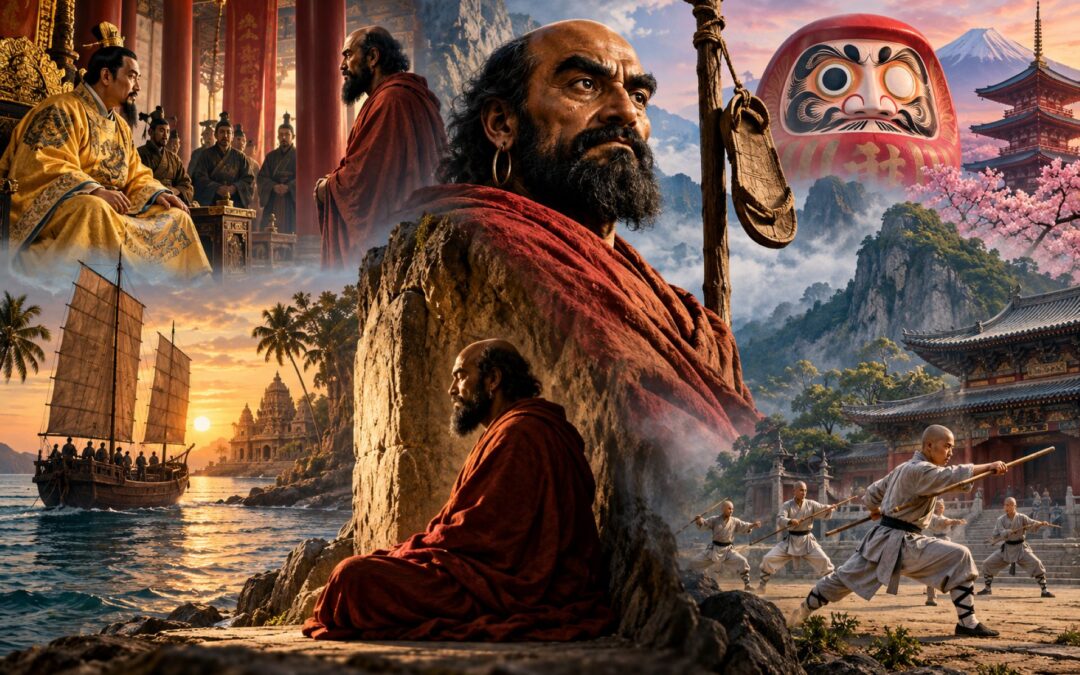
In the mountains of China, an Indian Buddhist monk is said to have spent nine years meditating in a cave, staring at a wall until his determination became legendary. His name was Bodhidharma, and according to popular tradition, he brought a distinctive form of Buddhism from India to China, transformed the spiritual practices of Shaolin monks, and helped establish the foundations of kung fu. Centuries later, his image would become familiar across East Asia, appearing in Buddhist temples, martial-arts traditions, paintings, and the round red Daruma dolls of Japan.
It is an extraordinary legacy for someone whose actual life remains remarkably difficult to reconstruct. The familiar stories describe Bodhidharma as a South Indian prince who escaped a dangerous royal court, travelled across the seas, challenged a Chinese emperor, and became the first patriarch of Chan Buddhism. Yet many of these details appear in sources written generations or centuries after his supposed lifetime, and some of the most famous claims about his achievements cannot be established by historical evidence.
Understanding Bodhidharma therefore requires following two connected histories: the life of an early Buddhist teacher and the gradual creation of a religious and cultural legend around him. His influence on the development of Chan, which later became known as Zen in Japan, is deeply embedded in Buddhist tradition. His reputation as the founder of Shaolin kung fu tells a more complicated story about how religious memory, martial practice, and cultural exchange became intertwined.
Who Was Bodhidharma, and What Do the Earliest Records Say?
Bodhidharma was a Buddhist monk traditionally associated with the transmission of Indian meditation teachings to China during the fifth or sixth century CE. Chinese Buddhist tradition subsequently recognized him as the first patriarch of Chan Buddhism, a school that emphasized direct insight into the nature of reality and the importance of meditative practice. Beyond this broad identification, however, his biography is surrounded by uncertainties concerning his birthplace, ancestry, travels, activities, and death.
The earliest surviving references to Bodhidharma do not present the continuous life story familiar from later accounts. One important source is Yang Xuanzhi’s Record of the Buddhist Monasteries of Luoyang, composed around the middle of the sixth century. It refers to a foreign Buddhist monk named Bodhidharma who admired the extraordinary architecture of a monastery in Luoyang. The account identifies him with the western regions and provides a different picture of his origins from the later tradition of a South Indian royal prince.
Another important early source is the preface associated with Tanlin, a Buddhist figure connected with writings attributed to Bodhidharma. This tradition describes Bodhidharma as coming from southern India and presents him as a religious teacher associated with a distinctive approach to Buddhist realization. The seventh-century monk Daoxuan subsequently included material about Bodhidharma and his followers in his Continued Biographies of Eminent Monks, contributing to the historical record from which later generations reconstructed the early Chan movement.
These sources are valuable, but they are not interchangeable eyewitness accounts. They emerged in different literary and religious circumstances, and their descriptions do not produce an uncontested chronology. The historical scholarship on Bodhidharma therefore distinguishes between the relatively limited early testimony and the elaborate biographies that developed through subsequent centuries.
The difference becomes especially significant when considering Bodhidharma’s position in Buddhist lineage traditions. Later Chan genealogies presented him as the twenty-eighth patriarch in a succession descending from the Buddha in India and as the first patriarch of the Chinese tradition. Such genealogies helped Chan communities explain the authority of their teachings by connecting them to an unbroken transmission of spiritual realization. Historians nevertheless distinguish the religious function of these lineages from independent evidence that every named transmission occurred exactly as subsequently described.
John McRae’s study Seeing Through Zen examines how these narratives developed as Chan Buddhism established its distinctive identity. In this perspective, the stories surrounding Bodhidharma reveal not only what later Buddhists believed about a revered founder, but also how they understood legitimate teaching, spiritual authority, and the relationship between India and China.
The historical uncertainty does not make Bodhidharma irrelevant. It means that his importance cannot be measured solely through a list of reliably documented personal achievements. The figure who appears in the early sources became the centre of an evolving Buddhist tradition whose teachings and stories exerted an influence far beyond what can be established about the individual himself.
From South Indian Prince to Buddhist Traveller
According to one influential tradition, Bodhidharma was born into the royal family of the Pallava dynasty, which ruled parts of southern India and became an important political and cultural power in the Tamil region. The story identifies him as the youngest of three princes, sometimes describing him as particularly favoured by his father. His apparent suitability for succession supposedly provoked jealousy among his elder brothers, leading to hostility and, in some versions, an attempt on his life.
These dramatic episodes help explain his transformation from prince to monk within the traditional narrative. Having witnessed ambition, betrayal, and violence within the royal household, Bodhidharma is said to have rejected political power and devoted himself to Buddhism. The story presents renunciation not as an inability to obtain worldly authority, but as a conscious rejection of something he might otherwise have possessed.
There is no secure contemporary evidence establishing this royal genealogy or the assassination attempt. Even the identification of Bodhidharma with a particular Pallava ruler belongs to later biographical reconstruction rather than an independently documented succession history. The narrative remains meaningful because it expresses a familiar Buddhist contrast between attachment to worldly status and the pursuit of spiritual liberation.
Bodhidharma’s spiritual teacher is traditionally identified as Prajñātāra, who supposedly recognized his abilities and encouraged him to carry Buddhist teachings to China. Some later traditions and interpretations portray Prajñātāra as a woman, although this identification remains disputed. The teacher-disciple relationship is important within Chan’s account of its origins, but it should not be treated as a securely reconstructed episode from Bodhidharma’s early life.
The traditional journey to China takes Bodhidharma from southern India through the maritime routes of Southeast Asia before reaching the Chinese coast. Elaborate retellings place his departure near Mahabalipuram, describe stops around Sumatra, and locate his arrival at Guangzhou. Some even provide precise years, royal introductions, and accounts of prolonged study during the voyage. These details cannot be assembled into a verified travel itinerary, although the wider geographical setting is historically plausible.
South India was connected to a substantial maritime trading world. Merchants, religious specialists, sailors, and political representatives travelled between the Indian subcontinent, Sri Lanka, mainland Southeast Asia, island kingdoms, and Chinese ports. The circulation of Buddhist teachings formed part of these broader relationships, which are explored in the history of India’s cultural connections with Southeast Asia.
The Pallavas themselves belonged to a region in which maritime commerce, temple patronage, and relationships with overseas societies became increasingly important. These connections make the idea of an Indian monk travelling toward China entirely credible in general terms, without establishing that Bodhidharma personally followed every route described in his legends. Maritime trade also depended on local Southeast Asian societies that shaped religious and commercial exchange rather than simply transporting Indian influence eastward.
The journey carries an additional symbolic significance. In later Chan memory, Bodhidharma represented the movement of Buddhist spiritual authority from its Indian homeland into China. Whether or not the traditional itinerary is historically recoverable, his arrival became a way of explaining how an Indian religious inheritance could develop into a distinctively Chinese form of Buddhism.
Bodhidharma and the Buddhist World of Medieval China
When Bodhidharma is traditionally placed in China, Buddhism was already well established in significant parts of the country. Buddhist teachers, translators, merchants, and pilgrims had been participating in exchanges between China, Central Asia, and the Indian subcontinent for centuries. Religious communities had produced translations of scriptures, established monasteries, developed devotional practices, and attracted support from rulers and wealthy patrons.
The political landscape was divided between competing northern and southern dynasties. Northern rulers, including those of the Northern Wei, sponsored major Buddhist institutions and monumental religious projects, while southern courts also participated in Buddhist learning and patronage. The religion’s position varied across regions and social groups, and it would be misleading to imagine a uniformly Buddhist north facing a predominantly non-Buddhist south.
Bodhidharma therefore did not arrive as the first person to introduce Buddhism or meditation to China. His traditional significance concerns a particular understanding of Buddhist practice that later Chan communities associated with him. The development of Chan Buddhism was part of a much longer Chinese engagement with Buddhist philosophy, meditation, monastic discipline, and the interpretation of Indian religious teachings.
The most famous story from Bodhidharma’s supposed early years in China concerns his encounter with Emperor Wu of the Liang dynasty. Emperor Wu, who ruled from 502 to 549, was a major patron of Buddhism and supported religious institutions, including monasteries and temples. According to the traditional dialogue, he asked Bodhidharma what spiritual merit he had accumulated through such acts of patronage.
Bodhidharma’s response was startling: he denied that these achievements produced the kind of ultimate merit the emperor expected. The exchange then turned toward the meaning of emptiness, spiritual realization, and the limits of conventional religious accomplishment. In later versions, the emperor failed to understand Bodhidharma’s teaching, and the monk departed for the north.
The dialogue does not survive as a securely documented contemporary conversation. Its importance lies in how Chan tradition used it to distinguish external religious accomplishments from direct understanding. Constructing temples, supporting monks, and sponsoring Buddhist institutions could be valuable activities, but the story challenges the assumption that such acts automatically constitute awakening.
This distinction also explains why Bodhidharma was represented as an unconventional figure. The monk who supposedly confronted an emperor embodied the idea that spiritual authority could not be reduced to political rank, institutional prestige, or visible achievements. His willingness to reject imperial expectations became part of the distinctive personality later Chan literature assigned to him.
The story belongs to a larger history of religious exchange between India and China, in which imported Buddhist concepts underwent centuries of interpretation and transformation. Ideas concerning karma, liberation, emptiness, and the nature of mind were translated into Chinese intellectual environments and gradually became foundations for new religious traditions. Bodhidharma’s importance lies within that development, not outside it as the sole person responsible for bringing Buddhist insight to China.
Wall-Gazing, Huike, and the Teachings That Shaped Chan
Among the practices most closely associated with Bodhidharma is biguan, commonly translated as wall-gazing. Early descriptions connect him with a form of meditation or contemplative discipline that later generations interpreted through the famous image of a monk sitting motionless before a wall. The precise original meaning of wall-gazing remains debated, particularly because Buddhist meditation language can describe both physical practices and states of understanding.
The wall became a powerful symbol of sustained concentration and freedom from distraction. In popular interpretations, Bodhidharma’s attention was so complete that ordinary disturbances could not interrupt him. Yet treating the practice as merely the physical act of staring at a surface risks missing its relationship to a broader Buddhist understanding of mind, attachment, and awakening.
One of the most important textual sources associated with the early Bodhidharma tradition is the Treatise on the Two Entrances and Four Practices. Preserved within the material studied by Jeffrey Broughton in The Bodhidharma Anthology, it describes spiritual realization through two complementary approaches. These are often understood as entrance through principle and entrance through practice.
Entrance through principle concerns the recognition of an underlying Buddhist truth obscured by mistaken distinctions and attachments. The practitioner seeks to understand that the possibility of awakening is not confined to a privileged class of people or achieved simply by accumulating impressive religious accomplishments. Rather, ignorance and attachment prevent people from recognizing the nature of reality as understood within the Buddhist tradition.
The teaching is associated with quieting conceptual discrimination and resting in an understanding that is not dependent on ordinary distinctions between self and others. This helps explain why wall-gazing became associated with Bodhidharma’s approach. The emphasis is not necessarily on an extraordinary physical feat, but on a disciplined transformation in how experience is understood.
Entrance through practice gives this understanding a practical ethical expression. Instead of separating spiritual realization from everyday difficulties, the treatise describes four practices through which a person can respond differently to suffering, changing circumstances, desire, and moral conduct.
The first practice involves accepting adversity without becoming consumed by resentment. Suffering is approached through the Buddhist understanding of causes and conditions rather than treated only as evidence of personal injustice. This does not mean that suffering is desirable, but that the practitioner’s response to it need not be governed entirely by anger and attachment.
The second practice concerns adapting to circumstances. Pleasure, success, loss, and changing fortune are understood as dependent on conditions that cannot remain permanently under one’s control. Instead of treating every favourable development as a lasting personal possession, the practitioner learns to recognize the instability of external circumstances.
The third practice is seeking nothing. It challenges the relentless pursuit of satisfaction through possessions, recognition, or imagined future achievements. The point is not that effort becomes unnecessary, but that spiritual practice should not become another form of compulsive acquisition.
The fourth practice involves living in accordance with the Dharma, or Buddhist teaching. Understanding must be expressed through conduct rather than confined to abstract ideas. Compassion, generosity, and freedom from rigid attachment become part of the way spiritual realization is cultivated.
Together, these practices present meditation as something more substantial than the pursuit of unusual mental states. They connect insight with the ordinary difficulties of human existence, suggesting that the practitioner must transform both understanding and behaviour. The teachings also help explain why later Chan Buddhists could emphasize direct experience without dismissing ethical discipline.
Whether Bodhidharma personally composed the treatise is uncertain. Scholars such as Atsushi Ibuki have challenged straightforward assumptions about its authorship, and historians distinguish a text belonging to the early Bodhidharma tradition from an authenticated transcription of the monk’s own words. Nevertheless, the work provides unusually valuable evidence for ideas associated with the religious movement that later claimed him as its founding patriarch.
The traditional account of Bodhidharma’s disciples introduces another important figure: Huike, who became recognized as the second patriarch of Chinese Chan. One famous story describes Huike standing outside in the snow, determined to obtain instruction from the seemingly unresponsive master. In dramatic later versions, Huike cuts off his own arm to demonstrate the seriousness of his commitment.
The episode should not be accepted uncritically as documented history. Its narrative function is to illustrate the extraordinary dedication expected of someone pursuing Buddhist realization and the significance of transmission between teacher and disciple. Huike’s place in early Chan tradition is historically important, but the most dramatic details of his encounter with Bodhidharma belong to the evolving literature of the lineage.
Later stories also describe Huike asking Bodhidharma to pacify his troubled mind. The resulting teaching directs attention toward examining the mind itself rather than treating inner distress as an object that can simply be handed over for someone else to remove. The episode expresses a characteristic Chan interest in direct recognition, although its precise dialogue cannot be established as an eyewitness record.
Chan is sometimes summarized as a tradition that rejects scriptures in favour of meditation. That description is misleading when taken literally. Chinese Chan communities read, discussed, interpreted, and transmitted Buddhist texts, and their teachings developed within a sophisticated religious culture shaped by earlier Buddhist literature.
What distinguished the tradition was not the complete abandonment of scripture, but its emphasis on the relationship between textual knowledge and lived realization. A practitioner might understand religious concepts intellectually while remaining governed by the attachments those concepts were intended to overcome. Bodhidharma’s traditional teachings dramatized the difference between possessing an explanation of awakening and cultivating the understanding that explanation was meant to express.
Bodhidharma, Shaolin Monastery, and the Nine-Year Meditation Legend
Few institutions are more closely associated with Bodhidharma than Shaolin Monastery, located on Mount Song in China’s Henan province. Its reputation combines Buddhist religious history with centuries of martial practice, making it one of the world’s most recognizable symbols of the relationship between spiritual discipline and physical training.
However, Bodhidharma did not establish the monastery. Shaolin was founded around 495–496 under Northern Wei imperial patronage for an Indian Buddhist monk generally identified as Batuo, or Buddhabhadra. The monastery’s institutional history recorded by the Henan government distinguishes its original foundation from the subsequent tradition associating Bodhidharma with Chan practice at the site.
The most famous Shaolin story places Bodhidharma in a cave near the monastery, meditating while facing a wall for nine years. His commitment supposedly demonstrated a form of concentration that ordinary practitioners could scarcely imagine. Later accounts transformed the cave into a sacred location associated with the origins of Chan’s distinct spiritual approach.
The nine-year period is not a reliably established biographical fact. It belongs to the developing image of Bodhidharma as an extraordinary meditator, and the distinction matters because the existence of a revered sacred location cannot independently prove every event traditionally associated with it. The legend nevertheless became central to the monastery’s religious identity.
Wall-gazing also offered later Buddhists a way to understand Bodhidharma’s apparent indifference to external rewards. In the encounter with Emperor Wu, the monk supposedly rejected the assumption that impressive religious achievements guaranteed enlightenment. At Shaolin, his prolonged meditation represented the corresponding positive ideal: unwavering dedication to direct realization rather than the pursuit of public recognition.
Over time, Shaolin’s identity incorporated several overlapping traditions. It was a Buddhist monastery, a centre associated with Chan religious history, an institution supported and challenged by different political authorities, and eventually a prominent site of martial practice. These different aspects of its development did not necessarily arise together or originate from a single founding teacher.
The relationship between Bodhidharma and Shaolin therefore requires distinguishing a religious genealogy from an institutional chronology. His traditional role as an early Chan patriarch explains why later communities connected him with the monastery’s spiritual heritage. It does not establish that he founded the monastery or created the martial techniques for which Shaolin later became famous.
Did Bodhidharma Really Bring Indian Martial Arts to China?
The claim that Bodhidharma founded Shaolin kung fu is among the most enduring stories about his life. According to a familiar version, he arrived at Shaolin and found monks weakened by prolonged meditation and insufficient physical conditioning. To improve their strength, circulation, and endurance, he supposedly taught them exercises drawn from Indian martial and bodily disciplines. These practices gradually developed into the fighting system associated with Shaolin.
The story is attractive because it connects several real historical and cultural phenomena. India possessed diverse martial traditions, Buddhist monks travelled between India and China, Bodhidharma became associated with Shaolin, and Shaolin eventually developed a celebrated martial reputation. But the existence of these separate facts does not establish the specific chain of transmission proposed by the legend.
The Indian subcontinent has a long history of armed combat, military training, wrestling, weapon use, and regional fighting practices. These traditions developed in different political and social environments, and their surviving forms cannot simply be treated as unchanged remnants of remote antiquity. Martial knowledge circulated through soldiers, courts, communities, teachers, and military institutions rather than belonging to one continuous national system.
Several South Indian traditions are frequently invoked in discussions of Bodhidharma. Kalaripayattu, strongly associated with Kerala, combines physical training, movement, weapon use, and other practices within established teaching traditions. Its history includes medieval developments, while claims that its present techniques have survived essentially unchanged for thousands of years require much stronger evidence than is generally available.
The UNESCO International Centre of Martial Arts’ account of Kalaripayattu provides context for this important martial heritage. Its cultural significance does not depend on proving that it is the direct ancestor of every other Asian fighting system. Nor does the reputation of a tradition as exceptionally ancient establish precisely when each of its current techniques developed.
Silambam, associated particularly with Tamil traditions, places considerable emphasis on staff fighting and coordinated movement. It is therefore often compared with the staff techniques that became important in Chinese martial arts. A shared reliance on a long wooden weapon, however, is not sufficient to demonstrate that one system descended from the other.
Staffs were widely accessible weapons across many societies. Their effectiveness depended on reach, leverage, timing, and the ability to strike or defend from a distance. Different fighting cultures could develop broadly similar solutions to these practical problems without receiving instruction from one common historical teacher.
Other traditions associated with southern India include Varma Kalai, known for teachings concerning vulnerable points of the body and their relationship to healing or combat, and Adimurai, associated with unarmed striking and close-range fighting methods. Their inclusion in discussions of Bodhidharma reflects an attempt to connect his supposed regional background with the physical techniques of later Shaolin practice.
Yet it remains impossible to establish that Bodhidharma personally trained in these particular systems in forms corresponding to their later descriptions. The traditional account of his royal upbringing sometimes assumes that a South Indian prince would necessarily have received extensive weapons training. Even if martial education was available in his political environment, that general possibility cannot prove his individual proficiency or his subsequent instruction of Chinese monks.
The argument also encounters a chronological problem. Historical references to Indian martial practices and evidence for the later development of specific regional systems belong to different periods. Similar terminology, equipment, or movement patterns cannot be used to fill the intervening centuries without independent documentation.
Shaolin’s own martial history is considerably better established in later periods. Monks associated with the monastery participated in military affairs, and surviving evidence documents martial activity connected with changing Chinese political circumstances. These developments involved relationships between monastic institutions, armed conflict, local security, imperial authority, and techniques practised within the surrounding society.
In Meir Shahar’s historical study of Shaolin Monastery, the monastery’s martial reputation emerges from this wider religious and military history. Shaolin fighting practices were not a timeless system introduced fully formed by one foreign monk. They developed through processes involving Chinese military techniques, institutional needs, religious symbolism, and later training traditions.
During the Ming period, Shaolin monks gained particular recognition for staff fighting. Written discussions of their martial abilities become much more substantial in this later historical context than in records concerning Bodhidharma’s supposed lifetime. The monastery’s association with Buddhism did not prevent its members from participating in activities involving force, protection, or warfare.
One especially important element of the Bodhidharma martial legend is the Yijin Jing, commonly translated as the Muscle/Tendon Change Classic or Sinew Transformation Classic. This text became associated with exercises intended to transform or strengthen the body and was traditionally attributed to Bodhidharma. Popular accounts sometimes describe it as a manual he personally composed for the monks of Shaolin.
The attribution presents a serious historical problem. The Yijin Jing belongs to a much later textual tradition, with evidence pointing to its circulation in the seventeenth century rather than the sixth. Research into the early history of the Yijinjing helps explain why its association with Bodhidharma cannot be treated as proof of authorship.
The legend’s logic worked in the opposite direction from the popular historical claim. As Bodhidharma became increasingly revered as a foundational Chan figure, associating bodily disciplines with his name could provide those practices with spiritual authority and prestigious antiquity. A later attribution to a famous patriarch is not equivalent to evidence that the patriarch personally created the attributed work.
The proposed relationship between meditation and physical training also needs careful treatment. Buddhist monastic life could involve demanding routines, and physical conditioning could serve practical purposes. Shaolin monks might benefit from strength, endurance, and techniques of self-defence, especially in periods of insecurity. None of these considerations establishes that Bodhidharma was the individual who introduced their martial training.
It is therefore misleading to describe Shaolin kung fu as a direct continuation of Kalaripayattu, Silambam, Varma Kalai, or Adimurai through Bodhidharma. The historical evidence supports connections between Asian religious cultures and the existence of substantial martial traditions in both India and China. It does not demonstrate the specific transmission of a complete Indian combat system by Bodhidharma to Shaolin.
His martial legacy is nevertheless real in a different sense. Within the stories, images, and practices associated with Shaolin, Bodhidharma became a symbolic ancestor whose spiritual discipline helped explain the relationship between physical training and inner cultivation. This symbolic authority became part of the cultural identity of Shaolin martial arts even though their technical history cannot be traced securely to his personal instruction.
The distinction allows both Indian and Chinese martial traditions to be appreciated without forcing either into an unsupported origin story. South Indian fighting systems possess their own histories, while Shaolin kung fu emerged through centuries of development within China. Bodhidharma occupies a significant place in the religious imagination connecting these worlds, but he cannot be established as the inventor of Shaolin kung fu.
The Many Deaths of Bodhidharma and the Legend of the Single Sandal
The uncertainty surrounding Bodhidharma’s birth and travels continues into accounts of his death. Later traditions provide different descriptions of how his life ended, sometimes involving hostility from other religious figures and sometimes presenting a departure that seems to transcend ordinary mortality. None supplies an uncontested, contemporaneous record of his final days.
One tradition claims that Bodhidharma was poisoned by rivals who resented his influence or opposed his unusual teachings. Other narratives have encouraged speculation that his death was connected with the political instability and violence of the late Northern Wei period. These stories fit the portrayal of a controversial religious teacher, but the motives and circumstances they describe cannot be accepted as established historical facts.
Bodhidharma’s supposed hostility toward conventional religious achievement may help explain why later storytellers imagined him encountering opposition. In the famous dialogue with Emperor Wu, he challenges an emperor’s understanding of religious merit. In accounts of his teaching, he emphasizes a kind of realization not reducible to scholarship or institutional status. These literary characteristics could be developed into stories of conflict with established authorities without proving that any specific confrontation occurred.
The strangest account of his death concerns a single sandal. According to the legend, a Chinese official travelling in Central Asia encountered Bodhidharma walking toward India. The monk was carrying a staff from which one sandal hung, and he explained that he was returning to his homeland.
The encounter seemed impossible because Bodhidharma was believed to have died several years earlier. When the official’s account reached China, the monk’s tomb was supposedly opened to investigate. Instead of finding his body, those present discovered only a single sandal, suggesting that Bodhidharma had somehow departed beyond the ordinary limits of death.
This story became an important part of his visual identity. Traditional images sometimes depict him carrying a staff with a sandal attached, an otherwise peculiar detail that acquires meaning through the legend. The image also connects his death to the theme of movement between India and China that runs through his entire traditional biography.
The empty tomb does not establish that Bodhidharma literally escaped death or returned bodily to India. Its significance is religious and symbolic, presenting an extraordinary master whose spiritual attainment could not be contained by ordinary expectations. Like the nine-year meditation and the encounter with Emperor Wu, the sandal legend helped transform an uncertain historical life into a memorable expression of Chan ideals.
From the First Patriarch of Chan to Japan’s Daruma
Bodhidharma’s reputation continued expanding long after the period in which he supposedly lived. In China, Chan Buddhism developed through successive teachers, monastic communities, philosophical debates, and institutional changes. Its traditions increasingly portrayed Bodhidharma as the foundational figure linking their understanding of enlightenment with the Indian Buddhist past.
This development should not be mistaken for the immediate triumph of a complete system personally established by one monk. Chan took shape over centuries as Chinese Buddhists interpreted inherited teachings and developed distinctive approaches to meditation, religious practice, and transmission between teachers and disciples. Its history included multiple lineages and sometimes conflicting explanations of what authentic Buddhist realization required.
As forms of Chan Buddhism spread to other East Asian societies, they encountered new religious, political, and cultural environments. Korean Seon, Japanese Zen, and Vietnamese Thiền developed through different historical relationships with Chinese Buddhism. Their traditions shared important foundations, but they were not identical institutions or direct personal creations of Bodhidharma.
In Japan, Bodhidharma became known as Daruma, a figure whose importance eventually extended beyond monasteries and formal Buddhist teaching. Japanese Zen inherited his reputation as an early patriarch, while popular religious culture transformed his appearance and associated him with perseverance, protection, good fortune, and the fulfilment of wishes.
His image became especially recognizable through the Daruma doll, a rounded figure traditionally produced without ordinary arms or legs. The design reflects the familiar seated representation of Bodhidharma and is often connected with the legend that his prolonged meditation caused his limbs to wither or disappear. Such stories belong to the imaginative development of his religious identity rather than reliable descriptions of physical events.
Another legend claims that Bodhidharma became so frustrated with falling asleep during meditation that he removed his eyelids. Some versions connect this extraordinary act with the origin of tea plants, which were said to have grown where his eyelids fell. These narratives emphasize the ideal of uncompromising wakefulness, although they should not be confused with historical explanations of tea cultivation or Bodhidharma’s actual bodily condition.
Daruma dolls also developed distinctive associations with health and protection. Their traditional red colouring became connected with Japanese beliefs and customs surrounding diseases such as smallpox. During periods when epidemics threatened children and communities, red objects and protective religious figures could acquire special significance. Daruma’s image became part of these broader cultural practices rather than remaining exclusively a symbol of meditation.
The town of Takasaki in Gunma Prefecture became particularly famous for producing Daruma dolls. Its traditional Daruma-making culture demonstrates how the image of an early Buddhist monk developed into a recognizable object of everyday Japanese religious and social life.
A familiar custom involves purchasing a Daruma doll with its eyes left blank. The owner paints one eye while making a wish or committing to a goal, then paints the other when the desired outcome has been achieved. Daruma dolls are consequently associated with personal ambitions, business success, examinations, and even political campaigns in which candidates use them as symbols of hoped-for victory.
The custom is not simply a continuation of something Bodhidharma himself taught. It represents the accumulation of Japanese artistic, religious, and popular practices around a figure inherited from earlier Buddhist traditions. The historical monk, the Chan patriarch, and the Japanese symbol of perseverance are connected, but they belong to different stages of cultural development.
Daruma’s popularity also reveals a contrast between religious philosophy and popular symbolism. The early Bodhidharma tradition emphasized freedom from attachment and the limitations of pursuing external rewards, while modern Daruma dolls are frequently used to represent the pursuit of particular achievements. The difference is not necessarily a contradiction, but it shows how religious figures can acquire new meanings as their images move into different cultural settings.
Japanese Zen continued developing sophisticated approaches to meditation long after Bodhidharma’s traditional lifetime. The emphasis on attention, disciplined practice, and nonattachment can be explored through later works such as Shunryu Suzuki’s Zen Mind, Beginner’s Mind, which belongs to a much later stage of Zen history. Bodhidharma’s significance within this tradition is partly that his image represents an early ideal of direct realization, even as the teachings and institutions around that ideal changed.
The transformation from Bodhidharma to Daruma illustrates the extraordinary distance a religious reputation can travel. A monk associated with early Chinese Buddhist meditation became a patriarch of Chan, a legendary figure connected with Shaolin martial arts, and eventually a familiar presence in Japanese homes and public life. Each transformation preserved something of the earlier identity while adding meanings shaped by different communities and historical circumstances.
The Bodhidharma known to historians is far less clearly defined than the figure preserved in Buddhist legend. His precise origins, travels, personal relationships, and death remain uncertain, while his supposed creation of Shaolin kung fu cannot be substantiated. Yet the early teachings associated with him helped shape the identity of Chan Buddhism, and the traditions that developed around his name became central to how generations of Buddhists understood spiritual authority and awakening.
His enduring importance lies in this relationship between an uncertain individual and an extraordinary cultural inheritance. Bodhidharma became a bridge through which later communities imagined the transmission of Buddhist understanding from India to China and its subsequent transformation across East Asia. The stories about him reveal how religious traditions preserve historical memories while continually reshaping them, allowing one monk’s image to acquire meanings that extend far beyond what can be established about his life.
Last Updated on October 26, 2026 by Aseem Gupta