
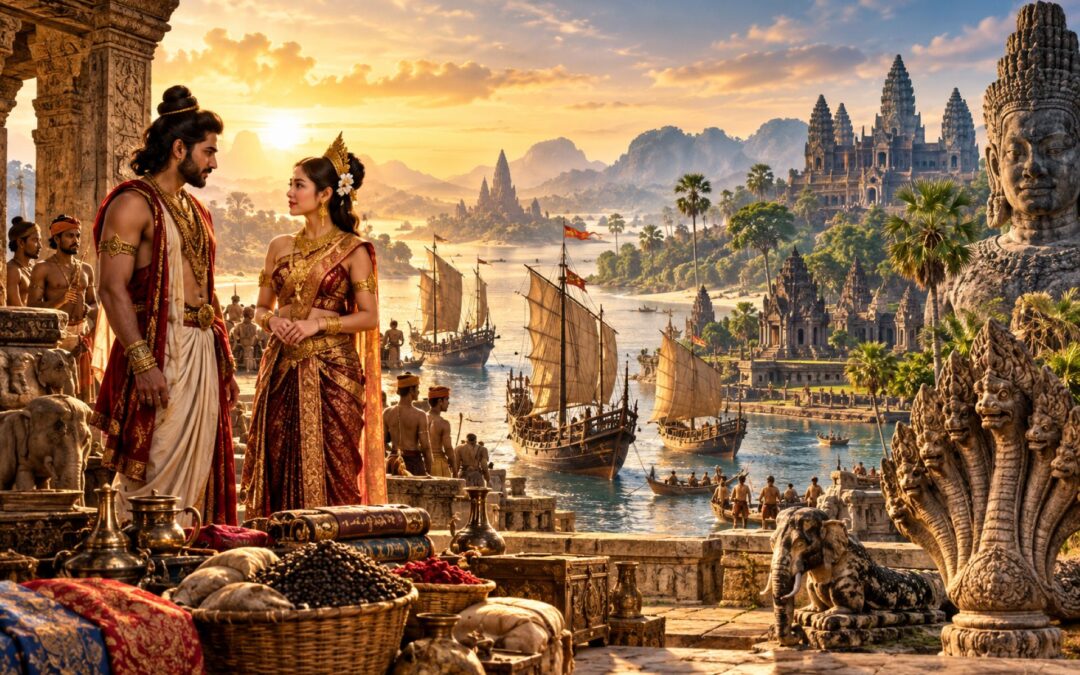
Across Southeast Asia, traces of Indian civilization appear in unexpected places. Hindu deities adorn Cambodian temples, Sanskrit inscriptions survive in ancient Indonesian kingdoms, and royal traditions reflect ideas that originated thousands of kilometres away on the Indian subcontinent. These similarities raise a fascinating question: how did Indian culture become so deeply embedded in societies separated from India by the Bay of Bengal?
One answer survives in a Cambodian founding legend about Kaundinya, an Indian stranger who married a local princess named Soma and became associated with the origins of an early kingdom. Yet the history behind this story is considerably more complicated than a romantic encounter between two people. What historians call the Indianization of Southeast Asia was a prolonged process of maritime trade, religious exchange, political adaptation, and dynastic connections in which Southeast Asian societies played an active role.
Across the Bay of Bengal: The Networks Behind Cultural Exchange
Long before Indian religious and political traditions became prominent in Southeast Asian kingdoms, merchants were connecting the two regions through the Indian Ocean. The Bay of Bengal was not an isolated stretch of dangerous water separating distant civilizations. It was part of a growing commercial world in which ports, ships, merchants, and coastal settlements formed relationships across considerable distances.
India’s eastern coastline was especially important to this development. Kalinga, associated with parts of present-day Odisha and adjoining regions, had maritime traditions remembered in stories of Sadhabas, or seafaring merchants. The region’s boatbuilding heritage is also commemorated through the boita, a traditional vessel associated with overseas voyages. These traditions preserve the cultural importance of maritime commerce, although they cannot establish the precise design of every ancient ship or the identity of individual merchants travelling to Southeast Asia.
Other coastal regions contributed to these connections. Tamil ports along the Coromandel Coast, settlements in Andhra, and trading centres in Sri Lanka linked inland agricultural and manufacturing economies with overseas markets. Indian textiles, ornaments, metal goods, and other products circulated alongside commodities obtained from neighbouring regions. Southeast Asian ports supplied forest products, aromatic substances, spices, and locally produced materials that attracted merchants from across Asia.
The seasonal monsoon winds made repeated voyages possible. Sailors learned to take advantage of changes in prevailing winds, planning outward and return journeys according to the time of year. From the Indian coastline, ships could travel toward Sri Lanka, cross the Bay of Bengal, reach the Andaman Sea, and continue toward the Malay Peninsula, Sumatra, or other regional destinations. Maritime journeys still involved dangerous weather, uncertain supplies, and the possibility of piracy, but accumulated navigational knowledge made long-distance commerce increasingly practical.
These routes should not be imagined as fixed highways followed by every vessel. Some merchants travelled between neighbouring ports, while others undertook longer crossings. Cargoes could change hands several times before reaching their final markets, allowing communities that never met directly to participate in the same commercial networks.
Archaeologist Sunil Gupta describes these interconnected processes through the concept of a Bay of Bengal interaction sphere. His approach emphasizes the movement of people, technologies, goods, and cultural practices between societies rather than treating Southeast Asia merely as a destination for Indian influence. Maritime commerce developed through relationships involving communities on both sides of the bay.
This eastern network also belonged to a wider world of exchange. During the early centuries of the Common Era, India’s commercial connections with Greece and Rome linked the subcontinent with Roman Egypt and Mediterranean markets. Precious metals, textiles, spices, and luxury goods circulated through overlapping routes, while Indian ports served both as producers’ outlets and as redistribution centres for commodities originating elsewhere in Asia.
The result was more than the movement of merchandise. Ships carried merchants who formed relationships with local authorities, religious specialists who travelled between communities, and individuals who settled permanently in foreign ports. Trade created the conditions through which ideas could travel and, more importantly, through which people in different societies could develop reasons to adopt them.
Kaundinya and Soma: A Founding Legend, Not a Biography
One of the most memorable accounts of these early encounters concerns a man usually called Kaundinya and a local princess named Soma. In a familiar telling of the legend, a stranger arrives by sea, encounters the ruler of a coastal territory, and eventually marries into the local ruling family. Their union becomes associated with the foundation of a powerful kingdom in the region of present-day Cambodia.
Some modern retellings turn this encounter into an elaborate romance. They describe Kaundinya as a wealthy Brahmin merchant from Kalinga whose ship was attacked by pirates, only for his courage to attract the admiration of a princess. Soma supposedly recognized his bravery, proposed marriage, and helped establish a new royal dynasty with him.
The difficulty is that this reconstruction combines elements of different historical traditions with details that cannot be independently verified. No surviving contemporary account establishes Kaundinya’s precise birthplace, the contents of his ship, an encounter with pirates, or Soma’s personal feelings toward him. Those details may make the story memorable, but they cannot be presented as a documented first-century biography.
The earliest relevant traditions appear in Chinese accounts concerning a polity called Funan. One narrative describes a foreign man, conventionally rendered as Hun-tien, arriving in a territory ruled by a woman known in Chinese transcription as Liuye. The stranger possesses a remarkable bow, and an encounter involving his weapon leads to the submission or marriage of the female ruler, depending on the version and its interpretation.
Later traditions associate the beginnings of royal authority with Kaundinya and Soma. A seventh-century Champa inscription refers to a marriage involving Kaundinya and the Nāga princess Soma, while still later Cambodian traditions developed related founding narratives. These stories share important themes, but their surviving forms were recorded at different times and cannot automatically be treated as descriptions of one independently established event.
Historian Michael Vickery examined these problems in Funan Reviewed: Deconstructing the Ancients. He distinguished early Chinese accounts, later inscriptional references, and the much more recent Cambodian tradition of Preah Thong and Neang Neak. The existence of similar founding motifs does not establish that every version preserves an unchanged memory of the same historical couple.
The Nāga element is especially important. Nāgas, supernatural beings frequently associated with serpents and water, appear in religious and mythological traditions across South and Southeast Asia. In Cambodian royal symbolism, connections with Nāga ancestry could express relationships between kingship, sacred territory, and indigenous legitimacy.
A marriage between a foreign ancestor and a local princess therefore carries a meaning beyond romance. It brings together two potential sources of authority: an outsider associated with prestigious connections and a woman whose lineage represents claims rooted in the land itself. Whether or not a marriage resembling the legend occurred, the story offered later rulers a way to explain why their political order possessed both local legitimacy and connections to respected religious and cultural traditions.
It is tempting to read Kaundinya and Soma as a literal explanation for how an Indian merchant founded Cambodia. A more historically responsible interpretation recognizes the legend as evidence of how communities remembered, represented, and legitimized their origins. The political history of the region must be reconstructed from a much wider body of evidence.
Funan and the Local Societies That Built Early States
The kingdom conventionally called Funan occupies an important position in the history of early Southeast Asia. Chinese sources describe rulers, diplomatic exchanges, commercial activities, and political relationships associated with a territory centred broadly on the lower Mekong region. Historians generally place the development of Funan within the early centuries of the Common Era, although its precise extent, internal organization, and political continuity remain subjects of debate.
Funan was not simply the ancient name of a unified Cambodia resembling the modern country. The term survives through Chinese historical writing, and the territory associated with it included areas of present-day southern Cambodia and southern Vietnam. Its rulers operated within a complex landscape of river settlements, agricultural communities, trading centres, and regional alliances.
Archaeological evidence shows that the region possessed substantial social and economic foundations independent of the founding legend. Sites such as Angkor Borei and Oc Eo reveal long histories of settlement, craft production, exchange, and increasing political complexity. Rivers and waterways connected communities across the Mekong Delta, while coastal routes linked them with the wider maritime economy.
The region’s geography was particularly advantageous. River systems supported settlement and agricultural production, while waterways provided access to coastal markets. Communities could participate simultaneously in inland economic relationships and overseas commerce, creating opportunities for local leaders to accumulate resources, organize labour, and establish authority.
These developments complicate the idea that an arriving Indian merchant created a kingdom from nothing. In their archaeological reassessment of Funan and mainland Southeast Asia’s earliest kingdoms, Pierre-Yves Manguin and Miriam Stark emphasize the indigenous processes underlying early political and urban development. Overseas relationships were important, but they interacted with societies that already possessed their own histories and institutions.
Trade nevertheless helped reshape the political environment. Leaders who could protect settlements, control access to valuable waterways, negotiate with merchants, and organize agricultural resources possessed opportunities to extend their influence. Commercial prosperity and political consolidation could reinforce one another without requiring the state itself to have been founded by foreigners.
Kenneth R. Hall’s study of the Indianization of Funan as an economic process helps explain this relationship. His interpretation directs attention toward trading networks, indigenous economic activity, and the development of political authority, rather than making imported Indian culture the sole cause of state formation.
Chinese accounts also describe rulers whose relationships with India or Indian religious traditions appeared important. References to figures bearing names resembling Kaundinya occur in different contexts, including traditions about a later Brahmin who supposedly introduced Indian customs or reorganized laws. Such accounts are valuable evidence for the importance attached to foreign cultural authority, but they do not prove that every similarly named ruler was the same person.
The emergence of Funan was therefore a regional historical development shaped by agriculture, trade, political competition, and cultural exchange. Indian connections contributed to that world, but they did not replace the agency of the communities already living there.
How Indian Ideas Became Instruments of Southeast Asian Kingship
The central question is not simply why Indians travelled to Southeast Asia. It is why certain ideas associated with India became valuable to Southeast Asian rulers, religious communities, and political institutions.
As trade expanded, rulers faced opportunities and challenges connected with increasing wealth, relationships among settlements, and competition between political centres. Authority over a small community did not necessarily provide all the institutions or symbols useful for governing larger networks of people. Religious prestige, formalized political ceremonies, diplomatic recognition, and written expressions of sovereignty could become valuable resources.
Indian traditions offered several possible ways of addressing these needs. By the early centuries of the Common Era, parts of the Indian subcontinent possessed established forms of royal ceremony, religious patronage, legal and political thought, written administration, and monumental architecture. Southeast Asian elites encountered these practices through merchants, travelling religious specialists, diplomatic relationships, and communities with longstanding overseas connections.
Their adoption was not necessarily evidence that existing political systems had failed. A ruler could selectively borrow prestigious forms while continuing to rely on local customs, kinship relationships, military power, and agricultural resources. Outside ideas were useful partly because local political circumstances gave them new functions.
Sanskrit became an especially important vehicle for this process. Across several Southeast Asian kingdoms, inscriptions employed Sanskrit to record royal genealogies, religious donations, political claims, and ceremonial achievements. Its prestige was connected with religious learning and the authority of traditions that extended beyond any single kingdom.
Yet the use of Sanskrit did not mean that local languages disappeared. In many places, Sanskrit and regional languages performed different functions within the same political and religious environment. Local communities adapted writing systems of Indic ancestry to record their own languages, gradually developing literary and administrative traditions with distinct identities.
Religious exchange followed a similarly selective pattern. Brahmanical traditions associated with Shiva, Vishnu, and other deities gained patronage in several kingdoms, while Buddhism developed influential institutions through monastic networks, teachers, manuscripts, and pilgrimage. These traditions did not always spread together, and rulers could support different religious practices according to their political relationships and devotional commitments.
Brahmins and other religious specialists could offer knowledge of ritual practices, sacred texts, genealogical expression, and ceremonial forms. For rulers seeking to present their authority as legitimate and cosmically meaningful, such expertise could be valuable. Royal consecrations, temple foundations, and religious donations allowed political power to be expressed through symbols recognized by influential communities.
This relationship did not require the wholesale importation of an Indian administrative class. Evidence supports the movement of specialists and the adoption of particular practices, but not a single coordinated program through which Indian immigrants replaced indigenous officials across Southeast Asia. Local courts determined how imported knowledge would fit their own political arrangements.
Marriage and kinship could also facilitate exchange. In a society where political authority depended heavily on lineage and alliances, marriage into an established ruling family might help an outsider obtain recognition. Conversely, connections with foreign merchants or specialists could give local elites access to commercial relationships, prestige, or forms of expertise that strengthened their position.
This is one reason the Kaundinya–Soma tradition carries such explanatory appeal. The foreign figure represents access to a wider cultural and commercial world, while the local princess represents established territorial and dynastic authority. Their union offers a symbolic solution to the question of how outside influences could become legitimate within an indigenous political order.
That interpretation, however, must not be mistaken for knowledge of Soma’s actual intentions or Kaundinya’s economic resources. Historians cannot measure the couple’s supposed commercial advantages or demonstrate that a particular marriage caused Funan’s territorial expansion. The importance of the story lies in the political relationship it imagines, not in a verified sequence of negotiations between two historical individuals.
A broader explanation appears in Hermann Kulke’s reconsideration of Indianization and cultural convergence. Rather than treating Southeast Asian states as Indian colonies or replicas, this approach emphasizes the interaction of indigenous political developments with cultural forms that local elites found useful.
The distinction is crucial because adopting a religious symbol or political title does not necessarily mean adopting the entire society from which it originated. A Sanskrit royal inscription could express authority over communities with their own customs and institutions. A Hindu temple could incorporate local architectural choices, sacred geography, and ritual traditions. An Indic model of kingship could acquire meanings shaped by Southeast Asian political realities.
Religious ideas also developed through the activities of people beyond royal courts. Merchants might support temples or monasteries, teachers could train local disciples, and religious communities could maintain connections across political boundaries. Over generations, traditions that initially arrived through international networks became part of local institutions capable of producing their own texts, specialists, and artistic forms.
This process was neither uniform nor irreversible. Different rulers favoured different religious institutions, political alliances changed, and cultural practices evolved across centuries. Indianization was not a single event imposed upon Southeast Asia, but an accumulation of choices made within changing local circumstances.
From Cambodia to Srivijaya: The Reach and Limits of Indian Influence
The influence of Indian religious and political traditions extended far beyond the territories associated with Funan. Across mainland and maritime Southeast Asia, rulers adopted forms of kingship, religious patronage, writing, and artistic expression connected with South Asian traditions. The results, however, varied considerably between societies.
In the Khmer world, Sanskrit inscriptions and Hindu religious practices became important elements of royal authority, while indigenous territorial traditions and local forms of sacred kingship remained significant. The monumental temples of Angkor developed centuries after Funan’s earliest recorded history, and their architecture reflected generations of local artistic experimentation. Their Indian-derived religious imagery should not obscure the creativity of the Khmer builders and institutions that produced them.
Champa, in parts of present-day Vietnam, offers another example. Cham rulers patronized Hindu religious traditions and used Sanskrit inscriptions, but their political communities emerged from an Austronesian-speaking regional environment with its own maritime connections. Indic forms became part of Cham culture without eliminating its distinct language or social history.
Farther south, Srivijaya developed into an influential maritime power associated particularly with Sumatra and surrounding commercial networks. Its position along routes connecting the Indian Ocean and the South China Sea gave it opportunities to participate in trade, diplomacy, and religious learning. Buddhism became particularly important within its intellectual and political environment.
The Chinese Buddhist pilgrim Yijing, who travelled through Southeast Asia during the seventh century, described religious study in Srivijaya and its connections with the wider Buddhist world. His accounts indicate that Southeast Asian centres could become important places for learning rather than merely receiving teachings from elsewhere. Religious knowledge circulated through institutions and communities that had acquired substantial expertise of their own.
These developments formed part of the wider network of exchanges connecting India and China through Southeast Asia. Ports in the Malay world were active commercial and cultural centres, not empty passages between two supposedly more important civilizations. Their rulers and inhabitants influenced how goods, texts, and religious specialists moved across the region.
The differences among Khmer kingdoms, Champa, and Srivijaya demonstrate why Indianization cannot be understood as a uniform transformation. Shared Sanskritic or religious influences existed alongside distinct languages, political institutions, artistic traditions, and regional priorities. Southeast Asian societies did not become Indian; they developed new forms of their own through sustained cultural interaction.
Nandivarman II and the Possible Southeast Asian Connection to the Pallavas
The movement of people and ideas across the Bay of Bengal was not necessarily confined to an eastward direction. One of the most intriguing possible examples of a connection returning toward India concerns Nandivarman II, a ruler of the Pallava dynasty in southern India.
The Pallavas governed an influential kingdom centred on Kanchipuram and other parts of the Tamil region. They were important patrons of religious institutions, Sanskrit and Tamil learning, and temple architecture. Their political history also involved prolonged competition with neighbouring powers, including the Chalukyas and Pandyas.
Their origins have generated considerable scholarly debate. Earlier theories attempted to connect the dynasty with different regional or foreign ancestries, while Pallava genealogies themselves contain accounts of prestigious descent and marriage connections. Such material is valuable for understanding royal self-representation, but dynastic origin legends cannot automatically be read as literal genealogical records.
One tradition includes a marriage involving a Nāga woman. Because Nāga symbolism also appears prominently in Southeast Asian religious and royal traditions, this has sometimes encouraged speculation about an overseas connection to the dynasty’s origins. The difficulty is that Nāgas were widespread in South Asian mythology long before such interpretations were proposed, and their presence in a genealogy does not establish that a particular ancestor came from Southeast Asia.
A more concrete historical problem emerged during the eighth century. Following the death of the Pallava ruler Paramesvaravarman II amid military conflict, the kingdom faced a succession crisis. With the immediate royal line unable to provide an uncontested successor, leading political figures sought a claimant from a collateral branch of the dynasty.
Their choice eventually fell upon the young Nandivarman, whose ancestry was traced through Hiranyavarman and an earlier Pallava line associated with Bhimavarman. Traditional accounts describe Nandivarman as approximately twelve years old when he was selected for the throne. His accession therefore depended not merely on biological descent, but on the political recognition of a claimant whose connection to the reigning line required explanation.
The Vaikuntha Perumal temple at Kanchipuram is especially important to reconstructions of this episode. Its historical reliefs and associated interpretations have been used to examine Pallava royal succession, genealogical claims, and the presentation of Nandivarman’s legitimacy. They provide evidence that the circumstances of his accession mattered to the dynasty’s political identity.
A further question concerns the geographical origins of Hiranyavarman’s branch. Some scholars have considered the possibility that this line was established outside the Pallavas’ immediate South Indian heartland. Dennis Hudson, in his examination of Nandivarman’s royal career and the Vaikuntha Perumal temple’s historical imagery, developed an interpretation involving a Cambodian connection.
This possibility makes Nandivarman’s story particularly interesting within the wider history of Indian–Southeast Asian relations. If a collateral Pallava branch had established itself in Southeast Asia before one of its descendants returned to assume the Kanchipuram throne, it would represent a remarkable dynastic connection crossing the Bay of Bengal in both directions.
But that interpretation must remain distinct from established facts about the succession. The available evidence does not justify describing Hiranyavarman as a securely identified ruler of Champa, or asserting that Nandivarman possessed a definitively established mixed Indian and Southeast Asian ancestry. Nor does the existence of Nāga symbolism independently prove the same connection.
Nandivarman’s subsequent reign was lengthy and politically demanding. His position had to be maintained in the face of challenges involving rival claimants and competing South Indian powers. Royal patronage and the presentation of dynastic legitimacy remained important, but his career cannot be reduced to the assumption that an overseas background automatically made him a more successful ruler.
The significance of the episode lies partly in what it reveals about the possibilities and limitations of historical reconstruction. Pallava political relationships existed within a world of maritime connections, and an overseas dynastic link is a legitimate subject of scholarly investigation. Yet a plausible interpretation of those links is not equivalent to a fully documented biography of an Indian prince returning from a Southeast Asian kingdom.
Even with these uncertainties, the succession demonstrates that the historical relationship between India and Southeast Asia cannot be understood solely as the export of ideas from one fixed centre. The same maritime world that supported religious and commercial movement also created opportunities for personal, diplomatic, and potentially dynastic connections across political boundaries.
What “Indianization” Gets Wrong About a Shared History
The term Indianization remains useful because it identifies an important historical pattern: the appearance and adaptation of Indian-derived religious, linguistic, artistic, and political traditions across much of Southeast Asia. The problem begins when that pattern is interpreted as proof that Indian civilization was simply transplanted into societies that possessed little of their own.
Older historical interpretations sometimes described Southeast Asian kingdoms as extensions of a Greater Indian cultural world. Such approaches recognized genuine Indian connections but could underestimate the importance of indigenous political institutions, local religious traditions, and Southeast Asian participation in maritime commerce. Modern scholarship has increasingly challenged the assumption that resemblance necessarily implies dependence.
Cultural influence is also not the same as political colonization. Indian merchants, religious specialists, and travelling elites contributed to exchanges that often proceeded through patronage, settlement, marriage, and voluntary adaptation. That does not mean every interaction was peaceful or that Indian–Southeast Asian relations remained free from military coercion.
The distinction becomes especially clear in later history. In 1025, Rajendra Chola launched a major expedition against Srivijaya, striking important maritime centres across the region. As the history of the Chola Empire’s maritime expansion demonstrates, commercial connections could coexist with political competition and warfare. The presence of shared cultural traditions did not eliminate conflict between powerful states.
Nor was Indian influence always dominant or exclusive. Southeast Asian societies developed through relationships involving local communities, regional neighbours, Indian merchants, Chinese networks, and other participants over successive centuries. Their religious and political identities changed as circumstances changed, rather than following an inevitable movement toward a single imported civilization.
Kaundinya and Soma illustrate how royal traditions could explain the union of foreign prestige and local legitimacy. Nandivarman II illustrates how dynastic connections might have crossed the same maritime world in the opposite direction, even though important details remain contested. Neither episode can bear the historical weight of a claim that one civilization created another.
The more convincing picture is one of cultural convergence, in which Southeast Asian communities adopted external influences and transformed them into locally meaningful institutions. The Sanskrit inscriptions, Hindu and Buddhist temples, royal genealogies, and artistic traditions that survive today are evidence of those relationships, but also of the independent creativity of the societies that developed them.
Indian influence became deeply embedded in Southeast Asia because centuries of trade, migration, religious learning, and political relationships made certain ideas valuable to the communities that encountered them. Those communities did not simply preserve Indian civilization in a foreign setting. They reworked its traditions through their own languages, institutions, sacred landscapes, and political ambitions, producing cultures that were connected to India without being copies of it.
The enduring significance of Indianization therefore lies in the history of exchange itself. The similarities visible across South and Southeast Asia are genuine, but their origins cannot be reduced to one legendary merchant, one royal marriage, or a single act of cultural transmission. They emerged through generations of people who crossed the sea, established relationships, adopted unfamiliar ideas, and turned them into something of their own.
Last Updated on October 26, 2026 by Aseem Gupta