
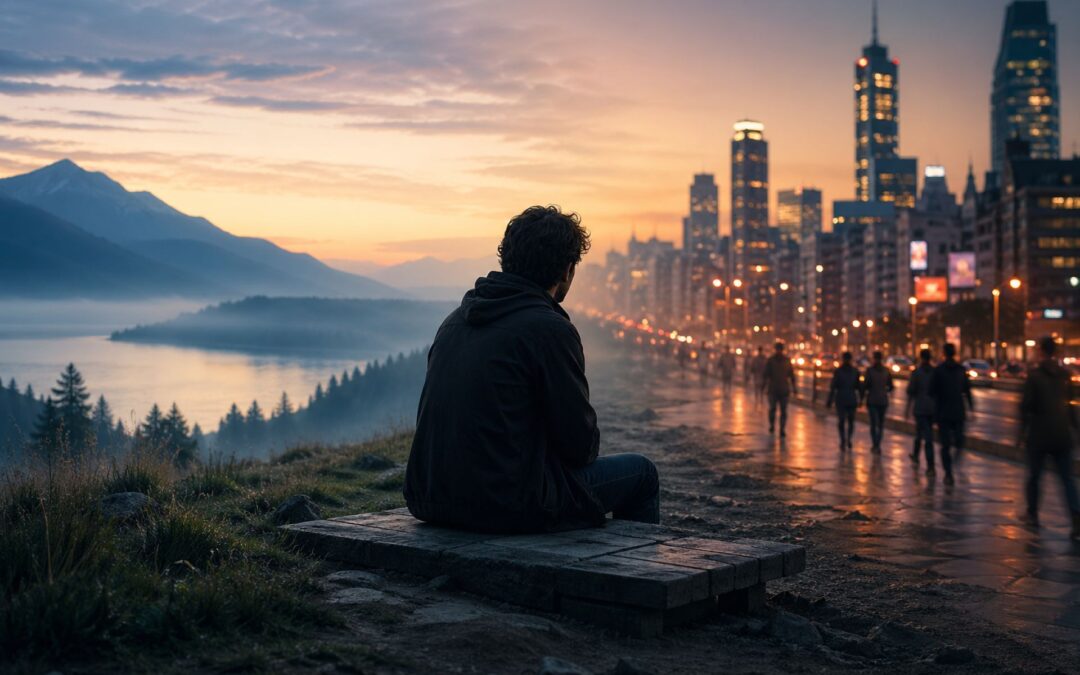
There’s a quiet kind of person who moves through the world a little differently.
Not withdrawn in the traditional sense. Not broken. Not incapable of connection. But someone who, despite understanding the value of people, feels most at ease when alone.
If you’ve ever felt drained after social gatherings, if you’ve ever left a room full of people just to breathe again, or if you’ve ever questioned why solitude feels more natural than belonging—then you already understand this experience.
Being a loner isn’t about disliking people. In fact, it often comes from the opposite place. You can appreciate deep relationships, meaningful conversations, even moments of shared joy. But there’s something about groups—the expectations, the subtle pressures, the constant stimulation—that slowly begins to feel restrictive.
It’s as if your thoughts become less your own. Your movements slightly adjusted. Your identity, diluted just enough to fit in.
And after a while, you want out.
You want silence. Space. The ability to exist without being observed or influenced. A place where your mind can settle back into its natural rhythm.
But here’s where things become complicated.
Because no matter how much you value solitude, you’re still human. And being human means carrying a need for connection—whether you like it or not.
Some of your best memories likely involve other people. Moments of laughter, shared struggles, unexpected closeness. Even if you prefer to be alone most of the time, those experiences still matter.
This creates a tension that’s hard to resolve.
You feel better alone, yet you don’t want to be completely alone. You crave independence, yet you can’t entirely disconnect. You move away from people, only to realize that life without them feels incomplete.
So the real question isn’t simply how to be a loner.
It’s how to live this way without losing yourself in the process.
Because taken too far, solitude can turn into isolation. And forced too far in the other direction, social life can feel suffocating.
Somewhere in between those extremes, there’s a way of living that allows you to keep your independence without cutting yourself off from life itself.
That’s what this article is about.
The Meaning of Being a Loner
The word “loner” often carries the wrong weight.
It tends to suggest someone antisocial, disconnected, or even emotionally distant. But that interpretation misses something important. Being a loner isn’t necessarily about avoiding people—it’s about how you relate to them.
At its core, a loner is simply someone who doesn’t rely on constant social presence to feel complete.
You don’t need to be surrounded by others to feel secure in yourself. You don’t feel the urge to belong to a group just for the sake of belonging. And while you can form meaningful relationships, you don’t feel defined by them.
In fact, what sets a loner apart is not the absence of connection, but the freedom from dependency on it.
This is why many loners still have friends, relationships, and social lives—just on their own terms. They might see people less frequently, avoid large gatherings, or prefer one-on-one interactions over group dynamics. Not because they dislike others, but because they value depth over frequency, and authenticity over conformity.
There’s also a strong sense of inner orientation.
While many people look outward for validation, direction, or identity, loners tend to look inward. Decisions are often guided by personal reflection rather than group consensus. This can make them appear distant, but in reality, it’s a form of independence.
And independence comes with both strength and friction.
Because the world is largely structured around groups—teams, communities, networks, social circles. Choosing not to fully integrate into these systems can feel like stepping slightly outside the default path of life.
You’re present, but not entirely absorbed.
Connected, but not attached.
And that subtle distance is where both the challenge and the advantage of being a loner begins.
Why Some People Naturally Prefer Solitude
For some, solitude is not something they learn—it’s something they recognize.
It feels familiar, almost instinctive. While others seek out noise, activity, and constant interaction, you find yourself drifting in the opposite direction, not out of resistance, but because it simply feels more natural.
There isn’t always a clear explanation for this.
Part of it may come down to temperament. Some people are more sensitive to external stimuli—the sounds, conversations, movements, and subtle social cues that fill shared spaces. What feels energizing to one person can feel overwhelming to another. Over time, solitude becomes less of a preference and more of a necessity—a way to return to balance.
Then there’s the role of experience.
Life shapes how comfortable we feel around others. Certain environments, relationships, or moments in the past can make solitude feel safer, more predictable, more controllable. When being alone means not having to adjust, perform, or navigate expectations, it begins to feel like a form of relief.
But even beyond sensitivity or experience, there’s something deeper at play.
Some people are simply more internally oriented. Their attention naturally turns inward—to thoughts, ideas, reflections. They don’t feel the same pull toward external stimulation because their inner world is already rich enough to occupy them.
Silence, for them, isn’t empty. It’s full.
This is why long periods alone don’t necessarily feel like deprivation. Instead, they can feel productive, restorative, even meaningful. Time spent alone becomes time spent thinking, processing, creating, or simply existing without interruption.
At the same time, this natural inclination can create a quiet sense of difference.
You notice that others seem to thrive in environments that drain you. They move easily through social spaces, draw energy from interactions, and rarely seem to need the same kind of retreat. Meanwhile, you find yourself stepping back, not because you want to disconnect, but because you need space to stay grounded.
And this raises a question that often lingers in the background:
Is this just who you are?
Or is it something that can—and should—be changed?
The answer isn’t simple. And more importantly, it may not be the right question to ask.
The Hidden Cost of Belonging to Groups
There’s a reason groups feel good.
They offer identity. A sense of belonging. A shared rhythm of thinking, speaking, and behaving that makes life feel smoother, more predictable. When you’re part of a group, you don’t have to define everything from scratch—you inherit a structure.
And for a while, that can feel comforting.
But there’s a trade-off that often goes unnoticed.
Because the more you integrate into a group, the more subtle adjustments you begin to make. You soften certain opinions. You hold back thoughts that don’t quite fit. You align your behavior—not always consciously, but gradually—so that you remain accepted within the collective.
Individually, these compromises seem small. Almost harmless.
But over time, they accumulate.
What starts as belonging can slowly become conformity.
Your movements are no longer entirely your own. Your thinking begins to orbit around shared assumptions. Even your sense of self can start to blur at the edges, shaped not just by who you are, but by what the group reinforces.
For many people, this is a natural and acceptable trade. The comfort of belonging outweighs the cost of adaptation.
But for someone who values independence, this process can feel suffocating.
It’s not that the group is doing anything wrong. It’s simply that its very nature requires a certain level of alignment. And for a loner, too much alignment begins to feel like a loss of freedom.
You start to notice it in small ways.
A growing restlessness during conversations. A quiet urge to step away. A sense that your inner world is being compressed into something more manageable for others.
And eventually, you reach a point where you need to leave—not out of rejection, but out of self-preservation.
This is why many loners drift in and out of social circles rather than settling permanently within them.
They can participate, connect, even enjoy the experience—but only for a limited time. Beyond that, the cost becomes too high.
And so they return to solitude.
Not because they don’t value people, but because they value something else just as much—the ability to remain fully themselves.
The Energy Drain of Social Environments
For some people, social environments are energizing.
They walk into a crowded room and come alive. Conversations spark momentum, noise becomes stimulation, and interaction feels like fuel.
But for a loner, the same environment often works in reverse.
It’s not just about preference—it’s about energy.
Being around people requires constant processing. You’re picking up on tone, body language, expectations, subtle shifts in conversation. Your attention is pulled in multiple directions at once, whether you realize it or not. Add to that the noise, the movement, the unpredictability of social situations—and it becomes a lot to handle.
At first, it might feel manageable. Even enjoyable.
But over time, something starts to build.
A quiet sense of overstimulation. A mental fatigue that doesn’t come from doing anything physically demanding, but from simply being present in a space that never fully settles.
You might notice it in moments like these:
A growing difficulty in following conversations.
An increasing sensitivity to sound.
A subtle urge to withdraw, even when nothing is wrong.
And eventually, a single clear thought emerges:
You need to leave.
Not because you dislike the people. Not because the situation is bad. But because your mind has reached its limit.
This is something many loners come to understand about themselves over time—that social interaction, even when positive, has a cost.
It consumes energy.
And unlike those who recharge through interaction, you recover through absence. Through silence. Through stepping away from stimulation and returning to a space where nothing is being demanded of you.
This is why solitude feels so essential.
It’s not just a preference—it’s a reset.
A way to clear the noise, process everything you’ve absorbed, and return to a state where your thoughts are your own again.
Without that space, everything begins to blur together. The external world starts to crowd out the internal one.
And for someone who relies on that internal space, that’s not just uncomfortable—it’s unsustainable.
The Paradox of the Loner: Wanting Connection While Avoiding It
At first glance, being a loner seems simple.
You prefer solitude. You avoid unnecessary social interaction. You feel more like yourself when you’re alone.
But if you look a little closer, things don’t quite add up.
Because despite all of this, you still care about people.
You still remember certain conversations long after they’ve ended. You still value the rare moments of genuine connection. And some of your most meaningful experiences—the ones that stay with you—often involve others.
This is where the paradox begins.
You feel better alone, yet you don’t want to be completely alone.
You withdraw from groups, yet you still crave understanding. You protect your space, yet part of you wants to share it—just not with everyone, and not all the time.
It’s a tension that doesn’t resolve itself easily.
On one side, there’s the clarity and calm that comes with solitude. On the other, the depth and richness that only connection can provide. Lean too far in either direction, and something starts to feel off.
Too much isolation, and life begins to feel empty.
Too much social involvement, and you begin to feel overwhelmed.
So you move back and forth between the two.
You step into the world, engage, connect—and then retreat again. You take in experiences, emotions, interactions… and then you need time to process them. Sometimes more time than others.
It’s almost like your mind digests life differently.
Where others can move quickly from one experience to the next, you need pauses. Space to reflect, to make sense of things, to let moments settle before you move on.
And without those pauses, everything starts to feel excessive.
This is why being a loner isn’t about choosing one side over the other.
It’s about managing a constant pull in both directions.
You don’t fully belong to solitude, and you don’t fully belong to the crowd.
You exist somewhere in between—seeking connection, but only in a way that doesn’t cost you your sense of self.
And learning how to navigate that space… is where the real challenge begins.
Is It Nature, Experience, or Both?
At some point, the question naturally comes up:
Why am I like this?
Is it something you were born with? A temperament shaped from the beginning? Or is it the result of experiences—moments that slowly pushed you toward solitude over time?
The honest answer is: it’s probably both.
Some people seem to arrive in the world already leaning inward. As children, they spend more time observing than participating. They’re comfortable alone, not because they’ve learned to be, but because it feels natural. For them, solitude isn’t an escape—it’s a baseline.
But life doesn’t leave that baseline untouched.
Experiences shape how that natural tendency develops. The environments you grow up in, the relationships you form, the moments that leave a mark—whether positive or difficult—all contribute to how strongly you move toward or away from others.
Maybe certain situations made social interaction feel draining or unpredictable. Maybe being alone felt simpler, more stable, more within your control. Over time, what began as a preference may have solidified into a pattern.
And yet, even if you could trace every reason, every influence, every cause…
Would it really change anything?
There’s a tendency to believe that understanding the origin will somehow resolve the present. That if you can explain why you are the way you are, you’ll know what to do about it.
But in many cases, the explanation doesn’t alter the reality.
You are who you are—at least for now.
And instead of trying to undo that, the more useful question becomes:
How do I work with this?
Because being a loner isn’t inherently a problem to fix. It’s a way of being that comes with its own strengths, its own limitations, and its own rhythm.
You can spend a long time trying to become someone else. Forcing yourself into environments that don’t suit you, measuring yourself against people who operate differently, treating your natural inclinations as something to overcome.
Or you can start from where you are.
Not as a final identity, but as a starting point.
From there, the goal isn’t to eliminate your preference for solitude. It’s to understand it well enough that it stops working against you—and starts working for you instead.
The Strength Found in Solitude
Solitude is often misunderstood as an absence.
An absence of people. Of activity. Of connection.
But in reality, it can be a resource.
When you’re alone, something shifts. The constant input from the outside world fades, and your attention turns inward. Thoughts become clearer. Ideas have space to form. You’re no longer reacting—you’re observing, reflecting, creating.
This is why solitude has always been tied to depth.
Many artists, writers, and thinkers have relied on it—not because they rejected the world, but because stepping away from it allowed them to see it more clearly. Without interruption, without pressure to respond or perform, the mind begins to operate differently.
More independently.
More honestly.
You’re not filtering your thoughts through how they’ll be received. You’re not adjusting your perspective to fit a group. What emerges in that space is often closer to what you actually think and feel.
And that clarity has value.
It allows you to make decisions that align with you, not just with what’s expected. It gives you a stronger sense of direction, one that isn’t constantly influenced by external noise. Over time, this builds a kind of quiet confidence—not loud or performative, but grounded.
There’s also a creative advantage.
When you’re constantly surrounded by others, your attention is fragmented. But in solitude, it consolidates. You can follow a thought without interruption. Explore an idea fully. Sit with a problem long enough for something original to emerge.
This is where a lot of meaningful work happens.
Not in the presence of others, but in the absence of distraction.
At the same time, solitude strengthens your ability to be with yourself.
That might sound simple, but it’s not.
Many people struggle with being alone because it forces them to face their own thoughts without distraction. But if you spend enough time in solitude, that discomfort begins to fade. You become more familiar with your inner world, more capable of navigating it without needing constant escape.
And that’s a form of resilience.
Because when you’re comfortable alone, you’re less dependent on external validation, constant stimulation, or the presence of others to feel stable.
You carry your sense of stability with you.
This doesn’t mean solitude is always easy. It has its own challenges, its own moments of doubt or emptiness. But when approached consciously, it offers something that’s difficult to find elsewhere:
A space where you can think clearly, create freely, and exist without compromise.
The Danger of Slipping Into Isolation
Solitude, when chosen, can be powerful.
But there’s a point where it stops being a choice.
The shift is subtle. Almost invisible at first.
You begin by stepping away from situations that drain you. You protect your time, your energy, your space. That feels right. Necessary, even. But over time, the line between recharging and withdrawing can start to blur.
You say no more often.
You delay responding.
You avoid situations you might have tolerated before.
And slowly, without realizing it, your world becomes smaller.
This is where solitude begins to turn into isolation.
The difference isn’t just about being alone—it’s about disconnection.
In solitude, you’re still connected to life. You engage, you experience, you return to yourself when needed. There’s movement between you and the world.
In isolation, that movement stops.
You’re no longer stepping away from something—you’re staying away from everything.
At first, it might even feel comfortable. There’s less friction. Fewer demands. No need to navigate expectations or social complexity.
But something else starts to fade.
Perspective.
When you spend too much time alone, your thoughts begin to loop. Without external input, there’s nothing to challenge them, expand them, or ground them. Small concerns can grow larger than they are. Assumptions go unchecked.
And over time, the absence of connection doesn’t feel like peace—it starts to feel like emptiness.
There’s also a practical cost.
Relationships require maintenance. Not constant attention, but some level of presence. When that disappears completely, connections weaken. Opportunities pass. Life continues moving, but you’re no longer part of its flow.
This is why awareness matters.
Not to force yourself into social situations that feel wrong, but to recognize when your preference for solitude is quietly turning into avoidance.
Because once isolation becomes the default, it’s much harder to step back out.
The world doesn’t close its doors—but it becomes easier to believe it has.
And that belief can keep you locked in a space that no longer serves you.
Solitude gives you strength.
Isolation slowly takes it away.
Finding the Balance Between Solitude and Participation
If there’s one thing that becomes clear over time, it’s that neither extreme works.
Living entirely for yourself—cut off from others, detached from the world—eventually turns empty. But constantly surrounding yourself with people, forcing connection, and suppressing your need for space leads to a different kind of exhaustion.
Both paths take something from you.
So the answer isn’t choosing one over the other.
It’s learning how to move between them.
Balance, in this context, doesn’t mean equal time alone and with others. It means intentional engagement. Choosing when to step into the world and when to step away—not out of habit, but with awareness.
For a loner, this often looks like being selective.
You don’t need constant interaction. You don’t need large groups or frequent gatherings. But you do need some connection—conversations that matter, relationships that feel genuine, moments that pull you out of your own head and into shared experience.
The key is quality over quantity.
A single meaningful interaction can be more fulfilling than hours spent in shallow social environments. And because you’re not trying to force yourself into every situation, the ones you do choose become more intentional, more aligned with who you are.
At the same time, solitude needs boundaries too.
Left unchecked, it can expand until it takes over everything. That’s why it helps to create small points of contact with the world—regular habits that keep you engaged without overwhelming you.
It could be meeting a friend occasionally.
Participating in something that interests you.
Allowing yourself to show up, even when part of you resists.
Not constantly. Not excessively. Just enough to stay connected.
Because connection isn’t something you either have or don’t have—it’s something you maintain.
And balance isn’t something you achieve once and keep forever.
It shifts.
There will be periods where you need more solitude, and others where you feel more open to interaction. The important thing is not to get stuck in one mode for too long.
To remain flexible.
To recognize when you’re withdrawing too much, or pushing yourself too far.
And to adjust.
In the end, living as a loner isn’t about isolating yourself from the world. It’s about finding a way to exist within it—without losing the space that allows you to feel like yourself.
Living Well as a Loner
Once you stop fighting your nature, something important changes.
You no longer see your preference for solitude as a flaw to fix or a limitation to overcome. Instead, it becomes something to work with—something that, when understood properly, can shape a life that actually fits you.
Living well as a loner isn’t about following a strict set of rules. It’s about creating conditions where both your independence and your need for connection can coexist without constantly pulling you apart.
That starts with accepting your rhythm.
You may never enjoy constant social activity. You may never feel completely comfortable in large groups or high-stimulation environments. And that’s fine. Trying to force yourself into those patterns usually leads to frustration, not growth.
But acceptance doesn’t mean avoidance.
It means choosing your challenges carefully.
There are situations worth stepping into, even if they feel uncomfortable. Not every discomfort is a sign that something is wrong—sometimes it’s just unfamiliar. The difference lies in whether the situation expands your life or drains it without return.
Over time, you learn to tell the difference.
You also begin to shape your environment more deliberately.
The way you structure your days, the kind of work you do, the people you keep around you—these things matter more when you’re sensitive to overstimulation. A life that constantly demands your attention outward will leave you exhausted. But a life that allows space for reflection, autonomy, and controlled interaction can feel deeply satisfying.
There’s also value in maintaining a small number of strong connections.
You don’t need a wide social circle. You don’t need constant contact. But having a few people who understand you—who don’t demand more than you can give, and who don’t disappear when you need space—creates a kind of stability that solitude alone can’t provide.
These relationships don’t have to be frequent to be meaningful.
They just have to be real.
And perhaps most importantly, you learn not to measure your life against others.
A loner’s path doesn’t always look like the conventional one. It may appear quieter, less socially active, less visible from the outside. But that doesn’t make it empty.
In fact, when lived intentionally, it can be just as rich—filled with thought, creativity, depth, and moments of connection that feel genuine rather than routine.
There will always be a bit of tension.
Moments where you question whether you’re too distant or not involved enough. Moments where you wonder if you’re missing out or holding yourself back.
That doesn’t disappear completely.
But over time, it becomes easier to navigate.
Because you’re no longer trying to be something else.
You’re learning how to live well as who you already are.
Conclusion
Being a loner isn’t a problem to solve.
It’s a way of experiencing life—one that comes with its own rhythm, its own challenges, and its own quiet strengths.
You may always need more space than others. You may never fully enjoy the constant presence of groups or the pressure to belong. And there will likely always be moments where you question yourself—where you wonder if you should be more social, more involved, more like everyone else.
But the answer isn’t to force yourself into an identity that doesn’t fit.
Nor is it to retreat so far into solitude that you lose touch with the world entirely.
The real path lies somewhere in between.
In recognizing that solitude can give you clarity, independence, and depth—but connection gives life texture, meaning, and shared experience. One without the other is incomplete.
So you move between them.
You step into the world when it matters.
You step away when you need to.
Not perfectly. Not always with certainty. But with increasing awareness.
Because in the end, living well as a loner isn’t about choosing isolation or constant connection.
It’s about learning how to belong to yourself—without disconnecting from everything else that makes life worth living.