
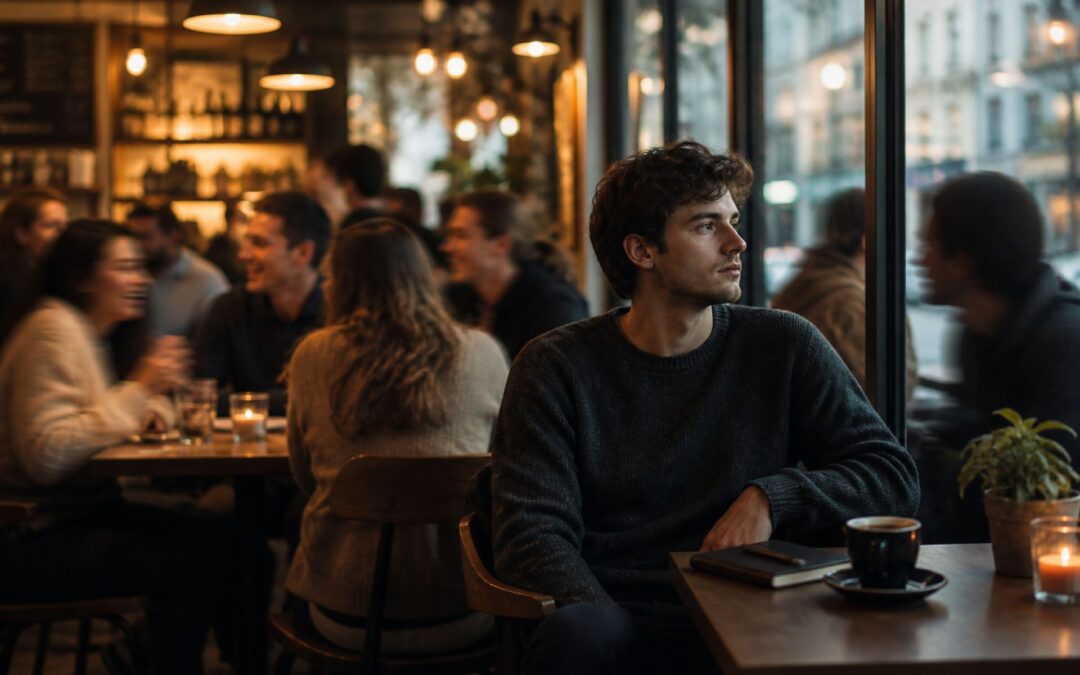
The Misunderstood Nature of Being Alone
In a world that constantly celebrates connection, visibility, and social presence, being alone is often treated with suspicion. The person who prefers solitude is rarely seen as someone making a conscious choice. Instead, they are labeled—quietly or openly—as an outsider, someone who doesn’t quite fit, someone who must be lacking something essential.
There’s an unspoken assumption beneath this judgment: if someone is alone, it must be because they cannot belong.
And to be fair, sometimes that assumption holds a grain of truth. There are people who withdraw from others because they struggle to connect, because past experiences have left them guarded, or because social interaction feels more draining than fulfilling. In these cases, solitude is not always a preference—it can be a consequence.
But this is only one side of the story.
What often goes unnoticed is that solitude can also be a deliberate act. Not an escape born of weakness, but a choice rooted in clarity. A refusal to participate in environments, relationships, or dynamics that feel misaligned, exhausting, or harmful. The problem is that society rarely distinguishes between the two. It tends to flatten all forms of aloneness into a single narrative: something must be wrong.
Part of this misunderstanding comes from fear. The solitary individual is difficult to read. Without constant social interaction, there are fewer signals to interpret, fewer behaviors to categorize. This lack of visibility creates a kind of ambiguity—and ambiguity makes people uncomfortable. The “lone wolf” becomes a figure of projection, someone onto whom others can cast assumptions, doubts, even quiet unease.
At the same time, we are conditioned to believe that happiness is inherently social. That joy is found in shared experiences, laughter, companionship. And while this is undeniably true, it is only half the picture. The same people who bring comfort can also bring conflict. The same relationships that offer meaning can also become sources of stress, disappointment, and pain.
Human interaction, for all its beauty, is not neutral. It comes with friction.
And for those who have experienced that friction repeatedly—through toxic environments, judgment, betrayal, or simply the exhausting demands of constant social negotiation—solitude begins to take on a different meaning. It is no longer seen as absence, but as relief. Not as isolation, but as space.
Space to think without interruption.
Space to exist without being evaluated.
Space to be, without needing to perform.
This is where the misunderstanding deepens. Because from the outside, solitude and loneliness can look identical. Both involve being alone. Both involve distance from others. But internally, they are worlds apart.
Loneliness is the pain of wanting connection and not having it.
Solitude is the peace of not needing it—at least for a while.
When people fail to see this distinction, they misinterpret those who choose to step away. What might be a healthy boundary is mistaken for withdrawal. What might be self-preservation is seen as avoidance.
But the truth is simpler, and perhaps more uncomfortable: not all forms of togetherness are worth the cost they demand. And not all forms of aloneness are something to be fixed.
Sometimes, being alone is not a problem.
Sometimes, it is the solution.
The Hidden Cost of Human Interaction
We like to believe that human connection is an unquestionable good. That more interaction means more happiness, more meaning, more fulfillment. And in many cases, that belief holds. Relationships can elevate us, support us, and bring a richness to life that solitude alone cannot provide.
But there’s a side to this equation that we tend to ignore.
Every interaction carries a cost.
Not always a visible one. Not always immediate. But it’s there—in the form of compromise, expectation, emotional labor, and, at times, quiet resentment. To be around others is to enter a constant negotiation. You adjust your words, your tone, your behavior. You hold back certain thoughts, soften certain truths, and adapt yourself—subtly or significantly—to maintain harmony.
Over time, this adds up.
In environments where the people around us are supportive, respectful, and aligned with our values, this cost feels minimal. The trade feels fair. What we give is balanced by what we receive. But in less ideal situations, the imbalance becomes harder to ignore.
Think about workplaces where tension lingers beneath polite conversations. Where competition, ego, or passive aggression shape the atmosphere more than the work itself. Often, it isn’t the tasks that exhaust people—it’s the constant navigation of personalities, the need to read between the lines, the unspoken pressures that come with simply being around others.
The same applies to schools, social circles, even families. A single toxic presence can alter the entire experience. A harsh comment, a dismissive attitude, a pattern of judgment—these things don’t disappear when the interaction ends. They linger. They accumulate.
We don’t just experience people in the moment. We carry them with us afterward.
This is why human interaction is never purely positive or purely negative. It is, at its core, a trade-off. The more we engage, the more we open ourselves to both the light and the shadow of others. And while the rewards can be meaningful, the costs can be draining in ways that are difficult to articulate.
The Roman emperor and Stoic philosopher Marcus Aurelius captured this reality with striking honesty. He described the people he encountered as meddling, ungrateful, arrogant, dishonest, jealous, and surly—not out of bitterness, but out of clear observation. His point wasn’t that all people are like this, but that these traits are part of the human condition. To interact with others is to inevitably encounter them.
And to endure them.
This doesn’t mean withdrawing from all human contact. But it does challenge the assumption that more interaction is always better. Sometimes, what drains us is not life itself, but the constant exposure to the unresolved parts of others—their insecurities, their projections, their unexamined behaviors.
In such cases, solitude becomes less of an absence and more of a refuge.
A place where the noise quiets down.
Where the need to adapt disappears.
Where the subtle weight of social friction is lifted, even if only temporarily.
It’s in this contrast that the value of solitude begins to reveal itself more clearly. Not as a rejection of people, but as a response to the hidden costs of being around them.
The Freedom Found in Solitude
There is a kind of freedom that only becomes visible once everything else falls away.
No expectations.
No interruptions.
No need to explain yourself, adjust yourself, or accommodate anyone else.
When you are alone, truly alone, something shifts. The constant background noise of social life—the subtle awareness of being seen, evaluated, or responded to—disappears. And in its place, there is space. Not just physical space, but psychological space. A quiet that isn’t empty, but full of possibility.
In solitude, your time belongs entirely to you.
You wake up when you want. You move through your day at your own pace. You arrange your surroundings exactly as you like, without compromise. Every object, every routine, every decision reflects your preferences alone. There is no negotiation, no silent adjustment to fit someone else’s rhythm.
It’s a rare kind of autonomy—one that feels almost radical in a world built on coordination and compromise.
But the freedom of solitude goes deeper than control over time and space. It extends into thought.
Around others, even in subtle ways, we filter ourselves. We hold back certain ideas, shape our opinions to be more acceptable, soften our edges to avoid friction. This isn’t always conscious, but it happens. Social life, by its nature, requires a degree of self-regulation.
In solitude, that pressure disappears.
You can think without interruption, without needing your thoughts to make sense to anyone else. You can explore ideas freely, follow them wherever they lead, without worrying about how they’ll be received. There is no audience, no judgment, no expectation of coherence or politeness.
You are, for once, entirely yourself.
This is why solitude can feel not just peaceful, but intoxicating.
The absence of judgment.
The relief from expectation.
The ability to exist without performance.
It creates a sense of ease that is hard to replicate in social environments. And once experienced deeply, it can become something you crave—not out of avoidance, but out of recognition. You realize how much of your daily energy is spent navigating others, and how different it feels when that demand is removed.
In this state, even the simplest things take on a different quality. Silence feels richer. Time feels slower. Activities that once seemed mundane—reading, thinking, walking, simply sitting—become more absorbing, more complete.
There is no fragmentation of attention. No pull in multiple directions.
Just presence.
This is the quiet appeal of solitude. Not as an escape from life, but as a return to it in a more direct, unmediated way. A space where you are not reacting, not adjusting, not performing—but simply existing on your own terms.
And once you’ve tasted that kind of freedom, it becomes difficult to ignore how often it is absent in the presence of others.
Why Philosophers Valued Solitude
Long before modern concerns about overstimulation and social exhaustion, philosophers had already recognized something essential about solitude: it is not merely an absence of others, but a condition that makes certain kinds of thought and experience possible.
For many of them, solitude wasn’t a retreat from life—it was a way of seeing it more clearly.
Arthur Schopenhauer expressed this idea with blunt precision. He argued that a person can only truly be themselves when they are alone. In his view, the presence of others inevitably shapes behavior, subtly or overtly. We adjust, we perform, we conform. And while this may be necessary for social life, it comes at a cost: the dilution of individuality.
Solitude, for Schopenhauer, restores that individuality. It removes the pressure to be anything other than what you are. And in doing so, it reveals a deeper connection between solitude and freedom. Not freedom in the external sense, but the internal freedom to think, feel, and exist without interference.
A similar sentiment appears in the reflections of Jean-Jacques Rousseau. Disillusioned with the hostility and artificiality he perceived in society, Rousseau found comfort in withdrawing from it. But his solitude was not empty. It was filled with a different kind of presence—the presence of nature.
Away from the noise of social life, he discovered a quieter, more sincere form of contentment. One that didn’t depend on validation, competition, or comparison. In solitude, he could step outside the constant friction of human interaction and reconnect with something more stable, more grounding.
This movement away from society and toward something more essential reaches a particularly vivid expression in the life of Henry David Thoreau. His experiment at Walden Pond was not an act of isolation for its own sake, but an attempt to strip life down to its essentials.
Living alone in the woods, Thoreau sought simplicity, self-sufficiency, and clarity. What he found was not deprivation, but richness. Without the constant distractions of social life, he became more attentive—to nature, to his own thoughts, to the passage of time itself.
His solitude wasn’t about rejecting the world, but about engaging with it more directly, without the filters imposed by society.
What unites these perspectives is not a rejection of human connection, but a recognition of its limits. Each of these thinkers saw that constant interaction, while valuable, can obscure something fundamental. It can pull attention outward, away from the inner life, away from deeper reflection.
Solitude, in contrast, creates the conditions for that reflection to emerge.
It allows questions to surface that would otherwise be drowned out. It creates distance—not just from others, but from assumptions, habits, and inherited ways of thinking. And in that distance, there is an opportunity to see more clearly: who you are, what you value, and how you want to live.
This is why solitude has held such enduring appeal for philosophers. Not because they rejected society entirely, but because they understood that without moments of separation, it becomes difficult to understand anything at all—including ourselves.
The Spiritual Power of Walking Alone
Beyond philosophy, solitude has long been seen as something deeper—something almost sacred.
Across spiritual traditions, stepping away from the crowd is not viewed as withdrawal, but as a necessary movement inward. A deliberate turning away from noise, distraction, and attachment, in order to encounter something more fundamental.
In Buddhism, solitude is not just encouraged—it is often essential. The path toward clarity, insight, and liberation requires distance from the constant stimulation of social life. Not because people are inherently bad, but because interaction tends to entangle us. It pulls us into cycles of desire, expectation, comparison, and emotional reactivity.
When you step away from that cycle, even temporarily, something changes.
Your attention, no longer scattered across countless interactions, begins to settle. You start to observe rather than react. You notice patterns in your thoughts, your impulses, your attachments. And slowly, a kind of clarity emerges—not imposed from the outside, but discovered within.
This idea is expressed with striking simplicity in the Rhinoceros Sutta. Using the image of a rhinoceros—an animal that moves through the world alone—the text encourages the reader to “wander alone, like a rhinoceros.” At first glance, this may seem like a call for isolation. But its deeper message is about disentanglement.
To walk alone is to loosen the grip of attachment.
Relationships, while meaningful, often come with expectations. Roles, responsibilities, emotional investments. These are not inherently negative, but they can become burdensome, especially when they pull us away from inner stillness. The Sutta suggests that by stepping back from these attachments, we create space for something more enduring.
Not pleasure, not distraction—but equanimity.
There is also a recognition here that much of what we chase in social life—approval, validation, sensory pleasure—offers only temporary satisfaction. It draws us outward, into a constant search for fulfillment that never quite resolves. Solitude interrupts this pattern. It reduces the noise, the craving, the endless movement toward something just out of reach.
In that stillness, we begin to see things as they are.
The Taoist tradition carries a similar insight, though expressed in a different language. The sages who followed the path of the Tao often turned away from structured society, not out of disdain, but out of a desire to return to something more natural, more unforced. Social systems, with their rules and expectations, were seen as artificial layers placed over a deeper reality.
Solitude became a way of shedding those layers.
By stepping away, they could realign themselves with the flow of life itself—something that doesn’t demand performance, doesn’t impose rigid identities, doesn’t require constant striving. In solitude, they found a kind of harmony that is difficult to access in the presence of constant social pressure.
What both traditions point toward is the same underlying truth: solitude is not empty.
It is full of what we usually cannot hear.
It is the space where distractions fall away, where attachments loosen, where the mind becomes quieter—not because it is forced to be, but because there is less pulling it in different directions. And in that quiet, something deeper begins to take shape.
Not answers, necessarily.
But awareness.
And sometimes, that is far more valuable.
Solitude as a Path to Individuality
If solitude offers peace and clarity in spiritual traditions, it takes on a different, sharper edge in the philosophy of Friedrich Nietzsche. For him, being alone was not about serenity or harmony—it was about separation. A necessary distance from the collective mindset that shapes how most people think, act, and live.
Nietzsche saw society as something that subtly molds individuals into conformity. Not through force, but through shared values, expectations, and moral frameworks that are rarely questioned. People absorb these norms without realizing it, internalizing them until they feel natural, even inevitable.
He called this phenomenon “herd mentality.”
Within this herd, individuals are guided by what he described as “slave morality”—a system of values that prioritizes obedience, humility, and conformity, often at the expense of strength, creativity, and individuality. It is not necessarily imposed from above; it is reinforced collectively, through social approval and disapproval, through praise and rejection.
To remain fully immersed in this environment is to risk losing oneself within it.
This is where solitude becomes essential.
By stepping away from the herd, even temporarily, you create the distance needed to see it clearly. You begin to notice how much of what you believe, value, and desire has been shaped by external influence. Ideas that once felt like your own start to reveal their origins. Assumptions begin to loosen.
And in that space, a possibility emerges.
The possibility of creating your own values.
For Nietzsche, this was the real purpose of solitude—not escape, but transformation. It is only when you are no longer constantly influenced by others that you can begin to ask deeper questions: What do I actually believe? What do I want? What kind of life feels authentic to me, rather than inherited or imposed?
These are not easy questions. And they rarely arise in environments filled with noise, expectation, and constant interaction.
They require silence.
They require distance.
They require solitude.
This process is not comfortable. To step away from familiar structures is to step into uncertainty. Without the guidance of collective norms, there is no clear path to follow. You are left to navigate on your own, without the reassurance that comes from agreement or validation.
But this discomfort is also where growth happens.
Because individuality is not something that can be given. It has to be formed. And that formation requires a space where external influence is reduced, where the pressure to conform is temporarily lifted, where you are free to explore—even if that exploration leads to confusion before clarity.
In this sense, solitude becomes a kind of workshop.
A place where identity is not assumed, but constructed. Where values are not inherited, but examined and reshaped. Where life is not simply lived according to expectation, but questioned at its core.
And while this process may eventually bring you back into the world, you do not return in the same way. You return with a stronger sense of self. With a clearer understanding of what you stand for. With a reduced need to seek constant approval or alignment.
Solitude, then, is not the opposite of society.
It is what allows you to engage with it without losing yourself.
The Trade-Off: What Solitude Takes Away
For all its clarity and freedom, solitude is not without its cost.
It’s easy to romanticize being alone when it feels like relief—when it offers distance from stress, judgment, or emotional strain. In those moments, solitude feels like a solution, even a form of protection. But when extended too far, or when it is not fully chosen, that same solitude can begin to shift into something else.
Something heavier.
The absence of people does not only remove pressure. It also removes warmth. Conversation. Spontaneity. The small, often overlooked moments of connection that quietly sustain us. A shared laugh, a casual exchange, a sense of being seen and acknowledged—these things may seem minor, but their absence can slowly become noticeable.
And then, over time, difficult to ignore.
This is where solitude crosses into loneliness.
Unlike chosen aloneness, loneliness carries a different emotional tone. It is not peaceful, but restless. Not freeing, but constricting. It arises when there is a gap between what we experience and what we desire—when we want connection but cannot access it, or when the connections we have feel insufficient, distant, or unfulfilling.
In such cases, being alone is no longer a refuge. It becomes a reminder.
A reminder of absence.
This is why solitude, despite its many benefits, cannot be treated as a universal answer. It works as long as it aligns with an inner need. As long as it is something we move toward, rather than something we are trapped within.
Because humans, by nature, are not entirely self-sufficient.
We may value independence. We may thrive in periods of isolation. But there remains, somewhere beneath that, a basic need to connect—to share experiences, to be understood, to feel part of something beyond ourselves. When that need is consistently unmet, the effects are not just emotional, but psychological.
Isolation can distort perspective. Without external input, thoughts can become repetitive, unchecked. Without interaction, it becomes easier to retreat further inward, to avoid rather than engage. What once felt like freedom can gradually turn into inertia.
A narrowing of experience.
This is especially true for those who do not choose solitude, but fall into it. People who long for connection but struggle to find it. For them, the idea that “it’s better to be alone” can feel hollow, even frustrating. Because their experience of being alone is not one of peace, but of exclusion.
So while solitude can protect us from the difficulties of human interaction, it can also deprive us of its benefits.
The support that comes from being understood.
The growth that comes from being challenged.
The comfort that comes from simply not being alone.
Like everything else, it is a trade-off.
And ignoring that trade-off—pretending that solitude has no downsides—can lead to a kind of imbalance. One where the very thing that once provided relief begins to create a different kind of discomfort.
Solitude gives.
But it also takes.
And understanding both sides is what allows us to use it wisely, rather than be shaped by it unconsciously.
Finding the Balance Between Solitude and Society
If solitude gives us clarity and society gives us connection, then the real challenge is not choosing one over the other—but knowing when to move between them.
There is no fixed point where this balance settles.
What feels nourishing at one stage of life can feel suffocating at another. There are moments when solitude becomes necessary—when the noise of the world feels overwhelming, when interaction drains more than it gives, when you need space to think, to reset, to return to yourself. And there are other moments when that same solitude begins to feel limiting, when the absence of connection becomes too noticeable to ignore.
The mistake is to treat either state as permanent.
Many people try to resolve this tension by committing fully to one side. Either they immerse themselves in constant social engagement, filling every quiet moment with interaction, or they withdraw completely, seeking refuge in isolation. But both extremes, over time, tend to create their own form of imbalance.
Constant interaction can lead to exhaustion.
Constant solitude can lead to stagnation.
The balance between the two is not something you decide once. It’s something you adjust continuously.
It requires a different kind of awareness—one that isn’t based on rigid ideas about what you should want, but on an honest recognition of what you actually need. This means paying attention to your internal state, rather than defaulting to habit or expectation.
There are times when being around others feels effortless, even energizing. Conversations flow. Presence feels natural. In those moments, connection becomes something that adds to your life rather than takes from it.
And then there are times when the same interactions feel heavy. When even small social demands seem to require disproportionate effort. When the thought of being alone brings relief rather than discomfort.
Both states are valid.
The key is not to judge them, but to respond to them.
This is where self-inquiry becomes essential. Not in an abstract sense, but in a practical, ongoing way. Asking simple questions, repeatedly:
What do I need right now?
Am I seeking connection, or avoiding it?
Am I choosing solitude, or hiding in it?
These questions don’t always have clear answers. But asking them creates a kind of alignment. It prevents you from drifting too far in one direction without noticing. It allows you to correct course before imbalance turns into dissatisfaction.
Over time, this process builds a more flexible relationship with both solitude and society.
You no longer see being alone as something negative that needs to be fixed. Nor do you see social interaction as something inherently good that must be maximized. Instead, both become tools—ways of engaging with life that serve different purposes at different times.
Solitude becomes a place you return to, not escape into.
Connection becomes something you choose, not something you depend on.
And within that movement—between being alone and being with others—you begin to find a rhythm that feels more natural, more sustainable.
Not perfect.
But real.
The Courage to Choose Solitude
Knowing that solitude can be valuable is one thing. Choosing it, especially when it goes against expectations, is another.
Because stepping into solitude often requires going against the current.
There is a subtle pressure in social life to remain available, engaged, and involved. To respond, to show up, to participate. And when you begin to pull back—when you say no, when you create distance, when you choose your own space over shared presence—it can feel uncomfortable. Not just for others, but for you as well.
Doubt begins to surface.
Am I withdrawing too much?
Am I missing out?
Is something wrong with me for wanting this?
These questions are not accidental. They are the result of a culture that tends to equate constant connection with well-being. So when you choose solitude, especially deliberately, it can feel like you are stepping outside of something familiar and socially reinforced.
This is where courage comes in.
Not the dramatic kind, but a quieter form. The kind that allows you to trust your own needs, even when they don’t align with what others expect. The kind that lets you step away—not out of avoidance, but out of clarity.
Sometimes, that clarity involves recognizing that certain environments or relationships are doing more harm than good.
Not all connections are healthy.
Not all closeness is beneficial.
There are situations where being around others doesn’t just drain you—it diminishes you. Where the dynamic is marked by control, manipulation, constant criticism, or emotional instability. In these cases, choosing solitude is not just a preference. It becomes a form of self-preservation.
Walking away from such situations is rarely easy.
It can mean letting go of familiarity, of shared history, of the comfort that comes from simply not being alone. Even when those connections are unhealthy, they can still feel difficult to leave behind. There is a certain inertia in staying where you are, even if it’s not where you should be.
Choosing solitude, in these moments, requires confronting that inertia.
It requires acknowledging that being around certain people may be more harmful than being alone. That the fear of isolation, while powerful, is not always a reliable guide. And that sometimes, the discomfort of stepping away is a necessary step toward something healthier.
There is also a different kind of courage involved—one that has nothing to do with leaving others, but with facing yourself.
Because when you are alone, there is nowhere to hide.
No distractions to fill the silence.
No conversations to avoid uncomfortable thoughts.
No external noise to drown out what’s happening internally.
Solitude brings you into direct contact with yourself. And that can be unsettling. Thoughts you’ve ignored may surface. Questions you’ve postponed may demand attention. Emotions you’ve avoided may become harder to escape.
But this, too, is part of its value.
Because the same space that reveals discomfort also creates the opportunity to understand it. To process it. To move through it, rather than around it.
And in doing so, something shifts.
You become less dependent on others to regulate your state. Less afraid of being alone. Less likely to tolerate situations that don’t serve you, simply to avoid isolation.
Solitude, when chosen with awareness, builds a kind of inner stability.
A sense that you are enough company for yourself.
And from that place, your relationship with others changes. You no longer cling. You no longer stay out of fear. You engage because you want to, not because you need to.
That is the quiet strength solitude offers.
Not isolation, but independence.
Conclusion
Solitude is neither a virtue nor a flaw. It is a condition—one that can either nourish or diminish us, depending on how and why we enter it.
To be alone by choice, in alignment with our needs, can be deeply restorative. It creates space for clarity, independence, and self-understanding. It allows us to step outside the constant influence of others and return to ourselves. In that space, we are no longer reacting—we are reflecting.
But to be alone against our will is something entirely different. It carries a weight that solitude, in its healthier form, does not. It reminds us that connection, too, is a fundamental part of being human.
This is why the question is not whether solitude is good or bad.
The real question is: what is your relationship with it?
Are you using solitude to reconnect with yourself—or to avoid others?
Are you seeking connection because you value it—or because you fear being alone?
These distinctions matter. Because they shape whether solitude becomes a refuge or a prison.
There is no universal answer, no fixed formula that applies to everyone at all times. The balance between being alone and being with others is something that shifts, often quietly, with circumstances, needs, and inner states.
What matters is staying aware of that movement.
Listening closely enough to recognize when you need space, and honest enough to admit when you need connection. Having the courage to step away when something drains you, and the openness to step back in when something calls you forward.
In the end, solitude is not about rejecting the world.
It is about finding a way to exist within it without losing yourself.
Because sometimes, being alone is exactly what you need.
And sometimes, it is simply better than wishing you were.