
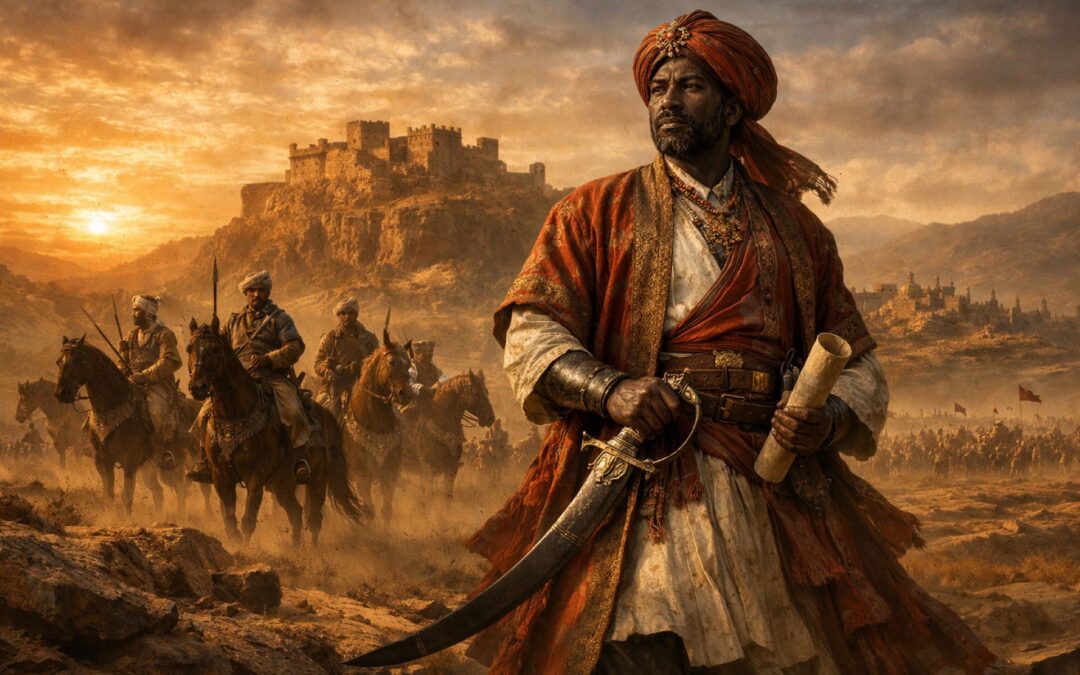
In the long and complex history of the Indian subcontinent, the rise of Malik Ambar stands out as one of the most extraordinary personal journeys ever recorded. Born in the Ethiopian highlands in the mid-sixteenth century, he began life as a child who was captured, enslaved, and sold through the networks of the Indian Ocean slave trade. Yet within a few decades, that same enslaved boy would rise to become the most powerful political and military leader in the Deccan—commanding armies, shaping state policy, and defying the might of the Mughal Empire at the height of its power.
Malik Ambar’s life unfolded during a turbulent period in Indian history. The Mughal Empire under Emperor Akbar was expanding rapidly across the subcontinent, absorbing kingdoms and consolidating imperial authority. To the south of the Mughal frontier lay the Deccan plateau, a politically fragmented region ruled by several competing sultanates such as Ahmadnagar, Bijapur, and Golconda. These states were wealthy, militarily capable, and fiercely independent, but they were also weakened by internal rivalries and succession struggles. For the Mughals, the conquest of the Deccan represented both a strategic necessity and a symbol of imperial dominance. For the Deccan states, survival depended on resisting Mughal expansion.
It was within this volatile environment that Malik Ambar carved out his remarkable career. After gaining his freedom in India, he transformed himself from a former slave into a skilled military commander and political strategist. By gathering a loyal following of soldiers and administrators, he gradually emerged as the de facto ruler of the Ahmadnagar Sultanate. Though he never formally claimed the throne, he effectively governed the state as regent, installing a young prince as a nominal ruler while he directed policy, diplomacy, and warfare.
What truly distinguished Malik Ambar, however, was his ability to challenge one of the most powerful empires in the world. Through innovative military tactics, especially the use of fast-moving cavalry and guerrilla warfare, he repeatedly frustrated Mughal armies that were larger, wealthier, and better equipped. Campaign after campaign, Mughal generals struggled to defeat him. Even Emperor Jahangir himself would later complain bitterly about the stubborn resistance of this former slave who had become the greatest obstacle to Mughal domination of the Deccan.
Yet Malik Ambar was far more than a military commander. He was also an able administrator and state builder who reorganized revenue systems, revitalized agriculture, and founded cities. His administrative reforms would influence later regional powers, including the rising Marathas. At the same time, his story reflects a broader and often overlooked historical reality: the presence and influence of Africans—known in India as Habshis or Abyssinians—who served as soldiers, generals, and rulers across the Indian Ocean world.
The life of Malik Ambar therefore represents more than an individual success story. It reveals the interconnected nature of the early modern world, where people, ideas, and ambitions moved across continents. From the Ethiopian highlands to the courts and battlefields of the Deccan, Malik Ambar’s journey demonstrates how talent, determination, and political skill could sometimes overcome even the harshest beginnings.
His rise from enslaved child to kingmaker of the Deccan remains one of the most remarkable transformations in Indian history—and one that reshaped the balance of power between the Deccan sultanates and the Mughal Empire for decades.
When we examine the world into which Malik Ambar emerged, it becomes clear why the Deccan plateau became the stage for such an unlikely and dramatic rise.
The Deccan in an Age of Empires
By the late sixteenth century, the Deccan plateau had become one of the most politically volatile and strategically important regions in the Indian subcontinent. Stretching across central India between the northern plains and the southern peninsula, the Deccan was a land of fortified cities, fertile agricultural zones, and major trade routes connecting inland markets with the ports of the Arabian Sea. Whoever controlled the Deccan controlled a gateway between northern and southern India, making the region a prize coveted by ambitious rulers.
At the time of Malik Ambar’s rise, the Deccan was divided among several Muslim-ruled sultanates that had emerged after the breakup of the powerful Bahmani Sultanate in the late fifteenth century. From this fragmentation arose five principal successor states: Ahmadnagar, Bijapur, Golconda, Bidar, and Berar. Each of these kingdoms competed fiercely with the others for territory and influence. Alliances shifted frequently, wars were common, and succession disputes often destabilized royal courts.
Despite this political instability, the Deccan sultanates were far from weak. They commanded considerable military resources, including large cavalry forces and heavily fortified cities. The region’s wealth came from agriculture, taxation, and trade in textiles, horses, and precious goods moving through the Indian Ocean networks. Many Deccan rulers also maintained diverse armies composed of local warriors, foreign mercenaries, and elite soldiers from across the Islamic world.
One distinctive feature of Deccan politics was the presence of powerful military elites of foreign origin. Among them were Turks, Persians, Central Asians, and Africans—often referred to in India as Habshis or Abyssinians. These groups were valued for their military abilities and administrative skills, and many rose to high-ranking positions in the courts of the Deccan sultans. Some even became kingmakers, shaping the outcome of political struggles behind the throne. This environment created opportunities for talented outsiders to gain influence and power.
Meanwhile, to the north, a far larger political force was steadily expanding toward the Deccan. The Mughal Empire under Emperor Akbar had already consolidated control over much of northern India. Akbar’s reign was marked by administrative reforms, military expansion, and the integration of numerous regional kingdoms into the Mughal imperial system. By the 1590s, Mughal armies had begun pushing southward toward the Deccan plateau, seeking to bring the independent sultanates under imperial authority.
For the Deccan states, this posed an existential threat. The Mughal Empire possessed vast resources and could field enormous armies supported by sophisticated administrative machinery. Individual Deccan kingdoms often struggled to match this power on their own. At times they attempted to resist collectively, forming temporary alliances against the Mughals. At other times, internal rivalries weakened their resistance and allowed the Mughal armies to advance.
The Ahmadnagar Sultanate was among the first Deccan states to face the full weight of Mughal expansion. Located on the northern edge of the Deccan plateau, it stood directly in the path of Mughal conquest. As Mughal forces advanced into its territory, Ahmadnagar became the focal point of a prolonged and brutal struggle for control of the region.
It was in the midst of this geopolitical contest—between the powerful Mughal Empire and the fiercely independent Deccan sultanates—that Malik Ambar would rise to prominence. The political chaos, constant warfare, and shifting alliances of the Deccan created an environment in which a skilled and determined leader could rapidly gain influence.
But to understand how Malik Ambar entered this world, one must first look far beyond the Deccan—to the highlands of Ethiopia, where his remarkable story began.
The Ethiopian Highlands and the World of the Indian Ocean Slave Trade
Malik Ambar’s remarkable journey began thousands of kilometers away from the Deccan plateau, in the rugged highlands of northeastern Africa. Most historical accounts suggest that he was born around the mid-sixteenth century in the region of Harar, in present-day Ethiopia. At the time, this area was part of a complex political and cultural landscape shaped by trade, migration, and conflict between local kingdoms and neighboring Islamic states.
The Horn of Africa had long been connected to the wider world through the trade routes of the Red Sea and the Indian Ocean. Merchants from Arabia, Persia, and India regularly sailed along the eastern coast of Africa, exchanging goods such as ivory, gold, spices, textiles, and slaves. These maritime networks formed part of what historians describe as the Indian Ocean trading system—an interconnected economic world that linked East Africa, the Middle East, South Asia, and Southeast Asia.
Within this system, enslaved people were one of the many commodities transported across the sea. Unlike the large-scale plantation slavery that later developed in the Atlantic world, slavery in the Indian Ocean network often took different forms. Enslaved individuals could be employed in domestic service, administration, or the military. In many cases, especially within Islamic courts, enslaved soldiers and officials could rise to positions of considerable authority.
It was through this system that the young boy who would later become Malik Ambar entered the wider world. His birth name is believed to have been Chapu, and like many children in regions affected by conflict and raiding, he was likely captured at a young age and sold into slavery. From the Ethiopian highlands, he was transported across the Red Sea, eventually arriving in the Arabian Peninsula.
From there, Chapu’s journey continued eastward toward the Indian subcontinent. The Deccan sultanates had a long tradition of purchasing African slaves, particularly those from Abyssinia, who were highly valued for their perceived loyalty and martial ability. Over time, Africans in India came to be known collectively as Habshis or Sidis, and many served as elite soldiers, guards, and administrators in royal courts.
The presence of Africans in India was therefore not unusual in the sixteenth century. In fact, several Habshi figures had already risen to significant positions of power. Some became generals, while others served as influential courtiers or regional governors. In rare cases, they even ruled territories in their own right. This social mobility, though limited, meant that a talented and determined individual could sometimes transcend the circumstances of enslavement.
When Chapu eventually arrived in India, he was purchased by a nobleman associated with the Ahmadnagar Sultanate in the Deccan. In this new environment, he would receive training, education, and exposure to the political and military life of the region. Over time, he adopted the name Ambar, a name by which he would become known throughout the Deccan.
Although his early years in India were spent in servitude, they also provided him with the knowledge and connections that would shape his future career. Within the courtly and military culture of the Deccan, ambition, skill, and strategic intelligence could open unexpected paths to power.
For the young Ambar, the world that had once reduced him to a commodity would eventually become the stage upon which he built his extraordinary rise. But that transformation would begin only after he achieved something that changed the course of his life entirely: his freedom.
From Chapu to Ambar: Enslavement and the Road to India
When the young boy from Ethiopia arrived in the markets of the Arabian Peninsula, his life followed a path common to many enslaved people moving through the Indian Ocean trade networks of the sixteenth century. From East Africa, captives were frequently transported across the Red Sea to ports in Yemen or the Arabian coast, where they were sold to merchants and political elites who operated across the wider Islamic world. It was in this environment that the boy known as Chapu entered the long chain of transactions that would eventually carry him to India.
At some point during this journey, Chapu was purchased by a merchant in Baghdad. The city, though no longer the political center of a great empire as it had been in earlier centuries, remained an important hub of commerce and intellectual life in the Middle East. In Baghdad, enslaved youths like Chapu were often educated and trained, particularly if their owners believed they possessed potential for administrative or military service. Rather than being confined to purely menial labor, some were prepared for roles within elite households, courts, or military structures.
It was during this stage of his life that Chapu began acquiring the skills that would later prove crucial to his success. He learned languages, administrative practices, and the cultural norms of the Islamic courts that dominated much of the political world stretching from the Middle East to South Asia. These experiences exposed him to systems of governance, diplomacy, and military organization that would later shape his own approach to leadership.
Eventually, Chapu was sold again—this time to a nobleman from the Deccan named Chengiz Khan, a prominent military commander serving the Ahmadnagar Sultanate. Ahmadnagar was one of the major Deccan states resisting Mughal expansion, and its ruling elite relied heavily on skilled military retainers and administrators. Under Chengiz Khan’s household, the young slave entered a far more politically dynamic environment.
It was likely during this period that Chapu adopted the name Ambar. Within elite households of the Deccan sultanates, enslaved retainers were often trained alongside other members of the courtly retinue. Ambar would have been exposed not only to military training but also to the political intrigues that shaped Deccan governance. The court of Ahmadnagar was a place where alliances were negotiated, rival factions competed for influence, and military campaigns were constantly planned against both neighboring states and the advancing Mughal Empire.
For Ambar, this household became an informal academy of politics and warfare. Observing the operations of a major Deccan court allowed him to develop an understanding of strategy, logistics, and administration. He also gained familiarity with the complex social world of the Deccan, where Persians, Turks, local Deccanis, and Africans interacted within a competitive political hierarchy.
Chengiz Khan’s patronage therefore played a critical role in shaping Ambar’s future. Under his master’s protection, Ambar gained education, experience, and connections that few enslaved individuals could access. Yet despite these advantages, he remained legally a slave, dependent entirely on the status and fortunes of his owner.
The turning point came with the death of Chengiz Khan. With his master gone, Ambar’s position within the household changed dramatically. In many cases, the death of a patron could lead to the dispersal or sale of enslaved retainers. But for Ambar, it instead opened the door to something far more significant—the chance to secure his freedom.
Once freed, the former slave would begin building a career that would eventually make him one of the most powerful figures in the Deccan.
Freedom, Opportunity, and the Rise of a Military Leader
The death of Chengiz Khan marked a decisive turning point in Ambar’s life. At some point after his master’s passing, he was granted his freedom—an event that transformed his social position almost overnight. No longer bound by the legal status of slavery, Ambar now entered the volatile political landscape of the Deccan as a free man. In a region defined by shifting alliances, military competition, and political uncertainty, freedom also meant opportunity.
The late sixteenth-century Deccan offered fertile ground for ambitious military entrepreneurs. Warfare between rival sultanates was frequent, and the looming threat of Mughal expansion created constant demand for capable commanders and soldiers. In such an environment, individuals who could organize troops, manage resources, and deliver military success often rose quickly through the ranks of power.
Ambar began building his own military following, recruiting a group of loyal retainers and soldiers who recognized his abilities as a leader. Among them were Africans like himself, as well as local Deccani warriors and cavalrymen seeking employment and patronage. In the fragmented political world of the Deccan, private armies were not unusual. Powerful nobles and commanders often maintained their own military forces, which they used both to serve their rulers and to advance their own influence.
What set Ambar apart, however, was his remarkable skill in navigating the political currents of the region. He demonstrated an ability to forge alliances, negotiate with rival factions, and maneuver within the complex court politics of the Deccan sultanates. At a time when many nobles relied primarily on inherited status, Ambar’s rise was built on talent, strategy, and personal loyalty.
As he expanded his military following, Ambar gradually established himself as a figure of growing importance within the Ahmadnagar Sultanate. His forces proved disciplined and effective, earning him both respect and influence among the ruling elite. More importantly, his understanding of the region’s geography and political dynamics made him an invaluable asset in the growing struggle against the Mughal Empire.
Meanwhile, the Ahmadnagar Sultanate itself was entering a period of profound crisis. Mughal armies under Emperor Akbar had begun pressing deeper into the Deccan, targeting Ahmadnagar as the first major state to be brought under imperial control. Internal divisions within the sultanate weakened its ability to respond effectively, as rival factions competed for power at court while Mughal forces advanced on its territories.
For Ambar, this moment of instability presented both danger and opportunity. The weakening of traditional authority created space for capable leaders to assert themselves. Through military success and political maneuvering, Ambar steadily increased his influence, transforming from a former slave commanding a small band of followers into one of the most important military figures in the region.
Yet the greatest test of his abilities was still to come. As the Mughal Empire intensified its campaign to conquer the Deccan, the fate of Ahmadnagar—and the future of Ambar’s rising career—would be decided on the battlefield.
The Collapse of Ahmadnagar and the Mughal Advance
By the closing years of the sixteenth century, the Ahmadnagar Sultanate stood directly in the path of Mughal expansion. Emperor Akbar had already consolidated control over much of northern and central India, and his attention increasingly turned toward the Deccan. For the Mughal Empire, conquering the Deccan was not only a matter of territorial ambition but also a strategic necessity. Control of the plateau would secure imperial frontiers, open access to southern trade routes, and bring the independent Deccan sultanates under Mughal authority.
The Ahmadnagar Sultanate was the first major obstacle to this expansion. Located on the northern edge of the Deccan, it formed a defensive barrier between the Mughal Empire and the rest of the Deccan states. As Mughal armies moved southward during the 1590s, Ahmadnagar became the focal point of a prolonged and increasingly desperate struggle.
At the center of the kingdom’s resistance was one of the most remarkable figures in Deccan history: Chand Bibi, the regent of Ahmadnagar. A skilled diplomat and military leader, Chand Bibi organized the defense of the kingdom when Mughal forces laid siege to the capital city in 1595. Despite overwhelming odds, she managed to rally the defenders and temporarily hold off the Mughal assault. Her leadership became legendary, symbolizing the determination of the Deccan states to resist Mughal domination.
However, Ahmadnagar’s internal divisions ultimately proved as dangerous as the invading armies. Rival factions within the court competed for power, weakening the unity required to resist the Mughal advance. Political intrigue, betrayals, and shifting loyalties undermined the kingdom’s defenses from within.
The situation deteriorated further in 1600 when Mughal forces launched another major campaign against the sultanate. After intense fighting, the capital city of Ahmadnagar finally fell to the Mughals. Chand Bibi was killed amid internal conspiracies, and much of the kingdom’s territory was absorbed into the Mughal imperial system. From the perspective of the Mughal court, the conquest appeared to be a decisive victory that would soon lead to the complete subjugation of the Deccan.
Yet the fall of the capital did not end resistance.
Many of the Ahmadnagar nobility and military commanders refused to accept Mughal rule. Instead, they withdrew into the rugged interior of the Deccan plateau, where fortified hill towns, forests, and difficult terrain offered natural advantages for guerrilla warfare. These surviving leaders sought to reorganize resistance and restore their state in exile.
Among them was Malik Ambar.
By this time, Ambar had already gained a reputation as a capable military commander with a growing network of loyal followers. As the established leadership of Ahmadnagar collapsed, he emerged as one of the few figures capable of rallying the remnants of the sultanate’s forces. Rather than accepting Mughal conquest as inevitable, Ambar began organizing a renewed struggle for the survival of the Deccan state.
In doing so, he transformed what had appeared to be the end of Ahmadnagar into the beginning of a new phase of resistance. The Mughal Empire might have captured the capital, but the war for the Deccan was far from over. And at the center of this renewed resistance stood the former slave who was about to become the most formidable opponent the Mughal armies would face in the south.
The Creation of a Shadow State
After the fall of Ahmadnagar’s capital in 1600, the Mughal Empire believed it had effectively ended the independence of the sultanate. From the Mughal perspective, the conquest appeared complete: the royal court had been dismantled, much of the territory occupied, and the ruling dynasty scattered. Yet the political reality of the Deccan proved far more complicated. While the Mughals had captured the capital, they had not secured the countryside, nor had they eliminated the networks of nobles, commanders, and local power brokers who remained loyal to the old regime.
It was within this fractured landscape that Malik Ambar began constructing what historians often describe as a “shadow state.” Rather than attempting to immediately reclaim the lost capital, Ambar focused on rebuilding the political and administrative structure of the Ahmadnagar Sultanate elsewhere. His goal was not simply to wage war against the Mughals, but to restore a functioning government capable of sustaining long-term resistance.
A crucial step in this strategy was the preservation of royal legitimacy. Ambar located a young prince from the Ahmadnagar ruling dynasty and proclaimed him the rightful ruler of the sultanate. The prince served as a symbolic monarch, maintaining the continuity of the dynasty and providing a legal foundation for resistance against the Mughal Empire. In practice, however, real authority rested firmly in the hands of Malik Ambar, who governed as regent and chief minister.
With legitimacy secured, Ambar turned to rebuilding the machinery of government. He reorganized revenue collection, reestablished administrative offices, and began reasserting control over territories that had slipped from Mughal grasp. Many local landholders and regional chiefs, wary of Mughal domination, rallied to his cause. Through negotiation, alliance-building, and occasional coercion, Ambar gradually expanded his influence across large parts of the Deccan.
His leadership style combined political pragmatism with strategic patience. Rather than confronting the Mughals in large conventional battles—where the imperial armies held clear advantages—Ambar focused on rebuilding the strength of the Ahmadnagar state while avoiding decisive defeat. He ensured that resources continued flowing into the resistance, allowing his forces to remain active and mobile across the region.
Over time, this shadow government became surprisingly resilient. Mughal garrisons held certain cities and strongholds, but the countryside increasingly slipped beyond their control. Ambar’s administration collected taxes, maintained armies, and governed territory in the name of the Ahmadnagar ruler. What had seemed like a defeated kingdom was slowly reconstituting itself under his leadership.
This strategy frustrated Mughal commanders who had expected the conquest of Ahmadnagar to be swift and permanent. Instead, they now faced a revived state that refused to disappear. Every attempt to pacify the region encountered the same persistent problem: the elusive and highly capable leader orchestrating resistance from the Deccan interior.
By reconstructing the political structure of the Ahmadnagar Sultanate, Malik Ambar transformed himself from a military commander into the effective ruler of a restored state. But his success depended on more than administrative skill. To survive against the vastly superior resources of the Mughal Empire, he would also need to revolutionize the way war was fought in the Deccan.
Master of Guerrilla Warfare
One of Malik Ambar’s greatest strengths as a leader was his ability to adapt military strategy to the realities of the Deccan landscape. The Mughal Empire possessed enormous advantages in resources, manpower, and traditional battlefield strength. Mughal armies were large, heavily equipped, and supported by a sophisticated imperial administration capable of mobilizing vast supplies. Facing such power in open, conventional battle would have been disastrous for the smaller forces of the Ahmadnagar resistance.
Instead, Malik Ambar developed a style of warfare that neutralized many of these Mughal advantages.
The geography of the Deccan plateau played a central role in this strategy. The region was characterized by rugged hills, dense forests, and narrow passes that made large-scale military movement difficult. Mughal armies, accustomed to fighting on the open plains of northern India, often struggled to operate effectively in this unfamiliar terrain. Supply lines were long and vulnerable, and large formations of troops moved slowly through the difficult landscape.
Ambar recognized that mobility and speed could become powerful weapons against a larger enemy. Rather than organizing his forces into massive armies, he relied heavily on highly mobile cavalry units capable of striking quickly and disappearing before Mughal forces could respond. These cavalrymen were familiar with the terrain and able to move rapidly across the plateau, using local knowledge to avoid direct confrontation with superior Mughal forces.
This form of warfare relied on constant harassment rather than decisive battles. Ambar’s forces attacked supply caravans, ambushed isolated detachments, and disrupted Mughal communications. Whenever a Mughal army advanced into the countryside, they often found themselves cut off from their supply lines and surrounded by fast-moving enemy forces that refused to engage in open combat.
These tactics gradually wore down the Mughal armies. Maintaining large forces in hostile territory became expensive and exhausting. Soldiers faced constant uncertainty, as Ambar’s cavalry could appear suddenly, launch an attack, and vanish into the hills before a counterattack could be organized. Over time, Mughal commanders discovered that occupying the Deccan was far more difficult than conquering it.
Malik Ambar also proved highly skilled at coordinating military operations with political alliances. He forged relationships with local chieftains and regional powers who had their own reasons to resist Mughal control. By incorporating these groups into his military network, he expanded both the manpower and intelligence available to his forces.
Another key element of his strategy was flexibility. Ambar avoided rigid command structures and allowed his commanders considerable freedom to operate independently. This decentralized approach made his forces harder to predict and easier to adapt to changing circumstances on the battlefield.
These methods would later influence other regional powers, most notably the Marathas, who adopted similar tactics in their own struggles against the Mughal Empire. The emphasis on fast cavalry raids, surprise attacks, and strategic mobility would become a defining feature of warfare in the Deccan during the following century.
Through this innovative approach to warfare, Malik Ambar transformed what seemed like an impossible struggle into a prolonged and frustrating conflict for the Mughal Empire. The imperial armies might have possessed overwhelming strength on paper, but in the rugged terrain of the Deccan they faced an opponent who understood how to turn geography, mobility, and patience into powerful strategic advantages.
And as the years passed, the conflict between Malik Ambar and the Mughal Empire would evolve into one of the longest and most stubborn struggles of the early modern Indian world.
The Long War Against the Mughals
As Malik Ambar consolidated his authority in the Deccan and refined his military strategies, the conflict with the Mughal Empire evolved into a prolonged war of attrition. What the Mughals had initially expected to be a swift campaign of conquest turned into decades of frustrating and costly warfare. Despite their enormous resources, imperial armies repeatedly found themselves unable to eliminate the resistance led by the former Ethiopian slave who had become the de facto ruler of Ahmadnagar.
During the final years of Emperor Akbar’s reign, Mughal commanders launched several campaigns aimed at crushing Ambar’s growing power. Imperial forces occupied important towns and established garrisons across parts of the Deccan, but their control rarely extended far beyond fortified cities. The countryside remained contested territory, where Ambar’s mobile forces operated with increasing confidence.
Whenever Mughal armies attempted to advance deeper into the region, they encountered the same pattern of resistance. Supply lines were attacked, communications disrupted, and isolated detachments ambushed. Mughal troops were forced to operate in a hostile environment where local support was limited and the enemy rarely offered the kind of direct battle in which imperial forces excelled.
The situation did not improve when Akbar died in 1605 and his son Jahangir ascended the Mughal throne. Jahangir inherited the Deccan conflict along with the rest of the empire’s responsibilities, and he quickly discovered that the struggle against Malik Ambar was far from resolved. Mughal generals continued to lead campaigns into the region, but Ambar’s tactics repeatedly undermined their efforts.
At times, the conflict escalated into large-scale engagements as Mughal armies attempted to force decisive confrontations. On several occasions, imperial commanders managed to capture important territories or push Ambar’s forces back temporarily. Yet these successes rarely lasted. Once Mughal armies withdrew or became overstretched, Ambar’s forces reappeared, reclaiming lost ground and restoring Ahmadnagar’s influence.
One of the most notable Mughal efforts to defeat Ambar came when Prince Khurram—later known as Emperor Shah Jahan—was sent to lead campaigns in the Deccan. As a rising figure in Mughal politics, Khurram sought to prove his military ability by defeating the persistent resistance. His campaigns achieved some successes, forcing Ambar into temporary negotiations and territorial concessions. However, even these victories failed to permanently eliminate Ambar’s power.
The ongoing struggle deeply frustrated the Mughal court. Jahangir himself reportedly expressed irritation and anger toward Malik Ambar, viewing him as a troublesome rebel who repeatedly undermined imperial authority. From the Mughal perspective, it was humiliating that such a powerful empire could be held in check for so long by a leader whose origins lay in slavery.
Yet Ambar’s endurance was not merely the result of clever tactics. His leadership also depended on a network of alliances with other Deccan states, including Bijapur and Golconda, which sometimes cooperated with him against the Mughal threat. These alliances helped maintain a balance of power in the region and prevented the Mughals from isolating Ahmadnagar completely.
Over time, the conflict between Malik Ambar and the Mughal Empire became one of the defining struggles of the Deccan. Campaign after campaign drained imperial resources, while Ambar’s resilience strengthened his reputation as one of the most formidable opponents the Mughals had encountered in India.
But warfare was only one aspect of his leadership. While he fought against imperial expansion, Malik Ambar was also engaged in the complex task of governing the territories under his control—reforming administration, stabilizing the economy, and building the institutional foundations of a revived Deccan state.
Administration, Revenue Reforms, and Governance
Although Malik Ambar earned his reputation primarily as a military strategist, his success in resisting the Mughal Empire would not have been possible without effective governance. Sustaining a long war required more than skilled cavalry and clever tactics—it required a stable system of administration capable of collecting revenue, organizing resources, and maintaining political loyalty across a wide and contested territory. In this area as well, Ambar proved to be a remarkably capable state builder.
One of his most significant contributions was the reform of land revenue administration. Agriculture formed the backbone of the Deccan economy, and the ability of the state to collect revenue from agricultural production determined whether armies could be paid and governments could function. Ambar introduced systematic methods of land measurement and assessment to ensure that taxes were collected more efficiently and fairly.
These reforms were partly inspired by earlier administrative systems that had been implemented in northern India under the Mughal Empire, particularly those developed during the reign of Akbar. However, Ambar adapted these methods to the local conditions of the Deccan. Land was surveyed and categorized based on its productivity, and tax demands were calculated accordingly. This approach allowed the state to increase revenue while reducing arbitrary taxation that might alienate farmers and landholders.
By stabilizing the revenue system, Ambar was able to maintain the financial foundation necessary for his resistance against the Mughals. Soldiers could be paid regularly, supplies could be secured, and administrative officials could continue operating even during periods of intense warfare. In a region often destabilized by conflict, this administrative stability became one of the key pillars of his power.
Ambar also worked to strengthen relationships with local landholders, many of whom controlled rural areas that were difficult for centralized authority to directly manage. Rather than attempting to dominate these local elites entirely, he incorporated them into the administrative structure of the state. In exchange for loyalty and tax contributions, many local chiefs retained a degree of autonomy within their territories.
This pragmatic approach helped secure the cooperation of influential regional figures whose support was essential for maintaining control of the countryside. It also created a political network that extended far beyond the immediate reach of the central administration.
In addition to revenue reforms, Ambar invested in improving infrastructure and agricultural productivity. Irrigation systems were repaired and expanded in several areas, helping to stabilize food production and encourage economic recovery in regions affected by war. These projects demonstrated that his ambitions extended beyond short-term military survival; he was actively working to build a durable and functioning state.
The effectiveness of these administrative measures ensured that Ahmadnagar, despite losing its capital and facing constant Mughal pressure, remained a viable political entity. The state’s institutions continued to operate, taxes continued to flow, and its armies remained capable of fighting year after year.
Ambar’s reforms also had long-term consequences. Many of the administrative practices he introduced influenced later systems of governance in the Deccan. In particular, some historians believe that aspects of his revenue administration helped shape policies later adopted by emerging regional powers, including the Marathas.
Thus, while Malik Ambar is often remembered for his military resistance against the Mughal Empire, his achievements as an administrator were equally important. They allowed him not only to wage war effectively but also to govern and stabilize the territories under his authority—laying the foundations for a political order that could survive in the shadow of one of the most powerful empires in the world.
Khadki and the Vision of a Capital
As Malik Ambar consolidated his authority in the Deccan, he increasingly sought to build not only a functioning administration but also a political center that reflected the stability and ambition of his revived state. This vision took shape in the development of the city of Khadki, which would later become known as Aurangabad.
Located in a strategically advantageous position in the Deccan plateau, Khadki served both military and administrative purposes. The region was well suited for defense, with surrounding hills and natural barriers that made it difficult for large armies to approach unnoticed. At the same time, its location allowed access to important trade routes connecting various parts of the Deccan, making it an ideal site for a growing urban center.
Under Malik Ambar’s direction, Khadki began to develop into a significant administrative and military hub. The city was planned with the practical needs of governance and defense in mind. Fortifications were strengthened, roads were improved, and new residential and administrative quarters were established to accommodate officials, soldiers, merchants, and artisans.
One of Ambar’s most important contributions to the city’s development was his investment in water management and irrigation. The Deccan plateau often faced seasonal water shortages, and urban growth required reliable access to water supplies. To address this challenge, Ambar initiated the construction of an elaborate system of canals and reservoirs designed to bring water from nearby sources into the city.
These engineering projects were both practical and symbolic. On a practical level, they supported agriculture, urban life, and military logistics. On a symbolic level, they demonstrated Ambar’s authority as a ruler capable of shaping the landscape and sustaining a thriving population under his administration.
Khadki quickly became more than just a fortified base of operations. It evolved into a lively center of commerce and governance where merchants, scholars, soldiers, and officials gathered. Markets expanded, artisans established workshops, and the city began to attract people from across the region seeking opportunities within Ambar’s administration.
The development of Khadki reflected Malik Ambar’s broader vision for the Deccan state he governed. While he remained locked in a prolonged struggle against the Mughal Empire, he was simultaneously building institutions and infrastructure that suggested a long-term political project. Rather than simply defending remnants of the Ahmadnagar Sultanate, Ambar was effectively creating a new center of power capable of sustaining the Deccan’s independence.
In later decades, Khadki would gain even greater historical significance. When the Mughal emperor Aurangzeb established his base in the Deccan during the seventeenth century, the city was renamed Aurangabad and became one of the most important Mughal administrative centers in southern India. Yet its foundations as an urban center had been laid earlier under the leadership of Malik Ambar.
Through the creation and development of Khadki, Ambar demonstrated that his ambitions extended far beyond the battlefield. He was not merely a commander resisting Mughal conquest but a statesman shaping the political and urban landscape of the Deccan.
The African Diaspora in the Deccan
Malik Ambar’s rise to power was extraordinary, but he was not entirely alone in representing the presence of Africans in the political life of the Indian Ocean world. For centuries before his time, people from East Africa had been moving across the maritime trade networks that connected Africa, Arabia, Persia, and South Asia. Through these connections, African soldiers, merchants, sailors, and administrators found their way into many societies around the Indian Ocean, including the courts and armies of India.
In the Indian subcontinent, Africans were generally known as Habshis, a term derived from “Abyssinia,” the historical name used for the Ethiopian region. Many of these individuals arrived as slaves through the Indian Ocean trade, but their social roles often differed from the rigid plantation systems later associated with Atlantic slavery. In several Islamic courts, enslaved Africans were trained for military and administrative service, and their loyalty to their patrons often made them valuable members of royal households.
Because of their reputation as skilled warriors and dependable retainers, Habshi soldiers frequently rose to influential positions within the Deccan sultanates. Over time, a distinct African elite developed in several regions of India. Some Habshis became military commanders, governors, or powerful courtiers who played key roles in court politics. Their influence was especially visible in the Deccan, where the diverse political environment allowed talented outsiders to gain prominence.
The story of African political influence in India predates Malik Ambar. In the fifteenth century, for example, an African nobleman named Malik Sarwar rose to become the ruler of Jaunpur in northern India. In western India, another African figure named Malik Ayaz served as a powerful governor of the port city of Diu under the Gujarat Sultanate. Across the subcontinent, Africans served as generals, admirals, and administrators in various states.
Within this broader context, Malik Ambar represented the most dramatic example of the possibilities available to Africans in the Deccan. His rise from slavery to the position of regent and kingmaker demonstrated how military skill, political intelligence, and strategic leadership could overcome barriers of origin and status. At the height of his power, he commanded armies, directed diplomacy, and governed territories that rivaled those of many established rulers.
At the same time, Ambar’s career highlights the cosmopolitan character of the Deccan sultanates. These states were not isolated kingdoms but part of a wider world shaped by migration and exchange. Their courts included Persians, Turks, Central Asians, local Deccani nobles, and Africans, all competing for influence within a complex political hierarchy.
For many Africans in India, service in royal courts offered opportunities that were rarely available in other contexts of slavery. Although their status could remain precarious and dependent on patronage, the fluid political environment of the Deccan sometimes allowed talented individuals to achieve remarkable success.
Malik Ambar’s career therefore reflects both an individual achievement and a broader historical pattern. His story belongs not only to the history of India but also to the history of the African diaspora across the Indian Ocean world. Through his leadership and accomplishments, he became one of the most prominent African figures in early modern Asian history.
The Final Years and Death of a Kingmaker
By the early seventeenth century, Malik Ambar had spent decades resisting the Mughal Empire and shaping the political destiny of the Deccan. Despite constant warfare and political intrigue, he remained the central figure in Ahmadnagar’s revived administration. His authority as regent and chief strategist was widely recognized, and both allies and enemies understood that the survival of the Deccan resistance depended heavily on his leadership.
Yet the pressures of prolonged conflict were immense. The Mughal Empire continued to send large armies into the Deccan, determined to bring the region fully under imperial control. Campaigns led by Mughal princes and experienced generals placed constant military pressure on the territories governed by Ambar. At times the Mughals succeeded in capturing key fortresses or forcing temporary settlements, but these gains rarely produced lasting stability.
Even as he grew older, Ambar remained deeply involved in both military and administrative affairs. He continued to coordinate campaigns, negotiate alliances with neighboring Deccan states such as Bijapur and Golconda, and maintain the delicate balance of power that allowed Ahmadnagar to survive. His leadership ensured that Mughal forces could not easily consolidate their hold over the region.
However, time was gradually catching up with the veteran statesman. By the 1620s, Malik Ambar had spent more than two decades directing the resistance against Mughal expansion. The long years of campaigning and governance had taken their toll, and the political landscape of the Deccan was once again shifting as new generations of leaders emerged.
Malik Ambar died in 1626 at the age of around eighty, bringing an end to one of the most remarkable careers in the history of the Indian subcontinent. His death created an immediate power vacuum within the Ahmadnagar administration. Although his successors attempted to continue the policies he had established, none possessed the same combination of military skill, political intelligence, and personal authority that had defined Ambar’s leadership.
Without his guidance, the fragile balance that had sustained Ahmadnagar’s resistance began to weaken. The Mughal Empire, which had struggled for decades to suppress Ambar’s forces, soon found new opportunities to extend its influence across the Deccan. Over the following years, imperial armies gradually tightened their control over territories that had once been defended by Ambar’s strategic brilliance.
Yet even as Mughal expansion resumed, the legacy of Malik Ambar’s resistance remained deeply embedded in the region’s political culture. His methods of warfare, his administrative reforms, and his vision for Deccan autonomy would continue to influence later movements that challenged Mughal authority.
For many contemporaries, his life had already entered the realm of legend. The idea that a man who had arrived in India as an enslaved child could rise to become the most formidable opponent of the Mughal Empire captured the imagination of both supporters and critics alike.
When historians look back on the early modern Deccan, Malik Ambar stands out as a figure who reshaped the course of its history—proving that determination, intelligence, and strategic leadership could alter the balance of power even against the mightiest empire of the age.
The Legacy of Malik Ambar
Malik Ambar’s life left a profound and lasting imprint on the political and military history of the Deccan. Although the Ahmadnagar Sultanate eventually fell under Mughal control after his death, the decades during which Ambar successfully resisted imperial expansion reshaped the balance of power in the region. His leadership delayed Mughal domination of the Deccan and demonstrated that the empire’s authority, while formidable, was not invincible.
One of the most enduring aspects of his legacy lies in his military innovations. By emphasizing mobility, surprise, and deep familiarity with local terrain, Malik Ambar pioneered a style of warfare that proved highly effective against larger and more heavily equipped armies. These methods would later influence the rise of the Marathas in the seventeenth century. Leaders such as Shivaji would adopt similar tactics—relying on fast cavalry, guerrilla warfare, and strategic use of the Deccan’s geography to challenge Mughal authority.
In addition to his military achievements, Ambar’s administrative reforms helped strengthen the institutions of governance in the Deccan. His revenue system brought greater organization to land taxation and agricultural management, helping stabilize the economy in territories under his control. These reforms provided the financial foundation necessary to sustain long-term resistance and maintain effective administration despite the pressures of constant warfare.
His efforts to develop urban centers such as Khadki further demonstrated his vision as a state builder. By investing in infrastructure, irrigation systems, and city planning, Ambar contributed to the long-term growth of a region that would remain politically and economically significant for centuries. The city he helped establish would later become Aurangabad, one of the major administrative centers of the Mughal Empire in the Deccan.
Malik Ambar’s story also holds a unique place in the history of the African diaspora. As an Ethiopian who rose from slavery to become the most powerful political figure in the Deccan, his life illustrates the complex and interconnected nature of the Indian Ocean world. His achievements highlight the important roles played by Africans in the courts, armies, and governments of South Asia—an aspect of history that is often overlooked.
More broadly, his life challenges simple narratives about power and status in the early modern world. Despite beginning his life in one of the most vulnerable social positions imaginable, Ambar managed to navigate the political and military structures of a foreign land and ultimately shape the destiny of an entire region. His rise was not merely the product of circumstance but of remarkable intelligence, adaptability, and determination.
Today, Malik Ambar is remembered as one of the most remarkable figures of early modern India—a strategist who frustrated a powerful empire, a statesman who rebuilt a shattered kingdom, and a leader whose journey from the Ethiopian highlands to the heart of the Deccan remains one of the most extraordinary transformations in Indian history.