
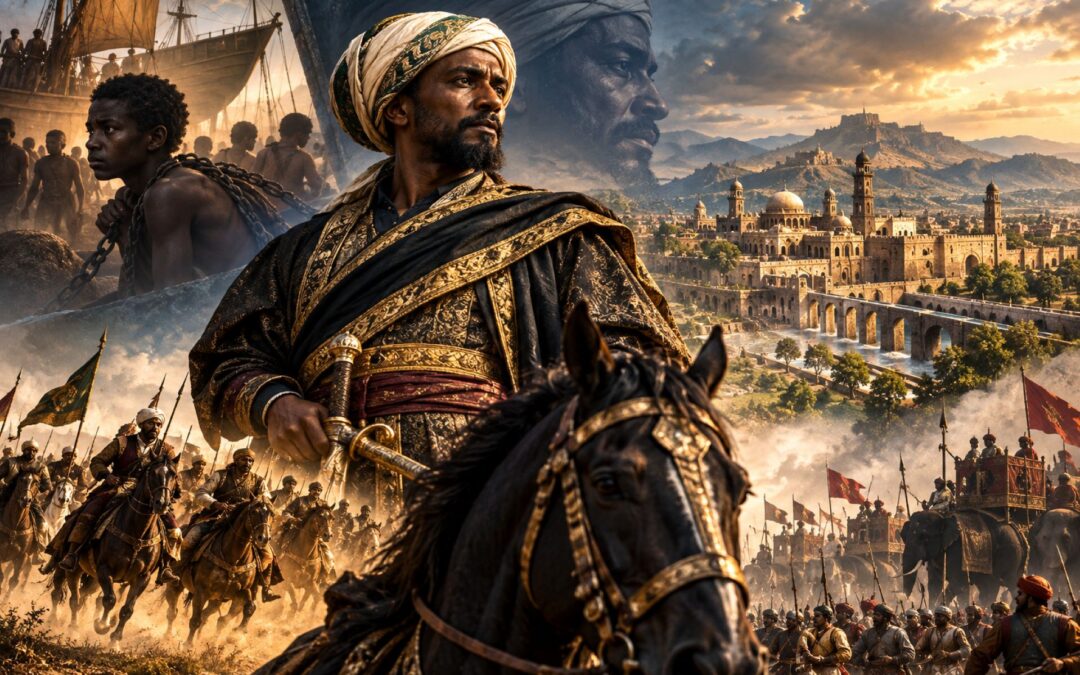
In the early seventeenth century, the Mughal Empire was the dominant political power in northern India. Its armies had conquered vast territories, its emperors commanded extraordinary wealth, and its military campaigns were steadily extending imperial authority toward the Deccan. Yet one of the most persistent obstacles to Mughal expansion was a man who had arrived in India decades earlier as an enslaved child from Ethiopia.
His name was Malik Ambar. Born around 1548, he had been taken from East Africa, sold through trading networks across the Indian Ocean and the Middle East, and eventually brought to the Ahmadnagar Sultanate. By the beginning of the seventeenth century, he had transformed himself into a formidable military commander and the effective ruler of that kingdom, directing its administration and armies without ever formally becoming its sultan.
Ambar’s extraordinary career was not simply the story of an individual escaping slavery and acquiring power. It unfolded within the distinctive political environment of the Deccan, where soldiers, merchants, administrators, and ambitious nobles from different backgrounds competed for influence. His ability to build alliances, exploit the weaknesses of larger armies, and govern a fractured kingdom enabled Ahmadnagar to resist Mughal conquest long after its survival appeared unlikely.
From Chapu to Ambar: Enslavement Across the Indian Ocean
Malik Ambar was born around 1548 in the region of present-day Ethiopia, probably under the name Chapu. His exact birthplace, family background, and ethnic identity remain uncertain. Some traditions associate him with the Oromo peoples, while other historical reconstructions connect his origins with the Kambata region of the Ethiopian highlands. What is clear is that his childhood ended with his entry into the slave-trading networks connecting northeastern Africa with Arabia, Persia, and India.
The circumstances of his enslavement are disputed. According to one account, his impoverished parents sold him because they could no longer support him. Another tradition suggests that he was captured during a raid and subsequently sold. Neither explanation can be established with complete confidence, but both reflect the insecurity experienced by communities exposed to warfare, raiding, and the commercial demand for enslaved people.
The historical reconstruction of Malik Ambar’s early life by historian Richard M. Eaton places his experiences within a much larger system of military slavery. Captives from East Africa could pass through several owners and travel enormous distances before reaching the courts and military establishments of western and southern Asia. Although enslavement involved coercion and the denial of personal freedom, some enslaved men received specialised training because their owners expected them to become valuable soldiers or administrators.
Chapu was reportedly transported across the Red Sea to Mocha, a major commercial port in present-day Yemen. From there, he entered the trading networks that connected the Arabian Peninsula with Baghdad and the wider Persianate world. The precise sequence of his sales and movements is difficult to reconstruct, but accounts of his early life consistently emphasise the importance of his years in Baghdad.
There, he came under the ownership of a merchant generally identified as Mir Qasim al-Baghdadi. Qasim reportedly recognised the young man’s intelligence and arranged for him to receive an education. Ambar learned languages, acquired familiarity with administrative and intellectual traditions, and received training that would later prove valuable in military service.
During this period, he converted to Islam and acquired the name Ambar, commonly associated with ambergris, a valuable aromatic substance traded across the region. Later retellings sometimes connect the name directly to his intelligence, but that interpretation should not be confused with its linguistic origin. His education nevertheless appears to have been an important factor in his subsequent career, distinguishing him from men trained exclusively for manual labour or ordinary military service.
In the early 1570s, Ambar was brought to India and sold into the service of a powerful Ethiopian-born noble at the court of Ahmadnagar. This official is commonly identified as Chengiz Khan and also appears in accounts under the name Mirak Dabir. Like Ambar, he had experienced slavery before acquiring considerable political authority.
The relationship gave Ambar an opportunity to observe government and warfare at close range. His master occupied a senior position in the Nizam Shahi establishment, where military command, diplomacy, financial administration, and court politics were closely connected. Service within this household exposed Ambar to the practical workings of power in a way that would shape his later career.
Chengiz Khan died in the mid-1570s, and Ambar subsequently obtained his freedom. His emancipation was a decisive turning point, but it did not immediately bring him wealth or political influence. Without the protection of his former master, he had to establish his own position in a region where political advancement depended heavily on military reputation, personal relationships, and the ability to command loyal followers.
How the Habshis Found Power in the Deccan
Ambar’s rise becomes easier to understand when placed within the history of Africans in the Deccan. People of East African origin were often described in Indian sources as Habshis, a term connected to the geographical designation Abyssinia. Over time, these communities included enslaved soldiers, freedmen, merchants, noble families, and people whose ancestors had lived in India for generations.
Their experiences were far from uniform. Many Africans remained in dependent or exploited positions, while others acquired military rank, administrative responsibilities, land revenues, and influence at royal courts. Women of African origin also entered elite households through marriage, concubinage, and other arrangements, although their opportunities and vulnerabilities differed considerably from those of men serving in the military.
As the Metropolitan Museum of Art’s account of Africans in the Deccan explains, Habshis and Siddis became part of South Asia’s wider political and cultural history. Their presence reflected longstanding commercial connections across the Indian Ocean rather than a single episode of migration. African identity could remain socially significant even as individuals and families adopted local languages, customs, and political loyalties.
The Deccan was particularly receptive to foreign military specialists because its rulers constantly competed for territory and influence. Armies depended on experienced cavalrymen, commanders, administrators, and soldiers who could serve under changing political circumstances. Talent and patronage could therefore provide opportunities for advancement, although birth, religious affiliation, personal connections, and control over resources continued to shape political careers.
This environment had developed through centuries of conquest and political realignment. The earlier collapse of Delhi’s authority in the Deccan during the fourteenth century had helped create powerful regional states with their own military establishments and political traditions. The Bahmani Sultanate became one of the most influential of these kingdoms before fragmenting into successor states, including Ahmadnagar, Bijapur, Golconda, Bidar, and Berar.
These sultanates competed fiercely, but their relationships were not determined by religious identity alone. Their armies and courts included people from diverse ethnic, linguistic, and religious backgrounds, while alliances regularly crossed the boundaries separating Hindu and Muslim rulers. The Deccan sultanates’ struggle with Vijayanagara demonstrated how shifting calculations of territory, prestige, and military advantage shaped the political order.
The consequences of the Battle of Talikota in 1565 were especially important. A coalition of Deccan sultanates defeated Vijayanagara’s army, damaging the southern empire’s ability to dominate regional politics. Yet the victorious states did not remain permanently united. Their competition continued, creating opportunities for military entrepreneurs who could move between courts and offer valuable services.
For a freedman such as Ambar, this political fragmentation created possibilities that would have been more limited in a rigidly centralised system. Commanders could attract followers, negotiate service with competing rulers, and sometimes acquire enough military independence to influence royal succession. Ambar’s experience of slavery remained central to his personal history, but his subsequent ascent depended on mastering the complex political society into which he had been brought.
A Mercenary Rises as Ahmadnagar Falls
After gaining his freedom, Ambar entered the competitive world of Deccan mercenary warfare. He served various regional powers, particularly Bijapur, and gradually assembled a force of cavalrymen loyal to him personally. Some accounts describe his early following as numbering roughly 150 horsemen, although such figures should be treated as historical estimates rather than precise military records.
For a commander without inherited royal authority, cavalry offered an effective foundation for advancement. Mounted soldiers could travel quickly, raid enemy territory, escort important figures, and support larger armies during campaigns. A successful captain could attract additional recruits by offering employment, opportunities for plunder, and access to influential patrons.
Ambar’s reputation eventually earned him the title Malik, an honorific associated with status and authority. The name Malik Ambar, by which he is remembered today, therefore reflected an achievement acquired during his career rather than a royal position inherited at birth.
During the 1590s, Ahmadnagar entered a period of exceptional danger. The Nizam Shahi court was divided by succession disputes, rival nobles competed for influence, and the Mughal emperor Akbar was determined to extend imperial authority into the Deccan. The kingdom’s internal divisions made it vulnerable to a powerful external enemy.
Mughal forces began besieging Ahmadnagar in 1595. Its defence became closely associated with Chand Bibi, a royal woman who played a remarkable political and military role during the crisis. She helped organise resistance against the besieging army and attempted to preserve the state through a combination of military action and diplomacy.
The immediate struggle did not end with the Mughals capturing Ahmadnagar in 1595, as some simplified accounts suggest. The siege continued into 1596, when a settlement involving the surrender of Berar temporarily relieved pressure on the capital. The concession was deeply controversial, and the continuing struggle over Mughal expansion intensified divisions among the kingdom’s nobles.
The imperial threat soon returned. Akbar’s commanders advanced into contested territory while Ahmadnagar’s political factions struggled to agree on an effective response. Chand Bibi’s attempts to negotiate during the renewed crisis contributed to accusations of betrayal, and she was killed by members of her own side in 1600.
The Mughals captured Ahmadnagar fort in August that year. The fall of the capital was a major imperial victory, and the Mughal court had good reason to believe that the Nizam Shahi kingdom was approaching its end. Its armies controlled important territory, while the dynasty’s leadership had been severely weakened.
Ambar, however, had been building an independent military position throughout the turmoil. He became associated with the forces of Abhang Khan, another prominent Habshi military leader, and took advantage of changing loyalties among commanders resisting Mughal domination. As rival leaders lost influence or were removed from the political struggle, Ambar attracted an increasingly substantial following.
He recognised that military resistance would be more effective if it possessed a legitimate political centre. Rather than claiming kingship for himself, he supported the restoration of Nizam Shahi authority under a surviving member of the dynasty. Around 1600, he installed Murtaza Nizam Shah II as the nominal sultan and established a political base beyond the territory securely controlled by the Mughals.
The arrangement supplied the resistance movement with a recognisable royal identity. Nobles who might hesitate to serve an ambitious military commander could instead present themselves as loyal supporters of the Nizam Shahi dynasty. Ambar strengthened his connection to the ruling household by marrying his daughter to the young sultan.
He subsequently became the effective head of the government, exercising authority through the office of peshwa or chief minister and his position as the kingdom’s dominant military commander. Although Murtaza II possessed the royal title, Ambar controlled much of the practical machinery of power, including the armies and political relationships on which the state’s survival depended.
His authority was not absolute from the beginning. Rival nobles continued to possess armed followers, regional resources, and competing ambitions, while the Mughal presence remained a constant threat. Nevertheless, Ambar had accomplished something extraordinary: he had transformed a position acquired through military service into effective leadership of a kingdom whose capital had fallen to one of the most powerful empires in the world.
Why the Mughal Armies Could Not Secure the Deccan
The Mughal Empire possessed advantages that should not be underestimated. Its rulers could mobilise enormous armies, obtain revenue from productive agricultural territories, deploy artillery and siege equipment, and draw on an elaborate system of military appointments. Under Akbar, the imperial government had also developed methods for incorporating regional elites into its administrative and military structures.
Yet defeating an army and permanently controlling its territory were different tasks. The Deccan presented difficult strategic conditions, including extensive plateaus, rugged hill country, fortified settlements, and considerable distances between major political centres. An invading force could capture an important city while still facing resistance across the countryside.
Large armies depended on supplies of food, fodder, money, ammunition, and replacement animals. These requirements became especially burdensome during prolonged campaigns far from the principal centres of Mughal power. Maintaining military pressure required reliable roads, secure supply routes, and cooperation from regional landholders whose loyalties could change.
Ambar understood these difficulties and developed a style of warfare that exploited them. Rather than committing his forces to major battles whenever a Mughal army approached, he relied heavily on mobile cavalry capable of avoiding unfavourable engagements. His soldiers could withdraw before a stronger enemy, attack exposed detachments, and threaten the routes connecting an imperial army with its sources of supply.
The effectiveness of this strategy depended on more than the speed of individual horsemen. Mobile warfare required knowledge of local terrain, dependable intelligence, access to horses and provisions, and support from communities that could provide information or shelter. A commander who understood the movement of enemy forces could make even a numerically superior army vulnerable to repeated disruption.
Ambar also exploited the psychological effects of prolonged insecurity. Soldiers who could not protect their supply convoys or anticipate attacks faced exhaustion and declining confidence. Imperial commanders were sometimes compelled to divert resources toward protecting communication lines instead of concentrating their strength against the main centres of resistance.
His military following drew on several communities, including Habshi soldiers, Deccani commanders, and increasing numbers of Maratha cavalrymen. The Marathas possessed valuable familiarity with the western Deccan’s terrain and fortified landscapes. Their local connections and experience in mounted warfare strengthened the military system through which Ambar challenged the Mughals.
This did not mean that Ambar invented guerrilla warfare or that every later Maratha tactic originated with him. Mobile raiding, selective engagement, and attacks against supply lines had longer histories. His significance lay in combining these practices into an effective regional strategy against a formidable imperial opponent.
The political circumstances following Akbar’s death in 1605 also worked in Ambar’s favour. Jahangir succeeded his father after a difficult struggle within the imperial household, and the transition temporarily complicated Mughal efforts to consolidate their position in the south. Ambar used the opportunity to rebuild his strength and challenge imperial control over territories associated with Ahmadnagar.
During the following years, his forces recovered substantial territory and repeatedly frustrated Mughal campaigns. By around 1610, his political and military influence had expanded considerably, although imperial garrisons continued to hold important positions. The struggle became a prolonged contest in which control of forts, districts, and supply routes changed repeatedly.
Jahangir found Ambar particularly infuriating because the Deccan commander challenged assumptions about imperial superiority. Mughal political ideology presented the emperor as a sovereign whose authority should extend over competing rulers. Ambar’s resistance demonstrated that the empire’s immense resources did not automatically translate into effective control.
The emperor’s hostility is visible in the court’s artistic and literary representations of his opponent. One celebrated allegorical painting presents Jahangir triumphing over Malik Ambar through an imaginary act of violence. The imagery belongs to the political symbolism of Mughal court art, in which imperial authority could be represented through elaborate visual assertions of superiority.
Such imagery was revealing precisely because the real military situation remained unresolved. Jahangir could commission paintings portraying the destruction of his enemy, but his commanders continued to struggle against Ambar’s forces. The distance between imperial ambition and conditions on the ground became one of the defining features of their rivalry.
Ambar’s strategy did not eliminate the Mughal advantage. Imperial forces could still win battles, occupy territory, and exploit divisions among their opponents. What his methods achieved was the prevention of a straightforward conquest, forcing the Mughals into a costly, exhausting struggle that demanded continuous military and political attention.
The Ruler Without a Crown: Power, Patronage, and Betrayal
Ambar’s authority depended on more than his military success. He governed through a Nizam Shahi sovereign whose legitimacy helped hold together the state’s nobles, military officers, and regional landholders. The arrangement gave him enormous influence, but it also created a persistent tension between the nominal ruler and the man who exercised effective power.
For the nobility, supporting Ambar could provide military protection and access to political rewards. Yet many commanders possessed their own followers and ambitions, making loyalty conditional on continued success. A noble might serve Ahmadnagar while also negotiating with Bijapur or the Mughals if circumstances suggested that another alliance would offer greater security.
Ambar responded through a combination of personal patronage, military appointments, diplomatic negotiations, and administrative reform. His relationships with Maratha landholding and military families were especially important because these groups controlled resources needed to sustain regional resistance. Access to local revenue, horses, manpower, and fortified positions could be as valuable as formal royal recognition.
His revenue policies are often described as efforts to rationalise assessment and collection while working through established local interests. Historical accounts associate him with reforms involving land measurement, agricultural revenue, and arrangements that gave influential local figures a stake in the political system. These measures should not be reduced to a simple claim that Ambar transferred all state-owned land into private Maratha ownership.
The importance of such reforms was practical. Maintaining cavalry and supporting long military campaigns required a dependable revenue base, while excessive demands could alienate cultivators and the local intermediaries responsible for collecting payments. Ambar therefore had to balance the state’s fiscal needs against the political costs of extracting resources from the population.
His relationship with Maratha chiefs brought particular advantages and difficulties. Their military abilities strengthened his position, and service under Ahmadnagar created opportunities for families that later became prominent in regional politics. At the same time, their growing importance made it increasingly difficult for any single ruler to control them without negotiation.
These problems were compounded by instability within the royal household. Murtaza Nizam Shah II, initially installed with Ambar’s support, eventually became a potential rival to his powerful minister. The relationship grew increasingly contentious as the sultan attempted to assert authority independent of the man who had placed him on the throne.
The conflict also involved members of the royal family. Ambar’s daughter was married to Murtaza, but accounts describe tensions involving another wife of Persian background and accusations that reflected the racial and social prejudices surrounding the Habshi elite. These disputes were politically consequential because marriage, status, and succession determined which factions could claim authority within the royal household.
In 1610, the struggle ended violently. Historical accounts implicate Ambar in the poisoning or removal of Murtaza II, and some describe the death of the Persian wife during the same episode. The exact circumstances are difficult to reconstruct, particularly because court narratives were shaped by political hostility and competing claims to legitimacy.
The succession was also more complicated than the simple story of Ambar placing his daughter’s son on the throne. Richard Eaton’s reconstruction identifies the young Burhan Nizam Shah III as the child of Murtaza’s Persian wife. Ambar nevertheless retained effective authority under the new ruler, ensuring that the change of sovereign did not end his dominance.
This episode exposes an important contradiction in Ambar’s career. He had resisted an expansionist empire by defending the political independence of Ahmadnagar, but his own authority depended on controlling a dynasty whose rulers were not always free to govern independently. Military effectiveness, political calculation, and coercion were closely connected in the system he commanded.
His methods also created vulnerabilities that could not be solved through military brilliance alone. Because important commanders remained attached to their own families, territories, and economic interests, the loyalty of the state could weaken when Ambar suffered a major setback. The political coalition that enabled him to resist the Mughals was therefore both his greatest resource and a continuing source of instability.
Khirki: Building a Capital in a Dry Landscape
Ambar’s influence extended well beyond warfare and court intrigue. As the Mughals contested Ahmadnagar’s traditional political centres, he developed alternative bases from which the Nizam Shahi government could operate. His most significant urban achievement was the establishment and development of Khirki, a settlement that later became associated with the city of Aurangabad.
The location presented advantages and difficulties. Its position offered access to important routes and surrounding military territory, but reliable water supply was a major challenge. Supporting a growing urban population required more than constructing buildings and establishing a court; it demanded arrangements for obtaining, transporting, and distributing water.
Ambar became associated with an ambitious network of waterworks, including channels, conduits, and systems that brought water toward the settlement. These installations formed part of a larger history of water engineering in the Deccan, where rulers and local communities developed techniques adapted to difficult terrain and seasonal conditions.
Research into the city’s Malik Ambar-associated water infrastructure demonstrates the importance of these systems to the urban landscape and its subsequent history. Their development cannot be reduced to a single construction event, and later generations modified, extended, and maintained different parts of the network.
Khirki also became a centre of political and cultural activity. Contemporary descriptions and later accounts associate the settlement with elite residences, gardens, public spaces, and the facilities required by a functioning royal establishment. Such developments reinforced Ambar’s authority by giving the Nizam Shahi government a visible and practical centre outside the old capital.
His patronage reflected the cosmopolitan society in which he had built his career. The Deccan supported artistic traditions shaped by interactions among Persianate courts, local Indian communities, merchants, military specialists, and migrants from other regions. Ambar operated within this environment, employing and supporting people from different religious and social backgrounds.
The city’s later history extended far beyond his lifetime. Khirki became known as Fatehnagar before eventually acquiring the name Aurangabad under Mughal rule. Although its political identity changed, the urban development associated with Ambar remained an important part of its historical foundations.
These achievements complicate an understanding of Ambar based exclusively on military resistance. His government had to maintain revenue systems, support urban communities, provide infrastructure, and sustain courtly institutions while fighting an almost continuous external struggle. The same ruler who used mobility and disruption against imperial armies also invested in the permanent institutions required by a regional state.
Defeat, Defections, and the Battle of Bhatvadi
Despite his remarkable military achievements, Ambar was never invincible. His ability to defeat or evade Mughal forces depended on maintaining reliable alliances, access to resources, and freedom of movement. When those conditions weakened, the advantages of the imperial military system became more dangerous.
By the middle of the 1610s, the Mughals had renewed their efforts to consolidate authority in the Deccan. Their commanders understood that defeating Ambar required more than marching against his cavalry. They also needed to weaken his relationships with regional nobles and deny him access to the territories that supported his military operations.
The year 1616 brought a particularly serious reversal. Mughal forces achieved important successes against Ambar, and the campaign exposed the vulnerability of his military position when confronted with effective imperial operations and changing local loyalties. Some accounts describe severe losses among his troops during engagements involving artillery and difficult terrain.
Political defections intensified the damage. Several influential commanders shifted their allegiance toward the Mughal side, depriving Ambar of military support while strengthening his enemies. The resulting pressure forced him to accept substantial territorial concessions and temporarily reduced his ability to challenge imperial control.
The reversals demonstrated the limitations of a coalition held together through patronage and military success. Commanders who had benefited from serving Ambar could reconsider their position when the imperial court offered attractive terms. Such changes were common features of Deccan politics, where rulers competed continually to attract experienced soldiers and powerful local families.
The situation became more complicated as relations with Bijapur deteriorated. For many years, Ahmadnagar and Bijapur had benefited from cooperation against Mughal expansion, even while pursuing their own territorial ambitions. However, the interests of the two sultanates were never identical, and Bijapur’s rulers increasingly sought arrangements that might protect their own position.
Bijapur’s willingness to cooperate with the Mughals placed Ambar under additional pressure. Instead of confronting only an invading imperial army, he now faced the possibility of coordinated operations involving a powerful neighbouring sultanate. His response required both renewed military initiative and careful management of the territories still under his control.
Ambar eventually moved onto the offensive. In 1624, his campaigns brought the conflict toward Bidar and Bijapur, provoking an opposing coalition that included Mughal and Bijapuri forces. He then repositioned his army near Bhatvadi, in the broader Ahmadnagar region, where local terrain would become a crucial factor in the ensuing battle.
The Battle of Bhatvadi is remembered as one of the most remarkable victories of his career. Unlike campaigns in which he relied primarily on avoiding large engagements, this confrontation culminated in a decisive defeat for forces that possessed substantial military resources. The outcome demonstrated how terrain, preparation, and the condition of opposing armies could overturn expectations based on numbers and imperial prestige.
Accounts of the battle emphasise the importance of water and difficult ground. A nearby dam or water-control structure became central to the military situation, with flooding and saturated terrain affecting the movement of the opposing army. The precise sequence of engineering decisions and battlefield manoeuvres remains a subject of historical reconstruction.
Historian Pushkar Sohoni’s reassessment of the Battle of Bhatvadi examines the landscape and the role of water-management structures in the confrontation. The research helps explain why the battlefield environment mattered, rather than treating the victory solely as evidence of Ambar’s tactical genius.
An army approaching through unfamiliar territory faced serious problems when its movement was restricted by mud and waterlogged ground. Cavalry formations lost some of their ability to manoeuvre, transport animals struggled to carry supplies, and maintaining orderly positions became increasingly difficult. These conditions could become particularly damaging when troops remained exposed to harassment and uncertainty over an extended period.
Ambar’s forces were well suited to exploiting such difficulties. Their experience with mobile operations allowed them to threaten vulnerable positions and disrupt an enemy already struggling with the landscape. As the opposing troops became increasingly exhausted and disorganised, the advantage shifted toward the army that could move more confidently through the surrounding terrain.
Descriptions of the final fighting include cavalry attacks, manoeuvres against exposed positions, and the collapse of coordination among the Mughal and Bijapuri contingents. Some narratives provide elaborate accounts of feigned retreats and attacks from unexpected directions, although the surviving evidence does not establish every tactical movement with certainty.
One important casualty was Muhammad Lari, a commander associated with the Bijapuri forces. His death contributed to the disintegration of the coalition’s position during the battle. Identifying him correctly matters because the opposing army was not a single uniform Mughal force, but a coalition whose different contingents brought their own commanders and political interests.
The engagement ended in a major victory for Ambar. His forces defeated the opposing coalition, strengthened their immediate position, and gained opportunities to recover or acquire contested territory. Subsequent operations extended his successes, including fighting over important fortresses and districts associated with the regional struggle.
Bhatvadi did not permanently end Mughal ambitions in the Deccan, nor did it eliminate the political rivalries that had repeatedly weakened Ahmadnagar. Its significance was that Ambar had recovered from serious earlier defeats and once again demonstrated the capacity of a regional commander to overcome forces backed by formidable imperial and neighbouring states.
The victory also illustrated the broader characteristics of his military approach. Terrain was not merely an obstacle to be endured, but a resource that could be used against an opponent. Mobility, intelligence, logistical disruption, and coordination with local forces mattered as much as the numbers assembled for a battle.
By the time of Bhatvadi, Ambar was an elderly commander who had spent decades navigating the shifting balance of power in the Deccan. His ability to recover from earlier reversals and impose another major defeat on his enemies was among the final achievements of an exceptionally long military career.
What Malik Ambar Left Behind in 1626
Malik Ambar died in 1626, at approximately seventy-eight years of age. Unlike many prominent figures in the violent politics of the Deccan, he did not die in battle or through assassination. He survived repeated military campaigns, succession crises, and political betrayals to reach old age while retaining considerable influence over the kingdom he had helped preserve.
His death did not settle the contest between Ahmadnagar and the Mughal Empire. The Nizam Shahi state continued to face imperial campaigns and internal pressures, eventually losing its independence in 1636. The survival of the kingdom during Ambar’s lifetime had therefore delayed imperial conquest rather than permanently prevented it.
Even his enemies recognised the exceptional nature of his career. Mughal chronicler Mu’tamad Khan, despite writing from within a political tradition hostile to Ambar, praised his abilities in military leadership and administration. The assessment is particularly striking because Mughal descriptions of their opponents could be deeply shaped by imperial prejudice and the expectation of submission.
Ambar’s most visible military legacy lay in the development of regional methods of resisting larger armies. His use of mobile cavalry, disruption of supply networks, and reliance on local terrain anticipated practices that would become important in later Maratha warfare. These connections should not be interpreted as proof that he personally invented every technique subsequently associated with Maratha commanders.
His political influence also helped create opportunities for Maratha military families whose importance increased during the following decades. Some figures associated with the Nizam Shahi military world, including the wider Bhonsle family network, would become significant in the political history from which Shivaji’s kingdom later emerged. That development involved numerous intermediate struggles and cannot be attributed to Ambar alone.
His administrative and urban legacy was equally important. The development of Khirki, the water infrastructure associated with his government, and his efforts to sustain regional revenue and military institutions demonstrate that his influence extended beyond battlefield victories. His career illustrates the interdependence of military strength, political legitimacy, local cooperation, and state administration.
For the history of Africans in India, Ambar occupies an especially prominent position. His rise from enslavement to the highest levels of political authority challenges any assumption that people of African origin occupied only marginal positions in the subcontinent’s past. At the same time, his exceptional success should not obscure the coercion, inequality, and vulnerability experienced by many others whose lives passed through the same trading networks.
Malik Ambar never formally became the sovereign of Ahmadnagar, yet he directed much of the kingdom’s fate for more than two decades. His achievements depended on personal ability, but they were also made possible by the Deccan’s complex society, competing political centres, and traditions of military service across ethnic and religious boundaries.
His life reveals why the Mughal conquest of India was neither inevitable nor straightforward. Even an empire with enormous financial and military resources could struggle to overcome a regional opponent who understood the local political landscape, maintained effective alliances, and adapted his methods to conditions that favoured resistance. From an enslaved Ethiopian child to the power behind Ahmadnagar’s throne, Malik Ambar became one of the most consequential figures in the history of the seventeenth-century Deccan.
Last Updated on October 25, 2026 by Aseem Gupta