
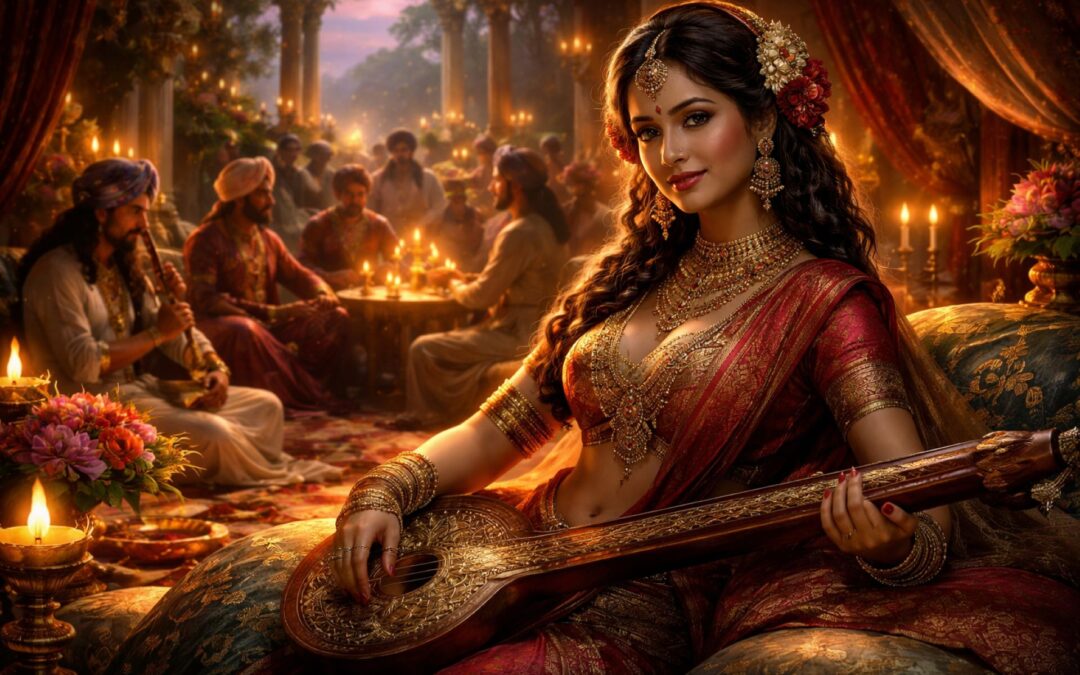
In the modern imagination, the word courtesan often conjures a narrow and reductive image—one tied almost exclusively to sexuality and moral ambiguity. But in ancient India, courtesans occupied a far more complex and fascinating position. They were not merely participants in a shadowy underworld of desire; they were, in many cases, among the most educated, culturally refined, and economically powerful women of their time.
These women moved through the highest circles of society—entertaining kings, influencing nobles, hosting intellectual gatherings, and shaping artistic traditions. Some commanded immense wealth, maintained large households, and even influenced matters of state. Others became patrons of religion and charity, leaving behind legacies that extended far beyond their profession. In a society where many women were confined to domestic roles, courtesans often enjoyed a degree of independence and agency that was both rare and remarkable.
Yet, their story is not one of simple empowerment. It is layered with contradiction—prestige alongside stigma, autonomy alongside exploitation, admiration alongside social exclusion. To understand the courtesans of ancient India is to step into a world where art, politics, economics, and intimacy intersect in unexpected ways.
This is not just a story about desire. It is a story about power—who held it, how it was exercised, and how a group of women, often misunderstood, came to shape the cultural and political fabric of an entire civilization.
Breaking the Myth: Who Were the Courtesans of Ancient India?
To understand courtesans in ancient India, the first step is to dismantle a persistent modern misconception: that they were simply prostitutes. While some courtesans did engage in transactional relationships, reducing them to this single dimension misses the broader social institution they were part of.
Courtesans belonged to a distinct and recognized category of women who existed outside the traditional framework of marriage and domestic life. Unlike most women, they were not expected to marry, bear children, or remain confined to the household. Instead, they operated in a parallel social space—one that intersected with power, culture, and wealth.
Their roles were diverse. Some were performers—skilled dancers, musicians, and actresses who entertained at courts, festivals, and elite gatherings. Others were companions to powerful men, offering not just physical intimacy but conversation, wit, and emotional connection. Many were trained intellectuals, capable of engaging in discussions on poetry, philosophy, and politics. In fact, the most elite among them were valued less for their bodies and more for their minds and cultural sophistication.
Ancient texts make clear distinctions within this world. There were high-ranking courtesans who catered to kings and nobles, and there were lower-ranking women who worked in more public or commercial settings. The existence of such categories reflects a structured and hierarchical system rather than an informal or marginal profession.
What set courtesans apart was not merely what they did, but how society perceived them. They occupied a paradoxical position—socially excluded in some respects, yet simultaneously respected and even celebrated in others. They were seen as custodians of the fine arts, preservers of cultural knowledge, and essential participants in elite social life.
In many ways, courtesans filled a gap within the social order. As expectations around household women became more restrictive over time, especially in terms of education and artistic expression, courtesans emerged as the primary bearers of music, dance, literature, and refined conversation. For men of status and culture, their company offered something that conventional domestic life often could not.
Seen through this lens, courtesans were not outsiders to society—they were integral to it.
Origins of Courtesanship: From Sacred Institution to Social System
The institution of courtesanship in India did not emerge suddenly or in isolation. Its roots can be traced back to some of the earliest phases of urban and cultural development on the subcontinent, evolving gradually alongside the growth of complex societies, trade networks, and political structures.
References to organized prostitution and courtesanship appear as early as the 8th century BCE, indicating that this was not a marginal or hidden phenomenon, but a recognized social institution. By the time of early Buddhist literature—particularly the Jataka tales—we find detailed descriptions of courtesans, their roles, their earnings, and even their classification within society. This level of documentation suggests a system that was not only widespread but also regulated and understood.
The emergence of courtesanship is closely tied to prosperity. In societies where trade flourished and wealth accumulated, a surplus economy created the conditions for specialized professions—entertainment, performance, and companionship among them. Courtesans thrived in such environments because their services depended on a class of patrons who had both the means and the desire to indulge in refined leisure.
But courtesanship was not a single, uniform pathway. Women entered this world through a variety of routes, reflecting both agency and coercion. Some chose it voluntarily, drawn by the promise of independence, wealth, or artistic expression. Others were born into it, inheriting the profession through family lines. Still others were pushed into it by circumstance—sold due to financial hardship, gifted in political or social exchanges, or even captured during times of conflict.
This diversity of entry points reveals an uncomfortable truth: courtesanship existed at the intersection of opportunity and exploitation. For some women, it offered a rare avenue for upward mobility and personal autonomy. For others, it was a condition imposed upon them by forces beyond their control.
Over time, what may have begun as loosely defined roles became more structured and institutionalized. States began to recognize the economic and social value of courtesans, integrating them into administrative systems, regulating their activities, and even investing in their training. This transformation—from a loosely organized practice to a formalized social system—underscores just how embedded courtesanship became in the fabric of ancient Indian life.
It was not an anomaly. It was an institution.
A World of Categories: The Many Types of Courtesans
The world of courtesans in ancient India was not monolithic. It was highly structured, with clearly defined categories that reflected differences in status, function, skill, and clientele. This internal hierarchy reveals that courtesanship was not a single profession, but a spectrum of roles within a broader social system.
At one end were the most elite courtesans—women who moved in royal courts and among the urban elite. At the other were more common public women who operated in marketplaces or private homes. Between these extremes existed a range of specialized identities, each with its own social meaning and economic reality.
Some categories were shaped by circumstance. There were women who entered courtesanship after marriage—housewives whose husbands relied on their earnings for survival. Others adopted religious disguises, posing as ascetics or pilgrims while seeking patrons at sacred sites. These variations, while striking to modern sensibilities, reflect the adaptability of the system to different social and economic conditions.
However, the most important distinction lay between two prominent classes: the Rupajiva and the Ganika.
The Rupajiva were valued primarily for their physical beauty and charm. Their appeal rested on appearance and allure, and their success depended on their ability to attract and retain wealthy clients. While they could be influential, their status was often more precarious, tied closely to youth and desirability.
In contrast, the Ganika represented the pinnacle of courtesan society. These women were not only expected to be beautiful but also highly educated and artistically accomplished. They were trained in music, dance, poetry, conversation, and a wide range of intellectual and practical skills. Their role extended far beyond entertainment—they were companions, cultural arbiters, and, in many cases, intellectual equals to the men they interacted with.
The rise of the Ganika is particularly significant when viewed in the broader context of social change. As expectations around household women became more restrictive—limiting their access to education and the arts—the Ganika filled a cultural vacuum. They became the primary bearers of refinement, offering a level of sophistication that was increasingly absent in domestic spaces.
Their clientele reflected this distinction. Wealthy urban men—merchants, administrators, nobles, and military leaders—known as Nagarika sought out the company of these elite courtesans. For them, the relationship was not merely transactional; it was an experience of culture, conversation, and status.
This layered system of categories highlights a crucial point: courtesanship in ancient India was not defined by a single identity. It was a complex, hierarchical world where status was earned, skills were cultivated, and roles were clearly understood.
To speak of “the courtesan” as a singular figure is to miss the richness of this entire ecosystem.
Masters of 72 Arts: Education, Skill, and Cultural Refinement
At the highest levels of courtesan society, beauty alone was never enough. What truly distinguished elite courtesans—especially the Ganika—was their mastery over an astonishing range of skills. These women were not merely entertainers; they were rigorously trained cultural specialists, expected to embody refinement in its most complete form.
Ancient Indian texts describe a curriculum of 72 arts that an accomplished courtesan was expected to master. This was not a symbolic number—it represented a structured and demanding education that blended intellectual, artistic, and practical disciplines.
These skills ranged from the expected—music, dance, and poetry—to the surprising. A Ganika might be trained in:
- Arithmetic and writing
- Chess and strategic games
- Perfume-making and garland crafting
- Cooking and hospitality
- Horse riding and even sword fighting
- Interpretation of omens and signs
This breadth of training reveals something profound: courtesans were being prepared not just to entertain, but to engage, influence, and adapt to a wide range of social situations. They were expected to converse with scholars, charm nobles, host gatherings, and navigate complex interpersonal dynamics with ease.
Their artistic contributions were equally significant. In the courts of powerful empires like Vijayanagara, courtesans were known to compose and perform sophisticated poetry, often blending devotion and sensuality in intricate ways. Entire genres of literature—particularly those centered around themes of love, longing, and divine play—were shaped and popularized by these women.
What makes this even more striking is the contrast with the condition of many household women of the time. As social norms increasingly restricted their access to education and artistic expression, courtesans became the primary custodians of cultural knowledge. Music, dance, literature, and refined conversation—these flourished not in domestic spaces, but in the salons and courts where courtesans presided.
This duality created a paradox. Courtesans were socially marginalized in one sense, yet culturally indispensable in another. They carried forward traditions that might otherwise have faded, preserving and evolving the artistic heritage of the subcontinent.
To be a Ganika was to be more than desirable—it was to be cultivated, disciplined, and intellectually alive. In many ways, these women represented the pinnacle of cultural refinement in ancient India.
Entertainers, Intellectuals, and Hosts of Elite Society
Courtesans were not confined to private chambers or hidden corners of society—they were highly visible figures in the public and cultural life of ancient India. Their presence was woven into the rhythms of elite society, where they functioned as entertainers, intellectual companions, and, perhaps most importantly, hosts of sophisticated social spaces.
At a basic level, courtesans were performers. They appeared at festivals, royal courts, garden parties, boat excursions, and musical gatherings. Their performances were not casual diversions but carefully crafted displays of skill and refinement, often forming the centerpiece of elite entertainment. Music, dance, poetry, and dramatic expression came together in ways that elevated these events into cultural experiences rather than mere leisure.
But their role extended far beyond performance.
Courtesans also hosted gatherings in their own residences—spaces that functioned remarkably like the famous salons of early modern Europe. These gatherings, known as goshti, brought together men of similar social standing—merchants, nobles, administrators, and intellectuals—for evenings of conversation, debate, and artistic appreciation.
In these settings, the courtesan was not a passive participant. She was the anchor of the entire experience.
She curated the atmosphere, guided discussions, and often participated actively in conversations on poetry, philosophy, aesthetics, and politics. Her home became a space where ideas could be exchanged freely, where wit and intellect were valued as much as wealth and status. Food and drink flowed, performances unfolded, and dialogue moved fluidly between the artistic and the intellectual.
For many elite men, these gatherings offered something that was increasingly absent from domestic life. As household norms grew more restrictive, limiting the education and social roles of wives, courtesans became the primary companions for cultured interaction. They provided not just entertainment, but stimulation—intellectual, emotional, and aesthetic.
This made them central to the cultural ecosystem of the time.
They were the keepers of taste, the facilitators of conversation, and the living bridges between art and society. Through their performances and their salons, courtesans shaped what people listened to, what they read, how they spoke, and even how they thought about beauty and expression.
In this sense, they were not just part of elite society—they helped define it.
The State and the Courtesan: Taxation, Training, and Control
Courtesans in ancient India were not merely tolerated by the state—they were actively integrated into its economic and administrative framework. Far from existing on the margins, they were recognized as valuable contributors to both revenue generation and social stability.
One of the clearest indicators of this relationship is taxation. Historical sources suggest that courtesans, whether operating independently or within brothels, were subject to substantial taxes. In many cases, the state claimed 25 to 30 percent of their earnings, with rates rising even higher—sometimes up to 50 percent—during periods of fiscal strain. This was not incidental income; it was a structured and reliable source of revenue for the state.
But taxation was only one part of the equation.
The state also invested in the training and maintenance of courtesans. Teachers who instructed them in the arts—music, dance, writing, acting, and other refined skills—were often supported financially by the state itself. This suggests a deliberate effort to cultivate a class of highly skilled entertainers and companions who could serve both cultural and economic purposes.
Training extended beyond the obvious artistic disciplines. Courtesans, along with actors and others in related professions, were sometimes instructed in skills that had clear administrative and strategic value. They were taught how to observe, gather information, and interact with outsiders—particularly foreign visitors and diplomats. In this way, they became informal participants in intelligence networks, capable of identifying threats, gathering insights, and assisting in maintaining internal security.
This connection is explicitly reflected in ancient political treatises like the Arthashastra, which outlines a system of oversight through officials such as the “Superintendent of Courtesans.” This role was responsible for regulating their activities, granting status titles like Ganika, and ensuring that the system functioned efficiently within the broader machinery of the state.
Importantly, this oversight was not purely exploitative—it also included elements of protection and welfare.
Courtesans were often granted legal protections that set them apart from other women. Harm against them—whether physical, financial, or reputational—was punishable under specific laws. In some cases, provisions were even made for their later years, with recommendations for pensions or state support once they could no longer sustain themselves through their profession.
This dual approach—control and care—reveals how seriously the state regarded the institution of courtesanship. It was not an informal or chaotic system, but a regulated and strategically managed one.
In many ways, courtesans were both assets and agents of the state—generating revenue, sustaining cultural life, and quietly contributing to governance behind the scenes.
Wealth, Power, and Economic Independence
One of the most striking aspects of courtesan life in ancient India was the level of wealth and economic independence that many of them achieved. In a society where property rights and financial control were often limited for women, courtesans stood out as rare exceptions—individuals who not only earned substantial wealth but also exercised direct authority over it.
At the highest levels, elite courtesans commanded enormous fees for their services. Their clientele—kings, nobles, wealthy merchants, and military elites—were capable of paying extravagantly for access to their time and company. Over time, this translated into significant personal fortunes. Contemporary accounts suggest that some courtesans amassed wealth that rivaled, and in some cases even exceeded, that of landed aristocracy.
This wealth was not abstract—it was visible and operational.
Well-to-do courtesans lived in prime urban locations, often in the best streets of the city. Their residences were not modest homes but elaborate establishments, designed to host gatherings, performances, and elite guests. These spaces functioned as both personal residences and cultural hubs, reinforcing their status and influence.
Managing such wealth required organization, and courtesans often oversaw complex households. They employed a range of assistants and staff, including:
- Personal attendants and maidservants for grooming, fashion, and domestic tasks
- Artists and performers, such as singers and dancers, who formed part of their entertainment retinue
- Managers or intermediaries, who handled negotiations, finances, and logistical matters
- Security personnel or escorts, who ensured their safety and managed interactions with clients
In some cases, especially among the wealthiest, these households could be vast. Historical references even describe courtesans who commanded large numbers of servants or slaves, indicating both their economic power and their position within broader systems of labor and hierarchy.
What makes this particularly significant is the autonomy associated with this wealth.
Unlike many women of the time, courtesans were not merely passive holders of property under male supervision. They had the authority to decide how their earnings were spent, invested, or distributed. They could acquire assets, support dependents, fund artistic endeavors, and engage in charitable activities—all on their own terms.
This financial independence translated into social leverage. Wealth allowed courtesans to negotiate from a position of strength, choose their patrons selectively, and maintain a degree of control over their professional and personal lives.
However, this independence came with its own set of vulnerabilities. Their status was often tied to youth, beauty, and skill—factors that could change over time. The same system that enabled their rise could also render them precarious if they lost favor or relevance.
Even so, within the constraints of their world, courtesans carved out a space that was both powerful and unusual. They were not just participants in the economy—they were significant economic actors, shaping and benefiting from the flow of wealth in ancient Indian society.
Courtesans in Politics, Espionage, and Warfare
Beyond culture and commerce, courtesans also played a subtle but significant role in the political machinery of ancient India. Their proximity to power, combined with their social mobility and access to elite circles, made them uniquely positioned to operate in domains that extended far beyond entertainment.
One of their most intriguing functions was in the realm of intelligence and espionage.
Ancient political thought, particularly as outlined in texts like the Arthashastra, recognized the strategic value of individuals who could move freely between different layers of society. Courtesans, actors, and performers were ideal for this purpose. They interacted with nobles, merchants, visiting dignitaries, and even foreign envoys—often in informal and unguarded settings where information flowed more freely.
As a result, they were sometimes trained to observe, gather intelligence, and report on suspicious activities. They could identify potential threats, monitor the behavior of influential individuals, and assist in counter-intelligence efforts. Their role was not that of formal spies in the modern sense, but rather embedded observers within the social fabric—individuals who could quietly contribute to the state’s awareness and security.
Their influence also extended into military life.
Courtesans were known to accompany armies on campaigns, particularly in large imperial expeditions. Their presence served multiple purposes. At a basic level, they provided entertainment and morale support for troops, helping maintain cohesion and spirit during long and demanding campaigns. But their role could also be more complex—facilitating communication, maintaining social order within camps, and even acting as intermediaries between different groups.
A notable example comes from the Vijayanagara Empire, where thousands of courtesans reportedly accompanied the army during major campaigns. This was not a marginal or incidental presence—it was an organized and deliberate inclusion, reflecting the recognized value of their role.
Their political influence was not always indirect.
Given their close relationships with powerful men, courtesans could shape decisions, influence opinions, and, in some cases, alter the course of events. Their salons were spaces where ideas circulated and alliances formed. Their conversations could carry weight, and their favor could become a form of soft power.
This influence, however, was rarely formalized. It operated through relationships, persuasion, and access rather than official authority. Yet, in many ways, this made it more subtle—and sometimes more effective.
In a world where information was power and proximity to authority mattered, courtesans occupied a unique position. They stood at the intersection of intimacy and influence, where personal relationships could quietly intersect with political outcomes.
They were not just witnesses to history—they were, in their own way, participants in it.
Love, Mobility, and the Possibility of Becoming Queen
For all their association with wealth and influence, courtesans in ancient India were not confined to a fixed social position. Unlike most women of their time, whose lives were tightly bound by birth and marriage, courtesans occupied a more fluid space—one where mobility, though rare and uncertain, was nonetheless possible.
One of the most fascinating aspects of this world is the role of love.
Ancient texts, including works like the Kamasutra, acknowledge that courtesans could form genuine emotional attachments. Yet, they also advise caution—encouraging courtesans to prioritize wealth, stability, and influence over romantic entanglement. Love, in this context, was both a possibility and a risk. It had the power to elevate—but also to destabilize.
And yet, history and legend offer numerous examples where courtesans transcended their status through relationships with powerful men.
Perhaps the most striking cases are those where courtesans rose to become queens.
In the Vijayanagara Empire, the celebrated emperor Krishnadevaraya is said to have married Chinnadevi, a woman of humble origins who had been a dancer and companion. Despite the rigid hierarchies of royal life, she became one of his most beloved queens—an extraordinary elevation that speaks to the permeability of status under certain circumstances.
Similar stories appear across regions and traditions. In Rajput courts, rulers were known to form deep attachments with courtesans, sometimes formalizing these relationships through marriage. These unions were not merely personal—they could reshape court dynamics, influence succession, and alter the balance of power.
Some narratives go even further, illustrating the complex emotional and social worlds courtesans inhabited. In one tale, a courtesan who becomes queen uses her networks and intelligence to restore a fallen king to power—only to later confess her love for another man. The king, rather than punishing her, grants her freedom, allowing her to pursue her own desires. Whether historical or literary, such stories reflect an awareness of courtesans as individuals with agency, emotion, and choice.
These examples should not be romanticized too easily. The path from courtesan to queen was exceptional, not typical. Most courtesans remained within their established roles, navigating a system that both empowered and constrained them.
Yet, the very existence of these stories reveals something important.
Courtesans occupied a rare space in ancient society—one where identity was not entirely fixed by birth. Through talent, intelligence, relationships, and sometimes sheer circumstance, they could cross boundaries that were otherwise rigid and impermeable.
In a world defined by hierarchy, they represented possibility.
Charity, Religion, and Public Contributions
While courtesans are often remembered for their association with luxury and elite society, another dimension of their lives reveals a very different story—one of philanthropy, religious devotion, and public service. Many courtesans did not simply accumulate wealth; they actively reinvested it into society, leaving behind tangible contributions that benefited communities for generations.
Historical and literary sources are filled with references to courtesans engaging in acts of charity. They donated food during times of famine, supported the poor, and contributed to religious institutions. In Buddhist and Jain traditions in particular, courtesans are frequently depicted as generous patrons who funded monasteries, supported monks, and gave away significant portions of their wealth.
One of the most famous examples is Amrapali, a renowned courtesan of ancient India. According to Buddhist accounts, she eventually renounced her life of luxury and donated her vast wealth to the Buddhist order, becoming a symbol of both generosity and spiritual transformation. Her story reflects the deep connection that some courtesans had with religious life—not merely as donors, but as participants in broader spiritual traditions.
In South India, temple inscriptions provide further evidence of courtesan philanthropy. Devadasis—women dedicated to temple service—often made substantial endowments to religious institutions. These included donations for temple construction, maintenance, rituals, and festivals. Their contributions were not symbolic; they played a direct role in sustaining religious and cultural infrastructure.
Beyond religion, courtesans also invested in public works.
Records suggest that wealthy courtesans funded the construction of wells, tanks, gardens, bridges, and rest houses—projects that served the broader population. These were not acts of quiet charity but visible contributions that enhanced their social standing and left lasting marks on the urban landscape.
What makes this particularly noteworthy is the element of control.
Courtesans were not simply intermediaries passing on wealth—they were decision-makers. They chose where to donate, what causes to support, and how to allocate their resources. In a society where many women had limited say over financial matters, this level of agency was exceptional.
At the same time, these acts of generosity also served a social function. They helped legitimize the position of courtesans within society, balancing the stigma attached to their profession with visible contributions to the public good. Charity, in this sense, was both a personal expression and a strategic act.
Taken together, these examples challenge a one-dimensional view of courtesans as figures of indulgence. They were, in many cases, patrons, benefactors, and builders—individuals who used their wealth not only for personal gain but for collective impact.
Their legacy, therefore, is not confined to courts and salons. It is etched into temples, roads, water systems, and the cultural memory of generosity itself.
Sexuality, Autonomy, and Birth Control in Ancient India
At the center of the courtesan’s world lay a reality that is often either exaggerated or oversimplified—sexuality. While it was undeniably a part of their profession, it was governed by systems of knowledge, control, and strategy that reveal a far more complex picture than mere indulgence or exploitation.
Courtesans were expected to navigate intimacy with precision. Relationships were not purely emotional or physical; they were also economic and social transactions that required careful management. Texts like the Kamasutra emphasize this clearly—advising courtesans to prioritize financial security and influence over romantic attachment. Desire, in this framework, was something to be understood, shaped, and even leveraged.
This required a degree of autonomy that was unusual for the time.
Unlike many women in traditional domestic roles, courtesans often had greater control over their bodies, their relationships, and their choices. They could select patrons, negotiate terms, and, to some extent, define the boundaries of their interactions. While this autonomy was not absolute—and was always shaped by the pressures of the system they operated within—it nonetheless represented a significant departure from the norms governing most women’s lives.
A crucial aspect of this autonomy was the management of pregnancy.
For courtesans, maintaining control over reproduction was not just a personal concern—it was directly tied to their livelihood. Pregnancy could interrupt their careers, alter their social standing, and impose long-term responsibilities that conflicted with their profession. As a result, various methods of birth control were developed and used across ancient and medieval India.
These methods ranged from herbal solutions to physical barriers. Some plants, known for their contraceptive properties, were used in different preparations. References also exist to mixtures made from natural ingredients that functioned as early spermicides. In addition, physical techniques—such as pessaries made from substances like honey, ghee, and salts—were employed to prevent conception.
While these methods were not foolproof, they indicate a sophisticated awareness of reproductive control. The existence of such practices suggests that sexuality in ancient India was not approached naively; it was studied, documented, and, to an extent, managed.
At the same time, this autonomy existed within constraints.
Courtesans operated in a system where their value was often tied to youth, beauty, and desirability. Their choices, while broader than those available to many other women, were still shaped by economic necessity and social expectations. Freedom, in this context, was real but conditional.
This duality—agency within limitation—defines much of the courtesan experience.
They were not passive participants in a system imposed upon them, nor were they entirely free agents. Instead, they occupied a middle ground, where knowledge, strategy, and self-awareness allowed them to navigate a complex world on their own terms, even as they remained bound by its rules.
Conclusion: Rewriting the Legacy of India’s Courtesans
The story of courtesans in ancient India resists simplicity.
They were not merely figures of desire, nor were they straightforward symbols of empowerment. They existed in a space defined by contradiction—respected yet stigmatized, independent yet constrained, celebrated yet set apart. And it is precisely within this tension that their true significance lies.
Courtesans were among the most culturally influential women of their time. They preserved and advanced the fine arts, hosted intellectual life, contributed to economic systems, and, at times, shaped political outcomes. They commanded wealth, exercised agency, and navigated a world that offered them both opportunity and vulnerability.
In many ways, they reveal the hidden architecture of ancient Indian society.
Through them, we see how culture was transmitted outside the household, how power could operate through relationships rather than institutions, and how alternative paths of female agency existed—even within a deeply hierarchical system. They challenge the assumption that history is shaped only by kings, warriors, and formal authorities. Sometimes, it is shaped in salons, in conversations, in performances, and in the quiet influence of those who move between worlds.
At the same time, their lives remind us of the costs embedded in such roles. The same system that allowed for autonomy also imposed limits—tying their status to fleeting attributes and exposing them to social judgment. Their story is not one to romanticize uncritically, but one to understand in its full complexity.
To revisit the courtesans of ancient India is to confront a richer, more layered past—one where art, power, intimacy, and survival intersect in unexpected ways.
And perhaps most importantly, it is to recognize that these women were never merely on the margins of history.
They were at its very center.