
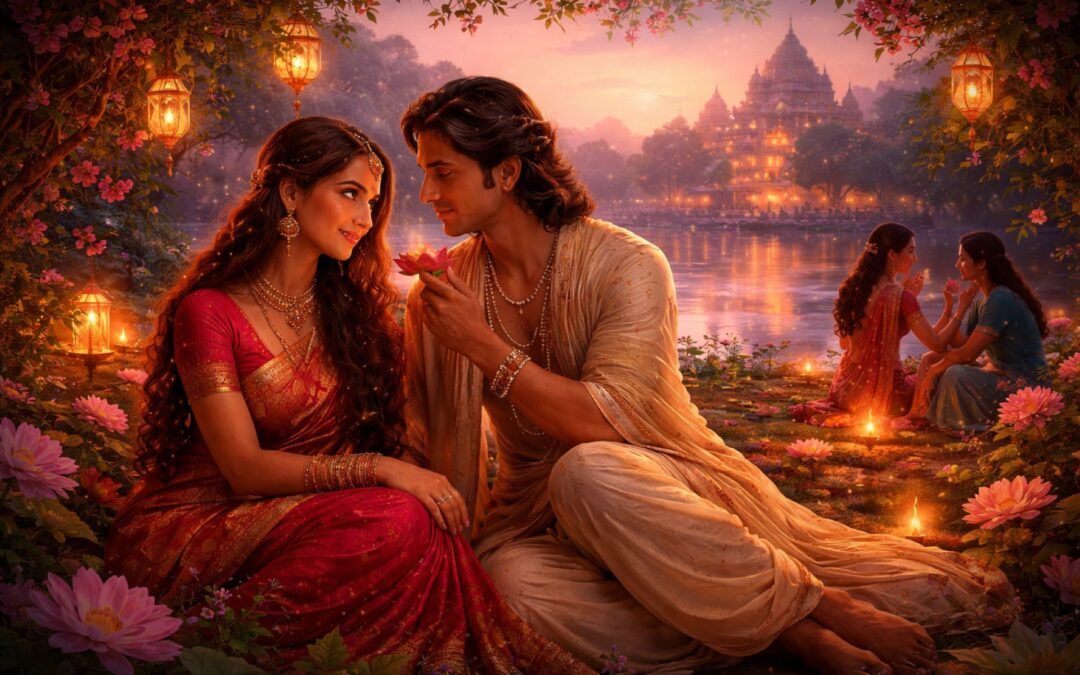
When we imagine ancient India, we often picture a world governed by rigid traditions—where duty overshadowed desire, and romance was subdued, controlled, or even absent. It’s an image shaped by selective readings of history, reinforced by modern assumptions about the past. But what if that image is incomplete?
What if ancient Indians flirted in marketplaces, met potential partners in social gatherings, and navigated the same emotional complexities that define modern relationships today?
Across a wide range of classical texts—from the Kamasutra to narrative literature like the Kathasaritsagara and early Tamil Sangam poetry—there emerges a surprisingly familiar picture. Men and women mingled freely in certain social settings. They exchanged glances, jokes, and gifts. They worried about attraction, compatibility, and even rejection. Some relationships flourished, others faltered, and many existed somewhere in between—uncertain, evolving, and deeply human.
Far from being a distant, unrelatable world, ancient India reveals itself as emotionally recognizable. People sought connection, struggled with desire, and tried—often imperfectly—to understand one another. They flirted, they fell in love, they tested relationships before committing, and sometimes, they walked away.
In other words, they weren’t so different from us.
This article is an invitation to rethink what we assume about the past. Because once you look closer, you begin to see that the story of romance in ancient India is not just about history—it’s about the timeless nature of being human.
Rethinking Romance in Ancient India
One of the most persistent myths about ancient India is that it was a society defined entirely by restraint—where love was secondary to duty, and relationships were rigidly structured by social norms. According to this view, romance as we understand it today—playful, uncertain, emotionally complex—simply didn’t exist.
But the historical record tells a very different story.
Ancient Indian literature does not portray men and women as emotionally distant or socially isolated. Instead, it reveals a world where attraction, desire, and companionship were openly acknowledged parts of life. People didn’t just marry out of obligation; they navigated courtship, flirtation, and emotional connection in ways that feel strikingly familiar.
Texts like the Kamasutra were not merely manuals of physical intimacy—they were, in many ways, guides to social behavior, emotional intelligence, and romantic strategy. They discuss everything from how to initiate a conversation to how to interpret subtle signals of interest. The very existence of such detailed guidance suggests something important: romance was not hidden or suppressed, but studied, refined, and taken seriously.
Even more telling is how these texts acknowledge the messiness of relationships. They speak of unrequited love, miscommunication, jealousy, and the anxiety of not knowing where one stands—experiences that are unmistakably modern. The idea of being “stuck in the friend zone,” for instance, may sound like a contemporary concept, but its essence appears in ancient advice: be clear about your intentions, or risk being seen as just a friend.
This challenges a deeper assumption—that people in the past were fundamentally different from us. In reality, while the social structures around them may have differed, their emotional lives were remarkably similar. They desired connection, feared rejection, and sought validation, just as we do today.
Reframing ancient Indian romance in this way does more than correct a historical misconception. It collapses the distance between past and present, reminding us that beneath the layers of time, culture, and custom, the human experience of love has always been, at its core, the same.
Where Love Began: Social Spaces and First Encounters
If ancient Indian society had truly been as restrictive as we often imagine, men and women would have had little opportunity to meet, interact, or form romantic connections. But the sources suggest the opposite. Social life, in many contexts, created ample space for interaction—and with it, the possibility of attraction.
Mixed-gender social groups were not unusual. Friends, extended networks, and community gatherings often brought men and women into regular contact without the immediate pressure of courtship. These environments allowed relationships to develop organically, through conversation, shared experiences, and subtle familiarity. In many ways, they functioned much like modern social circles—where introductions happen casually, and connections grow over time.
Educational spaces, too, played an unexpected role. Accounts from narrative literature such as the Kathasaritsagara describe young men and women studying in close proximity, sometimes even forming secret romantic bonds. Monasteries and traditional learning centers, often imagined as austere and detached, were not entirely removed from human emotion. Students, like students everywhere, found ways to connect.
Beyond these semi-private environments, public spaces were central to the social and romantic life of ancient India. Markets, town squares, temples, gardens, and parks were not just places of commerce or worship—they were arenas of visibility. To be seen was to exist socially, and to exist socially was to invite attention.
Festivals, in particular, created a unique atmosphere. Music, dance, and collective celebration brought people together in ways that lowered social barriers and encouraged interaction. Groups of young men and women could meet, observe one another, and engage in lighthearted exchanges. In such settings, romance didn’t need to be hidden—it could unfold in plain sight, woven naturally into the rhythms of communal life.
Even taverns, as referenced in classical plays and stories, served as spaces where different social groups—including women—could mingle. These were dynamic environments where conversation flowed easily, and where the boundaries between strangers could dissolve, if only for an evening.
What emerges from all this is a simple but powerful realization: ancient Indians did not live in isolation from one another. They met, observed, and interacted in a variety of social settings—many of which closely resemble the ways people encounter potential partners today.
Love, it seems, often began not in secrecy, but in shared spaces—amid crowds, conversations, and the quiet possibility of being noticed.
The Art of Attraction: What Made Someone Desirable
Attraction in ancient India was never reduced to a single trait. It wasn’t just about physical beauty, nor purely about status or wealth. Instead, desirability was seen as a balanced combination of appearance, personality, intellect, and emotional awareness—a surprisingly holistic view that feels strikingly modern.
Physical presentation, of course, mattered. Both men and women were expected to maintain good hygiene, dress elegantly, and present themselves with care. Fragrant oils, well-chosen garments, subtle ornaments, and decorative elements like henna were all part of crafting an appealing presence. But there was a clear warning against excess—beauty was to be refined, not ostentatious.
Yet appearance alone was never enough.
Emotional intelligence played a central role in attraction. Compliments were not just encouraged—they were considered essential. But they had to be thoughtful and sincere. Praising only physical beauty was seen as shallow; true admiration required noticing a person’s intelligence, kindness, humor, and character. In this sense, attraction was as much about making the other person feel seen as it was about being seen yourself.
Interestingly, this applied equally to both genders. Women were encouraged to express admiration for a man’s virtues and achievements, reinforcing the idea that emotional validation was a two-way exchange. Love, in this framework, was not passive—it was actively nurtured through words and attention.
Beyond emotional connection, intellectual and cultural sophistication were highly valued, especially among educated circles. The ideal partner was someone who could engage the mind as well as the heart. Knowledge of poetry, music, storytelling, philosophy, and the famed “64 arts” elevated a person’s desirability, sometimes even outweighing physical attractiveness. A compelling conversation, it seems, could be just as powerful as a pleasing appearance.
And then there was wit.
Humor, playfulness, and the ability to engage in light-hearted banter were considered indispensable. Attraction thrived in moments of laughter, teasing, and clever exchanges. A quick wit could break tension, build intimacy, and create a sense of ease—qualities that remain just as important in modern relationships.
What stands out most is how multidimensional this understanding of attraction was. It wasn’t about checking a single box or conforming to a rigid ideal. It was about balance—between внеш, emotion, intellect, and personality.
In other words, ancient Indians didn’t just ask, “Are they attractive?”
They asked, “Do they engage me—fully?”
Flirting, Signals, and Subtle Courtship
If attraction was the foundation, then flirtation was the language through which it was expressed—and in ancient India, that language was rich, nuanced, and deeply intentional.
Courtship rarely began with direct declarations. Instead, it unfolded through signals—small, almost imperceptible gestures that conveyed interest without forcing a response. A lingering glance, a faint smile, the adjustment of ornaments, or a deliberate attempt to be seen in someone’s presence—these were all considered meaningful indicators. The art lay not just in expressing attraction, but in recognizing it.
Ancient texts placed great emphasis on reading the room. A person was expected to observe carefully: Does she look at you often? Does she respond to your teasing? Does her demeanor soften in your presence? These subtle cues formed the basis of romantic progression, allowing relationships to develop organically rather than abruptly.
Playfulness was central to this process. Teasing, mimicry, and light banter were not trivial—they were essential tools of connection. By joking, feigning misunderstanding, or gently poking fun, individuals could lower emotional barriers and create a sense of intimacy. Humor acted as both a test and a bridge: a way to gauge compatibility while making the interaction enjoyable.
Physical proximity, too, had its place—but it was approached with care. Small, seemingly accidental touches—leaning in to whisper, brushing against someone in a crowded space—were part of the subtle dance of attraction. These gestures were never meant to overwhelm, but to suggest interest while respecting boundaries.
Gift-giving added another layer to this communication. Simple offerings—flowers, ornaments, or thoughtfully chosen tokens—served as expressions of affection. But it wasn’t the material value that mattered; it was the intention behind the gesture. A well-chosen gift signaled attentiveness, care, and emotional investment.
Perhaps most fascinating was the creativity involved in romantic expression. Lovers exchanged messages written on palm leaves or lotus petals, sometimes using substances that revealed the writing only under heat or sunlight—an early form of invisible ink. Others shared symbolic tokens infused with personal meaning, transforming ordinary objects into intimate messages.
What all of this reveals is that flirting in ancient India was not crude or impulsive. It was deliberate, layered, and deeply communicative. Every glance, every word, every gesture carried meaning.
In a world without texts or instant messages, people mastered something we often struggle with today—the art of saying everything without saying too much.
Respect, Consent, and Emotional Intelligence
Beneath the playfulness of flirtation and the excitement of attraction, ancient Indian romance was anchored by a principle that feels remarkably progressive: respect. Courtship was not meant to be a pursuit driven by pressure or persistence alone, but by sensitivity, awareness, and mutual willingness.
Ancient texts repeatedly emphasize patience. Love, they suggest, cannot be forced into existence—it must be allowed to unfold at its own pace. A suitor was advised to observe, understand, and respond rather than rush or overwhelm. The metaphor often used is telling: do not pluck a flower before it blooms. True connection, like nature, requires time.
Consent, while expressed in a different cultural vocabulary, was clearly central to this framework. A woman’s willingness—her comfort, her interest, her readiness—was to guide the progression of the relationship. Ignoring these signals or acting impulsively was not just frowned upon; it was seen as a failure of character. A man who disregarded a woman’s boundaries was considered unworthy of her trust.
But respect went beyond restraint. It required emotional intelligence.
Ancient Indian texts encouraged individuals to adapt their approach based on the personality of the person they were courting. A timid person required gentleness and reassurance. A bold individual might respond better to wit and confidence. A more reserved partner might need time and subtlety. In other words, there was no one-size-fits-all method—successful courtship depended on understanding the other person as an individual.
This adaptability reflects a sophisticated view of relationships. Attraction alone was not enough; one had to engage thoughtfully. Words, tone, timing, and behavior all needed to align with the emotional context of the interaction.
There was also a clear warning against excess—whether in the form of aggression or overattention. Being too forceful could create discomfort, while being overly cautious or distant could lead to missed opportunities. The ideal approach lay somewhere in between: attentive, but not overwhelming; expressive, but not intrusive.
In many ways, this framework anticipates modern conversations around healthy relationships. It recognizes that connection is not built through dominance or strategy alone, but through empathy, patience, and mutual respect.
Strip away the centuries, and the message remains strikingly familiar:
the foundation of romance is not just desire—it is understanding.
Women, Agency, and Taking Initiative
One of the most surprising aspects of ancient Indian romance is the degree of agency attributed to women. Contrary to the common assumption that women were passive participants in relationships, many classical texts present them as active, expressive, and influential in shaping romantic outcomes.
Women were not merely expected to respond to advances—they could initiate them.
Expressions of interest could take many forms: a lingering glance, a playful remark, a carefully chosen compliment, or even a more direct display of affection. Far from being discouraged, such behavior was often admired. A woman who could combine confidence with charm and wit was seen as especially captivating—someone capable of drawing attention not just from one individual, but from an entire gathering.
This portrayal challenges the stereotype of silent, restrained femininity. Instead, it reveals a more dynamic social reality, where women were recognized as participants with desires, preferences, and the ability to act on them.
Importantly, this agency extended beyond mere flirtation. Women were encouraged to evaluate potential partners, to test their character, and to decide whether a relationship was worth pursuing. Their consent was not just a formality—it was central to the legitimacy of the relationship itself.
In some narratives, women even take the lead in steering the direction of the relationship, setting the pace, or signaling when they are ready to move forward. This active role reflects an understanding that attraction is not one-sided; it is a mutual process, shaped by the choices of both individuals.
There is also an implicit recognition of confidence as an attractive quality. A woman who could express herself openly—without losing grace or composure—was seen as deeply desirable. Her initiative was not threatening; it was magnetic.
Of course, this does not mean that all women in ancient India experienced the same level of freedom across all contexts. Social norms varied widely depending on time, region, and class. But the existence of these ideas in respected texts suggests that female agency in romance was not only acknowledged—it was, in many cases, celebrated.
What emerges is a more balanced picture of relationships, where both men and women were expected to contribute, express, and engage. Attraction was not a performance carried out by one and received by the other—it was a dialogue.
And in that dialogue, women were very much heard.
Dating Before Dating: Premarital Relationships and Compatibility
One of the most striking parallels between ancient Indian romance and modern relationships lies in the idea of getting to know someone before committing. Long before the concept of “dating” became formalized, ancient texts describe practices that served a very similar purpose—allowing couples to explore compatibility before entering into marriage.
Premarital relationships, both emotional and physical, were not entirely taboo. In fact, in certain literary traditions—especially in early Tamil Sangam literature—the concept of clandestine love reflects relationships that developed outside the formal structure of marriage. These were not portrayed as immoral deviations, but as natural expressions of human connection.
The Kamasutra goes even further by offering detailed guidance on how such relationships might unfold. It suggests that individuals should not rush blindly into marriage, but instead take the time to understand one another—emotionally, intellectually, and even physically.
This “trial phase,” in essence, functioned much like modern dating.
Couples were encouraged to spend time together, observe each other’s habits, and assess compatibility. Questions that sound remarkably contemporary were implicitly considered: Do you enjoy each other’s company? Can you hold meaningful conversations? Do your temperaments align? Are you emotionally attuned to one another?
In some cases, this exploration extended to physical intimacy, with an emphasis on mutual comfort and consent. Rather than being treated as a forbidden subject, compatibility in this dimension was acknowledged as an important factor in long-term relationships.
What’s particularly notable is the practicality of this approach. Marriage was not seen as a leap of faith alone—it was a decision that could benefit from experience and understanding. By allowing space for premarital connection, these traditions aimed to reduce the likelihood of mismatched unions and future dissatisfaction.
At the same time, not all premarital relationships were expected to lead to marriage. Some existed simply as meaningful connections in their own right—relationships that fulfilled emotional or personal needs without necessarily culminating in lifelong commitment.
This perspective reflects a nuanced understanding of human relationships. Love was not always linear, nor was it confined to a single ideal outcome. People could explore, learn, and grow through their interactions—sometimes finding lasting partnership, and sometimes not.
In essence, ancient Indians recognized something we continue to grapple with today:
compatibility cannot be assumed—it must be discovered.
Love Without Marriage: Live-In Relationships in Ancient India
While marriage was an important social institution in ancient India, it was not the only recognized form of partnership. Alongside formal unions, there existed another, more flexible arrangement—relationships based on mutual affection rather than binding vows.
Many classical sources acknowledge the possibility of men and women living together as companions without undergoing a formal marriage ceremony. These relationships were not always treated as illegitimate or scandalous; in certain contexts, they were understood as valid expressions of love, sustained by choice rather than obligation.
At the heart of such arrangements was mutual consent. When two individuals found emotional connection and compatibility, they could choose to share their lives without immediately seeking societal approval. The emphasis was less on ritual and more on the lived experience of companionship.
This challenges a deeply ingrained assumption—that ancient societies were uniformly rigid in their expectations of relationships. Instead, we see evidence of flexibility, where personal bonds could take precedence over institutional frameworks.
These live-in partnerships also reflect a broader understanding of love as something that evolves. Not every relationship needed to culminate in marriage to be meaningful. Some connections existed for a period of time, fulfilling emotional, intellectual, or physical needs, without the expectation of permanence.
In many ways, this mirrors modern attitudes toward relationships. Today, live-in arrangements are often seen as a way to understand compatibility before marriage—or as an alternative to it altogether. The underlying logic is the same: shared experience reveals truths that formal commitments alone cannot.
Of course, as with other aspects of ancient Indian society, acceptance of such relationships likely varied across regions, communities, and social strata. But the fact that they were discussed—and in some cases normalized—suggests that the emotional realities of human connection were acknowledged even then.
What emerges is a picture of a society that, while structured, was not entirely inflexible. It allowed room for relationships to exist outside prescribed norms, as long as they were grounded in mutual affection and understanding.
In essence, love in ancient India was not confined to a single path. It could take many forms—some formal, others fluid—but all rooted in the same fundamental desire: to share life with another.
When Love Fades: Breakups, Conflict, and Moving On
If ancient Indian texts were honest about attraction and intimacy, they were equally candid about something less romantic—the reality that relationships don’t always last.
Love could fade. Interest could wane. And when it did, people were expected to recognize it rather than cling to something that no longer worked.
Ancient sources identify a range of issues that could strain or break a relationship, many of which feel strikingly familiar. Neglect was a major one—failing to give attention, losing interest in maintaining one’s appearance, or taking the partner for granted. Monotony, too, was seen as dangerous. Predictable routines and a lack of novelty could slowly erode attraction, turning excitement into indifference.
Communication—or the lack of it—played a crucial role. Ignoring a partner’s feelings, being dismissive, or failing to engage emotionally were all recognized as signs of a weakening bond. At the same time, imbalance in attention could be just as harmful. Overwhelming a partner with excessive intensity or, conversely, offering too little engagement could both destabilize the relationship.
What’s remarkable is that ancient texts didn’t just diagnose these problems—they offered solutions.
To sustain attraction, individuals were encouraged to actively invest in the relationship: plan outings, create shared experiences, and keep the dynamic fresh. Romance, in this sense, was not a one-time achievement but an ongoing effort.
But when a relationship could not be repaired, ending it was considered a valid option.
Breakups were approached with a degree of structure and emotional awareness. Rather than abrupt or confrontational endings, texts often suggest a gradual withdrawal—reducing time spent together, easing emotional intensity, and allowing space for both individuals to adjust. There was even advice to ensure the other person had opportunities to move on, emphasizing a sense of responsibility even in separation.
Above all, kindness was paramount. Ending a relationship did not justify cruelty. The bond that once existed deserved respect, even in its conclusion. Harsh words, public humiliation, or vindictive behavior were discouraged.
There was also a practical warning: allowing an unhappy relationship to stagnate could lead to deeper complications, including resentment or the temptation to seek fulfillment elsewhere.
In many ways, this approach feels surprisingly mature. It recognizes that relationships are not static—they evolve, and sometimes, they end. But even in endings, there is a right way to act.
Strip away the historical context, and the message remains timeless:
how you end a relationship matters just as much as how you begin one.
The Reality of Desire: Adultery and Social Complexity
Ancient Indian texts do not present romance as an idealized, perfectly ordered system. Instead, they acknowledge a more complicated truth: human desire does not always conform to social expectations.
Adultery, for instance, was neither ignored nor entirely denied. It appears in multiple sources—not as a rare anomaly, but as a recognized part of social reality. This alone is telling. Rather than pretending that all relationships were stable and faithful, ancient thinkers chose to confront the complexities that arise when emotional or physical needs go unmet.
One of the commonly cited causes of extramarital relationships was neglect. A partner who failed to provide attention, affection, or compatibility—especially in intimate matters—could create conditions where dissatisfaction grew. In such cases, individuals might seek connection elsewhere, not necessarily out of malice, but out of unmet emotional or personal needs.
The Kamasutra approaches this subject with a mix of realism and caution. It describes scenarios in which relationships outside marriage occur, often emphasizing discretion, emotional sensitivity, and an understanding of the risks involved. The focus is less on moral outrage and more on navigating human behavior as it exists.
In contrast, the Arthashastra takes a more legalistic stance. It outlines penalties and consequences for adultery, reflecting the importance of social order and stability. Yet even here, the existence of such laws implies that these situations were common enough to require regulation.
What emerges from these differing perspectives is not contradiction, but complexity. On one hand, there is an acknowledgment of human desire and its unpredictability. On the other, there is an effort to maintain social cohesion through rules and consequences.
Perhaps the most revealing insight is this: ancient Indian society did not assume that marriage alone could perfectly contain or resolve all aspects of human emotion. It recognized that relationships could falter, that desires could shift, and that individuals might act in ways that defy ideal norms.
This does not mean such behavior was universally accepted or encouraged. Rather, it was understood—studied, discussed, and, in some cases, regulated.
In doing so, these texts present a view of human relationships that feels deeply honest. Love is not always simple. Commitment is not always sufficient. And desire, at times, follows its own unpredictable path.
It is in this willingness to confront uncomfortable truths that ancient Indian romance feels most modern—not because it was perfect, but because it was real.
What Ancient Romance Reveals About Us Today
Step back from the details—the markets, the festivals, the poetry, the coded messages—and a larger pattern begins to emerge. The story of romance in ancient India is not just a historical curiosity; it is a mirror.
Across centuries, cultures, and changing social structures, the core of human relationships remains remarkably consistent. People then, as now, sought connection. They worried about being attractive, about saying the right thing, about whether their feelings were reciprocated. They navigated uncertainty, experienced rejection, and hoped—sometimes against reason—that things would work out.
The tools may have changed, but the emotions have not.
Where we have text messages, they had glances and gestures. Where we plan dates through apps, they met in markets and festivals. Where we debate compatibility and emotional availability, they did the same—through conversation, shared experiences, and careful observation.
Even the challenges feel familiar. Miscommunication, imbalance in effort, fading attraction, the tension between desire and commitment—these are not modern inventions. They are enduring features of human relationships, present long before the world we recognize today.
What changes, perhaps, is not the nature of love, but the context in which it unfolds. Technology, social norms, and cultural expectations evolve, but the underlying emotional landscape remains strikingly stable.
And that realization does something subtle but powerful: it humanizes the past.
It becomes harder to see ancient people as distant or fundamentally different. They were not abstract figures bound only by duty or tradition. They were individuals—curious, expressive, sometimes confused—trying to understand themselves and each other in the same ways we do.
In that sense, the study of ancient romance is not just about history. It is about continuity. It reminds us that despite the illusion of progress and change, some aspects of the human experience are timeless.
Love, it seems, is one of them.
Conclusion
Ancient Indian romance, when viewed without modern assumptions, reveals a world that feels far less distant than we imagine. Beneath the layers of tradition and time, we find people navigating attraction, uncertainty, desire, and connection in ways that are strikingly familiar.
They met in social spaces, flirted through subtle signals, valued wit and emotional intelligence, and sought partners who could engage them beyond the surface. They explored compatibility before commitment, formed relationships outside rigid structures, and, when necessary, found ways to let go with dignity. Even the more uncomfortable aspects—neglect, conflict, and infidelity—were acknowledged rather than ignored.
What makes all of this remarkable is not just that these practices existed, but that they were understood, discussed, and even refined through thoughtful reflection. Ancient Indian texts did not shy away from the complexities of love—they embraced them.
And in doing so, they leave us with a simple but powerful realization:
we are not as different from our ancestors as we like to think.
The settings have changed. The language has evolved. The tools we use to connect are entirely new. But the emotional core of romance—the desire to be seen, understood, and valued—remains exactly the same.
In the end, the story of love in ancient India is not just about the past.
It is about us.