
In the year 1066, England faced a crisis that would determine not only who ruled the kingdom, but also how its people would speak for centuries to come. A dying king without an heir triggered one of the most dramatic succession struggles in medieval Europe. Three powerful rulers—each convinced of his rightful claim to the English throne—prepared to seize the crown by force. What followed was a whirlwind year of invasions, forced marches, and decisive battles that ended with a single confrontation on a hill near Hastings.
Most histories remember 1066 for its political consequences. The Norman victory replaced England’s Anglo-Saxon ruling class with Norman elites, reshaped the country’s aristocracy, and tied England more closely to continental Europe. Castles rose across the landscape, new systems of governance emerged, and rebellion was crushed with ruthless efficiency. The Norman Conquest was not merely a change of rulers—it was the complete restructuring of English society.
Yet one of the most profound effects of the conquest unfolded quietly over generations rather than in the heat of battle. When the Normans took power, they brought with them a new language: a dialect of French spoken by the ruling class. For centuries afterward, English peasants continued speaking their Germanic Anglo-Saxon tongue, while Norman nobles governed, judged, and administered in French. The result was a linguistic collision that permanently transformed English itself.
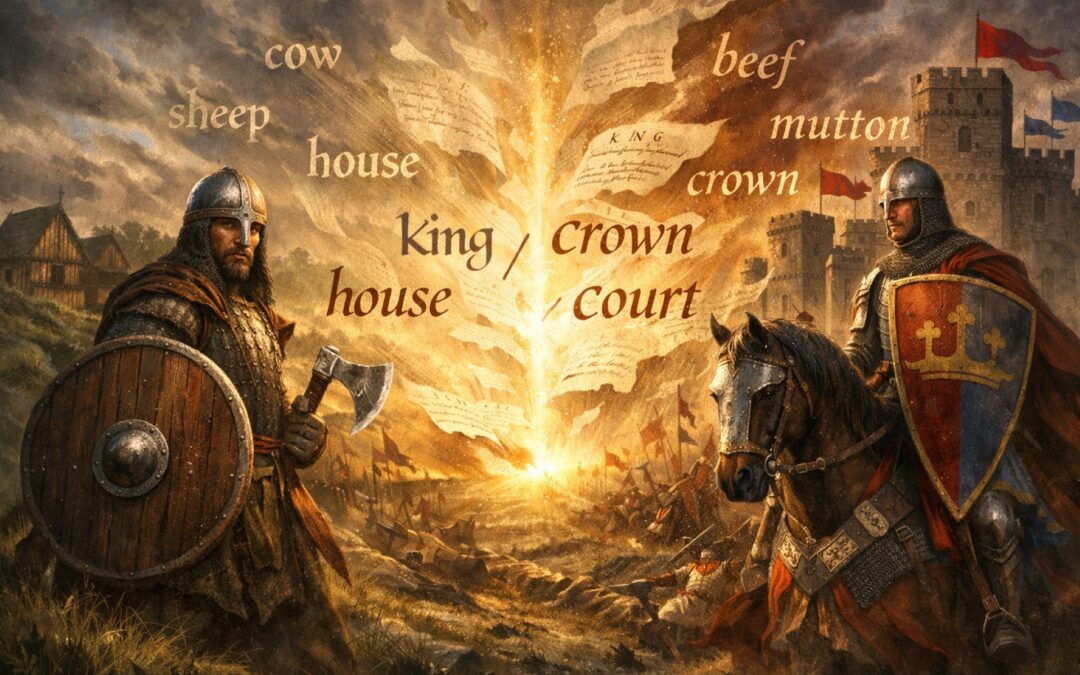
Modern English still carries the marks of this medieval conquest. Words associated with government, law, and prestige often come from Norman French, while the everyday vocabulary of ordinary life traces back to Anglo-Saxon roots. Even the way English distinguishes between animals in the field and the meat on a noble’s plate—cow and beef, pig and pork, sheep and mutton—reflects the social hierarchy created after 1066.
To understand why the English language sounds the way it does today, one must look back to that turbulent year. The Norman Conquest was not just a military victory. It was the moment when two languages, two cultures, and two social orders collided—and in doing so created the foundations of modern English.
England Before the Conquest
To understand the dramatic events of 1066, it helps to first look at the England that existed before the Norman Conquest. Anglo-Saxon England in the early Middle Ages was a kingdom shaped by centuries of migration, warfare, and political consolidation. Its language, culture, and institutions were deeply rooted in the Germanic traditions brought by settlers from northern Europe.
After the collapse of Roman rule in Britain during the 5th century, various Germanic tribes—primarily the Angles, Saxons, and Jutes—migrated across the North Sea and gradually established a patchwork of kingdoms across the island. Over time these kingdoms consolidated into what historians often call the Anglo-Saxon Heptarchy: seven major realms that included Wessex, Mercia, Northumbria, East Anglia, Essex, Sussex, and Kent. Through alliances, warfare, and dynastic marriages, these competing states eventually coalesced under the dominance of Wessex, forming the foundations of a unified English kingdom.
By the 9th century, however, a new and formidable threat appeared on England’s shores: the Vikings. Scandinavian raiders from Denmark and Norway launched frequent attacks on monasteries, towns, and coastal settlements. What began as seasonal raids gradually evolved into full-scale invasions. Viking armies conquered large portions of England, establishing the region known as the Danelaw in the north and east.
The Anglo-Saxon kings fought back for generations. One of the most important figures in this struggle was Alfred the Great of Wessex, who reorganized defenses, built fortified towns known as burhs, and laid the groundwork for reconquering territory lost to the Vikings. Over time the Anglo-Saxons regained control, but the Viking presence left a lasting mark on England’s population, culture, and language. Scandinavian settlers integrated into local communities, and Old Norse words blended with the existing Anglo-Saxon vocabulary.
By the early 11th century, England had developed a relatively sophisticated political system. The king ruled with the support of powerful regional nobles known as earls, who governed large territories and commanded military forces. Beneath them was a network of local officials and assemblies that managed law, taxation, and administration. Although the king was theoretically the supreme authority, in practice his power often depended heavily on the loyalty of these influential nobles.
This structure made the English throne particularly vulnerable during moments of transition. Unlike later hereditary monarchies, the succession was not always automatic. Powerful nobles could influence who became king, rival claimants could emerge from different branches of royal families, and ambitious leaders could seize the opportunity to press their own claims.
By the middle of the 11th century, England appeared relatively stable on the surface. But beneath that stability lay a fragile balance of power between the crown and the great earls. When King Edward the Confessor approached the end of his life without a clear heir, that balance would collapse—and England would soon become the center of one of the most dramatic succession struggles in medieval history.
The Problem of King Edward’s Succession
King Edward the Confessor ruled England for more than two decades, but by the time his reign approached its end, a dangerous political problem had emerged. Edward had no children. In a medieval monarchy where legitimacy and stability depended heavily on clear lines of succession, the absence of an heir created uncertainty that powerful men across Europe were ready to exploit.
Edward himself had an unusual background for an English king. His mother was a Norman, and much of his early life had been spent in exile in Normandy. During periods when Viking kings controlled England, Edward and other members of the Anglo-Saxon royal family had fled across the English Channel for safety. He remained in Normandy for roughly thirty years, growing up among Norman nobles and forming close relationships with the ruling elite there.
This long exile meant that Edward’s worldview was heavily shaped by Norman influence. When he eventually returned to England and became king, many of the people he trusted most were Normans rather than native Anglo-Saxon nobles. This created tension within the English political establishment, where powerful earls expected to play a central role in governing the kingdom.
Among these earls, none were more influential than the family of Godwin, the Earl of Wessex. Godwin had accumulated enormous wealth and political power, controlling one of the largest and most important regions in England. Through careful alliances and strategic marriages, his family became deeply embedded in the kingdom’s ruling structure. Edward himself even married Godwin’s daughter, Edith, strengthening the connection between the royal house and the Godwin family.
When Godwin died, his vast power passed to his sons, particularly Harold Godwinson. Harold inherited the earldom of Wessex and quickly became one of the most dominant figures in English politics. He was respected as a military leader, a capable administrator, and one of the king’s closest advisors. By the later years of Edward’s reign, Harold was effectively acting as the king’s right-hand man.
But Harold was not the only person with ambitions for the throne.
Edward’s deep connections to Normandy created another potential claimant: William, the powerful Duke of Normandy. According to Norman sources, Edward had once promised William that he would inherit the English crown. Whether this promise was genuine, misunderstood, or exaggerated later for political reasons remains one of the most debated questions in medieval history. Nevertheless, William believed that he had a legitimate claim.
Complicating matters further was an earlier agreement between Scandinavian rulers. A previous English king of Viking origin had reportedly made a pact with the King of Norway stating that if either ruler died without an heir, the surviving king would inherit the other’s kingdom. Decades later, the Norwegian king Harald Hardrada believed that this agreement entitled him to claim the English throne.
Thus, as Edward’s life drew to a close in early 1066, England found itself in a dangerously unstable situation. The kingdom had a dying king, no direct heir, and at least three extremely powerful men who believed they had a rightful claim to the crown.
When Edward finally died in January 1066, the question of succession would no longer be theoretical. It would be settled the only way medieval politics often allowed: by force.
The Three Claimants to the English Throne
When King Edward the Confessor died in January 1066, England suddenly became the center of a three-way struggle for power. Three formidable leaders—each commanding armies, wealth, and political legitimacy—believed that the English crown rightfully belonged to them. What might have been a routine royal succession instead became a contest that would reshape the future of England.
Harold Godwinson
Harold Godwinson was the most powerful nobleman in England and the obvious candidate to succeed Edward in the eyes of many English leaders. As the Earl of Wessex, Harold controlled the richest and most influential region in the kingdom. His family had long dominated English politics, and Harold himself had earned a reputation as both a skilled warrior and a capable administrator.
He also had a close personal connection to the late king. Harold’s sister, Edith, was Edward’s queen, making Harold the king’s brother-in-law. Over the years Harold had become one of Edward’s most trusted advisors and had led successful military campaigns on the king’s behalf. To many English nobles, he appeared to be the natural choice to preserve stability after Edward’s death.
According to the version of events promoted by Harold’s supporters, Edward named Harold as his successor on his deathbed. Acting quickly to secure his position, Harold had himself crowned king almost immediately after Edward’s burial. This rapid coronation prevented rivals from organizing opposition and allowed Harold to establish control over the kingdom before competing claims could take shape.
William of Normandy
Across the English Channel, however, another man believed the crown had been stolen from him.
William, the Duke of Normandy, had risen from a precarious childhood to become one of the most formidable rulers in northern Europe. Known early in life as “William the Bastard” because he had been born outside of marriage, he spent much of his youth fighting to maintain control over Normandy against rebellious nobles and assassination attempts. Those years of constant danger forged him into a ruthless and determined leader.
William believed that Edward the Confessor had promised him the English throne years earlier. The two men shared a long connection through Edward’s years in exile in Normandy, and William claimed that Edward had formally designated him as the future king of England.
Even more importantly, William insisted that Harold Godwinson himself had sworn an oath supporting William’s claim. During a visit to Normandy, Harold had allegedly pledged on sacred relics that he would recognize William as Edward’s successor. If true, Harold’s acceptance of the crown would not only be political theft—it would also be a violation of a sacred promise.
For William, the issue was therefore not merely ambition but legitimacy. In his view, the English throne had been taken from him unjustly, and he was prepared to launch an invasion to reclaim it.
Harald Hardrada
The third claimant came not from England or Normandy, but from Scandinavia.
Harald Hardrada, the King of Norway, was one of the most legendary warriors of his age. His life had been spent almost entirely in warfare and adventure. As a young man he had fought across eastern Europe and the Mediterranean as a mercenary, serving in the elite Varangian Guard of the Byzantine Empire. Over decades of campaigns he accumulated enormous wealth and a fearsome reputation as a battlefield commander.
Hardrada believed his claim to the English throne rested on an earlier agreement between Scandinavian rulers. Years before, an English king of Danish origin had reportedly agreed with the King of Norway that whichever ruler died without an heir would leave his kingdom to the other. Since Edward had died childless, Hardrada concluded that the English crown now belonged to him.
But Hardrada’s motivations likely went beyond legal claims. For a warrior king who had spent his life seeking glory, conquering England offered the opportunity for one final legendary achievement.
Thus, within weeks of Edward’s death, three powerful rulers—Harold Godwinson in England, William in Normandy, and Harald Hardrada in Norway—were all preparing for the same prize. England was no longer facing a simple succession dispute. It was about to become the battleground for one of the most consequential conflicts in European history.
The Race for the Crown
With three powerful claimants preparing to seize the English throne, the year 1066 quickly turned into a race. Whoever moved fastest, gathered the strongest army, and struck at the right moment would become king. The problem for England was that these invasions were coming from two different directions at once.
Harold Godwinson, having crowned himself king in January, understood that his position was precarious. Both William of Normandy and Harald Hardrada of Norway were openly preparing to invade. Harold therefore spent much of the year preparing England’s defenses, particularly along the southern coast where William’s invasion fleet would most likely land.
To defend the kingdom, Harold assembled a large army composed of two main groups. The first was the housecarls, professional warriors who served the king and the great earls. They were heavily armed and trained soldiers, often fighting with massive two-handed axes capable of breaking shields and armor. The second group consisted of the fyrd, a militia made up of local farmers and freemen who could be called upon for military service in times of crisis.
Through the summer months Harold stationed this army along England’s southern coastline, waiting for William’s fleet to appear across the English Channel. Day after day the soldiers stood watch along the shore, ready to repel an invasion.
But the invasion never came.
Across the Channel in Normandy, William had gathered a massive force of ships and soldiers, but one critical factor remained beyond his control: the wind. The Channel winds stubbornly blew in the wrong direction, preventing William’s fleet from sailing safely toward England. For weeks his army waited in frustration along the Norman coast.
Meanwhile, Harold faced another problem. Maintaining a large army in the field required enormous supplies of food and equipment. As the weeks dragged on without an invasion, the provisions for Harold’s army began to run out. Eventually, after months of waiting and seeing no sign of William’s fleet, Harold made the difficult decision to disband much of his army and allow his soldiers to return home to harvest their crops.
The south coast of England was suddenly far less defended.
At almost the exact same moment, events in the north took a dangerous turn.
While the southern winds kept William trapped in Normandy, those same winds were pushing the fleet of Harald Hardrada across the North Sea. The Norwegian king arrived off the coast of northern England with a large Viking army and quickly began advancing toward the city of York. Alongside him was an English ally: Tostig Godwinson, Harold’s own exiled brother, who hoped to reclaim power by helping Hardrada seize the throne.
Hardrada defeated a regional English force near York, and the city soon surrendered to the invading army.
When news of the invasion reached Harold in southern England, the situation became urgent. He had just sent much of his army home, believing the danger had passed. Now a powerful Viking force had landed in the north and was threatening to take control of the country.
Harold had no choice but to act immediately.
Gathering his remaining troops as quickly as possible, he began a forced march north toward York. The journey was extraordinary in both speed and endurance. Covering roughly two hundred miles in only a few days, Harold’s army raced across England to confront Hardrada before the Norwegian king could consolidate his control.
This desperate gamble would lead directly to the first great battle of the year—and the final chapter of the Viking age in England.
The Viking Invasion and the Battle of Stamford Bridge
When Harald Hardrada landed in northern England in September 1066, it seemed as if the Viking age had returned in full force. Leading a large and experienced army, Hardrada advanced inland toward the city of York, accompanied by Harold Godwinson’s exiled brother, Tostig. Their arrival was swift and destructive, and the region was quickly thrown into chaos.
Local English forces attempted to stop the invasion but were defeated near York by the Norwegian army. With resistance crushed, the city surrendered, and Hardrada appeared well on his way to securing control over northern England. For a moment, it looked as though the Viking king’s claim to the English throne might succeed.
But Hardrada had not yet faced the one man who stood between him and the crown.
King Harold Godwinson, having received word of the invasion, launched one of the most remarkable military responses of the medieval era. In an astonishing show of speed and determination, he gathered his troops and marched north from southern England with incredible urgency. Covering roughly two hundred miles in only a few days, his exhausted army arrived near York far sooner than Hardrada expected.
The Norwegian forces had no reason to believe that Harold’s army could reach them so quickly. Many of Hardrada’s men had even left their armor behind, expecting negotiations rather than battle. When Harold’s army suddenly appeared near the River Derwent, the Vikings were caught almost completely unprepared.
The confrontation took place near a small crossing known as Stamford Bridge.
According to later legend, the bridge itself became the stage for a remarkable act of resistance. A single Viking warrior reportedly held the narrow crossing against the advancing English soldiers, cutting down anyone who attempted to pass. For a time he single-handedly blocked Harold’s army from crossing the bridge, allowing the Viking forces on the other side to prepare their defenses. Eventually, English soldiers managed to get beneath the bridge in a barrel and thrust a spear upward through the planks, killing the warrior and allowing the English to advance.
Once across the bridge, the English army met the Viking shield wall in full battle.
The fight was brutal and chaotic. Despite their initial disadvantage, the Vikings quickly formed defensive lines and fought fiercely. Hardrada himself is said to have charged into battle with characteristic ferocity. But the lack of armor among many of his troops proved disastrous. Harold’s soldiers pressed their advantage, and the English army slowly began to overpower the Norwegian forces.
During the battle, Harald Hardrada was struck down and killed. Tostig also fell in the fighting. With their king dead and their leadership shattered, the Viking army collapsed. The survivors fled, leaving the battlefield to the English.
The victory at Stamford Bridge was decisive. Hardrada’s invasion had been completely destroyed, and with his death the centuries-long era of Viking attempts to conquer England effectively came to an end.
But Harold Godwinson had little time to celebrate.
Even as his exhausted army recovered from the battle in the north, another invasion was already underway—this one from across the English Channel. While Harold had been fighting the Vikings, the winds had finally shifted.
And William of Normandy was on his way.
William’s Invasion of England
While Harold Godwinson was marching north to confront the Viking invasion, events across the English Channel were finally moving in William of Normandy’s favor.
For months William had been preparing one of the largest amphibious invasions attempted in medieval Europe. He assembled hundreds of ships and gathered an army made up not only of Norman soldiers but also of knights and mercenaries from across northern France and neighboring regions. The promise of land, wealth, and titles in England attracted warriors eager to join the campaign.
But before launching the invasion, William faced an important political obstacle. In medieval Europe, kings were believed to rule with divine approval, and openly attacking a crowned monarch could be seen as an act against God. To strengthen his claim and justify his campaign, William sought the support of the Church.
He appealed to the Pope, arguing that Harold Godwinson had violated a sacred oath. According to William, Harold had sworn over holy relics that he would support William’s claim to the English throne. By accepting the crown himself, Harold had not only stolen the throne but had also broken a sacred promise.
The Pope accepted William’s argument and gave his blessing to the invasion. This papal support transformed William’s campaign into something that could be framed as a righteous cause rather than simple conquest. With the Church on his side, William now had both political legitimacy and religious approval.
Despite all this preparation, however, William still faced the same problem that had stalled him for weeks: the wind.
The English Channel’s winds refused to cooperate. For months his fleet remained stuck along the Norman coast, unable to sail safely to England. Meanwhile Harold’s army had been waiting along the southern shoreline, ready to repel the invasion.
Then everything changed at once.
After Harold disbanded much of his army and marched north to fight Hardrada, the long-awaited shift in the wind finally arrived. With the English defenses weakened and the Channel winds finally favorable, William seized the opportunity.
In late September 1066, his fleet of hundreds of ships set sail for England.
William’s army landed on the southern coast near Pevensey, in Sussex. After coming ashore, the Normans quickly established a fortified camp and began securing their position. Rather than marching immediately inland, William focused on consolidating his foothold and gathering supplies.
At the same time, Norman forces began raiding and burning nearby villages. These attacks served two purposes. They provided food and resources for William’s army, and they also forced Harold to respond. By devastating the countryside, William ensured that the English king could not simply wait safely in London.
Meanwhile, Harold Godwinson had just completed the brutal campaign against the Vikings in the north. His army had marched hundreds of miles and fought a major battle only days earlier. Yet when news arrived that William had landed, Harold once again had to move quickly.
Turning his exhausted army south, Harold marched toward London and then continued on toward the Norman position.
Two armies were now racing toward a confrontation that would determine the fate of England.
On October 14, 1066, near a small town called Hastings, the two forces finally met. The battle that followed would decide not only who ruled England—but would also set in motion changes that would transform the English language itself.
The Battle of Hastings
On October 14, 1066, the armies of Harold Godwinson and William of Normandy met near the town of Hastings in southern England. What followed was one of the most famous battles in European history—a single day of brutal fighting that would determine the fate of an entire kingdom.
Harold’s army arrived first and took up position on the top of a hill, a strong defensive location that forced the attacking army to fight uphill. The English soldiers formed a dense defensive formation known as a shield wall. Standing shoulder to shoulder, they locked their shields together to create a barrier that was extremely difficult for attackers to break. Behind the shields, the English housecarls wielded heavy axes capable of cutting through armor and shields alike.
William’s army approached from below. Unlike the largely infantry-based English force, the Norman army had a more varied composition. William commanded archers, infantry, and mounted cavalry—giving him tactical flexibility that Harold lacked.
The battle began with Norman archers firing volleys of arrows toward the English line. But the elevated English position reduced the effectiveness of the attack. Many arrows struck the shield wall or flew over the defenders entirely.
Next, Norman infantry advanced up the hill in an attempt to break the English formation. The fighting was fierce and chaotic, but the shield wall held firm. English soldiers hurled weapons and struck down attackers who tried to push through the defensive line. The Normans struggled to gain ground.
William then sent in his cavalry, hoping that mounted knights might break the English defenses. But even the cavalry found it difficult to penetrate the tightly packed shield wall. Charge after charge was repelled as the English defenders held their position.
For a time, it appeared that Harold’s strategy might succeed. If the English line remained intact, the Normans would eventually exhaust themselves attacking uphill.
Then the battle took a dramatic turn.
At some point during the fighting, part of the Norman army began to retreat. Whether this retreat was caused by confusion, fear, or a deliberate tactic is still debated by historians. What matters is how the English soldiers responded.
Believing the enemy was fleeing, some English fighters broke ranks and pursued the retreating Normans down the hill. This was a critical mistake. The strength of the English defense depended entirely on maintaining the shield wall.
Once the formation broke apart, William’s forces seized the opportunity. The Normans turned around, surrounded the pursuing English troops, and cut them down. William reportedly repeated this tactic several times during the battle, drawing English soldiers out of their defensive formation and destroying them in open combat.
As the day wore on, the English defensive line gradually weakened.
Sometime late in the battle, Harold Godwinson himself was killed. The exact details remain uncertain, but the most famous account claims that he was struck in the eye by an arrow before being cut down by Norman soldiers. With their king dead and their army disorganized, English resistance collapsed.
William’s forces secured victory on the battlefield.
The Battle of Hastings had lasted only a single day, but its consequences would shape English history for centuries. William had defeated the last Anglo-Saxon king of England. Soon he would earn a new name that history would remember forever.
William the Bastard had become William the Conqueror.
The Norman Transformation of England
William’s victory at Hastings did not immediately make him king of England. Although Harold Godwinson had been defeated, the English nobility did not instantly accept William’s rule. In fact, many Anglo-Saxon leaders initially attempted to organize resistance and place another member of the royal family on the throne.
For a short time, England stood on the edge of continued conflict. Some English nobles supported Edgar Ætheling, a young member of the old royal dynasty and the closest surviving relative of the Anglo-Saxon kings. However, Edgar lacked the political power, military strength, and experience necessary to challenge William’s army. As William advanced deeper into England, burning villages and crushing resistance along the way, opposition began to crumble.
Eventually the English nobles submitted and offered William the crown. On Christmas Day in 1066, he was formally crowned King of England in Westminster Abbey.
Yet the coronation did not bring immediate peace.
William ruled a land that had not willingly accepted him as its king. Throughout the early years of his reign, rebellions erupted across England. Anglo-Saxon nobles attempted to reclaim their lands, regional leaders organized uprisings, and even foreign powers occasionally supported revolts against Norman rule.
William responded with overwhelming force. Rebellions were crushed ruthlessly, and entire regions were devastated in order to eliminate resistance. One of the most infamous campaigns was the Harrying of the North, in which Norman forces systematically burned villages, destroyed crops, and caused widespread famine in northern England to punish and suppress rebellious populations.
Alongside military repression, William undertook a sweeping restructuring of English society.
The Anglo-Saxon ruling class was almost entirely replaced. English nobles who had once governed the kingdom lost their lands and titles, which were redistributed to Norman lords loyal to William. Within a generation, the aristocracy of England had been transformed into a Norman elite.
The Normans also reshaped the physical and political landscape of the country. Castles began to appear across England—fortified structures that allowed Norman rulers to maintain military control over key regions. Grand cathedrals and churches were constructed in a new architectural style influenced by continental Europe.
Administrative systems also evolved. The Normans strengthened royal authority and introduced new methods of governance and record-keeping. One of the most famous examples was the Domesday Book, a massive survey ordered by William in 1085 to record land ownership, wealth, and resources across England. It allowed the king to understand and control his newly conquered kingdom with remarkable precision.
But perhaps the most subtle and long-lasting transformation was cultural.
The new Norman rulers brought with them their own language, customs, and traditions. Norman French became the language of the court, the aristocracy, and the legal system. Anglo-Saxon English continued to be spoken by the majority of the population, particularly among farmers, craftsmen, and laborers.
For centuries, England would live under this unusual linguistic arrangement: two languages existing side by side, each tied to a different social class.
Over time, those languages would begin to merge.
And from that merging, the foundations of modern English would emerge.
How the Normans Changed the English Language
The Norman Conquest did more than replace England’s rulers. It created a cultural and linguistic divide that would permanently reshape the English language. After 1066, England became a society where two languages existed side by side, each associated with a different class and sphere of life.
The Norman elite spoke a dialect of French, while the majority of the population continued to speak Old English, the Germanic language of the Anglo-Saxons. For generations, these languages existed in parallel. French dominated the institutions of power, while English remained the everyday speech of farmers, craftsmen, and ordinary people.
Over time, however, the two languages began to mix. Words crossed between them, vocabulary expanded, and English slowly absorbed large amounts of French influence. The result was not the disappearance of Old English, but its transformation into a far richer and more complex language.
Language of Power and Government
Because the Normans controlled England’s political institutions, many words connected to government, law, and authority came from French. Administrative and legal systems were largely conducted in the language of the ruling class.
As a result, modern English contains many political and legal terms derived from Norman French. Words such as government, court, judge, crown, parliament, and authority reflect the influence of Norman rule. These terms entered English because they described institutions controlled by Norman rulers.
Even centuries later, the vocabulary of governance in English continues to carry this Norman legacy.
Language of Class and Refinement
The Norman Conquest also created a subtle linguistic distinction tied to social status. French words were often associated with sophistication, refinement, and elite culture, while Anglo-Saxon vocabulary remained the language of everyday life.
This created pairs of words that still exist in English today. In many cases, the Anglo-Saxon word is shorter and simpler, while the French-derived word sounds more formal or elegant.
An Anglo-Saxon might come in to a room, while a Norman might enter a chamber.
A person might buy something using the Anglo-Saxon word, but purchase it using the French one.
Something might be fair in plain English, while something more refined might be called beautiful.
These word pairs reflect the cultural hierarchy that developed after the conquest. Language itself began to mirror the social structure of Norman England.
Language of Food and Daily Life
One of the clearest examples of this linguistic divide appears in the names of animals and food.
The Anglo-Saxon farmers who raised livestock used Old English words such as cow, pig, and sheep. But when these animals were served as meat at the tables of Norman nobles, they were referred to using French words.
Thus the animals remained cow, pig, and sheep in the fields, but on the plate they became beef, pork, and mutton.
This distinction reflects the social structure of the time. The Anglo-Saxons raised the animals, while the Norman elite consumed them. The language of food preserved that social divide.
Changes in Written English
The Norman influence also affected how English was written.
Because many Anglo-Saxons were not formally trained in writing, Norman scribes often recorded English words according to their own spelling conventions. This gradually reshaped the written form of the language.
Certain letter combinations changed as Norman scribes adapted English pronunciation into their writing system. For example, Old English often placed the H before the W sound in words like hwaet, hwaer, and hwaenne. Norman scribes reversed the order, creating the wh combinations that appear in modern English words like what, where, and when.
Pronunciation patterns also shifted as French-speaking elites interpreted English sounds through their own linguistic framework.
These changes may have seemed small at the time, but over generations they helped shape the spelling patterns and vocabulary that define modern English today.
The language that eventually emerged was neither purely Anglo-Saxon nor purely Norman French. It was a hybrid—formed by centuries of interaction between conquerors and conquered.
And that hybrid language would eventually become modern English.
Conclusion
The events of 1066 are often remembered as a dramatic struggle for the English crown—a year of rival claimants, rapid marches, and decisive battles that culminated in the Norman victory at Hastings. But the true legacy of the Norman Conquest extends far beyond the battlefield.
William’s triumph fundamentally reshaped England. The old Anglo-Saxon ruling class disappeared and was replaced by Norman nobles. Castles rose across the countryside, new systems of governance took hold, and England became more closely connected to the political and cultural world of continental Europe. The conquest transformed the structure of English society from the top down.
Yet perhaps the most enduring consequence of this upheaval was linguistic.
When the Normans brought their French dialect to England, they unintentionally set in motion a centuries-long blending of languages. The everyday speech of Anglo-Saxon farmers merged with the vocabulary of Norman rulers, producing a language that reflected the social realities of medieval England. Words of power, law, and prestige often came from French, while the language of ordinary life retained its Germanic roots.
Modern English still carries the imprint of that collision. The language we speak today is filled with echoes of medieval class divisions, Norman administration, and Anglo-Saxon tradition. Even simple word pairs—like cow and beef, buy and purchase, or room and chamber—tell the story of two cultures forced together by conquest.
In this way, the Norman Conquest was more than a military victory. It was a cultural turning point that shaped England’s identity in ways that are still visible nearly a thousand years later.
A single battle changed the fate of a kingdom. But it also changed the language that kingdom would speak for centuries to come.