
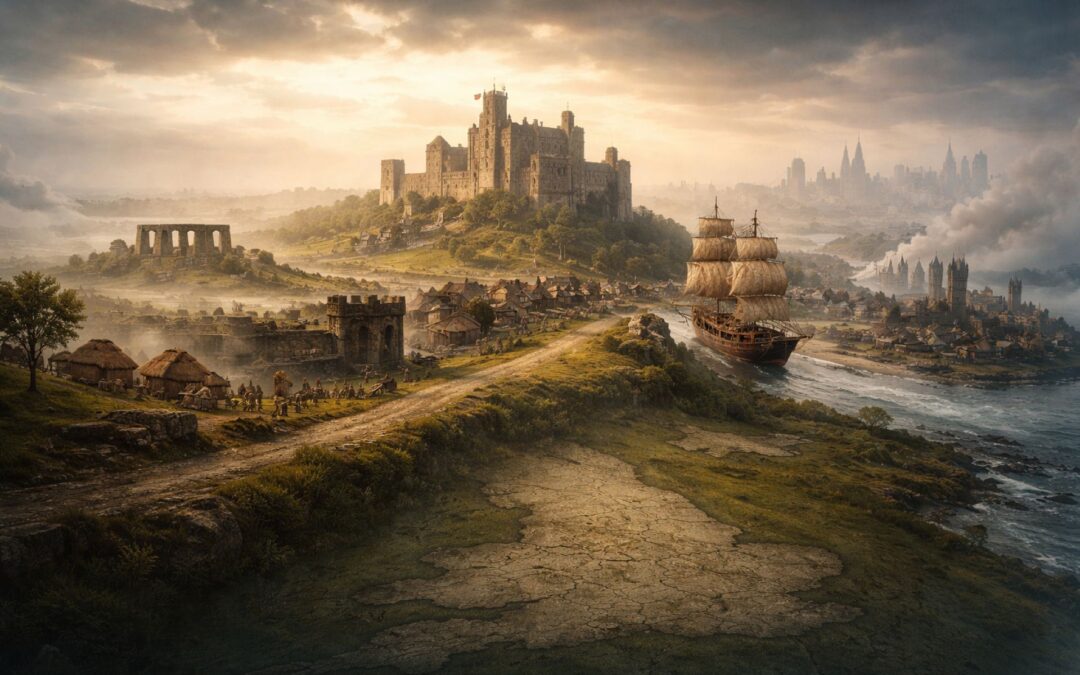
Introduction: The Making of England
England was not born—it was assembled.
Unlike nations that emerged from a single founding moment or a unified cultural core, England is the product of relentless layering. Over thousands of years, wave after wave of people arrived on its shores—some as settlers, others as conquerors—each leaving behind fragments of language, governance, belief, and identity. What we now call “England” is less a fixed entity and more a historical mosaic, shaped as much by external forces as by internal evolution.
Long before it became a kingdom, the land itself was part of continental Europe. Early humans walked across what is now the North Sea, unaware that rising waters would one day isolate them on an island. Later came the first farmers, the builders of stone monuments, and the Celtic tribes who connected the region to a wider European cultural world. But it was the arrival of Rome that first imposed a lasting political structure—roads, cities, and administration that would outlive the empire itself.
When Roman power receded, England did not collapse into obscurity. Instead, it transformed. Germanic-speaking Anglo-Saxon groups established new kingdoms, laying the foundations of the English language and identity. Viking invasions tested the survival of these early polities, while also contributing their own cultural imprint. Then, in 1066, the Norman Conquest rewired the very structure of English society, binding it more closely to continental Europe and reshaping its ruling elite.
From there, the story becomes one of consolidation and conflict. Medieval kings struggled with their barons, giving rise to foundational documents like Magna Carta. Wars with France defined England’s place in Europe, while internal upheavals—from the Black Death to the Wars of the Roses—reshaped its society. The Tudor period brought religious revolution, severing ties with Rome and redefining the relationship between crown, church, and people.
By the early modern era, England was no longer just a kingdom—it was becoming the core of something larger. Civil war and revolution redefined the balance of power between monarch and Parliament. Union with Scotland created Great Britain. And through trade, colonization, and industrialization, England helped build a global empire that would dominate the world.
Yet even as its political form changed, the deeper story remained consistent: England was always evolving. Its language absorbed Latin, Germanic, Norse, and French influences. Its institutions adapted through crisis and compromise. Its identity expanded with each transformation.
To understand England, then, is not to look for a single origin, but to trace the accumulation of centuries—each era leaving its mark, each conflict reshaping its trajectory. What emerges is not just the history of a nation, but the story of how one small corner of the world came to exert an outsized influence on global history.
The history of England is, ultimately, the history of becoming.
Prehistoric Foundations and the Earliest Peoples
Long before the name “England” existed, and even before Britain was an island, the land that would one day become the heart of the United Kingdom was part of a vast continental landscape. During the last Ice Age, sea levels were significantly lower, exposing a stretch of land known today as Doggerland—a broad, fertile plain that connected Britain directly to mainland Europe. Across this terrain, early human groups migrated freely, following herds, rivers, and seasonal rhythms.
Around 11,000 years ago, as the climate warmed and glaciers melted, rising seas gradually submerged this land bridge. Britain became an island, cut off physically from Europe, though not culturally. This separation would prove to be one of the most important geographical facts in English history—close enough to the continent to be influenced by it, yet distant enough to develop along its own path.
The earliest inhabitants of this landscape lived as hunter-gatherers during the Mesolithic period. They moved in small groups, relying on forests, rivers, and coastlines for survival. Their world was one of mobility and adaptation, shaped by seasonal patterns and environmental change. But this way of life began to shift dramatically around 4000 BC with the arrival of farming.
Agriculture did not emerge independently in Britain. It was introduced by migrating communities from continental Europe, who brought with them domesticated animals, cultivated crops, and a fundamentally different relationship with the land. Instead of moving through the environment, these early farmers began to settle it—clearing forests, building permanent dwellings, and establishing the first enduring communities.
With settlement came new forms of expression. Across the landscape, people began constructing monumental structures—long barrows, burial mounds, and ceremonial sites that still dominate the English countryside today. Among the most iconic of these is Stonehenge, a structure whose precise purpose remains debated but whose scale and alignment suggest complex social organization and astronomical awareness.
These developments marked a profound transformation. The land was no longer just a space to inhabit; it became a place to shape, remember, and ritualize. Communities developed shared identities tied to specific locations, and the seeds of social hierarchy and organized belief systems began to emerge.
As the Neolithic period gave way to the Bronze Age, further changes followed. New technologies, especially metalworking, spread across the region, linking Britain into wider European trade and cultural networks. Successive waves of migration continued to bring new ideas, languages, and practices. Over time, these influences blended, gradually giving rise to the cultural patterns that would later be associated with the Celtic world.
What is striking about this early period is not the presence of a single defining culture, but the constant process of change. Even at this foundational stage, the land that would become England was shaped by movement, exchange, and adaptation. Isolation did not mean stagnation—it created a space where influences could merge into something distinct.
By the time written history begins to touch Britain, this long prehistoric evolution had already laid the groundwork. The landscape had been settled, reshaped, and symbolically charged. Networks of trade and communication connected it to the wider world. And perhaps most importantly, a pattern had been established—one that would repeat again and again in the centuries to come: new arrivals, new influences, and a continual redefinition of identity.
Celtic Britain Before Rome
Before England existed as a political or cultural entity, the land was part of a much broader world shaped by Celtic culture. By the first millennium BC, much of what is now England had been absorbed into a network of societies that stretched across western and central Europe, unified not by a single state but by shared languages, artistic styles, religious beliefs, and social structures.
The people living in Britain during this period were not “English” in any meaningful sense. They were tribal communities, organized into kin-based groups with their own local leaders, territories, and identities. These tribes—such as the Catuvellauni, Iceni, and Brigantes—occupied different regions of the land, often competing with one another for resources and influence. Power was decentralized, and authority rested in the hands of warrior elites who commanded loyalty through kinship, reputation, and force.
Celtic society was deeply rooted in oral tradition. Knowledge, law, and belief systems were passed down through spoken word rather than written texts. At the center of this intellectual and spiritual life stood the Druids—religious and cultural figures who acted as priests, judges, and keepers of knowledge. Although much about them remains uncertain due to the lack of written records from within Celtic society itself, external accounts—particularly from later Roman writers—suggest that they held immense influence.
Economically, Celtic Britain was far from isolated. Trade networks linked the island to continental Europe, facilitating the exchange of goods such as metals, livestock, and crafted items. Technological advances, particularly in ironworking, allowed for improved tools and weaponry, which in turn supported agriculture and warfare. Hillforts—large, fortified settlements built on elevated ground—served both as defensive structures and as centers of trade and power.
Culturally, the Celtic world was rich and expressive. Distinctive art styles—characterized by intricate patterns, flowing lines, and symbolic motifs—appeared on metalwork, jewelry, and weapons. These artistic traditions reflected a worldview that emphasized continuity, nature, and interconnectedness, themes that would echo faintly even in later English culture.
Yet despite these shared elements, Celtic Britain was not unified. There was no single “British” kingdom, no centralized authority capable of coordinating large-scale defense or governance. This fragmentation would prove to be a critical weakness.
When external forces arrived—most notably the Romans in the first century BC and later in 43 AD—they encountered not a single nation, but a patchwork of tribes. Some resisted fiercely, others cooperated, and many shifted alliances depending on circumstance. This lack of unity made sustained resistance difficult and ultimately allowed a more organized and centralized power to impose control.
In many ways, Celtic Britain represents the final phase before England’s history begins to take on a more recognizable shape. It was a world defined by local identities, oral culture, and fluid power structures—a stark contrast to the administrative and political systems that would soon be introduced by Rome.
But even as Roman rule would transform the land, the Celtic imprint would not disappear entirely. It would survive in the fringes—most notably in Wales and Cornwall—and in subtler forms within language, place names, and cultural memory.
The stage was now set for the first great external power to fundamentally reshape the island.
Rome Conquers and Transforms Britain
The first serious attempt by an external power to conquer Britain came not as a full-scale invasion, but as an ambitious experiment. In 55 BC, the Roman general Julius Caesar crossed the English Channel and landed on the southern coast. His expedition, however, was more reconnaissance than conquest. Although he managed to engage local tribes and push inland, he failed to establish a permanent foothold and withdrew shortly after. A second, larger expedition followed in 54 BC, reaching as far as the River Thames—but once again, Rome did not stay.
For nearly a century after Caesar’s campaigns, Britain remained beyond the direct control of Rome. Trade and diplomatic contact continued, and some tribes even developed relationships with Roman authorities. But it was not until 43 AD, under Emperor Claudius, that a full and sustained invasion was launched. This time, Rome came to stay.
The Roman conquest was methodical. Well-trained legions advanced across the land, defeating tribal resistance and establishing fortified positions. Over the following decades, most of what is now England was brought under Roman rule. The process was not without resistance—most famously in 60 AD, when Queen Boudicca of the Iceni led a major uprising that temporarily overwhelmed Roman forces and destroyed several settlements, including London. But the rebellion was ultimately crushed, and Roman authority reasserted itself.
What followed was not just conquest, but transformation.
The Romans imposed a new political and administrative system on the region. Britain became a province of the empire, governed by Roman officials and defended by legions stationed across the land. A network of roads—engineered with remarkable precision—connected towns, military bases, and trade routes, allowing for efficient movement of troops, goods, and information. Many of these roads would shape travel and settlement patterns in England for centuries to come.
Urban life expanded under Roman rule. Settlements such as Londinium (London), Eboracum (York), and Camulodunum (Colchester) developed into important administrative and commercial centers. These towns featured forums, baths, temples, and markets—introducing a level of urbanization previously unseen in Britain. Roman architecture and infrastructure brought a new sense of permanence and organization to the landscape.
Culturally, the impact was equally significant. Latin became the language of administration and elite communication, while Roman customs, law, and religion spread throughout the province. However, this was not a complete replacement of local traditions. Instead, a blending occurred—Roman practices layered over existing Celtic foundations, creating a hybrid Romano-British culture.
To the north, the limits of Roman expansion were marked by one of the empire’s most iconic structures: Hadrian’s Wall. Built in the early second century AD, it stretched across the island, delineating the boundary between Roman-controlled territory and the lands beyond. It was both a defensive barrier and a statement of imperial power.
For nearly four centuries, England—though not yet called that—remained part of the Roman world. It was connected to a vast empire that stretched from the Middle East to the Atlantic, sharing in its trade, culture, and governance. But like all empires, Rome was not immune to decline.
By the early fifth century, pressures on the empire had intensified. Barbarian invasions threatened its core territories in Europe, and resources were increasingly stretched thin. In 407 AD, Roman legions were withdrawn from Britain to defend more critical regions on the continent. Without military support, Roman authority in Britain quickly unraveled.
The departure of Rome did not simply leave a vacuum—it triggered a profound transition. The administrative systems, urban centers, and infrastructure that Rome had built began to decay. Local leaders struggled to maintain order, and the once-integrated province became fragmented.
Yet Rome’s legacy did not vanish. The roads remained. The towns endured, even in diminished form. The idea of centralized governance, written law, and structured administration had taken root.
And perhaps most importantly, Rome had demonstrated that Britain could be unified—controlled not as a collection of tribes, but as a single political entity.
That idea would not disappear. It would be inherited, reshaped, and contested by those who came next.
The End of Roman Rule and the Anglo-Saxon Settlement
The Roman withdrawal from Britain in the early fifth century did not mark a clean break—it marked a slow unraveling.
When the last legions departed around 407 AD, they left behind a province that had grown accustomed to Roman systems of governance, defense, and economic organization. But without the military backbone of the empire, those systems could not sustain themselves for long. Urban centers declined, long-distance trade weakened, and the administrative structure that had once held the province together began to fragment.
Into this vacuum stepped new forces.
Even before Rome’s departure, groups from across the North Sea—Germanic-speaking peoples from regions corresponding to modern-day Germany, Denmark, and the Netherlands—had begun appearing in Britain. Initially, many of these groups, later known collectively as the Anglo-Saxons, may have arrived as mercenaries, hired by local Romano-British leaders to defend against external threats. But over time, their role shifted from defenders to settlers—and eventually, to rulers.
By the mid-fifth century, Anglo-Saxon migration had intensified. Whether this process involved violent invasion, gradual settlement, or a combination of both remains a subject of debate among historians. What is clear, however, is the outcome: the cultural and political landscape of much of eastern and southern Britain was fundamentally transformed.
The Anglo-Saxons brought with them their own languages, customs, and social structures. Unlike the Romanized Britons, whose culture had been shaped by imperial institutions, the Anglo-Saxons were organized around kinship groups and warrior elites. Their society was decentralized, with power distributed among local leaders rather than concentrated in a single authority.
As they established themselves, the older Romano-British culture receded. In some areas, local populations were displaced; in others, they were absorbed. Over time, the Germanic languages of the Anglo-Saxons replaced the Latin-influenced speech of Roman Britain. From these early dialects would eventually emerge Old English—the linguistic foundation of the modern English language.
This was not just a change of rulers; it was a transformation of identity.
The shift from a Roman province to a collection of Anglo-Saxon kingdoms marked the beginning of a new historical phase. The continuity of Roman Britain gave way to a patchwork of emerging polities, each with its own leadership and territory. The memory of Roman unity faded, replaced by a more fragmented and localized political order.
Yet this fragmentation did not mean stagnation. On the contrary, it set the stage for new forms of development. Over the coming centuries, these Anglo-Saxon communities would consolidate, compete, and evolve—laying the groundwork for what would eventually become a unified England.
At the same time, the remnants of the earlier British population did not disappear entirely. Many retreated to the western fringes of the island—to regions such as Wales and Cornwall—where their languages and cultural traditions continued to survive. This geographical divide between Anglo-Saxon east and Celtic west would remain a defining feature of the British Isles.
In the absence of Roman authority, Britain entered what has often been called the “Dark Ages”—a term that reflects the scarcity of written records rather than a complete collapse of society. Life continued, communities adapted, and new identities formed.
Out of the ruins of Roman Britain, a new world was emerging—one that would define the next several centuries of English history.
And at its center were the Anglo-Saxons, whose legacy would prove to be one of the most enduring in the story of England.
The Heptarchy and the Birth of an English Identity
In the centuries following the Anglo-Saxon settlement, England did not yet exist as a single kingdom. Instead, the land was divided among a collection of competing realms—each ruled by its own king, each pursuing its own ambitions. This period is often referred to as the Heptarchy, a term used to describe the seven principal Anglo-Saxon kingdoms that dominated much of what is now England: Northumbria, Mercia, East Anglia, Essex, Kent, Sussex, and Wessex.
These kingdoms were not static entities. Their borders shifted constantly as rulers fought for dominance, forged alliances, and absorbed weaker neighbors. At times, one kingdom would rise to prominence and assert overlordship over others, only to be challenged and replaced in turn. Power was fluid, and political stability was rare.
Yet despite this fragmentation, something important was beginning to take shape.
The Anglo-Saxon kingdoms shared a common cultural foundation. They spoke related Germanic dialects, followed similar legal traditions, and were bound by comparable social hierarchies. Over time, these shared elements began to foster a broader sense of identity—one that extended beyond individual kingdoms.
One of the most significant forces driving this cultural convergence was the spread of Christianity.
Beginning in the late sixth century, missionaries from both Rome and Ireland introduced Christianity to the Anglo-Saxon world. The conversion of kings often brought their kingdoms into the new faith, and with it came profound changes. Christianity introduced literacy through the use of Latin, enabling the recording of laws, histories, and religious texts. Monasteries became centers of learning and culture, preserving knowledge and producing manuscripts that would shape intellectual life for generations.
This religious transformation also helped to connect the Anglo-Saxon kingdoms to a wider European world. Where once they had been culturally aligned with other Germanic peoples, they were now part of a broader Christian civilization that spanned the continent.
At the same time, political consolidation was underway.
Larger kingdoms began to absorb smaller ones, reducing the number of competing powers. Northumbria and Mercia emerged as early dominant forces, while Wessex, in the south, gradually expanded its influence. These shifts were not just territorial—they were steps toward a more unified political landscape.
The idea of “Englishness” began to emerge during this period, though it was still far from fully realized. The term Angelcynn, meaning “the kin of the Angles,” started to appear in written sources, suggesting an awareness of a shared identity among the Anglo-Saxon peoples. This identity was cultural and linguistic rather than political, but it marked an important turning point.
For the first time, the inhabitants of these kingdoms could be seen not just as Mercians or West Saxons, but as part of a broader community.
However, this fragile sense of unity would soon be tested.
In the late eighth century, new threats began to appear from across the sea—swift, unexpected, and devastating. The Anglo-Saxon kingdoms, still divided despite their shared culture, would be forced to confront a challenge unlike any they had faced before.
The Viking Age was about to begin.
Vikings, Alfred the Great, and the Survival of Anglo-Saxon England
The relative stability of the Anglo-Saxon kingdoms was shattered in the late eighth century by a new and terrifying force: the Vikings.
The first widely recorded raid came in 793, when Norse warriors attacked the monastery of Lindisfarne off the coast of Northumbria. To the Anglo-Saxons, this was not just a military strike—it was a profound shock. Monasteries were not only religious centers but also repositories of wealth and knowledge, and their sudden vulnerability signaled that the island was no longer secure.
At first, Viking activity took the form of hit-and-run raids. Small groups of warriors would arrive in swift longships, plunder coastal settlements, and disappear before local forces could respond. But over time, these raids became more frequent, more organized, and far more ambitious.
By the mid-ninth century, the nature of the threat had changed entirely.
In 865, a large and coordinated Viking force—known in Anglo-Saxon sources as the Great Heathen Army—landed in England with a new objective: not just to raid, but to conquer and settle. Over the following years, this army moved systematically across the land, defeating one kingdom after another. Northumbria fell first in 867, followed by East Anglia in 869 and Mercia in 874.
Within less than a decade, most of the Anglo-Saxon world had collapsed.
Only one major kingdom remained unconquered: Wessex.
Under the leadership of King Alfred, Wessex became the last bastion of Anglo-Saxon resistance. Alfred’s early efforts to defend his kingdom met with mixed success. At times, he was forced to buy off Viking forces to prevent invasion. But by 878, the situation had reached a crisis point. Viking forces had overrun much of Wessex, and Alfred himself was driven into hiding, reportedly taking refuge in the marshlands of Somerset.
For a moment, it seemed as though Anglo-Saxon England might disappear entirely.
But Alfred regrouped.
Drawing together what remained of his forces, he launched a decisive counterattack against the Viking army at the Battle of Edington in 878. The victory was transformative. Alfred forced the Viking leader Guthrum into submission and negotiated a settlement that divided England into two spheres of influence.
The northeastern and eastern parts of the country came under Viking control, forming what became known as the Danelaw, where Norse customs and laws predominated. The south and west remained under Anglo-Saxon rule, centered on Wessex.
This division did not end the Viking presence—but it stabilized the situation and ensured the survival of an Anglo-Saxon core.
Alfred’s significance, however, extends far beyond this single victory.
He undertook a series of reforms that strengthened his kingdom and laid the groundwork for future unification. He reorganized the military, establishing a system that allowed for rapid mobilization and defense. He built a network of fortified towns, known as burhs, which acted as both defensive strongholds and centers of administration. These measures made Wessex far more resilient against future attacks.
Equally important were Alfred’s cultural and intellectual initiatives. Recognizing the decline in learning that had followed the collapse of Roman Britain and the disruptions of Viking invasions, he promoted education and literacy. He encouraged the translation of important texts into Old English, making knowledge more accessible and helping to standardize the language.
In doing so, Alfred was not just defending his kingdom—he was shaping its identity.
By the end of his reign, Wessex had emerged not only as a surviving state but as the nucleus of a future England. The idea of a unified English people, which had begun to take shape during the earlier Anglo-Saxon period, now gained a political foundation.
The Vikings, ironically, played a crucial role in this process. Their invasions forced the Anglo-Saxons to confront a shared threat, accelerating the move toward unity.
Alfred’s successors would build on this foundation, pushing back against Viking control and gradually reclaiming lost territory. The struggle was far from over, but the balance had shifted.
England had survived—and in surviving, it had begun to become something more than a collection of kingdoms.
Unification Under the Kings of Wessex
Alfred the Great’s victory at Edington did more than preserve Wessex—it created the conditions for something unprecedented: the gradual unification of England.
At the end of Alfred’s reign, the land remained divided. The Danelaw controlled much of the north and east, while Wessex dominated the south and west. But unlike earlier Anglo-Saxon rulers, Alfred and his successors did not merely defend their territory—they pursued a long-term strategy of expansion, consolidation, and integration.
This process unfolded over several generations.
Alfred’s son, Edward the Elder, and his daughter, Æthelflæd—who ruled Mercia after her husband’s death—played a crucial role in this effort. Working in coordination, they launched campaigns to reclaim lands under Viking control. Their approach combined military pressure with strategic fortification, extending the network of burhs deeper into contested territory. As Viking-held towns fell, they were incorporated into an expanding Anglo-Saxon system of governance.
What made this phase distinctive was not just conquest, but absorption.
The reclaimed regions were not treated as foreign lands but as part of a growing political entity. Administrative systems were extended, law codes applied, and populations integrated. Over time, the distinction between Anglo-Saxon and Viking-controlled areas began to blur, replaced by a more unified structure under West Saxon leadership.
This momentum culminated in the reign of Alfred’s grandson, Æthelstan.
In 927, Æthelstan achieved what no ruler before him had managed—he brought together the various Anglo-Saxon and formerly Viking territories under a single authority and adopted the title “King of the English.” This was more than a symbolic gesture. It marked the emergence of a unified kingdom that, for the first time, resembled what we can meaningfully call England.
Yet this new kingdom was not immediately secure.
The rise of a unified England alarmed neighboring powers, particularly the Scots and remaining Viking rulers. In 937, a coalition of these forces challenged Æthelstan’s authority in what would become one of the most decisive battles in early British history: the Battle of Brunanburh.
The outcome was a decisive English victory.
Brunanburh was not just a military success—it was a defining moment in the consolidation of English identity. Contemporary accounts celebrated it as a triumph not merely for a king, but for a people. The idea of “England” as a single political and cultural entity gained new strength in its aftermath.
However, unification did not eliminate instability entirely.
In the decades that followed, England faced renewed pressures, particularly from Scandinavian forces. At times, Danish rulers would once again seize control of the English throne, most notably under King Cnut, who ruled over a vast North Sea empire that included England, Denmark, and Norway. This period demonstrated that England’s political unity, though real, was still vulnerable to external domination.
Even so, the foundation had been laid.
By the early eleventh century, England was no longer a loose collection of kingdoms. It was a recognizable state with a centralized monarchy, a shared administrative system, and a growing sense of collective identity. The legacy of Wessex had expanded into something far larger.
This transformation—from fragmentation to unity—was one of the most important turning points in English history. It created the framework upon which all future developments would build.
And yet, just as England seemed to have secured its place, a new crisis loomed—one that would test the very structure of the kingdom and redefine it in ways no one could have anticipated.
The year 1066 was approaching.
Renewed Viking Pressure and the Succession Crisis of 1066
Despite the hard-won unification achieved under the kings of Wessex, England in the early eleventh century remained a kingdom under pressure. The Viking threat, far from disappearing, returned in a new and more organized form.
Throughout the late tenth and early eleventh centuries, waves of Danish invasions struck England once again. These were not the fragmented raids of earlier centuries but large-scale campaigns aimed at domination. Anglo-Saxon kings struggled to contain them, often resorting to paying vast sums of tribute—known as Danegeld—in an attempt to buy peace. While this strategy occasionally delayed conflict, it also signaled weakness and invited further incursions.
By the early eleventh century, England fell under the rule of a powerful Danish king: Cnut the Great. His conquest was not merely a takeover—it integrated England into a broader North Sea Empire that included Denmark and Norway. Under Cnut, England was governed effectively, and a degree of stability returned. But this stability was tied to his personal authority, and after his death in 1035, the empire quickly fragmented.
The English throne once again became contested.
After a period of political instability, the native Anglo-Saxon line was restored in 1042 with the accession of Edward the Confessor. Edward’s reign brought a measure of continuity, but it also sowed the seeds of future crisis. Deeply influenced by Norman culture—having spent years in exile in Normandy—Edward appointed several Norman advisors to positions of power, creating tension among the English nobility.
More critically, Edward failed to produce an heir.
When he died in January 1066, England faced a succession crisis with multiple claimants to the throne, each backed by different factions and foreign powers. The most immediate successor was Harold Godwinson, one of the most powerful English nobles, who was crowned king shortly after Edward’s death. But his claim was far from uncontested.
Across the English Channel, William, Duke of Normandy, asserted that Edward had promised him the throne. To the north, Harald Hardrada, the king of Norway, also claimed the crown, supported by factions within England itself. Even the king of Denmark, Sweyn II, had interests in the outcome.
What followed was one of the most dramatic years in English history.
In September 1066, Harald Hardrada launched an invasion of northern England. Harold Godwinson responded with remarkable speed, marching his army north and defeating the Norwegian forces decisively at the Battle of Stamford Bridge. It was a stunning victory—but it came at a cost. Harold’s army was exhausted.
Almost immediately after this triumph, news arrived of a second invasion.
William of Normandy had landed on the southern coast of England. Forced to act quickly, Harold marched his troops south, covering an immense distance in a matter of days. On October 14, 1066, the two armies met at the Battle of Hastings.
The battle would change England forever.
Despite fierce resistance, Harold’s forces were ultimately defeated. Harold himself was killed—traditionally said to have been struck in the eye by an arrow—and with his death, the Anglo-Saxon line of kings came to an abrupt end. William emerged victorious and, by the end of the year, was crowned king of England.
The consequences of 1066 cannot be overstated.
This was not simply a change of rulers—it was a complete transformation of England’s political and social order. The old Anglo-Saxon elite would be replaced, the language of the ruling class would shift, and England’s future would become deeply intertwined with continental Europe, particularly France.
The succession crisis of 1066 was the culmination of centuries of instability, invasion, and consolidation. But it was also a turning point—a moment where the trajectory of English history was fundamentally altered.
A new era had begun.
The Norman Conquest and the Remaking of England
William’s victory at Hastings did not instantly secure his rule—but it ensured that England would never be the same again.
In the months following the battle, William moved carefully but decisively. After securing key positions in the south and receiving the submission of English nobles, he was crowned King of England on Christmas Day in 1066. Yet his authority remained fragile. Across the country, resistance continued to flare, particularly in the north and west, where Anglo-Saxon leaders refused to accept Norman rule.
William’s response was ruthless.
Through a series of campaigns, most notably the Harrying of the North, he crushed opposition with devastating force. Entire regions were laid waste—villages burned, crops destroyed, populations displaced or killed. The aim was not merely to defeat resistance but to make it impossible. By the early 1070s, Norman control over England was effectively secured.
But conquest was only the beginning. What followed was a systematic restructuring of English society.
One of the most immediate changes was the replacement of the ruling elite. The Anglo-Saxon nobility was almost entirely dispossessed, their lands confiscated and redistributed to Norman lords loyal to William. This created a new aristocracy whose power was tied directly to the king, reinforcing a more centralized and hierarchical system of governance.
At the heart of this new order was feudalism.
Land became the primary source of power, held in exchange for loyalty and military service. William ensured that no single noble grew too powerful by scattering their holdings across different regions, preventing the formation of rival power bases. This system bound the nobility to the crown in a way that had not existed under the Anglo-Saxons.
To administer this transformed kingdom, William commissioned one of the most remarkable documents of the medieval world: the Domesday Book in 1086. This comprehensive survey recorded land ownership, resources, and wealth across England. It was both a tool of taxation and a demonstration of control—evidence that the king’s authority extended into every corner of his realm.
The cultural impact of the Norman Conquest was equally profound.
The language of the ruling class shifted from Old English to Norman French. For centuries, French would dominate the court, law, and aristocracy, while English remained the language of the common people. Over time, the interaction between these languages would produce a richer and more complex form of English, incorporating a vast vocabulary from both Germanic and Romance roots.
Architecturally, the Normans reshaped the landscape. Castles—symbols of military power and control—were constructed across the country, reinforcing Norman dominance and providing strategic strongpoints. Romanesque churches and cathedrals, built in stone and on a grand scale, reflected both religious devotion and the authority of the new elite.
Perhaps most significantly, the Norman Conquest tied England more closely to continental Europe.
William and his successors were not just kings of England—they were also lords of vast territories in France. This dual identity would draw England into centuries of conflict and competition with the French crown, shaping much of its medieval history.
Yet for all the disruption it caused, the Norman Conquest also brought continuity.
Many aspects of Anglo-Saxon governance—such as local administrative divisions and systems of taxation—were retained and adapted rather than discarded. The result was not a complete replacement, but a fusion: Norman structures layered onto Anglo-Saxon foundations.
This blending would become a defining feature of England itself.
By the end of the eleventh century, England had been fundamentally remade. Its rulers spoke a different language, its aristocracy had been replaced, its political structure had been centralized, and its cultural trajectory had shifted toward Europe.
The England that emerged from the Norman Conquest was no longer simply an Anglo-Saxon kingdom.
It was something new—stronger, more complex, and poised to play a far larger role in the history of Europe.
The Plantagenets, Magna Carta, and the Growth of the Medieval State
The Norman dynasty established by William the Conqueror did not last long. By the mid-twelfth century, a succession crisis had once again plunged England into instability. Following the death of Henry I, a struggle for the throne broke out between his designated heir, Empress Matilda, and Stephen of Blois. The resulting civil war—often referred to as The Anarchy—revealed just how fragile royal authority could be when succession was disputed.
Order was eventually restored in 1154 with the accession of Matilda’s son, Henry II, the first of the Plantagenet kings.
Henry II inherited not just England, but an enormous collection of territories stretching across western France—through his family lineage and his marriage to Eleanor of Aquitaine. This vast domain, often called the Angevin Empire, made him one of the most powerful rulers in Europe. But it also entangled England deeply in continental politics, particularly in its long rivalry with the French crown.
At home, Henry II focused on strengthening royal authority.
One of his most enduring contributions was the development of a more structured legal system. Royal courts expanded their reach, and the idea of common law—a system of law applied uniformly across the kingdom—began to take shape. This marked a significant shift away from localized and inconsistent justice toward a more centralized legal framework.
However, the growing power of the monarchy did not go unchallenged.
Tensions between the king and the nobility simmered throughout the Plantagenet period, eventually reaching a breaking point during the reign of King John. His failures in war—particularly the loss of English territories in France—and his heavy taxation alienated the barons. In 1215, this discontent forced John to agree to one of the most important documents in English history: the Magna Carta.
Magna Carta did not create democracy, but it established a crucial principle—that the king was not above the law.
It placed limits on royal authority, protected certain rights of the nobility, and introduced the idea that governance required consent, particularly in matters of taxation. Although its immediate impact was limited and conflict soon resumed, its symbolic importance would grow over time, becoming a cornerstone of constitutional development.
The struggle between crown and nobility continued throughout the thirteenth century, but it gradually led to more stable forms of governance.
Under Edward I, who came to the throne in 1272, the English state became more organized and effective. Edward strengthened royal administration and expanded the role of Parliament, which began to include not just nobles but also representatives from towns and counties. While still far from a modern legislative body, Parliament became an increasingly important institution in the governance of England.
Edward also pursued military expansion.
He successfully conquered Wales, bringing it under English control, and attempted to do the same in Scotland. While his campaigns in Scotland met with fierce resistance, they underscored England’s growing ambition to dominate the British Isles.
At the same time, England remained deeply involved in continental affairs.
Conflicts with France over territory and influence persisted, setting the stage for one of the longest and most defining series of wars in English history: the Hundred Years’ War.
The Plantagenet period, therefore, was one of both expansion and constraint.
On one hand, the monarchy became more powerful, developing stronger administrative, legal, and military structures. On the other, that power was increasingly checked by the nobility and, gradually, by emerging institutions like Parliament.
This tension—between authority and limitation, between centralization and resistance—would become a defining feature of English political life.
By the end of the thirteenth century, England was no longer just a feudal kingdom held together by personal loyalties. It was evolving into a more structured state, with institutions, laws, and political traditions that would endure for centuries.
But this growing complexity also made it more vulnerable to crisis.
In the centuries that followed, England would face challenges that tested not just its rulers, but the very fabric of its society.
War, Plague, and Upheaval in the Late Middle Ages
The fourteenth century opened with England as a more organized and assertive kingdom, but it soon became an era defined by crisis—military, demographic, and social. These overlapping shocks would reshape the country more profoundly than any single conquest.
At the center of this period stood the Hundred Years’ War with France, a long and complex conflict that began in 1337. Rooted in competing claims to the French throne and long-standing territorial disputes, the war drew England deeply into continental affairs once again. Under Edward III, England achieved a series of remarkable early victories. Battles such as Crécy (1346) and Poitiers (1356) demonstrated the effectiveness of English tactics, particularly the use of the longbow, and temporarily shifted the balance of power in England’s favor.
For a time, it seemed as though England might establish lasting dominance in France.
But even as these victories were being celebrated, a far deadlier force arrived on English shores.
In 1348, the Black Death reached England, part of a devastating pandemic that swept across Europe. Within just a few years, it is estimated to have killed up to half of the population. Entire villages were wiped out, labor became scarce, and the social order was thrown into disarray. The sheer scale of mortality disrupted every aspect of life—from agriculture and trade to governance and warfare.
The consequences were both immediate and long-term.
With fewer workers available, labor became more valuable. Survivors demanded higher wages and better conditions, challenging the traditional feudal system in which peasants were bound to the land and owed service to their lords. In response, authorities attempted to impose controls, such as the Statute of Labourers, which sought to cap wages and restrict worker mobility.
These measures only deepened resentment.
By 1381, tensions erupted into open revolt. The Peasants’ Revolt, led by figures such as Wat Tyler, saw thousands of rebels march on London, targeting officials and institutions they blamed for their hardships. Although the revolt was eventually suppressed, it marked a turning point. It exposed the fragility of the existing social order and signaled that the lower classes could no longer be easily controlled.
Meanwhile, the war with France dragged on.
After initial successes, England’s fortunes began to decline. The prolonged conflict drained resources, and internal divisions weakened the kingdom’s ability to sustain its campaigns abroad. By the mid-fifteenth century, England had lost nearly all of its continental possessions, bringing an end to its ambitions of ruling large parts of France.
These external failures were mirrored by internal instability.
Political tensions among the nobility escalated into a series of dynastic conflicts known as the Wars of the Roses. Beginning in 1455, rival branches of the Plantagenet family—the House of Lancaster and the House of York—fought for control of the throne. These were not continuous battles, but intermittent periods of violence, shifting alliances, and political intrigue that spanned several decades.
The impact was profound.
The wars weakened the traditional nobility, as many powerful families were destroyed or diminished. Authority became increasingly centralized, not through deliberate reform, but through the exhaustion of competing elites. By the time the conflict drew to a close, the old medieval order had been deeply shaken.
The decisive moment came in 1485 at the Battle of Bosworth Field, where Henry Tudor defeated the Yorkist king Richard III. With this victory, Henry became Henry VII, marking the end of the Wars of the Roses and the beginning of a new dynasty.
The late medieval period, therefore, was not just an era of decline—it was one of transformation.
War had exposed the limits of England’s power abroad. Plague had upended its social and economic structures. Internal conflict had broken the dominance of the old nobility. Out of this turmoil emerged a kingdom that was more centralized, more flexible, and ready to enter a new phase of its history.
The medieval world was coming to an end.
And with the rise of the Tudors, England was about to be reshaped once again—this time from within.
The Wars of the Roses and the Rise of the Tudors
By the mid-fifteenth century, England was a kingdom weakened by decades of war abroad and instability at home. The loss of territories in France had damaged royal prestige, while economic strain and political factionalism had deepened divisions among the nobility. At the center of this growing crisis was a fragile monarchy—one unable to command loyalty or maintain order.
This instability erupted into open conflict in 1455, beginning what would later be called the Wars of the Roses.
The name derives from the symbols of the two rival branches of the Plantagenet dynasty: the red rose of the House of Lancaster and the white rose of the House of York. But beneath the symbolism lay a deeper struggle—a contest for legitimacy, authority, and control over the English crown.
The immediate cause of the conflict was the weak rule of King Henry VI, a Lancastrian monarch whose mental instability and ineffective leadership left a power vacuum at the heart of government. Competing factions of nobles maneuvered to dominate the court, and when these rivalries could no longer be contained, they spilled onto the battlefield.
The wars themselves were not a single continuous conflict but a series of intermittent struggles spanning roughly three decades. Alliances shifted frequently, loyalties were fluid, and the outcome often hinged on the ambitions of powerful individuals rather than clear ideological divisions.
At various points, the Yorkists gained the upper hand. In 1461, Edward IV seized the throne, establishing a period of relative stability under Yorkist rule. Yet this stability proved temporary. Renewed conflict, betrayal, and political intrigue once again destabilized the kingdom, culminating in one of the most dramatic episodes of the period—the brief reign of Richard III.
Richard’s rule was controversial and short-lived. His seizure of power, following the disappearance of his young nephews—the so-called “Princes in the Tower”—undermined his legitimacy in the eyes of many. Discontent spread, creating an opportunity for a new challenger to emerge.
That challenger was Henry Tudor.
A relatively obscure figure with a tenuous claim to the throne through the Lancastrian line, Henry had spent years in exile in France. In 1485, he returned to England with a small but determined force and confronted Richard III at the Battle of Bosworth Field.
The battle proved decisive.
Richard III was killed in combat, becoming the last English king to die on the battlefield. Henry Tudor emerged victorious and was crowned Henry VII, marking the end of the Wars of the Roses and the beginning of the Tudor dynasty.
But Henry’s victory was more than just a change of rulers—it was a turning point in English history.
To secure his position, Henry married Elizabeth of York, uniting the rival houses of Lancaster and York and symbolically ending the dynastic conflict that had torn the country apart. This act was both politically strategic and deeply symbolic, signaling a new era of unity and stability.
Henry VII also moved quickly to strengthen royal authority.
Learning from the chaos of the preceding decades, he curtailed the power of the nobility, limited their ability to raise private armies, and centralized control within the monarchy. The crown became stronger, not through conquest, but through careful governance and the reduction of internal threats.
Economically, the kingdom began to recover. Trade expanded, finances stabilized, and the foundations were laid for a more prosperous and orderly state. At the same time, new ideas from the Renaissance, emerging in Italy, began to filter into England, bringing with them changes in art, learning, and culture.
The end of the Wars of the Roses thus marked the close of the medieval era in England.
In its place emerged a more centralized monarchy, a more stable political order, and a kingdom ready to enter a period of profound transformation. Under the Tudors, England would not only consolidate internally but also undergo religious revolution, expand its horizons overseas, and begin its rise toward global influence.
The chaos of civil war had given way to the promise of renewal.
And at the center of this new chapter stood the Tudor dynasty.
Henry VIII and the English Reformation
The Tudor dynasty began with stability under Henry VII, but it was his son, Henry VIII, who would transform England more radically than almost any ruler before or after him.
When Henry VIII ascended the throne in 1509, his reign began with promise. Young, charismatic, and well-educated, he embodied the ideals of the Renaissance prince. England was politically stable, financially secure, and increasingly connected to the cultural currents of Europe. But beneath this promising start lay a problem that would come to define his rule: the question of succession.
Henry was desperate for a male heir.
His first marriage, to Catherine of Aragon, produced only one surviving child—a daughter, Mary. Concerned about the stability of the dynasty and the risk of renewed civil war without a clear male successor, Henry sought to annul the marriage. However, when the Pope refused to grant the annulment, Henry took a step that would fundamentally alter England’s religious and political landscape.
He broke with the Roman Catholic Church.
In the 1530s, Henry initiated the English Reformation, declaring himself the supreme head of the Church of England. This was not simply a religious shift—it was a political revolution. Authority over the church, which had previously rested with the Pope in Rome, was transferred to the English crown. Religion and state became inseparable in a new way, with the monarch at the center of both.
The consequences were profound.
One of the most significant actions of this period was the Dissolution of the Monasteries, in which monastic institutions were dismantled and their vast lands and wealth confiscated by the crown. This not only weakened the influence of the Catholic Church in England but also redistributed land to loyal nobles, further strengthening the monarchy’s support base.
Religious life across the country was thrown into upheaval.
Traditional Catholic practices were challenged, new forms of worship were introduced, and the population was forced to navigate a rapidly changing spiritual landscape. For many, this period was marked by uncertainty and fear, as adherence to the “wrong” form of Christianity could lead to persecution.
Henry’s personal life mirrored this instability.
In his relentless pursuit of a male heir, he married six times. His second wife, Anne Boleyn, was executed after failing to produce a son, though she gave birth to a daughter who would later become Elizabeth I. His third wife, Jane Seymour, finally bore him a son—Edward—but died shortly after childbirth. Subsequent marriages ended in divorce, execution, or survival by circumstance rather than success.
By the time of Henry’s death in 1547, England had been irrevocably changed.
The break with Rome had established a precedent that the English monarch held ultimate authority over both church and state. The religious unity that had once defined the country was fractured, setting the stage for decades of conflict between Catholic and Protestant factions.
At the same time, the monarchy had become more powerful than ever.
Henry had consolidated control, expanded royal authority, and reshaped the structure of governance. But he had also created deep divisions that would not easily be resolved.
The English Reformation was not a single event—it was the beginning of a prolonged period of religious and political struggle.
In the years that followed, England would swing between Protestantism and Catholicism, as successive rulers attempted to impose their vision on the nation. These conflicts would test the stability of the kingdom and shape its identity in lasting ways.
The question was no longer just who ruled England—but how it would be ruled, and under what faith.
Religious Conflict, Mary I, and the Elizabethan Settlement
The upheaval unleashed by Henry VIII did not end with his death—it intensified.
When Edward VI, Henry’s young son, took the throne in 1547, England moved decisively in a Protestant direction. Under the guidance of his advisors, religious reforms accelerated. Catholic practices were dismantled, Protestant doctrine was enforced, and the Church of England took on a more clearly reformed identity. But Edward’s reign was short-lived. In 1553, he died at just fifteen years old, leaving the future of England’s religious settlement uncertain once again.
His successor was his half-sister, Mary I.
A devout Catholic, Mary was determined to reverse the Protestant changes of her father and brother. Upon ascending the throne, she restored papal authority and sought to bring England back into the Roman Catholic fold. But her methods were severe. In an effort to suppress Protestantism, her regime carried out a series of persecutions that led to the execution of hundreds of Protestants, many of them burned at the stake.
These actions earned her the enduring epithet “Bloody Mary.”
Mary’s reign was also marked by political and military setbacks. Her marriage to Philip II of Spain was deeply unpopular, fueling fears of foreign influence over English affairs. And in 1558, England lost its last remaining foothold on the continent—the port of Calais—to France. This loss symbolized the final end of England’s medieval ambitions in France.
When Mary died later that same year, she left no heir.
The crown passed to her half-sister, Elizabeth I, whose reign would mark one of the most significant turning points in English history.
Elizabeth inherited a divided nation—religiously fractured, politically uncertain, and wary of further upheaval. Her approach was not to impose extremism, but to seek a workable balance. Through a series of measures known collectively as the Elizabethan Settlement, she re-established the Church of England as a Protestant institution, while allowing for a degree of tolerance in practice.
This compromise did not eliminate conflict entirely, but it stabilized the country.
Under Elizabeth, England entered a period often described as a Golden Age.
Culturally, this was a time of extraordinary flourishing. Figures such as William Shakespeare produced works that would become central to English literature and identity. The arts, theater, and intellectual life expanded, reflecting a society that was growing more confident and outward-looking.
Economically and militarily, England also began to assert itself.
Exploration and trade expanded beyond Europe, with figures like Sir Francis Drake and Sir Walter Raleigh leading voyages that extended English influence across the Atlantic and into new territories. These ventures marked the early stages of what would later become the British Empire.
This growing confidence was tested in 1588, when England faced one of its greatest external threats: the Spanish Armada.
Spain, the most powerful Catholic nation in Europe, launched a massive naval force with the intention of invading England and overthrowing Elizabeth’s Protestant regime. The defeat of the Armada—due to a combination of English naval tactics and unfavorable weather—became a defining moment. It not only secured England’s independence but also signaled its emergence as a serious maritime power.
By the time Elizabeth died in 1603, England had been transformed.
Religious conflict had been contained, if not entirely resolved. The monarchy had stabilized. The country had begun to expand its horizons beyond Europe. And a distinct sense of national identity had taken root—one shaped by shared struggles, cultural achievements, and growing ambition.
Elizabeth left no direct heir, but she left behind something arguably more important: a stronger, more unified England, ready to enter a new and uncertain chapter.
That chapter would bring new conflicts—this time not between Catholics and Protestants alone, but between king and Parliament, between authority and liberty.
The question of who truly held power in England was far from settled.
The Stuarts, Civil War, and the Struggle Over Sovereignty
When Elizabeth I died in 1603, the Tudor dynasty came to an end. The English crown passed to her closest Protestant relative, James VI of Scotland, who became James I of England, uniting the two crowns under a single monarch for the first time. Although England and Scotland remained separate kingdoms, this Union of the Crowns marked a significant shift in the political landscape of the British Isles.
James I inherited a relatively stable kingdom—but also one with unresolved tensions.
He believed strongly in the divine right of kings, the idea that monarchs derived their authority directly from God and were not accountable to earthly institutions. This belief put him increasingly at odds with Parliament, which had grown in confidence and influence over the preceding centuries, particularly in matters of taxation and governance.
These tensions deepened under his son, Charles I.
Charles shared his father’s belief in royal authority but lacked his political tact. His attempts to rule without Parliament, raise taxes unilaterally, and impose religious uniformity alienated large segments of the population. Many feared that he was moving England back toward Catholic practices, while others resented his disregard for established political norms.
By 1642, these conflicts could no longer be contained.
England descended into the English Civil War, a brutal struggle between two opposing forces: the Royalists, who supported the king, and the Parliamentarians, who sought to limit his power. The war was not just a political contest—it was a clash over the very nature of authority in England.
Key battles, including those at Edgehill, Marston Moor, and Naseby, gradually turned the tide in favor of Parliament. Central to this success was the creation of the New Model Army, a disciplined and professional fighting force led by figures such as Oliver Cromwell.
By 1649, the outcome was clear.
In a moment unprecedented in English history, King Charles I was captured, tried, and executed. The monarchy was abolished, and England was declared a republic, or Commonwealth. Power now rested, at least in theory, with Parliament.
In practice, however, authority soon concentrated in the hands of Cromwell.
As Lord Protector, Cromwell ruled with considerable power, maintaining order but also imposing strict controls. His regime brought a measure of stability, but it lacked broad support, and after his death in 1658, the system quickly unraveled.
In 1660, the monarchy was restored.
Charles II, the son of the executed king, returned to England and reclaimed the throne. The Restoration did not simply return England to its previous state. The events of the Civil War had permanently altered the relationship between monarch and Parliament. Although Charles II ruled as king, his authority was more constrained, and the idea that the monarchy could be challenged—even overthrown—had been firmly established.
Yet tensions persisted.
When Charles II died in 1685, he was succeeded by his brother, James II, a devout Catholic. His attempts to promote religious tolerance for Catholics—and fears that he intended to re-establish Catholic dominance—sparked widespread opposition among England’s political elite.
This opposition culminated in the Glorious Revolution of 1688.
Rather than descend into another prolonged civil war, key figures in England invited William of Orange, a Protestant ruler from the Netherlands and husband of James II’s daughter Mary, to intervene. William landed in England with an सेना, but the anticipated conflict never materialized. James II fled the country, effectively abdicating the throne.
William and Mary were crowned as joint monarchs.
But their rule came with conditions.
In 1689, they accepted the Bill of Rights, a landmark document that placed clear limits on royal authority and affirmed the supremacy of Parliament. It established that the monarch could not govern without Parliament’s consent, particularly in matters of taxation and law.
This marked a decisive turning point.
The long struggle between crown and Parliament had been resolved—not through absolute victory by either side, but through a rebalancing of power. England had moved away from absolute monarchy toward a constitutional system, in which authority was shared and regulated.
The events of the Stuart period fundamentally reshaped English governance.
No longer could a king rule unchecked. The principle that power must be constrained—by law, by institutions, and by representation—had taken root. This transformation would have lasting implications, not just for England, but for political systems around the world.
By the end of the seventeenth century, England had undergone a profound shift.
It was no longer simply a kingdom ruled by a monarch—it was becoming a state governed by laws and institutions.
And this evolution was far from over.
Revolution, Parliament, and the Road to Great Britain
The Glorious Revolution of 1688 did more than replace one monarch with another—it redefined the very structure of power in England. With William III and Mary II on the throne, the balance between monarchy and Parliament was no longer ambiguous. It had been fundamentally altered.
At the heart of this transformation was the Bill of Rights (1689).
This document established clear limits on royal authority. The monarch could no longer suspend laws, raise taxes, or maintain a standing army without the consent of Parliament. It also affirmed certain rights, including free elections and regular parliamentary sessions. While far from a modern democracy, England had taken a decisive step toward a system in which governance was bound by law and shared with representative institutions.
This shift created a more stable political framework.
Power was no longer concentrated solely in the hands of the monarch, and the risk of arbitrary rule was significantly reduced. Over time, this would allow England to develop a more predictable and resilient system of governance—one capable of managing both internal tensions and external ambitions.
The next major transformation came under Queen Anne, the last monarch of the Stuart dynasty.
During her reign, a long-standing issue was finally resolved: the political relationship between England and Scotland. Although the two kingdoms had shared a monarch since 1603, they had remained separate states with their own parliaments, laws, and institutions. This arrangement was increasingly seen as inefficient and potentially unstable.
In 1707, this changed with the Acts of Union.
The English and Scottish parliaments were formally merged, creating the Kingdom of Great Britain. A single Parliament, based in Westminster, now governed both nations. While Scotland retained certain legal and religious distinctions, political sovereignty was unified.
For England, this marked a profound shift.
It ceased to exist as a fully independent sovereign kingdom and became the dominant partner within a larger political entity. From this point onward, its history would be inseparable from that of Great Britain—and later, the United Kingdom.
The early eighteenth century also saw the rise of a new ruling dynasty.
Following Anne’s death in 1714, the crown passed to George I of the House of Hanover, a German prince with limited familiarity with English politics or language. This circumstance had unexpected consequences. As the monarch’s direct involvement in governance diminished, greater authority shifted to ministers and, increasingly, to Parliament itself.
This period witnessed the gradual emergence of the modern cabinet system.
Political power began to concentrate in the hands of leading ministers, particularly the figure who would later be recognized as the prime minister. Figures like Robert Walpole played a key role in shaping this system, managing government affairs and coordinating policy through Parliament.
The result was a further evolution of the English state.
What had once been a monarchy struggling against its own limits was now becoming a more complex political system—one in which executive authority, legislative power, and institutional governance were increasingly intertwined.
At the same time, England—now as part of Great Britain—was expanding its influence beyond Europe.
Trade networks grew, colonial interests expanded, and the foundations were laid for a global empire. The navy became a central instrument of power, protecting trade routes and projecting influence across the seas.
By the early eighteenth century, the transformation was clear.
England had moved from medieval monarchy to constitutional state, from internal conflict to political stability, and from insular kingdom to a key component of an emerging global power.
The stage was now set for the next great phase of its history—one defined not by survival or internal struggle, but by expansion, industry, and dominance on a world scale.
Empire, Industry, and England at the Center of British Power
By the eighteenth century, England—now part of Great Britain—had entered a new phase of its history. The internal struggles that had defined earlier centuries had largely been resolved, replaced by a period of growing stability, expanding commerce, and increasing global ambition.
At the heart of this transformation was the rise of Britain as a maritime and imperial power.
England’s geographic position, once a defensive advantage, now became a platform for expansion. Its ports connected it to global trade networks, while its navy ensured control of key sea routes. Over time, Britain established colonies across North America, the Caribbean, Africa, and Asia, creating a vast and interconnected empire.
Trade became the engine of growth.
Goods, people, and capital flowed across oceans, linking England to distant territories in ways that would have been unimaginable in earlier centuries. London emerged as a major financial center, while merchants and trading companies—most notably the East India Company—played a central role in expanding British influence abroad.
Yet this expansion was not without setbacks.
The American War of Independence in the late eighteenth century dealt a significant blow to British prestige, resulting in the loss of its thirteen American colonies. For a moment, it seemed as though Britain’s imperial ambitions might falter.
But instead of decline, this loss triggered adaptation.
Britain shifted its focus toward other parts of the world, particularly India and Asia, where its influence would grow even more extensive. The empire did not collapse—it reoriented, becoming even more global in scope.
At the same time, a transformation of equal—if not greater—importance was unfolding at home.
The Industrial Revolution, which began in the late eighteenth century and accelerated through the nineteenth, fundamentally reshaped England’s economy and society. Innovations in machinery, manufacturing, and transportation increased productivity on an unprecedented scale. Factories replaced traditional forms of labor, cities expanded rapidly, and new social classes emerged.
England became the workshop of the world.
Industrial output surged, powering both domestic growth and imperial expansion. Railways, steamships, and improved infrastructure connected regions and markets, further integrating the economy. The wealth generated during this period reinforced Britain’s position as the dominant global power of the nineteenth century.
This dominance was not purely economic.
The Royal Navy ensured that Britain controlled the seas, allowing it to protect trade routes, project military power, and maintain its empire. By the height of its influence, the British Empire had become the largest in history, spanning continents and encompassing a significant portion of the world’s population.
Yet beneath this success lay tensions.
Industrialization brought not only prosperity but also inequality. Urbanization led to overcrowded cities, harsh working conditions, and new social challenges. Political movements emerged demanding reform, representation, and improved living standards. Over time, these pressures led to gradual changes, including the expansion of voting rights and the development of modern political institutions.
By the late nineteenth century, Britain stood at the peak of its power.
England, as the core of this empire, had played a central role in shaping global trade, politics, and culture. The English language spread alongside imperial expansion, becoming a dominant medium of communication across vast regions of the world.
But this position of dominance was not permanent.
The twentieth century would bring challenges on a scale unlike any before—global wars, economic strain, and the eventual unraveling of empire. The structures that had sustained Britain’s power would be tested, and in many cases, would not endure.
The age of empire had reached its height.
What followed would be a period of transformation—one that would redefine England’s place in the world once again.
War, Decline, and the Modern English Nation
The twentieth century marked a dramatic turning point in England’s long history. After centuries of expansion and global dominance, the forces that had sustained British power—empire, industry, and naval supremacy—were tested to their limits.
The first of these great tests came with World War I (1914–1918).
Although Britain emerged on the winning side, the cost was immense. Millions of lives were lost, the economy was strained, and the illusion of unchallenged global dominance began to fade. The war exposed the vulnerability of even the most powerful nations and signaled the beginning of a new, more uncertain era.
Barely two decades later, a second and even more devastating conflict erupted.
World War II (1939–1945) placed England at the center of a global struggle for survival. In the early years of the war, much of Europe fell under Nazi control, leaving Britain—under the leadership of Winston Churchill—as one of the last major powers resisting German expansion. The Battle of Britain, fought in the skies over England, became a defining moment, as the Royal Air Force successfully defended the country against sustained aerial assault.
Victory in 1945 secured Britain’s place among the victorious Allies, but it came at a tremendous cost.
The war had drained national resources, damaged infrastructure, and accelerated economic decline relative to rising powers such as the United States and the Soviet Union. Maintaining a vast global empire was no longer sustainable.
What followed was a process of decolonization.
Over the next few decades, Britain gradually relinquished control over its colonies, granting independence to territories across Asia, Africa, and the Caribbean. The empire that had once spanned the globe was dismantled, replaced by a looser association known as the Commonwealth of Nations.
For England, this marked a profound shift.
No longer the center of a global empire, it became part of a modern, post-imperial state—the United Kingdom—grappling with its changing role in the world. Economically, the country faced challenges as traditional industries declined and new forms of production and trade emerged. Politically, it adapted to a more interconnected and interdependent global system.
At the same time, internal transformations reshaped society.
The expansion of the welfare state, the growth of public services such as the National Health Service (NHS), and increased access to education reflected a new vision of governance—one focused on social stability and collective well-being. Immigration from former colonies brought new cultural influences, contributing to a more diverse and dynamic society.
Despite these changes, continuity remained.
England’s institutions—its legal system, parliamentary structure, and cultural traditions—continued to draw on centuries of historical development. The legacy of earlier eras, from the Anglo-Saxons to the Industrial Revolution, remained embedded in its identity.
By the end of the twentieth century and into the twenty-first, England stood as a modern nation shaped by a long and complex past.
It was no longer an empire, but it remained influential—economically, culturally, and politically. The English language, shaped by centuries of interaction and change, had become a global medium of communication. Its institutions and ideas had influenced systems of governance around the world.
The story of England, however, did not end with decline.
It evolved.
From a prehistoric landscape connected to Europe, to a Roman province, to a patchwork of kingdoms, to a unified state, to the core of a global empire, and finally to a modern nation within the United Kingdom—England’s history is one of constant transformation.
Each phase left its mark.
And together, they form the foundation of the England that exists today.
Conclusion: How England Was Made
England’s history is not a straight line—it is a layering.
Across two millennia, the land that became England was shaped not by a single people or moment, but by a succession of transformations. Prehistoric settlers established the first relationship with the land. Celtic societies gave it cultural depth. Rome imposed structure and demonstrated the possibility of unity. The Anglo-Saxons created the foundations of language and identity. Vikings challenged and reshaped that identity. The Normans rewired its elite and bound it to Europe.
Each layer did not erase the one before it—it built upon it.
What emerged over time was a kingdom defined as much by adaptation as by continuity. Medieval struggles between kings and nobles gave rise to ideas that would outlast them—law, rights, and limits on power. Religious upheavals under the Tudors redefined authority and belief. Civil war and revolution under the Stuarts settled the question of sovereignty, placing enduring power in institutions rather than individuals.
By the time England became part of Great Britain, it had already developed many of the characteristics that would define it for centuries: a strong but constrained monarchy, a powerful Parliament, a flexible legal system, and a capacity to absorb and adapt to change.
These qualities would underpin its rise.
Through trade, empire, and industry, England became the center of a global system that reshaped the modern world. Its language spread across continents. Its institutions influenced systems of governance far beyond its borders. Its economic and technological innovations helped drive global transformation.
And yet, even as its empire faded, its deeper legacy endured.
Modern England is still a product of everything that came before it. Its language carries traces of Latin, Germanic, Norse, and French origins. Its political system reflects centuries of negotiation between authority and liberty. Its culture bears the imprint of conquest, conflict, and exchange.
To understand England, then, is to understand a process rather than a point in time.
It is the story of how a small island region—shaped by geography, challenged by invasion, and transformed by internal struggle—became one of the most influential societies in history.
England was not created in a single moment.
It was made—slowly, continuously, and through the accumulation of centuries.