
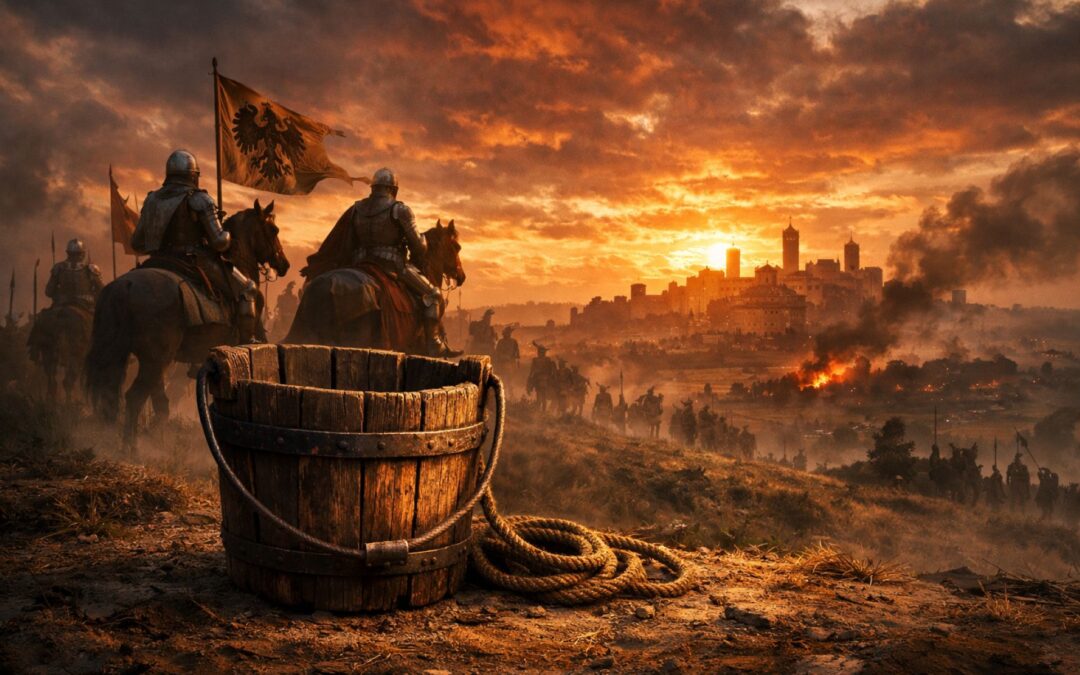
Introduction: When a Bucket Became a Symbol of War
History is filled with wars fought over territory, religion, power, and wealth. Empires have clashed over trade routes, dynasties have battled for thrones, and nations have fought for survival. But every now and then, history produces a conflict so strange that it sounds almost fictional. The War of the Bucket, fought in medieval Italy in 1325 between the city-states of Bologna and Modena, is one such story.
At first glance, the war appears almost comical. According to popular legend, the conflict began when soldiers from Modena stole a wooden bucket from a well in Bologna. Outraged by the insult, the people of Bologna supposedly launched a war to recover their bucket. The story has endured for centuries, often retold as one of the most absurd causes for war in European history.
The reality, however, is far more complex—and far more interesting. The bucket itself was not the true cause of the conflict. Instead, the war was the product of a long-standing rivalry between two powerful Italian city-states that stood on opposite sides of a much larger political struggle. That struggle revolved around one of the defining questions of medieval Europe: who held ultimate authority in Christendom—the Pope or the Holy Roman Emperor?
Throughout the Middle Ages, this power struggle shaped politics, alliances, and warfare across Europe. In northern Italy, it divided cities, families, and entire regions into opposing factions known as the Guelphs and the Ghibellines. Bologna aligned itself with the papal faction, while Modena supported the imperial cause. Their rivalry had been simmering for decades before finally erupting into open war.
The famous bucket would only enter the story later, after a brutal battle that left thousands dead and one city humiliated. In truth, the War of the Bucket was not fought for a piece of wood and rope. It was the culmination of centuries of political tension, ideological division, and local rivalry that defined medieval Italian life.
To understand why two cities would go to war in such dramatic fashion—and why a simple bucket would become a lasting symbol of their conflict—we must first step back and explore the deeper struggle that divided medieval Europe: the power struggle between the papacy and the Holy Roman Empire.
The Power Struggle Between the Papacy and Secular Rulers
To understand the War of the Bucket, it is necessary to look beyond the rivalry between Bologna and Modena and examine a much larger conflict that had been unfolding across Europe for centuries. During the Middle Ages, one of the central political questions of Christian Europe was deceptively simple: who held ultimate authority—the Pope or the Emperor?
Both institutions claimed to represent the highest authority in Christendom. The Pope stood as the spiritual leader of the Catholic Church, believed to be the successor of Saint Peter and the earthly representative of God. The Holy Roman Emperor, meanwhile, claimed to be the secular protector and political leader of the Christian world, ruling over a vast network of territories across Central Europe.
In theory, the two powers were supposed to work together. The Emperor would defend and support the Church, while the Pope would provide spiritual legitimacy to imperial rule. In practice, however, the relationship quickly became a rivalry over influence, authority, and control.
The Early Weakness of the Papacy
Contrary to the image many people have today, the papacy was not always a powerful and dominant institution. In its early centuries, the Church often found itself vulnerable to outside control and political manipulation.
During the Roman Empire, early Christian leaders frequently faced persecution. Several early popes were executed for their faith, and the position itself offered little political protection. Even after Christianity became the official religion of the Roman Empire in the fourth century, the papacy remained subject to the authority of powerful rulers.
Following the collapse of the Western Roman Empire, the papacy entered a long period of instability. Popes were often influenced—or outright controlled—by powerful nobles, kings, and emperors who saw the position as a useful tool for advancing their own political agendas.
At times, the papal office even became entangled in corruption and scandal. Powerful families competed to place their preferred candidates on the papal throne, and some popes became notorious for their political maneuvering and personal excess. During certain periods, secular elites effectively dictated who would become pope.
This weakness meant that the papacy was often less an independent authority and more a prize fought over by powerful rulers.
Charlemagne and the Birth of the Holy Roman Empire
A turning point in the relationship between church and state came in the year 800. On Christmas Day of that year, Pope Leo III crowned the Frankish king Charlemagne as “Emperor of the Romans.”
The coronation was a dramatic moment in European history. By crowning Charlemagne emperor, the Pope symbolically revived the idea of a Western Roman Empire centuries after the fall of Rome. The new political entity that eventually evolved from Charlemagne’s empire would later become known as the Holy Roman Empire.
The ceremony also established an important precedent. If the Pope had the authority to crown an emperor, it implied that imperial legitimacy ultimately came from the Church. The emperor’s power, at least symbolically, depended on papal approval.
But the situation was not so straightforward. At the time of Charlemagne’s coronation, the Pope himself depended heavily on the protection of the Frankish king. Without Charlemagne’s military support, the papacy might not have survived the political instability of the period.
This created a complicated relationship in which both sides claimed authority over the other. The Pope crowned the emperor, suggesting spiritual superiority, but the emperor possessed the military and political power necessary to protect—or threaten—the papacy.
From this moment forward, the relationship between popes and emperors would be defined by tension. Each institution claimed ultimate authority, and neither was willing to submit to the other.
The Question of Authority: Who Ruled Christendom?
As medieval Europe developed, this unresolved question of authority became increasingly significant. The Holy Roman Emperor ruled a vast but decentralized realm made up of duchies, counties, bishoprics, and free cities. Maintaining control over such a complex political structure was a constant challenge.
To strengthen their authority, emperors often relied on the Church. Bishops and abbots controlled significant territories and wealth, making them important political figures within the empire. If the emperor could appoint loyal individuals to these positions, he could effectively extend his influence throughout his realm.
However, this practice created a direct conflict with the papacy. Church leaders believed that ecclesiastical positions should be determined by the Church itself, not by secular rulers seeking political advantage.
What began as a practical administrative issue gradually escalated into one of the greatest political and religious conflicts of the Middle Ages. The dispute over who had the authority to appoint church officials would soon erupt into a dramatic confrontation between pope and emperor—a struggle known as the Investiture Controversy.
And it was this conflict that would ultimately divide cities, families, and entire regions across Europe—including the Italian city-states that would later fight the War of the Bucket.
The Investiture Controversy and the Fight for Control
The simmering tension between the papacy and the Holy Roman Emperor eventually exploded into one of the most dramatic political struggles of the Middle Ages: the Investiture Controversy. At its core, the dispute centered on a deceptively simple question—who had the authority to appoint bishops and other church officials?
The answer to that question carried enormous political consequences. In medieval Europe, bishops and abbots were not merely religious leaders. They were also powerful landowners and political authorities who controlled cities, fortresses, and vast estates. Whoever controlled these appointments could extend their influence across large portions of Europe.
For the Holy Roman Emperor, the ability to appoint bishops was an essential tool of governance. For the Church, allowing secular rulers to control church positions threatened the spiritual independence of Christianity itself. As both sides dug in their heels, the conflict escalated into a struggle that would reshape the balance of power in medieval Europe.
Why Emperors Wanted Control of Bishops
The Holy Roman Empire was unlike the centralized kingdoms that would later emerge in Europe. Instead of a unified state with strong royal authority, the empire was a complex patchwork of duchies, counties, bishoprics, and free cities. Local nobles held significant power, and many were more interested in advancing their own interests than obeying imperial authority.
This fragmented political structure made governing the empire extremely difficult. The emperor constantly faced rebellions from ambitious nobles who sought greater independence. In such an environment, loyal administrators were invaluable.
Church officials offered a useful solution. Unlike hereditary nobles, bishops and abbots were typically appointed rather than born into their positions. Since they were expected to remain celibate, they had no legitimate heirs to pass their lands or titles to. When a bishop died, the position could simply be reassigned.
By appointing loyal supporters to church positions, the emperor could create a network of reliable allies who governed key territories on his behalf. These bishops served both as spiritual leaders and as political administrators, helping the emperor maintain authority across his sprawling realm.
For emperors, controlling these appointments was therefore a practical necessity. Without it, their ability to govern the empire would be severely weakened.
Church Corruption and Simony
However, the practice of secular rulers appointing church officials opened the door to widespread corruption. In many cases, positions within the Church became valuable political rewards rather than spiritual responsibilities.
One particularly troubling practice was known as simony—the buying and selling of church offices. Wealthy individuals could effectively purchase positions such as bishoprics, gaining both prestige and access to the considerable wealth associated with the role.
This corruption deeply troubled reform-minded members of the Church. Many believed that spiritual leadership was being undermined by political ambition and financial greed. Instead of serving religious purposes, church offices were increasingly being used as tools for worldly power.
By the eleventh century, pressure for reform was growing within the Church. Many clergy and scholars argued that the Church needed to free itself from secular control and restore spiritual integrity to its leadership.
Papal Reform and the Assertion of Authority
Around the middle of the eleventh century, a series of reformist popes began pushing for major changes. Their goal was to eliminate corruption within the Church and assert papal authority over ecclesiastical appointments.
One of the most determined reformers was Pope Gregory VII. In 1075, Gregory issued a set of declarations outlining sweeping claims about papal authority. According to these principles, the Pope alone had the power to appoint or depose bishops. Even more dramatically, Gregory asserted that the Pope had the authority to depose emperors themselves.
These claims represented a direct challenge to imperial authority.
When Holy Roman Emperor Henry IV heard of these reforms, he reacted with outrage. From his perspective, the Pope was attempting to strip the emperor of one of his most important governing powers. Henry refused to recognize the papal decrees and continued appointing bishops as he had before.
The conflict quickly escalated into open confrontation. Gregory VII responded by excommunicating Henry IV, effectively expelling him from the Christian community and declaring that his subjects were no longer obligated to obey him.
This move had enormous political consequences. Many of Henry’s rivals within the empire seized the opportunity to rebel against him, arguing that a ruler excommunicated by the Pope had lost his legitimacy.
Faced with the possibility of losing his throne, Henry took a dramatic step. In 1077, he traveled across the Alps to the castle of Canossa in northern Italy, where the Pope was staying. According to tradition, Henry stood barefoot in the snow for three days, begging the Pope for forgiveness until Gregory finally lifted the excommunication.
Although the moment seemed like a victory for the papacy, the conflict was far from over. The struggle between popes and emperors would continue for generations, with both sides repeatedly attempting to assert dominance over the other.
In northern Italy, the consequences of this long-running power struggle were particularly profound. Cities and families began to align themselves with one side or the other, creating political factions that would dominate Italian politics for centuries.
These factions—the Guelphs and the Ghibellines—would eventually pull entire cities into violent rivalry. And it was this rivalry that would ultimately bring Bologna and Modena to the brink of war.
Italy’s Fragmented Political Landscape
While the struggle between the Pope and the Holy Roman Emperor was unfolding across Europe, its consequences were particularly dramatic in northern Italy. The region occupied a unique position within the medieval political world. Technically, much of northern Italy was part of the Holy Roman Empire, but in practice imperial authority there was often weak and inconsistent.
Separated from the German heartland of the empire by the Alps, Italian territories were difficult for emperors to control directly. Travel across the mountains was slow and dangerous, and maintaining a permanent imperial presence in the region proved challenging. As a result, many Italian cities gradually developed a high degree of independence.
Over time, these cities evolved into powerful city-states—political communities governed largely by their own local institutions rather than by distant emperors or kings. Cities such as Milan, Florence, Venice, Bologna, and Modena became centers of trade, banking, and manufacturing. Wealth from commerce allowed these cities to build strong defensive walls, hire armies, and assert political autonomy.
This growing independence created a political environment that was both dynamic and unstable. Italian city-states competed fiercely for influence, territory, and economic advantage. Alliances shifted frequently, and rival cities often fought small wars over trade routes, farmland, or strategic fortifications.
At the same time, the broader struggle between pope and emperor began to influence local politics. Italian cities found themselves drawn into the larger conflict that had begun with the Investiture Controversy.
The Rise of Independent Italian City-States
By the twelfth and thirteenth centuries, many northern Italian cities had developed into self-governing communes. These communes were typically ruled by elected councils, magistrates, or local elites who represented the interests of powerful merchant families and guilds.
Their prosperity depended heavily on trade and economic stability, which made independence from imperial taxation and interference highly desirable. Many cities preferred to align themselves with the papacy, which offered political support without attempting to directly govern their internal affairs.
However, not all cities followed the same path. Some regions, particularly those with stronger aristocratic traditions or closer ties to imperial administration, maintained loyalty to the Holy Roman Emperor.
The result was a patchwork of competing political loyalties across northern Italy. Cities that supported the papacy were known as Guelphs, while those that supported imperial authority were known as Ghibellines.
The Guelphs and Ghibellines
The rivalry between the Guelphs and the Ghibellines became one of the defining features of medieval Italian politics. What began as a dispute over the authority of pope and emperor eventually spread into nearly every level of society.
Cities declared allegiance to one faction or the other, and internal political struggles often revolved around these loyalties. In some cases, entire families became identified with one side of the conflict. Rival factions fought for control of city governments, sometimes leading to violent clashes in the streets.
The divide could become so deeply ingrained that even small cultural differences came to symbolize political allegiance. Stories from the period describe how Guelphs and Ghibellines adopted distinct clothing styles, symbols, and traditions to signal their loyalty.
Yet beneath these ideological labels, practical interests often played an important role. Wealthy mercantile cities frequently supported the papal faction because they opposed imperial taxation and interference in their commercial activities. Agricultural regions and territories with strong feudal traditions were more likely to support the emperor.
In many cases, cities even switched sides depending on who controlled the local government at a given moment. Loyalty to the Guelph or Ghibelline cause could be fluid, shaped by political ambition as much as ideological conviction.
This volatile environment meant that rivalries between cities could easily escalate into armed conflict. When opposing factions controlled neighboring territories, tensions often turned into raids, skirmishes, and occasional full-scale battles.
Two cities that embodied this rivalry more than most were Bologna and Modena. Bologna strongly supported the papal-aligned Guelph faction, while Modena sided with the imperial Ghibellines. Their competing loyalties—and their geographic proximity—ensured that tensions between them would remain high for generations.
By the early fourteenth century, this rivalry had already produced numerous clashes. But in the year 1325, a combination of political tensions, territorial disputes, and military ambition would finally push the two cities into a conflict that would become legendary: the War of the Bucket.
Bologna and Modena: A Rivalry Decades in the Making
By the early fourteenth century, the rivalry between Bologna and Modena was already deeply entrenched. These two neighboring city-states in northern Italy had spent decades competing for influence, territory, and political dominance. Their conflict was intensified by the wider struggle between the Guelph and Ghibelline factions that divided much of medieval Italy.
Bologna was one of the most powerful Guelph cities in the region. Wealthy, populous, and economically vibrant, it was a major center of commerce and learning. The city was home to one of Europe’s earliest and most influential universities, and its political leadership strongly supported the papal cause.
Modena, on the other hand, aligned itself with the Ghibelline faction and the authority of the Holy Roman Emperor. Compared to Bologna, Modena was smaller and less economically powerful, but it remained an important regional stronghold for imperial supporters.
Geography made their rivalry almost inevitable. The two cities lay only a short distance apart in the fertile Po Valley, an area filled with valuable farmland and strategic fortifications. Control over these lands was a constant source of tension.
Over time, relations between the two cities deteriorated into a pattern of frequent skirmishes and retaliatory raids. Each side regularly sent small military expeditions into the other’s territory, burning crops, seizing livestock, and damaging infrastructure. These attacks were not always intended to trigger full-scale wars, but they served as demonstrations of strength and intimidation.
The hostility between Bologna and Modena was further fueled by earlier military confrontations. One notable conflict occurred in 1249 at the Battle of Fossalta, where the Bolognese defeated a Modenese force and captured Enzo of Sardinia, the son of Emperor Frederick II. Enzo would remain imprisoned in Bologna for the rest of his life, becoming a powerful symbol of the city’s victory over imperial forces.
Humiliation and rivalry were not limited to battlefield defeats. Victorious cities often engaged in symbolic acts designed to mock and embarrass their enemies. In one instance following a victory, the Bolognese reportedly launched a live donkey into Modena as a gesture of ridicule. Such acts reinforced resentment and ensured that hostilities between the two cities remained intense.
By the early 1300s, decades of rivalry had hardened attitudes on both sides. The political divide between Guelph and Ghibelline factions provided an ideological justification for conflict, while territorial disputes and personal rivalries among local leaders kept tensions high.
In Modena, the Ghibelline ruler Passerino dei Bonacolsi had emerged as a powerful figure determined to defend his city’s interests and assert its strength against its rivals. Bologna, meanwhile, remained confident in its military capabilities and political influence.
Under these conditions, it would not take much to ignite a larger conflict. A series of raids, retaliations, and military maneuvers would soon push the two cities beyond minor skirmishes and into open war.
In 1325, a confrontation that might once have remained a small border dispute instead escalated into one of the most famous—and most unusual—conflicts in medieval Italian history.
The Road to War in 1325
By 1325, tensions between Bologna and Modena had reached a point where open conflict was almost inevitable. Decades of rivalry, ideological division, and territorial disputes had created an atmosphere in which even minor incidents could escalate into war.
The immediate trigger for the conflict came when Bolognese forces carried out one of their familiar raids into Modenese territory. These raids were a common feature of the ongoing rivalry between the two cities. Armed groups would cross into enemy lands, burn crops, damage property, and retreat before the opposing army could respond. While such actions were often intended as displays of strength rather than declarations of war, they frequently provoked retaliation.
In this particular case, Bolognese forces moved into Modena’s countryside and laid waste to farmland belonging to their rivals. For Modena’s ruler, Passerino dei Bonacolsi, the attack was an insult that demanded a decisive response.
Rather than conducting a similar raid, Passerino chose to escalate the situation dramatically. The Bolognese defenses relied heavily on two important forts located southwest of the city. These fortifications helped protect Bologna from invasion and secured control over the surrounding territory. If Modena could capture one of these strongholds, it would weaken Bologna’s defensive position and shift the balance of power in the region.
Passerino therefore gathered an army and marched toward one of the forts with the intention of placing it under siege.
When Modenese forces arrived, events took an unexpected turn. According to contemporary accounts, a representative from the Bolognese garrison approached the Modenese commander with surprising news. Instead of resisting the siege, he revealed that he secretly sympathized with the imperial Ghibelline cause and was willing to surrender the fort voluntarily.
The offer immediately changed the situation. Rather than engaging in a long and difficult siege, Modena was handed control of the fort almost effortlessly. The defection not only strengthened Modena’s position but also represented a humiliating betrayal for Bologna.
The loss of one of their major defensive positions alarmed the Bolognese leadership. Allowing Modena to hold such a strategic location so close to their territory posed a serious threat. Bologna could not simply ignore the situation.
At this point, the conflict began to escalate rapidly. Bologna mobilized its forces and prepared to reclaim the lost fort. Their army was significantly larger than the one Modena could field, giving them confidence that they could quickly reverse the situation.
The Bolognese strategy divided their forces into two main groups. One half of the army moved to besiege the captured fort and retake it from Modena. The other half positioned itself defensively along a nearby river to prevent Modenese troops from crossing and interfering with the siege.
For Modena, the situation appeared difficult. Their army was smaller, and Bologna’s defensive positioning seemed designed to block any attempt to relieve the fort. Crossing the river under enemy observation would be risky, and a direct assault against the larger Bolognese army could easily end in disaster.
Yet the Modenese commanders were not prepared to accept defeat. Instead of confronting the Bolognese army head-on, they devised a plan that relied on deception and speed.
One night, the Modenese forces launched a clever maneuver. They created the impression that their army intended to attack far to the north, drawing the attention of the Bolognese defenders. Believing the threat was coming from another direction, Bologna moved its troops accordingly.
With the defenders distracted, the Modenese army quickly crossed the river at a weaker point. By the time the Bolognese realized what had happened, their enemies had already slipped across the river and were advancing toward their next objective.
Rather than attacking the besieged fort directly, the Modenese army headed for another strategic location—the fortress at Zappolino. This move forced Bologna to react immediately. Losing both forts would leave the city dangerously exposed.
Faced with that possibility, the Bolognese army abandoned its positions and rushed to defend Zappolino. There, in the hills southwest of Bologna, the two rival armies finally prepared to meet in open battle.
The Battle of Zappolino
By the time the two armies approached the hills near the fortress of Zappolino, the situation had changed dramatically. Bologna had mobilized a large force and rushed to defend the position, while the Modenese army—though significantly smaller—had successfully maneuvered itself across the river and into striking distance.
Estimates of the forces involved vary, but contemporary accounts suggest that Bologna fielded a much larger army. Their troops included large numbers of infantry supported by cavalry units drawn from the city’s allies. Modena, by comparison, had fewer soldiers and would need to rely on tactics and timing to overcome the numerical disadvantage.
When the Modenese army reached the battlefield near Zappolino, the day was already drawing to a close. Only a couple of hours of daylight remained. Under normal circumstances, medieval armies avoided beginning battles so late in the day. Commanders typically used the remaining time to establish camps, organize their formations, and prepare for combat the following morning.
A battle fought at dusk carried obvious risks. Darkness could cause confusion among troops, disrupt communication, and make it difficult to control the flow of the fight. For most commanders, it was far safer to wait.
The Modenese leaders, however, understood that waiting would likely favor Bologna. If both armies camped overnight, the larger Bolognese force would have time to organize itself more effectively and possibly receive reinforcements. The longer the conflict dragged on, the more dangerous the situation would become for the smaller Modenese army.
Recognizing this, the Modenese commanders made a bold decision. Instead of waiting for morning, they would attack immediately while the Bolognese army was still organizing its defensive lines.
The sudden assault caught Bologna off guard. Modenese troops charged directly into the Bolognese positions, forcing a fierce and chaotic engagement. The battle quickly became a brutal clash of infantry and cavalry as soldiers fought hand-to-hand across the hills near Zappolino.
During the fighting, the Modenese executed a classic cavalry maneuver that had proven effective in many medieval battles. While their main forces engaged the Bolognese front line, mounted units swept around the flank and attacked from behind. This maneuver struck the Bolognese army at a vulnerable moment and created confusion within their ranks.
Once their formation began to collapse, the situation deteriorated rapidly for Bologna. Soldiers who found themselves attacked from multiple directions began to retreat, and the retreat soon turned into a full rout.
The Modenese victory was decisive. Thousands of Bolognese soldiers were reportedly killed during the battle and the subsequent pursuit. Modenese cavalry chased the fleeing enemy forces for miles, driving them back toward the walls of Bologna itself.
Despite their numerical advantage, the Bolognese army had been defeated by a combination of surprise, aggressive tactics, and well-timed cavalry maneuvers. The defeat was not only a military disaster but also a humiliating blow to Bologna’s prestige.
Yet the consequences of the battle did not end on the battlefield. In the days following their victory, the Modenese army would carry out actions that would transform the conflict into one of the most famous—and most unusual—episodes in medieval history.
The Famous Bucket and the Myth Behind the War
After their decisive victory at the Battle of Zappolino, the Modenese army pushed forward toward Bologna itself. Their cavalry chased the fleeing Bolognese forces all the way back to the city walls, demonstrating just how complete the defeat had been. At this point, the Modenese had several possible options. They could attempt to lay siege to Bologna, try to capture the city outright, or withdraw after their victory.
Instead, they did something far more theatrical.
Rather than launching a full siege—which would have required significant time, resources, and manpower—the Modenese army set up camp outside the city and began celebrating their victory. For several days they remained in the area, effectively taunting the defeated Bolognese who were now safely behind their walls but unable to challenge the victorious enemy army.
During this period, the Modenese soldiers carried out raids through the surrounding countryside, burning farms and causing additional destruction in Bolognese territory. These actions were meant both to weaken their rival and to underline Modena’s triumph.
It was during these events that the famous bucket entered the story.
According to later tradition, Modenese soldiers discovered a bucket at one of Bologna’s public wells. Seeing an opportunity to further humiliate their rivals, they took the wooden bucket as a trophy of war and carried it back to Modena. The object was later displayed as a symbol of the city’s victory.
Today, a bucket associated with this event is still preserved in Modena, where it became a lasting reminder of the conflict between the two cities.
However, the famous story that the war itself began because Modena stole Bologna’s bucket appears to be largely a myth.
For centuries, popular retellings suggested that the entire war had been sparked by the theft of a bucket from a well in Bologna. The idea that two medieval cities would launch a bloody conflict over such a trivial object made the story memorable and amusing, helping it spread widely in folklore and historical anecdotes.
Modern historical research, however, paints a different picture.
The evidence suggests that the war had already begun due to the long-standing political and military tensions between the two cities. Bologna’s raid into Modenese territory, the struggle for control of strategic forts, and the broader Guelph–Ghibelline rivalry were the real causes of the conflict.
The bucket was taken only after Modena had already defeated Bologna at Zappolino.
In other words, the bucket was not the cause of the war but rather a symbol of victory that emerged afterward. The story likely became exaggerated over time because it captured the imagination of later generations. The idea of a “war over a bucket” was simply too amusing—and too ironic—to forget.
Nevertheless, the symbolic power of the bucket endured. By displaying it publicly, Modena preserved a physical reminder of its triumph over a powerful rival. For Bologna, the stolen bucket became an enduring symbol of humiliation.
What began as a brutal medieval battle between rival factions was gradually transformed into one of history’s most peculiar legends—one in which a simple wooden bucket became the most famous trophy of war.
Peace, Reparations, and the War’s Immediate Aftermath
Despite the dramatic victory at Zappolino and the humiliation inflicted on Bologna, the War of the Bucket did not lead to major territorial changes in northern Italy. Like many medieval conflicts between rival city-states, the war was intense but relatively short-lived.
Following their victory, the Modenese army eventually withdrew from the outskirts of Bologna. Although they had demonstrated their military superiority in the battle, capturing the city itself would have required a prolonged siege. Such operations were costly, risky, and uncertain, especially for a smaller city-state like Modena. Maintaining an army in the field for an extended period would have placed significant strain on resources.
Instead, the conflict soon moved toward negotiation.
Within a few months, Bologna and Modena reached a peace settlement. Under the terms of the agreement, Bologna was required to pay heavy war reparations as compensation for the conflict and the destruction that had taken place. These payments were a common feature of medieval peace agreements and served both as punishment and as a way for the victorious side to recover the costs of war.
In exchange for the reparations, Modena agreed to return the territories it had captured during the campaign. This arrangement restored the general balance of power between the two cities and prevented the war from escalating further.
However, one item was never returned.
The bucket taken from Bologna remained in Modena’s possession. Rather than being treated as an ordinary object, it became a symbol of the city’s triumph. The Modenese placed the bucket on display in their cathedral, where it served as a visible reminder of the victory over their rival.
Later, the bucket was moved to Modena’s city hall, where it continued to be preserved as a historical artifact. Even centuries after the conflict, the object remained a point of local pride and an enduring symbol of the rivalry between the two cities.
In practical terms, the war changed very little in the political landscape of northern Italy. The borders between the rival city-states remained largely the same, and the broader struggle between Guelph and Ghibelline factions continued to shape regional politics.
Yet the War of the Bucket left a powerful cultural legacy. The combination of a dramatic battle, a humiliating defeat, and the strange symbolism of a stolen bucket ensured that the conflict would not fade easily from memory.
What had been one of the bloodiest clashes in medieval Italian history would eventually become famous for something far more unusual: the story of the bucket itself.
The War of the Bucket in the Context of Medieval Italian Politics
Although the War of the Bucket is often remembered for its unusual name and the story of the stolen bucket, the conflict itself was part of a much larger pattern that defined medieval Italian politics. Far from being an isolated incident, it reflected the fragmented and competitive political environment of northern Italy during the Middle Ages.
Unlike centralized kingdoms such as France or England, Italy was divided into dozens of independent or semi-independent political entities. Powerful city-states such as Florence, Milan, Venice, Bologna, and Modena governed themselves and pursued their own interests. Each city maintained its own alliances, armies, and political ambitions.
This fragmented system created an environment in which warfare between neighboring cities was common. Territorial disputes, trade rivalries, and political alliances frequently led to conflicts. Raids, sieges, and open battles were recurring features of life in the region.
The ideological divide between the Guelphs and the Ghibellines further intensified these rivalries. Cities that supported the papacy often found themselves in opposition to cities that backed imperial authority. These alliances provided justification for local conflicts, but they also connected smaller wars to the larger struggle between the Pope and the Holy Roman Emperor.
In practice, however, local interests often mattered more than ideological loyalty. Cities sometimes changed sides depending on political circumstances or leadership changes. While the labels of Guelph and Ghibelline remained influential, they frequently served as tools within broader struggles for power and influence.
The War of the Bucket illustrates this dynamic perfectly. The conflict between Bologna and Modena was shaped by the wider papal–imperial rivalry, but it was also driven by local tensions, territorial disputes, and long-standing resentment between the two cities.
In the centuries that followed, northern Italy would continue to experience similar conflicts as city-states competed for dominance. Eventually, powerful regional states such as Milan, Venice, and Florence would emerge, gradually reshaping the political landscape.
Yet the medieval world that produced the War of the Bucket remained defined by its intense local rivalries and shifting alliances. Cities guarded their independence fiercely, and disputes could quickly escalate into warfare.
For this reason, the story of the War of the Bucket should not be viewed merely as an amusing historical curiosity. It was a vivid example of how deeply political, ideological, and regional tensions shaped life in medieval Italy—where even a small trophy taken after battle could become a symbol of pride, humiliation, and rivalry that lasted for centuries.
Conclusion
The War of the Bucket stands as one of the most unusual conflicts in medieval history, not because of its scale or its political consequences, but because of the strange symbol that came to define it. A simple wooden bucket, taken as a trophy after a battlefield victory, became the enduring reminder of a bitter rivalry between two Italian city-states.
Yet the real story behind the conflict reveals far more than a humorous anecdote. The war was the result of decades of tension between Bologna and Modena, fueled by territorial disputes, local rivalries, and the broader ideological struggle between the Guelph and Ghibelline factions. These divisions were themselves part of a much larger contest for authority between the papacy and the Holy Roman Empire, a struggle that shaped the political landscape of medieval Europe.
The Battle of Zappolino in 1325 was one of the bloodiest clashes in medieval Italian history, demonstrating how fiercely these city-states defended their interests and allegiances. Despite Bologna’s larger army, Modena achieved a decisive victory through bold tactics and strategic maneuvering. The aftermath of the battle left thousands dead, territories temporarily contested, and one city humiliated by the loss of an object that would become legendary.
Although the war ultimately produced few lasting territorial changes, its symbolic legacy endured. The bucket taken by Modena remained on display for centuries, transforming from a simple tool into a powerful emblem of victory. Over time, the story evolved into a popular legend that suggested the entire conflict had been fought over the bucket itself.
In reality, the War of the Bucket reflects the volatile political environment of medieval Italy, where fragmented city-states, shifting alliances, and ideological rivalries frequently erupted into violence. The bucket did not cause the war—but it became the perfect symbol of it.
And centuries later, the story continues to fascinate historians and readers alike, reminding us that even the most serious conflicts in history can leave behind surprisingly strange symbols.